

Can videos be downloaded for off-line viewing?
Not yet– but we hope to provide this functionality in the future.
How does Living Gems use AI?
All videos included in Living Gems are 100% real Dharma talks by Thich Nhat Hanh.
We do use AI to:
- Enable our meaning-understanding search (see above) to work, using AI to understand references to dates, as well as to transform your query into a numerical form (“embedding”) that represents the meaning of what you searched for.
- Initial transcription of audio to text. Great care was taken to ensure that our automatic transcription process is as accurate as possible, and we also have a dedicated team ensuring that transcripts are reviewed for errors and corrected.
- Translation between languages, also here great care was taken that our automatic translation uses the terms that Thay himself would have used.
- In some cases, providing descriptions or titles for talks were those were missing.
AI-generated transcriptions, descriptions, or titles are labelled with a message denoting that they may be inaccurate:
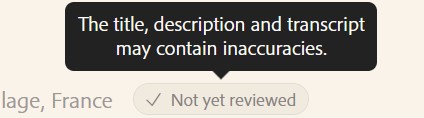
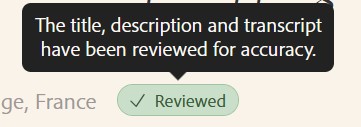
While reviewed-for-accuracy content is also indicated:
Is Living Gems part of the Plum Village App? How is it different?
Living Gems is currently a separate project from the Plum Village app, available through your web browser as part of the Plum Village website (which also works on your phone!)
Living Gems aims to provide access to the full, curated archive of all of Thay’s teachings, with a great search, interactive transcripts, and a more in-depth experience of the full range of Thich Nhat Hanh’s teachings.
The Plum Village app contains shorter clips of Thay’s teachings, as well as other teachers, and further practices such as guided meditations.
We hope that you will enjoy using both.
I appear in one or more of the videos in Living Gems and would prefer not to. What can I do?
Many of these recordings were made during retreats where participants knew filming was taking place, though formal consent processes were not standard at that time. Our intention in sharing these teachings is to make the Dharma available to support those who may be experiencing similar difficulties.
At the same time, we care deeply about the wellbeing and privacy of everyone who participated. If you recognise yourself in a recording and would prefer it not to be publicly available, please contact us at livinggems@plumvillage.org. We will respond promptly and remove the material without question.
During our review process, we also take care to avoid including identifying information and to handle sensitive material with particular attention.
Will Living Gems include other teachers besides Thich Nhat Hanh?
Currently we don’t anticipate including other teachers.
How do I create a new playlist, or add a video to a playlist?
Click on the “Add to Playlist” button. When viewing a video in standard view (not full-screen or picture-in-picture mode), this will be below the video, on the left.
To add to an existing playlist, check the appropriate box. To create a new playlist, click on the bottom-most checkbox, add a title, and choose whether or not to make the playlist public.
How does the search work?
- Living Gems offers three modes of search, “standard” (“default”) search and “exact match” (“quotes-mode”) search, and “regex” (an advanced form of search)
- Standard search understands semantic meaning and searches for related topics. So, for example, searching for “Mother Earth” will also return talks containing “caring for our environment”. This search mode is also able to respond to simple natural language queries (for example, “How do I deal with suffering in my relationship?”)
- Standard search understands dates: searching for “13 june 2006”, “2009-07-01”, or “July 1997” will return talks corresponding to those dates or date ranges.
- Put your query in “quotes” (or select “exact match”) if you want to search for phrases appearing exactly or almost exactly, in a Dharma talk.
- Quotes-mode search is sensitive to accents and diacritical marks. For example, “huong dan tong quat” will not find results containing “hướng dẫn tổng quát”.
- All modes of search search based on “segments”, the portion of a talk that was most relevant to your query. In that case, the search will display the talk, with all relevant segments. However, when a search finds a talk with a related title, it will return that full talk without identifying the most relevant segments.
- “regex” search, can be found in the … menu inside the search box on https://plumvillage.org/gems/search (not visible on the homepage, only after clicking on the homepage 🔍 or at the link above). With this option, you can do some super-advanced full-text searches, such as (some examples):
\yGod\W+(?:\w+\W+){0,20}scientific\yTwo words withnother arbitrary words in between (here: “god”, up to any other 20 words, “scientific”: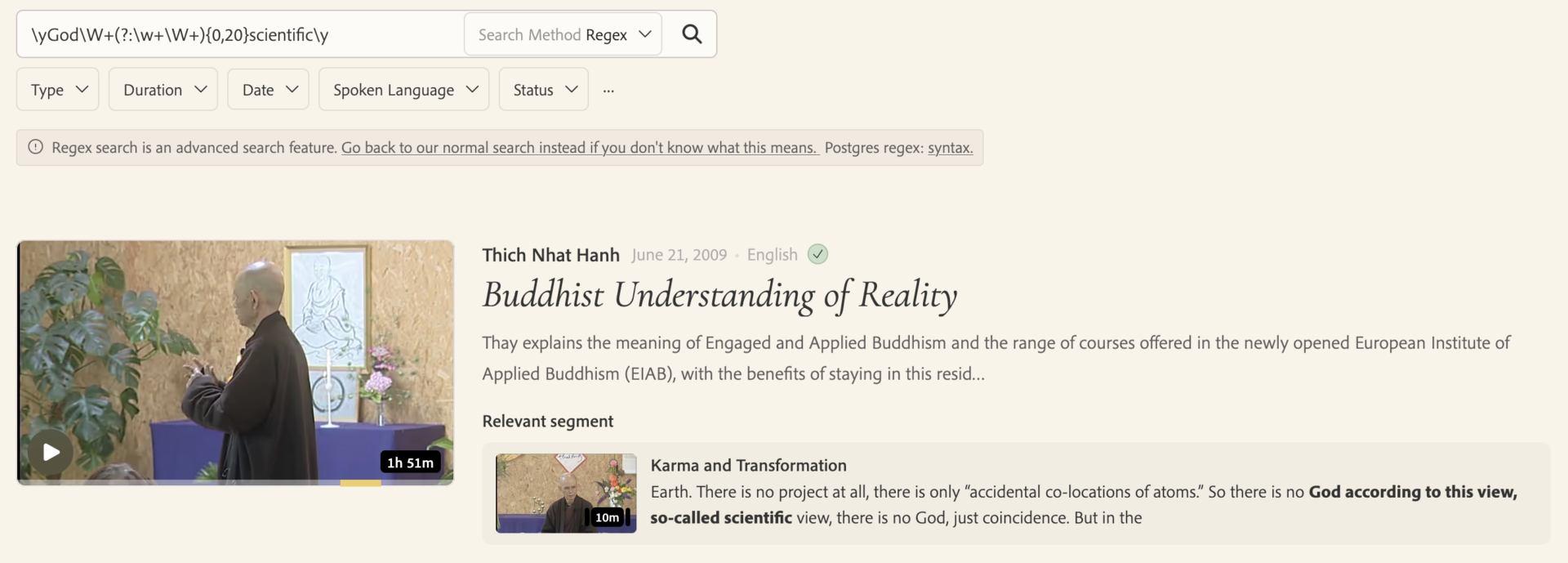
\y\w+\.(com|net|org)\ywebsites and email addresses.
[\u4e00-\u9fff] Chinese characters
To use this effectively, I would suggest asking your favorite AI chatbot for something like “Show me a regex to find Chinese characters, it will be used in Postgres, in a query like SELECT * FROM table WHERE text ~* ‘regex’, show me only the regex for that usecase.“
Note that this feature has some constraints:
* It’s a best-effort thing, we’re not planning on spending much time supporting it. It may be broken.
* This works on a basis of the transcript text of a segment as the “unit” of text it searches on. So the regex does not operate over the whole text of the talk in one go, only the text of each segment (chapter). This means that in the example of the “n words in between” above, if “god” is at the end of one segment, and “scientific” at the beginning of the next, it will not match. It also searches the transcript text only, no titles or descriptions.
* It uses Postgres regex syntax, which is different from other software.
* It’s case-insensitive, but it is accent-sensitive (for vietnamese).
* most of the time it highlights the matched text in the “relevant segment” in the result, however if the matched text snippet is too long you won’t get the bold text, bit it did still match. Note that clicking on the segment will take you to the start of the segment, not exactly the time in the transcript that matched. Browser Cmd+F will help you there.. - Living Gems saves search queries to help us improve the search, but not who searched for what.
May I search for talks related to whatever is on my heart, and know that my searches will be private?
Yes, we understand searches can be private and therefore it is not possible for anybody to trace back searches to specific users.
I’m a monastic in the Plum Village tradition, how do I access Living Gems?
In order to have unlimited free access to Living Gems, including access to monastic talks, you must be logged in with an email address ending in one of the following:
plumvillage.org
plumvillageasia.org
eiab.eu
pvaustralia.org
mountainspringmonastery.org
nhapluu.org
pvfhk.org
thaiplumvillage.org
healingspringmonastery.org
maisondelinspir.org
bluecliffmonastery.org
deerparkmonastery.org
magnoliagrovemonastery.org
pvthailand.org
We can also allow access to monastic talks for users on a personal (e.g. @gmail.com) email address on a case-by-case basis if needed, but would prefer to avoid doing that and request you to ask your practice center for an email address.
Once you are logged in, monastic talks appear along with all other talks, for example in the search. You can also see a list of all the monastic talks we have by selecting the slightly hidden “monastic talks” filter on the search page available under the … menu next to the other search filters.
How do I cancel or amend my monthly or yearly contribution?
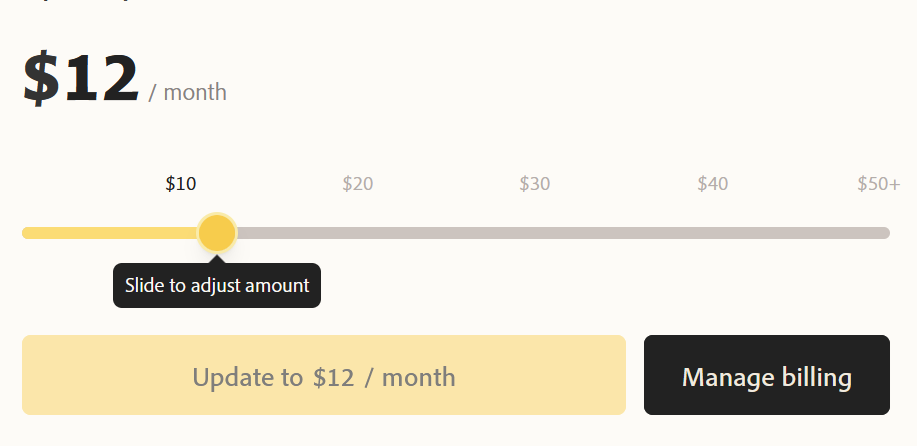
If you wish to cancel or amend your monthly subscription, you can do so via https://plumvillage.org/gems/support-us . Here you will have the option to change your contribution amount, switch to annual billing, or manage billing. In order to cancel your contribution, select “manage billing”, and then “cancel subscription”:

We’d love to understand what led to your decision to cancel your subscription. Was there something about Living Gems that didn’t meet your expectations? Or perhaps you have suggestions on how we could improve? Your feedback would be incredibly valuable to us.
Please feel free to send an email to livinggems@plumvillage.org and share your thoughts with us. We genuinely want to hear from you.
I have another issue or question, what do I do? How can I contact the Living Gems team?
Underneath any talk there is a Feedback button, you can use it to give us feedback or report bugs or things that aren’t as they should be.
If you have a question about how to use Living Gems, or for anything else, you may also contact us at livinggems@plumvillage.org
Câu Hỏi Thường Gặp (FAQ)
Chức năng tìm kiếm hoạt động như thế nào?
- Tìm kiếm thông thường hiểu nghĩa ngữ cảnh và sẽ tìm các chủ đề liên quan. Ví dụ, nếu tìm “Mẹ Đất”, kết quả cũng có thể bao gồm những bài pháp thoại có cụm từ “chăm sóc môi trường sống”. Chế độ này cũng có khả năng hiểu các câu hỏi ngôn ngữ tự nhiên đơn giản (ví dụ: “Làm sao con có thể chuyển hoá khổ đau trong mối quan hệ của mình?“).
- Tìm kiếm thông thường cũng hiểu ngày tháng: tìm “13 june 2006”, “2009-07-01”, hoặc “July 1997” sẽ hiển thị những bài pháp thoại tương ứng với ngày hoặc khoảng thời gian đó.
- Nếu bạn muốn tìm chính xác một cụm từ như trong bài pháp thoại, hãy đặt cụm từ trong dấu ngoặc kép hoặc chọn chế độ tìm kiếm chính xác.
- Chế độ tìm kiếm chính xác phân biệt dấu và âm tiếng Việt. Ví dụ: nếu bạn tìm “huong dan tong quat” thì sẽ không tìm thấy kết quả chứa “hướng dẫn tổng quát”.
- Cả hai chế độ tìm kiếm đều dựa vào các đoạn nội dung (segments) – tức là phần liên quan nhất trong bài pháp thoại. Khi đó, kết quả sẽ hiển thị bài pháp thoại kèm theo những đoạn liên quan nhất. Tuy nhiên, nếu tìm thấy một bài pháp thoại có tựa đề liên quan, hệ thống sẽ hiển thị toàn bộ bài mà không đánh dấu đoạn nào cụ thể.
- Living Gems lưu lại câu truy vấn để giúp cải thiện chức năng tìm kiếm, nhưng không lưu thông tin người sử dụng.
Có thể tải video xuống để xem khi không có mạng không?
Hiện tại thì chưa được – nhưng chúng con đang làm việc để có thể cung cấp tính năng này trong tương lai.
Living Gems có bao gồm pháp thoại của các quý thầy cô khác ngoài Sư Ông Làng Mai không?
Hiện tại, chúng con chưa có kế hoạch đưa pháp thoại của các vị giáo thọ khác vào nền tảng này.
Làm sao để tạo một danh sách phát mới, hoặc thêm video vào danh sách phát?
Xin nhấn nút “Save” (Lưu). Khi đang xem video ở chế độ bình thường (không phải toàn màn hình hoặc chế độ cửa sổ nổi), nút này nằm phía dưới bên trái của video.
Để tạo một danh sách mới, chọn ô dưới cùng, nhập tên danh sách, và chọn có muốn chia sẻ danh sách đó công khai hay không.
Để thêm vào danh sách phát đã có, chỉ cần chọn vào ô thích hợp.
Con có thể tìm kiếm những bài pháp liên quan đến điều đang ở trong tim mình, và yên tâm rằng các tìm kiếm đó sẽ được giữ riêng tư không?
Dạ được. Chúng con thấy điều này rất quan trọng. Tất cả các tìm kiếm sẽ được ẩn danh.
Điều này có nghĩa là nhóm phát triển có thể sử dụng các chủ đề được tìm kiếm để cải thiện chất lượng của chức năng tìm kiếm, nhưng thông tin về người thực hiện mỗi lượt tìm kiếm sẽ hoàn toàn được giữ riêng tư cho chính người đó.
Con gặp sự cố hoặc thấy lỗi, con nên làm gì?
Bên dưới mỗi bài pháp thoại có một nút Góp ý (Feedback).
Quý vị cũng có thể vào trực tiếp biểu mẫu góp ý tại địa chỉ: https://tally.so/r/nrK7jL
Nếu quý vị có câu hỏi về cách sử dụng Living Gems, xin vui lòng gửi email đến: livinggems@plumvillage.org