





If you wish to support our podcast, please follow this link. Thank you!
Welcome to a new episode of The Way Out Is In: The Zen Art of Living, a podcast series mirroring Zen Master Thich Nhat Hanh’s deep teachings of Buddhist philosophy: a simple yet profound methodology for dealing with our suffering, and for creating more happiness and joy in our lives.
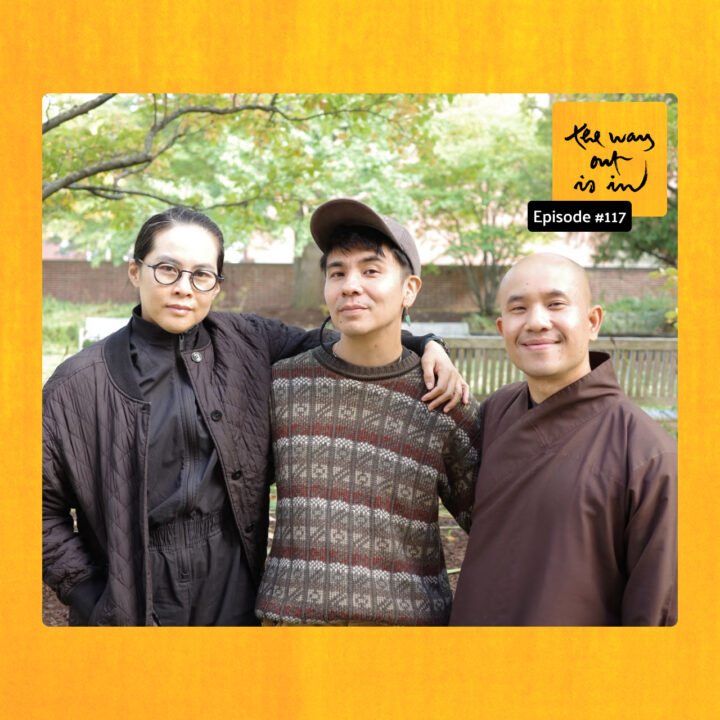
This special episode features a deep conversation about Vietnamese identity in the diaspora, led by Zen Buddhist monk Brother Phap Huu, scholar Nho Tran, and acclaimed novelist Ocean Vuong.
The discussion explores Vietnameseness, the complexities of being Vietnamese in the West, and the challenges of maintaining cultural identity while adapting to new environments. The three speakers reflect on their personal journeys; the role of Buddhism in shaping their understanding of identity; the need to reject binary thinking and embrace the multifaceted nature of Vietnamese identity; the practice of joy; communal healing; the significance of filial piety; the role of language and tradition in preserving cultural heritage; honoring one’s roots while allowing for personal growth; and more.
With an intro by Jo Confino and a short meditation guided by Brother Phap Huu.
Co-produced by the Plum Village App:
https://plumvillage.app/
And Global Optimism:
https://globaloptimism.com/
With support from the Thich Nhat Hanh Foundation:
https://thichnhathanhfoundation.org/
List of resources
Ocean Vuong
https://www.oceanvuong.com/
Interbeing
https://en.wikipedia.org/wiki/Interbeing
The Plum Village Tradition
https://en.wikipedia.org/wiki/Plum_Village_Tradition
The Way Out Is In: ‘Cultivating Joy and Togetherness in the Midst of Hardship (Episode #95)’ https://plumvillage.org/podcast/cultivating-joy-and-togetherness-in-the-midst-of-hardship-episode-95
The Way Out Is In: ‘Roots and Renewal (Episode #91)’
https://plumvillage.org/podcast/roots-and-renewal-episode-91
The Way Out Is In: ‘Spiritual Friendship (Episode #90)’
https://plumvillage.org/podcast/spiritual-friendships-episode-90
Maya Angelou
https://en.wikipedia.org/wiki/Maya_Angelou
Hoa Nguyen
https://www.hoa-nguyen.com/
Édouard Glissant
https://en.wikipedia.org/wiki/%C3%89douard_Glissant
Sarah Ahmed
https://en.wikipedia.org/wiki/Sara_Ahmed
Paris by Night
https://en.wikipedia.org/wiki/Paris_by_Night
The white gaze
https://en.wikipedia.org/wiki/White_gaze
Chinua Achebe
https://en.wikipedia.org/wiki/Chinua_Achebe
Paul Celan
https://en.wikipedia.org/wiki/Paul_Celan
Hayao Miyazaki
https://en.wikipedia.org/wiki/Hayao_Miyazaki
Nina Simone
https://en.wikipedia.org/wiki/Nina_Simone
On Earth We’re Briefly Gorgeous
https://en.wikipedia.org/wiki/On_Earth_We%27re_Briefly_Gorgeous
Quotes
“The first Dharma seal of our practice is, ‘I have arrived, I am home.’ And ‘arrive’, here, means to be with yourself and not feel disconnected from who you are.”
“How lucky we are that Thay offered us a practice where there isn’t a demand for perfection, but a demand for presence and a demand for love in all of its manifestations. That is a thing that begins to heal.”
“Part of what Buddhism has taught me is to be able to be brave and ferocious enough. I think people don’t understand the ferocity Buddhist practice demands of you. That’s why I love the idea of the wrathful deities – because Buddhism has been commodified in the West as self-help, corporate self-help especially: ‘Go calm down so you can answer more emails efficiently for the corporation.’”
“The things that I lean on most, every day, are Buddhist ideas of committing oneself fully with courage. Courage is very different from fearlessness, because fearlessness means there is no fear – but there’s a lot of fear in me. I don’t know about y’all, but, living in this world, there’s a lot of fear. But courage is doing something despite fear. Buddhism has given me that set of tools. And Thay’s being, Thay’s embodiment to walk out of turmoil and sitting calmly within oneself, is a tremendous power. That’s what a lot of Westerners don’t understand when they see someone like Thay. They’re like, ‘Wow, what a peaceful monk.’ Sure. But what I see is, ‘Wow, this is an impenetrable force of survival’ – and it feels so strong to me.”
“Buddhism is a way of being. It’s a way of being liberated in the present moment to give honor to all of the conditions that have come together to give you this moment.”
“Fear becomes knowledge and knowledge becomes progress.”
“Joy is an act of resistance.”
“Our practice is a practice of joy. Yes, we take suffering seriously, but joy is the name of the game.”
“Something I want to say to young Asian-American artists is that just because a white audience is bored of your pain, you don’t need to start tap dancing for that audience. You get to engage with your history robustly. And it’s up to you to navigate that on your terms and not fall into being swayed by audience fatigue. Because trends come and go. Some people will find diasporic violence interesting; some people will find it overdone. But you’re not beholden to them – you’re beholden to how you want to tell your story, as thoroughly as you want.”
“Sometimes we perpetuate the white gaze among each other. That’s a well-documented colonial artifact: once the empire retreats, its tools – material, psychological, and structural – are picked up and implemented, often right away, to abuse one another.”
Dear listeners, welcome to this latest episode of the podcast The Way Out Is In.
This is not the normal episode you would expect, but it is a recording done at Harvard University with Brother Phap Huu, Nho, who is a core member of the community and a spiritual sister to Phap Huu, and also the great author Ocean Vuong. And it's a conversation about what it means to be Vietnamese in this moment, not how to replicate what existed in Vietnam many years ago, but what it means to be an immigrant, what it mean to be Vietnamese in this current world. It's a very deep conversation and also it's not just about Vietnam or being Vietnamese. It actually can speak to all of us because in some sense we are all refugees, immigrants. We're all trying to find our way in the world. We're finding new ways of being. So we really hope you enjoy this rather wonderful, deep, joyful conversation about what it means to be a Vietnamese person today in the West.
The way out is in.
Let us all find our breath, become aware of our whole body, allow our shoulders to drop, our arms to relax, our hands to be rested. Let us bring our awareness to our in-breath and out-breath, identifying it just as it is. This is in-breath, this is out-breath. Now let us breathe in deeper and breathe out longer and slower. As I breathe in, I fully take refuge in my in-breath. As I breath out, I fully take refuge in my out-breath. In-breath and out-breath. Breathing in, I am aware of my whole body. Breathing out, I give permission to just be, just rest. In, aware of this body. Out, resting. Breathing in, I see this body is not mine alone, it is a continuation of my ancestors, my spiritual ancestors, and of this whole planet, the cosmos. Breathing out, I am a continuation. In, no separation. Out, continuation. Breathing in, I invite my teacher to breathe in with my lungs and sit with my back. Breathing out, he is in me, and I am in him. Thay, breathe with my lungs, sit with my back. You are here. With body, speech and mind in perfect oneness, I send my heart along with the sound of this bell. May all those who hear it, even in the darkest places, may they wake up and walk the path of transformation and healing.
Thank you, Brother Phap Huu, for that really grounding and beautiful guided meditation. I was, as I was making my way over here, I was like, what are we gonna talk about? But mostly I was worried because I was late. So I was sort of running over here. And then, but as I came over this way, I saw your head pop up in the window. I was like oh, I'm home. It's here. And I stepped in, and as soon as I stepped in, Ocean's like, this is one of the preserved classrooms. Because Radcliffe used to be a woman's college and sort of was telling immediately the history of this space. And in that moment, really quickly, I remember Thay and also other writers always saying, like, whenever you step into a room, bring your ancestors with you. File them in, yeah, Maya Angelou, file in your ancestors with you and you walk in with a lot of integrity and pride and just hold yourself as if you're holding all of your ancestors with you. And this year, on October 11th, would be Thay's, our collective Thay's, 100th continuation year. And we find ourselves together in this place and this time, almost by the hands of the ancestors bringing us together, this conversation we had, I think, didn't begin after the meditation, but it began, I think a few years ago, when we first all just hung out together at Ocean's home in Western Massachusetts. And the conversation was so alive and so light and so free, where we were just talking about our Vietnameseness. We're talking about being children of refugees, being refugees ourself, what does it mean to be Vietnamese and what does is mean to live that hyphenated life, right? You're just somewhere caught in the in-between or in that liminal space of being, and both the beauties of it and the limitations of being in that liminal space. We talked about video games, we talked about going to temple and what it meant. And this conversation, I think, is a continuation of that conversation, but I feel like we should get into it and really get into what does it mean to each of us to be that hyphenated Vietnamese, to be a child of refugees, to be a refugee yourself? And how that has informed the way that we think of what is rightfully our inheritance as a culture, and how we think about how we continue our parents and our teachers.
Yeah, I love how everything happens so organically with our meeting and how auspicious to arrive at Thay's 100 continuation anniversary, a Libra, who would have guessed, of course, right? The only sign that is not after organic matter. The scale, everything else is an animal or a being. And this is a fabricated sign, a sign that comes from the world, that comes from intention. Taurus, Cancer, these are all organic beings. And the Libra is the sign that someone had to make. And the make was to create order and balance and to judge, make judgment and discernment. And that actually is a wonderful segue into this idea of what is Vietnamese identity beyond Vietnam. And I think that's something that it's up to us to make it. And right now there's no space for it. So we are the 1.5 second generation or the generation that then comes. I mean, we're sitting at Harvard. I don't know any Vietnamese person in my life that has sat at Harvard before, having a conversation about Vietnamese life. Most of my family have never been in a university unless it's to visit me. So we get to launch a beautiful, imperfect inquiry into what this is and what it can be. And I think for me, the most fruitful position is to acknowledge that it can never be what Vietnam was or is. It can also never be what America was or is. And the struggle is that we are in a third space, but the third space cannot be seen. We are standing in a third identity as immigrants and refugees, which means that our Vietnamese is not beholden to the mainlands. It is not, quote unquote, perfect to the mainland. Some of us, like my cousins, don't have Vietnamese at all. Are they any less? Is my beautiful friend, poet, Hoa Nguyen, any less Vietnamese? Hoa, by the way, insisting that she pronounces her last name Nguyen, because it's difficult for her to say […], and so for her it's Nguyen. Is she any less? So I think so far, the critical framework has borrowed Western puritanical binaries to judge us. And we have also, let's admit it, borrowed that binary. Academia loves that binary, black and white. So, for lack of a legacy of developing it we have borrowed it. We borrowed the view that white academia often voice on us, which is East meets West. And I think it's important to reject all of that and borrow from black thinkers. For example, Édouard Glissant, who says, after the Middle Passage into the Caribbean, without being able to trace, at least we are able to point to Vietnam and say there is a place, there is a Weihun. But for some of these black thinkers coming out of the Middle Passage, they cannot point to a specific place. And so Glissant said, well, maybe the idea of origin is a Western fantasy. And he says that the Arawaks, the indigenous communities in the Caribbean move nomadically. They move according to the seasons and the weather and they don't see in origin as a pure genesis, the way the West does. Glissant even says that colonialism works, moves very antithetically to nomadic tribes in that it moves like an arrow. It flies out of the instrument and must go only one way. And usually it lands at death. And I think we have an opportunity to borrow from those thinkers. And Glissant healthily says, there is a creolization to the refugee, to the immigrant, that culture is not the fantasy of purity or origin, but the creation of the present, a total mosaic, complicated, contradictory present. And I think that's what I want for us. I really want us to be able to look at Vietnamese identity in the diaspora and say, this is something else. It started somewhere, but now it's something else. It is not beholden. You know, it would be incorrect to look at a 17-year-old Vietnamese kid in America and say, you're not saying, ma, right. I was at the temple last year, and it was an 11, 12-year-old girl. Her mom passed away, and we're doing the ceremony, the 49 days. And she, you can tell she doesn't speak Vietnamese often with her mother, she's probably speaking English, but the aunties are like, you're speaking Vietnamese here. So she tries to say, ma, and maybe because she's thinking of the English, ma, Hey, ma, right? And she's crying. And so she's trying to say, mom, where are you? Mom, I'm here. Because the auntie's like, speak to your mom. She's around. You know, she's still here, in the beautiful 49-day tradition. And I'm there, in the back, and I'm listening in this ceremony. And then she starts saying, ma, […] It breaks my heart, but compounded into a third space. Linguistically, her error, the fancy word for this is catachresis. Her error in pronunciation makes her to start saying, Ghost, where are you? And I'm like, damn, that's more accurate than anything. I'm, like, girl, now I'm crying. I'm like, that's right. And I'm saying, Oh, you know what? That mistake, quote unquote, would never happen in Vietnam. That mistake is made possible by the refugee experience. So the old argument would say, oh, you're wrong. Get it right. But my work and my thinking is like, no, no. That's so special. Inside the fact that we are in Bridgeport, Connecticut, inside an old post office turned into a temple, an 11-year-old girl is trying to say, mom, where are you? And she ends up saying ghost, where are you? The diaspora is inside that sentence. That is a specially made thing and there's no place for it. There's no infrastructure or institution for it, it can only be read as an error. And yet to me, the error is everything. It is the creolization of that moment. And I'm like, wow, she's discovering, to me, a double layer whether she intended it or not. And I'm like, that's it. In my heart, I was like, that's the diaspora. That moment, right there, trying to say mom and you end up saying ghost.
Thank you, everyone for being here and going deep into this space. It brings me to this moment I had with Thay in 2012. And we're in Hong Kong leading a retreat. And Thay just looked at me and he said, Thay has renewed Buddhism 60%. 40% I leave it to all of you. And I was a little bit shocked because I thought Thay was being humbled because I'm like Plum Village is so cool. It's like, it's not very temple, traditional, and I wouldn't even be a monk if it wasn't for the renewal of Buddhism. And I can understand everything that you're teaching me. But he looked at me with deep eyes and he said, no, no there's still so much to do because we have to translate and we have to find a way that the teachings and the culture still stays intact but at the same time be accessible for everyone. And this has been my own journey of like understanding what does it mean to honor my Vietnamese roots, but also dance in the third space where I'm not going to pretend to know how to chant like a traditional monk. All my chanting is in English and all of my thinking is in English, but then I can always like return to then the depths of the Vietnamese language where it's so much deeper in some spaces. And where I'm at now, like sitting here with everyone in the space and having this opportunity to reflect, what's coming up for me is that our journey, my journey, I'm going to speak for me, my journey is a journey of also honoring the sacrifices that my parents have given me. And before it was a burden, but now it's more becoming like a source of incredible energy that they have given permission to be something so different that they couldn't even imagine. And then connecting to Thay, which is a refugee, and a refugee not by choice, but by conditions, and have found a way to be at home wherever he went. And I think, spiritually, like for me, the word home is a very big word, về nhà, to arrive at home, to come home. And the first Dharma seal of our practice is I have arrived, I am home. And arrive here means to be with oneself and not to be feeling disconnected from who you are. And the question who you is also a very deep question because I also agree, I cannot just say I'm Vietnamese. Because I'm also Canadian, and I'm also French now because I've lived there for 20 years, and I am also very international. Or I'm not myself, even, because I have listened and I have learned from so many great human beings that this journey is not mine alone. But it is, at the same time, so important to also just embrace the beauty that I never knew I could say as a Vietnamese person. We are so resilient. Like we know how to […] And I think that's both a flower and both a healing that needs to be done. And […] means we can work hard, we can go through so much suffering. We can bend our backs in order to succeed, which is a response from colonialism, response to war, response to survival. And it has also been a way for us to then embrace our suffering, our pains, much more stubbornly. And I think now, I want to hear from all of us, like, how are we healing this? As well as how is it empowering us to take our ancestors' pain and suffering, and to honor their pain and suffering at the same time as heal their pain and suffering. This is what I've been meditating on in every action, at every opportunity that I'm able to engage in a retreat, leading, facilitating. And so there's a dance between the healing, the transformation and the moving forward.
You know, what both Ocean and Brother Phap Huu shared, what you both shared, really makes me think of, I really love the language of a fantasy of origin or a fantasy of wholeness, and the idea of the attachment to this notion of perfection, right? And… Because I think that's, you know, if we're going to bring in some Buddhist language, excuse me for that, but like, you know, if you're going bring in some Buddhist language that is, those binaries of perfection and imperfect are things that people often get caught in on and that's where we start to have these notions of less than, better than, or enough and not enough and all of our sort of neuroses start to begin there. And I think that the more I contemplate my own identity as this person, this being that exists here with the complexity and the multitudes of what I contain and more that I don't even know about, I love and rely on and ride the waves of both imperfection and uncertainty. And I think that imperfection and that uncertainty shows you fragments of wholeness. But it reflects these fragments of who we are, reflects this sort of wholeness, but those fragments also allow you a space of creative becoming. And that, for me, is like this inheritance that you get, both from your roots, where we can point to. That's my […] over there. Vietnam is my Kui Hung. And here are the branches, right? And when I was young, Thay said to me, he said, you know, you and I are like […]. He's like, my roots are in Vietnam and the wind is blowing and it's touching the land of France, it's hitting the land in the US. And it was, at that time, I was very young, so I was always like, this guy is obsessed with Vietnam. And, cause I just didn't appreciate it, cause I was just like, I'm an American. And he is forever forcing me to be this Vietnamese person that I'm not. But in fact, now, as I get older, and I'm thinking more and more about it, I think he's giving me permission to say, yeah, I have this place where I could find my roots, and my becoming aren't determined and defined by those roots. And so when I think about your question, Brother Phap Huu, and I think about what Ocean has shared about imperfection and this fantasy of wholeness and origins, I just think how lucky we are that Thay has offered us this practice where there isn't a demand for perfection, but there is a demand for presence and there is a demand for love in all of its manifestations. And I think that is a thing that begins to heal. Because in 1997, my first retreat with Thay, he came over here, and his only retreats were for Vietnamese people. And it was targeted for Vietnamese people and young Vietnamese families that were navigating their life and their identity in this new place. And the practice was for us to be able to embrace who we were because there was a big I don't know, I don't know about you guys, but when I was growing up there was a lot of brainwashing even in elementary school. I remember being told that even though technically we lost the war but you won because you're here. And you're not a communist, you're not X Y& Z, like there was so much that we were fed that made us both explicitly and inexplicitly hate our Vietnameseness. And I remember one day, I was put up, like all the Vietnamese kids were put on display and we were made to do a dragon dance and none of us had, none of us know how to do dragon dances. Like, so we had to like… it's like someone was like drumming and someone was holding, like dancing in a dragon and, like… And we felt paraded and like around the school as if like, look at these little Vietnamese kids that we got and look what, you know, we were just a sideshow for everyone. And we thought this is how we're going to be accepted. But those micro-experiences really started feeding into this marginalized identity as being Vietnamese, as being something that was on display for people to look at and to mock, because I remember the American kids were laughing at us and we were forced to sing the Southern Vietnamese national anthem in front of the whole school. And none of them understood Vietnamese. And we didn't understand Vietnamese, right? And so when I encountered the practice, it was a very basic sort of like, do you know who you are? And it was a very gentle invitation to start unraveling all the things that I didn't know that… all the ways in which I was torturing myself by not being able to embrace the fragmentation of who I was as a person because I was chasing after the fantasy of fullness and wholeness and purity and I'm still doing that today. And the practice has allowed me to slow down and really be like, what's going on here, actually? What am I doing to myself and what am I doing to everyone else around me when I think like this?
The idea of the process, what you're describing, that there's grace. To me, like healing, particularly communal healing that comes from an epicenter, like the wars of the 60s and 70s and prior, in Vietnam, was that war for nearly a century in the 20th century. And it give each other grace to not be obliged to follow the purity rules, and I think you're onto something there, Nho, because the purity rules existed in Confucian-inflected Vietnam prior to the diaspora. You know, those, this idea of how to behave and respectability, right? Mắc mặt, đừng làm gia đình quê, đứng có sáu hổ. And so the shame is something that is generational, it is tied to community, ancestry, and deeply patriarchal, right? It's all around the dignity of men, you know? And so the dignity of men then controls the behavior and the freedom and it starts to police the freedoms of everybody around us. And we are raised by those poor folks. We were raised by women and men who come out of that. And part of what Buddhism taught me is to be able to be brave and ferocious enough. I think like people don't understand how ferocious Buddhist practice demands of you. I think that's why I love the idea of the wrathful deities because Buddhism has been commodified in the West as self-help, corporate self-help especially, right? Go calm down so you can answer more emails efficiently for the corporation. And I think to me the most, like the things that I lean on most every day is Buddhist ideas of committing oneself fully with courage. Courage is very different than fearlessness, because fearlessness means there is no fear. There's a lot of fear in me. I don't know about Nho, but living in this world, a lot of fear. But courage is doing something despite fear. And Buddhism has given me that set of tools and Thay's being, Thay's embodiment to walk out of those turmoils and to sit so calmly within oneself is a tremendous power. So I think that's what I think a lot of Westerners don't always understand when they see someone like Thay. They're like, wow, what a peaceful monk. And, sure. But what I see is that, wow, this is an impenetrable force of survival, and it feels so strong to me. And I think about the Buddha's final teaching on his deathbed, the reclining Buddha, and he says, to paraphrase, because all forms will fade, go forth with earnestness. And I think that whole sentence is so important because I think it doesn't mean don't have humor or joy. It means that keep in mind that all this will go away. So don't waste your time messing around. And I think that's taught me how to make art, how to teach. You know, I teach with the earnest desire to go to the root of it, because we don't have time. We don't time to be cynical or ironic or perform this sort of disassociated, I'm cooler than you, so I don't care what the kids say nonchalance. When you're gonna die, you don't wanna have time for nonchalance. Your family, your community is going to get wiped away. Nonchalance is a privilege most of us cannot afford. And I think the antidote of that is grace, to say, who are you? I don't know. We will never be at a true arrival. And so the labels will only constrict us further. And I thing giving our generation, we get to know, cause let's, you know, our parents and our aunties and uncles went through what they went through. I'm not in the business of trying to correct or reform anybody. I think part of that grace is also like, yeah, people have their things, but we get to offer a way. And that way I think has to begin with rejecting the old Confucian models and the American Puritan models of binaries. Who is right, who is wrong? And rather say, who are we? And whatever you are is who we are. If that makes sense, right? If you're a Vietnamese kid who can't speak the language, don't know, can't even point to it on the map. I know some of y'all are out there. If you can't even point to Vietnam on the map, I want you to know that you are as Vietnamese as anybody else. And now, not only that, but that lack of knowledge is now indicative and representative of the violence. Sara Ahmed calls this epistemic violence, the disruption of knowledge systems through geopolitical violence, disruption. So we can joke and say, yeah, you don't know where it is. But I'm like, well, that wouldn't have happened though without these wars. So you are the result of it. There's no right or wrong. You are what has become of us. And I want you to be whole in that position.
[…] like this conversation was bringing up for me, that when you say we are who we are because of the past, and also who we could become is what I am, I'm always tapping into now, because I look back at […], at Thay, and his courage was not to dwell on the hardship of his suffering, but his courage that he's given to all of us through Plum Village and through his teaching and his way of being is also, yes, we suffered, but now we have permission to be happy, to be joyful, to sing songs, to write poetry, to dance together, to renew this present moment, which that was almost like liberating for me because when I was coming to Plum Village, like there's an opportunity to talk about our suffering, but we get so attached to it, right? It's like, that's our only identity. It's, like, oh, this is the journey I went through. But Thay also says, and? What about the present moment? Like, what are the potentials that you can see in yourself that I could do for my parents? That was some radical idea that I've never heard. All I heard is like, okay, now go and become a doctor, make us proud, or get rich, because we have suffered so much. And that part is still in me, actually. I can still recognize that perfectionism that has been transmitted to me because of fear, because a lot of our ancestors were also slaves, had to bend over and perform for the rich, for the status. And so we have this like way of being that we are so scared of being wrong and we're so scared of being, being free in a way. And I look back and we, me and Nho and our friend Anne, sometimes we would do something joyful, but I can feel like myself, like I resist expressing too much joy cause I don't know how. And what the practice and what is radical about Buddhism that I also think people don't understand is so much more than a religion. Buddhism is a way of being. It's a way being liberated in the present moment to give honor to all of the conditions that have come together to give you this moment. And for me, what I continue to see and understand in Thay's teaching about joy, because I was really skeptical about joy at the beginning. Like what Nho said, like sometimes it's very performative. And I was put in places where like, Con hát kê bài này đi, like sing a song, make us happy. But actually now I'm like, no, I'm going to be joyful. I have the right to be joyful. I have the right to honor my ancestors, to learn this Vietnamese song and to sing it with pride and to sing it with my whole heart. And I'm so happy now that there are some moments where I'm in an English speaking community. I'm like, you guys, you know what? Today, I'm gonna offer you a Vietnamese song and I'm not even gonna translate it. Y'all just gonna hear the melody and be moved by it. And before that, I was like, okay, I want you to understand it so that you can accept me, so that can accept this language. And once again, it's like, we're serving. And what Thay, I got to witness in his presence, because I got to travel with him around and he was entering into a lot of white spaces, right? And he was entering into spaces where it's a radical present moment. He's teaching, he's teaching those of representation of ancestors that have come and colonized our country, but he's teaching them how to be in peace, how to reconcile, how to heal, how to hold their suffering and also how to be joyful so that they can also be a part of this collective transformation, this collective healing that I believe that this is a very pivotal moment in our era, in our times. We are witnessing so much suffering and so much pain, but there's also a reckoning right now that I feel. And to combat or to not combat, to embrace all of this, I understood joy is a form of resilience and to be able to still be with pain because it… Yesterday when we were walking, like in Buddhism, there's this ideal of the Pure Land, of purity, like we're practicing so that there's no more suffering. I came in with that idea, it's like I can only be happy when I don't suffer anymore. And I was like, oh my gosh, after five years, is it working? But there was one day, Thay said, I would never want to send you guys to a place where there's no more suffering, because you wouldn't learn. You wouldn't have empathy. You wouldn't understand. And that is no mud, no lotus, right? And this idea that perfection is where there's no more suffering is an illusion. And I think as a continuation and as we are a manifestation of our parents and our ancestors suffering, but now I… My dad passed this year, so like I'm stepping into a space where I'm like dad, you've always had this mantra which is enjoy, easy, be happy…. You have the right to do this. And in August, I started to step into that more and I started to feel Thay's insight more, which is like, yes, there is suffering around, but collectively we can bring a refuge for one another to hold, to listen and to sing. So this is something that for me has been so alive and has been a force for me to move forward.
Almost every year, Thay gives a Dharma talk and he says, I would never want my disciples to be in a place where they don't suffer, that they only know happiness. And every year it's a drag on me, because the origins of that was that when I was, after my first retreat in 97, I wrote him a letter, an aspiration letter, I was like, what, nine or 10. And for the first time, I actually saw our elders, our aunties and uncles, laughing and singing. Like, because usually when you see them, they're head down, grinding, working. They're at the nail shop, they're at the banh mi shop, they're just working so hard. And for the first time in this retreat, I saw what Vietnamese joy looked like. And it was such a shock to me, because my mother was laughing, my father was laughing. I didn't know my father could smile, like it was such a surprise to me. And so I wrote him this letter, and I said, you know, I wanna ordain, and I wanna be in a place where I'm happy in the morning, happy in the afternoon, happy in the evening, and I want everyone to share that happiness too. And every year since, he goes, you remember that letter? He was like, never. I will never let you be in that place of that… He's like, you want to be happy in the morning, happy in the evening, happy… He's, like, what an illusion, right? And every year he would drag me because of that letter I wrote, just on the dot. He'd be like, Nho, remember that letter? I'm like, I do, god, let it go. But it makes me think of, you know, listening to both of you again, it's all, again, like Phap Huu said, it's so, it's so rich. To think, you know, when I'm listening to Ocean and it makes me think of like, I think Marx, it was a Marx quote, where he said, you're conditioned by conditions not of your own making, right? And it is to say that you are a product of conditions that you did not create for yourself. And so therefore, like don't be, like there has to be some sort of grace when you approach yourself or the way that you perceive and you treat yourself. And then your comment on what does it mean to be a practicing Buddhist and that it takes courage. And it takes a lot of courage to sit still, to slow down and actually to turn around to face it. I've been on this thing, cause I was on a airplane recently and I like to watch like nature videos on the airplane. And there's this video of the sea turtles and they were telling the story about how hard it is for sea turtles to lay eggs on the beach and how long it takes. Like how there's a lot of intervention to make sure the sea turtles don't go extinct and all that stuff. And then, you know, 30 years later, the sea turtle returns back to the very place that it was born through a very like arduous and like challenging trip. And at the end of the trip, where they're about to land on the shore to lay their eggs, the music starts to change. And suddenly there's a shark that comes. And they're like, you know, at the end of trip, there is a shark. There's always these, you know, the school of sharks that come by and like it becomes a very tragic story when they follow some turtles who are like running away from this running away, trying to swim away from these sharks. They're exhausted and they can't keep up with the pace of the sharks. And there's one particular turtle that was swimming and then decided that she wasn't gonna swim anymore. And so she then just turned around and started facing the shark. And because she had turned around to face the shark, her body had turned and her shell had blocked the shark's mouth now. And the shark couldn't bite her anymore. And in fact, because she turned around and she faced the shark, the shark was like, kind of like grabbing, like sort of like snapping at her shell and was pushing her towards the shore faster. And I just thought, wow, what a Buddhist story, where the turtle's like, I'm not running anymore, I'm just gonna turn around and face the very thing that is about to kill me and eat me alive, and then actually take that source of immense fear or immense threat to your very existence and turn it into a force that pushes you to where you're trying to go.
Fear becomes knowledge and knowledge becomes progress.
Yeah. And I often think, you know, when I reflect on that moment and reflect on us sitting here and being here, I think one of the things that I learned from listening to you both and listening to Brother Phap Huu here talk about Vietnamese joy, I think about how, again, the opening of imperfection, how that informs so much of our being, not just present time with us, but in the past and also in the future, where, you know, when Thay was calling for peace during the Vietnam War, he would have… I went to interview these aunties and uncles that were of his first cohort in the School of Youth for Social Services this past year, and this auntie said, after a long day of collecting bodies and burying them, doing funeral rites, building schools and teaching children, trying to at least maintain some sort of stability in the village communal life, they would come back home and Thay would say, let's pick up a guitar. And everyone would just start singing together. And singing and singing and singing. And he said that moment of collective joy, even in the midst of this burning hell that everyone was witnessing, was a thing that actually drove everyone and motivated everyone and inspired everyone to get up every morning and face what the reality, what the conditions were offering, were imposing on them at that moment. And so when Brother Phap Huu says, joy is an act of resistance, I take that very seriously. And I used to think that in our Plum Village retreats, when we had our […] or our […], you know, the times we would get together, it was so scrappy and it was so, I just thought it was so silly and I'm like, we're not serious meditators. But actually, as I'm growing and as I am getting older, I'm realizing how important that joy is, and then I'm listening to these Dharma talks all from Thay, and Thay is like, our practice is a practice of joy. Yes, we take suffering seriously, but joy is the name of the game. And so, I don't know, I just wanted to name that because what you guys were talking about really sparked a lot of curiosity in me to understand what is it that brings you joy? How does, what is your relationship to joy in the context of all of your complex and multi-fold identities?
I like to think of it as heavy joy.
Heavy joy. Say more.
Well, I think, you know, it's easy to fall into the binary of like, enough diasporic tears, enough diaspora sadness. But then the other end of that, this happens in the writing community is like alright, enough, you know, immigrant stories that are sad, let's, you know, smile and grin. And that starts to become disingenuous too, especially in the history of Asian American presence in this country is always in servitude, opening the door after you, sir, smile, and grin. Here you go, here's your laundry, sir, madam. Smile and grin. Pick your color, please, smile and grin. So we are always opening the door and saying, after you, after you. And so the Asian-American joy has often been a performance of legibility and to defang ourselves. Look, I'm just a happy-go-lucky person. I had friends who had taken the citizen test, and in their photos, if they don't smile, they tell them, take it again. So the Asian-Americans smile, and this is, a lot of scholarship has been done about this, particularly in black communities. Like what is, African-Americans have to smile to render themselves a non-threat in order to protect themselves. So the performance, down to the minstrel painted across, blackface traditions is this idea that the joy will save you and the performance of happiness will save you. So I think that's why, you know, we can avoid the ping-ponging of sadness and joy as if they are completely isolated binaries. And that's why I think heavy joy. Joy will wait. And I was raised by women and I think one thing that I think is important to say as a Vietnamese American was that in my household raised by woman, I did not have the stereotypical, like we did not talk about what happened. These women were loose in the mouth. I'm like, you are going to know where you come from, what you came from, and what it costs. So there were four women who raised seven sons.
Wow.
So what I learned was that they would sob telling these stories about what they've been through. And they did that to show us what it costs, because they know that they went from a patriarchal country into another patriarchal county, but they were holding forth a matriarchy in the household. So they made sure we knew how many bananas they had to sell on a little float at five in the morning to get breakfast. They made us know every cost. And they also threw in some myths […].
That means I found you in the garbage trash.
That's the origin story of all Vietnamese kids, by the way.
So mythology, right? And so, and they would start crying with such fervor. My cousins and I were like seven, eight, nine, watching and listening to these stories. And we were never ashamed of crying. We thought it was so powerful. Wow, look at them show up to their histories with their full emotional range. And we thought they were so fierce. And we didn't know that in America, crying was seen as weakness and shame. We even have euphemisms for it. Oh, I'm sorry, I lost control. I got misty- eyed, right? All of these things to avoid saying that we felt something. So we were very lucky to have that education. And in the same breath, they'll start cracking up. So I'm like, oh, this is heavy joy.
Yeah. Yeah, yeah.
This is joy with weight. It is not empty, performative, joy that comes out of the fatigue of reality. Because I think about that a lot as a writer and a cultural producer, in that so many Americans or folks on the West, and even Asian Americans community were like, well, why is there so much trauma? Let's get over it. I'm like, well, you tell me when we can get over it and I'll be the first one to sign up. But I think it's important to also push back and say, I'm not writing about trauma. Trauma is subjective. Trauma it's between you and your therapist. I'm writing about violence. And I think the white critical framework often forces us into a trauma negotiation, to a trauma discourse, to actually defang us. Oh, look at them, they're just reporting on their trauma. It's so self-indulgent. It's all about them. But when you push back and you actually say, no, I'm writing about violence. When I recenter the conversation on violence, now you have to ask, where does it come from? Who did it? Who benefited from it? Who still benefits from it, and what are the aftermaths? Now you are in a historical question. You are no longer in this sort of therapy, self-improvement speak. So it's important for us to always push back on those frames and say, and one of those things is that the price of my laughter is the pain and I don't have to choose. And one thing that I want to say to young Asian American artists is that just because a white audience is bored of your pain does not mean you need to start dancing a tap dance for that audience. You get to engage with your history robustly. And it's up to you to navigate that on your terms and not fall into being swayed by audience fatigue. Because trends come and go. Some people will find, you know, diasporic violence interesting. Some people will find it overdone. But you're not beholden to them. You're beholden to how you want to tell your story as thoroughly as you want. Including not telling it at all. That's okay too. And I think giving that openness, you know, one thing, an example that I often give, and I was so touched, Nho, when you said that Thay would be obsessed with Vietnam. Because I think even when we are ejected or leave the homeland, it still haunts us in a different way that folks in the homeland are not haunted in the same way. There was a sentence very similar to the ghost where are you situation. When I was young, my mother would look out the window at night, this one beautiful summer night in Hartford. And there was a full moon over the city. And then we're looking at it together. There's no TV or radio, we're just looking at… The past time that's quite gone now, looking out a window with your mom in the summer. It's a beautiful moon over this desolate city. And she says to me […] That the moon in Hartford will never be as beautiful as the moon in […]. Now, she's not a fool. She knows it's the same moon. But what is she saying by that, right? And what's happening there? She's romanticizing. And this is often the biggest faux pas in Asian-American discourse. How dare you romanticize? I was like, have you seen Paris by Night?
Oh yeah, I grew up with that.
I'm like, Paris by Night is an institutional life-saving performance of intra-communal romanticization. Rice paddies, army helmets, everything is about recreating a hyperbolic representation of what is no longer experienceable. And I think that is what I'm really interested in because we get young Asian American creatives get so shook about the white gaze and they say, oh gosh, I don't want to romanticize the homeland. And I said, but between us, my mother was speaking to me when this conflict, she is romanticizing, but there's a very useful function to that romanticization. She's able, because in writing there's context and subtext. And the subtext in that sentence is basically, I miss my home. I know it's not the same moon, but inside that sentence is great loss, pain, hurt, desire, and the desire to give something to your child, an experience your child never gotten. And so it turns it into a fairy tale. And so, someone could say, look at that sentence. It's such a romanticizing, exotic look. But between us, it's a very edifying conversation. And that sentence would not be possible without war. Nobody in Vietnam now would ever say, legitimately, the moon in Gò Công is so much more beautiful than the moon in Hartford, Connecticut. That's a diasporic sentence. And I think I'm interested in preserving and centering the diasporic sentence. All of that history is inside that moment. And I thing we should also give our community members more grace. Romanticization is a deeply legitimate response to trauma and pain and violence and hurt. And actually, it's very beautiful. Paris by Night could have been about many things, but they chose for it to be about the most recognizable symbols of Vietnam. And that was what was carried. And then they recreated that in like Minnesota, Buffalo. They travel, it was a traveling performance. And then, they bootleg the tapes. Every month when they came out, you got to go to a grocery store in Hartford, you know, to get the bootleg tapes. So then that's also a diasporic cultural function. You wouldn't have to do those things in the mainland. So I've always wanted to celebrate that. I think the obsession that you said that Thay had with Vietnam, but also the desire to commit to something completely new and unfathomable. It makes me think about what the writer Achebe, you know, said about writing in English as a Nigerian writer. And he says, the English world would never fathom the unimaginable things we would do to their language. I'm like, daaa…
Wow. Yeah.
And he to use it as a defense of writing in English. He's like, they don't even know what we can do with this thing. We're gonna make this unfathomable. And it reminds me of Paul Celan, whose family was murdered in the Holocaust. Austrian writer writing in Germany, fled to Paris, learned French, learned English, but continued to write in German. And when he asks, they ask, why? This is the language of your killers. He says, true, it is also the language for which I first learned poetry. And it is up to me to create a third language. So he started to push German words together to create like a Frankenstein German. And I felt like that was such a powerful way to acknowledge the painful history while also acknowledging the agency and innovation possible in the present.
Beautiful. Just listening to that in Upper Hamlet, there's a vườn rau, it's the vegetable garden, and it's run by all the Vietnamese brothers, and it's like one of the most favorite space for like all those who want some like real good food because there's MSG there. Because at the dining table, there's no MSG because there was like this whole conspiracy that MSG is like really bad for you, right? I mean, this, you know, it even happens in a monastery where…
And, you know, MSG is in Donald Trump's favorite food.
No way!
Cheetos.
Cheetos, Pringles. It's all there. It's all there.
That's a crazy metaphor about Asianness, is that, girl, what you fear is already in your favorite thing.
It's already there.
We're already inside you.
Yeah, yeah.
There's no escaping. I'm, you know, I want to go back really quick to what you said, Ocean, about the white gaze. Because I think there is a conversation to be had too because just because the complexity of our identities and of being an immigrant and refugee and Vietnamese-American, Vietnamese-Canadian, Vietnamese-Australian, the hyphenated life. And our ideas like, you know, there's violence that are imposed upon us by communities outside and there's violence that is bestowed upon us by our own community. Like when someone looks at someone and says, you're not Vietnamese enough, or when someone looks at you and say, you are not Buddhist enough. I mean, if you go on Facebook where every Vietnamese and their mothers are commenting on everyone's life, you shall see that no one is not enough of anything to anyone. And, you know, should a video of the brothers and sisters singing in Plum Village, they would say that's not Buddhist enough. Or should you write about the Vietnamese experience? They'd be like, he's not Vietnamese enough. He's not queer enough. He's not, you know, x y and z enough. And so, you're sharing of the Frankenstein German language when you're just crushing together and seeing what could happen. I think that is much more closer to the reality of what it is to be, first of all, Vietnamese. We are, you know, when I was in Vietnam one summer, I kept asking people, what does it mean to you to be in Vietnam, in the country? So what does that mean? What do you think the sort of spirit behind the Vietnamese people is? And I cannot tell you how many people said, Vietnamese people are very […] Like, it's hard to translate, but it's like, it depends on the conditions. It depends on the fate, you know? And from the north to the south, we don't agree on very many things, but it seems like the Vietnamese people have agreed that we're very […]. And this is something that I, in my own research, I've been looking in medieval Vietnam, they were already spouting this thing, where they knew that they were inheriting a lot of Chinese forms, but they weren't forcing themselves to be defined by it. And in fact, one of the first major Buddhist writings from the Trần dynasty, of like Trần Nhân Tông, was written all in […], because he was like, Vietnamese people can, we could hang on our own. We don't need that classical Chinese. But at the end, the very end, the last verse, he wrote it in classical Chinese, and it was sort of like, and this is how Vietnamese kept always sort of like skirted along these borders of Chineseness and Vietnameseness where we have our own language and we will make these things accessible to the Vietnamese people by using our language. And if we need to, we will play with your language as well. We'll end the crescendo in classical Chinese because we know how to rock with you, but you can't rock with us. Do you know what I mean? And so there's this beautiful […], a practice of like being so incredibly fluid in who we are as a people, as a nation, and our identities, right? Whether we are Vietnamese in America, Vietnamese in Canada, Vietnamese in France. And so I wonder what you all think about why do we feel the need, if that's so embedded in our culture, this beautiful spirit of […]. And there's a discipline behind it. It's not willy-nilly, it's very disciplined.
Yeah.
Why do we have to do that to it? What are we doing to ourselves when we try to police each other's Vietnameseness or police each others Buddhistness? And who is going to be the judge of that?
Yeah.
And why don't we liberate ourselves from that? And how can we liberate ourselves from that?
I can answer by giving everybody who's listening an exclusive breaking news that I am actually mostly Chinese. Uh, oh. But my father….
Podcast ends here.
You heard it on The Way Out Is In.
Emptying my wallet of all my Vietnamese cards. My father is ethnic Chinese, and he grew up in […]. And it's also why many Vietnamese people have been scratching their heads over this for many years. Why I personally do not pronounce my name Vuong, but I say Vuong because my father does not say Vuong. His name is Vuong. So when he calls me, he says, […], right? And he speaks Chinese to his family in Vietnam. So his name has been Vietnamized to Vuong, but it is wong, W-A-N-G, or in Cantonese W-O-N G. So I have a hybrid. It's gonna be so confusing to go up to people in America and say, my name is V-U-O N G, but please call me Wong. You know? So, I said, let's do a hybrid of Vuong to acknowledge it's his name. My mother's Vietnamese maiden name is Le, right? And we had a long long tradition of people using Lee, pronouncing it Lee, so I had to correct that, because that's her name. And so there you go. But I wake up every day and look in a mirror and say, I'm a Vietnamese-American. My culture is deeply rooted in Vietnamese, but then also my father's Chinese. And that's a long history of Chinese in Vietnam and the power dynamics, the discrimination, you know, all of that. So it's important for me to say, I think it's really important in America too, because people are like, why is he pronouncing his name Vuong? It's Vuong. But then that's a binary understanding and actually a lack of understanding of Vietnamese history, that entanglement. And also like our own colonial past with the Cham nations and our attempt at ethnic cleansing. Like, are we ready for that? Are we ready? And I think that's, but that's also important to say that we are not perennial victims. We are entangled in this world. And I think, to answer your question, Nho, I think I lived for a long time in Lefferts Boulevard in New York City when I was there. And it was traditionally a working class community in the 20s. Then after World War II, it was a community of Lithuanian-Americans. And more recently, it's a place where Trinidad, Caribbean, Guyanese and Trinidad and Jamaican immigrant communities would populate at the end of the A train in Richmond Hill. And I lived there for a while and boy, you know, you have to be careful who you call Jamaican, Trinidad, you know? And I think these are major distinct and everyone had this hierarchy that they set up that actually really resembles the policing that you were talking about, you know, both inside those communities and against each other. And I think a lot of that comes from the lack of agency and power. When we have so little, we have to hang on to what we have and that becomes a self-fortifying ideal. My Vietnamese life is more authentic than yours and that's very comforting when we have so little to hold onto. And so it becomes scarcity syndrome and I think that's more of a function of violence than anything innately Vietnamese. I think many communities who have to facture themselves to land somewhere. You know, my first novel began in fragments On Earth We're Briefly Gorgeous, because I wanted the readers to feel that they're coming upon a shipwreck and say, well, where did this come from? And I think a lot of diasporic communities, both in Vietnamese communities and beyond, experience great fractures and flotsam. And when you're just holding on, if you borrow that metaphor, you're holding onto a piece of debris like Leonardo Caprio in the Titanic, you want to be like, my little door that I'm hanging on is better than your piece of wood. Mine's the real ejection from the center. I'm holding on to the authentic lineage, and you are not. And that becomes a psychologically soothing thing. And again, I think with my elders, I know that 100%. I look at that with just grace. I say, I know where that's coming from. It comes from hurt. And I can let it be and I can move from that and let it stay.
Yeah.
Like you can, you get to hold on to that and I will let it sink. You get to hold on, I will let it sink. That is the difference of agency without having to correct or cancel. Cause I think that's also a problem too, the reactionary canceling of our elders without understanding where they're coming from. Cause that's easy too. We go to school, we learn all this language and then we come back and then will yell at our grandmas. And I was like, is that how you want to live? I was visiting this school last year and I relate to it, but there's these very young Asian Americans. They're like, I don't want to have filial piety because it's a stereotype. I'm like, okay, fair. But if you reject that, you're only moving from one end of the cage to the other because you're still beholden to the white gaze. And white people just keep expecting me to have filial piety. I'm gonna reject that. I was like, what are you gonna do? Go home and cuss out grandma? Do you wanna live like that? Or do you want to center your own agency and stop living up to or denying the white gaze's misconception of you. My take is that we're always gonna be misconceived. You can do it or don't do it, baby, they're not gonna understand you. So do what you value. Do not surrender your agency. That's the saddest thing. You're gonna go home and cuss out your elders because you wanna be, you wanna buck the trend, right? And you wanna be able to ask yourself, what is important to me? I will preserve what is not helpful to me, I will discard, but it's up to me not the white gaze to control me.
Beautiful. I want to add, from the Buddhist side, in a monastery, what agency has been showing itself in our tradition, and it takes a lot of courage to unlearn a lot of the white gaze. And just to acknowledge, oh, that was a reaction from colonialism or of these habits or the things that we've picked up. And it's scary to let go because it's comforting also the habits that we have learned in order to be seen, and to be heard, and to be accepted. And the practice of Buddhism is mindfulness is agency. Like in this present moment, you have an opportunity to embrace that habit energy and you say, oh, I don't have to do this anymore. I'm a new person. I am embracing the past and I'm caring towards the future. And one moment for me where I saw Thay's courage was when us young monastics, we were up and coming in his community. We were like the second generation. So the first generation were a lot of my elders that were all refugees, but we're like the children of the refugees. And when we came in, we were, like, let's do hip hop for the concert, for the văn nghệ. We're like, I don't want to do fan dance anymore, I don't want to candle dances. I want to rock what I grew up with, you know? And it was the first time in 2012 we did Lupe Fiasco, The Show Goes On.
Oh, amazing.
And Price Tag by Jessie J and B.o.B. And we rocked the stage. Like the whole community, 800 people started dancing. And in the monastic community, there were two reaction. One is like, that's not supposed to happen. Monastics are not supposed to do this. And the second reaction is like yes, yes, do it, be free. And when there's fear and uncertainty then you go and you tattletale. So Thay was still there, so they went and they tattletale to Thay. And on my day of rotation of seeing him as an attendant, he said, Phap Huu, come here, have a cup of tea. Apparently, you've done something and I've been told. And I got really fearful. I was like, oh my gosh, my teacher, I'm about to be canceled, that's what I thought. I really thought I was about to be canceled, because the report back to Thay was this is what the young monastics did. And I don't think it's appropriate for monastics to be doing hip hop. Because once we're doing it, we kind of lose our body a little bit, which the mindful manners of it is to be seen in a particular way, very graceful, no movement. Like, you know, don't show your skin, but it's not like we were like taking out our robes or anything, but just the body movement that comes with the beats and everything. And as Thay was recounting everything he was telling me, in my head, I was just like, okay, just tell me to never do this again. And then he just looked at me with so much compassion. And he said, do you know what Thay said to the monastics that reported this about your performance? He said, but that's my kind of Buddhism. Mic drop. And in that moment, I was like, Thay, you're my guy. Ride and die, you know, from now into the eons. I just felt so understood and so seen. And what does it mean to be, to just be a Buddhist? Because Buddhism, it just keeps evolving. Buddhism dances with culture, dances with art, dances with the present moment. And this is where I feel so grateful to be a student of Thay with Vietnamese roots and with the understanding of change and the understanding of bridging. And recently, Thay used to tell us, but you have to go back to Vietnam. You've got to go back to Vietnam to […] you know, to experience not just the language but the smell, the noise, the culture, the incense, which we don't have. Maybe back in our days, like those temples, we can feel some of that. But now it's becoming quite different. And now, when I go back to Vietnam though, my earlier days, I used to come back even with a Western gaze to Vietnam. And I would compare everything. I was like, oh, if only they were more educated. Or oh, you know, in the West, we're so much better. But as I keep growing, and as I enter into my own authentic self, I'm like, oh, this is so rich. This is so unique. I wanna know more. I wanna, oh, this is why I squat so much because everybody squats, all my ancestors squat. And this is we are so unique in language and culture. Like, if you go travel through Vietnam, the same canh chua, sweet and sour soup, is different from north, center, and south. The south, we love it sweet. The center, they love it spicy. The north, I'm not sure. I don't remember. But, you know, I think as a Vietnamese, especially us in the third category, I want to say we can be fully authentic Vietnamese and we can be fully a hybrid and a condition, and whatever condition shows up, we can meet it, we can sing with it, we can dance with it. Banh Bao, we've made new versions of it. Like we've taken the tacos and made it better with some MSG and some like, you know, some like seasoning. So, and I think this is where like, in our, in this conversation where I think our friendship is like, we are continuously flowing as a Vietnamese with so much authenticity of who we are and embracing all of the xuyen, all the conditions that shows up in front of us. And at the same time, bringing our ancestors to meet that. And this is where I feel that healing for my parents because I have so much grace for my parents. I was just with my mom and I continue to have so grace and acceptance. Mommy, I'm just happy that you have found a way and I don't need you to change anymore. When I was growing up, I was like, mom, you gotta be different, you gotta be better, da, da da da, because this is what I saw out there. And the understanding is like, no, what they went through, can we even do that? Could we have traveled the sea like that and not give up? Could we work two jobs in the week, in the day sometimes, and not see our children? I remember in the week, whenever I come home, I would never see my parents because they're working. And when I'm asleep, they would come home. And when I wake up, already they were gone, but food was already made for school. It's like, can I do that in my generation? Like if I was to have children, right? So the expectation that we also have for our parents, sometimes in Buddhism, what I've learned with mindfulness is just accept that there are some sufferings that maybe they can't change. And it's OK.
Yeah.
But I am their continuation. I'll change that for them. I transform, I'll do my part in transforming that for them. And that is […], that's my filial piety. For me, filial piety is not just buying them a car or like making sure that they're proud of me for the position I am in now. Actually […] is like I see you, I understand you, and I accept you. And I'm going to embrace also what you transmitted to me. I'm not going to push it away. There are so many things I push away from my parents that I recognize in me, but I'm running away from myself. It is only the moments when I'm embracing them. And I do this also with my elder monastic community. I say, you know what, my elders, I got you here. I got you here. And I think this is where I'm unlearning and I am stepping into my full agency. Yesterday we were just joking, you know, how was your day? I've done my best and that's all I can do. And I think that for us to like just be able to have food on our tables and not have to worry about that, that's a success story already. And for us then to find each other in the West and be friends. And like, when we come together, like we start, our mouth is also spilling tea, non-stop, because that's part of our ancestral joy. Ancestral, you know, we're a village community. What I go through, I want you to know about it. Tell me about your life. Oof. And sometimes it's not even about solving each other's problem, but it's just like knowing and I want to hold some of that for you. And just to have that knowledge that my people can embrace that for me. And I think that's one of the beauties that I've learned in our culture, it's like, sometimes we're silent, but that silence is not to suppress it, but that silence says, I know, and I will cry with you. And sometimes with other communities, it's like, oh, I'll give you some advices, you know? And I think that this is where the power that I keep connecting back to my Vietnamese side, I'm not rejecting it anymore. And I'm also bringing it in to my way of being and to dance with it, and I can navigate now. I feel so rich. I know how to navigate in Vietnam. I know how to navigate in France, in Plum Village, in America. And I love speaking Vietnamese now. That's one of my greatest joys. If I'm at a coffee shop or at a restaurant and I can hear the waitress or the barista speaking Vietnamese, I'm speaking Vietnamese to them. And I've had so much encounters like this and the joy that it brings back to all of us that I see you, that language, it's almost like it's another neural pathway in us that is so healing just to hear that language. And recently we were on a train and somebody was rocking V-Pop. And they were putting it on a speaker and all of us just stopped, was like, am I imagining Vietnamese music? But then all of us Vietnamese, we looked at each other and we're like, that's Vietnamese music. That's Vietnamese music. And we communicated with the one that was playing it. And he's half Puerto Rican and half Vietnamese. And the moment we said, we're also Vietnamese. He said, oh, we just connected just like that. And he was just telling us so many years he has been distant from that root of his and he's catching up now. And that moment for me was really healing. It was something so beautiful because I think back in my days, my younger self, I would want to see that I'm not Vietnamese. I don't want to even acknowledge that, but I think there is a turning page in our time, especially, you know, you're a poet. You're a teacher. You're what?
Something.
You're a dean, you're a scholar. And I'm a monk, and for us to be who we are authentically, that is the continuation that Thay and our parents, our mother, our father, our ancestors really want us to do, to be exactly who we are with all of the uniqueness, all of the pain, all the suffering, and all of the […] that we have. And I think that's our gift that not many can have.
We still have time, right? Because there's one more, like maybe two more questions I have.
Okay.
Okay. Because I think that just listening to both of you guys again, I'm sandwiched between you guys, so then I'm just ping-ponging back and forth in brilliance. And so I want to kind of stay a little bit in the conversation of power, agency, and filial piety. I think most Vietnamese know that song, what's it? [Speaks Vietnamese]
Yeah, we all know the beginning of it. Right? Like it's… [Singing in Vietnamese]
[Singing in Vietnamese]
Yeah, we all know that the beginning of that song and it's like, it is like the anthem of filial piety to really… you know, when you translate it, it's like when you drink water, you always remember its source. And I think one of the resistance perhaps to Vietnamese in general not just diasporic community but just Vietnam in general as they're interfacing a lot with Western ideas and cultures and the Western gaze is that it's so backwards to consistently think of going back to your source, right? And there's an assumption…
I have a lot of thoughts on this, yeah.
Yeah, and your assumption is that when you go back to the source, it's kind of like the MAGA movement, you know, let's just be honest. Right? Like the idea is like Make America Great Again, where you're going back to some untouched past. But for me, when I think about, as you know when I opened up this question about power, and agency, and filial piety. When I think about the ways that we were raised and we were taught through the stories of our mothers and the stories our teacher, the going back to the […], going back the source is actually a forward movement. It's not this illusion or fantasy of going back to an untouched past and like just holding up and revering and this blind obedience to something. It's the thing that Ocean, you were talking about, and Brother Phap Huu were talking about, the tears, the heavy joy of your parents, of your mothers and your grandmothers and your aunts, or the sacrifices that you were talking about, Brother Phap Huu. And so I would, you know, I would be really interested to hearing your thoughts on like power, agency, and what does it actually mean? And what does the practice of filial piety mean for those who have filial piety embedded within their cultures and the language that they speak and the songs that they sing?
Yeah, I think about that all the time, especially as a professor, I travel, I give talks to very young Asian-Americans, Asian-American student groups. And I think that's one thing I always warn them. I say, do not let white boredom of your values dissuade you from engaging in your values. Do not let white taste turn your values into trends, either trendy or non-trendy. We're in a very precarious moment right now as Asian-Americans because we are finally very, very cool. And there was a Miyazaki anniversary here at the Brattle Theater, 25 years of Spirited Away. And the theater was filled with mostly non-Asian kids who were not born in 2001, enjoying Miyazaki. I never thought I would see it. It was great. It was beautiful. But I also know the history of this country, what it does to those cultural systems. And I think part of me is like, okay, this is good, but how long until it turns? How long until it gets warped into something grotesque, until it get stripped of its origins and become normalized in ways that deny our own presence? Like, it might be, there might be a future where, you know, there will be an anime convention where Asians are not legible in it, or what have you, right? So I think these things are on the horizon. And I think what Brother Phap Huu you said so well about filial piety in your application of it in the monastery with your monastics was critical thinking. You're saying, that's my filial piety. It's not buying my elders a car or doing this and that. And I think it's really important for us to take these stereotypes that have been misunderstood by the white gaze or the dominant gaze. Because sometimes we perpetuate the white gaze to each other.
Absolutely.
It's not people of color do it as well. And that's been a well-documented colonial artifact that once the empire retreats, its tools, both material and psychological and structural are then picked up and implemented often right away to abuse each other. And so I think it's important to not be swayed by that and be stubborn and fierce about using it and applying it to yourself and even challenging that boredom. I would be like, you know what? Y'all could use some filial piety.
Mm-hmm.
That would, we could have some, you know, filial piety and we won't be in the world that we're in. Why do you think, you know, honoring elders where they are fruitful is a backward thing? And if you do, then you're not thinking widely enough. I challenge you to reconsider it, to rethink it and not take trends wholesale. In the same way you don't take someone asking you, why do you write trauma porn? I was like, hold on, time out. That question is a trap. And I'm gonna reject that trap and dismantle it and recenter on violence. So the question is often rigged and I think it's important to ask the application. And so for myself, you know, and also it's important to also say some grandmas are narcissistic assholes.
Yeah.
Who deserve to not be engaged with, that exists, right? So it's like, we don't reject anything wholesale, but we never take the white reading of it as the final reading. It's really interesting because whiteness, the canon never allows its weakest producers to inform its existence. It's always the greatest: Faulkner, Melville, Hawthorne. They never allow, it's very interesting, they never allow the weakest or the poorest producers to have any sway on itself. So why should we allow the same, right? There are moments where our community members err. But I said, well, that's okay. Let them err and then we will assess amongst each other what we should continue and the same applies. And many people in media treat my success as a writer, as a kind of nebulous, mysterious explosion, even using explosive language. He blew up on the scene, came out of nowhere, right? And I reject that a lot because I say, my filial piety allowed me to apply filial piety beyond kin and towards my mentors, Just like you said, brother. And I learned the schema that you can learn from your elders by asking them to take you to the root of their own knowledge. I was not the student that goes to my teachers and says, I'm trying to do this. Help me get there. Many people ask, how did you become a successful writer? I said, this. Most students come to the teachers and say, I'm paying you, I'm pay tuition. You are mine servant in a way. I mean, there's some students approach it that way. You need to get me to do what I want. Instead, I was like, how did you become you? Show me what you value. I'm gonna go to another professor and say show me what you value. Give me your root system and I will follow you there and I will make affordances there and I would celebrate you and understand what you have surpassed and succumbed. And then I apply that to myself. And now I know more about them than I would if I were just forcing them to be a utilitarian asset to my dreams. Because everything I was told about success was antithetical to that. People told me, Ocean, do you want to be a good writer? Cut everybody off. Protect your time. Seize it. Stop caring about the little things. And I'm like, did you forget that being a writer is moving the tiniest little things around all day, from commas to words and periods? So the care that I do in life, whether it's with elders or friends or community members, is preparation for the care I will do on the page. It is one ecosystem. And while I don't take filial piety as a mandate, I investigate it without throwing it away. Whether it is trendy or not, I don't care. And I think a lot about Nina Simone, again, like look to black discourse. Even amongst its disagreements, it has been very edifying to me as Asian-American. There's not a single question I have asked myself that a black writer has not asked on a global scale. The conditions are different, but the large questions are the same. And Nina Simone, in some of her performances, when the crowd is especially white because of the economics of a concert, she'll turn her back to that crowd to remind them, it's like, I'm not, I can do that. And they would be so livid, people would start shouting. And I think about that so often. I think, what does it mean for me to turn my back on the crowd? What would that look like on the page, in my thinking, in my life, in me communications, in order to face myself? Because there's an assumption that the crowd is the correct place to look. And if you look at, you know, meanwhile the world is three dimensional, right? What if Nina Simone was looking at her drummer? Right? What a beautiful thing. And so I think a lot about that a lot and I think that the stubbornness. One thing my mother would say about Vietnamese people: lì lợm.
How do you even translate that into English?
It's untranslatable. I try. It's not exactly disobedience.
No, it's not.
It's more like a stubborn.
Stubborn. Resistence.
Yeah. That's like, […] is like unflinching. Because you would say if someone's getting like beat and they're not crying, lì. Right? And so I think about being lì a lot.
In the old Han records, they described the Vietnamese people as they were trying to, you know, it was like a, it was like, they were trying to… It was during a time of Chinese domination in Vietnam, and they were sending young Chinese men to go marry Vietnamese women. But Vietnamese people were so stubborn that for generations they couldn't get the Chinese men to convert the Vietnamese women to become Chinese wives. But the Chinese men would become Vietnamese husbands and listen to their wives. And they had written that Vietnamese people were, they said something like, they have the minds of bugs because they refuse to be civilized in the Confucian ways because they were so lì.
Yeah.
Like just…
Love that for us.
Yeah. Over and over again they kept trying to conform us in a particular way but conformity wasn't happening. Or it was happening on surface level and then we'd go right back to the source.
Just coming to filial piety, the root temple of our tradition is Từ Hiếu, which is meaning kindness and filial piety. While listening to both of you, I think one of the most beautiful elements of Plum Village was this filial piety where everyone knows how to be kind to one another. I've seen it switch now in Plum Village, where the retreat model in the Western world is like, I'm going to retreat to feel good about myself. I'm like, no, you're going to a temple. And I can see differences of behavior and attitude when somebody comes to Plum Village. If they're Vietnamese, for example, they will enter into the kitchen and just say, how can I help? Because they know that they are not monastics. They can't be doing the spiritual work, but there are these people who have been doing this work for generations. And I get to come here for one week and to learn and to experience something that I don't have to do the hard work for. At least I can help with the chores. And in the Western mind, it's like, what's the schedule? If it's not service meditation, I'm not helping. I pay for this. So I get to sit here and be under a tree, but then when they actually help us and work with us and join the messiness of the monastery, which is like washing the pots, sweeping the grounds, cleaning the toilets, that's when the love comes out because it is a shared experience. We're caring for this place as if we're caring of ourself. For me, I see that as filial piety in action, right? It's not, it's not to weaponize it, because it has been weaponized in the Vietnamese culture, too. Like, you have to be respectful.
Yeah.
And like you said, there are some people that I don't think they deserve my respect because they is mean. And… But what my hiếu is that I will always bring forward is I will never forget where I come from. I'll never forget all the people that have come here and helped build this monastery. A lot of my elders, a lot of my mentors are not monastics anymore. And some of them, they weren't perfect. I got scolded by some of them where I felt that was very unjust. And I was hurt, but when I look deeper, I can see, man, they just suffer. They don't know how to transform this. But I get to be here now. I get be in a monastery where I have a roof that is not leaking. When, their generation, that roof was leaking. And they've done the work. So there is a ripple to every action. And when I think about hiếu, which is filial piety, it's this generous love that I see myself a part of something so much more than me. And so I'm not comparing. I'm like not doing the math, like how much time am I putting here so therefore I'm going to get respect. And unfortunately, the human mind, we love calculating things, right? We love comparing. We love associating ourselves with power, with authority, because I've done that, so I want respect. In our culture, which I have learned, is no respect, you can't demand it. It's just when you see virtue in someone's way of being, that that learning comes forward, that wanting to be with them comes forward. And I remember when I wanted to learn in Plum Village, it's like you have to want to learn it. And now today I feel like sometimes I come into a retreat, like there's a menu. Who's giving a Dharma talk? Who I want to learned from? But back then, back in our days, it's no, that's your teacher. And when you… And it embeds into our culture. Thay wants to bring back filial piety. When your teacher is coming to the hall, everybody stands up and greets the teacher. Whether that teacher is gonna make you enlightened or not, but he or she or them is gonna give their attention to all of you for an hour and a half. You stand up to show your respect. And I've been meditating on like, what our culture globally is also lacking now is some rituals, to have filial piety, to have love, to have respect. It's like the motion of gratitude for something that is there. And this is where the spiritual comes in and I've learned and I've practiced it. Today, before coming to this podcast, I lit an incense at the altar where Thay's photo is and I said, Thay, as Vietnamese, we're coming together to have a discussion and I am honoring you because somehow you were the thread that brought all of us together. And thank you for being there and be with us. It's a very ritual practice, but it's very real for me. So when I come here, this is very sacred, this conversation, this presence of each and every one of us. And I think this is also hiếu in action. You're remembering of those that have come before you and knowing that now we are moving them forward. We do it with sacred action, sacred speeches, sacred motion. And for me, that is a filial piety that is very concrete and we can offer on a daily basis.
Beautiful. I have one last question while we're on this subject, and I think it's a good closing question for all of us to contemplate. You know, we began our conversation talking about inheritance, continuation, because this was in honor of Thay's 100th birthday. And I think all three of us, we were exposed to Buddhism through our parents. And in fact, that was the best that they could offer us in terms of ways in which we can get in touch with our Vietnameseness, where we can be in community. I think one time I heard Ocean, I heard you speak about where our Vietnamese, the spoken Vietnamese language was never interrupted, it was in the temple first and foremost, because everything you heard, everything you spoke, everything was in Vietnamese and it was continuous, there was a flow. You didn't have to code-switch then, you're just in a flow in that moment. And so the act of our parents bringing us to a temple so that we could remember who we were, even though we never knew who we are, because we never were exposed, or at least I was never exposed to Vietnam before. I was born in the States, and so I never knew what Vietnam was like before that. For our parents, that was an act of filial piety, to their parents, to let them know that, oh, we're doing our best to raise the next generation in honor of you. And so, through our parents we were exposed to the Dharma, through Dharma we have our teacher Thay, and we're here in this moment. And so I wonder if there was, if you could write a love letter to those who have loved you into being, whether that be your parent or your mother, your grandmother, or even Thay, what would you say to them?
Cảm ơn. That simple. Thank you for surviving. Surviving is not a passive act, it's a creative act. It's a making. One makes one's survival. One doesn't survive like driftwood waiting for something to pick it up. You make your own survival. And I think in that sense, Vietnamese community in the diaspora are survival artists, you know, to take almost nothing and turn it into a place to be and stand even if it cannot be seen. And I think that then it becomes like a home, a spirit, you know, that that spirit is of surviving and passing something on. And that's what, you know, we're doing here, Nho and Brother Phap Huu. And Anne here, y'all somehow decided to do this podcast and to turn your life into a conductor of energy, just like a telephone pole is a conductor. And where does that… Why? Where does that come from? Y'all could have just stayed home and hung out, right? But to do this without, not for profit or for gain or for fame, but to become a conductor, to lay your body down physically, mentally, metaphorically so that the information can transmit so that that the chain cannot be broken. You have to be that chain. And I'm in awe of that. So I think for me, it's like gratitude, cảm ơn and awe because it defies logic of survival. It defies everything that capitalism tells us the corporate model should be, which is a ruthless, efficient system of profit. That to do anything for altruism, for plentitude, to share, to presume there is abundance is to upset the natural law of profit and to be brought up by the system and y'all being born here, and then reject it in this way, feels like such a li-lam thing to do.
Just to say cảm ơn to […], to Thay for surviving and giving us so much love despite the hard work that they had to go through and the rejections that they also faced. In this moment, I just know they're all smiling and I feel so full and at ease and proud, proud. And I'm not sure if they were able to feel proud, but I'm feeling proud for them, yeah.
Beautiful. […]
Cảm ơn.
Well, dear friends, this comes to the end of the conversation. I hope you enjoyed it. And I'm so grateful for Ocean and Nho for their availability and their openness in today's sharing. If you enjoyed this podcast, please know that there are so many more in the series The Way Out Is In. You can find us on Apple Podcasts, on Spotify, on any other platforms that carry podcasts, and especially our Plum Village App. And this podcast is brought to you by the Thich Nhat Hanh Foundation, as well as Global Optimism and all the donors that have been supporting. If you would like to see us continue, please visit www.tnhf.org/donate. Know that this podcast, there are no advertisement, there are no sponsorships so every donation really supports the team and the production of the podcast. And today we would like give our gratitude to Anne, who is sound engineer and recorder, as well as the whole team behind. And of course, my co-partner, who is not here, but is supporting in spirit, Jo Confino. Clay, aka The Podfather, Cata, our co-producer, and the founder of the Plum Village App, as well as the whole team behind Anca, Jasmine, and Cyndee who do all the social media and all the uploading so that everybody can have access to the podcast. And of course to everyone who is part of the podcast family, thank you so much for continuing to tune in and to listen to every episode. We know you are there and we are so happy. Thank you, and see you next time.
The way out is in.