

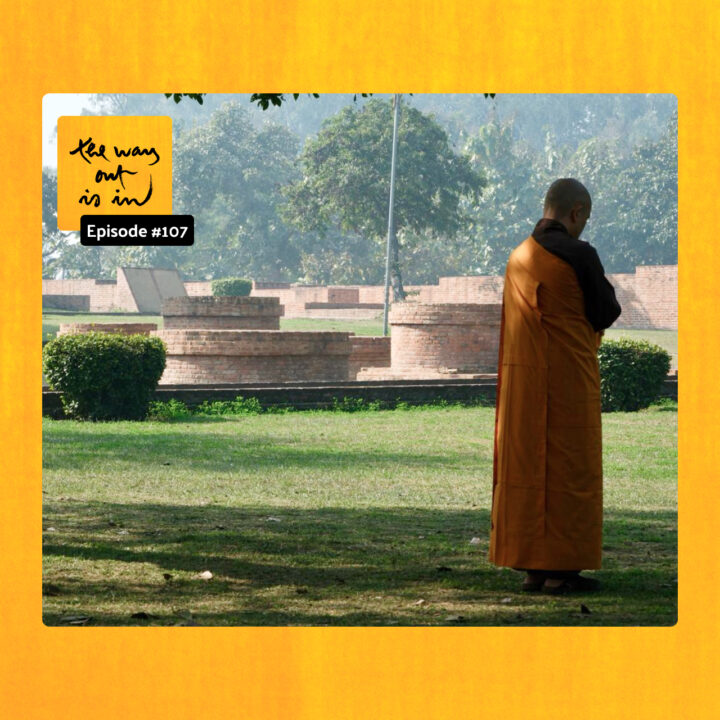






This week’s show was recorded using an improvised audio recording setup while the podcast team was on pilgrimage through India. Thank you for your understanding. 🙏
If you wish to support our podcast, please visit this link. Thank you!
Welcome to a new episode of The Way Out Is In: The Zen Art of Living, a podcast series mirroring Zen Master Thich Nhat Hanh’s deep teachings of Buddhist philosophy: a simple yet profound methodology for dealing with our suffering, and for creating more happiness and joy in our lives.
The final in a series of six episodes recorded during the In the Footsteps of the Buddha pilgrimage, this instalment was made in Sravasti, India, in February 2026. In it, leadership coach Jo Confino is joined by Zen Buddhist nun Sister Tam Muoi and Dharma teacher Shantum Seth to share their experiences and reflections as they visit Sravasti and Jeta Grove. They discuss the power of community, and how the sangha held space for grief when co-host Brother Phap Huu received news of his father’s passing.
They further explore themes of impermanence, non-attachment, transformation, the balance between the ultimate and historical dimensions in Buddhist teachings, and the importance of insight and practice. All three share personal stories illustrating these themes and the ways the pilgrimage has deepened their understanding of and connection to the Buddha’s legacy.
The episode concludes with the group singing a song composed by a fellow pilgrim, capturing the essence of the ‘way out is in’ teachings.
About the pilgrimage:
In 1988, Shantum Seth was invited by Thich Nhat Hanh (Thay) to organize a pilgrimage to the sacred sites associated with the Buddha’s life across India. Subsequently, Thay encouraged Shantum to continue guiding such journeys each year, offering pilgrimage itself as a mindfulness practice – one that the Buddha had suggested.
Shantum has been leading these transformative journeys ever since, offering people from around the world the opportunity to follow In the Footsteps of the Buddha with awareness and insight. After 15 years at the United Nations, Shantum left to volunteer with the Ahimsa Trust, which represents Thay’s work in India and promotes the practice of “peace in oneself and peace in the world”.
Through Buddhapath, his expression of Right Livelihood, Shantum continues to guide pilgrimages and share the wisdom and culture of the places he visits in India and across Buddhist Asia, cultivating community through these deeply meaningful journeys.
To learn more about upcoming pilgrimages, visit www.buddhapath.com, or follow Shantum on Facebook and Instagram at @eleven_directions.
Shantum Seth, an ordained Dharmacharya (Dharma teacher) in the Buddhist Mindfulness lineage of Zen Master Thich Nhat Hanh, teaches in India and across the world. A co-founder of Ahimsa Trust, he has been a student of Thich Nhat Hanh’s teachings for the past 35 years, and, since 1988, has led pilgrimages and other multi-faith, educational, cultural, spiritual, and transformative journeys across diverse regions of India and Asia.
He is actively involved in educational, social, and ecological programmes, including work on cultivating mindfulness in society, including with educators, the Indian Central Reserve Police Force, and the corporate sector. Across various Indian sanghas, Dharmacharya Shantum is the primary teacher of different practices of mindfulness from Thich Nhat Hanh’s tradition.
Sister Tam Muoi (Sister Samadhi) is from the UK and was ordained in 2012, becoming a Dharma teacher in 2022. Having encountered the practice whilst living in France, she became engaged in the French lay sangha and was ordained into the Order of Interbeing in 2004. She is actively supporting the recently created Being Peace Practice Centre in the UK and is deeply committed to the work of healing ancestral harm, and to participation in trainings and retreats exploring White Awareness. Read more here.
Co-produced by the Plum Village App:
https://plumvillage.app/
And Global Optimism:
https://globaloptimism.com/
With support from the Thich Nhat Hanh Foundation:
https://thichnhathanhfoundation.org/
Recordist: Ann Nguyen
https://ann.earth
Sound editor: Joe Holtaway
https://joeholtaway.com
Publisher: Anca Rusu
Producer: Clay Carnill
https://claycarnill.com
Executive Producer: Catalin Zorzini
List of resources
Interbeing
https://en.wikipedia.org/wiki/Interbeing
Plum Village Tradition
https://en.wikipedia.org/wiki/Plum_Village_Tradition
Jeta Grove
https://en.wikipedia.org/wiki/Jetavana
Mangala Sutta
https://en.wikipedia.org/wiki/Ma%E1%B9%85gala_Sutta
Avalokiteshvara
https://en.wikipedia.org/wiki/Avalokite%C5%9Bvara
Song: ‘No Coming, No Going’
https://plumvillage.org/library/songs/no-coming-no-going-song
Anathapindika
https://en.wikipedia.org/wiki/Anathapindika
Anuruddha
https://en.wikipedia.org/wiki/Anuruddha
Tathagata
https://en.wikipedia.org/wiki/Tath%C4%81gata
Shravasti
https://en.wikipedia.org/wiki/Shravasti
Sarnath
https://en.wikipedia.org/wiki/Sarnath
Kushinagar
https://en.wikipedia.org/wiki/Kushinagar
Dharma Talks: ‘The Noble Eightfold Path’
https://plumvillage.org/library/dharma-talks/the-noble-eightfold-path
Anapanasati Sutta
https://en.wikipedia.org/wiki/%C4%80n%C4%81p%C4%81nasati_Sutta
Angulimala
https://en.wikipedia.org/wiki/A%E1%B9%85gulim%C4%81la
Dharma Talks: ‘Redefining the Four Noble Truths’
https://plumvillage.org/library/dharma-talks/redefining-the-four-noble-truths
Poem: ‘Please Call Me by My True Names’
https://www.parallax.org/mindfulnessbell/article/poem-please-call-me-by-my-true-names
Laurie Anderson
https://laurieanderson.com/
Quotes
“Some non-attachments are more painful than others.”
“Thay talked about the fact that we allow 20% attachment; that we need to recognize we’re living in this life. And that we need to honor our feelings and our emotions in the historical dimension, whilst also in the ultimate dimension.”
“We can have joy and sadness at the same time. They do not cancel each other out.”
“We can have a moment of happiness and a moment of deep sadness, and we can contain both emotions at the same time.”
“Because of the years of practice, when the difficult time comes we’re able to meet it with a degree of equanimity and understanding and not be dragged into a vortex of despair and depression. We are able to meet the moment.”
“The matter of birth and death is as serious as if your turban is on fire.”
“The art of life is increasingly bringing the ultimate and historical dimensions together and recognizing that they inter-are.”
“Thay once said that what we practice in Plum Village is insight-based stress reduction or insight-based transformation. And what he meant was that once we’ve had an insight, everything is different. We cannot unlearn something that we’ve learned. And so all of our practice is about developing mindfulness, concentration, which leads to insight that is really understanding.”
“There’s no point practicing if we don’t generate some insights.”
“The insight is not there to be endlessly repeated, the insight is there to encourage us to practice. It’s like an anchor that helps us to stay put, and then we work at it.”
“Peace in oneself, peace in the world.”
“Happiness rests within oneself.”
“If I want transformation outside, I need to do it inside. And my general upbringing has been to shift outside things outside – not to ignore the injustices outside, but to have the presence and then the wisdom of the community to act in a skillful way.”
“In Zen circles we say that practicing with your family is the highest practice, the deepest Zen practice. That’s when you find out how you are doing. Because our parents know us as that stroppy teenager or that difficult child. We can’t float in as a spiritual practitioner; they can see straight through that.”
Dear friends, welcome to the sixth and final episode of this special series of the podcast The Way Out Is In.
I am Jo Confino. I'm a leadership coach and spiritual mentor working at the intersection of personal transformation and systems change.
And I am Sister Tam Muoi, Zen Buddhist nun, in the Thich Nhat Hanh tradition.
And I'm Shantum, a teacher in the tradition of Plum Village and organize retreats on wheels and pilgrimages in India and across Asia to the Buddhist sites.
We are on the final leg of our 14-day pilgrimage In the Footsteps of the Buddha. And we have arrived in Jeta Grove and Sravasti on the final day of our retreat on wheels. And dear listeners, we've got a rather extraordinary episode today because we had a day yesterday where the teachings collided with reality.
The way out is in.
Hello, dear listeners, I am Jo Confino and we were in Jeta Grove where the Buddha ordained many, many hundreds of monks and nuns. And we were there for a transmission of the five mindfulness trainings. So we have more than 50 participants who are joining us on this retreat and more than 20 of them decided to take the five mindfulness trainings which are the ethical heart of Buddhism and Thich Nhat Hanh's tradition, and we were sitting in Jeta Grove, and Brother Phap Huu, my partner in crime on this podcast, was performing the ceremony, and it was an extraordinary joyous moment because this is the heart of, in a sense, Thay's teaching was to spread the Dharma and to encourage other people to bring the teachings deep into their heart and into their lives. And we had just completed the ceremony. And it was a sort of everyone was happy. Brother Phap Huu and the other monastics had performed a beautiful job of chanting and the transmission when all of a sudden we got news that Brother Phat Huu's father was passing away and had had a major stroke in Vietnam and was on the point of passing. What was extraordinary was this sort of almost this moment of whiplash from a real celebration to great grief. And if you've been listening to this series, we just had an episode where we were talking about death and about the fact that death is certain, but the moment of it is unexpected and uncertain. And we had that very much of that sort of moment where Phap Huu had the shock of experiencing that moment. And it brought the teachings very much into the heart of reality because we were able to see, well, I was able to, and I'm sure all of us who were here were able to see the power of community of a moment where Phap Huu was in this midst of great grief and sudden grief was held within the community's heart. And where the sisters and brothers who were there also held this extraordinary space in which that grief could be felt within a sort of crucible, where it was, in a sort, a really loving crucible. And it also teaches us about the fact that while in the ultimate dimension we know that there's no birth and no death, that in the historical dimension, in terms of our everyday lives, there is death and we need to grieve. So there was this real collision of two realities of two dimensions. And sometimes people can use these teachings as a spiritual bypass by saying, ah, well, if there's no birth and no death, then there's just continuation and therefore we don't have to grieve. But there's a wonderful Zen story of a Zen master who is teaching his students about non-attachment. And all of a sudden, a young novice runs in with a note and hands it to the Zen master. And the Zen master bursts into tears, uncontrollable tears, and he's crying and crying. And the students are sitting there sort of in shock. And one of them eventually raises his hand and said, Master, master, why are you crying? And the master looks up and says, I've just had news that my son has died in a terrible accident, and then goes back to weeping. And after a while, the same student raised his hand and said, but master, master, you were just teaching us about the importance of non-attachment. And the Zen master looks and says that some non-attachments are more painful than others. And Thay talks about the fact that we allow 20% attachment, that we need to recognize we're living in this life. And that we need to honor our feelings and our emotions in the historical dimension, whilst also in the ultimate dimension. And also, there was a recognition and a teaching that I've learned very much from Plum Village that we can have joy and sadness at the same time. They do not cancel each other out. And Sister Tam Muoi, you were very much talking about this, that we can have a moment of happiness and a moment of deep sadness, and that we can contain both emotions at the same time. But sister, it would be good just to hear from, in a sense, from the monastic side. You know, there's a moment of shock, but then you so beautifully held the space, and we did chanting, and then Phap Huu had to go straight off to the airport to go to Vietnam. But just give us a sense of what was it like at that moment for you and how does the practice help us?
So in that moment, yesterday, I was sharing, giving a short Dharma talk, and then a sister came to kneel by the side of me, which in itself is unusual, and in two sentences she explained what had happened. And I think my first reaction is to stay very still, to not react, but to listen to what is happening in my body. So I stayed still and came back to my breathing, and then turned to the people listening, all our retreatants who are with us, as you say, 50 or 60 people. I was very aware that this news was going to reverberate in everybody and it was going to touch everybody in different ways and it's going to, we can even say trigger people in different way and it is very important to hold all that emotion that was going to come up. And so I delivered the news and I was very aware that we did not want everyone to start asking a million questions. Often when there is a difficult thing happens, people will start reacting on automatic pilot, wanting more information, in fact, many reactions which are actually to cover the feelings inside, and so I suppose what I was aware of was that let's come back to our breath, come back to our body, let's keep the silence so that we could all contain this emotion which was welling up amongst all of us. And I know that in Plum Village, when there are difficult moments we have a very skillful practice, which is to chant Namo'valo. It's a very beautiful chant, which is very soothing. It's the chant of compassion. It's to chant to Avalokiteshvara, the Bodhisattva of deep listening, listening to our own difficulty, but also allowing compassion to come up so we can offer ourselves compassion, compassion to the people around us. And compassion to everyone in the world. And so I was sitting next to Thay Phap Huu at that point, and I said, let's chant Namo. And he said, yeah, let us do that, knowing that also singing in itself is something that really soothes our nervous system, and this would help everyone, and that we would do something together. And so we chanted which held a lot of the emotion. Of course, I was brought back to thoughts about when my own father died. I was very lucky because I was staying with my parents at that time. It was during the COVID time and I was at home with my very elderly parents. And I remembered the morning when my father woke up with a rasp in his voice and we, by mobile phone, the doctor listened to my father's rasping voice and the doctor said, this means that the end is very near. And I felt very lucky to know that we knew that we only had a short time. And the nurse said, I said, how long do you think we have? Of course, not when my father was there, but in a separate room. And she said, it's a matter of hours. And I went into a bit the same mode as yesterday, of thinking these hours are going to be extremely important. They're the last hours with my father, and also I need to tell my mother so she can also appreciate these last hours with my father. There's an incredible sense of calm which comes over us in that situation. Yesterday we talked about the depictions in, just by the large statue of the Buddha lying down as he passed away, there are these three little statues depicting the reactions of people hearing about the Buddha's passing. And one was sitting with his head in his hands, very, very sad, grieving. There was another person beating the ground in grief and in refusal of accepting this news, and there was someone sitting in meditation still, coming back to themselves, taking care of all their emotions. And this is how we're trained, to come back to that still space, to notice the feelings inside and to soothe them, to take care of them with compassion. So that's what we practiced yesterday, and I think we practiced very well. Being a sangha was so much easier having the collective, all of us together. It's so hard to have this kind of news when you're alone. But to be together, to hold the energy, we all held hands and sang, No Coming, No Going. There was a lot of hugging. We practice hugging meditation where we just hold each other and breathe three times, recognizing the presence and the gratitude that we have for the presence of each of us and knowing that this is an extraordinary moment, that we're both alive now and we don't know for how long we will be able to journey together. Death comes unexpectedly.
And sister, it's also a reminder that the reason we practice is for these moments. I always remember in the story in ancient Egypt with the story of Joseph telling the Pharaoh that there were going to be seven good years and then seven years of famine. And so it was important in the good years to make enough, to store enough grain to help the country to survive the famine. And I sometimes feel the teachings are like that, is that often when they're good times, we think, ah, it's all fine, we don't need to practice. And then something difficult happens and we are unprepared. But what I spotted yesterday is it's because of the years of practice that when the difficult time comes that we're able to meet it with a degree of equanimity and understanding and in order to not get dragged into a vortex of despair and depression that we able to meet the moment. And that's true, of course, not just the death of a friend, but the death all sorts of things in life. Even the death our civilization one day is how do we meet these difficult moments with a degree of understanding, compassion, and agency. Shantum, we visited Shravasti yesterday and there was one of the great teachings around passing. And it would be great, maybe, before we move on to more joyful topics, just to share that teaching, because it just seems particularly relevant now.
Ironically, we heard the news of Brother Phap Huu's father's passing in the Anathapindika monastery in the Jeta Grove. And this is the land that was given by Anathapindika for the sangha to practice as a mindfulness practice center. And we've just been doing exactly that 2,600 years on. This land was given to the Buddha and the sangha in the four directions, in the present and the future. So I'm sure Anathpindika will be smiling. But there was a teaching given to Anathpindika himself when he was dying. I think that's the teaching you're referring to, where it's in the Plum Village chanting book. We call it the teachings given to the sick. It can be sometimes given, the teachings given to dying. And the Buddha sent Sariputra, his foremost disciple, to meet Anathapindika. He's heard that he's not well. And first, Sariputra asks Anathapindika, how are you doing? Is the pain getting better or worse? And Anathapindika says, the pain is getting worse. And then what Sariputra does very skillfully is touches the seeds of happiness in Anathapindika. He asked him to meditate on the Buddha, the Dharma, and the Sangha. And after many minutes, Anathapindika smiles. And then he goes into what is one of the deepest teachings we have on no birth and no death, where he starts with the sense organs, like the eyes, the ears, the nose. And he sort of does it like a guided meditation. Says, these eyes are not me. I'm not caught in these eyes. These ears are not me. I'm caught in these ears, and so on. And then, he goes to the six sense objects. This form is not me. I'm not caught in this form. These sounds are not me, I'm not caught these sounds. And then he goes to what is what we call the Six Sense Consciousnesses. Like the sight is not me. I'm not caught in the sight. Hearing is not me. I'm not caught in hearing. And these 18 factors really make up our sensorial experience. And then Sariputra moves, he moves into the different types of elements. The earth element is not me, I'm not caught in this earth element, this water element is not my, I am not caught as water element. So he goes into six elements. In India we also talk about the space and consciousness in Buddhist condition. And then he goes into the times, the past is not of me, and I'm caught in the past, I'm not caught in the present, in the future. And this way, and he also goes into what we call the five aggregates, the feelings, the perceptions, the mental formations, the consciousness. And each of them, he keeps saying, it is not me. And what does that mean? It is not me. And what he's saying is that things manifest because of cause and conditions. That's not a thing like a soul, like identifiable, intrinsic entity. And because of different types of cause in conditions, things come to be. And this is what the Buddha has been teaching for many, many years. And at the end of the meditation, Anathapindika starts crying. And Ananda, who's there, says, Anathapindika, has this meditation not been successful? And Anathapindika says, no, no. It has been very successful. This is what, this is, but you know, I've been teaching, I've be, I have been serving the Buddha and the community more than 30 years, but I've never heard such wonderful teachings. And Sariputra then says, you know, the Buddha teaches this to us monks every day. These teachings of no birth and no death. And then Anathapindika says, you know, there are some of us lay people who are very busy and then not be able to have the time to grasp these teachings. But there's some of us who have a little time and a little ability to grasp his teachings, which are so precious. So please go and tell the Buddha that he should share these teachings with lay people. And then he closes his eyes and passes away. And this is what, when we spoke in Sarnath, at the first turning of the wheel, and we start with the right view on the eight-fold path, this is right view. And when people say, what is ignorance? It is the ignorance of being contaminated in our mind with the idea of me and I. Now, of course, theoretically, we understand this, and it is the practice that really has to be imbibed every day. And that's why, when Thay told me many years ago, when you're going up to Vulture Peak, he said the matter of birth and death is as serious as your turban is on fire. And so this is a practice we have to do every day. And this is the practice which the Buddha suggested in the five remembrances of being old and sick and dying every day, and also losing people who are close to us. So I think this is crux of our Buddha Dharma practice. And I feel that to receive the news of Thay Phap Huu's father's passing at the Jeta Grove it was very, very poignant. Because immediately, they realized that all human beings, whether it was 2,600 years ago or now, we are all of the same nature. And can we then, somebody in the afternoon when all of us were sharing, and we were saying… There was a lot of grief, a collective grief. And the first thing actually, that Brother Phap Huu said to me when I was called in, and he was shaking, he was trembling. He said, I'm so glad I have the sangha. And then somebody in our group asked, you know, we often honor ancestors, but what about children who died? What do we do then? And there was a tree we could see just away. And I said, you look at the leaf of that tree, and that leaf falls. First we think the leaf is the child of the tree, and then the leaf becomes the parent of the tree in the terms of the compost. So there's no separation between what we think of as ancestors or descendants, and that's when this teaching goes into that there's, you're not getting caught in time of past, present, and future, which is something, again, we get very much caught on this idea of linear time. So I'm also very glad that we could then get Brother Phap Huu, I mean, within a few hours to land back in Vietnam, and he's now back in Vietnam within a few hours thanks to cars, planes, and again, I would say the sangha. Whether it's the visa or whether it was the airplane tickets or transiting from one airport to another. So there's both the deep teachings and the imbibing of teachings, but to do it with the sangha and with the, as Sister Tam Muoi says, you know, with that attentive responsiveness rather than the reactivity. And I was reminded actually when Sister Tam Muoi was saying that all three images below the Buddha's reclining Buddha, which you saw in Kushinagar where he passed away, and I was remind of Anuruddha. Anuruddha was the monk who was actually also from, who was a cousin, and he's the one meditating. And he received these very deep teachings from the Buddha a long time ago because somebody asked him, you know, will the Tathagata, will the Buddha exist after he passes away? Will he not exist after he passes away? Will they both exist and not exist after he passed away? Will he neither exist or not exist after he pass away? This is our Indian philosophy, philosophical way of asking. And then he said, I don't know, and then he talks to Buddha, and the Buddha said, I'm sitting right in front of you. Can you see me in form? Can you define me in feelings? Can you find me in mental formations? He said, I cannot define you, because we are always in constant change. He said then, what are you looking for me afterwards? If you cannot find me right now, because I'm always in flux. So just we manifest because of conditions and we manifest into other forms because of conditions.
And it's important to be very human and to grieve. So my father passed away when I was 24, and it took me 10 years to grieve him. And what I recognize is that when we don't grieve, then we hold it in and we constrain ourselves. And I remember what helped me to grive was 10 years when I walking in a park with my mother at Christmas. And all the trees were bare in this park. But there was one tree, and it had one leaf on. And my mother said, you know, it's really important for that leaf to let go. Because if we don't let go, then we're not fulfilling what needs to be done. And also, when the leaf falls, not only are we letting go ourselves, but we're letting the person go. We're letting their journey continue. I also remember one of the senior sisters in Lower Hamlet, Sister Hero. She lost her sister and she went to America for the burial, the cremation. And when she came back, she said a few of the sisters were saying, ah, sister, you know, don't worry, your sister continues in you. And I remember, or as Sister Hero said, she growled at them, and she said, don't get all ultimate on me. And so I find these teachings so much as a balance between the reality of our everyday experiences and our understanding of the depths of these teachings. And in a sense, Thich Nhat Hanh's, one of his core teachings was he used to draw a line between, a sort of diagonal line between the ultimate and historical dimension, and he called it the sort of the Zed of Zorro. And he said that the art of life is increasingly bringing the ultimate and historical dimensions together and recognizing that they inter-are as well. So we recognize no birth and no death, and also we need to grieve death. And it's such a sort of powerful teaching of how we do the two. And dear listeners, Phap Huu gives so much in his life. He's in such service, and also through these podcasts, he offers us the teachings in such a loving and approachable and committed way. So even though you will be listening to this episode several weeks after his father's passing, grieving takes time. So it would be lovely if all of us can together, as we listen to this episode of Phap Huu are understanding our love, to give him a moment where we can offer him a little bit of all that he offers us. So, Shantum, we traveled to Jeta Grove and to Shravasti and it would be good just to give us a little bit more flavor of these places because coming on this pilgrimage, what we're doing in the footsteps of the Buddha and so it's really good for our listeners who are not on this journey just give them a flavor so they can feel that they are joining us. Just about the importance of Jeta Grove. And just why, because one of the things I think a lot of people felt was that when they entered Jeta Grove, they felt it was like entering Plum Village. It's like, it's like it still had the energetic feeling of a place of veneration. And I'm always intrigued by that because there's some places you can go to that are historical, but they just feel like buildings or parks. But Jeta Grove just felt different for a lot of people. You walk in, just like Plum Village, and you feel you've entered a sort of different space all together where it felt peaceful, it felt grounded and calm. And I don't know if I was just sort of making that up, but it was a general feeling amongst all of us pilgrims. So it would be good, just give us a flavor. How important is Jeta Grove? And is it fair to recognize that this is a place that is still humming with the energy of the Buddha?
I feel that energy too whenever I go to the Jeta Grove, to Shravasti. Of course I know that the Buddha was there 2,600 years ago, but he did spend more time here than anywhere else. He spent 18 rain retreats in the Jeta Grove, another six at a monastery called the East Grove Monastery, not far from the Jeta Grove. So 24 rain retreats from the. 20th year of his teachings till the 44th year, the year before he passed away. So every year, if anybody wanted to come to study with the Buddha, they would come for the rain retreats here, the three or four months that everyone knew that the Buddha would be here. So it's a little like Plum Village. When you want to go and you knew that Thay was there, you went there, or the winter retreat or the family retreat. So I think in that sense, as I said also, it was bought for the community as a practice center. And I think it's kept that energy. Of course, in history, it pretty much went into oblivion for a while. It was rediscovered by the archeologists, meaning the British archeologists. But the trees, the well, and also the energy of other people coming there, I always find people, it's a large park, and people find their own space to just go and sit and do chanting. There's of course the tree, an old tree there, which they say was planted in the Buddha's time. That is not so, but the Bodhi tree is always representing the Buddha. And so Ananda had asked the Buddha when, at one point, when you're not here, people come to pay respects to you, what should they do? And the Buddha said, plant a Bodhi tree. And that Bodhi tree is, there's a Bodhi tree that people go to, there are two huts or two spaces which we know the Buddha would have stayed in called the Fragrant Hut and the Kosambakuti where he would have met people. So there's a walking meditation path between the two. So it's very real that you're walking exactly in the footsteps of the Buddha. And for our transmission, we sat under the Bodhi tree. And. I also feel that some of the key teachings are given there in the Jeta Grove and in Sravasti. I mean the teachings on the full awareness of breathing, the Anapanasati Sutta, you know, ana is in-breath, pana is out-breath, Anapana. And this was given to, in fact the Buddha actually said, I'll give this teaching a month from now, so anybody who wants to come in here they can. He didn't say what the teaching was, he said I'll extend. And if you look at the sutra, all the main characters were all there. It was a very, very important teaching. And when Thay heard this teaching, he said, this is one of the most happy days of my life. Because he said this is the path of not just understanding of body and our feelings and our mind, but it's also both the way of calming our mind but also awakening, just these 16 methods of breathing. And that was given here. As I said, the teachings given to the sick, the later, Mahayana Sutra, the Diamond Sutra. A sutra called the sutra given to the white-clad disciples, which are the lay people. So like this, the Sutras on happiness, the Mahamangala Sutra. So when you go there, you get that energy and then people chant these sutras. So I really feel like this is a place of practice and there's not that razzmatazz of Bodh Gaya, for example, which has its own energy. But as you mentioned once, you know, it was a discordant initially. Until you accept it as it is. Here it's easy to just walk into that space, listen to the rustle of the leaves, listen the birds, and listen to this sort of chanting of another Korean group or Thai group somewhere, far away. So for me, again, this is a place which reminds me of the Buddha's teachings, and the Buddha very much. And then we go to the old city which is close by, and we realize how much of the drama of the Buddha's life was taking place, and there was just a vibrant city which he was interacting with at the same time.
Thank you, Shantum. So I worked at the Guardian newspaper for more than 20 years. And when I was there, it was approaching its 200th anniversary, not 2,600th, but 200th anniversary. And I recognized, I felt that the energy of the person who founded the Guardian was still present in the Guardian in the present moment. So even though nearly 200 years had passed that there was like a gossamer thread that traveled throughout time. So even though many generations of journalists had come and go, many editors had come and go that the original intent was still present in the organization and was not dependent on each individual who joined, but that it had a hold that could not be sort of torn away. And so, sister, in that vein, for you, being a nun in this uninterrupted transmission of the Buddha, I just want to know what it felt like for you to be in Jeta Grove. And I know you've been on the pilgrimage, as we've discussed in a previous episode as a lay practitioner, but now you've come back as a nun. What did it feel like to be present where the Buddha taught? To be part of the transmission to the lay practitioners of the five mindfulness trainings? To just to be present, literally as we keep saying, in the footsteps of the Buddha?
As you said, the Jeta Grove is a very special place and I have gratitude to the Indian government because they have left this place as a huge park, it's very spacious, it is nature and there are no statues and neon lights and loudspeakers. We enter into a natural place with the trees, foresty area, the birds singing, not just one bodhi tree, but many bodhi trees. And that is always so inspiring. I think that's why it feels like Plum Village. When we arrive in Plum Village we walk onto the site and immediately we feel like we're in a very special place, a place where there's so much love and quiet and wholesome energy. And this was the same as Jeta Grove. And what I really enjoyed as we did slow walking meditation as a whole community, walking onto the site and finding a quiet place for our transmission ceremony, we found a place under a bodhi tree and Thay Phap Huu said, wonderful, this bodhi tree will be our altar. So when we did the transmission, we were all, the whole community, 60 of us were sitting under the shade of the bodhi tree and when we offered incense, we put the lighted incense at the foot of the bodhi tree. And so that bodhi tree was really holding all of us. It was very, very beautiful, very inspiring. And we know that at the time of the Buddha, they would have done the same. They didn't have a meditation hall. They would also all be sitting under the trees. And I remember sometimes Thay would do the same thing in Plum Village, particularly one time in Lower Hamlet when the meditation hall was being built. So suddenly we didn't have a hall. And so Thay said, right, we'll do the the same as at the time of the Buddha. We will have our Dharma talk under the oak trees. In Lower Hamlet we have a couple of enormous oak trees that give a lot of shade, they're very, very wide branches. And so Thay sat under the oak tree and the whole community, hundreds of us, sat on the ground under the tree. And we also did that once in, or maybe several times, in Upper Hamlet, under the four pines that Thay had planted. Thay was so happy to do that because he would say, this is just like in the time of the Buddha. And so I really felt that yesterday. And it was so meaningful to transmit the five mindfulness trainings to many of our friends because that is creating this unbroken transmission from the time of the Buddha to our present day. Unbroken transmission from teacher to disciple, teacher to student. And that is so beautiful. So it was a very inspiring moment yesterday morning.
Thank you, dear sister. So I want to talk about transformation because I think most of us who come into the practice want to transform something and often we feel that it's very, very difficult. We sometimes have a deep pain or suffering or feel we've done something in the past that that is difficult to forgive or that we find it difficult to forgive others and this can cause immense pain and suffering throughout our lives if we are not able to transform it. The purpose of the practice is to come deeply inside of ourselves to find forgiveness, to find understanding, to find love, to find a path that will take us out of our suffering, that's why the Buddha taught the Four Noble Truths. Suffering, the causes of suffering, there is a way out of suffering and there's a path to that.
So, Shantum, I want to come back to you because one of my favorite stories, and I can never pronounce the names, so I'm not even going to try, but is how the Buddha transformed a very difficult man who liked to chop off people's thumbs for a living. And the reason I love the sutra is because it shows that even if you've lived a life where you have caused immense suffering, that it is possible to change. And also, I think this sutra shows the Buddha's courage to face into the most difficult of situations, and also his enormous compassion that even though great wrong had been done, that the Buddha was able to look far beyond that. But I'll stop there because you are our historian on wheels. So it would be lovely if you just tell this story, but in the context also of our own lives. You know, the great thing about the sutras were they were not just stories, they were teachings, they were there to help us through these stories to understand and to connect to the teachings.
So Jo, you were referring to ungli mala or Angulimala. Ungli means the finger or thumb. And this man used to cut the finger or the thumb of his victims. I don't think he enjoyed it. I think it was a sort of practice that he'd been given by his teacher. It was like a tantric cult. And also, some people say that he'd been accused of having an affair with his teacher's wife, and this was a punishment that had been given by his teacher. So I think it was something that he was doing, but he was also a very skillful highway robber. And so the name Sravasti also means the place where everything was abundant, and this was at a crossroads of a trade route. And so the caravans would come from the Northwest, some going further East, some going further South. So it is good pickings for a highway robber. But he'd been told that he should have, I can't remember whether it was 100 fingers or 1,000 fingers, as a garland. So that's why Angulimala means the finger garland, the finger mala. And he used to tie them and put them around his neck as a cord. So it's said that he was waiting for his 100th victim. And at that time, the Buddha was doing walking meditation on his alms round. And people warned the Buddha, said, you know, Angulimala is there, please don't go out. And he said, no, I have to go for my alms round, that's my practice. And he's walking. And then he hears somebody behind him saying, stop, stop. And he just keeps walking slowly in his walking meditation style. And then Angulimala runs up and sort of catches up to him and says, stop. I told you to stop. Why didn't you stop? And the Buddha just turned and looked at him with deep eyes of compassion and said, I've stopped. I stopped a long time ago. It's you who haven't stopped. And Angulimala is unnerved by this, not just compassion, but just sort of response. And he says, what do you mean, what you mean? And then the Buddha says, you know, I've stopped doing unskillful things, and you've been creating a lot of havoc, and you have been doing things which are not skillful at all. And Angulimala sort of just goes off the ground, because I think it's just the energy of the Buddha, the compassionate energy of Buddha when speaking. And he said, I've done so many things. How can I stop? And he says, all you need to do is just turn around. And you can start doing good things. Just look the other way. And then he said I've so many bad things. Who's going to forgive me? What's going happen? And human beings don't like me. And he say, no, there are some people who are practicing that we know that we all have our seeds of violence within us, and they're not expressing them, they're trying to transform them. And they're the monks in the Jeta Grove who are going to meet them. And he says, how can I, and he says you can become, and he said, can I become a monk? Can I become part of that community? And the Buddha there and then ordains him, and then he goes and stays with the group in the Jeta Grove. And he's given the name Ahimsaka, the one who does not harm. And he practices very ardently, and it is said that this monk, when he goes out on alms around people, recognize him, they throw stones at him, they break his bowl, but he just responds without any anger, without any violent response. And the Buddha says, yes, you're reaping the karma, reaping results of your actions. And he then becomes an example of one of the most non-violent monks. And why this is such an important story on transformation is that we realize that everyone, even the most hardened terrorists, some we call them the Buddha and the terrorist, has the seeds of transformational ability and that we can with the right sort of conditions help anyone come back onto a path of ethical conduct, of love, and so they can touch that love in themselves. And many of these people do these things out of deep suffering and alienation and trauma, and this finding a loving community, finding a loving teacher, finding a path of practice allows them to transform fundamentally. And I really feel that is available to each and every human being, and if we can look at people with those eyes and know that that seed of transformation is available, So, you know, the transformation is even more poignant. And that's why when Thay talks about the mud and the lotus, if the mud is really, really, you know, what we call kichar, like really bad mud, the transformation also is phenomenal if you can work with it. So we work with little bits of mud and that's how it helps us in our practice. But still, as we go deeper, sometimes we find that the mud is even mucky and then… But if we practice with little bits, then we know how to handle the more mucky bits and the deeper mucky bit. And then we always revert to the sangha because we know that is really our refuge to help each other. And it's interesting because this monk is then walking back from his alms round one day and he hears the cries of a woman in the forest and he finds that she's in labour and not being able to give birth. And he rushes back to Jeta Grove and tells the Buddha, this is what's happening. And the Buddha says, go back to her and say that with the merit of your harmless life, with the merits of your ethical life, she will give a good birth. And he says, how can I? I've done so many horrible things in my life. And he said, no, since she's been reborn into a monkhood, into this path of practice, that merit will help her. And that is what the story is. That how he goes back and offers that sort of transmission to this woman. And there's one more story about Angulimala just while we're on this. Because the king then, a short while later, is on his horse going out of town trying to… And the Buddha, he passed the Buddha and says, Buddha, where are you going? And he says, well, I've decided to really lead the pack to get rid of Angulimala once and for all. Because nobody knows that he's actually become, I mean, the king doesn't know that he's become a monk. And then the Buddha says that if he stops violent action and if he takes a path of peace, what do you do? He said, well, it's impossible. And then, the Buddha said, you see that person behind me? That is Angulimala. And then he says, OK, so what is your father's name, your mother's name? And he refers to him in that name. And then says that, oh, he bows to Angulimala and says, can I offer you something? Do you need a shelter, do you need food? And he says, no, I have my alms bowl. I have the tree in the Jeta Grove. I have more than enough. And then the king says to the Buddha, he says I have so much power, but I am not able to transform people like this. But you with your kind words and your teachings, you are able to shift people. And so people pay much more respect to you than to me, even though I am the great powerful king of this area. So that is a secular king who was a very good friend of the Buddha and they had many, many discussions and if you have time, we can talk about those but they had a really good relationship and they were about the same age when they met. They were about 39 years old and he lived a full life till he was about 76 so they had interesting discussions all through lives.
Thank you, Shantum. And Sister Tam Muoi, I want to talk, ask you about transformation, because Shantum talked about the Buddha just said, stop. And it reminds me, as you said that, Shantum, of I attended a weekend workshop with a self-development group I was working with. And that particular weekend, there was someone who had a gambling addiction. And he took up a lot of the facilitators time. And the facilitator gave him many, many hours over those three days to help him process his addiction. And then on the last morning, in the last few minutes, the facilitators was, in a sense, closing, having the closing ceremony, bringing all that we'd learnt into a sort of synthesis. And this man put up his hand, and the facilitator said, here we go again, said, you know, yes. And the man said, I'm really worried because we're about to leave and I'm really concerned that I will just go straight to a betting shop and gamble on the horses. What should I do? And the facilitator just turned to him and just said, stop. And that sense of, you know, trying to shake him awake, saying actually you have the capacity to stop, in a sense that is what you're saying the Buddha said it wasn't like this gentle, well let's sit down and let's talk about all your wrongdoings and let us process them. He just sort of in a sense shocked him out of his, out of his bad habit. And so sister, I'd love to ask you about, you know, your sense of maybe your own transformation or maybe what you see in Plum Village over the many thousands of people who come wishing to transform. Because there's sometimes the need for a gentle approach and sometimes there's a need for the Zen sword. And Thich Nhat Hanh himself, Phap Huu has talked about this, that sometimes when monastics were not practicing well or there was a problem that Thay would have different approaches that there were some people where they needed gentle encouragement, just to say, you're doing great, but you can do this. And there were some where he brought the sword out and said, cut it out, because you're just not taking the action you can do and you're just sort of sitting back. I'd love to hear your sense of, when do we need to be gentle? When is it just about saying, 'you have the power, just stop'?
Thay once said that what we practice in Plum Village is insight-based stress reduction or insight-based transformation. And what he meant by that was that once we've had an insight, everything is different. We cannot unlearn something that we've learned. And so all of our practice is about developing mindfulness, concentration, which leads to insight that is really understanding. In fact, it's more than understanding. We understand with our head, but it comes down into our body, kind of down into, into our guts, we can say. It really, it becomes embodied. It can be quite frightening. I know in my own life, there have been maybe seven or eight times when I've suddenly woken up to something and it just brings up the hair on the back of your neck and you go cold and you think, oh my goodness, and it can be something so simple, but you've got it. The penny has dropped. And that touching insight, that is what gives the power and the motivation to do something differently. Instead of always going down the same road that we've always gone down, we wake up at that moment when we realize that this challenge that comes regularly in our lives, we wake up in that moment and think, oh, shall I react in the same old way that I every single time, or this time, shall I do something different? This reminds me, actually, of one of those wake-up times I had with my mum. Our mums are great teachers for many of us. And I was still a lay practitioner at that time. I went home to visit my mum, already I realized that going to visit our parents, in fact, in Zen circles we say that going to visit your parents, going to your family, practicing with your family is the highest practice, it's the deepest Zen practice. That's when you find out how are you doing. Because our parents, they know us as that stroppy teenager or that difficult child. We can't kind of float in as a spiritual practitioner that they can see straight through that. So anyway, I was going home to visit my parents and already I told myself, right, this is going to be different this time, because, frankly, it was very difficult for me to even be in the same room as my mother. I was so triggered. I decided that this was going to be a going home to spend time with my parents' retreat. And so even as I walked from the station to my parents home, I practiced walking meditation. As I put my hand on the door handle to open the door, I came back to my breathing and I thought, this is my going home retreat, I'm going to be really mindful of everything. To notice the kind of patterns that click in the moment that we're with our parents, like with my mom, I'm no longer like a practitioner and another human being, but I'm daughter and mother, and all those patterns come up. And so there was this moment when we were both doing the washing up together, she was at the sink, I was standing next to her, and I noticed that my mother's mood was changing. Which was something that would happen a lot. She was starting to go down, her mood was going down, and when my mother would start feeling depressed, she would just start cutting off, just cut off from everyone. As a child it's terrifying to see your mom's no longer there, there's no presence, she's disappeared. It's, it's terrifying. And as we stood at the sink, I could feel this was happening. And my stomach was just… came into a knot, and all I wanted to do was get me out of here. I would have run. But the practitioner came up in me and I thought, no, I'm going to do something different. And so I came back to my body. I felt my two feet on the ground. I just put my, put everything down, just came back into my breathing and said to my mum, Are you feeling angry? Are you feel sad? And she turned to look at me and said, yes, I'm really angry. And then she started to explain what had happened. And in fact, in the space of five or 10 minutes, she explained what had been difficult for her. And I just listened. And we moved through it. And after 10 minutes everything was fine. And I couldn't believe it. I even gave myself a little pat on my shoulder and said well done, well done. You did it! Success! It was the first time that I'd moved through that triggering difficult moment and also I felt how wonderful for my mum. My mum just doesn't have a vocabulary to talk about her emotions. When something was difficult for her, it must have been terrifying for her. She knew she would slide down into this place of darkness and could not come out. But all I had to do was say, tell me about it. I'll listen. And we got through it together. And that was, wow, that was such an insight and such a transformation in our relationship. So that's one example. And I wanted to tell another story, actually, from the Buddha that Thay would often tell this story. Every time he told this story, I would just sit there in the audience just crying and crying. I mean, just crying an ocean of tears. And it was a story about a family where, let me think, how does it go? It was to do with the father went away and there was a fire in the village and the hut where the family lived burned down. And when the father came back, he found the charred remains of a child by the hut. And he assumed that this was his son. And he was just insane with grief. And when he cremated that child, he took the ashes and carried them in a little pouch around his neck, and he could never get over his grief. It was just all consuming. But one night, years and years later, there was a knock at the door. And in fact, this child had managed to escape and had been kidnapped by the criminals who'd burned down the village. And he'd grown up with these criminals and he managed to escaped and he came back to his family home and he knocked at the doors. And he wanted to see his father and the father heard the knock at door. But he thought it was someone teasing him and he said, go away, go away. And the child, well the grown-up now man, knocked at the door but the father said, go away go away and that poor son had to just walk away. I would just cry and cry and cry. And I think what was activated in me was that here was a chance for transformation, but that father, he couldn't meet that opportunity. And that is such a terrible story. I think all of us, well, maybe not all of this, many of us, we have the luck to meet a teacher, to meet the practice, to be able to transform. But some of us we're just not able to. Maybe we've put some kind of strategy in place to protect our pain, our wounds are so painful. That we hang on to our suffering, we are attached to our suffering, and we feel we prefer to hang on to that suffering rather than take the risk of transforming and turning towards a place of not knowing, will I be able to transform my suffering? And so those people, we have so much compassion for them. Luckily, many come to Plum Village. And we see so much transformation because of the conditions in Plum Village, the opportunity we give to people to hear the practice, to listen to the Dharma, to have that conversation, to sit with that sister or brother and to be heard, to be held by the Sangha, to be vulnerable so that they can touch this place of non-fear. They can borrow the non-fear of the monastics. They can touch the courage to go to this place of facing their wounds and knowing that it's possible to transform, to have that courage. Thay would always say, we need a lot of courage to practice.
Thank you, sister. And there's such a deep pattern and people are not aware of their patterns of protection and they're very deep and they hold people back in such profound ways and one of the deepest patterns I have ever seen is the revenge of a child against their parents, that if the child feels their parents have done them wrong, that they self-sabotage their life because they need to prove that their parents have ruined their life. And I've seen occasions where even many years after the parents have died, that that person is still, would rather still punish themselves to prove that their parents had ruined their lives rather than transform their lives. And these are not conscious patterns. And I think, first of all, we need to become conscious of them. And I think, Shantum, this comes back to what you say about sometimes we have to be shocked out of some… We have to have a real shock to our system to break out that pattern. And some people, it's only on their deathbed that they may suddenly recognize something in their life. And I think the beauty of this practice is it's better not to wait till your deathbed, till the moment of your death to have an insight, but to hold it, have it quicker and quicker in the sense of then we can have a good life for ourselves and also benefit others.
So Jo, you were asking about different kinds of medicine for different people. It's not at all the same recipe for everyone. And Thay, like the Buddha, was so skilled at knowing the right medicine for different people. And often the Buddha was a likened to being a doctor, that he would be able to diagnose the difficulty and would know the right treatment to give. And for some people, it's compassion. For some people sometimes we can say that we as students who are suffering, we can be like a wild horse. And so Thay would say, I need to give you a very large field so that you can run around and have a lot of space. But there are some people that need to have maybe a rope around the neck and they need to be held quite tightly. And for some people, they need fierce compassion. And rather like, we know that when people have strong, addictive behavior, it can be the worst thing to keep giving them the drugs through pity and compassion. Sometimes we just have to cut it off and just refuse, which is so hard, it's causing a lot of pain to the person who is suffering, but in fact, that is the strong medicine that they need. And Thay would know how to do that. He would be the iron fist in the velvet glove. He could really be very, very hard with some of the monastics, even to the point of sometimes saying that that monastic has to leave the community. They cannot remain a monastic because they are unable to transform and they are actually spreading their difficulty and their, sometimes, toxic energy within the sangha. That was very, very rare, but this had happened and so there are many different medicines according to the suffering. And then, of course, that person has to be capable of taking the medicine. There is a very beautiful Zen story about someone who is sick, and they go to the doctor, and they receive the prescription, and they're so happy, they've been told what medicine to take, and so they go home, and the put the prescription up on the mantelpiece, and they sit and look at it, and say, yes, right, now I'm going to heal. But of course nothing happens. And so they go back to the doctor and say, I'm not getting better. And they say, well, did you take the medicine? Oh, no, I just put the prescription on the mantelpiece. And they say, you've got to eat that medicine. And so the patient goes home and he takes the prescription and he eats the prescription. Nothing happens, no transformation. So he goes back to the doctor again. Nothing's happening. He said, did you eat it? Yes, I ate it. I ate the prescription He said, no, it's the medicine you have to take. And so finally he took the medicine and he healed. So we have to be skillful.
I think Thay described Plum Village as an insight generator, because actually, there's no point practicing if we don't generate some insights. And I just want to pick up one thing you said, sister, about there's something about when you have a deep insight, it cuts through, as he said, all your defense, all one's defenses, it's like it cuts through the ego and it's just a bit worth reiterating. We are so defended. I was like, I like Star Trek and it was like sort of, you know, the USS Enterprise where sort of all shields are up and so nothing can come in because we're trying to protect ourselves from any hurt. But when we let our defenses down, or when an insight finds its way through that protection, it's like it touches us so deeply that we know it to be true and it's like it's very difficult to describe it in words but it's just, we just know it to be true. And once we know it to be true it can become unshakable and it can get covered. I feel it's a bit like sometimes when you have a channel of water and it has got silted up and you come away and you dredge out all the silt and it is like the channel then opens up and the water can flow through. And when it flows through, it's like such a relief. Oh man, it is such a relieve to say, ah, I can feel that flow. But then also, the water silts up again. And so, some people sort of think that in life, having an insight is enough. I've had the insight, I've taken the ayahuasca, I've seen the heavens open, I'm free. But the practice is that actually without the practice, it will sort up again. And then you might turn around a few years later and say, oh, what happened? And even the Dalai Lama talks about the fact that if you have a spiritual awakening, let it go. Don't hold onto it because it's like there's a part of us that wants to grasp onto it and relive it. And then we can spend years and years trying to recreate that same experience. And I recently interviewed Laurie Anderson, the artist, and she said she had an opening very early on and she spent years looking to repeat that opening, and it didn't come. So the opening is, the insight is not there to be endlessly repeated, the insight is there to encourage us to practice, but it's like an anchor that helps us to stay put, and then we work at it. Shantum, let's have a transformational moment from you. Can you give us a moment in your life where an experience like that, where you just had an opening where you recognize something that was so deep that it became an unshakable foundation in your life?
I find it difficult to pick one, and it's partly because I feel there are many, many moments that have happened, and because of the practice, really, and as you said, Plum Village is an insight incubator. And I don't think Plum village is just a physical space, Plum Village is a practice mind that Thay transmitted to us. So whether I'm in India or in the US or in France, I think we carry that Plum Village consciousness. And I've been very fortunate in the conditions that I've been born in and the conditions of my life to a large degree. As my brother once said, we chose our parents well. For me, it's moments which, when I was with Thay or afterwards in my own, I really felt they've helped me. I mean, I recall one which is in this context of terrorists, where there was this terrorist attack in India, in Mumbai, where there was a number of people with guns going around in the Taj hotel and other places in Bombay killing people. And just live reality TV. We were sitting in Delhi and I noticed when I was watching it that the seed of anger was becoming stronger and stronger. There was a lot of anger just welling up in me. And I remember Thay saying that when you're very angry like this, try and change where you are. Look the other way. Take a walk. This walk may take you five minutes, 10 minutes, 15 minutes, but just walk calmly with your steps. And I did exactly that. And then there were some flowers in the garden, and I saw them smiling. So that's when you realize, mm-hmm, life is still going on, and if the flowers are smiling, that's what transmits to you. And then I sat and reflected on this so-called terrorist. I didn't know who it was. But I realized that this is a young person, probably from a very economically disadvantaged place, who has been indoctrinated by a type of ideology given some sort of incentives. And if I was in the same position, I would probably be doing exactly what he's doing. And as it turned out, this man, Kasab, actually was from an area which had had drought for some years, his family had been very poor, he'd obviously been indoctrinated. But at that point, what happened was that my anger shifted to compassion. And I just felt, oh, it wasn't that I was forgiving the act, what he was doing, but I was understanding where he's coming from. And so I felt, oh, OK, so that's why he's acting like this. And sometimes when I find it very difficult to deal with a particular type of person, even a political figure, I meditate on them. And I try and see what are the seeds of goodness that I can find in them. People have done bad things to me in my life. I try to see, OK, can I see the good things in them? Even put a picture of that political leader on your altar. And I said, hmm… And I think that is not, you know, transformation is not something just outside, it's an inner transformation. And we can talk about transformation of society and of many things. And I was a political activist, I was in politics, I was elected at one point. But I realized that as one of the, I don't know what you call it, not the slogan, but a sort of teaching of the Buddha, and Plum Village is peace in oneself, peace in the world. And they both interrelate. And so if you want peace in the world, we have to have peace within oneself. When we read the sutra which was given here, at the Jeta Grove, on happiness, and the last line of that sutra says, happiness rests within oneself. So I think that sort of practice of transformation has helped me to know that if I want transformation outside, I need to do it inside, and my general upbringing has been to shift outside, things outside, but not to ignore the injustices outside, but to have the presence and then the community, its wisdom to act in a skillful way.
Thank you, Shantum. And it's a reminder, and sister, you're also talking about that a lot of people, and we get this in Plum Village a lot, think compassion is weak and that it excuses actions. And I think both of you have given wonderful examples of the fact that actually, and as we say in Plum Village, fierce compassion. That compassion is not weak. It's not weak to… It's not like when you recognize what a terrorist has done, that you excuse their behavior. But as Thay said in Call Me By My True Names, that in any given circumstance, we could be very different, that we've had privileged lives that have allowed us to be part of this practice, to have space and time and economic support. And if you've had none of those, then it's very easy for these other feelings to arise. Just before we finish, this is our last episode on the road, so Sister, I'd just like to ask you just for one moment that has deeply touched you on this trip, that has connected you to, well more so that has connected the past to the present. So one moment where the fact that we're here in India, we're walking in the footsteps of the Buddha, we are experiencing what his life might have been like and then connecting it to the life we currently have. Is there a moment where you've just felt that transmission of time to the present moment, something you have felt that has… yeah, that's just connected. Because we talk about collapsing the past into the present, and then how that in the present changes the future. So actually, I'm going to change my question. How has this collapse of the past into the present, how may that change, is there a little change in you that you want to bring into your life as you move forward? So is there something you've learned that actually may slightly change the direction of your path moving forward, something you have learned that you want to bringing to your life or into the way you are in service to the community?
Something I found very, very touching is as we go to each of these sites, and now archeological sites, but with the names that are so familiar to me, because we read the sutras in Plum Village at least two or three times a week, different sutras, in the Plum Village chanting book. And those sutras generally start with… Thus have I heard I was sitting one day in Shravasti or the Jeta Grove. And I often get asked to read the sutras because my voice is quite clear. We are a community come from many, many different places in the world. So we need to speak quite clearly so that non, if you don't have English as your first language, it's quite difficult to understand. So, I try to speak very clearly. And so, I often reading these sutras, I'm mentioning Shravasti or Jeta Grove or Bodh Gaya or wherever it is, and it's a bit dry. Some of them very difficult to pronounce, but I'm already imagining that when I'm reading those sutras now, I will be remembering how we as a community are sitting in that space exactly like 2,600 years ago we were sitting with our teachers, teaching us that there has been unbroken transmission from teacher to student, 2,600 years. And we are continuing that in Plum Village as well with the students coming to listen to us and also when we go on tour. And those places are now alive for me. I will really remember what it's like to sit in the Jeta Grove particularly as I believe there were over 24 rains retreats or maybe even more. Uh, that means, a quarter of the year spent in that grove with the Buddha actively teaching every day, evolving his teachings, creating teachings that would be the most skillful possible to go out into the world through his traveling monks and that have spread a little bit all over the planet. And thanks to Thay, very much coming to the West in the Plum Village tradition. And that we've received those trainings. And for myself, I feel much stronger the unbroken tradition from having sat under the Bodhi tree in many different sites, not only the Bodhi tree, but many bodhi trees. I've received the transmission from this land of India, from its ancestors, and I'm bringing at home embodied into my practice and into my teaching so that I can continue to transmit those teachings.
And also, I want to appreciate all the participants who've been with us, the sort of, I don't know, 54 pilgrims who have been with in this journey and just what… And many of them are sitting in front of us, having got up at 6.30, well, got up earlier than 6.30 to come and be present and listen to these podcasts. And what a joy, and I'm looking at everyone's faces, just what a beautiful community Plum Village creates, you know, just people who are deeply caring, deeply compassionate, who really want to learn about life and about meaning and how to show up fully. And the atmosphere that is generated of care the way everyone's been, you know, people have been ill, they've been sort of other difficulties and how everyone has been caring for each other and, you know, that is the living Dharma, it's not only our own transformation but it's just enjoying other people's transformation, enjoying other people having an insight, enjoying other people's laughter and that when we're on our own it's very difficult to generate that, but when we're amongst people we trust and care for that that generates even more love and understanding and how beautiful that has been. And sister, I will give you the final word before we start to close.
I really want to honor Shantum and the way that he organizes this pilgrimage because we feel that we've created a sangha, very few of us knew each other when we came on this trip. Some of our pilgrims have not been to Plum Village and are not part of our tradition up until now, but Shantum has made this a real retreat on wheels. It's not just visiting sites and learning history. We've had a real retreat with meditation in the morning. We've had Dharma sharing groups because being on this pilgrimage, it brings up so much. We've has wonderful moments of insight. We've also had challenges. And how do we practice with that? So having the opportunity to be in small groups of Dharma sharing where we can really get to know each other better, know how to take care of each other. It's really been a retreat on wheels and such a deeply nourishing experience.
Shantum, Shantum, Shantum. Everyone is showing appreciation at this moment. So dear friends, actually one final thing. So in the joy of our pilgrimage, one of our pilgrims, Danny has created a song that we are going to end this series with and so I just want Danny to come up and just introduce his song and then we will play that as an end. So Danny.
Okay, well, what do I say? Hello, and the song is about the pilgrimage of being here in this amazing country and the experience. It's called, incidentally, The Way Out Is In. I don't know where that title came from, but it came from somewhere. And I think it's come from the community and being in this experience, following in the footsteps of the Buddha, which we all are, so that's a very special experience. And I think it has a catchy title because some people have been singing it a few times and there's some lovely voices here, so hopefully we can all sing it later on.
So dear friends, as I said, this is the sixth and final episode on the pilgrimage. We hope that you have, to the extent that it is able, to feel that you have been journeying with us. And that has been the aim, that you get a sense of the colours, flavours, textures of this pilgrimage. And Shantum has been doing these for more than 30 years, not just in India, but also in China, Sri Lanka, and other places. And if you are interested in joining one in the future, you can go to his website, which is BuddhaPath.com. And just also to express my appreciation, Shantum, for all the work and all the care and love you bring to this. And also just a final appreciation to my partner on the podcast, Phap Huu, who is an extraordinary young man. And you talk, Shantum, about when Buddha is sort of around 39 and Phap Huu is 38, and is also sort of coming into his fullness, and what a pleasure that is. I was hesitant about whether we should do this episode with Phap Huu having to leave, and he texted, the show must go on, which of course is Phap Huu all over. The show must go on, life must go on even with death, life continues, and all the more reason to enjoy it, to be ethical in it, to be responsible, to care for ourselves and also to care for others. We have this one life and may we all play our part fully in it. So dear friends, there are many other podcast episodes. You can catch us on Spotify, on Apple Podcasts, on other platforms that carry podcasts and also on our own Plum Village App. And in the absence of Phap Huu, I'm going to try to remember who to thank. So there are may people. There is Global Optimism, which helps us co-produce this, and also the Plum Village App. There is Clay, AKA the Podfather. Joe, who also helps edit these episodes. Ann, who has been, actually a special thank you to Ann, who came on this trip with us, who has being holding the space apart from, and this is Plum Village practice. It's not just that she's been looking after the sound engineering, but her gentle presence has allowed us all to be fully present, and it shows that our energy just not contained within our body but spreads out far beyond our physical body, so thank you, Ann. And also, Anca, Jasmine, Cata, and all of you who I've forgotten. It's a village that brings this podcast, so, thank you to all.
Three, two, one, go! [Singing] On a pale red day In Northern India / where the Buddha lived / many years ago / Plum Village / the way out is in / Brothers, sisters walk / In the Buddha's footsteps / breathing in and out / in a mindful way / Plum Village / the way out is in / Thay is here as well / his spirit is all / like the Buddha before / we can walk the path / Plum Village / the way out is in / under the Bodhi tree / special place to be / sit still for a while / with an inner smile / Plum Village / the way out is in / […] sitting with the sunsets / another day is ending […] / Plum Village / the way out is in.
The way out is in.