







If you wish to support our podcast, please follow this link. Thank you!
Welcome to a new episode of The Way Out Is In: The Zen Art of Living, a podcast series mirroring Zen Master Thich Nhat Hanh’s deep teachings of Buddhist philosophy: a simple yet profound methodology for dealing with our suffering, and for creating more happiness and joy in our lives.
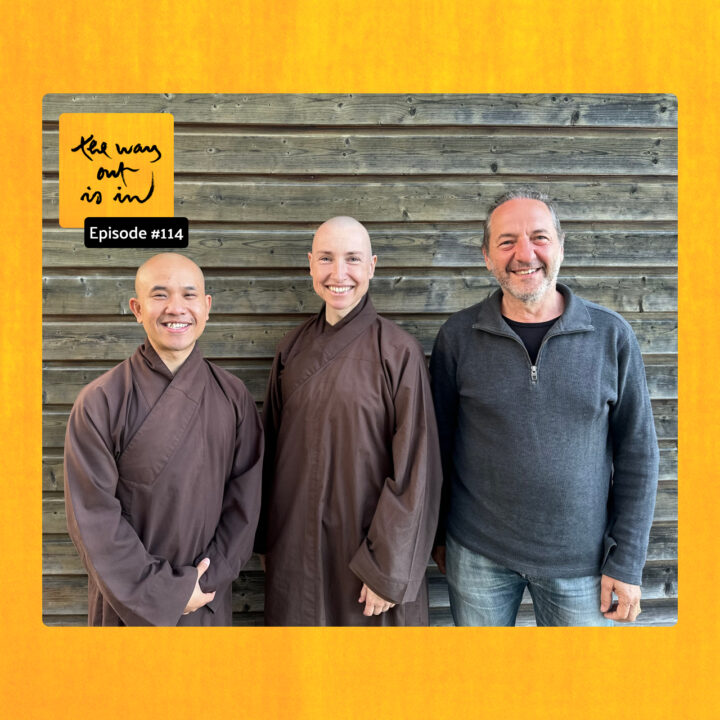
In this episode, Zen Buddhist monk Brother Phap Huu and leadership coach Jo Confino are joined by Zen Buddhist nun Sister True Dedication. Together, they explore the significance and offerings of the Plum Village community – a sanctuary of peace, healing, and mindfulness, in stark contrast to the fast-paced, consumer-driven world outside.
The three speakers further discuss the importance of a physical environment for spiritual practice, where individuals can reconnect with their true selves; the value of community living, where monastics share a collective career and work towards the flourishing of the community rather than individual success; the relevance of the five mindfulness trainings, which serve as ethical guidelines for personal and societal transformation; and much more.
The conversation also touches upon the need for support to maintain and expand the Plum Village facilities, the importance of generosity, and the impact of supporting engaged monastic communities.
Co-produced by the Plum Village App:
https://plumvillage.app/
And Global Optimism:
https://globaloptimism.com/
With support from the Thich Nhat Hanh Foundation:
https://thichnhathanhfoundation.org/
List of resources
Interbeing
https://en.wikipedia.org/wiki/Interbeing
Plum Village Tradition
https://en.wikipedia.org/wiki/Plum_Village_Tradition
The Bodhisattva vow
https://en.wikipedia.org/wiki/Bodhisattva_vow
The Five Mindfulness Trainings
https://plumvillage.org/mindfulness/the-5-mindfulness-trainings
The Fourteen Mindfulness Trainings
https://plumvillage.org/mindfulness/the-14-mindfulness-trainings
Es Devlin
https://esdevlin.com/
Rebecca Solnit
https://www.rebeccasolnit.net/
The Way Out Is In: ‘Stepping into Freedom – Live Recording with Q&A Session (Episode #67)’
https://plumvillage.org/podcast/stepping-into-freedom-live-recording-with-qa-session-episode-67
The Way Out Is In: ‘Cultivating Joy and Togetherness in the Midst of Hardship (Episode #95)’
https://plumvillage.org/podcast/cultivating-joy-and-togetherness-in-the-midst-of-hardship-episode-95
Quotes
“Plum Village emerged from our teacher’s vision of how the world could look and feel different from mainstream society. From the beginning, Plum Village has been a community of resistance. We could even call it a community of resilience: a physical environment that holds different values to the mainstream consciousness. We can all recognize those values. It might be unbridled capitalism, craving, consumerism, violence, or excesses of different kinds that we see in our immediate lives, around us, and in the economic and labor systems that we’re a part of. The vision for Plum Village was, ‘What if we create a physical environment that models entirely different values?’ Embodying those values is the resistance. For example, embodying peace, harmony, collectiveness, and community rather than individualism.”
“We need to reclaim our sovereignty from the machines of our creation.”
“Plum Village is holding an environment of peace and healing and freedom from the rat race; freedom from the world of technological overwhelm.”
“At a retreat, we are invited into a space of sharing our generosity in presence. We’re not sitting for ourselves: we’re sitting for the collective. When we are taking care of our emotions, we’re also taking care of the emotions of the collective, because we start to see the interbeing of the individual and the collective, their interconnectedness.”
“We organize our life in such a way that we are literally cultivating compassion, mindfulness, patience, and inclusiveness every day. We’re not perfect, but this is our work in progress and it’s quite noble and, though we struggle so much, we feel in our bones that we’re doing this work every day. It also allows me to have some faith in the future as we enter this period of disruption for society, for the climate, for agriculture, for nature – to be able to cooperate, to live cooperatively, to share resources, and to moderate and temper our needs. These are such important human practices. The qualities we’re holding here – compassion, mindfulness – are a treasure trove for future generations. These are exactly the values that we want to trust will still be there in decades and centuries to come.”
“In each hamlet are 50 or 60 monastics living together, cultivating non-violence in their speech, in their thinking, in their way of being, in their way of washing a bowl, in their way of brushing their teeth, in their ways of being with the mosquitoes. We’re living as an example of non-violence in the world. And then being able to lift that up into our engagement with everyone who comes to us. It may sound like we’re describing a bubble. But, because we are living in a constant relationship with the thousands of people that come and spend time with us every year, another way to describe us is as being like a river bank with a river flowing through it. We’re a gentle river bank that caresses the water for a little bit before it moves on back into the world. And so people have a chance to taste these energies that we’re generating as a collective here.”
“The only way that we are going to save ourselves from the collapse of civilization is through a collective awakening. Individual awakening is not enough.”
“We’re not going to sort everything out in this lifetime, but what we can offer is more tools, more practices, more understanding, more care, and more compassion for the next generation, so that they can carry this path forward into the future.”
“Thay has really expanded this home – it’s not just for the monks and nuns. The monastery is also open for the lay community to come in and taste true peace.”
“When you come to Plum Village for seven days and don’t drive a vehicle, that’s already an impact. When you’re vegetarian for seven days, that’s an impact. When you are not expressing anger for seven days, that’s an impact. When you’re listening to yourself and healing some blockage that’s been waiting for you to look at it and embrace it, that’s an impact. That’s healing. That is already work for your ancestors, work for society. And so the journey of a monastery – or we could call it a practice center – is important because it is also a place where we know we can put down our masks. It can become a great equalizer. Everyone here, we’re human beings; it doesn’t matter what titles we hold in the world outside. Here, in the monastery, there’s a power to the monastic’s presence.”
“It is very clear from the teachings of Thay and the Buddha, and from our own moral compasses, that, if we don’t take care of our suffering – our loneliness, our violence, and our hatred, by naming it and saying, ‘Okay, I’m co-responsible, and it is my responsibility to also transform this’ – we’re not going to change the system.”
Dear friends, welcome to this latest episode of the podcast The Way Out Is In.
I'm Jo Confino, a spiritual mentor and leadership coach.
And I'm Brother Phap Huu, a Zen Buddhist monk, student of Zen Master Thich Nhat Hanh in the Plum Village community.
And today, dear listeners, we're in a sense, going back to the core, which is what is it that Plum Village can offer in this troubled world?
Hello everyone, I'm Jo Confino.
And I'm Brother Phap Huu.
And today, dear listeners, da da da, da dah, we are joined by none other than Sister True Dedication. And this is the second time in the row that she has joined us. The last time was in a live podcast in London. So sister, welcome for another time.
Thank you. I'm very happy to be here with my two favorite podcasters.
Yeah, well, the only two podcasters, actually. Today, we are going to look at really the place that Plum Village can hold in this world. So what is it that Plum Village can offer? What benefits can it provide? And how is it grounded in a way that can benefit a lot of us who are overwhelmed, who are busy, who have lost maybe sight of what it means to be fully human. Sister, I want to come to you first, because in my life, Plum Village has been, in a sense, a central tenet of my spiritual development, my happiness, my joy, my understanding of the world, my way of taking action in the world. I can't imagine that I would be the person I am if it hadn't been for the teachings of Thay. And for the existence of Plum Village as a monastic community that holds this extraordinary space and shines this amazing light into the world. So what I really want to get to today is what is it about Plum Village that has allowed me and thousands and thousands of other people over the years, and thousands and thousands of people in the future to be able to come back, to being fully human, to know what it is to be alive and to know what it it is take action in this world.
Well, Plum Village emerged from our teacher's vision, I guess, for how the world could look and feel different from how mainstream society is going. So I think from the beginning, Plum Village has always been a community of resistance. We could even call it a community of resilience, a very physical environment that is holding different values from mainstream consciousness, let's say, and the values in mainstream consciousness we can all recognize them. It might be like unbridled capitalism, it might be craving and consumerism, it might be violence and excess of different kinds that all of us might see in our immediate lives and around us and in the kind of economic and labor systems that we're a part of. And the vision for Plum Village was to say, what if we created a physical environment that modeled entirely different values? And in embodying those values, that is the resistance. So for example, to embody more peace, more harmony, more collectiveness, more community rather than individualism. So at its roots, Plum Village is an island, kind of an island, an oasis of peace and healing and community life held in the energies of mindfulness and compassion and deep looking where we kind of hold this space by having this residential community here across these large hamlets and villages. And whether it's you, Jo, or anybody else, or many of our wonderful listeners who have visited us here in Plum Village. We step out of the […] taxi, and we step onto this land, we can feel our first steps on the gravel when we kind of walk into the hamlets. And we feel that we're entering an entirely different kind of energy zone. This is a place where we can go slower. This is a place where we can live more simply. And this is a place where we come home to ourselves, like our true nature as a full human. And there's this wonderful phrase that I think Thay really captured this very accurately. And so for about 40 or 50 years ago, many decades ago, he said, as humans, we need to be able to reclaim our sovereignty from the machines of our creation. We need to reclaim our sovereignty from the machines of our creation. And he was saying this in the 70s and 80s. And what he was seeing is that we have so much going on, we're overstimulated, overwhelmed, the screens, the devices… We have the devices now. You can imagine what the technology and industry or militarism of 40 or 50 years ago was then. But Thay was saying, all of us, we feel so much more whole, so much more clear so much more ourselves when we can be in nature, when we can live simply, and when we can listen, really listen to what's going on in our hearts. And we have to kind of reclaim those spaces. And I think in our times, these spaces are so rare, they're so precious, where we can switch off the devices, where can be nature, be with humans, but not be in a fantasy world and not be in a kind of Disneyland where we pretend that everything's okay, but where we can then really look deeply into our own pains and the pains of the world. So at its root, Plum Village is this environment of peace and healing upheld by everyone living here so that as soon as we step into it, each one of us feels more ourselves, like somehow… I want to say more natural, but it's not that we are against technology or that technology is entirely unnatural, but who we are in our hearts, maybe we can become closer to ourselves and to who we really are when we can free ourselves from this technology. And that's how we get to really be in any present moment, to listen to ourselves in the present moment and then to really reflect on our relationships, our dreams. And frankly, how short life is and how do we wanna spend our lives? So that is what we are holding. We're holding this environment of peace and healing and freedom from the rat race, freedom from this world of technological overwhelm.
Thank you, sister. And brother, just to bring you in here. So first thing sister said is it's a physical environment and I know from my own experience the insights, the understandings that I gained, the feeling deeply when I first came here of coming home to myself, of being, of letting go of my protections, my defenses, and feeling for the first time in my life completely free to be myself, could not have happened online, could not have happened if I was on a course. It could have only happened because this land is not just nature on its own, it's been cultivated energetically by Thay and the monastics over more than 40 years now. And I think when people come here it's not that they just feel they're in nature, they feel in the presence or in the ambience of mindfulness. It's an intentional space where people can feel more present, as you say, sister, more free, more able to show up, more vulnerable. So Plum Village does offer online courses because obviously there are many people who can't come here. But what is the importance of having this physical environment, not just for retreatants, but for you as a group of monastics that can hold a space? In order that when you do go and do online courses or whatever, that people are able to connect to the presence that is available here.
It's so important for me on my journey to know that I can lean onto others with deep experience. Like many of us, we have heard of mindfulness, we've heard of spirituality, we have a deep aspiration to be compassionate, to be loving, to know how to be slowed down. But if you grow up in an environment where none of that was shown to you, or you have never even seen it in person, then you won't be easily convinced in a way, because things online is sometimes it is an illusion. But when you come to a living community, and I think our teacher uses this word a lot, Plum Village is a living community of engaged practitioners. And that means whether we are new or we have been coming for many years or even those of us who are deep in this tradition, we always need a kind of nutriment to restore our spiritual being, like our spiritual energy, and that energy is not, you cannot just receive it from books and watching something online. Those have its power and it has its knowledge that transmit to you, but the difference when you're being in a community that has practice, your nervous systems has a chance to also take refuge in the environment. And when I say environment here, it's not just the nature, it is the people also. It is the collective consciousness. Like in Plum Village, you wouldn't hear a cuss word, for example. And that is a collective intention of why we are together. It's not to water these seeds in us, right? When we come to a retreat, we are being invited into a space of sharing our generosity in presence. We're not sitting for ourselves. We're sitting for the collective, as well as we, when we are taking care of our emotions, we're also taking care of the emotions of the collective because the individual and the collective, we start to see the interbeing of it, the interconnectedness of it. And when we're in this environment, it is so much quicker for us to learn this art of mindful living because we are beings of habits. Like what Sister True Dedication just mentioned, the rat race in the modern world, we all pick it up no matter how young we are and no matter how well insulated we may be in our homes, the moment we step into the city, that collective energy is like a wave that will just push us in a direction, whether we like it or not. And this is why, when we come to Plum Village or any other spiritual community that has a very strong grip on the intention of where we want to cultivate our 24 hours a day, there's a big practice of surrendering, of letting go, to take in this new energy, which is an ancient wisdom that we already have inside of us, because when we know how to slow down, the healing is possible. When we are taking care of our emotions and we're listening to our body, the magic of the rest and the healing within us can come into action. And so being in a community is also relearning the beauty of how to be a human being again. Like in your intro, like this is what I touched when I came to Plum Village was the beauty of human beings learning to be kind to each other. And in the retreat, like we're all gonna touch our habits and maybe even our darkness because the stillness allows it to come out. So the environment is also curated in a way in the architect of bringing us together more than in separation. And I think when we practice things online or with the app, it's by yourself and it's beautiful. It's wonderful. But when you can be with each other and you can listen to someone's story and someone's insight and it can water different seeds in you. It can water maybe the insights that have been buried for so long and it has an opportunity to manifest. And this is where we have seen, I have seen the collective healing in collective listening. And a lot of our healing journey now in the world is also very individualistic. And I am not against therapy and one-on-one sessions, but I see that there is an incredible speed of interbeing, of connectedness, of opening up, of listening, of also sharing from the heart in a community setting when it is guided with skillfulness. And the healing we can see in seven days is incredible. Like the day of arriving and the day of leaving is that we are meeting each other in new lights and new energies and this is very, very much architected by our teacher in his also deep looking of suffering of our society. And when he was exiled and particularly in the West, he really touched the seed of loneliness, as well as the separations of broken families, broken society, the inability to celebrate each other's success, but we're always competing with one another. And so our methodology of practice is not only spiritual, which is like mindfulness and being calm, being slow, it is actually a way of being to see a new society, like a being that that that collectively, kindness is not just a TED talk anymore. Kindness is not just a sign we make. It is actually felt, it is actually transmitted in every path of society. And this is where I think majority of us who have entered into Plum Village, and a student of Thay, we want to bring Buddhism, the practice of spirituality, naming it mindfulness, concentration, insight, not as something that only belongs in a monastery, but is cultivated here because the monks and nuns, we are committed day in, day out. This is our life. And we wanna generously share it so that it can penetrate into society. And it doesn't have to be like bold and like I think being bold as like being resisting to not consuming, that's boldness, but we don't have to be loud and say I'm a Buddhist, I'm a spiritual person. It's actually everything that you will see and learn is almost so normal in a way, but when you put the practice in, the normal becomes the extraordinary. And for me, this is what I had felt in my first trip to Plum Village in 1996, and that left an impact because I saw a new way of being that was really possible.
Beautiful, thank you, brother. And sister, just what Phap Huu was saying towards the end of what he was saying about, we are a community of monks and nuns. And I just wanna focus on that for a bit, because, you know, the teachings, Thay and Plum Village, you have your own lineage, but it's all based on the Buddha's teachings. There are many individual mindfulness teachers in the world who go out and teach courses in sort of public settings where it's not always online. But Plum Village, I've always seen, is different. You're not individuals going out and teaching, and you're not individuals who are lay people who are very, very committed practitioners and teachers, but then they go off and live a life in the so-called, in brackets, real world. Plum Village for me has always been different, that you are, as Phap Huu said, a group of committed human beings who have taken the vow, the Bodhisattva vow, to basically devote your lives to helping people to connect and to transform their suffering. And that you do it within a community setting. You all live together pretty much all year round. You are based in a physical setting that is a mindfulness setting. So I just want to sort of in a sense say what is the difference essentially between having a monastery with monks and nuns as opposed to, you know, going to a center somewhere which is where you, a bit more like a hotel, where you pay your money and you do your course, which of course people can benefit from as well. It's not to say one is bad and one is good, but what is the essential difference from it being a monastery?
First of all, I can tell you that to live in it feels very different. So maybe we could describe ourselves, yeah, as a stream or as a forest. There is something that's really non-individualistic about giving up every cell of your body to a shared experience. So as we've mentioned before in the podcast, we live in dormitories, we share food, we do everything together. And that is such a powerful experience for a human in today's modern post-industrialist world here in Europe to be able to live every hour of your day as a kind of shared collective experience. And I would say that it helps us live the insight of interbeing like more deeply. We give each other such frank feedback. There's no sense that you can, there's no, you know, our blind spots are reflected back to us every day of the year. And it helps us be very like humble, grounded, very down to, yeah, really down to earth. And our teacher used this phrase, we have a shared career. We don't have an individual career. We have a collective career. So the kind of the destiny of this river of wisdom is our destiny. It's not that I want something personal out of it myself. I want nothing more than the flourishing of this river or this forest. And I think this is a really important element that not only are we living a resistance to crazy individualism out there in the world, and through that really exploring the challenge of community life in the modern world. So we're really discovering all these different forms of communication resilience, conflict resolution or whatever you want to call it. How do we keep our harmony alive as a community? And we keep that harmony through all sorts of different practices that we're developing here. And that's so essential for our times when we know that the disruption of the coming decades we will need to face as collectives, as communities with solidarity. And so I feel we're such an important laboratory for like the collective experience. But in addition to the kind of practical aspect of it, the other part of it is that the community that we invest our time and energy in will outlive us. So we talk here and we know in many wisdom traditions we speak of seven generations. Here we're going for centuries. So how can we help be the like wisdom holders, wisdom keepers for not just understanding, but living insight that will endure for many, many generations to come. So we often talk about Plum Village, we're looking after it. Everyone who's listening, for your great-great-grandchildren. So that's our dream is that through this community that has such deep commitment, we're also caring for the future. So we are saying that we are patterning into this community, yeah, teachings, insights, practices, forms of conflict resolution, forms of deep, compassionate communication that will last for decades and ideally centuries to come. And Buddhism has already survived two and a half thousand years, so we've got a good track record and we hope that it will be able to continue forward and to hold these ethical values that are so needed in the world. And it's quite a radical commitment, the monastic commitment to live, to give up our possessions, to live simply, to give off a sense of an individual career to really invest in a collective movement for change. And that's very powerful. And it is also, yeah, it gives me a lot of faith because I trust that it's the living transmission that will carry these teachings forward. So when you speak about a lot of other teachers that might be lay teachers in the world, and of course teachers can train teachers. And there can be some level of transmission, but here we talk about like the bodily teaching of, you know, I'm in a dorm with some of my mentees, and, you know, and so that's a real, you're really, the transmission is happening day and night. And we teach as much by our way of living as by our speaking. It's not that we are household as one moment and teachers in another moment, but that we organize our life in such a way that compassion, mindfulness, patience, inclusiveness are like literally what we're cultivating every day and we're not perfect, as you well know. But this is like our work in progress and it's quite noble and even though we struggle so much, we feel in our bones that we're doing this work every day. And it allows me to have some faith also in the future as we enter this period of disruption for society, for the climate, for agriculture, for nature, to be able to cooperate, to be able to live cooperatively, to be able to share resources, to be able to moderate and temper our needs. Like these are such important human practices. Plus then with compassion, with mindfulness, with all these other aspects. So the kind of qualities we're holding here, it's like a, also a kind of treasure trove for future generations also, that these are exactly the kind of values that we want to trust will still be there in decades and centuries to come. And for me, one of the most important ones is the non-violence. Wow, in each hamlet we have 50, 60 monastics living together, everyone cultivating non-violence in our speech, in our thinking, in our way of being, in our way of washing a bowl, in our way of brushing our teeth, in our ways of being with the mosquitoes. You know, like, we're living an example of non-violence in the world, and then being able to lift that up into our engagement, as you know, with everyone who comes to us. And I think this is an important point, that it's not that we live in a bubble, because it may sound like we're describing a bubble. It's really unrealistic. But because we are living in constant relationship with the thousands of people that come and spend time with us every year, another way you could describe us as being like the river bank and the river flows through us. And we're a very sort of gentle river bank that caresses the water for a little bit before it moves on back into the world. And so people have a chance to taste these energies that we're generating as a collective here.
Thank you. And just picking up on time, Brother Phap Huu, so one of the teachings that has been most profound to me is about the understanding of ripening. And it picks up on what you're saying, sister, which is that a lot of people want instant results. I put in the effort, I had the idea, and I want to see the result tomorrow. And you occasionally see that with people who come to Plum Village, that some people will come and, you know, with the idea that they want to transform in the five days or six days they're here and then sort of maybe even being disappointed that it's not that quick. And so my understanding of ripening is that, and pick up on what sister says, you're holding a space of time. And there was a time before that. And there'll be a time after that. But what I'm particularly sort of respectful of Plum Village is that you don't, the teachings do not stand still either. And that you, that Thay was always very clear that you bring the teachings into the present moment. And the present movement now is different from 40 years ago, 30 years, 10 years ago. And that I'm deeply respectful of how Plum Village adapts the true teachings but makes them relevant for not each generation only, but each group that comes here. So for example, the climate leaders retreats, you know, you've had about 800 people or so come through into Plum Village or into physical retreats you've held, which are people who are at the frontline of the climate crisis and who need a particular sort of flavor of teachings. And what I've noticed more and more is that you don't just come with his page, you know, this is the teaching, I'm going to just give you the Buddha's teachings or the Plum Village teachings, but you make the teachings very relevant to this group of people who need this particular understanding or this particular way of seeing that wouldn't be necessarily the same as for teachers or for musicians or for other people. I'm really interested in how Plum Village is able to hold that space because you can only hold a space of ripening if you're present over time. You can't hold a place of ripenning for a day, a week, a year, ten years. It has to have the continuity of time for it to be able to continue ripening and adapting.
A foundational practice of Buddhism that has been transmitted from the Buddha and then re-emphasized again and again and renewed in a language by our teacher, which is the present moment. The now is where it embraces the past as well as it is holding the future, it is building the future. And as a student of Zen Master Thich Nhat Hanh, of Thay, his source of joy and of energy in his career as a monk. And I think a lot of people know him from a different generation just as a peace activist because of the war in Vietnam, but he was a monk from 16 all the way to 95. Is that correct? I think it's 95.
Yeah.
Yeah, yeah. As a monk, he always asked the question, is the teaching alive? Is Buddhism renewed? Is it meeting the world in the present moment? And that was his energy as a young Dharma teacher, as a young student in the institute. His learning was always like, and what does that Dharma have to do with the present moment? So as his descendants, his students, we have inherited that transmission of always asking the question, is the Dharma reflecting the suffering of today's modern society? And that takes an incredible humility of the teachers, of the Dharma teachers, to listen and to really also reflect again and again and again how can I translate this Dharma to meet the pain and the blockage of pain in individuals. And that is not new. That has been the methodology from the Buddha, because that was how he was liberated. That's how he touched enlightenment. And enlightenment of what? Enlightenment of suffering. And suffering changes. If you look at the Buddha's own sangha community, it evolves through the year. The teachings evolve, he evolved as a teacher. And it is because of, for me at least, from my perspective, the journey of Buddhism becoming a very strong religion and a household name and a strong tradition. And the danger of it, it also becomes, it gets stuck sometimes where it feels like it has made it in a way, but it is not continuously having its feet on the ground and being in touch with the people. And that's how, what I've learned in my journey to India with you, Jo, and the pilgrimage community is that when Buddhism started to fall out was when the monastics were out of touch with the people. And it's the people that is almost like a pulse of society, like the monastics have to be engaged. And that's why Thay, I feel very grateful for him because if the retreat model wasn't opened, we wouldn't have an experience in a monastery because in a more traditional way of looking and way of life, it was like, you go to the temple once a week, like kind of like in the West, you go to church on Sunday and you do a confession, you do a prayer and you go home. And in some of the cultural way of life was the same. You go to a monastery, you do some prayer, and then you go back into life. And Thay has really expanded like this home, it's not just for the monks and nuns. The monastery is also open to the lay community for the lay people to come in and taste true peace. And I… I want to invite us in thinking of fruits of practice. And we think we have to touch deep insight. You know, when you come to Plum Village for seven days and you don't drive a vehicle, that's already impact. When you're vegetarian for seven days, that's impact. When you are not expressing anger for seven days, that's impact. When you are listening to yourself and just healing some blockage that has been waiting for you to look at and embrace, that is impact already. That's healing. That is already work for your ancestors, work for society. And so the journey of a monastery, why I feel a monastery, or we can call it a practice center, it is so important because it is also, it's a place where we know we can put our masks down. It can become a great equalizer. Everyone here, we're human beings. It doesn't matter the titles we're holding in the world, here, in the monastery life, there's a power to the monastic's presence. It's like, in some ways we are like your elders because we, your elders in the practice, because we're doing this day in and day out. So there's already a humility that people touch when they come. And it's not for us to feel more superior than you, but there's this relations like, oh, here I can be a student again, I can learn again. And what am I learning? I'm just learning to be human again. I'm learning to more gentle, to slow down. Slowing down is an art. And everybody carries different energies of habits that the monastery is like a mirror. It just keeps reflecting back. And even myself, because the world comes to us, my seeds get reactivated by the people, the worldly people that come. Everybody's from the world, bringing it to the monastery. And I also was told by Es Devlin, like the monastery is like a liver and everything comes through and we're here to filter things. And we're to like help, you know, flush things. And as part of the liver, like as also a human being, like from the world coming I also get to meet myself deeper every time to see where I'm at in my practice, which habit energies that are still present that needs more attention to. So the ripening and the fruit of practice is always happening and sometimes we don't see it but it's there and it is a contribution to the collective. And sometimes just your way of being may support someone without you even knowing. And that is a contribute too. So in the training of a practice center, of a place like Plum Village, I think what we get to touch is beyond the self.
Thank you, brother. And of course, Plum Village is not just the liver, it is the heart.
It's many things.
It's may things, but it's quite interesting as you said that, just to think of the body, all our organs, because it's also the heart, which allows us to deeply feel. It's the lungs, which allow us to come back to our breath, you know, so it's like… It actually, it massages all of our organs all at the same time. And as you say, there are a lot of practices it does that through, so deep listening, loving speech, sort of a deep looking. So we have all these sort of practices that you get to practice for a full week here. Whereas often at home, you might do it for 10 minutes or an hour, but it's very hard to build that into a practice. And I think what Plum Village offers is like a chance to really experience them. So that you can see what works, and then when you leave, you can take whichever practice is relevant to your home. But sister, I wanna go into another aspect of Thay, which is ethics, because it's, of course, these practices in and of themselves are transformational, but what I find so powerful about what Thay has created is he built it on the foundation of ethics. It wasn't just these are good practices. It is what is it to live an ethical life? And of course, from the Buddha's original teachings, he developed the five mindfulness trainings and the 14 mindfulness trainings. And what's quite extraordinary is to see the amount of people who come to Plum Village, who at the end of it, there's often a ceremony where you can take the five mindfulness trainings and make a commitment. Can you tell us, just come back to this core, what is it about this ethical framework that Thay created that is so core to living… I was going to say a good life and there's a better word than that, but living a more caring, loving life in this often uncaring, unloving world? What is it that Plum Village contributes from the ethical perspective?
So the five mindfulness trainings that you mentioned are really our teacher's vision for a kind of global spirituality and ethic. And the text that we have has been written in such a way that it's, has just a couple of slightly Buddhist terms, but is the kind of text that should be fully accessible to anyone from any religion. And there's this really interesting thing, whether Buddhism is a religion or not, definitely it's a way of life, a rich cultural wisdom heritage, but it doesn't necessarily require belief in something or stories or something outside of us in the same way that other spiritual traditions might. It's really practice-based. So these five mindfulness trainings are five principles around which we can conduct ourselves in a really grounded way. And so the first principle is around non-violence and non-killing, aware of the suffering caused by killing in the world. How can we live in non-violance? And there's a paragraph describing that and really getting to the roots of violence in our craving, in our dogmatism, in some of our beliefs and our individualism. And the second principle is around simplicity. Aware of the suffering caused by exploitation, social injustice, stealing, oppression, how can each one of us live knowing that it's not about materiality, whether we're gonna be happy or not? I mean, the material conditions are just a tiny part of actually the root of our true happiness. And that's a real vision for the world. What does a world look like where we have a right concept of what happiness is? It's not about getting more, accumulating more, having more, grasping more, extracting more, appropriating more. It is about being able to enjoy the most simple moments of our life. That is where real fulfillment lies. So the first one, nonviolence. The second, simplicity. The third principle is around intimacy and how we are with our bodies, how we respect our own bodies and the bodies of our loved ones. And that's aware of the suffering caused by a kind of unmindful approach to our sexual energy and to our real human need for love and how we often mix up the two. And we all have such a deep human need to love and to be loved. And there were some real practices of deep looking, understanding and awareness that all of us can deepen our awareness of and listen truly to ourselves and take care of our bodies, our love, our hearts, our desires in such a way that we don't harm ourselves and we don't harm others. And then the fourth principle is around loving speech and deep listening and handling anger and aware of the divisiveness and the power of words to cause so much harm in the world, at the kind of global level, but also at the most intimate level, how we talk to ourselves, our kind of inner monolog, how we are with our loved ones, how we're with our children. And this is such a deep area of practice where we can build a more beautiful world just with our speech. And then the fifth principle is around how we consume. So we live in a society of runaway consumerism, and what would it mean to resist that as individuals in our friendship groups, in our families, and then in our society, and how to guard ourselves from the kind of pollution, the toxicity that's flooding into all our senses. So this vision of a global ethic, I think is one of the most powerful offerings we have. And it works both at the grassroots and the personal perspective, meaning each one of us can apply these ethics right away today in our daily lives. But it's also a vision for the whole world. And as part of the United Nations work at the turn of the millennium, our teacher was involved in helping come up with the kind of global ethic that could define the 21st century and the basic building blocks for the ethic were these five principles because they're so concrete so universal and so powerful. And you were speaking about the climate leaders and leaders from different fields that come, you know, to take refuge in Plum Village, to lay their head here to rest, to find sanctuary and and a reset. And for leaders in the world to know that there is an ethical direction that our societies can take, that our organizations can take, that our democracies can take, there is a ethical direction that is there available to us and thousands of years of wisdom offers that. And it can free us from the war machine. It can free us from this unbridled capitalistic inequality and craving. It can free us from yeah, the pursuit of wealth and accumulation is somehow like a good thing. That is a total wrong view. In these current weeks, we're hearing that the fossil fuel companies have reported some of the biggest profits, like in the history of their exploitation of natural resource. That is a moral issue that should be keeping every single politician awake at night. It is a moral failure, this level of greed, at a time of so much destruction of the Earth, of the war machine, of basic human's right to have, you know, an affordable cost of living ability just to feed their families. And here we have fossil fuel companies reporting these gigantic profits. And we offer an ethical compass. We offer a clear direction that it is impossible, it is impossible to say that these things are morally acceptable. And what often we find, we meet people and they say, but it's so hard to know on what ground do I stand to say this is not morally okay? How can I find the moral imperative to do something different? How can find the moral courage to call something out? And these five mindfulness trainings, they fit on one piece of paper. They are so simple, so clear, so powerful. Any one of us can read them and we know that that is wrong. We know this level of capitalistic profit is wrong. And that can give all of us confidence to not doubt ourselves, to not believe in these machines of our creation, to not belief in the story that we need such unbridled capitalism in order for humans to flourish. You know, which humans to flourish? At what cost? And is any of it true and real anyway? Like we have to count the costs of the direction our civilization is going in. And so what we, as a community, are trying to do, so what we as a community are doing is embodying this kind of resistance and doing our best in our daily life, starting in a really grounded way. These are our ethics and this is how we build up from the base. And that gives us such firm ground to stand on and to see which direction our society should be going in. And that is so helpful for leaders in the field of climate and nature protection. It's so powerful for educators. And it's so powerful for politicians. We have, you know, in the last century, they call it the century of secularism. You know, this age of secularity that we've let go of a lot of the traditional religious moral compasses that used to guide our political decisions and our democracies. And here we have a really rich moral compass in the five mindfulness trainings that can allow us to get to the root of the destruction of human life, of our natural world, and the forces of inequality and exploitation that are all around us. And we're offering a path that each one of us can tread to have really firm ground to stand on and to say, this is enough. We are calling this out. There is moral responsibility here, and this is not okay. We do not want to go in that direction for ourselves, and we do not wanna go in that direction, for our children. And now, more than ever, we have to be able to have that solid ground. And that's what our ethical code of the five mindfulness trainings is offering.
Thank you, sister. You talk about leadership, and so I'd like to come back to Phap Huu about leadership because one thing you said was that when people arrive they let go of their badges and their status and everyone's here together. But one of the things people are feeling in this world is a sense of powerlessness, a sense that actually that the forces of this system are so strong that actually there's nothing we can do about it. And that's leading to a lot of despair, lack of hope, not just amongst young people, but amongst many, many people of all ages. And what I see is that Plum Village is a real antidote to those feelings of powerlessness and despair and wanting to give up. In my practice of coaching, I coach a number of leaders, and I see so directly how the Plum Village teachings are able to help leaders to really see their lives differently, their roles differently to touch their own suffering, which often leads to them using their power in unskillful ways because they have power and that when they're able to touch their own sufferings, to touch more deeply who they are, to come and connect to childhood wounds and to family patterns and ancestral patterns that may be still affecting their lives, that they are able to be better leaders, create stronger teams, be more open, less directional, it's not so much power from the top down, but power with, so to bring people together. So I just want to ask you very specifically about how Plum Village can help people in a leadership position. And of course, the truth is that we're all in some level in a leadership position in some form. Whether it's within our families or our friends or many other ways we can show leadership. But how Plum Village is helping people to see that what they do in their own lives, the way they reframe their own understanding of themselves is making a difference in the world. And that it doesn't always have to be what they doing, but actually the quality of their being is so powerful in terms of Plum Village that you're not telling people here you can be more efficient, here you can do things quicker, here you can do things more effectively, but to say actually it's the quality of your presence that is a core leadership skill.
I think what we always offer very concretely is the journey inwards and that means meeting our suffering and being accountable with our own actions that we have made in the world, whether they are actions of suffering. We have to have the courage to embrace and acknowledge and say that I have been a person that was not kind to my children, for example. Or I have been moved, my actions have only been from the foundation of my traumas. And coming to a retreat, what we want to allow people to have a lead within themselves, to transform their suffering. For us, it is very clear from the teachings of Thay and the teachings to the Buddha and our own moral compass is if we don't take care of our suffering, our loneliness, our violence, our hatred, naming it as it is and just saying like, okay, I'm co-responsible and it is my responsibility to also transform this, we're not gonna change the system, period. The system has been created in the world so that we can run away from our suffering, so that can consume more, so that we could chase after status, chase after positions to feel better in order to ignore the suffering and the pain that we have inside of us. And the powerful leaders that really become humble to themselves and become humble to their lineage and what they're holding and being accountable and transforming, whether we are a person of race, whether we are a white person, whether we are a rich person, whether we are a bully from before, like we come and we, we embrace all of this and we start to see, ah, now the path forward for systems change, which has been asked a lot to Plum Village: What is our theory of system change? That theory is to go inwards and it's to really, as a collective, to have the ability to call it by its true name, the pain and the suffering. And to take on the responsibility of walking a path forward differently. And that takes incredible courage. And that's why the five mindfulness trainings is like a lighthouse, you know, it shows us the path. It's not about perfection. It's like showing us like this is the path we wanna keep going towards. If we don't have boundaries within our path of ethics, we will fall apart. The desire, our manas, which is like our craving, will be baited. And society gives us all the baits to keep us away from a more just and loving society. And we can see very clearly that division and hatred and capitalism and individualism is so well organized. And collectiveness, compassion, deep listening, being together, being uncomfortable together, it's not that well organized. And I, maybe I'm biased, but I would say, I have traveled quite a bit in the world. Plum Village offers that. And Thay has strategically and with his insight cultivated the retreats, cultivated the community, build the structure of how we listen to one another, how we come in, and the journey of meditation is not a violent practice, it's a very gentle practice. And then people, you know, say, oh, you guys are too soft. I'm like, well, how could you even heal if you can't be still? How could you even have the courage to meet yourself if you're not even having the ability to cultivate the joy that is present, that is also very needed? And so, as a leader, there are two aspects that we are emphasizing more in our times. One is having the foundation of stability to hold and embrace pain and suffering. And the second is to generate courageous joy. And joy is something that is… it is vital for our times, I would say. It is the antidote for us to not give up. And this joy here is like to see the beauty that is still existing within the destruction and pain that we're in. And in that joy, we're giving hope, we're giving confidence of knowing that the world could be a place of true sustainability, true harmony, true happiness, true compassion. And… And I trust that, because I felt that when I came here. Like I trust that joy is not about buying something and feeling happy just for a few minutes and then throwing that toy away. But joy is when you are able to see your loved ones being able to touch their own way of holding pain and suffering. And they change then their whole way of looking at you. There's compassion. There's kindness. And suddenly my father's joy became my joy. When I saw my dad knew how to embrace his trauma and his pain as a refugee, that was my joy. And that is a true joy. That is something that is… Then it gives me hope that I can do it and I can transmit this by my way of being. And so therefore to have these two practices of holding the pain, transforming it, embracing, caring for. And then, on the other side, bringing in the courage to have joy, to see that it is not something that belongs to the future, but it can be touched in the very here and now. And we just experienced in France the wildfire and as Sister True Dedication spoke about the pain and the suffering, like a lot of the… some of the monastics, when we heard these news and we watched the news, we cried. We cried, even though it's not happening right at our doorstep, but we expand beyond the human. We think of the animals, the insects, the ecosystem, the next generation of like the nature that they're losing, the beauty that they won't be able to see. And so in that moment, we are touching pain at the same time. And for me, in that moment of the fire happening within the summer retreat of our summer opening, the smoke arrived into Plum Village and there was a panic, a fear. And it was very natural for all of us to be afraid and to panic. And I caught myself right away that I was running towards a solution with fear and panic. But… And what I have to do is to come back to the very present moment to ask ourselves: Is this fire here? Am I calm? Am I present? What are the clear actions? Where's my resilience? Where's all this training of all this time? It's like, and I was so happy. I was able to catch myself right away: you're moving with fear and panic. Hold back, listen, breathe. And I walked the grounds. I went to the edge of our forest. And because Upper Hamlet, we're on a hill, so we can see the valleys. And very clearly the fire wasn't here. And then come back with clarity, with calmness, explaining to all the parents, explaining to everyone who is in fear that it's not here. And let's take care of each other's emotion, each other's collective safety right here, right now. And I think collectively with Sister True and others of our siblings, we've talked together, it's like, not only is mindfulness just to be aware, but it is also to build resilience in order to anticipate and welcome the crisis that is present and continue to come. And there is a way to be in crisis that is sustainable. And Plum Village is a fruit of that. Thay's manifestation of engaged Buddhism is through crisis. It is through brothers and sisters dying right and left to him. It's his community being labeled communist, anti-communist, traitors of the country, or whatever, and him being exiled. So all of these noises and storms of the world come and it will shake you, it will make you give up. And mindfulness, it's not about bypassing, it is about to be within it. It is to hold ourself firm within our own body and mind, our traumas, our pain, say, okay, that is of yesterday. What is here today? How can I take care of the present moment today? And when you take care deeply of the present moment the beauty of the past is also being cared for and you're not being moved by this energy of the pass and so this is why I've reflected myself, it's like, what is relevant today in the line of the Dharma is having the language and the ability to embrace the pain, embrace. And naming it, but not being caught in it only, because we're so much more than pain and suffering, and also to embrace the joy, the happiness, the peace, and what we want to see for tomorrow.
Sister, I just want to come back to community from a slightly different angle. One of the sayings of Thay that he's well known for is that one Buddha is not enough. We need many Buddhas in order to create transformation in the world. So I want to just move into sort of Plum Village's understanding of collective consciousness and collective change, because community is not just about bringing people together. It's about bringing people together in order to create the energy of transformation in not only in each individual person, but then to transmit that into the world. So I just want to ask a bit more about… Thay always said, and I remember one of the interviews he said, the only way that we are gonna save ourselves from the collapse of civilization is if there's a collective awakening. Individual awakening is not enough. So can you just talk a bit about that in relationship to community building and how Plum Village specifically, not only just your understanding of collective awakening, but how Plum Village is supporting that process?
So, what our teacher was saying was that as a society, as a collective, we need to change and transform our way of seeing things, our way of being, our ways of doing. And that is nothing less than a kind of shift in the collective consciousness. So as a society to transform our way of seeing, to see less with individualism, more with the insight of interbeing, to transform my way of being, so less of this rushing, grasping, craving, consuming, more simplicity, listening, presence. Transform our way doing things. To be not lost in the doing. We can do a lot and achieve a lot and realize a lot, create a lot, but not to be lost in doing, but really have a clear intention and presence so that we don't lose our life while we do things. Our livelihood, our investments, you know, bringing up children is not just to bring up children, it's to enjoy every day of our children being there, being alive, being different every day, being messy and chaotic. All the time. That is the beauty of being a parent, to not be lost even in the doing of being a parent, right? So how can we realize this shift in collective consciousness? And Plum Village is an organism that is actively responding to that, receiving in people, like thousands of people every year. I think it was 7,000 people last year for these week-long experiences, where, as we've heard, we all slow down, we come back to ourselves, and we have insights about our habits, about how we're living our life, and we get to see, like, am I really living in alignment with my values or not? And within just seven days, we can have so much arrival into ourself and clarity about ourselves that we're often set off on a different course by the time we're leaving Plum Village a week later. And often with a new ethical path that we really want to live in our daily life. And so we're shifting consciousness on one level at the grassroots. Thousands of people are shifting how they are being in their families, in their workplaces, in their daily life. And at the same time, we are patterning into society whole new ways of kind of thinking and being about things. And there was this wonderful article by Rebecca Solnit in 2022, around the time of our teacher's passing. And she said, it's hard even to measure the impact of all our teachers writings on collective consciousness in the West, because so many of these core ideas of interbeing and interconnectedness and presence and mindfulness have seeped so fully into the collective consciousness. It's just become part of the fabric of how we think about ourselves and better ways of being human. So Plum Village contributing into this patterning of how we can imagine different ways of being that are not just these mainstream things on offer which are do more, achieve more, get more, earn more, have more. We're offering a different counterbalance to that. And to respond to your question about one Buddha is not enough, this has been such a challenge for me, honestly, this line. Because it's way more radical than it looks, because, I don't know… I don't know if anyone listening is like me, but I'm very interested in outsourcing my spiritual path because it's really tough to be confronted with myself on the meditation cushion, in every walking meditation, in my working service life for the community. I meet myself all the time, and all of us fall short of being the best we can be all the time. And so this phrase, one Buddha is not enough is really challenging because I want to outsource awakening to the Buddha, I just want him to have done it and then say what kind of needs to happen or somehow that that insight exists somehow outside of me. There has been a Buddha. Isn't that great for humanity? And now we can just move on as a species and live an easy life. Something like this. Like I'm really being honest, like this is my where my mind goes. But then when I hear the phrase one Buddha is not enough, it means I actually, like me, little old me, like, like kind of flawed me… I have to somehow, in this lifetime, make a little progress on this. That's what one Buddha's not enough means. It means each one of us has this, quote unquote, seed of Buddha nature inside of us, and we have a certain responsibility to that seed of awakening in each one of us to give it a little bit more oxygen, to give it some more space, some more nourishment, and to allow there to be moments in our life when our awakened part of us has more space to show up. And that's quite confronting and quite challenging. And it's an extraordinary vision of collective awakening because it's not saying that there will be a leader and you follow that leader. It's not saying that there's a Buddha and you do what he did. It's saying each one of us has an infinite amount of agency in our own bodies, in our own life, in our own choices to choose different, be different, show up in a different way. And even if it's just a small adjustment, maybe that's all our ancestors are asking of us. Maybe they're not asking us to be totally liberated, totally awakened. Maybe they are looking on us with a lot of compassion. And our generation, we have a lot to face. We have a lots to face. The next decades are gonna be really tough. They're gonna be really, really hard. And the question is, how can we show up with the most compassion we can find, the strongest presence we can fine, the deepest insight? And as a species, like we gotta do this. We have to find a way. And I feel just so grateful to have found this tradition, this path, this community, this place, where every season, every day we are exploring what are the practices to help us have more resilience, more calm, more non-fear? What are the concrete practices to sit with our despair, our powerlessness, our anger, our disillusionment? This week, we will have 700 young people under 35 coming to be with us for a week. And they will have these questions. What do I do with my powerlessness? What do do with with my despair? What do with do with anxiety? What do to with my rage for previous generations? And we are called upon to give an answer. And luckily we have practices. We, as monastics, each one of us have held our own despair, have held our own rage, have held our own anxiety, and we'll dig deep into that experience to share with the 700 young people who will be with us this week. And that is us with our little, little like, I mean, I'm showing my little micro-Buddha seed, you know. That little Buddha seed transmitted to us by our ancestors, that capacity for a little bit of awakening in us. We've done our best to keep it alive. And then we'll be sharing it with these young people, many of whom who are here for the first time, their first contact with any kind of mindfulness or Buddhist practice. They're at the beginning of their lives and they're choosing how to spend their time, what career direction to choose. And they are faced with a choice about what direction their life can take. And hopefully, and we have a lot of faith, the kind of practices we are giving them this week will empower them to have a little more agency, a lot more freedom, a lot more choice, and hopefully a little bit more radicalness to not just be cogs in the machine, but to be able to really lean in to different ways of being and doing that will then shape the companies they're a part of, will shape the teachers they become, the doctors, the engineers, and it will come into every aspect of society. So for us, we really live the daily challenge of seeing the Buddha in ourself and the Buddha and everyone around us and our practice is to try to keep the light of those Buddhas alive.
Thank you, sister. And that, so as you were talking, such a strong image in my mind of carrying the flame forward, that flame has been lit thousands of years ago, and people have carried it. And in this generation, we're carrying it. The more we keep that flame alive and allow it to brighten and to develop its intensity is what we pass on to the next generation. And I think that's such a good reminder of what we were talking about earlier, of the ripening. We're not gonna sort everything out in this lifetime, but what we can offer is for the next generation to have more tools, more practices, more understanding, more care, more compassion, more understandings so that they can carry this path forward into the future.
And if I can add, I think it is very easy to be disheartened in our world. And I think one of our roles is to give people confidence and courage, to walk the path less trod, to keep going, to not give up. And there are fantastic people, and we meet a lot of them, in so many fields of life who are change makers, who can see that different ways are possible. And we offer a sense of solidarity, encouragement, and then all of these practices to be able to have that resilience to keep going and to believe that another way is possible. So to give each other courage, confidence, and boldness at the kind of level of boldness the situation needs.
So I have one last question, which is around generosity. So I've been engaged in this community for around 20 years. I've living next door for six years. And what I experienced is this extraordinary generosity of this community, that you are just fully engaged and committed and wholehearted in sharing these practices and helping create this transformation. And, dear listeners, you won't have seen Sister True Dedication as she was just speaking, but there was a lot of emotion and tenderness and power in what you said and you were tearing up because this community is so deeply engaged in this work. That's so important now. It's hard to say more than ever, but we're living in difficult times from many different directions, many interconnected crises. And so this is a moment where we need to build that courage and resilience. So I see all that in this community. And then also I see this community also needing generosity coming back. And so when we moved here six years ago, my wife, Paz, she came with a question which said, right from the beginning, what will it take to be good neighbors of Plum Village? Because it's easy to take. Because we think, oh, you have all the practices, you have the wisdom, you're holding the flame and please give me some. But in that process, people often forget what Plum Village needs. And I always remember you, sister, saying something that really just reframed my perception. You said, Plum Village is like a beautiful fruit tree that is giving lots of fruit. And people come along and they savor the fruit. They taste the fruit, they enjoy the fruit and sometimes they'll come in with a basket and they'll take a bunch of fruit with them. They'll go to the market and then they'll sell the fruit because they say, oh, I found this fruit here. Will you buy some? And Plum Village is not, and the monastics individually and collectively, are not very good at asking for help. And in the Plum Village tradition and also in the Buddhist tradition, there's a very strong element of dana, of generosity. So I have watched over the last 20 years that while you give out so much, that your resources are very limited. That the buildings here are… become run down. You do your best because you'll look after all the buildings and the land yourselves, you don't have a crew that come in and do it all for you. And that you're currently going through this very big sort of renovation scheme for the three hamlets here, which is to make sure that the buildings are as welcoming as the practices that people come and feel… not creating comfort in the sense of like a hotel, but comfortable enough that people can sleep well, can practice well. So I just wanted to ask you about what about your needs? Your needs are very clear to me. You need financial and other support to allow Plum Village to renovate, rejuvenate its buildings and land in order for you to keep providing these teachings in the future. And I just wonder, I don't really know what my question is. I mean, it's more about how would you like to see the generosity return to Plum Village? Because you never, you very rarely ask for it. It's not your natural thing. It's like Paz, as an artist, the last thing she wants to do is trying to market her art. You know, the person who creates the art is not the person who then feels they need to network to sell it. So your practice here is to help people to find this depth within themselves in order to generate change, but your job is not to ask for money. That can be quite difficult sometimes. So I just want to know what support it is you would like. What would it take for Plum Village to continue into the future so that not only do the teachings continue, but the physical presence also continues so that these… You can't separate those out.
So as a community, we are embarking on this phase that we're calling kind of rooted renewal. So wanting to keep all the simple, rustic, grounded, earthy characteristic of this village. You know, we're really just a village and with lots of muddy paths. And that's part of who we are. But we do need to renew and sort of expand the, yeah, the shelter, the refuge, to be able to hold everyone who wants to come here and who needs to come here and who is thirsty for what we have to offer. And I see this as a time of great testing and invitation. We will do whatever the collective would like us to do, in the sense that we also entrust ourselves to the collective. And whether we can receive support or not will ultimately be up to everybody. And whether that means something to everyone to be able to help us. And if that help is there, we will receive it so gratefully and yeah, with a lot of humility to be entrusted to continue to grow this place, to renew this place and to enable it to continue even beyond mine and Brother Phap Huu's generation. And we've been able to carry it after our teacher's passing and that has felt a great privilege and a great honor. And we also now are the bridge generation to ensure that it can continue for decades to come. What's really powerful about supporting a monastic community is that we are supporting a whole stream, a whole lineage, a whole forest, and that that will carry far into the future. It's a very noble gift to be able to allow us to create practice centers, to share our Dharma in the world, to create these spaces of healing. It's almost as though the benefit is kind of infinite because we just can't measure. I mean, none of us sitting here can even measure… Just this summer, when three or 4,000 people have come through. We can't the measure the healing, the impact, the transformation, and where those people take their insights and their shifts in their way of being and the impact that we'll have in the world. So it's very noble to be able to support the monasteries and the practice centers. And it's also very new in the West. It's very new. But I do like in really in my heart of hearts, I guess, you know, I donate my body, right? I donate my days, because I think we have a real chance here of really contributing to a very, very deep shift in the collective consciousness and anything that people can offer to be a part of that will help in that work that we're doing.
Thank you, sister. And I've been very aware that in the past when there were monasteries were always based within a local community. And so there was a very direct relationship between the local community supporting the monastery because it was very sort of close in geographically. I think what's interesting about Plum Village is you, in a sense, you support a global community. But because the global community isn't next door, they often, some people who are supported by the practice may not even have seen Plum Village. They have no idea that this building is falling apart or you have this need. Whereas if of course someone was in a local community related to the monastery, they would be in the monastery and they would see what needed and then they would feel that there was a direct relationship between, ah, this is how I can help. So I think it's really important to understand that even if you do not have a close physical connection to Plum Village is to know that Plum Village needs your support. So, dear listeners, thank you so much. It's always a great pleasure to know you are out there and we are in here, sitting in Thay's hut. In relation to support, if you would like to help Plum Village, there is a website you can go to, is plumvillage.org/donate and I know, as Sister True Dedication says, you know, any donation of any size is gratefully received, and it's never an individual donation, it's the collective donations that come together to form the possibility for change. If you enjoyed this podcast, there are many more. You can find us on Spotify, on Apple podcasts, and on other platforms that carry podcasts.
And this podcast is brought to you by the Thich Nhat Hanh Foundation and Global Optimism, as well as the amazing team that stands behind it. Today, we have Brother Nhat Nguyen on sound engineering, as well our two producer, Clay, AKA our podfather, as well Cata. And our other friend, Joe, who does the editing. And Anca, Jasmine, and Cyndee, who take care of the show notes, the uploading, and social media. And to all of you who continue to listen to the podcast, thank you so much for being part of the family.
The way out is in.