







If you wish to support our podcast, please follow this link. Thank you!
Welcome to a new episode of The Way Out Is In: The Zen Art of Living, a podcast series mirroring Zen Master Thich Nhat Hanh’s deep teachings of Buddhist philosophy: a simple yet profound methodology for dealing with our suffering, and for creating more happiness and joy in our lives.
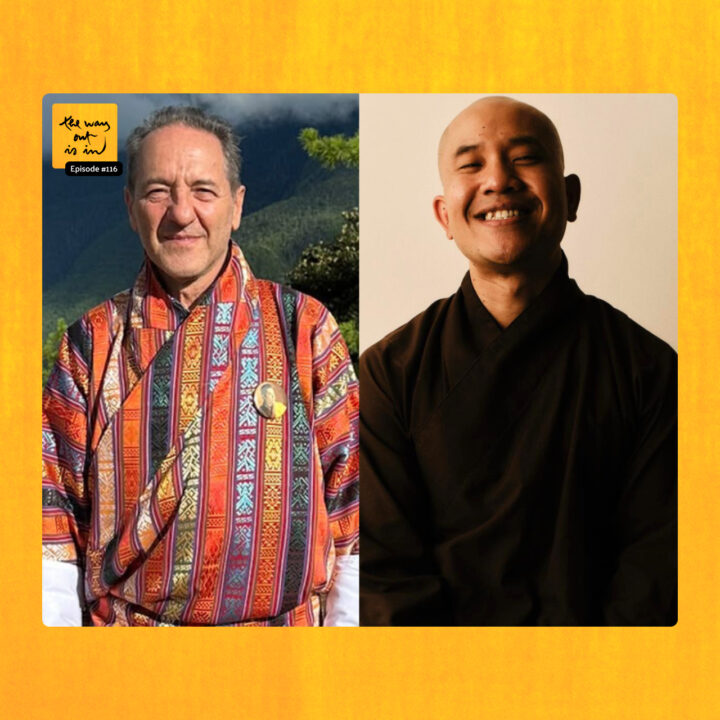
In this episode, Zen Buddhist monk Brother Phap Huu and leadership coach Jo Confino discuss the concept of ‘trust in life’. Together, they explore how Buddhist teachings can help us to navigate the tension between accepting life as it is and wanting to control it.
The conversation further touches on the challenges of modern life, such as information overload and the tendency to seek quick fixes, and how these can be addressed through mindful practices; the role of suffering in personal growth and the importance of being present with one’s experiences; developing inner trust and understanding; the role of mindfulness, direct experience, and discernment in cultivating trust; the significance of simplicity, listening, and the practice of ‘beginner’s mind’ in spiritual growth; the Buddhist concept of aimlessness; and more.
Co-produced by the Plum Village App:
https://plumvillage.app/
And Global Optimism:
https://globaloptimism.com/
With support from the Thich Nhat Hanh Foundation:
https://thichnhathanhfoundation.org/
List of resources
Brother Phap Ling (Brother Spirit)
https://plumvillage.org/people/dharma-teachers/brother-phap-linh
Interbeing
https://en.wikipedia.org/wiki/Interbeing
The Plum Village Tradition
https://en.wikipedia.org/wiki/Plum_Village_Tradition
The Sun My Heart
https://www.parallax.org/product/the-sun-my-heart/
Mahayana
https://en.wikipedia.org/wiki/Mahayana
Dharma Talks: ‘Redefining the Four Noble Truths’
https://plumvillage.org/library/dharma-talks/redefining-the-four-noble-truths
Ocean Vuong
https://www.oceanvuong.com/
Dharma Talks: ‘The Noble Eightfold Path’
https://plumvillage.org/library/dharma-talks/the-noble-eightfold-path
The Way Out Is In: ‘The Three Doors of Liberation (Episode #18)’
https://plumvillage.org/podcast/the-three-doors-of-liberation-episode-18
Quotes
“Trust in God, but don’t forget to tie up your camel.”
“Understanding is love, is peace – because, when we understand suffering, we don’t want to create more suffering.”
“If we listen deeply, we can see how many conditions we have to generate the understanding that allows us to have joy and happiness in the present moment.”
“As a human being, we all have a spiritual dimension, and it’s not far away. It’s not found in a retreat. It’s not found in a monastery. It is everywhere. It’s in the ultimate dimension, the historical dimension. It’s in the trees. It is us. But we’re not able to activate it – our collective culture doesn’t allow us to tap into that. We have been afraid of being sensitive, of having empathy, and it’s hard to be in a world where we’re not conditionedto be with our feelings.”
“Thay said not to bring your intellectual mind into Dharma talks, because it will try to agree or disagree. The intellectual mind will try to consume the understanding, which becomes a blockage to deeper understanding of your deepest potentials.”
“In Buddhist Zen Mahayana literature, sometimes we have to be a learner, and sometimes we have to let go of the learning because it’s enough. Just practice. Enjoy the present moment.”
“Sometimes we draw a graph and think growth is always going up or being solid. But, sometimes, growth is knowing that we’re suffering but not being carried away by it – just being present and holding it and listening to it.”
Welcome, dear friends to this latest episode of the podcast series The Way Out is In. I am Jo Confino, a leadership coach and spiritual mentor.
And I am Brother Phap Huu, a Zen Buddhist monk, student of Zen Master Thich Nhat Hanh in the Plum Village Sangha.
And today, dear listeners, we are going to be talking about what it really means to trust in life.
The way out is in.
Hello everyone, I'm Jo Confino.
And I am Brother Phap Huu.
Now, brother, this is only the second time that we've done a recording when we're not together in Thay's hut in Upper Hamlet. So tell us a bit about, it's coming to the end of the summer, tell us a bit about where you are and what you've been up to.
Hello, everyone. Hello, Jo. And hello, Cata. It is so nice to be back on the podcast. I am sitting recording at our practice center that is connected to Plum Village, organized by the lay community in Toronto called Tào Khê Practice Center. It is gorgeous. I'm in a cabin looking at Lake Huron, and nature is incredible. And I am on a home visit, so every two years in our monastic community in Plum Village, we have the policy, we get to visit our family, so I am at home with mom and family.
Mm, great. And I love traveling sometimes, brother, because I get to see how Thich Nhat Hanh's teachings have spread far and wide. And I was just recently in Bhutan hosting and chairing a global food consciousness summit. So it's about how to bring consciousness into our food systems. And there were about 450 participants from 65 countries and what was so extraordinary was how Thay's teachings are known to so many people working in this field and are practically used by people to really design and introduce food systems that are more conscious in nature and that are affecting sort of thousands of farmers all over the world. So that was just a great reminder that that Thay is not only present in Plum Village, but actually continues to have an impact all over the world. But today, brother, this is a topic that's very close to my heart. Because when I was young, I heard a saying that touched me very deeply, which was an old Sufi phrase, which goes something like this. It says, Trust in God, but don't forget to tie up your camel. Meaning that actually it's very important we trust in life, but also if we don't tie up our own camel, it's going to run away. And what I've noticed is for many, many people, there's a tension between saying I accept life as it is, I accept whatever comes to me, and also I want to control life and I want put my imprint on it and I want it to be the way I want it to be. So there's this very sharp tension between saying, ah, I'll accept what comes. And another part of us says, I'm not going to accept what comes because I want to determine what comes. I would really love in this episode to explore, in a sense, how the teachings of Thay, of Plum Village, and also your own insights, can help people to sort of navigate that world. So it's a very open question, really, which is, how do you see this issue, and how does it relate to the teachings of the Buddha and the way that Thay has interpreted it?
I think this is what drew me very deeply to the teachings of the Buddha and the path of meditation, where we can give the cult of a religion to Buddhism, but Buddhism really is a way of life. And in a lot of religions, we believe in destinies, which is already predetermined into who we will become, what we are, and all of the conditions that was there before us, that will make us who we are into the future. And I also grew up in some way with that kind of belief that's why before understanding deeper Buddhism and the true practice in Buddhism that's why we went to the temple as a devotional practice to ask for things so that we can receive and in a way we're not having trust and faith in our own self. We are putting our faith and trust into higher beings beyond us. And in the understanding of the teachings of the Buddha, he allows us to distinguish ourselves from the idea and concepts of another being that is in the clouds or that is so far away from us that we have to devote and sacrifice our life towards. But he invites us back to the present moment, which is the only true moment where we could really be truly alive. And it's not even about controlling the present moment, but is to be present in the present moment. And only when we are in the present moment where agency in our own life we start to tap into our understanding. And it's important to use that word understanding because we all are present, we all our alive, but do we understand how to be alive? Do we understand how to be conscious of all of the conditions that are around us, as well as are we conscious about our own life in the very present moment? And I'm going to bring in one of the powers that the Buddha speaks about. And the first power that the Buddha speaks about in the practice of spiritual, a spiritual dimension, it is to develop our faith, to develop our trust. And faith here is not towards something that is outside of us, faith here is towards our own understanding, our potential. And concretely, he wants to bring it into our own body. And that's why when we talk about spirituality, we have to talk about very concrete practice, such as when we practice mindful breathing, it brings us back to our own bodies. It is a bridge from being lost in our mind, in our thinking, in our perceptions, in our agonies, and then drawing it into the very present, which is there is life, there is a body. Is there tension in my body? What is my state of being in the very here and now? And when we're able to tune into ourself as a regular practice, we start to have trust and faith into our ability and not being lost in the future or being caught in the past. And when we are caught in past or we are being carried away into the future, there's no more fear because we know exactly what to do. So we have this faith, we have trust in our own ability into bringing us home to the present moment. And this really unlocks so many things for me because if we look at our own self, we are made of actions, of habits, actions that have come before us. Our ancestors, our closest ancestors, are our parents, our aunts, our uncles, our cousins, our grandparents who we may have had the chance to live with and we're indirect receiver of their actions. And then these action becomes our own habits. And in some ways that is out of our control. Like we can't determine that. We don't get to choose what family we are brought into, whose family, what culture we're gonna be born into. In some ways, that is just causes and conditions, and therefore our habits become a kind of pilot for our way of being, our way seeing, our ways of speaking, our way of thinking. And then whether we have agency to be aware of our habits, it depends on our luck in some way, to being in a spiritual understanding. Sometimes, it takes suffering to drive us into an environment where we get to listen to wisdom or we see friends and we see family members or we have a video that pops up that becomes a critical key into our understanding of, oh, this is why I suffer, this why I do particular things. And in today's time, in today's market, there's a lot of this, there's a lot of guru, Instagram guru, TikToks, and a lot of books. And they're all, I do believe there are wisdoms that are everywhere, but we also have to have a discernment. We have to have the ability to also always ask the questions and how does that apply to my own practice. And this is where our teachings of direct experience is so important. Thay always says that even the practice of Buddhism, we have to have a discernment. We have to have our mindfulness and ask, okay, that sounds very beautiful and pretty, but how does that apply into my everyday life? And we're not then just blindly giving our faith into other people's insight even. Because it is their insight, it's not yet our insights. But we need many insights in the world to help shine the light back to our own path of being so that we can shine our own lights into our understanding. And once we start to understand ourself more, it also allows us to understand the world more. And sometimes by understanding other people deeply, we can also understand our self. So it's not just one pathway, but in Buddhism, we always want to invite the individual practitioner to always come back to the themself, the way out is in. We can't just, you know, giving our trust outside of us, we have to develop that inner trust and our trust to the conditions that are around us, to the cosmos. And we can dive deeper into our Buddhist perspective on this.
Thank you, brother. I'm very interested in how we discern what feels true as opposed to what doesn't. So we live very complex lives and people are often presented with choices. Should I go left or should I go right? Should I move to this city or should I stay put? Should I take this job? Should be with this partner? Should not be with his partner? And people get very confused because there's no obvious answer. Doesn't say, all right, it's so clear that this is the direction. So people are often caught, in English as a term being caught on the horns of a dilemma, because we get stuck. And I'm just wondering, because you're talking about trust in our inner knowing, trust in our experience, trust in our practice. But I know lots of people who have been practicing a long time who get to decisions and just get completely confused and lost. And I'm just wondering, you know, that's partly the nature of being human, but how do we know if something is an insight or actually if we're just getting confused and buying into an old habit? So how do actually start to tease out what feels like more the truth?
Very good question, Jo. Coming back to Thay's teaching of applied Buddhism, I think our best discernment is always using our direct experience, but also activating our beginner's mind, our mind of exploring, our mind of investigation, our curiosity. I think if we don't have curiosity and openness, then we could become very poor as a seeker. Spirituality is about seeking in a way, but seeking here is not about intellectual knowledge or power or fame or pleasure. But seeking is the path to liberation. And on the path of liberation, once we find it, there's going to be a lot of obstacles on the path. And this is where I, in my generation, I feel that doubt is one of the obstacles in our pathways, where we are given so many options with the internet, with the information that we are able to listen, we're able to read, we are able to explore, but we don't really master anything because there is so much to… there's so much knowledge to grasp. Like, in some ways, we get lost in even the path of spirituality. And I've seen this in people that come through Plum Village. I've see this in our own direct community, our monastic order. And there's something that is very difficult in our human nature, which is greed. Even the greed of knowledge, even the greed of knowing. And there is a discernment where we also have to know what is enough. For example, when we find a spiritual path that that addresses our heart, and the heart has another language to our own self. There's a fulfillment that starts to arise. There is a warmth, there is a curiosity. We have intuitions. We, as a human, we have our own compasses, like our survival compasses. Our learning and openness, our radars that are also activating and we also have discern, also we have to have discernment towards also our fears. So there's unfortunately in our times, you know, there is so much also fake news and fake spirituality that we have to be mindful of. Coming back to where I'm starting and it's leading me in many pathways because I'm just trying to share from my direct experience. I think the first thing is our own knowing and our body, our nervous system, our mind says, ah, this is something that is fulfilling my hunger of seeking, my hunger of understanding. And once you found it, you got to be resilient. You got to stick with it. You have to do your daily practice. And sometimes the danger comes in our culture where we want quick fixes. People are like, okay, but I'm not enlightened yet. Or I haven't transformed my habits yet. And we know that habits that we have accumulate, that we had accumulated, sometimes are century old. You know, it has a root that is so thick and something that we've just explored as in mindful breathing and our mindfulness practice of understanding suffering is still so shallow and we want to get rid of our suffering, then we're ready to give up. We're ready to jump into the next adventure in some ways. So for me, my own direct experience was also not being caught in the words, but feeling the energies of the people I'm with and the environment that I'm in. And our feelings and the energy that is given out, you know, there's a direct exchange there. And we can tap into that and know and be sensitive to this. And for myself, like I came to Plum Village blindly. Like I came with my father's faith and he didn't say so much about Plum Village. He just said, I'm taking you to a place that changed my life. And because as a kid, as an eight-year-old, kids are so intuitive to energy, I just remember feeling that this place is so safe, and this place is so kind, and the people that were around were genuinely putting effort into transformation of their own self. In Plum Village, it's not glamorous, you know, there was a lot of things that that doesn't meet the standard of like a public space, you know, like the ladders were like crooked and there was, it was rugged. And I kind of loved that. It made it feel so down to earth and human, but my intuition was like, okay, but this place is where I could be so authentic to myself, so there's also that kind of knowing in the heart space. And just to wrap up, and we can keep exploring, once we found treasure, like a gem that speaks to our heart, we have to know how to treasure it. We have to know how to take care of it and cultivate it and not take it for granted. And that is also a very difficult practice because our human capacity of treasuring something, sometimes it's very limited. We are such beings of greed, of like, we're so tempted into the next shiny thing. And there's so many stories in Zen to remind us of not abandoning the ship and the raft that we are on, is telling us when we found a monastery, that has a teacher, that teaches the Dharma, it's not perfect, but it's teaching authentic Dharma and there's food and there is a space to sit and to sleep. Even if they kick you out, you're gonna kneel and keep begging to be able to stay there. It's like, you have to have a stubbornness in order to like not give up and to show your determination. You know, and I think in today's day, like, you know, we don't have tests for you to come through the gates of Plum Village. We don't ask you to do 108 prostrations or to show any kind of faith and determination besides your openness and your curiosity and harmony in being open to apply these teachings into your direct experience in the retreat. But besides that, it's very open and the practice is like, here it is, this is for you. And we all, we all also have to, like, also sometimes zone out and see the tradition as something very vast. And this is something for me that's also very important because there's no perfect community or perfect tradition. And sometimes we get stuck into one or two individuals that we may see that are not a perfect practitioner, who may have some faults, and they're very human. And then we're ready to throw everything under the bus, you know. So there's so much to say in this, but I don't want to get so tangled into it as we are speaking into the light of developing our own trust. Yeah.
Thank you so much, brother. So there are a few things in that that I think are hugely valuable and in a sense which Thay embodied. So one is simplicity. So what you're saying is there's so much information, so many different views and ideas that it's very easy to get lost in the complexity of life, but if we come back to what is most simple, it is always about connection, about where we feel safe, where feel we can show our generosity, where we can show our kindness. So I think Thay's teachings were all about sort of not eradicating complexity but going beyond complexity so people could find the essence of life. And from the essence, then you can build back some complexity. But what you're describing very much is that sense of starting off with things that are very simple that we can feel attuned to, and then deeply listening to ourselves. And I'd like you to talk a little bit more about what it means to listen deeply to ourselves rather than listen deeply to others. And maybe also if in relationship to Thich Nhat Hanh himself because he dealt with all sorts of difficult situations. He didn't have an easy life himself. And I'm just wondering if what you discovered about Thay in his ability to really listen deeply to find what was a right path forward for him or for the community in general.
Yeah, listening is a wonderful quality that we all are encouraged to develop and practice because once we know how to listen, communication is built. And I love this emphasis on listening in Plum Village because a lot of the times we think about communication as a bridge of speaking, but I've discovered one of the most powerful bridge of connection is listening. And we are, oh, it's horrible to say this, and I'm a part of it too, but we're really bad listeners in our modern time. We are so eager to cover silence in some ways, you know, we've been trained now to always fill in the emptiness. And this is not the deep emptiness of spiritual understanding of the Buddha's teaching, but the emptiness of being bored, not having anything to do, being still, and therefore our habit energy in our nervous system kicks in and said, like, get excited, like what is this feeling of just doing nothing, or it's like time is money, we've got to be proactive, we got to be productive. And in all of the wise teachers, the wise giants and leaders of our times and of generations that were before us, they all had the ability to sit and be still and to listen to the surroundings that were around them. And it's a very spiritual practice of sitting under a tree and listening to the sounds of the breeze that is touching our skin. It is listening to the birds that are freely flying and migrating. And it does something to us because it makes us feel that we're not the only one on this beautiful planet. It reminds us, as humans, that we are not the only intelligent being and that there is so much to tap into and know that we also this dust that is a part of this incredible cosmos. And once we touch that interbeing, this is the language and the insight that our teacher has articulated into, which is the interbeing, the emptiness of self, we are so much more than just one individual. We start to bridge so much wisdom of non-self, of non-discrimination. Like, how could we other each other if we are all sharing this wonderful planet? And so the listening begins to play an essential part in the path of deep love, true love, of liberation, of enlightenment. And so listening here, when it comes to a very concrete practice, I've just painted the grand picture of listening, but to our everyday life, you know, listening, how we wake up in the morning. Is that what are our habits? What are we doing the moment we wake up? What are the choices that we are making that we're listening to, right? Yes, we can be in the city. We might not have the sound of nature. It could even be the sirens. It could be the noises of the taxi drivers and the shouting of the people on the street or the road rage. Like all of that is gonna exist and we're not here to cut that off from us, but how can we still be at peace in all of this noise? And this is where we learn to listen to our breathing, we learn to listen to our spiritual practices that we have to develop. Sitting is a practice of listening. Meditation is listening, listening to our minds, our thinking, our perception, asking Are you sure? And developing our inner peace, like bring peace into the present moment, to listen to the noise and the non-peace that is out there. And the silence allows us to hold the violence, the pain, the suffering, and to bring peace to that by holding it and understanding it. Understanding is love. It is peace, because when we understand suffering, then we don't want to create more suffering. That is peace, right? So the listening is another language of looking deeply. It is to see through the objects of our meditation. It is to see through ourself. It is to see through our own suffering, to see through our happiness. What is our deepest sense of knowing how to be content in the present moment? And every day as a meditator, we have to ask, how could I be happy in this moment? Do I have the ability to generate joy and generate happiness? Thay loves using that word generating because we have to have the ability to generate that. And if we listen deeply, we can see that we have so many conditions to generate the understanding to have joy and happiness in this present moment. And sometimes we don't know how privileged we are and we forget the environment that we're in and we take it for granted. And if we listen to this very present moment, we know how much suffering there is in this world. And how could we ease the pain of someone in the morning and bring joy to someone in the afternoon? It is all possible. And reflecting back to us, the Buddha has said we have to learn to develop our inner island. We have an island of our five skandhas. They are the pathway into our own self. That is our eyes, our ears, our nose, our tongue, our mind, and our body. They are our senses. They're the gateway for us to feel, to experience the world. They're our senses. And we have to sometimes know how to close those doors to come back and take care of the island within us. And in the book, The Sun My Heart, Thay talks about, he was writing a book and he needed to go out for a walk to free his mind and ease his mind and take refuge in nature. And as he was walking, there was a very strong storm of wind that was coming through and he remembered that he forgot to close the windows and the doors of his cabin. And so when he went back the first thing he did when he saw the mess was not to clean the mess but to close the windows and close the door. And then he took the time to then tidy up the cabin, to take each piece of paper that was blown away into all over the place in his living space and he mindfully, one page at a time, knowing how to stack them in the right order. And then slowly tidy up his home. And said just like that, practitioners, we have to have the ability to be aware that when we are in a storm it is not to engage more but it is to check in and close the windows, the doors and take care of our inner space, our inner island and to listen where it is that is so noisy that we can embrace it and understand it, to ease and calm it. So the listening of a teacher that my teacher has given us is a work of peace. Coming out of 2026 high season, which is summer retreat, June retreat, so June, July, August, which was the peak in Plum Village. And I think within those three weeks, those three months, excuse me, we hosted like almost 4,000 people, 4,500 people. And I just realized so many moments. I had this ah moment and this deep gratitude moments holding these circles in the retreat. And I was like, oh my gosh, Thay, you genius. Like you were creating an experience for people to touch deep peace and be part of a peace movement. And there's many paths to peace. And you chose the path of retreat where people get to experience three weeks, two weeks, one week of direct experience. And every time that you are angry, you're triggered in a retreat. You listen to something, you heard something, and your suffering came out. But you knew how to be with that suffering. That is a peaceful moment. That's a peace movement right there. That is your contribution to a peaceful moment. So yeah, I was just realizing, you know, like, Plum Village is Thay's insight and I've been living in it for 25 years and I always said, oh Thay, I understand your path, I understand it, but then there's a moment when you're just like, I get it. I'm like, I'm locked in, like I get it. This is it. Like the environment that Plum Village was able to give to people in a retreat for them to hold their suffering, their understanding, their joy, their happiness, a safe place for kids to be free from the machines, to be free from the consumeristic mindset that is 24/7 in our capitalistic world and to hold each other's authenticity as it is was so powerful and I was like, okay guys, this is a peace movement and everybody who's in a retreat you're part of the peace movement, whether you know it or not. And a lot of this insight comes from listening, not coming from speaking, but coming from being, being silent and observing and feeling.
Mmm, beautiful, brother. And so what was coming up for me was all, pretty much all of the practices in Plum Village are about slowing down, stopping, being silent. And you think, well, what is the purpose of that? As you say, it's to create space. And in that space, we can find a sense of peace. And also we can find our sort of inner wisdom. And I wanted to ask you this because a lot in the coaching I do and in coaching training, they talk about, there's the person who is acting, so I'm angry at the moment. And when we're in our anger, we feel I am angry. But then there's always a sort of wise observer in us that can look at the anger and just say, actually, you're at the moment expressing anger. But you are not the anger. And so I'd love you to talk a little bit about what part of us do we touch when we touch that inner wisdom, when we're able to recognize that the normal behaviors, let's say, I have, which normally I think that's just me, that's who I am. I get angry when people say this, or I feel this way when that happens. And then there's this other part of me, as I said, that knows that is not all of me. That's just a feeling, but actually there's a part of me that also already knows, regardless of whether I've meditated or whether I've practiced, but there's part of it that's always present that is able to discern something deeper and more truthful. I just want to, just for you to touch that a little about what maybe even personally, what it feels like when you are able to sit in the middle of your life and not be caught by it.
I would say that we are just being our true selves, our high potential of love and understanding. There's always a choice when we practice mindfulness of how to engage into the present moment. What the present is offering us, whether it is anger, it is a confrontation of something that's very uncomfortable, and we could hide away from it, we can run away from that, we could be angry. And anger is like a bell of mindfulness. It's like, we can always ask the question, and why am I angry? Why do I care? Because anger comes from a place of connection. It's because I'm caring about something that's why I'm very angry. And then, our spiritual side or our love and understanding side is like, and now how do I move forward? Do I take anger and use it as a weapon? Or do I see anger and then bring up the other energies that are also inside of me, my love, my trust, my compassion. And compassion in these moments is very powerful because compassion is not about saying it's gonna be okay but compassion here is like then to meet the situation with awareness and not being driven by hatred. Compassion allows us to not be a hateful person but compassion is to discern right and wrong and clarity into what is present and we always say, we can speak about the truth. And how do we speak about it is always our option. Right? We can be very angry and be very violent about it, or we can speak about truths in a very calm, clear presence, and sometimes it's very painful to hear and even to say, but it is something that is so… it carries our understanding of these are the wisdoms, or these are words that can help the other person break free from their illusion of ignorance. And the way we say it matters, you know, it's like if we are always just presenting ourselves in these places with so much aggression, they won't listen to aggression. But if you say it in a calm and present way, then is still the same message, but it is presenting itself where the other can listen, can hear it. And I'm not saying that being loud and the enchanting things are not appropriate. There is a place for all of these, all these moments, but in deep conflict and in deep peace negotiation and speaking truths we have experienced that when we present ourself with clarity and kindness we're unshakable and our words carry a wisdom that is not even our own because we're speaking to help liberate suffering. And when we do this work it's a very community building role. It's not selfish, it's very selfless because we're putting ourself out there in a way. It's a very vulnerable position to be in. And for me, like when we speak about being with anger and taking care of our anger and tapping into our clarity of how to be with our anger, you can give it a label. Oh, you're a Buddha in that moment. You're a Zen master. I'm just like no, we're just a human being that knows how to be responsible for our emotions and responsible for suffering. And I think bodhisattvas and Buddhas are very responsible people. They're not here to pour out their suffering and lay it on others, but they are very, they're very capable of understanding it and holding it and transforming it and then sharing the way of transformation. And so for me, sometimes I'm like, okay, Phap Huu, you're a monk. You gotta, you gotta do better. And then sometimes there are days where I'm like, I'm just able to be at peace with something that I'm working with and I can let go of something that I know is not healthy for me. And that is just, oh, that's just me growing. That's just maturity also, you know. So we all have this in us and Thay has really said this and I think part of our podcast is to build on that spiritual thread in society. Thay said, as a human being, we all have a spiritual dimension, and that spiritual dimension is not far away from us. It's not in a retreat. It is not in a monastery. It is everywhere. It's innate everywhere. It is in the ultimate dimension, in the historical dimension. It is in the trees. It is us. But we're not able to activate it. Our collective culture doesn't allow us to tap into that. And therefore we have been afraid of being sensitive, having empathy and yeah, it's hard to be in the world where it's not conditioned by the right environment to be with our feelings, you know? So therefore, aggression seems more powerful. They coat it with strength, with stability. Oh, you're angry, so be loud, you know? And say that you can stand up for yourself. And the wise ones are like, oh, you're angry. Okay, I'm gonna take care of that. I'm going to be tender to myself because anger is present and I'm gonna take of my anger. And taking care is a very tender kind of energy that we are putting out and it's against the stream. It's against the collective mainstream way of being, you know. I was, so I'm on a home visit. I can't believe I'm talking about this. That's really funny, but go ahead, yes, anyways. Yesterday I went to the community gym and then I discovered there was a sauna so I went into the sauna with a lot of elders in there is a lot uncles and grandpas that were there and some were like really enjoying, you know, the silence and there's something about the sauna that the heat that makes me not really get lost in my thinking and I'm just dwelling with the body. The heat for me plays a very incredible like cushion for me just to be in meditation And, of course, people started talking. And all the conversations were so shallow. It was so shallow that we couldn't go anywhere deep. It was very superficial. And I just stopped engaging because I didn't want to lose energy. And then there was this gentleman that came in who was deaf and was doing sign language. And I connected to him and he shook my hand right away. And I think he's also on the spectrum of autism. So… I have a lot of autistic friends and they're very sensitive to energies of people and he is also older so his way of being, in our way of looking could feel a little bit not like our day to day but I was, I'm always here for the underdogs so I was very connected. And we had a whole connection going on through sign language of just experience that I see you and I love you through just hand motion of hearts, of, you know, heart to heart, you know, it was just a lot going on. And I was, that really stayed with me on the drive from Toronto to the practice center which is two hours, 20 minutes. And I just reflecting on that experience where the two of us connected because we weren't afraid of showing our vulnerability of human, which is to see each other, to love each other. We don't know each other. I've never met him. He's never met me. And we're in a sauna sweating and we're having a very deep connection. And I was talking with a dear friend that came up with my mother and I up into the practice center. And she's a psychologist, and she's saying that a lot of her clients, especially men, they just don't have the capacity to be vulnerable. And she also, if you can't share with me your information, then it's gonna be very hard for me to guide you into understanding a path forward. And so there's a lot of fear in expressing ourself. And therefore having friends is so crucial. And developing our ability to listen is so crucial because we all have friends, but are we listening to our friends? Are we developing our listening to speak about something that is deeper, you know? And she's my childhood friend and a Plum Village practitioner. And she was sharing to me that after having so much Dharma sharing in the monastery, sometimes she cannot go back to some of her brunch meetings with her childhood friends because she's like, I don't want to talk about the next fancy car. I don't want to talk about the purses and the housing and so on, and how big our houses could be if we invested in it. It's like, that doesn't matter to me anymore. I want to understand how we are actually doing, what is the impact of society having to our children, for example. And these are discussions that could be talked about, but somehow it touches something in all of us that it means we have to be vulnerable.
Thank you, brother. And, you know, just going back to one thing you were saying and it resonates so much with me is that I find with so many people that we're always looking for the answer outside. You know, whether it's the next book we read or the next course we take, the next degree we take and that actually, because I think people believe they don't have what it takes inside of them. And they're constantly looking outside. But when we actually look inside and take the time and the practice and as you say, quieten our mind and start to listen, we actually realize every one of us has that potential Buddha inside of ourselves. And I think that was one of the core teachings of Thay that actually we all have the Buddha seed and it's a question of how we water it. So I want to come back to you. You mentioned earlier about beginner's mind, which, you know, for me, is very much about touching the Buddha seed, because the beginner's mind is so important, because it's all about sort of shedding our knowledge, shedding our expertise, shedding our habits, and actually coming back almost like a newborn baby, where we're just saying, actually, we're open to experience life again rather than constantly sort of trying to navigate according to our set of beliefs. I'd love you to talk a little bit more about what it really means to have beginner's mind. How do we actually, and maybe quite practically, how do we gain that? Because we're so, most of us do not realize how much we are controlled by habits. We say, oh, that's who I naturally am, as opposed to actually that's what I've learned to be. So how do we get back to beginner's mind and what does it feel like to be in a place where we're not of course eradicated our views but we create a space for sort of, in a sense, a renewal of our way of seeing?
The beginner's mind in our tradition, we speak of it as our ability to be humble, to have humility, because we always… we always come to our own intellectual rationality, you know, we're going to try to grasp everything with just our mind. And we are being trained by this, you know. Our whole education in most of the Western world, it's about training our intellect. And we're not being taught on how to feel, how to love, how to listen. And the beginner's mind in Buddhism is very tied and connected to the mind of love. So the beginner's mind is a mind to expand our capacity of love. And love we know has four elements that is our kindness, that is our compassion, that is our joy and that is our inclusiveness. And Thay has added two more which is reverence and trust. And our beginner's mind gets in… Okay, our mind will get in the way when we always think we know it all. As simple as that. You know, I've caught myself so many times and I'm still practicing this. I always have this like auto-pilot, I say, oh, I know. Yes, I know. Uh, I know. Oh yeah, yeah, I know that. I know that. I say do you? Like, do I know that? You know? And I'm catching myself and I always remind myself to be quiet, like listen and whether you agree or not agree, just listen. And Thay has spoken about the art of listening to the Dharma. Thay said, don't bring your intellectual mind into the Dharma talks, because your intellectual mind will try to agree or disagree. It will try consume the understanding with your intellectual mind, which becomes a blockage to your deeper understanding of your deepest potentials. Because your intellectual mind will go, oh, yeah, but that's for them. That's not me. You know, oh, but I'm not a monk, the monk should do that. Or oh, that's for others. I had my story. My suffering is da da da da, so that our intellectual mind gets in the way and the beginner's mind tells us no, you are present. You're full of capacity The past is the past. The present holds all of your potential and you had to tap into that. And so the beginner's mind is one of the highest minds in Buddhism. And practically, you know, it's learning to sit without knowledge, without… Like pouring knowledge into our head. And I say this as a joke, but it's true, is like don't listen to the next podcast, like stop stop stop trying to grasp on so much understanding of other people's wisdom. And I find myself doing this too, like whatever I'm sharingm dear friends, is everything that I also do, so it's not a criticism, but it's also a reflection back to me. Because sometimes we don't trust our own knowledge, we don't trust our understanding. So we want to hear what other people have to say, and therefore, we don't have the discernment to ourselves. It's like, and where do I stand here? And what's my understanding here? And of course, when we don't have understanding, yes, we have to seek, we listen to Dharma, we listen to talks, we listen to podcasts, we read books. And in Buddhist Zen Mahayana literature, we say sometimes we have to be a learner and sometimes we have to let go of the learning because it's enough. Just practice. Enjoy the present moment. Like stop seeking, stop striving for. And so that's why, you know, Brother Phap Linh always says, you know, Buddhism is always contradicting itself because in one psalm it says go out there and have an aspiration and learn about it. And then the monk comes and says, OK, stop. Sit there and do nothing, right? It's contradicting itself. And the path of the practice is always, everything has to be very situational and intentional in that moment. And… When you catch yourself overstimulated, drained, in those moment you have to restore yourself by giving yourself space. Like you said, like develop the practice to give yourself space in order to understand more or to hear more, to listen more. So I always look at the mind of love and understanding and beginner's mind is my field of like sowing seeds for the understanding to grow and when there's so much understanding you have to harvest that, you have to make sure there… It's like the seasons of the farm, the happy farm, right? There's a harvest season, then there's the season to plow, there's a season to plant the seed. And then, day to day, there's still the weeding to do, there's still the tending to do, there's still just observing. It's like oh, the land is fine, I don't need to do anything. In this moment rest, take care of yourself, right? And then when you're harvesting, that's also taking care of yourself. You're taking in the wisdom that you're able to understand now from all of your meditation and your practice. And… I always remind myself that there's so much to learn in life. Never be too sure that you know everything and always be open. Even to the Dharma, you think you might understand what the Four Noble Truths is, but how are you practicing it in this moment? So then you're a learner again. And I think, as a teacher, my beginner's mind has to be much more activated because if I think I know, then I'm only transmitting one way. I'm not listening to the class that I'm teaching, the student that is in front of me. And every time, and I learned this from Ocean, Ocean Vuong, and I asked him, like, how do you check yourself when you know you're teaching well or not? And he said, well, whenever I ask a student if they've understood what I taught and they say no, I don't get angry at them. I always check back and say, oh, how did I explain it? How did I share it? And I go back to the drawing board and I said, oh, that methodology didn't work. Maybe it's this new generation. We have to teach this new generation in a different way, right? And then when I'm… It's the same for me as a Dharma teacher. It's like who's in front of me? When I'm with my Vietnamese community, the teaching is in a different flavor because the suffering is different than those of us who are in the West. And when I am with young people, it's different than when I'm with those who are older, right? And so on. And that's all beginner's mind, because we always have to be curious, understanding, and saying, okay, what is in front of us? And how do we engage in front us? And those who think they know it all, they would just come, oh wait, this is the methodology that I've been using and I will force it down your throat, you know? And that is quite violent, to be honest. And I've also learned from teachers in those ways. And I don't remember anything. And I've taken a lot when teachers are very engaging. Yes, they prepare their lectures and their teachings, but they're very present and I can feel that they are tapping into everyone that is in the room.
Beautiful. And related to that brother, when we talk about trust in life is also who do we trust in live apart from ourselves. So I was thinking as you were talking about age and about the role of elders in both Plum Village and society. So, I am going to be 65 later this year and I do… Still alive, still alive just. And there's a part of me that really feels that as I'm aging, I am deepening my understanding. And that comes not just from exploring the Dharma, but it does come from a sort of, as I am getting older I feel I am able more to synthesize, to have a broader understanding, to have seen what, to know what happened 30, 40, 50 years ago and to place it in the modern context. So, and also I recognize that I don't understand technology. I don't understand a lot of things young people just naturally understand. But I have developed something that has value, I hope, in it. And so I want to ask you about where you place your trust in people because elders have a particular role in Plum Village, but elders don't always know what's right, but there is actually a respect of listening to them. And also in Plum Village, a lot of young people come in and also have a new forms of wisdom around, for instance, accepting different sexual orientations in a sense that older people may not be, may have not built into their life and understanding. So, I'm just interested in who we place our trust in and how do we discern that?
I think, as a Buddhist perspective, we always place our trust in direct experience. There's this line that Thay said, and it stays with me forever. He said, Thay has had many teachers, and one of his greatest teachers is suffering and the experience in life. Because human beings, we're always changing, right? I've placed a lot of my trust in a lot of community members and I'm very happy that I can place my trust there. And as human beings, sometimes because of the ebbs and flow of life, you know, things take different rows and different turns. I've had two incredible mentors, and I've placed a lot of my trust in them. And because of causes and conditions, they had to disrobe and they left the monastic life. And I was so broken when they left, but I trusted in my own self. I trusted in my own deeper aspiration of why I'm here in my monastic form and why I am a monk. And they played a role in who I am today though, you know? It's like, I still have so much love and trust. I still have so much of love and gratitude towards them because my early years, like they really played a part. And I always come back to that direct experience of where I place my trust. And we have wise elders, but we also have elders that are not so wise, that are caught in views that, you know, sometimes I've accepted maybe in this generation, they will not change. And I have to be okay with that and I have to be skillful with listening too, right? Because that's just the reality of life. And then I follow in Thay's footsteps. He has always put his ears down to the ground, to the young people, to the next generation. He's like, what are they saying? What is their experience? What is their life journey? And also to have, you know, boundaries about that because sometimes the youth have views that are still very fresh, and sometimes naive, you know? But there's a freshness to that, and there's a curiosity that I wanna ask the question, oh, is that what is happening in the present moment? Or is that just a phase? Is that just a trend? You know, like there's so many things that we can put our hands and feel the pulse of the body and our discernment is also the compass of the Four Noble Truths, the Eight Noble Path, the understanding of love. We do have ethical guidance that guides us into our understanding of things, so when when it comes to, like growth also, like, Jo, what you just shared I also… Well, I'm turning 39 so I feel like I'm about to climb up to that 40 and I'm just like holy macaroni, but I'm, at the same time, still feeling so young. I'm still feeling like I can't be too sure like I still have to learn so much and it's true. And at the time I'm like oh, wow, I have an opinion, I can say something about that because I've also lived in a very rich environment where I have been able to see, listen, hear and learn from and to be generous in the offering. And it comes back into that question of beginner's mind. I think at any age, we can always stay young because our wanting to understand is always there. It makes us curious and I think that's what allows us to be so rich and healthy, you know? Like, Thay always jokes with us. He's like, sometimes Thay thinks he's younger than all of you because he's always curious of the world, and a lot of you are just stuck, and you're just comfortable. Get out there, get engaged with places where people can come to Plum Village, bring the retreats there. Bring the energy of this Dharma beyond the village, too. It's like, Thay said, there's so much work for us to do. You know, and that is a part of his, he said, when you're engaging, you're always learning. You know, there's the four pillars that Thay gave us, which is practice, study, service, and joy. And he said, when you are enacting one of them in the true sense of a spiritual practitioner that's engaged, all of them are enacted. When you're serving, you are learning, your beginner's mind is operating. There's joy because you are able to serve to the world. And there's a fulfillment, so therefore, you're learning and the practice is there. So there is, for me, with trust, you always have to cultivate it. You're always cultivating it. And trusting oneself is like, okay, I want to trust myself. But sometimes I also say, I always check in with myself and say, is that view correct? You know, the Buddha always says, are you sure? And the first noble truth is right view. And what is right view? It is the view of non-discrimination. Is there any sense of discrimination there? Is there also, is it carrying the insight of interbeing? Is it carrying that insight of suffering and happiness? And sometimes, when I can't trust myself, I do have to ask my elders, and that's wonderful. That's so rich, you know, and sometimes we are lacking spiritual food, you know, tap into the Dharma, tap into the podcast, tap into the Dharma talks of Thay, there's so much wisdom that I always come back to listening to Thay. He's a big part of my playlist and sometimes because of the age and where we are in life when you listen to something and you can have a wonderful aha moment and you go aha. I can clock it now, like when I was younger, I didn't understand that, but now I can feel that, I can vividly sense that in my bones because I've gone through that suffering. So therefore, I am a different person now, you know. And trusting in our own growth. I think reflecting back, we can always see where we've grown, and sometimes where we have fallen back. And sometimes I can recognize I'm lacking growth in myself and therefore I need to take a step back. I need to do less. I need to meditate more. I need take refuge more. And growth in our view is not about up or down. It's just about flowing, you know, because sometimes we draw a graph and we think growth is always going up up up up up or being solid solid solid but sometimes growth is knowing that we're suffering and not being cared away by it but being present and holding it and listening to it. And one of my friends who I've been talking and supporting is… I'm telling them to stop engaging in it because it's the same wound and you keep trying to fix it, but the more you're poking the finger, that wound is not gonna heal properly. Like you're just pressing it and more blood and more pus is coming out. I'm like, can you please just listen to me as a friend and just give it space and feel what needs to be felt. You can lay there and cry for two hours, it's okay. You can feel discomfort, yes. You can feel not knowing what to do next, it's okay, because you're bringing your mindfulness to it. You're being with all of the stages of suffering in a way. And I've done that myself. And sometimes it is painful, because that means you're gonna let go of a part of you in that new growth, and then you can trust in your ability of transformation. Yeah.
Mm, thank you, brother. So I just want to come back to suffering because that's the first noble truth.
We love suffering.
Most people trust in life when things are going well and as soon as something goes off the rails then they stop trusting in life and then feel they need to take control and try and eradicate it. And everyone I've ever met who's gone through suffering has changed normally for the better because they've had to face into that and find out something that was deep within them that until then they had not been able to access. And yet of course it's also true that as soon as we suffer we complain and say why me why why is it i'm having to do this? And then we try to either eradicate it, to deny it, to repress it. What is it about us that just cannot say, actually, this suffering is present and if I work with this, then I will develop as a human being? What is so difficult about that? Why is it that we immediately want to deny it or oppress it? And I know there's loads of reasons like we feel humiliated or we feel we're not good enough. You know, we have all this, but what is it about us that we know that actually we can only grow through suffering and yet we try everything to avoid it?
Because suffering is bitter, and whatever is bitter doesn't taste good. And ironically, I don't know if those who listen have ever eaten bitter melon. It's one of my least favorite vegetables, but in Eastern medicine, it's really good for you. It's really good for your liver, and it's just really good for you. It does wonders to your body. It's the same with suffering. It's like suffering when looked at it and practicing with it and not being a victim to it can be very healthy for us. But suffering leads to our running away from the present moment. And this is where it's very challenging in our modern times to have the agency of listening to our pain and being with it because it's, it's scary. You know, because being at home in the suburbs in Mississauga, it's a very big difference than being in Plum Village where the moment I step out of any of our buildings, we are thrown within community, we're thrown within trees, flowers, blue sky. And all of this environment plays an incredible role to our experiencing. And in our modern day, in some ways, we're living in cubicles, like cubicle dead matters, you know? Like it's just like, it's a block. And if we are skillful, we will have a lot of plants and it can remind us of the beauty of life. But in our society, sometimes the suffering makes us feel dead inside of us and the environment around us also makes us feel very dried up, you know, so it's a very difficult experience to go through it. And then here comes the marketing. Here comes the sweetness of food and candy to run away from suffering, right? Thay always says, when you're suffering, don't open that fridge because we can start just devouring all of this food because we want to not feel our pain or, you know, get online, whether it is an addiction to the screen or to game or to pornography. Like all of this is a way to make us feel a certain way. Right? Suffering is a feeling of a certain way and everything that is given to us is to make a feel a way a certain, to forget. Go shopping, feel better. I've done that. And it's instant noodle. And then afterwards they're like, dude, why did I buy this? Like, why am I playing a part in capitalism? Why am I taking more from the Earth again? And this is where Thay says mindfulness is the power of free will. It's like, if you have it, then you can say, actually, I don't need that. I am in pain and I'm going to take care of that. And I'm gonna learn to be with it. And this is where meditation and spirituality and retreats play a very essential part in our modern time. And I think meditation is a survival practice now, rather than an optional practice. Because my own pulse in our collective at the moment is, you know, we are driving ourselves more away from our true nature of interbeing, of understanding that we are so deeply connected to each other's trauma and each other's suffering and each other's violence and pain, but we are going to keep othering ourselves and others and we're going to keep, yeah, just destroying ourselves because there's also the mentality of YOLOs, okay you only live once, so let's just do whatever we want, you know, and greed comes in and then the system comes in that can drive us into paths of yeah, if I dare say, of evilness, you know. And true meditation is to not create more suffering, and I think this is where if meditation can replace, you know, the doom scrolling, let's doom scroll our mind, let's doom scroll our feelings. And if meditation and a walk in nature can actually calm our nervous system as well as give ourselves much more space to feel and to hear, I think these are really good replacement and a lot of it is free. And there's so much to say there, but I'm gonna stop there, yeah.
Thank you, brother. Last thought from me, or last question really, is the role of the Buddhist understanding of aimlessness and also intention. Because when we say trust in life, often what people want to do is control their life. That I, if only I get to this goal, if only I achieve this, then I'll be successful, then I'll be happy. And the teaching of aimlessness is to say actually I go with the flow of life. I let life show itself to me rather than I try and act on it. And also then within that is sort of the power of intention. So to say, to be careful of what we wish for. And actually, if we have a clear intention that we want to develop our understanding rather than earn more money, then where our intention goes, our action follows. So can you just give us sort of this sense of, when we talk about trust in life, how that interacts with this Buddhist understanding of aimlessness, that actually, what is it to let life show up for us rather than us to force life in a particular direction?
Thank you, Jo. Aimlessness is one of the doors of liberation. And sometimes it could be like a snake that if you don't know how to practice it, it will bite yourself and it could be poisonous even cause sometimes people then consider themselves not having a purpose to offer to the world and say, oh, I'm practicing Buddhism, I'm aimless. Yeah, right. Aimlessness, as many doors of the Dharma, is to help us to not be caught in and to free yourself in experiencing life. When we say aimlessness, it's like, yes, I have a goal there, and we may set our intention towards that path of meditation up towards that aspiration. I want to take Plum Village as an example. Thay set up Plum Village with the aim of being a refuge for refugees, Vietnamese boat people, so that they shall not lose their culture, that Vietnamese people are so community-based that we will lose the richness and our heritage of this thread and this organism of our community sense unless we are brought together, as well as in the culture of Vietnamese well-being and culture, Buddhism plays an essential role. Thay set up and he planted the seed, he did Plum Village. And if he stayed with just this is a place for refugee people, then it would never be what it is today, right? He set the intention and the goal was there. He brought the land, he started developing the practice center. And then he became free, he wasn't… he didn't get stuck into just that map that he set up at the beginning. As life has its wonders, Thay becomes a teacher, and the flow of people that is eager to learn about meditation and mindfulness comes to Plum Village. So Plum Village takes different shapes and form, the teachings, the way Thay engaged, the way Thay teaches. And what he taught at the early days is very different than what he teaches later because he grows as a person also and he's only able to learn more because he's practicing aimlessness. He is open. He being in touch with the present moment. He's being in contact with the flows that are being brought to his door. But it doesn't mean that he doesn't set new intentions every moment, right? So it's for us to not be caught in something. And sometimes we are so caught in the aim of our happiness that we think we have to get this. Then we are happy, then we're caught in our view. And the practice of aimlessness is to say, yeah, but look at your path to happiness. Look at all the signs that are around you. Can you touch happiness now? Are you enjoying the path of growth? And if you touch that, then you're like, oh, I don't have to be at the finish line to be happy. Then you're free, right? So the practice of aimlessness is to free yourself from the mindset of only when I arrive there I will be happy. Only when I arrive there I will feel successful. And aimlessness is to allow us to be in touch with every moment. And the Buddha says, the mind creates the world. Intentions are so important. Intention is what drives us. Intention is what creates our world. It's like if we are always consuming a particular source of stimulation and information that becomes our mind and that becomes our world. So having the mind of wanting to bring peace and bring love, those are very important mindsets that we have to cultivate and the aim is peace and what is the path to peace? We have to be open, we have to signless, we have to be aimless, we have to be aware, we have to walk it and see it for itself, you know. And the Buddha also speaks about aspiration as a source of energy, as food. And we have to have food that motivates us into engagement into the world. Somebody asked me, a kid asked us and asked me directly, it's like, what is our purpose in life and that's a very deep question, and many traditions ask these questions, right? And the wise, in some Zen masters, when they're being given that question, they won't say anything. Because then, if I'm to say something, then that will become your aim, and you won't understand what is your own purpose for your own life. But reflecting on it, as an individual, our life is so short. Like, we are of the nature of impermanence. We're all gonna die. We're gonna return back to this beautiful planet Earth and we're gonna be a dust and we're gonna nurture the Earth for the next generation. And what we have is this life that we've been given and how we live it is important. And what is our purpose? For me, as of now is how could I be kinder, be more loving and spread that love and spread that true sense of care, you know, to the ones that are around me and my beloved that I have in my community? And how can I serve? Because we're of the nature of generosity. We, when we can tap into our generosity, we are so much healthier in our state of mind, in our state of being. And generous is not just money. Generous is like, to ourself is not being selfish, you know, being, tending to each other, like helping each other out in the gardens, in the household. And that's why we did have the culture of going in Asia, in Vietnam, like so many people go to the temple as a neutralizer. It doesn't matter if you're a CEO, if you are a leader, if you are a janitor, if you're a celebrity. When you come to the temple, you're just a human being and we all learn to support the flow of it. Like get that broom and sweep the floor, you know? We all ate a meal, let's all help wash up, you know. And we're all of a nature to give. And it's the culture that we've been developing surrounding all of us, that we lost touch of so much of this sense of being that is so rich, that is very fulfilling. And this morning, we're at the practice center. We all had tea together and there wasn't much to say and I just loved that. And we were all just enjoying the view, the nature that was surrounding us. And just checking in very simply, how did you sleep? And in that, you know, there's a lot of care and there's a lot attending and I, someone said, oh, I didn't sleep so well. And somebody said, oh, you know, it's going to take time if you're coming from the busy city. So allow yourself to be quiet. Allow yourself to ease into the stillness that is there in you. And just those words, and I was just listening, I was observing and I said, oh, that's a lot of understanding there. It's not an expectation, it's like, what, you can't tap into this piece? Oh, you're not practicing well. You're not a practitioner, you know? And we can weaponize, like even the Dharma make each other feel so bad, you know. And there's choices of how we can just be nicer to each other. Yeah, that's my wish.
To trust in life. Brother, thank you so much. Please send our collective wishes to your mum and how wonderful that you can spend time with her. And dear friends, if you enjoyed this podcast, there are many more in the series. You can find us on Apple podcasts, on Spotify, on other platforms that carry podcasts.
And this podcast is brought to you by the Thich Nhat Hanh Foundation, as well as Global Optimism, and all of the donors that have been supporting. And dear friends, it is a free podcast. There's no advertisement, there's no sponsorship. So every donation really helps the team, this podcast to keep going forward. And there's a whole behind the scene team that takes care of all the editing, all of uploading and so on. So your generosity really supports this podcast moving forward. And we would like to give our gratitude to today Cata, our sound engineer, web engineer, helping us make this podcast available through the internet and to Clay, aka our Podfather, as well as Anca, Jasmine, and Cyndee, who do social media, from uploading the images, the titles, and the whole team behind it. And to everyone who continues to listen to this podcast. You're part of our wonderful family. Thank you for being there.
The way out is in.