

Last year in a landmark decision, the United Nations General Assembly proclaimed 21 December as World Meditation Day to raise awareness about meditation and its benefits, recalling the right of everyone to the enjoyment of the highest attainable standard of physical and mental health.
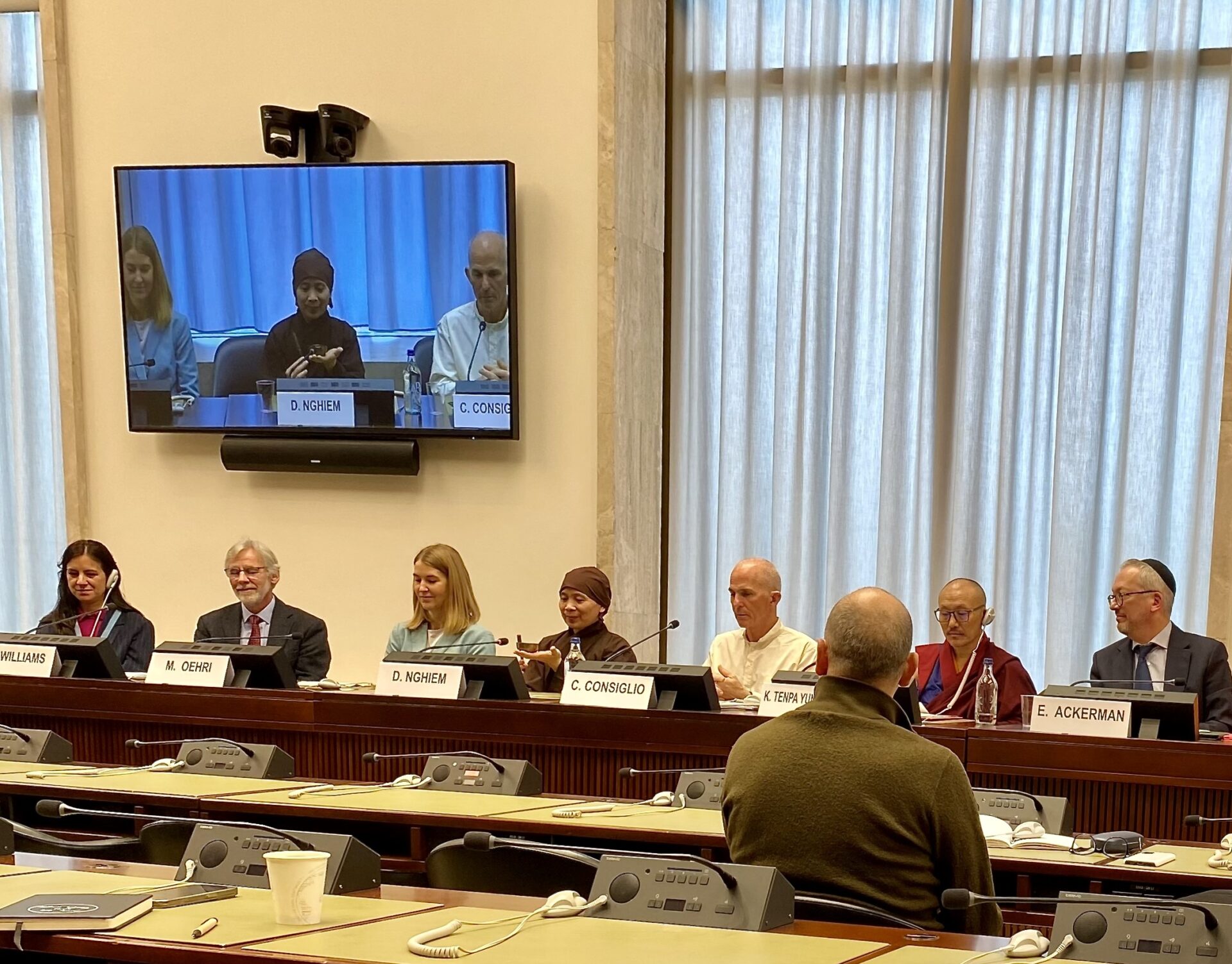
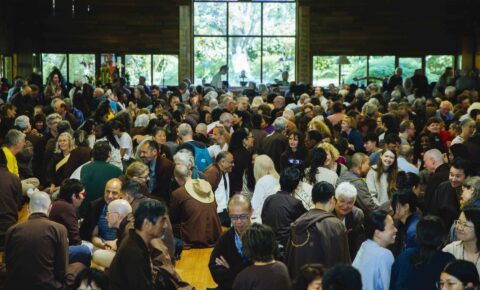
To advance and promote World Meditation Day, a two-day conference: “United and Present-Global Solutions from Within: A Mindful Approach to Diplomacy, UN Work, and Beyond” was held from 9-10 December 2025 in the Palais des Nations, Geneva, Switzerland. Sister Dinh Nghiem was invited as a panelist to share the Plum Village mindfulness practices.
Anchored in the UN System Mental Health and Well-Being Strategy, the UN Human Rights Mindfulness Initiative, and the landmark United Nations General Assembly Resolution on World Meditation Day, this conference explored how contemplative practices such as mindfulness can strengthen diplomacy, human rights, and systems leadership. It underscored that individual and collective well-being is not a luxury, but an essential and attainable foundation for protection, inclusion, and shared progress, as well as a strategic enabler of meaningful global impact.
The conference opened with a keynote address by Jon Kabat-Zinn (Founder of the Center for Mindfulness in Medicine, Health Care, and Society at the University of Massachusetts) and brought together representatives from different contemplative traditions, as well as United Nations agencies, diplomats, and researchers, to reflect on how mindfulness and compassion can support work in human rights and humanitarian settings. They also explored how our shared humanity and inner awareness can help place human rights at the centre of multilateral action—strengthening its effectiveness, resilience, and relevance in addressing today’s global challenges.
On 10 December, Sister Dinh Nghiem, representing Plum Village, was one of the panelists in the panel discussion “Advancing World Meditation Day“, moderated by Professor Mark Williams (Professor of Clinical Psychology, University of Oxford). Other panelists were: Father Cyprian Consiglio, Camaldolese monk; Khenpo Tenpa Yungdrung, Abbot, Yungdrung Bon Tradition; Chief Rabbi Eric Ackerman, Geneva Jewish Community; Swami Vedanishthananda ji, Spiritual Head and Director, Vedantic Centre Geneva; and Aïcha Redouane, Singer and interpreter of Arabic Sufi poetry.
The symposium began with an overview of meditation and science—demonstrating the beneficial effects of meditation through clinical studies for reducing chronic physical pain, as well as alleviating mental health issues, such as depression and anxiety. Mediation also was proven to be a means of stress reduction, contributing to a decrease in all cause mortality and a decreased risk in cardiovascular death mortality.
The panel discussion celebrated meditation as an everyday essential for peace, reflection, and connection across traditions—reminding us that human rights are lived and breathed through our shared humanity.
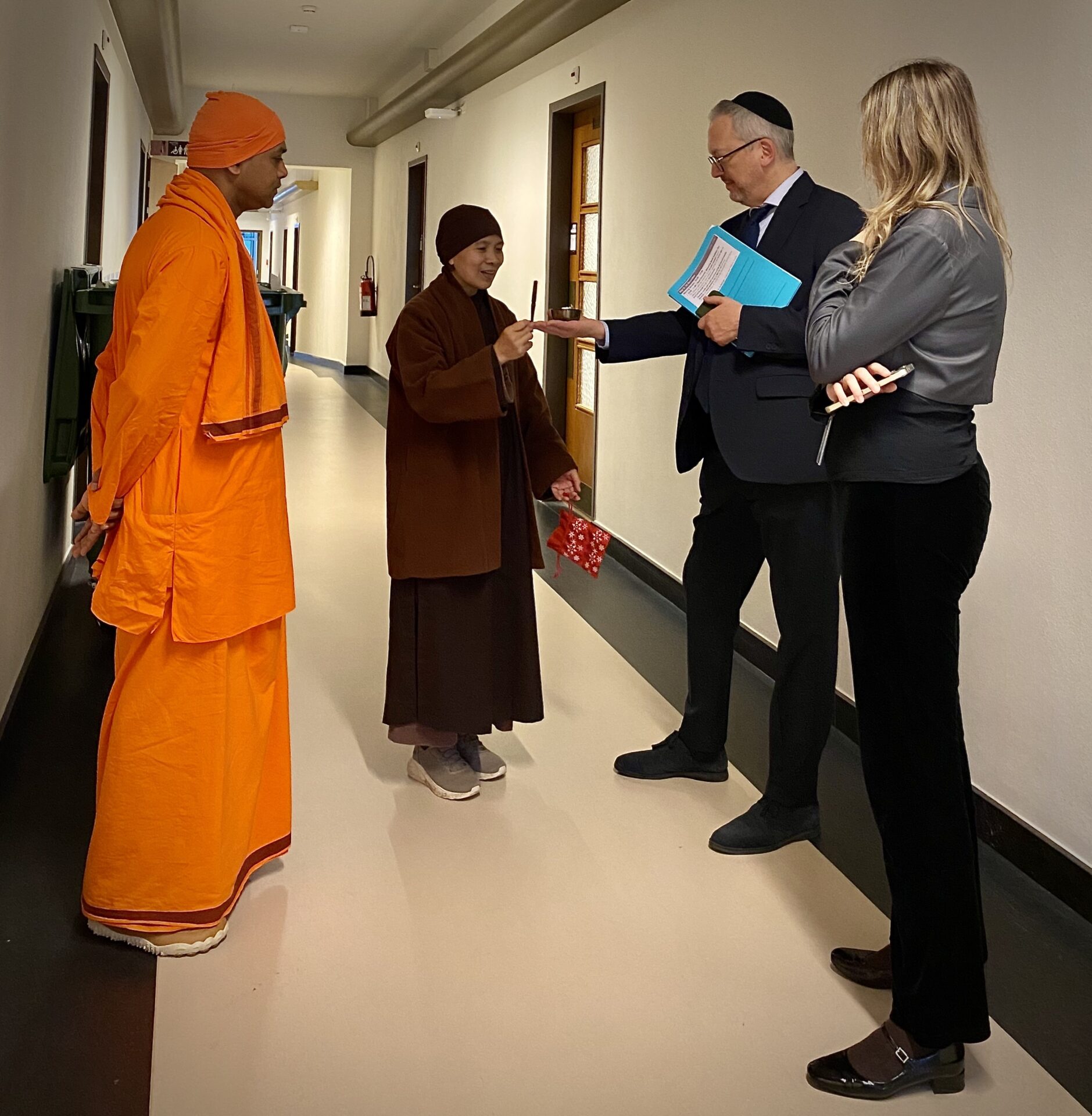
In her opening remarks, Dr. Myriam Oehri, OHCHR Consultant, elaborated on the creation of World Meditation Day and its relation to the Universal Declaration of Human Rights. She also shared about the intentionality and spirit of the advancement of the World Meditation Day resolution in order to raise awareness about the benefits of meditation around the world.
While meditation in its various manifestations has always been a universal practice, it is our hope that it can also become a truly unifying one.
In her panel sharing, Sister Dinh Nghiem introduced the Plum Village practice of listening to the sound of the bell. She spoke personally about her two nieces and their friends who attended the Wake-Up Retreat for young people (ages 18–35) in Plum Village last August.
At the end of the retreat, they asked each other: "What did you like the most about the retreat?"

All of them answered: "the people—their friends, the ones who came to the retreat." They continued that when they met for the first time, usually at school or work, and asked “how are you?”, what they would hear is: “I’m fine. I’m ok.” But here in Plum Village, they said that for the first time they met friends and they answered: “I’m overwhelmed  or I’m very tired or I’m struggling with my parents’ divorce."  And right away, they opened their hearts and they could be true.

After one week, they had the feeling that they had been together for months,  because they were really true—they were themselves and they had no fear of being judged.

One of my nieces shared that she was always stressed when she met people for the first time, asking herself: 'how should I behave myself? What should I wear?' But during that week, that fear just disappeared. They never worried about how they should behave, what they should wear, and they felt so safe.

Our conversation made me think a lot, because my own family couldn’t create such an environment for my nieces, my brother and sisters, even though all my family members know about the practice of mindfulness. I also thought a lot about what are the factors that can create such an environment for young people. And I think that one of those factors is the practice of listening to the sound of the bell.

For more than forty years, since the first day of the first retreat in Plum Village, our teacher, Zen master Thich Nhat Hanh, already set up the practice of listening to the bell. And it’s so simple, that it’s a regular practice. Every 15 minutes or half an hour or hour, we hear a sound of the bell and everyone stops and comes back to our mindful breathing  and we relax. And after that we continue our conversation and what we were doing.

It makes me think that it’s a regular practice like when we study language or sports or music. We don’t need to work hard for many hours, but we need regularity. It must become our life.

Now after more than forty years, in all our communities—monastic communities as well as lay communities all over the world—in all the meetings, we listen to the sound of the bell every half-hour or every hour. We listen to the sounds of the bell in all the meetings, in the kitchen, in the dining hall, and it becomes a habit.

I see my sisters here in the hall nodding, because in her communities, in her company, and now in Vietnam in many business companies, they also use the sound of the bell in all the meetings. And we see the difference, also among the monastics. We have meetings every week to decide everything and we see a big difference whenever we forget to invite the bell.

So now, I want to invite one sound of the bell so that we all can enjoy our mindful breathing and relax. Thank you for your listening.
Meditation and Mindfulness Practices as a Direct, Lived Experience
Throughout the rest of the panel session, Sister Dinh Nghiem was asked to invite a sound of the bell after each speaker and as a closing to the convocation. In this way, all the participants could directly experience the practice of listening to the sound of the bell—stopping, coming back to the breath, relaxing the body, and calming the mind.
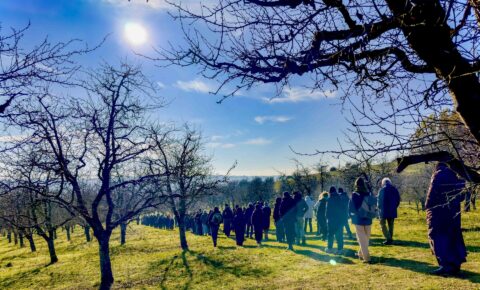
The previous day, Sister Dinh Nghiem also guided a deep relaxation session and an introduction to walking meditation for conference participants, offering a lived experience of mindfulness in action.
The entire panel discussion may be enjoyed here on the UN Web TV.
Global Moment of Silent Meditation
We sincerely invite you to join this global moment of silent meditation on Sunday, December 21st, World Meditation Day, at 12:00 Greenwich Mean Time (GMT). Zoom link: 6288686649
Let go of distractions, gently close your eyes, and let your 15-minute meditation be a gift to the world. Your participation is the key force driving the evolution of global consciousness, forming a wave of harmony and positivity.
We look forward to your participation—across regions, cultures, and time zones—in this shared meditation moment on Sunday, December 21st.
Local Time Guide (GMT 12:00)
- New York (USA): 7 AM / Central Time (USA): 6 AM / Pacific Time (USA): 5 AM
- Brazil & Argentina: 9 AM
- Western Europe: 1 PM / South Africa: 2 PM / Middle East: 2-4 PM / Moscow: 3 PM
- Pakistan: 4 PM / India & Sri Lanka: 5:30 PM / Nepal: 5:45 PM
- Thailand: 7 PM / China: 8 PM / South Korea & Japan: 9 PM
- Australia: 9-10 PM / New Zealand: 12 PM (exception)
Share Your Reflections