







If you wish to support our podcast, please follow this link. Thank you!
Welcome to a new episode of The Way Out Is In: The Zen Art of Living, a podcast series mirroring Zen Master Thich Nhat Hanh’s deep teachings of Buddhist philosophy: a simple yet profound methodology for dealing with our suffering, and for creating more happiness and joy in our lives.
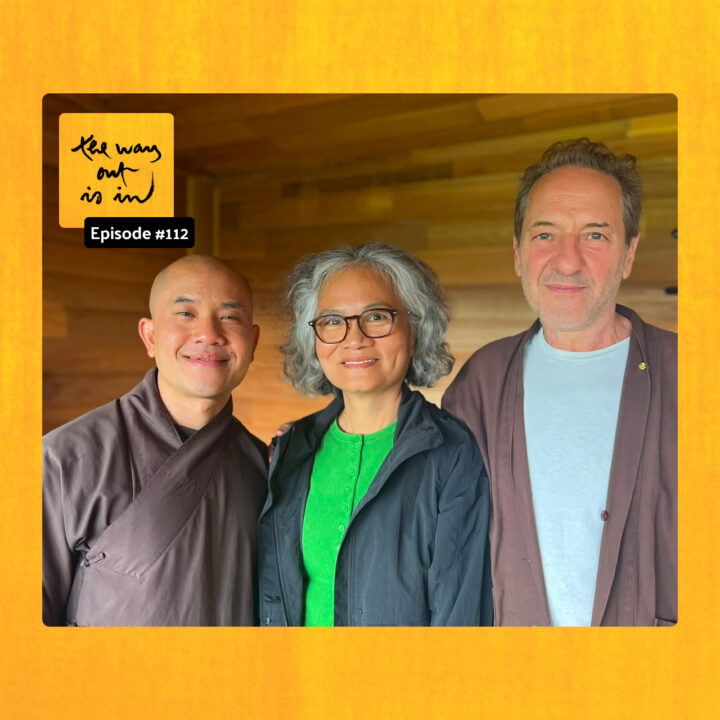
In this episode, Zen Buddhist monk Brother Phap Huu and leadership coach Jo Confino are joined by special guest Pham Minh Huong, businesswoman and spiritual practitioner, to discuss integrating Buddhist teachings into the business world.
Pham Minh Huong shares her journey from being a successful but lonely CEO to one who prioritizes trust, mindfulness, and community in her companies – by adopting practices like servant leadership and consensus-building, and by creating a culture of compassion and collaboration. She emphasizes the importance of presence, authenticity, and the power of mindfulness in navigating crises and maintaining a balanced life, but reflects also on the challenges of integrating spirituality into a business world dominated by metrics and competativeness.
Brother Phap Huu shares his own experience as the abbot of Upper Hamlet, while Jo reflects on writing about sustainable businesses for The Guardian and on his current work as leadership coach.
The conversation highlights the potential for businesses to be a source of meaning, connection, and positive change when guided by spiritual principles.
Ms Pham Minh Huong has nearly 30 years of experience in the finance and banking sector. Having previously served as Head of Treasury and Financial Markets at Citibank N.A., she was among the first members to contribute to its operational growth. She is a visionary leader and a pioneer in introducing new products to the market. Her significant contributions to the securities community and her personal professional reputation have established her as a highly respected leader in Vietnam’s financial market.
Co-produced by the Plum Village App:
https://plumvillage.app/
And Global Optimism:
https://globaloptimism.com/
With support from the Thich Nhat Hanh Foundation:
https://thichnhathanhfoundation.org/
List of resources
Sister Chan Khong
https://plumvillage.org/about/sister-chan-khong
Brother Phap Ung
https://plumvillage.org/people/dharma-teachers/brother-chan-phap-ung
Interbeing
https://en.wikipedia.org/wiki/Interbeing
Plum Village Tradition
https://en.wikipedia.org/wiki/Plum_Village_Tradition
The Way Out Is In: ‘The Three Jewels (Episode #89)’
https://plumvillage.org/podcast/the-three-jewels-episode-89
Order of Interbeing
https://plumvillage.org/community/order-of-interbeing
‘The Four Dharma Seals of Plum Village’
https://plumvillage.org/articles/the-four-dharma-seals-of-plum-village
The Way Out Is In: ‘Space, Time, and the Ultimate Dimension (Episode #54)’
https://plumvillage.org/podcast/space-time-and-the-ultimate-dimension-episode-54
The Art of Power
https://plumvillage.org/books/the-art-of-power
Quotes
“Now I have a path, there is nothing to fear.”
“When I first came to Plum Village, I saw that things were very organized, but I didn’t see leaders. And when I asked, people said, ‘That’s because of Yidma.’ Yidma, in Buddha’s teaching, is about consensus. But, at that time, I couldn’t believe that we could run a business in a slow way and build democratic governance as per Thay’s vision.”
“Good teacher, good methodology, and good friends.”
“If everything is important, then, actually, nothing is important.”
“What Buddhism and what the Buddha and Thay offer us is another dimension of really asking the question, ‘What is happiness? What is success?’”
“Engage, trust – and then there’s cooperation. And when there is cooperation, there is power and the result will come. We have to trust in that.”
“Sometimes it’s via absence that people recognize their love. If you’re always there, there’s not always the opportunity for that.”
Welcome, dear friends, to this latest episode of the podcast series, The Way Out Is In.
I am Jo Confino, a leadership coach and a spiritual mentor.
And I am Brother Phap Huu, a Zen Buddhist monk, student of Zen Master Thich Nhat Hanh in the Plum Village tradition.
And today, dear listeners, we’re going to explore the integration of the Dharma into business because a lot of people say, ah, the spiritual path, how wonderful to do this at home, but how on earth do we bring this into the world of livelihood and commerce and business and finance? And this we’re gonna explore today with a very special guest.
The way out is in.
Hello everyone, I am Jo Confino.
And I am Brother Phap Huu.
And brother, we are sitting with a very honored guest this morning. So do you want to just introduce her?
Yes, today I have a dear friend joining us on the podcast. Her name is Minh Huong, and we met in Plum Village in 2016, but she met Plum Village before that, and I’ll let her tell that story. And she has become a dear mentor of mine, one of the powerhouses in Vietnam, as well as a wonderful Sangha member in our community, and is very, very, I would say, in love with the Dharma.
So, Huong, you’re very welcome. And tell us a little bit about yourself because one of the things I’m fascinated personally is that you run 35 businesses in Vietnam. You have 7,000 employees and you are a great exponent and practitioner in the Plum Village tradition. And as I open this conversation, most people don’t think those two can connect, that you have your Dharma at home and then you run your business with an iron fist. So before we go into that, just tell us a little bit about your spiritual journey.
Oh, it’s actually, it has been a journey, you know, because I was born in a time of war, so I had experience in my childhood, there’s a lot of difficulties, but my old memory is the joy, the love. And then, when I grew up, I went to graduation in Soviet Union, which is the Kiev, Ukraine right now, and coming back I was looking for Citibank for 10 years, American bank. And then I start up my private investment so as a CEO of a very big, the largest security firm in Vietnam. So during that time I had a lot of success and I became quite famous in a way, I don’t know, I didn’t want to tell that, but I have everything I wanted when I was a student. The power of money, the power of being a famous person, but something in my mind, something is missing. So when I started my own business, and we’ve been through a lot of challenges, even sometimes we were facing a risk of bankruptcy. I think that was 2008, when there’s a crisis in a region from Thailand, and I managed to go through it. Of course, this is not the time to talk about that, but when I was trying all, and my definition of success at that time is we have to be the top and I have to be rich because money is giving me the power. But the more power, the more money I have, the more lonely I am. I was like, in the company, no… Because I’m the founder and as a chairman, I’m a big boss. I had a lot of power, but I feel powerless. Because, you know, my people, at lunch, when I wake up, nobody’s there. I have to eat my lunch by myself. And in the hall, if I came in, the whole group was silenced, you know? You can have that feeling. And I was also facing a lot of challenges in my personal life. So I was looking and at that time, the question was, what I’m doing? What is my life? So when I saw really the calligraphy Thay said […] actually I don’t see that calligraphic at my time, but actually I was asking the same question, what did I do? What I want? And then I lost. And happily that I got a book from Buddha teaching, and there’s a teaching saying that everything is illusion, so life is an illusion. So you have to let go. Oh my god, so good. I let go everything. I dropped my company, and I went to experience a lot of traditions. I was studying with Tibetan Buddhists for about seven years, and I also took a lot of meditations retreats in Thai and Malaysia. And I went for Vipassana as well. And I was very happy when listening to Dharma, learning Dharma. But I could not come back to my company. But that’s actually my child. I was founding… I founded it. So whenever I was away, my colleagues called me. Where are you? I said, I’m bowing to the Buddha. And they said, oh, we are bowing to you now. Where are you? So, you know, I feel lost because I love Dharma, I love everything Buddha is teaching, but I could not bring them to life. And I was avoiding my life. I was not myself when I was at my company. I cannot, and I was so confused. And at that time, in 2016, when Thay is coming back to Thailand, and I went to meet him just because he’s famous. I read his book, but I never think that I will quit Tibetan tradition because, you know, I feel the privilege. I’m so lucky because I got a higher, you now, kind of that perception at that time. So I came to Bangkok and I saw Thay. And I don’t know what happened, but I see how Plum Village is setting the life there. I see this is the life I want. I wish I could be younger, that I can be the monastic person, but actually I could not. But really, I think I was looking for so long, and I was searching for many, you know, I was like always running from one place to another place, searching for different teachings and it was running. Even my friend said I never stopped because I was looking for something. And when I came to Bangkok, to Plum Village in Thailand, I saw Thay and, you know, the first calligraphy I saw is… […]
Now I have a path, there is nothing to fear.
Nothing to fear. I said, what path? I was asking, yes, I’m looking for the path, but what is the path? But… And then I was contemplating in Plum Village and then I saw Thay. And you know, I was, I felt very pity for myself, where I had been, why I could not meet him, when he can give a live teaching but so I was avoiding seeing him because I don’t know, people were searching for chance to meet up with Thay and I was escaping. And when I ran in a different way and Thay was there. So I don’t know why I met Thay all the time in the elevators, in everything. And when I met him in the meditation hall and Thay looked at me and he finger-pointed and saying that […] our ancestor. And I see, I still remember his eye. He looked at me and he pointed like that. All of a sudden I see, oh my god, Thay devoted his whole life because I was reading his book at home, but in a different perception. And at the place I was reading again, and I saw Thay is a fighter. He’s there, even he’s sitting in the world, and he’s not escaping his life. And I’m escaping my life. So, I was crying all the time. I don’t know what happened to me, but I think I was crying because of happiness. I found that this is it. This is it, actually this is it. And I came back and during that year I took many of my friends as the leaders because we all understand our problem as the executive leaders, so I took them, many Vietnamese executive leaders to come back and at the same time I was enjoying… At the beginning, I was taking them because I think I have to accompany them, to show them the real teaching. Because, you know, it awoke me of my grandparents. Because our life, we are very fortunate to be Vietnamese. Before I’d never think that being a Vietnamese is good. You know, I feel sometimes a little bit inferior as being a Vietnamese because we are poor and then I look at the economic power of other countries and I feel we are inferior. But when I saw Thay, I was so proud to be a Vietnamese because his devotion, his work is actually human because I was looking for the values and when I was in Plum Village, this American professor came to me and said he wished he could understand Vietnamese so that he can understand Thay’s teaching and the root of Thay. And my whole, you know, proud and everything I said, I want to continue Thay’s dream. And that I understand his vision, I understand he’s talking about collective wisdom. I understand he’s taking about […] I don’t know why I don’t see Thay when he’s alive, but I can see his vision. And I came to the… And I have a wish that I will come back. And luckily I found myself, I’m so fortunate because I have the platform, a company, which I was avoiding all the time. And I came back and wholeheartedly I brought my people to Plum Village. But my practice was very poor. I only have emotions, a wish, a want, and then when I took my people to Plum Village, when they came back, all left. And we went to a crisis. We lost about 70 people. Because, you know, in our country, religion, it’s a different perception about religion. People don’t see the real essence of Buddha teaching. And I think I’m not skillful enough. And my practice is not there yet and there’s only one… there is only right or wrong and this is good, this is bad. I don’t know why I have that the five powers Thay was talking about that’s trust. And I trust Thay. I think he can build the Sangha when I see it’s very beautiful when I came to… I see the the Sanga where in Vietnam we have many pagodas but not many monks. We see the pagodas, we see everything is beautiful, but we don’t see monks, we don’t see the practice, just the pagoda. So I said, how they can do that? Because the monks are not paid, and here I have salary. And how they build the consensus? When it came to Plum Village I see things are very organized, but I don’t see leaders. And when I was asking, people said, that’s about Yidma. Yidma in Buddha teaching is about consensus. And at that time, I could not believe how we can run business in a slow way and how we build democratic governance as Thay’s vision. Consensus, you know? But something is missing when I set up my own company because it’s not just that, because business is human. Business is not just KPI, business is not just the number one or two, because we were number one or two always, all the time. And when I started rebuild my VNDIRECT again, Thay said there’s another possible way. I still remember he’s saying that. So you know what I did? I stop talking about Dharma. I have to… I start slowly seeing how Thay is building, so to be honest, everything I do right now is 100% following Thay’s. Everything I do, when I met any difficulties, I think what Thay would do in this situation. And you cannot believe that we are a group of 35 companies and I have about 7,000 people right now but I dropped KPI, because I hate KPI. That’s the reason I left Citibank. But I believe in cultivation. So we create an environment, same as Three Jewels. I translated into Vietnamese […] Good teacher, good methodology, and good friends. And I was fighting a meaning of how I empower people because Thay has a calligraphy which knocked me a lot. This is there’s nothing more precious than brotherhood but I transfer that into there’s-nothing more precious than collec-hood. The collective is actually a very right word and then I shift all my focus on building a collec-hood. We also start in the morning songs, the songs of Plum Village. In the afternoon we try to sit and I just make it without any expectation. I see how compassion and how patient Thay was with his students. So I came back and I did the same thing.
So Huong, there’s so much in what you just shared and it would be wonderful if every single business leader in the world were to listen to your story. And Brother Phap Huu, just to bring you in here because there are so many people who, as I start out by saying, ah, the Buddhist teachings, the spiritual path, how wonderful, but they cannot find the ability to connect it to their so-called real lives, especially in business. Business tends to be all about the bottom line, about money. And people… and there’s such a mechanistic way of seeing the world that it often excludes humanity. And so I’m just wondering, when you’re here, when you talk about this journey, just this extraordinary integration of Thay’s teaching into business and the success that can create, not just in terms of business success in terms of the traditional money, KPIs, key performance indicators, all that, but in terms connection, collaboration, happiness, a sense of purpose. Why is it that people find it so difficult to do what Huong is doing?
Well, I think not many people have the opportunity to have a broader view in life, especially in the business world in terms of what success means. And because what we’re trained, I mean, I remember growing up and when we talk about careers, it’s like what has the most money and power, that’s what you get attracted to. And so our attraction in the world, particularly as human, and I think as men, mostly men, like we look for a sense of domination. And in the Buddhist context, it speaks about our part of our mind consciousness, which is manas, which is greed, power, success. And a lot of the time the success, it looks in the way of for me to win, somebody has to lose. And I think what Buddhism and what the Buddha and what Thay offers us is another dimension of really re-asking the question like, what is happiness? What is success? And I’ll never forget this story because Thay once asked a business, a business leader in the United States, it’s like, he asked him, if you’re to choose between being successful and happiness, what would you choose? And that business leader said both. Thinking that he would be clever. But Thay said, you have to pick one. What is more important? And this business leader didn’t answer. And Thay said because if everything is important, actually nothing is important. And Thay answered for him, Thay said I would always pick happiness because if we look back at a humanistic level, we’re all humans. Our company is made of humans. Well, now AI is a different story, but coming back to the organism of a company or of people, it is the human. And what Chi Minh Huong was mentioning is her understanding of her own happiness, is her colleague’s happiness. She was touching interbeing, she was touching the interconnection of not just the KPI, but of the people that you’re working with, you’re sitting with, you are collaborating with, you are speaking about. And Buddhism, the monastic community, the monasteries in a way, also has these questions, like how can we sustain ourselves? How can we continue to grow? You know, we also ask questions like, are we growing in the right way? Are we being successful in the Buddha, Dharma and Sangha? But our KPIs are very different. Our KPI is, is there harmony in the community? Is there enough siblinghood? Is there enough understanding? Are we creating space so that we could be listened to so that are being seen? Are we transforming people’s lives? And are young people coming to the monastery? Thay always mentioned that it’s like, if we don’t have young people coming into communities, that means the body is starting to die. The body is becoming rigid and stuck. Like there’s not new blood cells coming in. And I think for me as an abbot, looking at the community, that’s always at my mind is the harmony between the multi-generation in our community, because having only young people, the community won’t be strong. We need elders. We need those who have come before to guide, to offer, to be a pillar of stability. But then the elders also have to learn to yield, give space, so that the young people feel that they are integrating, that they’re a part of this river. And so there’s a lot of mechanism and practices and techniques that Buddhism and the Buddha Sangha and Thay Sangha actually have… we call it spiritual technologies for harmony, for growth, for we even have something to like 360, like reviews. But what makes us different, I always feel, is the intentions that we all cultivate together. And it needs to be reminded again and again and again because the powers of the world, like fame, power, all of that seeps into the monasteries. It sneaks in and it can cloud our mind and it push our way of being. And we can be off track, the spiritual dimension, as well as our beginner’s mind.
Thank you, brother. And I was looking forward to this conversation because when I started out in journalism, I was a business and then a finance journalist. And I came in very naive and it was extraordinary to me that no one ever talked about people. No one ever talk about the repercussions of what they were doing. No one ever talked about community. No one ever talked about social responsibility, it was always about the money and the fame. And it was so dehumanizing. And so I then decided when I was at the Guardian to set up a section called Guardian Sustainable Business, which was to look at exactly these issues that you’re talking about. And I was just this morning reflecting, I just found one of my own articles which said, Is it possible to combine the words love and business in the same sentence? I ask this question because of the self-censorship that is prevalent in the corporate world. While business is made up of human beings, its mechanized approach has turned many of us into human doings. For far too long, employees have been expected to leave large parts of themselves at home before they head off for the office or factory. The lexicon of the corporate worlds has been dominated by the words of war and scarcity. Battling for market share, hostile takeovers, invading new territories and the like. That loud crude battle cry has largely shut out the quieter voice of community and collaboration, and dare I say it, love. So Huong, I’m really interested in, so you’ve taken a very radical approach compared with normal business. And when other business leaders see what you’re doing, are they shocked? Do they think you’re crazy? How do they respond to how you’re approaching business?
Actually, yes, a lot of people were looking at me at the beginning and they think that I will destroy the company. That’s why we have people leaving, especially the senior leaders. It’s very natural. I don’t use the word of love or happiness. It’s too luxury in a business world. But it’s actually, it’s there, you know, because it’s about the maturity. So we don’t use KPI, I use BMI. That’s a business maturity index. Because the world is driven by KPIs, mostly financials, numbers, bottom lines… all of these things. But what is actually the root cause of all that? It’s just manifestation of the maturity of a person in their career, the maturity over the business. I was looking at my business. Yes, we are number one, but can we be there? I want infinite game. I don’t want… Something that I have to try every day and the company is dependent on a small number of people. Because I have, I look at Thay, Thay has a trust in us. Buddha has a trust in every of us. We have Buddha inside and all of a sudden I realized that my, I have 7,000 Buddhas. I have all the power there. It’s not just me because before my company was relying on me. Without me, I think, you know, things will die. That’s why I was escaping to see how they die, and they are not dying. So, you know, I don’t use word of love or happiness because, you now, in business, it’s, I don’t know, in Vietnam, we don’t say that. It’s too luxury for us. But I use the word of maturity, the trust, the respect, and we cultivate that. We cultivate that, we make people feel they are empowered. We trust in people and we respect each other. And I start to respect the junior and I focus on the inferior teams because the people who are leaders, they’re already mature. They know how to handle themselves and doing the best. But if the junior team, the young people, feel they’re empowered. And then we can make a stream of power, the river stream. And I start to focus on the young people as Thay did.
So can you give me an example of how you work with the younger staff to empower them?
You know, I learned Thay’s teaching, we make the company very, not hierarchy, Vietnamese culture is very hierarchy and in our corporation also there’s hierarchy. There’s always, of course we still have that system, you know, we have to that systematic design but the design thinking is everything is designed to gearing for empowering people. So we create a leadership as a servant manager, a servant leadership. That’s just focusing on building people. And then we create another line is a value chain driver. So we create a different organization structure, very different. I don’t know, but we are very different now. I just learned from Thay, also how Thay was forming the Sangha system for business and there’s a system for people, but they’re all parallel. And everything we do is focusing for the eight years, I was starting up my whole corporation. So I’m very introvert, because we have to choose whether to grow, to go out, or we have to build a solid foundation first. So you know, during that time, I was taking an insurance company that’s about 3,000 people. And when I took the company, the company was at a loss, a big loss because of the COVID and also because of the business operations so was very fragile, it’s only revenue driven. So when I took over, I cannot choose KPI because, you know, if you choose KPI as revenue, you know, insurance is a risk taking. So, and I was looking at Thay, so I exactly choose the KPI of how I can calm the team because that was an angry organization because I’m a new person who took over the management and during my transition to set up my corporations I don’t have to fire anyone. You know, because I am not firing people I just rebuild the foundations. And the right people are staying and people are leaving. So we have very high turnover, but it’s a healthy turnover. And the result after three years, when I took the company and redo it, and bring mindfulness to the corporations, a lot of people in the industry said that the company, that’s a PTI insurance company, people say that the companies that went bankrupt for two years, because I insist it’s the noble path, the right livelihood. But after three years, we hit the profit as ever high since 26 years of operations. And, you know, people are settled and when they’re engaged, when there’s trust, there’s cooperation. You know, engage, trust, and there’s cooperation. And when there is cooperation, there is a power and the result will come. We just have to trust in that. And we did like that.
So, Brother Phap Huu, I mean, this is a shining example of Plum Village sort of flowing into the rest of life, because I mean what Huong just described is exactly how Plum Village has been created, which is Thich Nhat Hanh isn’t this dominant leader and there’s this sharp hierarchy and the youngsters are ignored, but actually it’s all about community and to create community. As Huong says, you need collaboration, you need trust, you needs patience. So how does it feel for you personally to hear this sort of amazingly shining example that actually this is not just a culture that can exist in a monastery, but actually what you’re creating here can actually be a model for many parts of life?
Dare I say, I feel so proud. I feel proud of Chi Minh Huong, and as a Vietnamese businesswoman also, in a very male-dominated society in Vietnam. I actually remember when Chi Minh Huong took over the insurance company, and she was writing to me, and saying how painful it is losing so many good people, like good, talented, trained business people are leaving the company because they don’t see the path. And I shared that pain with her in that moment because as leaders, sometimes you see a direction, but not everyone has that same understanding and not everyone trusts that new direction. And I just remember that moment when I received that text and I wrote back something very short and I just… And if I remember, just acknowledging that pain and just saying we have to trust the path that we are committed to. And in some way the Buddha was like that, Thay was like that, whenever we change a direction, the first thing that manifests is fear, because it is so against the norm, it’s so against the metrics that have been calculated. But if we know that there is a different way and is setting up a new culture, there is resilience, and there’s a lot of courage. So I would say in the story we just heard, there’s lot of courage and there a lot pain. And holding that pain with tenderness and being, trusting your own insights. And sometimes insights are for it to take root, we have to keep watering it. And that means we have to be very committed. And I see that Plum Village is a part of that resilience of a teacher who was exiled from his country, but did not give up his hope. Now, like we are flourishing and we are solid, but I know the years that it took for Thay and Sister Chan Khong to consistently just keep building the community. And there were shifts in the community also, because at the beginning, Thay only had lay students. And then when Thay shift his energy and focused on the monastics, because he understood that he’s not going to be here forever. And he had to change also his way of operating, because if he passes away and there’s no true communication and true trust and true transmission then Plum Village will die out with the leader when he passes. And so Thay had a drastic shift in his focus. And I’ve heard from lay OI members and elder OI members that some of them felt that shift was quite drastic. And some of them also felt jealous and not seen like the good people. Because Thay, there’s only so much you can do in your lifetime and so much you can’t do in 24 hours. And there are moments that you have to start to look at your legacy and look at your continuation beyond this physical body. And I became avid when I was in my early 20, 22. That’s very rare, but Thay wanted to change the structure of Plum Village. And his changing is his continuation of renewing Buddhism, because traditional temples are very hierarchy-based. The abbot is like the CEO, has the ultimate power, makes all the decisions. But from the very get-go, as I was a novice, we were trained in consensus. And it was a journey, what Chi Minh Huong was explaining, like in the early days of Plum Village, consensus was very difficult. There was a lot of arguments. There was… You know, we went through meetings of voting and the bigger party would win. But what you see that happens, it looks like it’s, in a way it is democratic, because the majority wins, but there’s a split that’s happening there. There’s a winner and a loser. And so Thay revisioned how to bring consensus, how to share our ideas and how to let go of our ideas. When we’re actually listening, we can see what the flow of river, what direction it wants to go into. And Thay always has the skillful means. Skillful means is so important in leadership, I would say. Thay would say that sometimes you might have a wonderful idea and you put it into the meeting. And we set up our meeting always in circles so we can all see each other. And once you’ve done your part, which is to share your insight, you put it into the center of the community, into the field of the community. You planted the seed. And if everyone sees that that seed is ready to be cultivated, they will start watering it. But if others feel like, no, that seed is not right yet. And if that seed, that idea is not taken, Thay said, it’s not a failure. It’s just that in this moment, there’s not enough condition for that idea to take root. But it’s not lost. And sometimes I’ve seen in my community that that idea 10 years ago is now being reshared. And now it is time for us to initiate that pathway of organization. And this is also in the Fourth Dharma Seal Plum Village, which is ripening. Sometimes we offer an input. And we may think that we have the best input. But it’s not accepted and we may feel very hurt because there’s pride in their self, even though we’re trained that we are one with the river, we’re one with the river, but nevertheless, we’re like, but why wasn’t my idea accepted? And there is a practice, especially as young novice, we all say novice, if you have input offer them, and if it’s not accepted, just let go, but it’s being put into the garden. And that insight of learning to see us as one, insight is very different than action. You have that notion, but you go through the action of sometimes, I’ve had many times my ideas wasn’t accepted and I was really hurt, but then many years later I see it starting to take part. And as I see, ah, success and failure is an illusion. It is an illusion, because in the ultimate dimension, nothing is lost, and these insights can take journeys, and they may mature again. And maybe in that moment, because of just the way I presented it, was very emotional, it was very naive sometimes, and therefore, sometimes aging, maturing, has a role for the insight to fully flourish into the growth of leadership and collaboration even. And so Thay really opened this door in the community of looking at how we operate more in a way horizontal, but there is also seniorship because there are elders who’ve been here that sometimes we need to seek their wisdom because are we making the same mistakes? And the seniors, I’ve seen in Upper Hamlet, one of our most great mountain is Brother Phap Ung, which we all know and sometimes we call him Brother Turtle, he’s slow, but it is steady and his pace and his mindfulness, he’s like a sponge that has soaked up so much experience in the community and I feel so grateful to have his presence not as a threat but as a a mountain that I can always come back and check. It’s like, my older brother, there are some ideas like this. How do you feel? And he has a presence of listening. And he also has the wisdom that the youth is gonna take this community forward. And he’s very empowering. Sometimes he will say that that idea is partially okay. And he’ll give some more input. He doesn’t deny it right away. And I think language is so important because I have received moments where I give an idea and say, oh, that idea is so dumb or it’s so ignorant, you know, and you feel so defeated, but there is language, like it’s partially okay, but let me offer some more insights to make it more whole. And this is the journey that we’ve been through. And one of the insights that I really, really appreciate, Thay keeps reminding us that we’re not perfect. And because we’re perfect, we’re always gonna grow and that’s the beauty. And that has helped me on numerous occasions because I do have high expectations. I do have…
Everybody of us.
I do have moments where I’m like, oh, that could have been better. And at the same time, having to yield, because only when we can see that it could be better, then we know where to offer. And everyone grows in that moment of recognition of shortcomings.
Thank you, brother. You remind me of a friend of mine who had started out as a management consultant and he went with the senior consultant to this business that was under threat of bankruptcy. And they looked at all the issues, they came up with what they were absolutely certain was the right answer of what that company could do to stave off bankruptcy. And they went into the board and presented it and the board turned it down. And when they left, my friend said to the senior, senior consultant said, but we have the right answer. And the senior consultant said, if they’re not ready for it, then it’s not the right answers. And that speaks so much to what you’re saying that actually right and wrong is such a limited binary idea. It might be right at some point, but right now it’s wrong. And the other thing about Brother Phap Ung is very much like the story of the hare and the tortoise, or the turtle, where the hare sort of, they go on a race and the hare runs ahead and is absolutely certain it’s gonna win. And the tortoise, turtle, is just plodding along. And then the rabbit sort of complete… the hare completely runs out of energy because it’s run too fast, too quickly. And the turtle just comes plodding along, passes him and wins the race. And I think that is such a powerful sort of metaphor for life that if we race too quickly, then we can easily run out of speed and collapse. But Huong, I just wanted to come back to you because you look very radiant this morning and you’re very bright-eyed and bushy-tailed. And so I want to come to your personal journey because you, we’re talking about you were very lonely, about when you came into a room, everyone would go quiet, that you didn’t have friends. And we know on the path that spiritual friendship is, as the Buddha said, not half the path but the whole path. And you’ve gone through this transformation, you had a real awakening, you found time when you met Thay, you’ve just had this illumination of what was possible and you have spent many years now following this path and it’s brought you success both from a traditional metrics of business but also it seems to have brought you personal happiness. So I just want to just talk to you about, ask you about your personal journey. How are you now that is different from how you were then? And if you’d continued to follow that path of a very narrow view of success, what’s the difference in that path for yourself?
Wow, I could not imagine myself without knowing Thay, to be honest. Sometimes I think if I lost everything but I still have Thay’s teaching, which one I choose? I think I will choose Thay’s teachings. You know, when you have a path there’s nothing to fear. Of course during the time of my personal practice there’s a lot of challenge. But I think I grow, I’m more mature now in the business areas, as well as my personal development. And it took time, it took time. At the beginning, when I met Thay, there’s emotions, there is a definition of, this is right, this is wrong. But the more, and I came to Plum Village actually quite often. Even I’m very busy, to be honest. For the last eight years, I had to almost like starting up the whole group. So there’s about five major business areas I have to start up. It’s very busy. Thay Phap Huu knows. But my priority is to come back to Plum Village. Here there’s a space for me to contemplate. You know, so I always feel like I give myself a retreat, you know, a gift that I have a space and a time in Plum Village to give me more energy, to give me going away. Every time I came back, my cautious, my same teaching, the same calligraphy. And the place is still there, you know, because in Plum Village you don’t see things are changing that fast as we do in life, but it’s different even this trip is so different and I’m very happy because I’m coming back. I always say to my friends that one time is not enough… So now, you know, my work is my life, it’s livelihood as I said. I don’t feel like I’m working. A lot of people were asking me how you can find your time, because I’m running 35 companies and every day I have to talk to about sometimes 50 people on different things. But one thing at a time. So it’s not work, it’s what I live. And, you know, I feel… Before the company I have is my debt, you know, it’s my liabilities Oh my god, you cannot imagine how I hate it. So when I met people, I never talk about my company. No, no. And I have a home full of small projects, which is my escape time. But now I feel like every day is new, there’s excitement. There’s something useful I can do for the people. Of course, I’m still very busy, to be honest. I cannot be that. But I know Thay’s… I think Thay is more busy than all of us, because look at his legacy and his work. So I never think that I’m busy now. I enjoy every minute of my life. I enjoy all the connections I have. And I’m learning. I’m leaning all the way. I don’t know, Thay has given me the wisdom. So right now in my company, trust is asset and wisdom to success. And that’s all the two words we are saying all the time, trust. And trust is the KPI, is the dimension of business maturity. And let the result manifest.
And just wondering, is there a particular practice that supports you? Because what you’re saying, just to be really clear, is you’ve got 35 businesses, you’ve 7,000 staff, you’re dealing with, in different sectors, you’re deal with multiple things, and you’re saying one practice is to take one thing at a time, rather than see it as one huge mess. You just say, actually, I’ll do one thing at a time and do it well. But a lot of people will hear this and say, how do you stop burning out? How do you not get overwhelmed by this? So what is it, is there a particular practice that allows you to show up every day, fresh, as Thay would say, fresh as a flower, while other people would come in looking exhausted and say, oh no, not another day in the office. What is it that allows to sustain this over time?
You know, stopping is a power, you know. So, breath, and Thay was teaching us how to stop, and mindfulness is giving you a real presence. And when you’re present, ideas come. I don’t have to think. I always say to my people, don’t think, just breathe. So, you know, I was in many meetings, so sometimes my day is heavy, because people are coming to me for ideas, for support, because I’m like SOS. I changed my name to Chief Connecting Officer, but now I change my name SOS, so my door is open. I don’t have…
Save our souls, save our souls.
I was in the big hall, open all the time. People just see and if they see me free and they come. So, you know, being presence and learning deep listening and that’s it. And I don’t know why ideas come, you know, because we are in investment business. So I just took last year, I was taking back the management of a FNB company and there’s hundred restaurant chains, you know, in FNB business is oh, my god, that’s a lot of a problem. And the company was running a loss, a huge loss. And the chairman, when we were discussing, he said he want to cut 30% of the people. I said, no, you cannot do that. Who you can cut? Do you know them? And when you do that, the 30 best people will go, and then you have the rest. So, you know, mindfulness is very powerful. Of course, I have to practice. I don’t have time. Before I was practicing vipassana, so I took like every morning and every afternoon about one or two hours sitting meditation. But now I wake up, I already have ideas, so I don’t have time for sitting meditation that much. But I believe Thay said we don’t need. So I took every possible way of just watching my breath, try to observe, and be present, you know? The present is very powerful. And when you’re present, even I came in a meeting, I don’t know anything about that, you know? I just, I have no idea. Like, we came to this talk and Thay Phap Huu, I asked Thay, what’s the topic? But I said to him, no, better not ask me because, you know, and then I have to think. I want to be there and I know what I can tell that’s useful for people to trust that there’s another way to run a business. Not many people, everybody, I am sure as leader, as chairman, everybody has a bodhisattva inside. They want to do something for the company. Not like that, but there’s a BCG and McKinsey way, you know, in our country everything is BCG and McKinsey. I said, I have another BCG and McKinsey, which is free. But mindfulness is Thay’s teaching, sitting in every calligraphy, song, the steps, the way we organize the meeting like a sitting around a table, the bell, and our management meeting right now is in the form of retreat. We also have six hours sitting together and then we have a business discussion. We also have the bell, we have the singing, with the songs. We also have sharing in a circle. So I form my management executive strategy meetings exactly like a retreat in our ways, but a different content. But the format, the skillful means is Thay’s skillful mean. So I package it. And even we now offer to our clients meeting as well in that way. So we found like we’d be friends, you know. It’s no boss and staff. We are friends. We are colleagues with a different span of accountability, but the intention, like Thay Phap Huu said, is one goal. And that makes us as a stream of river. We always sing that song. I love that. […]. I love that.
Go as a river.
Go as a river.
So I love this idea that why pay millions of dollars to hire McKinsey if you can actually find a much older spiritual technology that is more effective because, because often, I mean, it’s a reflection, isn’t it? Often companies, individuals, we’re looking outside of ourselves for answers. We’re looking for someone to tell us what to do. And Thay, as a teacher, was always very specific said, he never told people what to do but he offered people to create the environment in which they could become their own teacher, that they could learn it for themselves. So Brother Phap Huu, you are not the CEO of Plum Village, but you’re the abbot. You have a sort of certain seniority here. You have a lot of responsibilities. There are many things you have to do. There’s things you have to do with accounting, things you have to do on legal. You’ve got a big reconstruction fund. You’ve got the monastics, the monks to sort of support. You’ve got nonstop sort of retreats. I mean, we have 900 people coming tomorrow for the next two weeks. It’s also a big complex job. And what I’ve noticed in the last week, you’re normally out there in front and you’re sort of often doing the first talk and you are very, very present. And this week there has been a retreat with a few hundred people here, but I’ve noticed that you are in a different space this week. You are relaxing, you’re in the background, you haven’t shown up to everything. And so I just want to just ask you, in a sense, what Huong was saying, that sense of you need to slow down sometimes, you need stop sometimes, you need to refresh yourself in order to sustain your joy, your happiness and be present. So tell us a bit about how you do all this.
And on top of all that, taking a lot of criticism. I think giving myself space to also reflect on the judgment, the criticism, and the perceptions that I have heard, that I’ve received, and to also ask, is it true? Because sometimes some of it is true, right? Yes, I am normally, I love to be at the front line, I would say, like where there’s a lot of action and to be involved and to be connected. But I think this time around coming to the student retreat… And it’s a really big retreat, we’re celebrating 60 years of the Order of Interbeing as well as this year would mark 100 years of Thay, so there is this amazing energy of collective students from around the world coming here. And that’s why Chi Minh Huong and a whole delegation from Vietnam is here to come to the root temple in a way. And causes and conditions, my body couldn’t show up, it needed to, it wanted to get sick. And we always talk about deep listening. So I listened to my body and I just said, you want to get sick, let’s get sick, and just surrender, in a way. And then trust what I’ve been listening to what sometimes I call her bossman who is like, what does bossman Huong wants me to do? And she speaks a lot about trust and that was also Thay’s word. And Jo, you also have told me so many times you have to trust the community. And I think like that is my kryptonite sometimes. Like the reason why I’m always pushing myself at the front line is because I’m questioning the trust. I’m like, are they going to do it? Are we going to meet the demand? And then try to curate things more. And I think that there is a… there are levels when it is time, I have to show up because is leadership and sometimes showing up is to support, to say that I can see it. And this time around, especially this year has been really tough, so just having space for emotions and having space for like my feelings to come out with dad’s passing and then with, I think also I’ve bundled in some fears that I’ve had. Maybe it’s connected to Thay, it’s connected to Plum Village, it’s connected to my own questionings in life, as well as then you hear criticisms about you and then you want to question it all. And all of that, it needs space to transform. And there’s a song that Thay translated. It’s a very sad song in Vietnamese, it’s the song about a breakup, but Thay changed the words to it to make it a Dharmic song. And there a line that says that sometimes when you’ve overcome your difficulty, don’t go back into action and go back, go back and relearn again. So this retreat, I volunteered to be part of the tofu team because when I was a young bhikshu, I did a lot of tofu making as a young novice. So I wanted to return back to a familiar activity where I don’t need to think. You’re gonna make tofu and there’s a formula and you just follow the formula, you don’t have to think much. And I felt like that’s what I needed, just to go into spaces where I don’t want to have to use my mind so much. And a lot of my brothers and sisters found out that I wasn’t facilitating and their first question was like, is something wrong? And I said, actually, I don’t want to listen anymore for a short period because I’ve listened a lot and I want to create space so I can listen more later and pacing myself. And I know, after this, we will go to London together to offer a podcast for 500 people. And then we will back to Plum Village and we have three weeks of summer retreat and then one week of Wake-up retreat, which I know I will be really forewarned. So it’s been a wonderful… The sickness has given me a lot of space to think and to feel and to observe. And I think particularly in the last week though, just because this podcast gives a space of just a lot truth and yeah, I’ve been hearing things about me and it’s painful and it’s also… sometimes it could cripple me. And I am leaning on friendship a lot. I’ve been seeking a lot of help and to be listened and to be given advice and to listen truly and to then have space to feel the emotions through the day. Because that will ripple into the community. So to honor the present moment, like to honor presence, and I don’t wanna show up when I know that I would then have to bypass all of that rawness that I’m holding right now. So I feel lucky and privileged in a way, it is a privilege to have a community. So, and I just said dear community, you guys hold on to the wheel, the steering wheel, and I’m just gonna sit back and make tofu.
You know, I want to add that it’s very critical about the word presence. Sometimes you think that presence, you have to be physically be there, but presence means that crystal clear, everything just focus. You know, even my colleagues, they think that I have that superpower because I understand their problem. I don’t know how they got that problem. I was not with them, right? Because as a boss, you cannot be with everybody. But I don’t know why I always speak the right time, putting the right question at the right minutes. But later on I understand that presence is like you are there, you care, and sometimes we also need a presence for ourselves, for myself. So presence here is a manifestation of mindfulness. It’s not a physical presence, everything we have to be. It’s a connection when you’re 100 percent wholeheartedly, mindfully with them. And I’m sure they are supported.
And thank you for that. And I remember before I came to Thay, I was working with a sort of self-development group. And a lot of people were critical of one of the women leaders saying, you should spend more time with your children, you shouldn’t be traveling. And she said, it’s more important, my presence, in terms of the fact that they know I love them and the quality of the time I have with them than if I’m present all the time physically. Because when we’re present all the time, physically often, everything becomes assumed. And nothing gets valued. And actually sometimes it’s in the absence that people recognize the love. And if you’re always there, sometimes there’s not the opportunity for that. And brother, thank you for sharing that. And this is part of the path is to suffer. And also, you said you’re relying on friends. And how lucky to have friends, because if, like, when you go through periods of great loneliness, it can make it much worse. And just to add my tuppence ha’penny, here, you have such a beautiful heart and such a beautiful aspiration and such a depth of understanding and that you are… It’s not so much a role model, but that your presence allows other people to walk their path. And so sometimes when we receive criticism and when I’ve received it, it’s deeply painful. And also in the absence of the love you feel at that moment it also opens up to the level of love there is as well So, in the absence of it, also to appreciate the depth of love there is for you. What would you like to say to Phap Huu at the moment? He’s had a difficult week, you’ve known him, what would you say to him as mama?
You know, I 100% understand because we all have the same problem when you are at the top. You had a lot of expectations. You have a lot… It’s not because they don’t like us or we have any problem because just that’s human smite and I’m facing the same. There’s a lot expectations. So when there’s expectations, there’s always, you know, criticism but we go through it. You know, you have to trust. That’s the path give you a more mature… And then that space, when you look back, you will treasure it. You will treasure it because I feel the same all the time. Even… We think our intention there, what we do there, but it just takes time for people to see it. Maybe it takes a few years as you see it, but it takes time. So us, just be there, trust in ourselves. And you are luckier than others because you know, in Vietnam, we have a saying, dao duc, dao is the path, duc is accountability. So because you have a very, like a jewel said, a good heart and a mindset level that you have that Duc, you have that accountability. And the challenge you can experience is different than others and we have to thank to the challenge we can experience that makes us more mature and more fruitful as the path. Because our path is the wisdom. And the more challenge you can experience, the more difficulties you can experience, the more opportunity you realize.
And what does it feel like to have Phap Huu in your life? What difference does it make that Phap Huu is in your live?
I don’t know why I feel like even we don’t talk, right, because we, he’s busy, I’m busy. We never talk, but I know he’s there. You know, the connections in spiritual life is very different in life. Life, you have to be there, you have to connect so people will forget you. But I don’t talk to Phap Huu very much. I don’t know, but I think he’s there. I can understand every problem, everything he has because I still remember we met at a very difficult time at Phap Huu. Me too. At that time I also had a lot of difficult times. Your people are leaving, the company is in transition, nobody trusts what I’m doing. So confused. But because I look at him, and I’m sure that’s why he called me boss. But I think Thay chose Phap Huu to be the abbot for Lang Mai, the root temple. He has to see something in him. And we all trust him, because like you said, it’s right, enabler is what I think when I met Thay. Thay always enabled people. You know? Because I feel him, I met him, I feel I have a lot of power. He said, let’s do broadcast. And I said, I can do it. Otherwise, if somebody else is asking me, I said no, I cannot. You know? I feel like, so Phap Huu is like that, he’s there for us to excel. And sometime he needs time for him.
And needs to know who his friends are and how much he’s loved.
Everybody is loving him. I have many friends in Plum Village and one day I said everybody loves him, needs him, but they don’t know how they can help him. I’m sure Thay also, you know, because we in Vietnam, there’s many criticism about Thay. Me too, I was reading Thay’s book with criticism, so I don’t get anything. Only when I came to Plum Village and I met, of course I did not have a direct conversation with Thay, but I can see Thay through Thay Phap Huu, through many stories. Even I love to have a retreat that only about Thay story through his teacher. I see Thay in the monks and the sisters and brothers here. They are manifestations of Thay in different aspects. But Thay Phap Huu, I’m sure he’s the one.
Phap Huu, just one last thing on this. You talked about having high expectations. And of course, and then… everyone does. We all do or something like that. So high expectations, there’s a beauty in that because we want to excel. And there’s risk in that, which then we can fall short. And we were talking about not being perfect. What are you learning? And of course, this is very fresh for you and so it may not be the moment, but what are learning about yourself and your inner power through this, through a difficult process where you feel criticized, you feel ill, your energy is low and yeah, there’s this huge, this is a big moment. The OI’s 60th anniversary, Thay’s 100th anniversary, so you want to, there’s a part of you, I imagine, that wants to show up in your fullness. So how are you working with that? Because, and the reason I’m asking is because this is such a common experience, isn’t it? That we want to do this, and then we feel that, and then someone says this, and then, you know, it’s such a common thing to go through.
I can honor the rawness that I’m going through, and I’m still gonna show up when I need to show up. And that is the trust that I have within the community and within this path. Of course, in the community, I can always ask for someone else to, let’s say, sit at the bell for yesterday’s transmission. But I think that there are things that I know, like I need show up for that. And it’s not a question, do I or do I not? It’s, no, you just go. And I think there’s a beauty there, and sometimes you learn to, it’s not about your feelings, it’s about like surrendering into what is needed. And I feel for 25 years being in the community, I know when I need to show up. And what I have been learning in this moment is that don’t forget that you are young, that you’re a human, and that you make mistakes and that you can do something with the highest intention and something can be so wholesome and your aspiration is in a particular way, which you feel is like aspiration of bodhicitta, of mind of love, but somebody can misread it and have a perception and have a story about it. And not to be caught in that story because I know in my heart is not true and you can’t control all perceptions and you’re… But it’s, it’s very tempting to go and control our perception. That’s the truth. And there’s a truth that I’ve leaked a lot of energy in thinking of the past. I was like, oh, like, could I have done it differently? Or maybe I should have done this and that too, so that people can see my other side, you know? And then you go in down this rabbit hole of like what if should, what you could have, should have, and we all know that pathway and it really is a power to remind yourself to be in the present moment, to let go of that because I know it’s not true. And to remind yourself of also your goodness. What I saw is so easy to go negative. I was like whipping myself in a way, you know, because I felt like, oh, for people to have these perceptions, that means that I’ve done something wrong. But then there’s a side that I know I’ve done absolutely nothing wrong. So it’s really funny like how the mind and how our whole practice of mindfulness is coming back to the present moment. Coming back to now, the truth of the now. But the mind wants to leak its energy and I’ve been taming it. And I think being taming the mind and taming this storytelling in myself has also been very exhausting. And I’m starting to see and feel the fruit of what Chi Minh Huong just mentioned. It’s like, you’re gonna have a moment later and you’re going to be, that was such an important moment in your life to suffer and to listen and to trust your practice. And there’s no other refuge for me right now besides the practice. And for me, what I’ve been doing more is not being so still, because when I’m just doing sitting meditation, for example, the radio station of my mind activates into many different dimensions. But I’ve just been making tofu, cutting grass, sweeping the decks, so I can put my energy of focus into something very concrete. I’ve been washing more bowls, cleaning the bathroom more, and it’s been something where I can change the peg in a way or change the soundtrack in the mind. And it’s been very… it’s been bringing me back so much to my youth, my novicehood. And I think that is what has been also very nourishing for me. And I think that like we both just mentioned it, our presence doesn’t mean you have to show up. The presence is like I’m taking care and I love the community so much. And I love even people who have perceptions about me. I talked to a very dear friend and that dear friend, a few weeks ago, went to Deer Park and did sitting meditation at the monastery and came out of the retreat and said, brother, thank you for reminding me to go to the monastery. I have learned to forgive. And then I went through what I’m going through and I said, that word, forgiveness, is really far away right now in my mind consciousness, but I’m going to walk there. And I trust, and it’s arriving actually, Jo, and I’m feeling really at home with everything that is happening. And internally, I’m joyful that I have the spiritual dimension to have a faith. That’s a power, right? To have a faith in the practice, because there’s nowhere else for me to turn to besides the breath, besides the riding of the emotions. And I’ve learned to ride through my brothers and sisters that taught me how to journal. I’ve learned to put the emotions into the body. So I’ve been actively walking, exercising, and it’s very funny, but in the most difficult time, the safest place to go back to is your fundamentals.
Brother, thank you for the sharing. And just to share that what you’re just describing is leadership in action. You know, not only for the fact that you’re prepared to share it, because there’s such a power, which we’ve discussed before, such a power in vulnerability. Not being vulnerable for the sake of it, but through vulnerability, we allow other people to be vulnerable. We allow other people to not try and be perfect. Allow other people to say actually, you know, here is the abbot of Plum Village, who’s going through a difficult time and is finding it hard to resolve it. It’s going to take time. That is the practice. That is what this whole teaching is about. It’s about that when the suffering comes out, there’s causes to the suffering and there’s a path through the suffering and to greater happiness. And so, you know, you’re right, bang in the sort of… in the Four Noble Truths. And in your sharing, that is true leadership because most people, when they’re going through a difficult time, they hide away, they pretend. And the fact that you show up, you’re not pretending, you’re owning up to what you’re going through is, I think, the highest form of leadership. Huong, would you agree?
It’s 100% absolutely true. Authenticity is the leadership and in everyone allowing. So I truly believe what you said, I 100% agree. As a leader, we have to be very authentic and we are all human and the humanity of us gives space for people to grow also. Like yesterday when we had a morning session and there’s a question about Thay, how is Thay as a human? They cannot believe that Thay can go to the toilet because to them Thay is different.
Even Queen Elizabeth went to the toilet, so I’ve heard. Huong, I just want to get back to your journey because you’re very lucky because you run your company. You’re the boss, as Phap Huu says. But my real question is for people who are listening, they might be saying, oh, she’s so lucky. She can bring the practice into her work. She’s able to fully integrate it. But there are a lot of people who work in companies which, where they don’t have these opportunities, where they are under enormous pressure, where they are constantly told what to do and how to do it and whether they’re doing it right or wrong, that they go to work sometimes very miserable, that they don’t see an opportunity to show up, that they have to just have their whole heart, concentration, and energy on just making money, doing the job, there’s no opportunities to show up. And I’m just wondering, what would you say to them about how they can start to bring the practice into their lives, even if they are under all these pressures?
Well, you know, I always say welcome to life. Life is like that. Life is full of suffering, unexpected things, you know? As we are living now, there’s a lot of challenges on the climate change, AI introductions, on the good things, but also on the other things. So, I think, at my position, it’s not that easy because we are listed companies. I have expectations from the shareholders on the share price where everybody is working on shareholder values. So I have to balance, like also we have to be balanced as a woman between family and life, you know. So if you keep asking that kind of questions, it is endless. It’s endless. There’s no answer for that. The only answer you have is the power of now, the present. There’s always choice, you know? If you are crystal clear, if you have the mindfulness energy as a light, there’s always a choice. And, you know, because I was, we were, during the time, last year we had a very difficult moment. When VNDIRECT is a security company, its continuity is our life. If we are disconnected from the exchange, the company can go bankrupt. So we are facing a bankruptcy moment. We were attacked by the cyberattack and we had to stop for one week. So at that time, a lot of inputs, you know, like clients, we are about 1 million clients connecting through us for the exchange, and then we have the government pressure, we have the security committee pressure, employees, they have to face the clients, you know, all these happen in one moment, and I have to solve the problem of connecting the company. When in that chaos, what can you do? You better focus. The practice really helps us to go through that. Not me, but my whole team. I have to… And the communication. You know, people after the crisis, they came to me and said, who is helping you on the communication? I said, nobody is helping me. That’s mindfulness helping me. I communicate very authentically. I do all my best. I accept if anything wrong, I already did all the best. So I don’t have to regret on what I have done. So just trust that and we, you know, every step we choose, there’s 1% chance and we put back the company after seven days. I have strong belief in this practice.
I just want to go a bit deeper on that because I think it’s very important. Again, to make it relevant for our listeners, people go through a crisis. Something comes completely out of the blue. It could be an illness, it could be a bankruptcy, it could be a friend in danger, it could be anything. And you said, and you then brought the practice to bear on that. So give me a bit more detail about what you actually did. What was the practice in that moment? So you’ve got the cyber attack, the business is frozen. You’ve got all the million clients. You’ve the government. You’ve got everyone saying what’s going on. The risk that the whole company will collapse. So, and you’ve the rest of the businesses to run. So this is, you know, for our listeners, I’m sort of holding my hands out as I’m holding a huge rock above my head. And if I let go of it, I’m gonna be crushed by it. So all that is going on, what was the practice of mindfulness specifically for you that got you through that? You said, well, I communicated authentically, but give us a bit more flavor.
You know, I stopped asking why it happened or regretting, no, just present moment steps, to be honest, walking meditation. We can’t sit, you know, there’s no way you can sit, right? So you start, you do stepping, like […] my CEO of VNDIRECT, he said that steps help him to go through the challenge and the anxieties because we… And anger as well. Because it takes a lot of efforts for us to reconnect but then when we come to a license to go back again it’s another challenge. And normally in Vietnam the authority is very slow and we have to count every minute. You know? So when you only look at outside and see the difficulties, it makes you more illusioned, you know, more drifting away. The only thing, that’s all the way out is in. That’s the only way you come back to the breath, to the steps. And then you have… I don’t know why I’m crystal clear, at that time, I practiced so intensely. The only way I can do is practice so that I don’t get more inputs. I try to avoid all the inputs. I give myself space so that I can see clearly what needs to be done. And at that moment is only breath, step, and the present moment. So that’s the practice, and very simple practice, just the steps, because we don’t have time to sit, we don’t have time to do other things, just walking meditation is so powerful, it’s so powerful. It helped me to stop. It helped to be very still and crystal clear. Even we also had a communication supporter, a communication company, and I met him with the … during the trip… Max. And we met and we were chatting. He said he was advising many companies on crisis management and the crisis is very small, but he never made a company that have calm, stability, like we do. And I don’t know, it’s just the practice because we don’t have choice, right, to be worried. If worry can help, is good.
If worry could help, it would be good, but… That’s a good line.
So brother, let’s look at that from sort of, from your perspective, because what I hear Huong saying is that what she did was she created space, even though there was no, even though it looked as though there was no space, what she did was created space and she created space by being in the present moment and through the maturity of her practice and by not getting stuck in it being one way or the other, but just saying actually this moment, I’ll do my steps or whatever. So last night I had quite a bad night’s sleep because rather stupidly, and I try and do this less and less, I looked at the news quite late and saw that there was renewed fighting between Israel and Iran. And so I went to bed very troubled by that. And woke up at 20 to five and I thought, I’m gonna lie in bed, I’m going to breathing in, I’m breathing in, breathing out and… But it didn’t help me. So I got out of bed and I made myself a cup of tea and I sat there quietly and that did help. And when my wife Paz got up I was saying I said I was breathing in and out consciously but it didn’t helped me. She said that’s because your practice isn’t very good. I said thanks, my love. Good morning to you too. So there are two questions. One is about, which comes back to the ripening, about the fact that actually, and we write about this in our book, Calm in the Storm, that you have to, well, it’s really helpful in good times to be practicing so that when the crisis comes that you already have the practice, it’s not good enough to say, a crisis, oh, I’ll start practicing now, because then our practice is not deep enough. And the second part of it, which I’d like you to respond to, is about this question of space, because the present moment to most people is this tiny point between the past and the future. But when we’re in the present moment, it’s extremely spacious. And I’d love for you to almost ignore my poor practice, but maybe to focus on that second part, which is in the present moment which looks so tiny is the vastness that allows us to be present. And what I hear Huong saying is that in the present moment, the answers came to her because there was the space for those, the answers are almost already there, but she needed to create the space in order for them to show up for her, whereas if she’d been panicking and worried and closing down the space and fearing the future and worrying about the fact that she maybe a mistake was done in the past, that the present movement would have disappeared and the company may well have gone bankrupt. So I’d love to get into that moment of spaciousness that doesn’t look as though it’s spacious.
That’s a beautiful way of putting it, and I’m just gonna help dissect what Chi Minh Huong mentioned to all of us and her story. And actually, I’m now gonna come to when I saw her in Paris. What Chi Minh Huong was practicing is a Dharma from the Buddha is not shooting the second, the third, the fourth, the fifth arrows because our mind is really good at making the situation worse with the fear, the worries, the perceptions, and then the noises from around us. And it could be our closest friends with the best intention that wants to help, but that’s all just noise. And the first noble truth is just acknowledging that this is suffering. Like our company just got cyberattacked and we might get bankrupt. So to not right away to then let the ship to sink, which everybody is panicking and it’s about to flip. In the present moment, when we’re still, which is giving space is to then identify, first of all, yourself, like calm yourself because If you’re gonna panic, you’re not gonna be able to even see what to do. And so that present moment, that’s why it is the beginning, the middle, and the end of the practice. Like the present moment when we actually come to it, it is to feel, first of all, yourself, and then understand the situation, which is now we’re going into the mind and the reality, and then in the reality to see it as it is, not what it shall be. Most of us, a lot of us if we don’t have our Dharma, we’re gonna go to then the doom moment, and we are not even taking care of the pain, the trouble, the situation. And that is why the Dharma that we do every day, sitting, walking, eating mindfully, we call it a practice because, like Chi Minh Huong said, you can come to Plum Village and you’re in a happy… you’re well now, so everything is la la land. But in the crisis is when you know how to activate because you have trust, I know how walk. I know to listen, I now how to feel my body and the only thing you can do is to meet it. That’s what I heard from Chi Minh Huong and I look back at our own journeys and in our podcast we said so many times, there’s no other way than just to meet that. And in that moment of meeting it, you suddenly feel a lot more spacious because you’re not being overwhelmed by the noise of what if, what should have, what is the future because there’s not future right now, it is the now. And I think that the story that Chi Minh Huong just shared with everyone very generously is to say that that’s the power of mindfulness in the present moment. And that’s where the only place, the destination, because you know the more you worry, it’s not gonna help the situation. It’s not going to give you an answer. So there is another way that is an ancient wisdom that has been transmitted to us for 2,600 years, and still today, people think it’s just la la, it’s like, yeah, mindfulness, that’s not going to solve the problem. Actually, my friend, it is going to solve the problem because your fears and your intellect is not going to help right now. The intellect can only become clear when you identify, you give space for that intellect and all the wisdom that you have received, the data that you have from everything that you study can only be true in action when you’re calm and present and know how to activate it, and not to layer it on the crisis. Calm in the storm, right? Is that we have to be calm in the storm in order to activate the wisdom that we had. And the wisdom to activate it, we have concrete practices like breathing, because your breath is an indicator of how your body is, of your fear. How… Is it short, is it long? Can you strengthen it? Can you give it more length, more depth? And I just want to come back to then when I met Chi Minh Huong in Paris, because I was also not sure if she would come because it was national news in Vietnam and we’re coming to a conference for Vietnamese abroad and how to empower Vietnamese in the West and create collaboration. And they invited Plum Village as a spiritual dimension and connecting, and saying why mindfulness as a practice, it’s not a tool, it is a practice. And they positioned us, it would be me speaking and then Chi Minh Huong speaking, but because of timing, she had to fly so she’s like, actually, she’s gonna speak first and I’m gonna speak second. And it was really beautiful because everybody knew of the crisis, but nobody was sure if they can even bring it up. So in her 15 minute of her keynote, she just unapologetically authentically said, I’m suffering right now. You all know what is happening to my company. And there’s nothing for me to hide. And the only thing I can do is practice mindfulness right now, and that is what has gotten me to this podium to share to all of you, why it is so important to have a spiritual dimension. I was just sitting there like that is the best Plum Village advertisement ever in this whole conference. But I felt that authenticity and that non-fear that Chi Minh Huong had in that moment to share about that we could go bankrupt in the next hour, but I’m here and I’m trusting, I’m trusting my team, I’m trusting the practice that I’ve been cultivating for years. And I want to show up here fully too. And I don’t want to fake. I remember her saying, I don’t wanna fake to say that business is going well, because it is not. And I just felt the whole room in that moment was so still and so present and really met suffering with tenderness in that moment. And in a whole Dharma, Thay has always said don’t be afraid of suffering. The more you’re afraid of it the more it will have power over you. But I felt the way that Chi Minh Huong shared about it it was she was embracing suffering in a very mindful way and that’s the difference than suffering embracing you, but it’s you embracing suffering. And that for me was very powerful as a listener and as a friend, as a spiritual friend, in that moment because I was also breathing very deeply in that moment because I needed to give her the strength she needed to then go back to Vietnam with the whole team and continuously show up and have trust. Because how could you have trust in that moment when everything can crumble and everybody may lose their job? So that moment of just being spacious in the present moment is all we could do. And I remember at the end, before, she’s like, let’s go have a cake before I go though. And we did, we went to have a piece of cake. And we said, because we’re in France, the pastry here is incredible. We cannot let go of this present moment. And we walked by a patisserie and we’re like, that looks incredible. And we all just made a quick turn and shared a cup of tea and shared a piece of cake. And that for me was really beautiful even in the midst of Chi Minh Huong’s deep pain.
And, you know, brother, just to reflect that back to you, that’s what you’re doing now. Sharing the pain, taking time out, sitting with it, reflecting on it, recognizing the past is coming in, the future’s coming in. Recognizing that and then saying actually, creating the space physically, because here you have to create physical space and in your mind to find your path through this. So I see a very clear connection between what Huong described and what you describe. And just to add one thing to that, when I was at The Guardian, it was London Climate Week, and I’d been asked to go and give one of the keynote speeches at the conference. There were several hundred people there. And that morning I had been criticized, accused of something for writing an article that was not fair, which very much like you, brother, I felt I got what they were saying, but it was not true. My intention was very clear. The way I wrote it was very clearly, but with one interpretation, you could see it from their perspective. But I was pretty crushed because it was the first time I’d ever been accused of writing an article that was not in some way appropriate. And I was feeling really, really terrible. And the conference was actually in the same building as the Guardian offices. So it was time and I had to go down because I couldn’t not turn up. And they reserved the front seats for the speakers and so I sat there. And I was like number four and I sitting there and was crushed. I was feeling completely worthless. I was fearful of my job. I was fearful of what would come up and just thinking, how can I stand up and say anything? And then each person was getting closer to me and I thought, I’m stuck now, I can’t run away. And it was my time and I had just got up to the stage, I said, I’m feeling really, I’m really suffering right now. Something’s happened this morning, I’m feeling a deep amount of pain, I’m felling very powerless. I’m having to come up, I don’t really know what to say to you. Don’t know how to respond to this personal crisis right now. And then I realized as I was speaking that I was speaking for all of us because it was a climate conference. And everyone there was feeling powerless, everyone there was feeling that, you know, we’re in a crisis, we don’t know what to do about it, everyone was feeling under pressure and feeling that they didn’t know how to deal with it. And so then I was able to connect it to that. And afterwards, so many people came up to me and thanked me for my vulnerability and thanked for that honesty. So it’s in these moments that we do make the greatest impact, even though we want to do it just disappear down a hole… put the cover on, put the cover on, leave me alone, leave me alone.
Huong, I have a final question for you, which is, you’ve created all this, all this that you’ve manifested so much into the world. And how would you like to continue? Because Thay always said be careful of being number one because then there’s the fear of you’ll end up being number two. So there’s a pressure to maintain number one. You have all these companies, all these people relying on you, all this creation in the world. Is that a pressure for you? Would you be happy maybe tomorrow if you just felt actually, you know what? I’m going to go off and sit in a cave for three years. I’m gonna walk away. Or do you feel like, oh god, I have to stay because I have all these responsibilities. I have all these people to care for. So I’m just looking for, in a sense, I know it’s looking into the future a bit, but we’re allowed to do that sometimes. How you’ve been walking this path, you came from a path of deep suffering, of not having a path. You’ve now been walking your path. You’ve been seeing the benefits both to you personally and also within Vietnam and within all these people you’re empowering and providing a livelihood for. How do you see your path going forwards?
Yes, many people were asking me that question.
Oh, it’s so boring, so boring. Maybe I should ask you a better question.
To be honest, you know, before I was asking myself also, how can my company can continue when I’m not there? Of course, that question, but you know, to be honest, I’m sure Thay also had the same thing, so that’s why I have a strong belief in community and that’s I built the company, not because for me, but for my employees, who have like families there as well. And I did all the best and I don’t have to regret, and if it’s impermanence, I don’t know whether we are here tomorrow, right? So I live with that, so that I don’t have to be worried much. And everything I could do, every minute I could do is we already have direction. And I devote myself for the practice and really for Thay’s vision to treasure the wisdom of our ancestors. And with that mission, I feel my life is so meaningful. Even the failure is also, I think it’s meaningful. Of course, like you said, you could not sleep last night, me too, I cannot sleep last time, not because of the podcast, I don’t know why. But I enjoy it because that’s life, you know, we’re all human, our body sometimes… So I accepted, I learned to accept things. I learned to accept that the company could not be there for some reason, but we already live wholeheartedly, full, wholesomely, you know, every day, and let it be. Tomorrow will come and it will answer. So I live my life right now, you know, not strategically, because I remember we have a director when I hired him. He used to be the chief marketing officer of a very big conglomerate region, like European region. He came to my company, he said, you don’t have the strategy. Oh my god, to be honest, you asked me what is a strategy? I cannot find, I cannot give a 5-year strategy plan, you know. Of course, we have direction, we have mission, we have vision, we have foundations, we have value system. But what is the business plan for five years? I was thinking about that before, but now I know what I know today is more important than tomorrow, and we have a greatness path, which means that we have to be better every day. So that’s how I do. I’m very fortunate because I have the platform that gives me the true practice, because there’s challenge every day, there’s people leaving, there are complaints, there is expectation from clients, you know, that’s life. And that’s really a practice when you have to exercise the practice. That’s really […].
Hmm. It’s direct experience.
Direct experience. And I’m living that way so that I don’t have to worry if I’m not here what is, what will happen to the company? Somebody will still be there, I’m sure. There’s another me and there’s many people. Even if I’m leaving now, my phone is off, and I’m sure I can live for one year without any problem because I know my team is there. I’m just being there because I think if I can support I will give my support so that they will not face the difficulties, not because the company cannot survive without me, just because I want to be there to support them. And living with it is so meaningful and so joyful.
Thank you, Huong. And it reminds me of when I was a young journalist at the age of 28, I took over as the finance news editor for a UK newspaper called The Daily Telegraph. It was a big job and I knew nothing about finance. So that was a doubly difficult job. And so I was working very long hours because I was in charge of choosing the stories and then I would wake up every morning and rush downstairs. I was in a first floor flat and pick up all the newspapers at my doorstep. And did I make the right choice? Did I make wrong choices? And there was one evening where I was working very late and my eyes were quite red. And one of the senior journalists came up to me and he said, Jo, I have one piece of advice for you. So please, listen. And I say, what is it? And he said the cemeteries of England are full of people who thought they were indispensable. Now just go home. And it was… And that changed my life because then for the next 30 years, I negotiated a four day week because actually I had this feeling without me, of course it would all collapse. And Thay actually gives in the book, The Art of Power, he talks about a businessman who thought he was indispensable. And his name is Frederick and Thay gives a very long story about this guy who just gave all his time and energy to work, gave nothing to his family, wasn’t there for his son’s or daughter’s surgery, wasn’t there for his wife’s surgery, wasn’t there at key moments. And then he thought he was indispensable and then he suddenly died at the age of 50. And Thay says and he was replaced within three days, none of us are indispensable. And Brother Ppap Huu, last word for you, which is there are a lot of people who look at Plum Village and the Plum Village practices, and we just mentioned this a bit earlier, but I want to come back to it as very nice, lovely, very nice to have mindfulness, very nice to do walking meditation, very nice to focus on your breathing, but actually when the rubber hits the road, you know, it’s not very helpful. You can’t run your life according to these practices and understandings. And right here in front of us, we have, and this is the first time I’ve heard your story, and I’m sort of thinking, wow, that’s pretty spectacular. Someone who has not only focused on the practices herself, but has deeply, deeply, deeply integrated it into as a very senior business leader and as a woman into her life and into the lives of thousands of people in a way that I can’t imagine. I was, until you mentioned it I was unable to imagine that that was possible. So I’m just wondering what it’s like for you to have this living, shining example of what is possible that when people say, you know, I can’t see how I can integrate this into my work life. That you can just point to Huong and say, check her out.
I think examples are really important in the world, like just saying like, actually it is possible somebody did it. And it comes to this moment where I heard Thay give an answer about, is Buddhism a religion? And he said, well, for him, Buddhism is a way of life. It’s more, the question is like, how do we ask when we study the teachings and we study meditation, we study spirituality, the question we always have to ask is and how do I bring that into my life? Where does it belong in my life? Where are the critical moments that I need to cultivate it so that when the crisis comes, I know exactly what to do? And we just had an opportunity to listen to a woman in Vietnam who has put every practice and used all her strength in one of the most critical crisis moment. It was world Vietnamese news that whole week, I remember, and it survived. And Chi Minh Huong is here and she is thriving, not as just a businesswoman, but if anything as a spiritual friend to so many in this community. And I think one of the qualities that I really appreciate that because Chi Minh Huong doesn’t separate business, spirituality and friendship, it’s like we can just have a cup of tea and nobody would know that she is a businesswoman. And I think that is the beauty of interbeing. And I think when we don’t trust it, it’s because we still have a dualistic mind. Well, spirituality is here. My personal life is here, and then my business life is here. And that way of understanding limits us from the intersection of the fruit of life. Like not talk about spirituality, like we said, this is just life. When we see that the practice is life, then you will see how it fits in. And then you then have the courage and the trust that if we set a direction and the ones who don’t wanna follow it, they will organically just leave. And then, you will be with the ones that will see it and understand it and is open to it. And that’s a new opportunity. And I had that moment in the community where a lot of my closest colleagues and brothers and sisters they disrobed and I felt very alone. And I felt like my crew is gone now. Why am I still here? I don’t wanna be abbot anymore. I wanna go and chill. But when you also just give space and you relearn and you open yourself up and you trust the path because you’re still here it means there’s a trust there. The new friends, the new people, the new manifestation that will show up and you will be like that’s why I’m still here. And so I think like there is a also… Thay also… You have to be stubborn in the path. He said in his path he had stubbornness, when everybody says no, but you know it’s true, you say yes. And I think all of us, we have to cultivate that inner trust in ourselves, especially when we see something so beautiful and the world wants to say no, because it’s not mainstream, but you see it, you trust it, you’ve tasted it even. You have to be resilient and you have to keep on doing it and you will know that others will join you. And that’s where Plum Village began from the peace movement, because Thay didn’t want to join the war. He didn’t want to take up arms. And of course, that wasn’t a popular movement. The popular movement was to pick a side and fight. And he was like, I would take a side of peace to show that I know that there are those who will also walk this path. And I think this is why Plum Village is still here, it’s to say that for those who want to bring mindfulness into our everyday life, come and practice. And I like what Chi Minh Huong said, it’s still the same, I come back, it’s a very slow change. I’m not here to learn something new, I’m here to be again, to see again. But it will be new because you’re a very different person and your understanding of yourself is different, your understanding of your present moment, your suffering, your happiness is very different. And I really like that definition because a lot of times we go to retreats, it’s like to learn something. But I always say, you come to retreat to be alive again, and then to slow down again, to feel again, to listen again, and giving that space, that present moment, is where we will be able to be true and authentic to ourselves, and then that will ripple into the path that we choose in life. That authenticity will give us the ethical path that we choose in the world.
Beautiful. So we could talk all day, but our listeners won’t listen all day.
Sorry, listeners.
So thank you so much, Huong, for joining us in this very, very inspiring life you’re living and sharing, and that we can learn and put into practice ourselves. So thank you so much. Dear listeners, if you enjoyed this podcast, there are many more. You can find us on Spotify, on Apple Podcasts, on other platforms that carry podcasts, and also on our very own Plum Village App.
And this podcast is brought to you by the Thich Nhat Hanh Foundation, the Plum Village App, and Global Optimism, all of our partners. And if you would like to continue to support the podcast, please visit tnhf.org/donate for the podcast for us to continue offering these podcasts throughout the years. And we would like, to offer our gratitude to the whole team that is behind every podcast today, Georgine on sound engineer. As well as our other Joe, who does the editing, our podfather, Clay, our producer, Cata. And Anca, who takes care of all the show notes. And then Cyndee and Jasmine, who takes of our social media and the publication and for it to go far and wide. And to all of you who listen and continue to show up for every episode. Thank you so much for being part of this community and we look forward to seeing you in the next episode. Thank you very much.