







If you wish to support our podcast, please follow this link. Thank you!
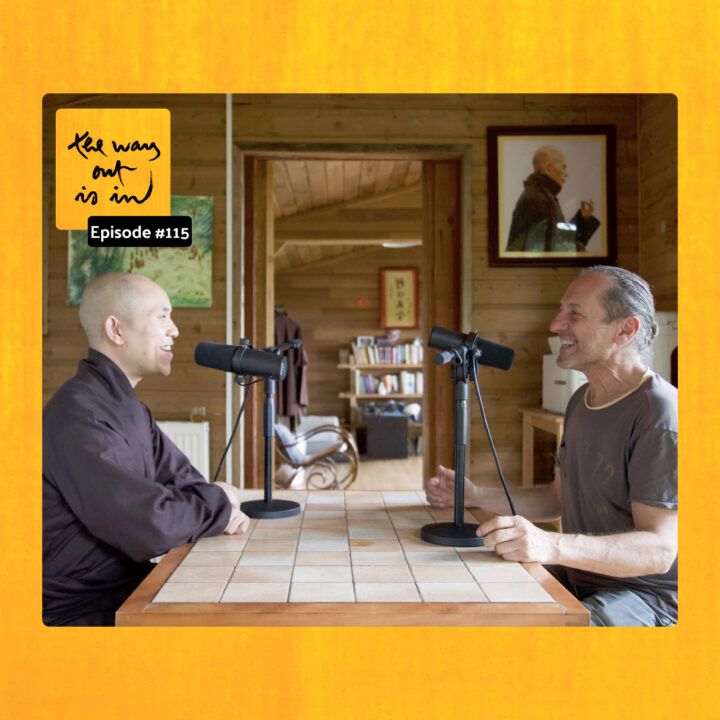
Welcome to a new episode of The Way Out Is In: The Zen Art of Living, a podcast series mirroring Zen Master Thich Nhat Hanh’s deep teachings of Buddhist philosophy: a simple yet profound methodology for dealing with our suffering, and for creating more happiness and joy in our lives.
In this episode, Zen Buddhist monk Brother Phap Huu and leadership coach Jo Confino discuss the difficulty of asking for help, exploring the cultural and personal barriers that can prevent people from seeking assistance. They emphasize the importance of recognizing indirect requests for help, and the need for compassion and presence when one is asked for help; the role of community and nature in providing support; and the necessity of self-forgiveness and self-care.
The conversation underscores collective responsibility for addressing societal issues, and the power of shared vulnerability in fostering deeper connections. The hosts also share practical steps, from both teachings and their own lives.
Co-produced by the Plum Village App:
https://plumvillage.app/
And Global Optimism:
https://globaloptimism.com/
With support from the Thich Nhat Hanh Foundation:
https://thichnhathanhfoundation.org/
List of resources
Sister Chan Khong
https://plumvillage.org/about/sister-chan-khong
Brother Phap Ling (Brother Spirit)
https://plumvillage.org/people/dharma-teachers/brother-phap-linh
Interbeing
https://en.wikipedia.org/wiki/Interbeing
The Plum Village Tradition
https://en.wikipedia.org/wiki/Plum_Village_Tradition
Wake Up Retreat 2026
https://plumvillage.org/articles/wake-up-retreat-2026-am-i-good-enough
The Four Mantras of Love
https://plumvillage.org/gems/event/The-Four-Mantras-of-Love-V2DFQvyDMgD3NEx7GTKfXz
European Institute of Applied Buddhism
https://www.eiab.eu/
Mahayana
https://en.wikipedia.org/wiki/Mahayana
The Way Out Is In: ‘The Three Jewels (Episode #89)’
https://plumvillage.org/podcast/the-three-jewels-episode-89
‘Beginning Anew’
https://www.parallax.org/mindfulnessbell/article/beginning-anew/
The Way Out Is In: ‘True Love: Practicing in Relationships (Episode #31)’ https://plumvillage.org/podcast/true-love-practicing-in-relationship-episode-31
Quotes
“Because we are alive, everything is possible.”
“Unfortunately, as humans, we tend to only recognize that something is really happening when we experience it.”
“The beauty of mindfulness and meditation is to welcome the vulnerability in ourselves.”
“For someone to ask for help, they need someone to be compassionate.”
“When you can listen deeply, you can hear what the other person is not saying.”
“Asking for help is a leadership skill.”
“People think the environment is outside of themselves – but they are the environment.”
“We need to turn to ourselves, to take responsibility and to forgive ourselves, and then reach out to people in a way that benefits them. Because, when we ask for help, we give them permission to also experience that.”
Dear friends, welcome to this latest episode of the podcast series, The Way Out Is In.
I'm Jo Confino, a spiritual mentor and leadership coach.
And I'm Brother Phap Huu, a Zen Buddhist monk, student of Zen Master Thich Nhat Hanh in the Plum Village tradition.
And today, dear listeners, we are going to be asking you a very simple question. Why is it so difficult to ask for help?
Hello everyone, I'm Jo Confino.
And I am Brother Phap Huu.
And brother, we are not in Thich Nhat Hanh's small Sitting Still Hut today. We have decamped to the house of myself and Paz where it is cooler because this is the fifth heat wave of the summer. It's more… It's about 40 degrees outside right at this moment, and in Thay's hut, which is made of wood and is very low ceiling, we probably would have burnt to death.
It would have been a sauna experience.
That would be novel, wouldn't it? Doing a recording in the sauna. So, brother, as I said, this is the fifth heat wave. It's… Everything is sort of dried out outside. Our pond just outside dried up a month ago. A lot of the trees are dying. A lot of the plants are struggling. A lot of humans are struggling. We're in a very rural area and we see a lot of the fields have burnt, all the corn, the sunflower seeds, the local farmers, the vineyards, the grapes have been too hot, so the wine harvest is not going to be successful this year. How does it feel to be living through this time?
Well, it's sad to see the state that we're in with all the scientists and all of the activists for years have been talking about the awareness of the impact of the way we live life, the drilling of the earth for the oil and the co2 emissions that is just out of control because of human greed and our lack of agency in the systems right now. It's not individual. I trust that individual humans, for all of us, we are, if we had the power to change, we would have. But the structure of our society that we rely on, unfortunately, it has been built in a way that money and power and greed takes control. And it's a pivotal moment in our collective human consciousness and being where we have to work together, meditate together, and suffer together in order to move the needle of the shift and of the change. So it's painful to be aware of what's happening because I'm meditating on more of the beyond the human realms, like all of the insects, of all of the plants, of the flowers, of all the ecosystems that is around and just being aware that there are thousands of insects that are going into extinct and then forests that have been caught by the wildfires. And it's just a moment of embracing grief and being present with some of the anger that also arises, as well as still be grounded in the present moment because our teacher has a calligraphy and as a mantra, 'because we are alive, everything is possible' also, to not lose oneself in despair. And we are in the midst of the Wake Up retreat. We have about 800 young people with us in the monastery and bless them for going through the heat wave together because our monasteries, all of our big event centers, buildings, we don't have AC. And the goodness of the Dharma and the activities is still powerful enough that everybody's still very present, but we are collectively sweating together and finding shade. And it's also allowing us to be slower because of the heat wave. So everybody is more present with the body because your body is coping with the heat. And it seems like the hamlet is slower and calmer and quieter. So there could be a positive there, when I'm just reflecting, walking the monastery today and then just coming here for the podcast because tonight is lazy evening. Normally there would be sport going on, music, games, but everybody is just finding refuge right now.
Thank you, brother. And one of the things I find very helpful is just to really experience this in proximity. You know, we've spent many decades trying to warn people of these dangers and it hasn't been at their doorstep. And unfortunately, as humans, it's only when we experience something that we tend to recognize it's really happening. And just outside the door where we're sitting is a beautiful pond that dried up about a month ago. And that pond is… I often sit next to the pond. It's a very beautiful spot for me. It's filled normally with life. It's got dragonflies and fish and newts and frogs and wild fowl nesting there. And I sit there early in the morning with a cup of tea and just watch all this vivid life. And now it's completely dried for a month. It's just no life there at all. And so it's very important sometimes to see in the microcosm the macrocosm because in that one pond, it's like a whole ecosystem on its own. There's so much life in there and other life that comes to benefit from it. And then to see it gone is very painful. So that is the life we're living. And as you say, brother, because of impermanence, anything is possible. So we hope that eventually, as Thay would say, people, there'll be a collective awakening, so people feel that actually they do have the agency and the capacity to help create change, even when, as you say, the system seems so locked up. But on to today, brother, because what we wanted to talk about was about asking for help. And Thich Nhat Hanh had something called the Four Mantras of Love. And the last one he said was the most difficult, which is to say, dear one, I suffer, please help me. And I wanted to explore this because we all need help. And when we don't ask for help, we suffer on our own. And the more we suffer, the more difficult sometimes is to be able to speak our truth and to get the help we need. We see that so much in modern society. People feel that they ought to handle things themselves. They ought to be independent. They need to sort things out on their own. But actually that can create a lot of loneliness and grief. So, brother, what is it about Thay that recognized the importance of being able to ask for help? Not just to give to other people. We have a lot generosity, but actually. Ask for that generosity back. Why did Thay focus on that?
Well, it's connected to the insight in the teaching of the Buddha, which is to touch deep interbeing is to come to a place of non-self. But majority of us, we live with self at the forefront of our path. Everything we do is about us, everything we do is relating to our safety, right? Our survival instinct. And as we're brought up, sometimes asking for help feels like a weakness rather than a skill in a way, but it is presented and it is received and then we get back the reaction of, you know, man up, you suck it up or like toughen up, young one, you know, life is only going to get harder, which is true. And at the same time, we have the capacity and we are innate of the generosity of love to support one another because our survival has been on community, on relying on one another. And I think it is from the industrial revolution where looking at our view of success and our view of like what it means to lead one's own life into society and there one's life already starts to create a boundary of like this is mine and this suffering is mine also. And in the practice of deep looking, which is to understand oneself and to understand one's suffering, we start to see that this suffering is not ours alone. And so when it is not ours alone, the path of transformation, sometimes it will need someone else to shine the light so that we can see our habits, our weaknesses, our tender places where it's like, you know, that area is tender, don't go there yet. You know, because by ourself, we may also put on the cape of trying to be a hero and try to solve everything, try to fix ourself within one retreat or within one year, and we put these kind of goals that are almost impossible. And there was this one time Thay said to the monastic community, and some of us we've been practicing for three years, four years, five years, and we still suffer and we still are struggling. And we questioned like, is it working or am I failing? And Thay said, well, you've lived your life in the world for 40 something years or 30 something years. You expect all that to be transformed within five years? You know, it's like, the math is not adding up, but it's this kind of like self-indulging competition that we also have with ourself in the race of even trying to be successful in a spiritual path. And so with these pictures that I'm painting, it comes back to then the pride that we have as an individual because asking for help is a very vulnerable moment in someone because they are going to surrender and saying that, I don't know what to do now. And that's very scary. And I think it also has the layer of our ancestors, you know, our parents, our ancestors. And depending which journey our ancestors have been on, it has so many layers within that, right? So if our ancestors have only known how to survive and has made it on their own, then that seed will have been amplified in us. And then the upbringing that maybe they didn't know how to offer love and their love was suck it up. Because, look what I got you, like, I've sacrificed so much for you, like, how could you not even handle that? And all of these wording are seeds that are imprinted in individuals, and it may lead to a lot of inferiority complex. And then asking for help shows us that we are less than. And then those with superiority complex, then the pride takes over, the pride doesn't allow oneself to present itself to say that I'm stuck right now, and I don't know what to do. So the beauty of mindfulness and meditation is to welcome the vulnerability in ourselves.
Hmm, beautifully spoken brother, and what my experience is is that, you know, we think that when we grow up, when we become strong, when we are, let's say, a business leader or when we succeed in life, that actually it becomes easier to sort of get by. But actually the higher up the ladder we get, actually the more difficult it is to ask for help. And we see that with CEOs, business leaders, all sorts of leaders in different sort of sectors of society. That often they're the most lonely because actually when you're supposed to be in charge, then it's even more difficult to show a weakness and ask for help. So given that brother, I just wanted to ask about Thich Nhat Hanh or Thay, as he was known. So Thay was a great leader and I'm just wondering how he handled this. Was he able to ask for help or was he always in Sitting Still Hut, where we normally record, and just sort of finding his own way and just hoping it would all work out.
Well, I met Thay much later in his years where I think he has figured out many things in life. But I imagine his youth and his young Dharma age, his young Dharma teacher career, he had to ask for a lot of help. And the things that he has been able to accomplish in life wasn't done by him alone, right? And even when he was exiled in America, I mean Sister Chan Khong, his spiritual student and our eldest sibling in the order, she was one of his greatest supporters and helper, and his friends that he's met on the path all played a part in supporting and showing the way of also integrating into new lands and a new culture, because Thay did have a culture shock when he was in America and then in Europe and of course, cause his whole life, he's only known Vietnam. And so what I can share though, in my time, was his curiosity and his also, I think, as a teacher, he also had a presence that he upkept for all of us to take refuge in him. But there were many moments he did ask us questions. And I would say that's asking for help. To hear our feedback, to hear our take on something, because he wants to also expand the understanding of a topic within his young student's mind. And maybe we are very naive in some of our answers, but it gives him a look within the next generation, in a way. And I do remember when he didn't know something, he would ask us. And that is also for a teacher to do that, it's very powerful. And it allows us to be part of his journey in awakening.
And I suppose, brother, one of the things about asking for help is it doesn't need to be, you know, beating your chest and saying, please help me, help me. I mean, sometimes getting help is to share something. And I'm sure that when Thay was going through great sufferings, for instance, when his community in Vietnam were sort of under siege and forced to disband, that was a very painful time that I would imagine, just by having the sangha around him, just by being able to rely on other people to support, that is, in a sense, asking for help.
Yeah, and now that you spoke about it, you're right. Like there are so, like when we say asking for help, it is an act of generosity because you're allowing someone to be part of your life because you are allowing them in. And one of my last, I would say leadership conversation I had with Thay, it was in 2014, at the German monastery of Plum Village called the European Institute of Applied Buddhism, I had a chance, just out of the blue, I just asked Thay, I'm like, how could I become a better abbot, like a better leader for the brothers community? And he said, you need to learn to trust your brothers more. And I was a little taken back because it was a criticism towards my character and towards my mindset in that moment. And I reacted to Thay and I said, Thay, explain, like say more. And he said, well, I watch you operate within the community and you're involved in everything. And everything that is taking part, you're always there and you are guiding, but you're not giving space. And he asked me, how do you feel when I ask you to do something? And I said oh, I feel honored. I feel grateful. And he's like, exactly. Everything that I'm asking you to do I can do it and maybe I can do it better than you. But when I'm allowing you to do something I'm giving you the feeling of rootedness within my life, within the community that we're building and I'm entrusting myself to you and that's a power that I'm given you so that you feel that you're not disconnected from the path that we're all walking together. So he said, he looked at me, he said learn to trust your brothers more, ask for help, delegate more and trust it. Even if it's not gonna be transformed or done perfectly, 70% is good enough.
So brother, for someone to ask for help, what they need is for someone to be compassionate. I was once told, and this is sort of quite a traditional stereotype, but I was told that men often find it very difficult to share. And when they're in relationship, if they have the courage to share something and their partner rebuffs them or criticizes them, or humiliates them in some way, if that happens two or three times, that person will just shut down for the rest of that relationship, that they lose the trust. So when people ask for help, often it's a very, very tender moment. It's someone who's taking a big risk. It's somebody who's going outside, as you said, the cultural referencing, which is suck it up, get on with it, pull your own bootstraps up. And someone who is prepared to be vulnerable. And that is a very vulnerable place to be. It can feel very unsafe. What do you feel and what do you see in your own experience are the qualities we need to show to someone to be present for them? Because it's not just something to nurture if someone comes to you once in a blue moon, it's almost something you need to create inside yourself so that any moment in your life, people say, ah, I can trust him or I can just her or I know that I can share with them. So tell me a bit about the qualities that it takes for someone to develop inside themselves so that they are a container for other people's pain.
Beautiful question, Jo, and it's making me reflect a lot on my last months in the community. And people usually ask me like what's my task as an abbot. I'm like, listening, being present to hear the sounds, to hear the pulse of the community. And it's very interesting for me I have a lot more space to listen to a community than individual. I'm going to be very honest. Sometimes I get really annoyed when people, and even my siblings want like individual time, and it's my practice to grow that. And I would say the presence, and this is why we are on the path of practice is to expand ourself more in freedom and space, like we need a lot of spaciousness to hold someone, to hold a interaction. Because our tradition is when we are listening, we're not scrolling on our phones. We're not being distracted. We are really putting all of our guards down to offer our presence to someone. And I've had really good role models in my young novice years where I've had elder brothers where I know they're super busy in their life, in running the mystery. And whenever I knock on the door and I have a question, they're able to just let things go and be present for like 20 minutes, 30 minutes, or sometimes it's just five minutes. And part of that is just that there is an interbeing of your joy is gonna be my joy. Your understanding is gonna be my understanding. Your moment of being stuck is part of me being stuck too, and if I can have a path forward, I can open it for you, then you can go forward. That means I'm going forward. So there's a lot interbeing there, and that is in the individual practice. And traditionally, what Thay has guided us is when we want to listen to someone who needs help, we have to bring in energies that can be the foundation for our listening, and that's compassion for us. And we have a Bodhisattva called Avalokiteshvara in the Mahayana tradition. And they represent the ability to listen deeply. And that ability, it's a very powerful ability because they're very generous in their being of presence. And they're very patient. And their presence alone is a kind of virtue because you can almost feel like you can vent in a way, cause they're going to give you the spaciousness where you can release your guards. And that takes a lot of conditions. And part of that is the training. And that means individually, you also have to learn to listen with your full body. And we practice this a lot in Plum Village, like when we hold a circle of sharing groups, Dharma sharing, I always invite myself to always come back to my body. Because when I'm hearing someone share, my mind gets in the way, and I start to think about a solution, or I start to pity them because they've gone through so much suffering, or I want to put on my teacher mode, like, what can I say to prove that I've been a monk for so long so that they can have some wisdom, right? And your mind starts to go on its own journey, and you're not listening anymore. So the power of deep listening is to be grounded within ourself and our foundational practice, our breath, our body, and reminding ourselves is be present, hear what needs to be said. And then, someone who has the ability to really listen, our teacher has this wonderful line, he says, when you can listen so deeply, you could hear what the other person is not saying. And I, I've always felt that Thay could hear the community in what we are not expressing through our words, but through our energies, and that is a listening too, when you're with someone, if they're nervous, you, as a listener, can help them be at ease, be grounded, be confirmed in a way that's like, I'm here for you. Don't worry. And I'm still weak at this, and I'm still working on this because I don't feel that people have a lot of space when they would say, I want to talk to Brother Phap Huu. I think there's a lot fear that comes up. And some of the fear is maybe what I will say back to them, or sometimes the fear of taking up my space and my time, or the kind of energy that I carry. And I caught myself about two weeks ago in the summer retreat, and one of the brothers caught me at a moment where I just finished like a meeting, right? And I'm not in my best shape and it's like summer retreat and it's the in between week two and week three. And the brother asked me, can I have a moment with you? And I've learned to say, yes, right now is the moment. And, because, or else in my head, then I have to schedule, I have to find a time. And I would like to be present moment. I'm like, right now is the moment. But I think that reply caught him off guard. And he said, no, I think I would need more time. I said, well, I have time now. And I was kind of forcing it. And it made him so uncomfortable that he got afraid. And I said oh dear brother, I'm so sorry. Yes, let's find another time. And I've been on this side of receiving, right, of hearing others, and I'm looking more deeply into my own capacity. And sometimes, honestly, I don't have a choice to say I don't have space. I have to create space because it's important. It matters. Even between the summer retreat and the Wake Up retreat, I had to guide four meetings for the community and that's four days and then three days and then we're into 800 people. And for me, it's not about having an option to be spacious and then arriving. It's then, in that moment, I'm creating space to listen, to be present, to catch my reactions, to make sure my energy is not overtaking someone else's space that is sharing. So it's really, it's an incredible journey of self-learning, I would say. So this is my take on the listening side. And you know, I know the theme is on the other end is, but that's what is really alive for me in this moment.
Yeah, and it's, of course, we need both. It's like you need the cause and conditions to be on both sides. And obviously, the heat is making our brains go a bit soft today, brother, because I'd like to share about my patience and impatience, because when I coach people, I'm endlessly patient, endlessly spacious, endlessly there for people. When people ask me, what's my theory of change? When I might start coaching someone, I said, I'm just gonna love you. I'm gonna be 100% here for you. I'm going to listen to, you're everything to me. But then when my wife, Paz, wants to talk to me, I can get very impatient. And even though my wish is not to be impatient, it just gets triggered. So it's very interesting because you said, you're very open to listening to the community, but as soon as it gets to the individual, then it becomes almost more stressful. And that's exactly how I feel. And it's very hard to change. It's very to, even if our greatest wish is saying, actually, I'm gonna change, and when we start to move towards it, it still just catches us because it triggers things from our past. So this is something for us all to work on, which is to be present people. And the more we cultivate that in the heart of who we are then actually, as I was saying earlier, any time of day, someone will feel we can be a refuge for them.
And this is why sitting meditation, you might not see the fruit of it right away, but it's so important. It's cause you're developing your presence. You're developing your spaciousness within your breathing, within your mind. So when you're in conversation or you're coaching or you are in meetings or you're on a one-on-one with someone, you can actively bring that mindfulness present. And sometimes, cause I'm sharing this because sometimes we think of meditation as just an act or a practice to be calm and to ease ourself and to have a blissful moment, which we need. But for us, it's very engaging. Like it's the muscle that you're building so that you can catch yourself, oh, I'm about to react right now. Come back to sitting meditation. Don't say it, don't say it, Brother Phap Huu, don't, don't react, don't lift your eyebrows. You know, it's like… And it's that kind of muscle, spiritual practice training muscles that now is engaged into every moment.
Hmm, thank you, brother. And it also reminds me that when I was trained as a coach, one person said to me, every conversation is a coaching conversation. Don't differentiate between when you're formally coaching and when you're just with a friend or even in a shop when you are buying something, is that actually the quality of any relationship is actually where very subtly we're asking for help of each other. I was recently, I hired a car, and someone, the person at the counter was just telling me how miserable his life was. And I just listened with a lot of love. And what I realized, he was in a sense complaining to me, but behind the complaint was asking for help, was saying, please help me, please listen to me. And because I listened to him, then he was able to actually lighten up. So I just want to explore that a bit more, brother, because often we think of asking for help as being a very direct thing. Sort of, I've got a problem, please help me. But a lot of the time when people criticize you or attack you, actually underneath that is a cry for help. So I'd like… maybe for you to share with me about that whole idea, because I find it fascinating, which is that often when people attack us or criticize us, we take it very personally and then it triggers us and then we go into retreat. But if we're able to shift our perception and to, in a sense, what you're saying, if we recognize that what is the person not saying here? The person is not saying please help me. And actually the attack is a cry for help.
I think it's a mechanism of masking, as I've also learned to use that language, where sometimes being authentic is so scary because it is not welcomed wholeheartedly. And we've learned through language, through actions to mask a lot of our inferior feelings. And we do it so well that we start to have habits when we actually want help we would do something very particular. And part of being in a community is also watching and seeing patterns of our siblings. And when somebody in a conversation doesn't respond or responding in a very particular tone, we know that this person is very uncomfortable in this moment and they need help. Even me and Thay, we had this duo, because Thay would receive so many people in his hut and he would have a reaction or a kind of body language where I knew that it's him asking me to end this meeting. So we have one side is the habit energy of masking our calling for help. And then we've also learned to establish skillful ways to rely on one another, to support us, right? You know, there used to be a card game called Signal and I think so many people still play it. And if you have like whatever combo, I can't remember, then there's a kind of body language that you give and you say signal and it means that you win as a pair or something like that. But coming back to the side of running by habit, I have a very direct experience. And I love my mom, I love her so much, but and, not but. And I know when she becomes passive-aggressive, that means that she's not being heard. And there are things that she wants to tell us, her children, but she doesn't have the language for it or the voice for it, or the way of expressing that. And I, when I see that and I understand that, I would take the courage to ask, what is it that is bothering you? You know? And then I can open up that door for my mother then to say things that without inviting it, she wouldn't do it. So in any relationship and friendships, I think it's so important to be mindful of these signs because it is that moment where somebody sees your energy and see your way of being and is it ah, my friend needs help right now. And in my own journey of life in the community, I build a really thick wall and I built a very kind of way where I just wanted to be the supporter but not receiving support. And there was a moment in my midlife crisis as a monk, I realized that I'm about to lose it. Like lose myself, lose my path, and if without openness, I would lose the Three Jewels, the Buddha, the Dharma, and the Sangha. And it comes back to the pride. Pride is… In Zen, we say pride will become one of your greatest obstacle for your own growth, because you think you know it all, you think that you do it alone, you are not reminded that you are one with the collective. And for me, pride was definitely my obstacle because I had a story where I can practice, I can do this by myself. I've been trained for so long. I've been meditating for so long. And I was starting to become passive-aggressive and I started to not ever want to have connection anymore because I started feeling isolated because my suffering was my story that I created that I'm suffering so therefore I'm not connecting. And I was blinded by my own pride where I wasn't able to see the helping hands that my siblings and my friends were putting out. And finally, there was a moment for me that it was like a bell of mindfulness where it just hit me so hard when I felt like I wasn't a part of this river anymore. And that was a very dangerous thought for me. And that was a moment where I knew I had to announce those words: I need help. And it was a really scary moment, to be honest, and it was very particular, it needed the right conditions. I needed to hit that moment where I knew like, I'm about to lose my monastic path if I don't ask for help. I'm about to lose the sangha if I don't ask for help. And it is also an awakening in itself also that you are suffering. I need help.
Thank you, brother, and of course, this is, as I see it, the shadow side of community. Because, and also within Plum Village, because everyone, of course for all the good reasons, wants to be the best practitioner they can be. Wants to be seen to be sort of walking this path and improving. And so if someone's not doing well, it can be very hard to admit it. And I was recently talking to one of the monks who was suffering, and he hadn't done anything wrong at all, but he felt that he was failing, and that underneath was a great fear that if he were to share it, that he might be asked to leave the community. And I think, dear listeners, this is true for all of us in our own way, that we all carry the fear that if we own up to our secrets, or if we show up fully as we are with all of our wounds that we will be rejected and marginalized and isolated as you were saying earlier, brother. And yet, what we don't realize is actually people are generally very kind and actually when we take the plunge, of course, within boundaries that, you know, we have to be careful of that. But when we find the capacity to share, often what we receive is just enormous amount of love and tenderness and then actually what we can find after that is that actually through our sharing we become a role model for other people to share. And I know we've discussed this before, brother, but, you know, it's worth repeatin. You know, I've noticed within Plum Village in the sharing groups. Recently, one of the… there was an artist retreat here and I was within a group. And we had, I think four within our small family group, four group sharings over the week. And the first three people were saying, oh, I'm so grateful to be here, talk about all the wonderful things about Plum Village. And then on the last day, actually, I decided to share something very deeply because there was something in, and it's in my understanding that when one person shares deeply, then it gives permission to everyone else. So I shared something very deeply about the fact that… Because the name of our group was True Joy. And I was feeling anything other than joy the whole time. And so everyone, and there's this expectation, you know, the name of your family group is True Joy. So you should be truly joyous. And on that last day, I just shared just how I was feeling about stuff in myself, but also the state of the world. And it just opened the floodgates, and then everyone was able to share very, very deeply. So, actually, and I don't know if you have anything to say about this, brother, but for me it feels like asking for help is a leadership skill.
Beautiful. I agree. I absolutely agree. And I think to not feel alone, you have to ask for help. And to see part of our theory of change, right, is to change the individual into the collective. And I truly believe that with everything that's going on in the world, one person is not enough anymore, right? Thay has that famous statement: one Buddha is not enough. You can't outsource the change that you want to see in the world to someone else. But it has to be each and every one of us. And looking at asking for help, I think Mother Earth is asking for a lot of help from us. We can respond. And our actions, our daily actions are our response. And I think in true friendship, when we ask for help, it really is a moment of also generosity, and it's not, and I say this because I've also extracted a lot from my siblings, where I just want their time and I'm not gonna do any work on myself, where I just want to be guided and led. But at some point in our lives, we also have an island within that we have to put the work, we have to, you know, dig deep and find and understand the source of our suffering. A friend, an individual, can be a mirror for us to hear ourself. And sometimes I feel like asking for help is like you can hear yourself also. You can say that I suck right now and I wanna own it, I want to admit it and I want know that I'm at a low right now. And that's why we practice mindfulness, to acknowledge these moments, to accept these moments. And it's not a failure, it is a journey. It is to meditate within. It is to understand what are the paths forward that we want to spend time to work on, right? To look within. And I say this because if we are only looking for friendship to ask for help as a way to extract people's generosity, then that is also going to become kind of consuming. You're consuming someone's love and if you consume so much but you don't have the ability to also generate love for oneself, then we're also not doing the work and being accountable for the feelings and the emotions and the journey that we are transforming within us. So I do want to say this because we all need to have support and ask for help, and we also have to do it with moderation.
Beautiful, brother, and just to pick up one thing you were saying, which I think is so important, is you said that when someone, sometimes when someone asks for help, what they want to do is hear themselves asking for help. And so one of the mistakes that so many people make is that when they're with someone and the other person asks for that they think the help is to give them an answer, to help them find exactly the answer, to advise them on what they should do, to talk about their own experiences. Well, this is what I did. Have you tried this? And they want to solve it for them. Whereas the power of listening is, and this is of course one of the core practices in Plum Village is you listen without trying to respond. You listen and you're also aware of your mind actively trying to either close down the conversation because you find it uncomfortable. Actively already thinking what they should be doing and having the answer already, and all that takes us away from actually listening. And some people, some of the time, the most important thing is just to know they can be listened to and to trust that they will find the answer for themselves as well. It's so important that because we think when someone's asked for help, that it's our job to save them. It is not our job to save them, it is our job to listen to them. So brother, I'd like to talk about other practices in Plum Village that can help support that. You know, we've talked about them before, but these are core practices that we need to be reminded of time and time again. And one of the core practices is beginning anew. And that is a way Thay created of… called restoring communication. And normally it's between two people, but it couldn't also be done in groups. And there are four parts to it. One is what we call watering the positive qualities in someone else. One of them is offering regret for something you might have done that you admit your responsibility in any situation. One of the is sharing a hurt, but the fourth one is asking for help. And Thay would say that like any other practice, this needs to be practiced. It's not once a year. And I did an episode a long time ago with my wife, Paz, because we have been practicing it regularly for 20 years. And it's like a muscle, because every week or so we go through that process and we ask for help. And so you're very quickly that asking for help becomes just a normal part of our relationship. It doesn't become something that we're hiding away and thinking, when can I tell him or her that, how do I break this or this is too small, maybe they haven't got the energy for it. But we have a set time where we are able to share from the heart and we don't respond to it. And occasionally we try and respond and we have to shush each other because there's that tendency that comes up. But it's just every week listening to what the other one is going through. And then when they're asking for help is to sort of say, ah. So one of my core ones is driving too fast. So I have a sort of, Paz and I have very different sort of speed of action. So I tend to go quite fast in my life and so I drive fast. And Paz hates it especially going around corners because she can get car sick. And it's such a struggle to change those habits but because it keeps on coming up and I know, I cannot now deny I know that. You know, sometimes we think, oh, did she say that? Is that important? But because has come up often, and because we keep sort of touching that place, it means I have developed, sometimes, the quality of slowing down and recognizing. And now she just has to say, look, oh, can you slow down a bit? And it's a bit like what you're saying, I don't have to know. It's not that she's not saying it, but she doesn't need to make it a big deal. She says it, and most of the time, some of the times, I then immediately respond to it. So it becomes a muscle, and I… One of the things about Thay's teachings is that a lot of people think you do it once or twice and you learn it, but can you just talk to us about just what it is like to just keep practicing? Why is it that we need to keep practicing?
Cause we're very forgetful. And we are so curated by all the other things, which is to avoid, to avoid suffering, to avoid uncomfortable moments, to avoid uncomfortable conversations. And the practice is to build also a strength within us. And part of our practice that we also do a lot in the monastery is after meditation, we would read texts that are written by our teachers and they're very beautifully like aspirations. And I also feel like those aspirations is to remind us of why we're doing this. And it is to tell us to to encourage ourselves to be mindful, to walk slowly, to listen deeply, to not neglect the present moment. Zen masters, teachers, patriarchs, matriarchs from generations, the only way they're able to sustain it, their insight and sustain their compassionate way of being is because they do it every day. It's almost like sports, right? If you don't do something for a long time, your muscles will remember, but you won't be as sharp as when you practice it every day, like flexibility, it's the same like when you, when you stretch, you practice, you have that, those movements that you can apply right away into daily life. And another practice that we have are mantras, right? And mantras for us, it is not something that we recite in Pali, Sanskrit or something we don't understand, but within languages and words that actually really give us reminder and vows such as, I am enough, you know, I'm enough to meet this moment. I am enough even though I make mistakes, even though, I still need to ask for help. Or we are flowers of the garden of humanity, and I am solid, I am free, present moment, wonderful moment, like just so many artistic words that have been introduced from wisdom from many teachers to remind us of developing our capacity to listen to the present moment. And another practice that's very deep, and one of the brothers, he shared this yesterday in my Dharma sharing and I was crying. He shared one of his suffering and I have never heard him say this and I know of the pain that he's been through through other people but I never heard him share it. And he made a mistake in the past that caused one of his older brothers, his own older brother to go through a very hard time. And it made him very depressed, and as a monk, he had a lot of trauma. And the practice that got him out of it was touching the earth every day. And he would ask Mother Earth to hold his shame and hold his guilt and hold his pain, even though there were days he didn't want to live anymore. He was thinking of just abandoning everything. And then he would listen to Thay's Dharma talk. He said, sometimes two Dharma talks a day. That's four hours of teachings. And it's not to ignore the pain, but in those moments when you're in such darkness, you need light. So Thay, his words, and his voice, and his tone was the light he needed. And he did it, he said, for years, he would just do that. And he was able to overcome it. And that's why he's still here with us. And he was sharing, he was sitting right next to me, and I just started crying. And this was yesterday's Dharma sharing in the Wake-up group. And it was so powerful to hear a monk who's been practicing for over 14 years share this as a Dharma teacher, someone who's holding the lineage and as a transmitter, but to be so open to people he just met. And I knew that, wow, the power of a retreat is not just for the people coming, it's also for the monastics that are in it. And that moment was right for him to express that. And as an older brother, I was so moved by it. And once again, I took, I'm saying, I take refuge in the Dharma, meaning the practice does work. Like, don't kid around, like this art of training, this art of practices have such immense power. And that brother was an example to all the young people in this retreat that there are rituals in a way that touching the earth is a ritual and is asking the earth for help. Sometimes you have to ask for beyond human to support you, your ancestors. He said on some days he would ask for the ancestors, spiritual ancestors, to give him strength, to overcome his shame. And there are days he would ask his genetic ancestors to embrace the guilt that he has as a family member. Wow, I was so moved by that. And of course, he asks for help among the siblings to just hold him and just know that he's going through a hard time. And we did know when he came back to Upper Hamlet, he was at another monastery. And he was thinking of leaving the monastic community and blessed one of the older brother in our community said, come back to Upper Hamlet, drop everything, just come back, take refuge. And in a way ask the community to hold you, to support you. And he did, bless him, for not allowing his ego and selfishness take over.
Thank you, brother. When you talked earlier, which I thought was very important about when we ask for help to do it in moderation and not to export our pain and in order to consume other people's sort of generosity, I just want to come back to that because it just feels so important that we find forgiveness inside of ourselves. Because so much of the time, that example you just gave, shame is such a powerful sort of, as soon as you mention that word in that example, it feels like a sort of clench inside me. We just feel that we all carry shame. We all wish we'd done something different. We've all hurt someone often in our lives. It's great to ask for help, but actually what I hear you saying is we have to help ourselves. And there're practices that can help us, but we need to find that own place of self-forgiveness. We can't get it from outside of us. We have to find it inside of ourselves. And the other thing, brother, I just want to come back to Mother Earth, because as you said, we can ask for help from Mother Earth, through touching the Earth, but we started off this conversation talking about how Mother Earth is suffering from climate change and the loss of biodiversity. And I'm just wondering, brother, actually for your advice, or maybe not advice, but just sharing on how we can connect more deeply to the pain of Mother Earth because actually it's quite difficult for some people to really connect with the environment. As Thay says, people think the environment is outside of themselves as they are the environment. So how can we connect to mother? So when we, you know, I look outside the back door now and I see so much of nature just in this locale of suffering and then we look, think of this and extend it globally across the world, just how much is being destroyed, how much Mother Earth is suffering, how many species, as you said, are going extinct. But often people… Heart is closed because either they don't know how to deal with the enormity of it or they don't see it as, they don't deeply connect to the fact that actually the future of our lives depend on the health of Mother Earth and that if we don't look after Mother Earth, then we're also destroying ourselves. And as Thay would say, we're even eating our own children. So I'm just, it's just such a conundrum for me that we're in this place where all these problems are upon us. We see them directly in our lives. We are directly affected by them. And yet people immediately want to forget. And I imagine in three weeks time, if the temperature comes down to rather than 40, late twenties and it's raining and sometimes, and it feels cool. And we'll all say, oh, someone will say that was a difficult summer. And you say, oh yeah, it was. But then we go back into this sort of falling asleep.
You know, I remember watching these ancient movies that shares the history of times. And a lot of kings and emperors in Asia, when there was a drought, they would bring the whole community together and they would do a prayer and ask for rain and ask for the earth to bless the land so that we can grow our fruits, our crops. So because there is a deep interrelationship that without the environment, how are we gonna feed ourself? And it's because of our, you know, reflecting on like my upbringing, if we were taught to grow trees and have a plant, have a relationship with a plant, I think society, we would understand and connect so much deeper. And funny enough, like in my later, a few years ago, I was like, oh my god, I'm growing, I'm adulting because I started to have plants within my office. And I tend the plant like I'm tending myself. I asked it, oh, do you need water? And you hear it, yes, I need water. And I think like very practically, like I think all of us should have plants. It's a direct action of seeing ourself beyond ourself. And there is, there is science and there are those who said like, if you sing to the plants, the plants will grow more. If you have a relationship to a plant, the plant will relate back to you in its own health, in its own well-being. And in the summer retreat, Brother Phap Linh, Brother Spirit, before every week, led a session for the novices and encouraging words for them in action with the hundreds of people that we see. In the second week, the novice that was in my Dharma family, Brother Source, Brother Nhat Nguyen, shared to the whole group that he was taught by Brother Phap Linh that this week, beyond just the human, we want to pay attention to all the trees and the nature that's also holding the space for all of us to have a retreat, to see that in Dharma sharing, the bamboos are also listening to our suffering. The oak tree that we're taking refuge under is also going to play a stability for us to have a refuge so that we can be grounded to offer our voice, to go inward to our journey, to feel the root of our pain. And wow, when the brother shared that, my way of looking at the trees and my way looking at hills, at the bushes, changed drastically in that one week. And I saw the kids building their little fantasy world within the bushes on this hill. I was so in love with it. Like they are in nature right now. And this, even though they're living in a fantasy, but it is a real fantasy because the trees is their relation, is their refuge. And for me, this is why prompts and reminders are so important, because we're gonna forget, we're absolutely gonna forget. And we like our cleanliness, right, of the feeling of safety in a way, and most of our upbringing, maybe a lot of us listening on this podcast, it is the city life. Maybe it's not the barefoot nature feelings that we can be grounded within. So I think Paris is doing a really amazing job. They are, you know, taking a lot of streets and not allowing cars and vehicles and making them pedestrian and building more gardens, more nature, and we need it so much because nature is a wonderful transformer. It absorbs the heat, it transforms the heat. And places with nature, even in Upper Hamlet, where there is asphalt and cement, the heat reflects back and we feel the intensity. But when we're in nature, it embraces, it transform it, and we feel so much better. It's so simple. I can't believe that we have to go back to basic, but we do, as humans, because we're so advanced, quote unquote, in technology and so on, but we're losing all of the wisdom of survival and the wisdom of interconnectedness, of the love that we had to the relation to all of these elements that are around us.
Thank you, brother. And just finally, it's a great reminder that when we… I talk about asking for help. It doesn't have to be another human being. You talked about finding refuge under a tree and that is such a powerful word when we really look at it, refuge. We can find refuge in nature, we can find a refuge under a tree, we can actually sit under a tree and speak to it. Doesn't have be out loud because people walking by might think maybe sort of lost it that we're completely hippies or whatever, which is no bad thing, but we can do it silently as well.
And with our pets, if we have animals, they're incredible support too.
Yeah, and just to know that there are lots of places to turn. And first of all, we need to turn to ourselves, to take responsibility for things, to forgive ourselves, and then to reach out to people in a way that also is of benefit to them. Because when we ask for help, we give them permission to also experience that.
And also, I realized that a lot of connections is through the vulnerability of asking for help also.
Yeah.
Yeah.
So dear listeners, we hope you have enjoyed this episode and that if you're going through a difficult time that you can find ways of asking for help for yourselves. If you enjoyed it, there are many other episodes you can find The Way Out Is In on Spotify, on Apple Podcasts, on other platforms that carry podcasts.
And this podcast is brought to you by the Thich Nhat Hanh Foundation and Global Optimism, and all of the generous donations that we have been receiving to keep this podcast going forward. And to our amazing team, our two producer, Clay, aka the Podfather, and Cata, as well as our team that makes it alive online, Jasmine, Anca, and Cyndee, thank you so much for being part of the team and making it possible. And today, for our recording, Brother Nghiem Thung, who is our sound engineer and has been part of the journey for a long time. And this will be his last recording with us in the podcast because he will be returning back into Guatemala as a lay friend and will continue building communities and part of their practice community as a lay friend, but always a member of Plum Village community. So thank you, brother, for being with the community as a monk since 2020 and with the podcast team since 2022.
And Brother Nghiem Thung, it's a joy to know you and everyone in Plum Village wishes you well on this next part of your journey. So go well, young brother.
Thank you.
The way out is in.