






If you wish to support our podcast, please follow this link. Thank you!
Welcome to a new episode of The Way Out Is In: The Zen Art of Living, a podcast series mirroring Zen Master Thich Nhat Hanh’s deep teachings of Buddhist philosophy: a simple yet profound methodology for dealing with our suffering, and for creating more happiness and joy in our lives.
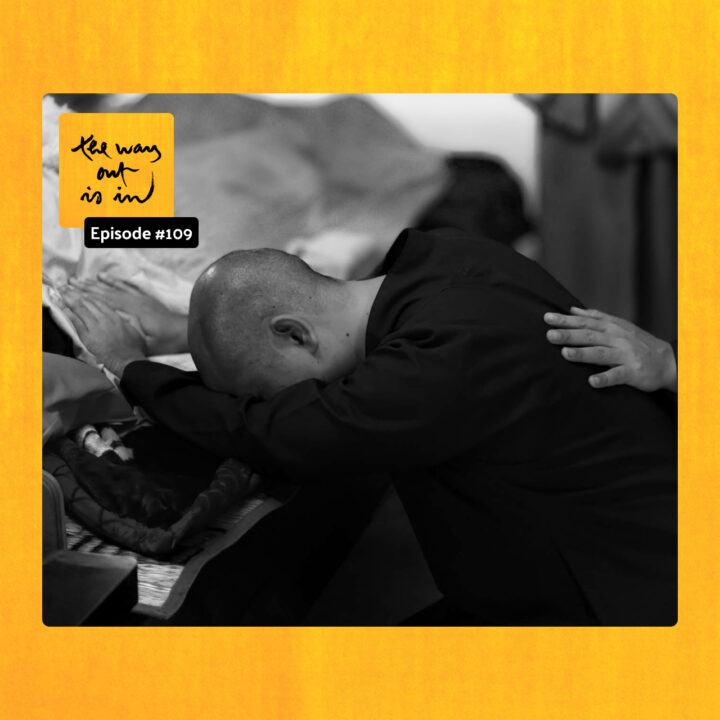
In this episode, Zen Buddhist monk Brother Phap Huu and leadership coach Jo Confino reflect on the passing of Brother Phap Huu’s father and the power of community in difficult moments, as well as considering insights into the teachings of no birth, no death.
This emotional conversation touches tender places and explores the Brother’s personal journey of grief and loss, from first hearing the news of his father’s stroke, to the funeral and the subsequent processing. Brother Phap Huu further explores his complicated relationship with his father, the sacrifices made by his parents, and his regret at not being able to fully express his gratitude and love.
Indeed, “It’s one thing to teach about ‘no birth, no death’, the passing of a loved one, but it’s a very different thing to experience it.”
The episode ends with a short meditation guided by Brother Phap Huu.
Co-produced by the Plum Village App:
https://plumvillage.app/
And Global Optimism:
https://globaloptimism.com/
With support from the Thich Nhat Hanh Foundation:
https://thichnhathanhfoundation.org/
List of resources
Bodh Gaya
https://en.wikipedia.org/wiki/Bodh_Gaya
Bodhi tree
https://en.wikipedia.org/wiki/Bodhi_tree
Christiana Figueres
https://www.globaloptimism.com/christiana-figueres
‘The Fourteen Mindfulness Trainings’
https://plumvillage.org/mindfulness/the-14-mindfulness-trainings
Interbeing
https://en.wikipedia.org/wiki/Interbeing
Jeta Grove
https://en.wikipedia.org/wiki/Jetavana
Joan Halifax
https://www.joanhalifax.org/
‘Listening to Namo Avalokiteshvara’
https://plumvillage.app/listening-to-namo-avalokiteshvara/
Plum Village Tradition
https://en.wikipedia.org/wiki/Plum_Village_Tradition
Sister Chan Khong
https://plumvillage.org/about/sister-chan-khong
Upaya Zen Center
https://www.joanhalifax.org/upaya
The Way Out Is In: ‘Slow Down, Rest, and Heal: The Spirit of the Rains Retreat (Episode #7)’
https://plumvillage.org/podcast/slow-down-rest-and-heal-the-spirit-of-the-rains-retreat
The Way Out Is In: ‘The Three Jewels (Episode #89)’
https://plumvillage.org/podcast/the-three-jewels-episode-89
Quotes
“Be kind in life because that kindness is something that you can never underestimate. It will come back. Just trust that.”
“For a lot of us immigrants in Canada, the temple was not just a spiritual and religious refuge, it was a cultural refuge. It was where we would see each other as Vietnamese. It was where we would smell the incense, eat the Vietnamese food, and hear the language… The temple was where we touched our little Vietnam and where everyone could feel that their longing was being answered by this community coming together.”
“The good training of Plum Village is to learn to see the flowers first.”
“It is never too late to say what needs to be said, even if someone has passed.”
“‘Enjoy and easy.’ Enjoy that no matter how hard life is, we can always taste joy. And no matter how hectic life is, learn to be at ease; be easy with yourself.”
“The practice of no birth, no death is also to see that life is also right here, right now.”
“For me, the practice of no birth and no death gives us permission to hold both and to not be tied down by only sorrow.”
“We’re here to connect the ultimate and the historical – not to see them as separate, but to bring them closer together.”
Hello dear friends, welcome to this latest episode in the podcast series The Way Out is In.
I am Jo Confino, a coach and spiritual mental working at the intersection of personal transformation and systems change.
And I'm Brother Phap Huu, a Zen Buddhist monk, student of Zen Master Thich Nhat Hanh in the Plum Village tradition.
And today, dear listeners, we are going to be talking about the passing of Brother Phap Huu's father. And it's one thing to teach about no birth, no death, the passing of a loved one, and it's a very different thing to experience that in real life. So we're going to just touch a tender place with Phap Huu today, just exploring his journey over the past month.
The way out is in.
Hello everyone, I'm Jo Confino.
And I'm Brother Phap Huu.
Brother Phap Huu, this is the first time we have met in the last month, and the last time we saw each other was the very moment that you heard that your father had suffered a stroke and was on the point of dying. And dear readers, just to put a little bit of context in this, we were on a tour together, In the Footsteps of the Buddha. We were following the story of the Buddhist life until his passing. And the day before this news, we had actually visited the place where the Buddha had passed. And Brother Phap Huu, you were giving a talk about no birth, no death, about what it is, what was it like for the Buddha to pass, and also reflecting on that for ourselves. That was the day before we visited the spot where the Buddha passed. And then we were in Jeta Grove, which is where the Buddha had ordained many, many hundreds of monks and nuns and where he had held many, many of the Rains Retreats. And it's a very sacred space. And, and it was an extraordinary moment because you were leading a group of monastics and we had about 60 people joining us on the pilgrimage and you organize for there to be a transmission of the Five Mindfulness trainings. And it's a very sacred moment because it brought together this continuation of nearly 2,600 years ago the Buddha was ordaining monks and nuns. And then in that present moment, you were transmitting the Five Mindfulness trainings to participants of the retreat, and it was an extraordinarily happy moment. I could tell it was a very sacred moment. And then all of a sudden, you got news that your father had suffered a stroke and that you had to go straight back to Vietnam with your mother who was present on the pilgrimage with you. I'm just wondering what was it like, because it's such a contrast, brother, one moment of enormous joy, of this sort of sense of history, the past coming to the present into the future, a moment of great celebration, and there are all these pictures of you with this real sense of joy, and then bang, you know, hit on the head with this terrible news. Just tell us what was going on in that moment.
And dear listener, just a warning, this is going to be one very emotional podcast and pass forward whenever I cry and you can skip, skip it all. Looking back at it, it's just… I can say that feeling the immense joy and then embracing death. It's, it's painful. It is very painful. And my mother was on this trip because I invited her to join, to come to India with me knowing that I have left home since I was 13 and I've entered a monastery being away from dad, being away for mom. And I felt like for a long time I am of service to the three jewels, which is the Buddha, the Dharma and the Sangha. And this Sangha is the Plum Village community, the Plum Village tradition. And I've always been in service to the sangha, to the world. And I haven't had so much time with my own parents, my own ancestors that have given me this life. So I invited my mom on this journey, on this trip, knowing that it would be one for the books, you know, it's going to be her first time and maybe her last time to India. My mother doesn't travel so much and she only travels when my sister or I would take her somewhere outside of Canada or Vietnam. And so it was, it was something that I've been longing to do, to take my mother on a tour with me so that she can also see me in action, you know, see me as a teacher, see me as a student of Thay, and her continuation, because being a monk wasn't like the first choice that I had or the first that my mom think that I would do in this lifetime, in this career. And it was a sacrifice, I would say, and it's her generosity that she gave permission for me to be a monk, and that meant leaving home at a very young age, at 13. That day was very auspicious for me because sitting under one of the big Bodhi trees of India where I knew that the Sangha of the Buddha has practiced, and I imagined monks and nuns sitting under these Bodhi trees as we were sitting under. And not only that, like my last trip to India, I was Thay's attendant in 2008. And this time, in 2026, in two parts, in the pilgrimage at Vulture Peak, watching the sunset and then transmitting the precepts, I touched emptiness, meaning I really felt a continuation of past, present, like from the Buddha to Thay, who I sat behind him during his Dharma talks and his transmission at the Jeta Grove. And now I am sitting at the bell transmitting and continuing the legacy of Thay and the Buddha. So the joy and the satisfaction I had in my heart was overwhelming. It was like a Dharma high, to be honest. I remember after the ceremony, we all went into our Dharma groups, our Dharma hubs, to hand out the certificate and the new names that we are given as a dharma name for those who receive the mindfulness trainings. And then we would do a group hug as well as we would take photos together and so I kind of feel like we were in the Pure Land of the Buddha. We're all on cloud nine and it was such a celebration because it was also coming to the end of our pilgrimage together and we spent already, I think like 13 days together. And that bonding for all of us on this trip has created a sense of family among all of us. And seeing mom in a different energy, like my mother was very sad and I walked towards her and just to ask her what is going on and as she explained it, the feeling of birth and death, like life is so fragile, was so hard for me to fully embrace, the teachings of no birth, no death. I know these truths, I know we're all of the subject to die, we're are all of the subject to get ill. It's a part of our journey in life, death. And how many times have I recited this? How many times have I meditated on my own self? And then I think one of the the hardest realization is I can't be there for dad in this moment. And being in the community, I have given permission to so many monks going home to take care of their parents. Some of them went home for five months, six months, two years, three years even, and then have this journey of farewell with their parents. And I see it as one of the greatest gifts as a monk and a nun, as a monastic, that we don't have these attachments that keeps us into a job or maybe our personal family. In the sangha, we can just be let go and the river of the sangha will continue. And of course, I had my fantasy that I have drawn up, it's like, oh, you know, when those moments come, I will be home, I will spend time to hold my father's hand, to be beside him, to offer gratitude, to pay my respect, to ask deep questions like, what are the things that you haven't done yet in this life that maybe I would try to do it in my life? It was a script that I wrote for myself. And realizing that, you know, you gotta rip that and throw it out the window and realize that, no, your dad is dying right now. And I was in India and getting to Vietnam was a whole journey and it wasn't gonna be quick and it was gonna be easy. And fortunately with the collective sangha, it was quick and relatively it happened with not so much of a hiccup and I am so grateful for everyone's collective support in that moment as well as, you know, all of the informations that I was receiving, messages… I received probably over 500 messages that day alone, I mean in the span of 10 hours, and I felt so much love and so much compassion, but I think the sorrow was so real. The sorrow of… There's two things to say. One, like when Thay passed away, when Thay died, I think collectively we already prepared for that. But that, no. I wasn't ready. Like I wasn't ready for dad to go. As a selfish son, because… my life, my dad's life has been always of sacrifice for the family. I haven't… I haven't really been a son to my dad…
What do you mean by that, Phap Huu? In what way haven't you been? Because I imagine he would have been extraordinarily proud of who you are and your service to the world.
I feel like that truth, I see that, I see his joy when he looks at me. I've never told him how much, how grateful I am to his sacrifice, his courage and his willingness to gamble with life. And then I haven't been able to tell him directly if it wasn't for him, I wouldn't be here in Plum Village. I never understood his trauma, and I never understood his suffering. And I had a lot of shame towards him. I had lot of… I had moments where I wish he wasn't my father, you know, I had moment where I didn't want him in Plum Village when he came to visit. I didn't want him to have an influence on me. And there's a history to this that I want to share because I was speaking to Christiana Figueres and she was also checking in and I've never really shared about my dad as a monk, and… And when she said that, I asked, god, you're right, there's still this side of me that I'm hiding my dad in my life, to me, to the sangha, to the world. Even though my dad was really much a people person, he was very invested in people. And a lot of people know my dad, know him as the happy monk, the lazy monk, the smiling monk, or the monk that has two mantras that says easy and enjoy. And so many people love my dad. And I didn't have that love. And I look back in my story so far I've been a better student like a disciple of Thay than a son to my father. And partially to my mother also. So like when you ask me like how is it coming back to Plum Village? I think it's like starting to… because my mind is more calm and I can start to articulate things better you know, putting words to the feelings, and the sense of guilt that I've been holding. And I've be holding before the death of my dad. And the realization that I can share to him through me, now, it's beautiful, but that's a part of me, like it's not enough. Like I see some of our monastics, in this moment, home with their parents as they are getting medical exams and their parents are aging and they get to be there. I feel jealous. I feel absolutely jealous that I didn't have that period. And I think this is just, you know, when you said like also be weak, I just want to honor all of the feelings that are coming.
And thank you, brother, you're referring to this moment where in Jeta Grove where you came and broke the news and shared that you needed to go home and I just said be strong and be weak, because it was that sense of, you know, we have strength in us but also we need to allow ourselves to feel all the feelings and not try to repress it or be strong. That we have strength in us, but also to allow that other side. But brother, let's, you know, one of the things about Plum Village, which I love, is that we can change the script and that there's the historical dimension where your father has passed, and then there's the ultimate dimension, that your father is still in you and around you. So… And it's never too late to make up for things. So, tell us a bit about your dad. Just whatever you want to share, just so, you know, I don't really know and our listeners won't know this, just tell us about him.
My dad is the youngest in the family. He's the ninth child. Everyone says I look like him and even my cousin saw an old photo of him, it's like Phap Huu, that's you. I'm like, dude, this is like 19 something. I wasn't born yet. I was, I was a dust in the galaxy somewhere. My dad grew up during the war in Vietnam and… from a village, a rice village called Go Cong in the south of Vietnam. And he grew up with a lot of siblings and loving parents, fortunately, because I receive a lot of that love as the limited time that I had with him. And my father grew up in a boarding school where he was the captain of the class. And during that era, not only were they getting educated, but they were also being trained, if needed to be drafted into the army. So my dad knew how to assemble guns. He knew how to take command, he learned martial arts. And at the same time, because life was very impermanent in community settings, he was always at the position of MC, singing. And that's maybe where, you know, my artistic side comes from, you know, where I like to do music and do rap and so on. And one of his characteristics that I have and that I've learned from him is his generosity. He, when I grew up, me and my sister growing up in Canada, our father always gave us lectures, like short, and is very consistent in the lecture of being kind. He always said, be kind in life because that kindness is something that you can never underestimate. It will come back. Just trust that. And this lecture that me and my sister, we received numerous times, comes from a direct experience of his. So when he married my mother, before I was born, it was… the war has ended and Vietnam was in a very difficult situation of finding us, we were refinding our identity and there was a shift in the country and there was a lot of fear in the county. So many people left as a boat person and my father was one of them. And the first time he left as a boat person, his whole boat was caught and they were put in prison. And before the sentencing, they were investigated and they go through a trial of questioning. The prison guard that questioned my dad was an old classmate during their boarding school. And my dad would tell us this story and I vividly memorized them because they were my favorite stories, to be honest, because they're so epic. And my dad reminded about the kindness story comes from this moment in the prison when the prison guard recognized my dad. And said, […], […] is my father's name, […] is like elder, […], is that you? And my father looks up and just nods his head, I am […]. And the prison guard say, do you remember me? Do you remember me? And you have to imagine my dad was in a lot of fear and don't dare say much because anything you can say would be used against you. And my father just shakes his head as in like not really remembering. And the prison guard says, I am the name, and we were in the same class and you were always kind to me. And he said, around the Lunar New Year, when we all get our vacation, you always gave me permission to leave two days earlier because his home village was much further than where their school was and back then, traveling is not as easy as today. So if it takes you two days, then you lose two vacation days. So my father, as the captain of the class, would sign a paper of health or make an excuse so that he can travel two days in advance so he doesn't lose his vacation day. And the prison guard recognized my dad and never forgot his kindness. And he asked my dad, what do you want the outcome to be of this investigation? My dad said, I would want for me to receive all of the punishment so that everyone in the boat gets freed and I stay behind. I would take all the blame. And the prison guard said, okay, if that's the case, I'm gonna ask you these questions and I need you to answer as loud as you can so that everyone can hear you so that when they get questioned they will say the exact same thing that you have said. If each and every one of you give a different answer then you're all caught together, then we have too many stories. It was because of that kind action in school as teenagers that this prison guard still remembered and guided my dad how to go through this interrogation for the outcome that he wanted. That was the first act. After that investigation, he told us the story of Bodhisattva Kuan Yin appeared, Bodhisattva Avalokiteshvara is real. So after that investigation then the file gets submitted to the next up in their rank who would give out the verdict after reading the investigation. And when he came into the office that that officer was very angry was raging and yelling and screaming at my dad saying like you betrayer of the country. How dare you leave the country? And so on and so forth, with a lot of curse words also. And in my dad's mind was just like, oh, this is the worst case scenario. And suddenly a beautiful woman comes in through the office and invites him out. Maybe it's his partner. And they go out for a few minutes, three or four minutes, and the officer comes back into the office, like a changed person, happy, maybe, you know, his date is… You know, he got a date, you know. And he was just so happy, he was so pleasant and he said look, I read the notes and it says that you just attempted to leave the country. You haven't left the country yet. So I am going to give the verdict that you were just attempting so it's less of seriousness in this moment. And my father was in prison for two years and he got the wish he wanted, which was to take on all of the responsibility. So when I was conceived, two years later, my birth name is Responsibility. My dad, after I was conceived, my dad left again as a boat person. And my dad didn't give permission for my mom and my sister to join. And I was in the womb of my mother. And my dad told my mother that if I am born as a boy, give me the name, Win Tei Nghiem, which is, Win is my family name, but Nghiem means being responsible. And I see that this has always been one of his characteristics, like to hold in the work that needs to be done and for him I see it is linked to him holding that pain and that suffering and going through it by himself in prison. And he was two years in prison and imprisoned he witnessed you know many horrendous things in there and at that time he also shared with me that there were many wise people in prison, not only criminals. So he also learned a lot in prison, and it was in prison when he touched spirituality. And there was a moment that he looked outside of his cell window, and it's a very small window, and he saw two prison guards just playing around and abusing a dog and then killing the dog. And in that moment, my dad's heart touched something that he would explain to me. He said, why are we so cruel as human beings? We have just ended a war in Vietnam where brothers were killing each other. And now that the war is over, we still are killing. We are still so violent and there's still so much hatred in us. And my father made a vow that if he ever makes it out of this, out of his journey, he would find a way of life that is very meaningful. So he explained to me that that is his moment of touching a spiritual aspiration, that to be something beyond what we feel and see every day, and there's something much more found before us, that is, that our potential can reach. When my father made it to Canada, well, before that he was in the refugee camp in Hong Kong. And I want to give in this story, in this history, just also gratitude to my mother, because my mother really in the family has been the woman of courage and the woman of great sacrifice also, to allow my father to journey again. And I see that my mother was a widow for three years without my father there. She took care of me. She took of my sister. And Vietnam, one of Vietnam's beauty and characteristic is we know how to bond together when hardship is there. So I know that I wasn't raised just by my parents, but I was raised by all of my uncles and aunties and all of the villagers that were present and there. And there's a story that only in 2020, when I came back to my mother's village and I was walking across the street where my grandparents live, and I walked past this little shack and it's like a convenience store, like it has everything and it was just a shack made out of straw. And this woman recognized me and asked if I was the son of my mother. And I said, yes, I am. And she said, oh my gosh, you're so grown now. Did you know that I breastfed you when you were a baby? My jaw dropped to the floor and my friends that were with me, their jaws also dropped and they were just like tell us more, tell us more, what else do you have? And I was so in shock and I think she recognized how shocked I was and she was so kind and she just said well, you know, my son and you were born in the same year and when your mother was busy I took care of you. And when I was busy, your mother took care of my son. And when you're hungry, my milk is your milk, and vice versa. And that was really an awakening for me. And just to realize that in me I have another human being's milk and that ancient wisdom, which is it takes a village to grow a child like, I am that example. I am literally, I am literally a plant from a community, you know, and my mother did her best, you know, she was longing also to hear news about my dad. So in my upbringing, like the unspoken sacrifices, I feel like I have that capacity. I'm ready to sacrifice. I think that's why I'm so good at Thay's attendance, because I can, it doesn't need to be about me. And that's where I feel, like, my path becoming the abbot of this community, it's because you sacrifice, there is a giving, there's a generosity that is beyond you. And I credit my parents. I've received these qualities from them. And meeting my dad in 1990, for the first time, my dad told me this story, cause I can't remember it. He, of course, he was very excited to meet me for the fist time. He said the first thing I said to him was, I grew up with my uncles and two of my uncles were in the army. And uncle number five, who has also transitioned, he was always drunk. He lost all four fingers, both of his hands, he only has a thumb, from a grenade. And he always cuss in his language, and I picked up and I knew how to swear in Vietnamese. Apparently, the first thing I said to my dad was a cuss word in Vietnamese, and are you really my dad? And my dad just laughed because he's like, that is uncle number five. That is absolutely uncle number five has transmitted to you verbal language that I would never have taught you, but you are a child, but you're a child of the community and you have soaked in everything of Vietnam. And he embraced me and he welcomed me. And my dad, after bringing my family over, I think was the first time he can finally find relief. You know, the fear, the fight, the freeze, you know, the tendency that we all go into when uncertainty is there. And after my parents, we all united in Canada. Very auspiciously that I found out just a few years ago that February 7th is the day that we landed in Canada. And February 7th is the day I became a monk. So that day is a day of two big life changes in my pathway of who I am today, you know, that day, February 7. And it explained a lot because I always was very emotional during February. And when my mom told me I connected the dots, I was like, wow, okay, it's because it was that day when our whole family reunited in a new land, and we were immigrants. And then once again, February 7th was the day I was born into the monastic community. My father was seeking spirituality because he was looking for healing. And it was through his suffering that brought him to Thay. And Thay is then Master Thich Nhat Hanh. And in the early 1990s, Thay and Sister Chan Khong would come to Toronto, would come to North America. And in the Vietnamese community, whenever there is information like, oh, there's a wise master that has come, then everyone in the Vietnamese community would know. And for a lot of us immigrants in Vietnam, like for a lot of us, immigrants in Canada, the temple was not just a spiritual and a religious refuge, but it was a cultural refuge. It is where we would see each other as Vietnamese among each other. That's where we would smell the incense, you know, see the Vietnamese food, hear the language, inside the temple, outside the temple is where we touch our little Vietnam and where everyone can feel that their longing is being answered by this community that comes together. So my dad went to a talk of Thay and later on to a retreat in Canada. And it was then he knew that Thay was his teacher. And he made his journey to Plum Village in the early 19… I think it was 1992. He had to save up and he made his first leap out of the country, first time was to Plum Village, out of his second country, which is now Canada, and it was a spiritual home, and it was him that brought us here.
Thank you, brother, for sharing that. And many boys have complicated relationships with their fathers. So do you want to just share, because you started by saying you had a lot of shame, you didn't want to include your father in your life, and then you tell the story of your father's courage and his difficult life, but obviously, there was more going on. So do you want it just to the extent that you want just to share what is it that made it difficult for you to find that deep sort of connection and to feel that sort of barrier fall away?
So this is the good training of Plum Village, is to learn to see the flowers first. I think if I wasn't a monk, I would just look at all of the mud first. I think as every household, especially immigrants, there was also a lot of suffering. And we were living in a house in Mississauga, in Canada, Mississauga, Ontario. And that house, at one point, I think we had like 17 people living in. Every nook of that house was used. We had one, two, three, four, like five families living there. And we were living in a home that we can say is ours, but it was shared by so many families, immigrant families. And going to school, you know, everybody talks about their own room, everybody talks about their own toys. I didn't have my own room. My first own room was actually in Plum Village. Not even, I don't even have my own room in Plum Village, so I still don't have my own room. I have my first own office. And, you now, we slept together. We shared the same bed, we shared a same room, and I think it's just, it's not my parents' fault at all, but it is the lifestyle that we were growing up in, like in poverty, not ever having enough, not ever wishing to ask for more, even though you want much more. And I think like for me, like that was, that built my caring side, like I was very sensitive to my parents' spending and how much it sacrifices for them whenever they would buy something that we would want. And then in the household, violence, domestic violence, and I was fortunate that I didn't receive it from my parents, but they couldn't keep me safe. And in many different episodes, I've shared about the abuse that I have received. And I think that I've hidden a lot of that, but there was this rage that I blamed, why didn't my parents protect me? And… And I shouldered a lot of that by myself, you know, because I saw how much that they have suffered. And they were working two jobs a week, sometimes a day to be able to give us a life that they dreamed of. So there's a side of me that I knew the hardship and there's the side of me that was longing for the safety. And later on, my dad had traumas, which we didn't understand, you know, and he had a particular way of dressing himself, way of… It's very shameful to say it now in my own opinion of just like the little things that became hard for me to accept. And I wish that that wasn't my father, you know. The way he showed up, he learned so much from Plum Village and he was so kind and sometimes he was so different also. And as a young child, like wanting to be accepted, you know, wanting to be cool, wanting to be quote unquote civilized, you know, and I felt like my… It's painful to say this, and, you know, at that young age my naiveness is like I thought my dad wasn't civilized and I buried so much of that, you know, and I, and… I've witnessed, you know, the suffering of my parents. Yeah, their arguments, their moments of wanting to divorce each other. And I remember me and my sister hiding under a blanket together as my parents are arguing. And, you know, we're just holding each other and I think like there's just so much layers that that have come through us, into us. And as we grow up, we move on. We keep moving on. And as a monk, my dad gave me permission to be a monk. He was the first one to give me permission to be monk and he was still very different. And I only later understood one of his trauma, but we didn't have this language back then. My dad would wear a lot of clothes, a lot layers of clothes even in the hot summer. And sometimes, even people would ask me like, why is my dad wearing so much clothes? Even the kids that would come to Plum Village. And I was so ashamed of it. I was like, why can't my dad just be normal? Like, why can't I have a moment where people don't have to ask about my dad, you know? It's very selfish now that I'm saying all of this and… But it was my truth and that was my upbringing, you know. And I held this grudge that like my dad, my dad was so different. I didn't see my mom and my dad having like a romantic relationship as most parents or even the couples I see come to Plum Village. So I also longed for that, for their love to, you know, to have had beautiful moments. I don't know if they have had a beautiful moment. And, you know, Thay was very sensitive. Thay knew that me and my dad, we were distant. And Thay would try to create moments where me and him would connect. And it was so difficult. I would cringe so hard when I was this young novice, and Thay was like, go hold your dad's hand for walking meditation. I'm like, oh heck no, I'm not holding my dad's hands. You know, I would just say yes, Thay, but I wouldn't do it. And there was even a moment when my dad was very close to me in the monastery. And he's a monk now. He ordained a few months before I did, not in Plum Village, in Vietnam. And it was given permission by my mother and of course by us, my sister and I, not knowing that I would become a monk. Like we went separate paths. And… And I think my dad, the reason why he didn't ordain in Plum Village was because he knew that he would still need to be a father to me and my sister. And Plum Village is a deep tradition, it's a very structured monastic order that Thay has created policies to keep the monastic order environment protective. And that means the policy we only visit home every two years. And maybe for my dad, like that wouldn't be possible as a father. And so he ordained in a different, with a different teacher, but all his practice is Plum Village to give him that freedom. That's my interpretation. I actually never asked him, but I felt that that was his skillfulness in terms of future looking of how he would relate to me and my sister and my mother. And in Plum Village, because I became a monk, so he came and he stayed for many years with us in sometimes a straight one year, sometimes many months together. Thay at one time called me into his hut and he pulled a shelf and he showed me a stack of letters that my dad wrote to him and he said, your dad has a lot of wisdom. He's been sharing with me a lot insights because Thay was preparing to go to Vietnam and my dad was writing about how he sees Vietnam and the things that Thay can offer to Vietnam that would help the society of Vietnam to have a compassionate path forward. And I'll never forget this, Thay looked at me and he said, your dad has a lot of wisdom. And I'm gonna use some of his points that he has shared to me to put in some of the Dharma talks. Reflecting back, like Thay is such a skillful teacher. He was so aware of the separation that I had with my father. And he was trying to water the seed and to bridge me and my dad. And of course, I've always had this love for my dad, but I was never able to express it. And I didn't know how, maybe I didn't feel, it wasn't right in me. And I think that's probably one of my big regret when my dad died so suddenly. And I wasn't there for Thay's death. And then here I, again, I'm not there for another man who was important in my life, you know. So that was also very heavy for me, like that truth and that realization. I was in a car and fortunately I was surrounded by love, you know, in that car in that moment.
What I suggest, Phap Huu, is, you know, because one of the things we are able to do, one of things I've learned from Plum Village is never too late to say what needs to be said, even if someone has passed. So maybe just speak to your dad as though I'm your dad sitting here, in the first person, because what was coming up in my mind is, what would you like to say, because it's not too late tell him? You can still, there's still the connection then. So maybe just to share to him now what he would have liked to have said that you can say now.
Dear dad, please breathe with me. As I breathe in. This is your breath. As I breathe out, this is your breath. As I'm sitting here, I'm sitting with your back. I am speaking with your voice. I get to live your sacrifice. I'll never forget the moment you came back from Plum Village, you were a changed person. So much tenderness you carry. And a lot of the evenings before sleeping, you would tell Quan and I a bedtime story, which was one of our favorite moments, because you had such an epic life already, and we looked forward to hearing your journey. And there was a moment you put your hand on my abdomen. And I don't know why but I felt like you were breathing with me and your hand on my stomach was checking in how my breath was, if I was breathing deep enough, if I was breathing out long enough. And I can still feel that hand on my abdomen right now. And I feel that caring, tenderness, and you just wanted to feel my breath. You one time told me, before you left on the boat, you put your hand on mommy's belly when I was inside. And you are reciting Buddhist scriptures, so that I could already hear chanting, and words that come from a wise person, the Buddha, and you wanted to transmit this to me because you were about to leave. And we weren't sure if we would see each other in this lifetime. So that moment of your hand on my stomach and feeling my breath, we made it. We survived. And your sacrifice was answered. You have been one of the kindest persons in the household that we were growing up in. You always found time to take us to the forest. You would save up to buy a video camera to film us and all of your nephews and nieces knowing that these were precious moment. Every… Every weekend when you can, you would take us to the park or to Lakeshore so that we could enjoy peace, enjoy a life, that there was tenderness and care. And in 1996, when you took Quan and I to Plum Village for the first time, it was a moment where you felt very satisfied as a father. You told us that, as a dad, you have three responsibilities. One, it is to offer us a livelihood, food on the table, a shelter, protection. The second is to do your best to give us an education so that we can find our careers in life. And the third was to open the door to a spiritual dimension. And that was Plum Village for us. And you said that you've opened the door, and if we like it, we can stay. And if we don't like it, we can leave. But as a father, that was something that you have made as a priority in your life to give us access to. Even though, even though, I didn't understand all of the pains that you held and all of trauma that you, you held in your body, you always protected us from that pain. You always smiled. I remember whenever one of us kids in the house would get angry, you would find a way to cheer us up. You would come up to us and say, one, two, three, smile. And we would do it and our anger would disappear. And I didn't know that you were holding so much inside. And you were shooing us from a lot of your pain. When we both were monastics, you said that our relationship is more like friends on the path, even though my dad, even though you said that you also long for a father and son relationship. And we've accepted that maybe our relationship is different and there is still a lot of love. But we couldn't be close in the same places. And that space you gave me also allowed me to grow into who I am now. I do regret not spending time with you when you're in Plum Village. I regret that I couldn't love you like how everyone was loving you. And I was even jealous of your love to everyone. I wanted that love just for myself. You were always available, but I wasn't ready to meet you. To meet you in all of my fears and to show you what I've been hiding. And I remember in 2012, just one year after my abbotship, you invited me into the room you were staying in in Upper Hamlet. And you asked me, what am I holding? And that was the first time we had a heart to heart and I broke out and I cried and I said I feel like there's so much expectations and there's two big giants ahead of me you, my father, and Thay, my teacher, where people identify me as your son and Thay student. And I felt this immense mountain of expectation and responsibility that I have to live up to. And that was a moment that I was very vulnerable with you and I was able to cry. And I remember you saying, you don't need to be me. You don't to be Thay. Just be exactly who you are. You're still so young. Do what you want to do as a young person. If you like to play soccer, play soccer. If you want to buy that jacket, just buy that jacket. Just be who you are. That was a moment that I feel was very healing for the both of us. Being able to just recall it now, I'm so grateful that we had that tender moment. And there was another moment that you taught me about love. You taught me affection. There was a person who fell in love, who had an attachment, a romantic attachment to me and you called me and then you said this person came up to me, to my dad, to you, as my dad, and said that I have feelings for Brother Phap Huu. And I was in shock, and I said, whoa, what courage, how brave they are to come to you and tell you that. And you stopped me midway and you said, listen, listen my son. In this life, people will have feelings, people will have perceptions, people will have admiration, and people will also hate you. But that is the feelings that they will have and that is their rights to have affection and love towards you or even anger towards you. But if it is affection, I want you as my son to practice to never manipulate that love, to never abuse that love and control that love but to see that that love could be turned into eternal friendship, into a spiritual friendship, which is your name, into a strength of those who are there and can be there for you and that you can also be there for them. You said that we all need love, we all seek love, and we all need to learn how to respect love and not manipulate and not take advantage of it. To today, I practice this and I'm very grateful for that teaching. I am… I love you so much. You have been the example of generosity, of skillfulness, of endurance, and you have given it to me, to mom, to sis. And Quan told me that the last time she drove you to the airport before you went to Vietnam, you apologized to her and you said that dad regrets not being able to be there for you, my sister, and for Phap Huu, your son. You're sorry about that. And there's nothing to apologize, dear dad. Because what you have given us is more than we can ever express all of our gratitude, we pay this debt. Even before your death I learned that you asked one of the friends at the temple to seek out the prison guard that helped you when you were caught in prison and to give him some of your retirement money that you have received to help out an old friend and you never forgot that gratitude and you're always a person that repays their debt. And this friend found out that the prison guard has already passed away, but found his daughter and was able to give this gift to her as an act of gratitude and respect to her father. You have always been a person who takes relationship at the heart and tend to it and care for it. And I also learned that when I came to your funeral that you had a wish, and that wish was you were going to ask the community to take me for one year so that we would travel together and to see the world. And […], I realized since I became a monk, you've never asked me to do anything with you. You've always said, you're a son of the three jewels now. You show up where the three jewels needs you. You told your friend, I want to take Phap Huu to Yangzhou, meaning to go see the world. And I'm not gonna do that. 2028, I'm gonna do that. This podcast is a witness to that, I'm gonna go and see and you share to the person that you wanted me to to step into the world not with an agenda, not with a schedule, not with a retreat tour, as I will do that for the rest of my life, to see the colors of the world, to see the vastness of the word, and to be open to whatever comes, as you have been doing for a lot of your life. And that was who you were when you took the boat into the ocean, the unknown. So it's… I take that as your will and I will honor that. Thank you, dad.
Thank you, Brother Phap Huu. And, you know, for everyone who's listening, it's never too late. It's never to late to… I think we all have regrets about if only I'd done this, if only done that, but actually it's never too late, we can make peace, we can tell the people that we love them. So, brother, thank you for being a courageous example of that. Brother, Thich Nhat Hanh was like a father to you. And he passed four years ago, and now your father's passed. And I think I texted you a couple of days after his passing and I said that someone once told me that you only become a man when your father has passed and then you become sort of your own man fully. And you've lost now two very important men in your life, you know. I just want a sort of sense of, if you're happy to share, of how you want to continue now. Because you just shared deeply just now about that sense of how you want to step into this world and you are, you know, I know when my father died, you know, someone said, you're the next in line, you're, you know, the next one to die, you know, you're the next in line, sort of… And I just wonder how you, if anything has come up for you about, you know, you're the abbot of the monastery, you're sort of leading in many ways this community, you're holding, as you say, many responsibilities. You have a commitment at the moment to spend your life supporting the Three Jewels. What is sort of showing up for you?
Never to take life for granted is one, your loved ones around you for granted also. And the things you want to do, do them. In the last six years of my dad's life, he went through PTSD and deep trauma. And I was very grateful that I could show up as a son during those moments. And his wish was to get healthy and come back to Plum Village because he said that that was… when he was in Plum Village was his greatest moments in his life. And we always said next year, we always say, okay, next season, next season, next season. And yeah, he never made it back physically since 2015. So, and his dream was just to come back, to be with the sangha and to sit, you know, under the trees, to sit under the bell tower, to hear the singing, to sit in the dining hall with everyone. So I think like, for me, your question is my koan, like how would this keep showing up for me? And I think anyone who have lost someone significant, we probably all have these questions. And I think my truest answer, besides what I just mentioned is I don't know. I don't know because it's important to let these waves of emotions to come through and I am very mindful of my mom's grief at the moment and my sister's grief also. And they're also far away from me in Canada. So, to balance everything and… The mission doesn't change. I'm back in Upper Hamlet. You know, I see my younger brothers, Brother Nhat Nguyen who is sitting with us today, very young brother. And yeah, I'm learning to see my continuation already. It's weird to say, I'm only 38. I'm very young. I'm not imagining anything crazy, drastic, but life is so fragile, and life is beautiful also. To see the things I wanted to do with my dad, also do it with my community, to see the world with my community, and I see it with his lens. But I think one of my pains in coming back to Plum Village is that I've been able to feel just as a son, you know, I just want to say it. And say I've been a better student to Thay than a better son to dad. So I kind of feel like, how do I… I want to be that son, you know, I want be that son. And when I was in Vietnam and I was asking all the questions, of how was my last… How was the last months of my dad? You know, many people, my relatives were saying like your dad somehow knew and he was saying, oh, I want my altar to be here. I want to be buried here. And my cousins were just like, oh this is just old people talk, but not thinking that my dad would pass. And they were all saying, well, uncle, you're still so healthy, you're fine. Uncle monk, you know, they would call him uncle monk. You're still so healthy, you are fine. Okay, noted. It's like we noted it. Like just don't talk about that. And we were recounting, and he had an intuition. And my last call with him was before India. And he called me and he asked, like, how was the Rains Retreat and what am I doing next? And I said, oh, I'm gonna go to India. I'm going to go to Indian with the podcast team, with Jo, we're gonna do some recordings, and then we're be in delegation and we can continue Thay's work in bringing the Dharma home to the motherland, which is or the Buddha land, the fatherland, the sacred land, the holy land, whatever we want to call it. And my dad loved India, so I told him, like, oh, I know you love Bodh Gaya, so I'm gonna go to Bodh Gaya and I'm going to, you know, carry you there. And it was a very quick conversation. It was also a conversation of like, cause, oh man, I just, you know, I was just getting through it. Getting through the conversation cause I got to pack. I got, I got to move on. I got the next thing to do. And that was my last conversation with him. So when I heard about his intention of wanting to take me for a year, I didn't think of it that much when I first heard that story, but… Yeah, when I was in the UK, especially at Cornwall, with Jack, James, and Caius, and we were just walking these lands, and it was so difficult, because I was feeling so empty. And I just realized that my dad has never asked me anything since I became a monk. And this is one thing I will honor, I will do. And I will bring him, yeah, he will walk with me, he will see with me, and we will be a father and son. That relationship will continue and it will be felt profoundly.
And you know, brothers, it's fascinating because just listening to you, what I feel is that he released you to do this work. And what was coming up for me as you were speaking is like you are, you're very young still, but you're like a father to many people. And it's like, you know, at a very early age, you took on a lot of responsibility. And what my guess is, is that he saw that. And he said, you said, I release you to the Three Jewels, do what needs to be done to support people. And it feels like, you know, you've done what he asked. You have lived up to his expectations as a son. You have made him proud. So as an outsider, I can see that angle too. Two more things brother, one is sangha. So we often talk about sangha, about the power of community. And when we were in Jeta Grove and you came and joined everyone and very, very beautifully asked for permission to leave the community and go back to Vietnam. You know, there was so much love for you. All the participants rather than saying, oh, you know, we've lost Brother Phap Huu, that's a shame. It was just this deep sense of warmth and caring for you that the India team, Shantum and his wife Gitu and daughter Nandini, you know, everyone came together to support you and get you to Vietnam. That when you arrived in Vietnam, there were your Plum Village monastics and your deep friend now was there to support you and did everything they could to make it work. And then you come back to Plum Village into the heart of the community with a lot of love and support. And it makes me think, you know, there are a lot people who suffer grief and often suffer it on their own or suffer or might have people around them for the first couple of days, but then everyone goes back to their life. And it feels that, you now, being part of this community in this sangha is just such a deeper and richer, more profound experience. And I just want to just check in with you what it's been like for you to, you know, we can talk about these things till the cows come home, but there's the reality of experiencing them. And often we experience them most deeply at the most difficult moments. And I'm just wondering what that's been like for your.
I think I am the richest person. The richest person in the world in that moment of being held by a community. They say it takes a village to grow a child. And I would also say it takes a village to suffer together, to hold the grief. And it just, just that realization of Thay and the Buddha is that community is the answer. And the community is, if you allow the community to hold you, it's incredible. And it's very, it is a practice though, to allow the community to hold your suffering, because you have to let go of your pride. My pride did get in the way at the beginning and I wanted to show up in a way to be strong and to say, you know, to be a little bit macho, like, I got to go to Vietnam because my dad might be dying, you know, but who am I to fake? You know, who am I to fool? And part of our tradition is being aware and holding the present moment. And when I knelt in front of the community, under the Bodhi tree, I felt that the only thing I can do was to be authentic. Because if I am not gonna be authentic, I'm just gonna lie to myself also. And I literally begged everyone to chant the Namo'valokiteshvara and to hold me because this is too much right now, this is too much. And it was that moment where I could smile. And what I can share was that it's so beautiful to know that you could smile in the deepest moment of grief and pain and suffering. That you don't have to think, I realized I don't think I just, I could only be suffering. There's no place for happiness because I was so happy that I was being held by everyone and I smiled and then I cry and then I smile and then cry. And you know, like these two truths, they really are interrelated. And in Vietnam, like, I mean, I'm sure my siblings were filming me like wailing. I was wailing, like ugly crying. And then there are moments where we were just laughing. We were celebrating my dad's life. We're celebrating us being together. And then especially having my nephew there. He was just, he was life. He was, he's the third generation. He was this ball of happiness that we have, that this is, this is beauty right here. There is death. My dad is laying right there, and this bundle of a force of nature is here. And we see that this child is a potential to so many things. And I think it is in community where you can see all of these truths manifesting at the same time. You have those who are crying and then those who were holding. And it was a moment, it was a real community moment when I was sitting there with Shantum, Nandini, Sister Hien Tam, Brother Thien Duc, and we realized that me and my mom, we don't have visas for Vietnam. And two waterfalls were coming out of my eyes and I couldn't think straight. I was, you know, my mind wasn't focused. And Ann just said, Brother Phap Huu, you cry, and I'll take care of the visa. And I just trust it, and I surrendered. That's friendship, that's community, that is boundless, boundless, boundless trust and love right there. And to this moment, you know, I shared before we come in, like how much gratitude I have to that crisis team in that moment and then to the whole pilgrimage tour in that movement because I did leave knowing that the pilgrimage will continue and is transformed now. And it's going to process my grief collectively. And I trusted that. And I was afraid that, I think my guilt was, my suffering's gonna be your suffering now. And I didn't want this for the tour. I didn't want this for the pilgrimage. I didn't want to put on more suffering on everyone. But that moment I realized I could. And there was enough strength. And there is strength. And, I pray, you know, and I vow, and you know, I see Thay's wisdom in building communities and it takes practice for this to thread together into this fabric to hold all of this. So that for me was a moment of just deep trust and deep gratitude. I still have goosebumps remembering that moment and remembering how I was held and how everyone just let go of what they're holding and to take care of a pain. And in Vietnam was the same. My siblings, my monastics in Da Nang, in Phu Hung and in Thu Duc, they all just let go of what they're doing preparing for the […] the largest delegation and every of our Plum Village monastics centers sent their delegation to the funeral. And it was my dad, what a skillful artist. Our village have never seen a Plum Village delegation. And like Thay, he brought Plum Village home. And we did the procession bringing from the temple to where he would be buried. We walked in slow walking meditation. And our elder brother Thay Phap Ung guided us and said Thay Duc Than always had two insight, which is enjoy and easy. Enjoy is that no matter how hard life is we can always taste joy. And no matter how hectic life is, learn to be at ease, be easy to yourself, have some space. And I remember he looked around at our whole delegation before we would start the procession and he just said, Easy, enjoy. Thay Duc Than is here with us and we walk with him. And we just started the procession and the whole village got to witness this incredible scene and it was around the lunar new year so like it was epic, like hundreds of motorbikes, and then markets, the most beautiful dresses, the loud music, and none of that was an interference. It was all exactly how it needed to be, and it was just so beautiful. And we walked across the rice paddies, where my dad have lived his youth, you know, helping tend to the rice fields, and so now returning him back to where it all started. So there, maybe just like the Buddha, like Thay, he also chose to go back to Vietnam, go where he started, and where he didn't get to live most of his life, and at least there to come home.
And brother, it's interesting because you talked about not wanting the group to suffer, but of course, when we show up in our suffering, actually, everyone softened on the pilgrimage. Everyone had a chance to come back and feel their own grief and their own loss and to feel a deeper closeness. So we always worry about how other people will be, but often, actually if we show authentically and fully, then actually, we give people permission to do that. And brother, just finally, as I mentioned at the beginning, just the day before, two days before, we were at the stupa marking the Buddha's passing and we did, I think, at least one episode or we spoke quite significantly in one or two of the episodes about no birth and no death and all the deep teachings. And so I just wanted to ask you, because you teach this, and then it's different to experience it. And I was speaking with Joan Halifax a few weeks ago, who's a student of Thay who runs the Upaya Zen Center in the States, who's an extraordinary teacher. And she's been working with the dying for 50 years, sitting with them, helping people to pass beautifully or as beautifully as possible. And then she had two open-heart surgeries, was at the point of dying. And she was sharing about it and just saying, you know, it's one thing to teach it, but it's another thing to be so close to it. And I just wonder, what you've learned, you know, because I, well, one last thing, Sister Lang Nghiem, Sister Hero, she, you now, her sister passed in America and she went off and she came back and she got a few responses from some of the sisters. oh, your sister continues in the clouds and in the plants, she's everywhere. And Sister Lang Nghiem sort of turned to them and said, don't you get all ultimate on me. In other words, there's the historical, which is the reality that your father has passed and there's all the grief of that. And also there's a knowing that actually we aren't just separate selves and separate bodies that are born and then die and that we are part of this extraordinary continuation of life and connected to everything. And I'm just wondering, a lot of people find those two very difficult to co-join because we tend to get caught up in just the grieving. So I just wonder what your experience of that has been.
Thanks to the practice, I have been able to honor the grief, to really hold the sorrow and give the sorrow permission to be there. And also to show up where there is joy, to show up where there's love and community. We are given permission to be in deep pain. And the practice of no birth, no death is also to see that life is also right here, right now. And I have been continuously present with all of this. Like right now we're hosting the transmission week in Plum Village and I've showed up for every ceremony. We transmitted the 14 mindfulness trainings on the first ceremony that we held. And I cried, Jo, because it brought me back to the transmission at the Bodhi tree when my dad had a stroke, knowing that he had a stroke when I was transmitting the transmission in that moment in the meditation hall in New Hamlet Plum Village. That emotion came so vividly. And I felt it in my bones. I felt it in my chest, you know, in my throat. And I gave permission for it to come and tears just started to come. And then that is a pass. And then I brought myself to the center and I said, and we're gonna transmit the trainings. And I was Sanghakarman master and I read the things. So the practice for me of no birth and no death, it gives us permission to hold both and to not be tied down by just sorrow. Of course, it's important to be in sorrow because that is a reality. But then not be blinded by just sorrow and see the beauty that are still there. And I feel like for me, like this is gonna be these coming years with this, with sorrow and life. And one thing that I have seen shifted in me definitely is I'm much more unapologetic. Life is too short, there are things we gotta do. And it's made me, I feel since Thay and my dad has passed now, I feel like, let's just do things. Like, let's just, like let's stop being cute. Let's stop being… Sometimes let's stop being so skillful, let's just name what it needs to be said, you know. And there was this like thread of things and I'm part of this, part of the thread of seniors and elders in the community and we're looking at a program and one of the elders was saying, oh, but when Thay was alive, like it should have been done like this. And I was just like, with all due respect, I would like to respectfully disagree with this. Thay is not here anymore, we are his continuation. Let us not bring Thay into these conversations. Let's not use Thay as a way to guide our community because we are leaning into something that he could have, should have, would have. But now we are the now. We are him. We have, we're holding the present moment in our minds, in our body, in our direct experience, so we know what needs to be done to carry this legacy forward. And I was very proud of myself that I was able to write, and I'm younger than many of them, but I was able to write quite a strong email, a strong message, and bringing the no birth no death into that. So I've seen something shifting in me, like you said, it's not going to be the same anymore. I'm not going to be the same anymore. In a good way, I would say. And what I continue to learn is knowing that… I am my dad, right? But not the knowing, just the doing it, the being it. I'm going to give that space for it to ripen, and I don't want to force anything. And please, people, don't come at me in the comments. I just give it time, give it permission, and there's still a part of me that I want to, I want to see, I want to hold and honor and say the things that I would have said to him, I would have done with him, knowing that I could do it now. But it's important to just, for me, for my grieving process, that I want to write those down. I want to lean into those pain in order then to be free from it. Because I feel if we just bypass them, then we're also not truthful to the things that we have buried inside of us, and… Now, I can say I'm more ripe to bring all that into my… my cutting through it. Yeah.
Beautiful. And brother is so important what you say about not to get lost in the ultimate dimension saying oh, my father's and everything not to get caught in the historical dimension which is just oh, it's the end and I'll never have a connection to my father again. But it's the way those relate to each other, and that was the beauty of Thay's teachings of the sort of his Zed of Zorro that actually we're here to connect the ultimate and historical not to see them as separate but to bring them closer together. So you speak about that very beautifully. Let's stop here, brother. I just wonder whether you have the capacity, you know, because there are a lot of people who will be listening to this podcast and it may be bringing up issues for them either of grief or it might be a sense of loss or a sense of I wish I'd done this or if only it'd been that way. And it'd be really nice maybe for everyone who's listening because it's, you know, one of the Buddha's, one of the stories the Buddha tells us about the mustard seed that actually someone said go and collect a mustard seed from any house where there has not been a death and she comes back and said actually I couldn't get any because every house has had suffered a death. So, you know, what you speak of is is everyone has experienced death in some form, whether it's someone close to them, whether it is a friend, whether it is a pet, whether it's people far away, but who they've heard about. So it'd be lovely maybe just to offer a guided meditation, just to bring us back to center here and just to allow us to all of us who have lost someone to touch that place with tenderness.
Absolutely. I feel like I need it for myself too. And before we get to that, I just want to take this moment to just offer my love and my gratitude to everyone on that pilgrimage tour, In the Footsteps of the Buddha. Many of us said from the beginning that it's going to be life-changing. And for me, on a personal note, it has really been life-changing. I'm very grateful for everyone who hold that moment and was there to support me, my family, my mother, and to allow me and my mother to leave with a soft heart and a tender heart knowing that we will continue in this pilgrimage, even though physically we're not there. And I follow all of the WhatsApp threads and I was very… I celebrated every moment where I have the tour continue from the next morning, the next episode that was recorded, and then the monastics journey to New Delhi, and to their retreat, and then everyone's trip to the Taj Mahal, and just the joy of everyone that came into my strength because I was holding so much pain and seeing the joy that the community was living and that was experiencing, you know, was so important for me to have that balance and so grateful, so so so grateful. So thank you everyone on that pilgrimage and love you so much.
And dear friends, now let us take a moment to breathe together, to meditate together, wherever we may find ourselves, in a park, on a chair, in our office, going for a walk, going for jog, whatever we may be doing, just give us permission to be still, whether we are seated or if we can lay down even or just stand still. And start to shift our awareness to the sensation in the body. Wherever there's any tension, any stiffness, just allow your body to relax, to be at ease, to feel the body, to let the body take refuge in the breath. So as you breathe in, just become aware that this is an in-breath. As you breathe out, know that this is an out-breath. The power of the in-breath. Holding, being aware of the body and breathing out the power of release, allowing our muscles any tension to dissolve, to arrive. Let us give ourselves some deep in-breath and out-breath, aware of the in-breath, and aware of the out-breath. Now I invite us to bring a dear one, someone who may have already transitioned, who have become a cloud, or someone who is going through hardship, maybe in their physical body, their mental well-being or someone who is near the end that we are holding and we are caring for. Or even someone who we really love and that is so precious to us. Let us just bring them into our presence of mind. May call them by their name. Now, as you breathe in, this is not imagining but we let them breathe in with our in-breath. As we breathe out, we let them breathe out with our out-breath. My dear loved one, breathe with my lungs. My dear loved ones, enjoy sitting, enjoy being still with me in this moment. Breathe in with me. Breathe out with me. Isn't that wonderful? Breathing in, I see my loved one is a part of me. Breathing out, they are not separated from me. In. There are elements of them in me. Out. No separation. Breathing in, my dear loved one, I continue you. You are not lost. Breathing out, this is interbeing. The truth that you are still so present in me. In. I continue you. Out. We inter-are. Breathing in, I am grateful for the time we have been together. Breathing out, I offer space to feel what needs to be felt. Gratitude, regrets, sorrow. These are all an expression of love. In. I am grateful. Out. Feel the feels. Breathing in, I'm in touch with the miracle of life in the very here and now. Breathing out, I practice to take life not for granted, to live deeply each present moment, each connection, relationship. How precious all of these wonders that I get to be connected to. In. Life that is present. Out. The gift of life. Thank you, dear friends, for practicing together. Let this meditation be a reminder of how much life there is inside of us, around us, and how much impermanence is also there. So let us continue to practice to be in touch with the wonders, our loved ones, to offer love, to say I'm sorry, to say I love you, to show up, the simple acts, there are actions that will continue us, past, present and future. Thank you, everyone.
Thank you, Brother Phap Huu. And dear friends, we hope that you'll be able to touch your own tenderness through the deep sharing of Brother Phap Huu. If you found value in this podcast, I've changed the word enjoy, normally we say, if you've enjoyed, I'm not sure if this is one to enjoy, but it's one to savor maybe rather than enjoy. If you've found value in this podcast, there are more than a hundred other episodes you can listen to and you can find us on Apple podcasts, on Spotify, on other platforms that carry podcasts and on our own Plum Village App.
And this podcast is brought to you by many conditions and two of them are the Thich Nhat Hanh Foundation as well as the Global Optimism and the Plum Village App. And we are very grateful for all of the generosity for us to continue this podcast. So if you would like to see us continue, please don't forget to support us in any means you can. And we would like to express our deepest gratitude to the whole team behind these podcasts. Today, we have Brother Nhat Nguyen for the first time as our sound engineer and recorder. And we have the team behind that will edit, which is our other friend, Joe, in London. And then our podfather, Clay, as well as Cata, our other producer, and the wonderful team of Jasmine and Cyndee, who takes care of the social media. And Anca, who take care of all the show notes and the publication of this episode. So thank you so much for journeying together with us, and we are so grateful for all and every single one of you that continues to come back to this podcast. It brings us so much joy, and thank you for listening to this emotional episode.
The way out is in.