

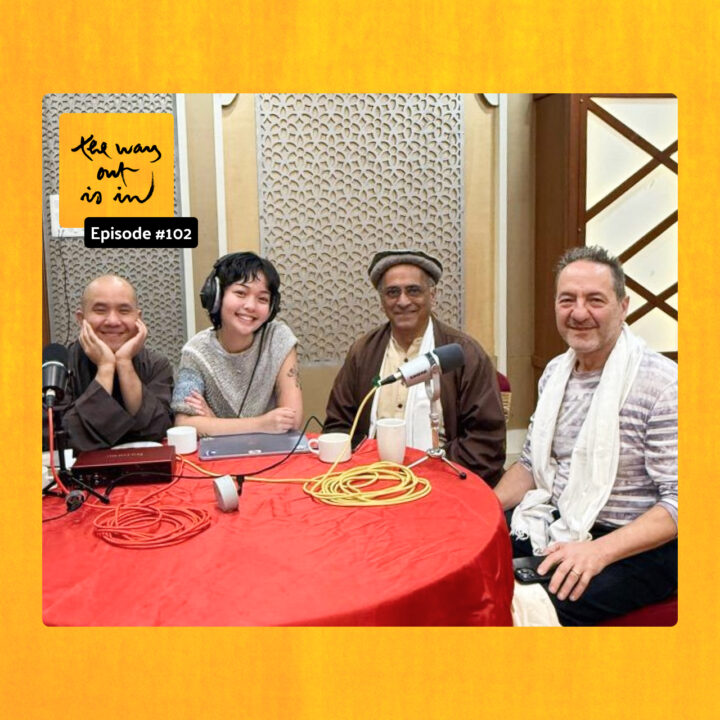






Welcome to a new episode of The Way Out Is In: The Zen Art of Living, a podcast series mirroring Zen Master Thich Nhat Hanh’s deep teachings of Buddhist philosophy: a simple yet profound methodology for dealing with our suffering, and for creating more happiness and joy in our lives.
The first of a series of six episodes recorded during the pilgrimage ‘In the Footsteps of the Buddha’, this instalment was made in Varanasi, India, in February 2026.
In this opening episode, Zen Buddhist monk Brother Phap Huu and leadership coach Jo Confino are joined by Dharma teacher Shantum Seth to discuss the importance of understanding the Buddha as a fully human being; a boat journey on the sacred Ganges river at sunrise, from which it was possible to witness cremation and devotion; teachings on death and impermanence as daily practice; the importance of living in the present moment; and much more.
The speakers also share personal experiences and reflections on their spiritual journeys, the role played by the community, and the continuation of the Buddha’s teachings through their own lives and practice.
About the pilgrimage:
In 1988, Shantum Seth was invited by Thich Nhat Hanh (Thay) to organize a pilgrimage to the sacred sites associated with the Buddha’s life across India. Subsequently, Thay encouraged Shantum to continue guiding such journeys each year, offering pilgrimage itself as a mindfulness practice—one that the Buddha had suggested.
Shantum has been leading these transformative journeys ever since, offering people from around the world the opportunity to follow In the Footsteps of the Buddha with awareness and insight. After 15 years at the United Nations, Shantum left to volunteer with the Ahimsa Trust, which represents Thay’s work in India and promotes the practice of “peace in oneself and peace in the world”.
Through Buddhapath, his expression of Right Livelihood, Shantum continues to guide pilgrimages and share the wisdom and culture of the places he visits in India and across Buddhist Asia, cultivating community through these deeply meaningful journeys.
To learn more about upcoming pilgrimages, visit www.buddhapath.com, or follow Shantum on Facebook and Instagram at @eleven_directions.
Shantum Seth, an ordained Dharmacharya (Dharma teacher) in the Buddhist Mindfulness lineage of Zen Master Thich Nhat Hanh, teaches in India and across the world. A co-founder of Ahimsa Trust, he has been a student of Thich Nhat Hanh’s teachings for the past 35 years, and, since 1988, has led pilgrimages and other multi-faith, educational, cultural, spiritual, and transformative journeys across diverse regions of India and Asia.
He is actively involved in educational, social, and ecological programmes, including work on cultivating mindfulness in society, including with educators, the Indian Central Reserve Police Force, and the corporate sector. Across various Indian sanghas, Dharmacharya Shantum is the primary teacher of different practices of mindfulness from Thich Nhat Hanh’s tradition.
Co-produced by the Plum Village App:
https://plumvillage.app/
And Global Optimism:
https://globaloptimism.com/
With support from the Thich Nhat Hanh Foundation:
https://thichnhathanhfoundation.org/
Recording by Ann Nguyen
https://ann.earth
Sound editing by Joe Holtaway
https://joeholtaway.com
Publishing by Anca Rusu
Produced by Clay Carnill
https://claycarnill.com
Executive Producer: Catalin Zorzini
List of resources
The Way Out Is In: ‘Ancient Path for Modern Times: Active Nonviolence (Episode #70)’
https://plumvillage.org/podcast/ancient-path-for-modern-times-active-nonviolence-episode-70
Interbeing
https://en.wikipedia.org/wiki/Interbeing
Plum Village Tradition
https://en.wikipedia.org/wiki/Plum_Village_Tradition
‘The Fourteen Mindfulness Trainings’
https://plumvillage.org/mindfulness/the-14-mindfulness-trainings
Sarnath
https://en.wikipedia.org/wiki/Sarnath
Dharadun
https://en.wikipedia.org/wiki/Dehradun_district
Bodh Gaya
https://en.wikipedia.org/wiki/Bodh_Gaya
Rajgir
https://en.wikipedia.org/wiki/Rajgir
Old Path White Clouds
https://www.parallax.org/product/old-path-white-clouds
Federico Fellini
https://en.wikipedia.org/wiki/Federico_Fellini
Ghat
https://en.wikipedia.org/wiki/Ghat
Alara Kalama https://en.wikipedia.org/wiki/%C4%80%E1%B8%B7%C4%81ra_K%C4%81l%C4%81ma
Jack Kornfield
https://en.wikipedia.org/wiki/Jack_Kornfield
Upanishads
https://en.wikipedia.org/wiki/Upanishads
Sister Chan Khong
https://plumvillage.org/about/sister-chan-khong
Bodhi tree
https://en.wikipedia.org/wiki/Bodhi_tree
Moksha
https://en.wikipedia.org/wiki/Moksha
Rishi Joan Halifax
https://www.joanhalifax.org/
Daily Contemplations on Impermanence & Interbeing
https://plumvillage.org/daily-contemplations-on-impermanence-interbeing#the-five-remembrances
Sutras: ‘Discourse on Knowing the Better Way to Live Alone’
https://plumvillage.org/library/sutras/discourse-on-knowing-the-better-way-to-live-alone
Sutras
https://plumvillage.org/genre/sutras
Leila Seth
https://en.wikipedia.org/wiki/Leila_Seth
On Balance
https://www.goodreads.com/book/show/1754796.On_Balance_an_Autobiography
Quotes
“Every step is a miracle. Every breath is an offering.”
“The transformation is both individual and collective – and not just right now; it is something which seeps into our understanding and informs our life. The real journey begins when you get home. When you see your familiar surroundings with these pilgrimage lenses, those are very, very important moments. When you see your familiar surroundings slightly differently, and you see what brings you suffering, what brings you joy, what brings a sense of ease, then you can tweak your life.”
“Siddhartha always says, ‘I’m on this path not for power, not for leadership, but to find liberation within us.’ And that means we have to be ready to let go of all of the ideology that we have received from our ancestors, not from just us, but from the lineage of our whole ancestors and society.”
“We can be free amidst the suffering. We can still find our calm, our peace with every storm that arises, that manifests. We find a way to understand it, to embrace it even, because we see that that storm is a part of us.”
“In the Mahaparinirvāṇa Sutta, the Buddha said, ‘Go to the places where I was born, died, where the first teachings were given, where I awakened.’ But I think he’s saying, ‘Leave your familiar surroundings and explore, and you’ll find different seeds in your consciousness being touched, which are not touched when you go every day to work or in your familiar surroundings.’ And that is the learning of yourself. It’s an interior journey on this exterior part.”
“In India, your path to God is through your guru – but in the Buddha Dharma, the guru shows you the path, and you walk it. In the classic example of the Buddha pointing to the moon, he says, ‘Don’t get caught looking at my finger; look at the moon.’”
“Somebody once asked Thay, ‘What happens when we die?’ He said, ‘I don’t know, but I can tell you what happens when we’re alive.’”
“The only ingredient that you have any control about for the future is the present. We can only act in the present. As you know, the past is gone, the future is an idea – but all these situations that arise in our lives, how do we respond appropriately? With ethics, with a sense of calm, with a sense of love, how can we respond appropriately to each situation? Because that is the ingredient for the future.”
“The Buddha is saying, ‘Stay open, stay alive. This is the most precious moment. This is a gift. And when we die, we’ll have no control over it.’”
“In Indian philosophy, we don’t have only yes or no. We say, yes, no, neither yes or no, both yes and no. So it’s the idea that I am the same person, I’m a different person, I’m neither the same or a different person, and both the same person and the different person. That’s the Buddha Dharma’s understanding of continuity, birth and death, and in that we don’t get caught.”
“Awakening is a collective awakening.”
“The Buddha was teaching us how to be a human being, how to take both the joy and the happiness of being a human being, but also to understand the suffering of a human being, and then take suffering as a noble truth. But it’s a noble truth only because we can transform it – otherwise it’s just plain old suffering. Use suffering as the compost for liberation. Looking at the cause, knowing the path to overcome suffering. And that’s key in Buddha. Otherwise, death is suffering, loss is suffering. The Buddha is saying, ‘Take that and look at it deeply, transform it, and live your life today as if it’s your last moment, your first moment, your present moment, our present moment.’”
“Secular in India means different from secular in the West. Secular in India means respecting all religions. It doesn’t mean non-religious. I was brought up in a household like that, where we had Hindu icons, Christian icons, Islamic icons, everything. And we would go to midnight mass or go to a mosque or go to a temple, but we were not religious. It was just respecting people like that. And we had friends from every religion.”
Dear friends, if you have a deep love for the Earth and wish to learn how to bring the energy of mindfulness to your climate response, Zen and the Art of Saving the Planet is a seven-week online learning journey where we as a community will learn how to cultivate insight, compassion, community, and mindful action in service for our beloved Earth. Inspired by the timeless wisdom of Zen Master Thich Nhat Hanh, This course includes Dharma talks and practices, community sharing groups and live interactive events with monastic teachers. I'm looking forward to teaching at these live events together with my monastic siblings. We'll learn together for seven weeks from 1st of March, 2026 into our closing event on 19th of April. Join us by heading to the website today, plumvillage.org/ZASP, that is Z-A-S-P, and we look forward to walking on this path with you. Thank you very much.
Welcome, dear friends, to this first episode of a special series of The Way Out Is In.
I am Jo Confino, working at the intersection of personal development and systems change.
And I'm Brother Phap Huu, a Zen Buddhist monk, student of Zen Master Thich Nhat Hanh in the Plum Village tradition.
And dear friends, we are recording a special series of this podcast live from India, where we are taking part in a 14-day pilgrimage, which is called In the Footsteps of the Buddha.
The way out is in.
Hello, dear friends. I'm Jo Confino.
And I'm Brother Phap Huu.
And we are joined by the famous, the legendary Shantum Seth, who has been leading what he calls retreats on wheels, pilgrimages in India to help us to get in touch with the Buddha. So, there are many people who follow the teachings of the Buddha, but actually we often know very little about his life. And so this podcast is really a chance to help you, to actually have a real deep context to the teachings of the Buddha. Who was the Buddha? Why did he become enlightened? What was his path? And how does that reflect on our lives today? So Shantum, do you want to just start by introducing yourself?
Thank you, Jo. Thank you Brother Phap Huu. It's really a joy to be together, actually live, rather than just watching you on YouTube. I'm a student of the Venerable Thich Nhat Hanh, who we call Thay. I met him in 1987, and since that time, he really brought the Buddha and the Buddha's teachings alive to me. He asked me at that time in 1988, when we first met, well, soon after we met, when he came on pilgrimage, that why didn't you come on a journey like this every year and take people with you. And following the instructions of my Guruji, I did that. And that's why I'm here right now, on this table. I live in India and I also want to help people understand India and understand India through the lens of the Buddha. So it's both the teaching that India is a teacher and the Buddha as a teacher.
Great. And just to put us in time and space, so we are sitting in the basement of the Pinnacle Hotel in Sarnath, near Varanasi. It's 6.30 in the morning. I'm still a bit jet-lagged. Phap Huu looks much brighter than I do. And we have with us many of the retreatants who are joining us on this pilgrimage, who are sitting in a semi-circle around us, all looking slightly tired and jet-lagged and sort of… Some suffering from Delhi-belly, others sort of looking very bright and cheery. So this is nice to have people with us. So Phap Huu, tell us, you came on this pilgrimage once before, I think in 1998 with Thich Nhat Hanh.
2008.
2008. So tell us, what is it like to be back? And tell us a bit about your first journey.
In 2008, I was Thay's attendant, so I was very focused on caring for him, and I was going through India with his eyes and his steps. I would say that the difference now is that I'm walking with my feet and I'm seeing India through my eyes, through my growth as a monk, and what it means to represent the lineage of the Buddha. In 2008, it was a very big retreat. We were here for one whole month and the pilgrimage was actually at the end of the whole tour. So we actually focused more on public events. Thay gave a Dharma talk at the Parliament. He was a chief editor at the Times of India. We did a lot of public events and one of the most touching was when we were in the village in the city of the community of the untouchables and I remember Thay coming in by helicopter because of the the roads to where we were offering the talks it would have been too long and too tiring. And what was very moving for me was when I travel with Thay he always traveled with present moment and impermanence together. So for him, he knows that this might be the last time that he is visiting a country. And he doesn't show it in retreats or when he gives a Dharma talk and so on. But as an attendant next to him, I was deeply moved with his mindfulness of every step is a miracle. Every breath is an offering. Like Thay would say, our breathing is peace, our breathing is an offering, not just the Dharma itself. And particularly about India is that this is where Buddhism manifested. This was the country that all of the condition led to a young prince finding a way beyond the royal family and beyond becoming a king and he wanted to find a way to transform suffering and touch liberation and help other beings touch that liberation. And 2500 years later it seems that Buddhism is more present and alive outside of Buddhism, outside of India. So I know that our teacher Thay has this great… he feels like there's a debt, all Buddhists, we have to help bring back Buddhism to India. Not saying that there's no more Buddhism here, it's just like a very alive monastic order, a monastic community, a tradition that is engaging and the teaching is relevant and it is renewed. So during that trip, Thay did a lot of work. And what was special was in 2008, Shantum and the community, the sangha of the Indian sangha bought a land and made an offering that this will be Plum Village India. And Thay planted a tree there and when I came down, I remember walking with Thay and it was really, there was no roads. It was, I think the day before, like Shantum asked a few of them with a machete just to clear the path so that the sangha can come down. And many years later, 18 years later, I am back and I've heard that this retreat center is much more alive now and the sangha comes every year to offer retreats for Wake Up communities, for also just everyone that's in India, and it's at the Dharadun, so we also have a relationship with the school that we will be offering a Dharma talk there after this pilgrimage. And then now, present moment, I think not only am I coming with my own footsteps and my own eyes, but I just realized I'm the eldest in this group, in the monastic group, so it feels like I'm the elder buffalo that is guiding all the young buffaloes through this river. And it feels very special. It feels it's an honor to be able to be connected back to the motherland of Buddhism. Yeah, coming back here yesterday, we visited the Deer Park where the Buddha gave his first Dharma talk after his enlightenment. And just walking around the stupa, I was walking beside Shantum and I have some photos from India and there was a lot of photos of me and Shantum and Thay. There was a moment I really felt like I was missing Thay, I was missing the teacher. And then our practice is always about coming back to the present moment and not being so attached to what was, and so during the walk there was a moment I was like no, no, Thay is here. Thay is now the footstep, Thay is now the breath. And now Thay gets to see Deer Park through my eyes. And that was very important for me to not see interbeing as an intellectual thing, but it was a realization in that moment. And then having the opportunity to offer the Dharma talk under a tree with our sangha coming from 16 different countries. And I just realized that… I wanted to share this merit to the Buddha, like, Dear Buddha, can you believe you have students from all over 16 different countries now, not just from India? So there was something that was very grounding for me to be able to acknowledge that.
Beautiful. Thank you. Shantum, why is it important for us to understand the life of the Buddha? So, you know, his teachings are 2600 years old. We live in a different world. The teachings are obviously very relevant, but why is it so important to have this understanding of this was the life the Buddha lived, this is the time he lived in, and also, as Phap Huu says, he's walking in the footsteps of Thay, and also we're walking in as the title of your pilgrimages, we're walking in the footsteps of the Buddha. Why is that so important?
So I think one of the most important transmissions that Thay offered was the Buddha as a human being. I was already inclined that way, but there was lots of Buddhism in the market, as it were. And many of them had the Buddha, as some sort of deific person. As a child, I was brought up in this area, so I used to go to Bodh Gaya and Rajgir as a child. It's to many of these Buddhist sites. And I was bought up with the idea that Buddha was a type of god. So, for me, understanding the Buddha as a human being, which is how Thay has presented him in the Old Path White Clouds, and all who spoke to him, I realized that we can all awaken the Buddha. We all have that potential. It's not that some person 2600 years ago who was awakened, he was actually awakened in the present moment, 2600 years ago, and we can awaken 2600 years later. And if you practice in a way that he offered, and I think that wisdom teaching of India or wisdom teaching the Buddha, which I feel is the greatest wisdom teaching in India, was offered to us so that we can awaken. It is not to defy somebody. I think that's why it's so important to go to these places and realize, yes, he slept here, he walked across this place, he met these people who were still, I mean India hasn't changed in some ways for 2600 years. There's still people cutting the grass with a sickle and the sickle design hasn't change from the Buddha's time, the ploughing of the earth with a buffalo, with bullocks. You know, when the Buddha was, well he wasn't Buddha, he was a young prince at 9 years old. That was one of his first meditations when he saw the ritual ploughing. So when you see the circumstances of the Buddha's life, you realize again, oh, it's a human being. And then you meet the people he met. You meet the young boy who cut the grass, who gave it to him. You meet a young girl who gave him the rice and milk pudding just after the ascetic period. And you meet this girl called Sujatha, who's actually in the same village. And you sit in the same cave that he sat and you realize that you're actually breathing with the Buddha. You're watching the sunset at Vulture Peak in a way which he was watching it and what Thay told me was that his Buddha eyes opened there and the Buddha loved watching the sunset at Vulture Peak and we watch it we can transform our own eyes into what we call Buddha eyes because the potential is in us. So that's why it's so important that we meet the Buddha as a human being and then you can watch a sunset in Miami or in Venezuela or wherever you're living. If you're interested in this path of awakening, if that's our career, or even part of our career, then we need to meet the Buddha. You know, and we can meet the Buddha through teachings, through practice, but to meet the Buddha as a person, as a human being, in the places that he lived is what do you call it in America? Gobsmackingly important.
And when, you've led many, many of these retreats over more than 30 years. So just give us a flavor of the journey, because this is our first episode, we're recording a series, and we're going to be recording a podcast episode from each of the sort of major sites we visit. What does the journey look like? And what I'm thinking more is, what change do people go through? So you've taken thousands of people on these journeys. What is the journey they go through?
In the Plum Village tradition, we have these retreats that you spoke about, and we call this a retreat on wheels. So we have a format which is similar to the Plum Village tradition. This is what Thay offered me as a practice, as a form of practice, and every two, three days we move. So we'll have a sitting in the morning, we'll have breakfast, then we might go to a site which of importance or we will go to a site which is important to the Buddha and hear what he was teaching there, what is the context, what is in fact the historical context, the social context, the cultural context at that time. And then also listen to or maybe have questions and answers to understand what is its relevance now. Do some walking practice in that area like we do in Plum Village, have lunch and then in the afternoon maybe go to something which is significant, which is India to understand the context of the Buddha's teachings. The Buddha's teachings weren't outside, they were always in a context. So to understand India is important. So going to the Ganges River, for example, yesterday, is important to understand that there were many, many different traditions. And to understand that the context of why the Buddha's teachings evolved at the time they did. And then in the afternoon or evening to share with each other what has struck us that day. India bombards all your senses, everything, you know, it's not sort of life as usual, really. You hear the hearing things, you're seeing things you've never seen before, you are smelling in a different way. So actually it's all our sensual experience is awakened. And so it's important that we all process that and then we process it as a community. It's wonderful because each person is actually experiencing in her own or his own way. So when you talk about the transformation, what happens? Actually, there are many, many transformations. But when we travel together and see the 15 of us sitting together, and we're all listening to each other, we realize that we are actually traveling with 15 pairs of eyes in 15 pairs of ears. And so we're traveling more like an organism rather than just single individuals. And so the transformation can be both individual, like Brother Phap Huu talked about yesterday when he realized that Thay was… he stepped with Thay. Each one of us have little transformations. But when we share together, we realize it's a collective transformation. And that has been Thay's great, I would say his great insight is that the awakening is a collective awakening. It's the next Buddha will be a sangha, his famous statement. So I feel that's just part of the transformation that happens and then in the evening we sleep and then we sit up and get up again and then the next day we might travel. And then the traveling itself is also a journey. So I always feel the pilgrimage is not about the destination really, it's about the path and it's like every step, every with the turning of the wheel or the bus. You know, we keep turning the four wheels of the bus. It's the same. And we see India like a movie, like it's a Fellini movie. This is great. I mean India is a phenomenally exciting place. It's completely… I had a friend who came once and he said, I saw him wearing these, you know, eye shades which you wear in the airplane when you don't want light coming. He said, you know, it is just too much me. I just needed to blank out because it is too fascinating. So I think… I feel that the levels of transformation also don't happen just on the journey. I met people 20 years later who keep in touch and write a letter, or we meet, and they say, you know, that thing and that journey affected me in such a way that it has really transformed my life. And I should say one other thing, Jo, that I actually didn't believe that when I was doing these journeys, I was surprised at the level of transformation. It thought it's just a journey. But actually, slowly, slowly after five, seven years, I started realizing, wow, this is a phenomenon. What's happening to people and to me, it's not just… I just felt, oh, that's interesting. I was involved very much in development work, in social development work. I was thinking the sort of level of shift happening here is more than I was seeing in my work with social development. So it's not one or the other, but also I just feel that the transformation is both individual and collective, and not just right now, but it is something which seeps into our understanding and informs our life. I have to say, the real journey begins when you get home. When you see your familiar surroundings with slightly shifted lens, these pilgrimage lens, and that's a slightly different lens. And those are very, very important moments. When you see your familiar surrounding with a slightly different… And then you see what brings you suffering, what brings your joy, what brings a sense of ease, and then, you can also tweak your life in that way. So here we are in this magical mystery tour, and in the footsteps of the Buddha. But, yeah, I think each person has their own way of shifting.
Thank you, Shantum. And Phap Huu, yesterday morning we started the journey in Varanasi, taking a boat ride along the Ganges, seeing the sunrise, seeing the burning of the bodies in the ghats, and seeing that sort of people come and bathing in the sacred river. What was your impression of taking that journey? What is it like to be on this extraordinary journey along the river with all these places where people come down and seek transformation?
What fascinates me is the power of devotion and the power of beliefs. So we had the opportunity to go on the Ganges and with Shantum's understanding and knowledge of everything that is happening on the right side of the boat, we hear the fascinating stories and we see people bathing and doing prayers, washing their laundry. And knowing that this river itself is a source of life for so many people in India. But also knowing that it is absolutely polluted, that in any normal circumstances, most of us wouldn't use that water, we wouldn't dip our toes in it. But seeing people still practice that today, 2026, as a Buddhist and as a student of the Buddha, I would say that the Buddha was very courageous because he stepped away from that in his journey of awakening. We have to know that the Buddha was very well-versed in the Vedas and he was brought up in that tradition. But none of those teachings for this young prince helped him understand the cycle of birth and death. And he, in one of his very famous journeys into the village, which is recorded in many historical facts, when the Buddha went into the village with his attendant, Channa, that was the first time that he was exposed to life beyond the palace because his father, when the Buddha was born, there were many gurus and saints that came to give their praises and their congratulations to the king and the royal family. And the last sage said that, first of all, he just weeped. And the king was like, why are you weeping? Is there something going to be wrong with my son? And he's like, no. Your son is going to be a conqueror. So first he was so happy, yes, I'm going to have the ultimate king, the heir that will take over many different kingdoms. And actually the sage is like, no, he's going to conquer suffering. He's going to find a way and liberate himself and living beings. And he's crying because he wouldn't be alive to see this. He knows his impermanence is coming. And so the king was very afraid of that. So the upbringing of the young prince, he made sure that the prince didn't see suffering. He had a palace for every season. So he was very pampered. But it was this trip into the village that he saw a very old woman who had a hunchback and asked his attendant, what is this? And I like the story. I like Thay's version. It's kind of like, like the attendant was a little bit like annoyed. I was like, oh my god, that's an old woman, you know? And he's like, Oh, young prince, this is an old person. We're all going to get old. He's like oh, really? And then he sees a person with a kind of disease on their body. And it's his first time seeing something like this. So the impression that this pampered prince was taking in, shocked him. And he asked his attendant again. And his attendant said, this is illness, we're all gonna get ill. And then he sees a funeral, and he sees people grieving, mourning. And once again, he asks his attendant, what is happening? And his attendant shared with him, this is someone passing and people are grieving. And then, he sees a spiritual person walking, so a monk. So we also have to understand that monastics were already there before Buddhism, before the Buddha himself. Maybe not in the exact same form as us monastics today, but a spiritual person who devotes their whole life to it has a different way of being. Maybe the clothes that they choose to wear, the way they conduct themselves. So there's a difference to the mainstream society. The prince asked us again, Channa, who is that? And he said, this is someone who has abandoned all of their desires in the world and is seeking a path of spiritual understanding, spiritual realization. So these were, maybe in our language, like the spiritual seed was planted in the Buddha, like it's already innate in us, but it was what we see, what we hear, what we feel in that moment that activates something very profoundly in the individual. And I'm sure every one of us who is listening to this podcast, we have a moment where it touches something very deep inside of us that asks us, what is our deepest aspiration? What is beyond just having a job, having a house, having a career? There's something more than that. So the prince touched that very young. And so when he made his journey to understand what is suffering, that means he went to many other teachers and there was a few of them that were very prominent that helped him on the journey. But what the Buddha was very free from was that if it doesn't liberate us from suffering, he's ready to abandon these teachers, to continue the journey. And there are many moments that he masters the teaching from these teachers. But he realized that he still is caught in the suffering of birth and death. And it's very powerful because he goes and he tells his teacher, so he's a very responsible student, and he said, I need to continue on, and all of the teachers are like, no, no, you're my brightest student. Stay, I'll give you this whole tradition. I'll make you the next leader. And Siddhartha always says, I'm on this path not for power, not for any leadership, but I'm on this to find the liberation within us. And that means we have to be so ready to let go of all ideology that we have received from our ancestors, not from just us, but from the lineage of our whole ancestors and society. So on that Ganges River what I was fascinated was the courage of the Buddha of letting go. Knowing that beliefs is a power and there's a need in all of us human beings where we do, sometimes we feel so lost and we need to have role models or we need to know that there are those that were before us that can find a path of happiness. But the majority of us, then we idolize them and then we let them do all the work and we still suffer. And that's a lot in spirituality. It's like even in Plum Village, it's like people come and they expect all of us to solve everyone's problems. And the thing about Buddhism is it's a very humanistic tradition. All of the practice, the teacher can't practice for you. The teacher can only show you the way, can only give you the practice, the teaching of their direct experience, and now it's in your hands. You have an individual responsibility, as well as if you're in a sangha or in a community, then you have the opportunity to learn from so many others. We need each other on the path, but when it comes to our own understanding, it has to be our own insight. You can borrow some of the insights from many teachers, but that's not yet your insight. That's still an insight of someone else's. And the beauty of Buddhism is that the Buddha himself has said that we all have awakened nature. And this is also a revolution in India, because when the Buddha enlightened, I think the first courageous act he did was that anyone who wants to become a monk is allowed. So the nuns order came a few years later. So the earlier years, mainly just men. But that means that any caste can come and be ordained. And I feel so proud of the Buddha to be a student of his and to continue this lineage because he wasn't afraid of the systems that were in place. And that takes incredible wisdom, courage, and understanding. Because when you see the path is there, you have no more fear. I think being on the boat and seeing the other traditions that has its beauty and the stories are very fascinating. But I'm biased. I'm a Buddhist. So I'm just like, I'm so happy I'm a Buddhist. And this is just, you know, I always want to be honest on the podcast, so I just have, you know, moments where I'm just like, oh god, I'm so happy I'm a Buddhist. And I'm so happy I'm part of the Plum Village tradition because Buddhism, even in the Buddhist world, the Buddha has become a god, the teachers have become deities, and the traditions have become a kind of set of rules that can't be changed. And the freedom in Buddhism is there is not one person from above the sky that tell us these are the doctrines and nobody can question them. And all of the teachings of the Buddha come from direct experience. And when we talk about mindfulness, like now, in today's world of the well-being industry, when we talk about mindfulness, it's all about relaxation, it is all about feeling better. It's more like connected to spas now. It's painful when I… There's a trigger point in me, I'm like, that's not mindfulness. That's wrong mindfulness because it's right mindfulness. And the right mindfulness is when we talk about mindfulness, the first thing about awareness is aware of the suffering. Aware of their suffering in life, therefore I want to understand, therefore I want to transform, aware of the suffering of. And that's why in the language of our mindfulness trainings, Thay helps us see that. Every mindfulness training in the five ethical practices that comes from the Buddha's time, Thay has put mindfulness at the very first line, aware of suffering, of killing, therefore, I would like to cultivate compassion. Aware of the suffering of the power of words. Therefore, I vow to practice deep listening and loving speech. So on this boat ride, just being able to see everything, I can tap a little bit into what the Buddha was against, or what the kind of stream he was gonna go, he's gonna go upstream now. Mainstream is this way, and he's going to go the opposite. Now, present moment, I still see Zen, and I still see Buddhism and their spiritual practice it's still on that path, in a way. We have the mainstream of our consumeristic mindset. Capitalism is younger than many other habits, but capitalism is very strong. Our individualistic mindset is also very strong, so to be spiritual is to go against the mainstream. But what the Buddha wanted was that Buddhism and the teachings, it can arrive in all households. It's not a kind of devotional practice that you have to have an altar, you have to have a Buddha statue. It's more, it's like you have to have the heart of compassion. You have to have the understanding of suffering in order to be a more free person. And when we speak about a free person, it doesn't mean that there's no more suffering around them. There's always gonna be suffering. That's the truth. That's first noble truth. But we can be free amidst the suffering. We can still find our calm, our peace with every storm that arises, that manifests. But we find a way to understand it, to embrace it even, because we see that that storm is a part of us. I know that Buddhism is made of non-Buddhist elements. So the Buddha himself has broke free from a lot of that. And there are teachings that he grew up with that he transformed into the understanding of what he taught us later. So this is what we will be exploring through this journey.
Shantum, that was a beautiful sort of, in a sense, context. And I want you just to add a bit to it. And because as Phap Huu was talking, what came up for me is my wife, Paz, is an artist, and we'll go to an art museum, and I'll see a cubist painting or a postmodernist painting or a surrealist painting. And I say, oh, those are lovely. And then Paz reminds me, she said, at the moment where that person painted it, it was a revolutionary act. They broke through a traditional way of seeing and brought something new into the world. So I just want to pick up on that, the Buddha as a revolutionary, because now we have his teachings and they're 2600 years old. But as Brother Phap Huu says, we don't really have the context for that. We just say, oh, that teaching's very helpful. That can help me to live a better life. That can helped me to touch the beauty. That can help me to sort of feel more calm. But at that moment that the Buddha broke free of the chains of his previous understanding that that was an extraordinary act. And Phap Huu talks about the courage of that. And I want a bit more, because what is it? How important is it? How difficult might it have been for someone living in that time to have, as Phap Huu says, great teachers, who he could have rested in, and they offered him to be their… They said.. please be my continuation. And he said, this is not enough. And that is an extraordinary sort of way of seeing the world, an extraordinary act to recognize that this is not enough. So give us some more color and flavor.
Yeah, so the sort of economic context is also important. It was a time when there was more settled agriculture, there was more surplus, there were merchants, and therefore there was a sort of, there's always been a calling amongst human beings to understand why we're here, what is all this life about, and it allowed young people to explore, to explore out of their sort of geographical context. Explore those existential questions which still exist. Many people were coming up with their own ideas. There were traditions of the Brahmanical tradition, which was linked part to the Vedas, which had the whole idea of a sort of gods and people who would sort things out, whether they would be for rain or weather, or gods who are linked to the nature, but also those who would sort things for you by the rites or rituals. There were others who were determinists, like the Ajivikas who said, yes, the fact that you're eating this grain of rice was predetermined, so, you know… no worry, you just live your life. There were hedonists, who said, you know, everything you have in this life is just here, you know, get into debt, do all the… have as much, you know, fun as whatever that fun means, it doesn't really matter, what suffering you cause in some ways. There were others like a contemporary called Mahavira who believed that there was a soul and that you have to liberate the soul through ascetic practices. And then there were the teachers which Brother Phap Huu alluded to, there were two teachers we know, Alara Kalama who was a teacher of great concentration, yogic concentration and we don't know exactly what he taught but we know that there was a circumstance where there were 500 bullock carts which went in front of him and he was so deeply absorbed in his concentration that he didn't even notice, so we think it is a type of deep yogic concentration. And the young Siddhartha before he became the Buddha mastered that, but the thing was he realized that once I'm out of that, then it's a bit like a trance-like situation, back to suffering, you know. As Jack Kornfield wrote something like, after the ecstasy, the laundry. And then there was a teacher called Udaka Ramaputa who taught what we think is something like the Upanishads, which was a type of mystic monism, which then got absorbed into the sort of Brahminical thinking as Vedanta. Again, the Buddha said, well, that's not it. Udaka offered the leadership of the school. So he tried all these different practices and there were many more and as we go along the journey we will see them, eternalists, determinists, nihilists, the whole works. And each time the Buddha was really, really sincere seeker. And when he would find something, he would go deeply into it, and say, ah, this is not the way out of suffering. And I think the mystery of life really hits us when we confront death. I think many, many religions are developed on, so what happens after this? And they try and answer it in some way. And then other people believe, oh yeah, yeah, okay. So whether it's, and it's normally the, and it is that mystery of death, that, and the fear of death I would say, which is deep, is a really deep fear, which allows people to then start believing in something. And it's not just your own death, it's the death of your loved one, and you know, you say, okay, well, I'll meet my loved one after, in heaven or whatever, whichever space we want. So, I think the key teaching that the Buddha offered was this teaching of no birth, no death. I remember the first journey. I mean, I went on a journey in 1988 with him. At that time I used to wear a turban. I had long hair, big beard, turban, and one day we were walking up towards Vulture Peak and I just stopped and we… He said, you know, the issue of birth and death is as urgent as if your turban is on fire. Another Zen match, as it were.
Is that why you've got very little hair now? It burnt off?
Well, he shaved, actually in Kushinagar on a full moon night, he shaved my hair on that first trip. He and Sister Chan Khong. From, I don't know, the nice long hair, he went off and then, and he gave me a robe, but then my hair grew again. So, I'm not a monk, I am a lay person and I chose that path and Thay said, yeah, you have to choose, but he said a lay path is maybe more difficult, but is as valid if you do that in a sincere way. So I think these schools of thought, and when we went to the Ganges yesterday, we saw the ritual washing. Seven generations of your sins, past generations will be washed if you bathe in the Ganga river. A day of fasting or three days of fasting at Varanasi is equal to a thousand years of penance somewhere else. Just seeing the Ganga river for the pious is a type of liberation. So there's lots of belief systems and then they're built in and then overly emphasized again and again over generations and then they become family traditions. The tradition of pilgrimage, I think is a wonderful tradition. It happens in many, many cultures, including traditions which are here, and the Buddha emphasized that himself. In the Mahaparinirvāṇa Sutta, he said, you know, go to the places where I was born, died, etc., where the first teachings were given, where I awakened. But I think he did it from the purpose not saying, me Buddha, he's saying that also leave your familiar surroundings and explore out, and then you'll find different seeds in your consciousness being touched, which are not touched when you go every day to work or in your familiar surrounding. And that is the learning of yourself. It's an interior journey on this exterior part. So that's not only in Buddhism, the others, but the Buddha emphasizes it as a way of an internal journey. It's not just, you know, ticking off Bodh Gaya. It's about that, if you're sitting under a tree, have that potential of awakening within us. Can be touched that way. Can we do it with every step? Can we do it with every breath? So I really feel Thay, I mean maybe I'm a student of Thay's, I really feel he got it. When I walked with him the first time in 1988, I felt I was walking with the Buddha. He was so familiar with the story of the Buddha, but it wasn't the story. He was embodying that and I felt, oh yeah, that's what the Buddha would have been doing. It just happened to be what… He'd just written this book Old Path White Clouds. Which is a… well, I would say legendary book. I don't know what the right word is, but it's a really a classic, a classic is the right word.
About the life of the Buddha.
He just finished writing that book in 1987 and then he wanted to offer this book to the Bodhi tree and that's one of the reasons he came on this pilgrimage initially. In that process, and we discussed these things. I mean, I was brought up in a way which was much more Hindu, you know, that's my family. And I was seeking. I went around the block many times, I went to many gurus, many teachers, but I found that my inclination was towards a nontheistic, non-guru path, but he became my guru. You know, it's a way that a guru in India means that your path to God is through your guru, but in, as Brother Phap Huu was saying, in the Buddha Dharma, the guru shows you the path, and you walk it. So the classic example of the Buddha pointing to the moon, he says, you know, don't get caught in my finger, look at the moon. Now I'm offering you a raft to get to the other shore, turns out carrying the raft on your back is to get you to the others shore. That's the teaching or the transmission that Thay gave in the form of Buddha.
Thank you, Shantum. And just one thing going back to the Ganges. So one of the things that people, especially from the West, are shocked to see is the burning of the bodies right next to the river. And you talked about sort of practice and beliefs and no birth, no death. So can you just tell us a bit about that practice and why is it that people come to die in Varanasi? What is that the burning of the body's about and And what does that teach us about birth and death?
I think the first thing we understand about looking at the pyres is that all of us are going to die. That's what happened to the Buddha when he was a young prince. That's important. Also that our loved ones will die, people who are close to us will die. And I think that realization is very important, to sit by a pyre, to watch another body. But what's happening in Varanasi is that in India, myth and reality are very, very intertwined. So in Varanasi, the myth is that Shiva, one of the triad of gods in Hinduism, so we have Brahma, the creator, Vishnu, the preserver, and Shiva, the transformer. Shiva's city is Varanasi, and he whispers when you're dying, a mantra called the Taraka Mantra. Taraka means the ferry boat mantra. And that mantra helps you to attain moksha, which is the Hindu word for nirvana. So it's instant moksha, instant nirvana. And the idea of a Hindu's life is to come out of the cycle of birth and death in the sense of rebirth. So the Hindus, or the Brahminical system, believes very much in the idea of an atman, or a soul, that transmigrates body to body because of your karma, your actions, and the results of your actions from one life to another life. So the ideal is to come out of that and be living with the gods, which is another realm. So what dying in Varanasi does is sends you straight off in the sort of river of heaven.
It's like a free pass.
Yeah, something like that. Yeah, you don't have to do much about it because you're dead. And yeah, go to heaven, do not pass it, whatever it is. Go, just go. And that sort of myth has imbued Varanasi with a lot of power. We have seven very important Brahminical pilgrimage sites in India, one of them being Gaya, where we'll be going. But Varanasi is the only one where we get instant moksha. I'd say that the myth has also come because the Ganges River, the Ganga River, which flows 2500 kilometers from the source to the Bay of Bengal, near Calcutta and Bangladesh. It's the only place where the river actually starts turning, because it's so slow flowing, it starts turning back towards the north. So Ganga is not just a river. She's a goddess for us. She's the daughter of Himalayas. She lives in the, you know, the water part of Brahma, she flows through the thigh of Vishnu, she lands on the head of Shiva, she breaks the force of her coming down to earth. She provides, as Brother Phap Huu was mentioning, water to 38-40% of India's population which is more than 500 million people. So we worship her as a goddess and that's why this Indian take where we have a pollution, in scientific terms, but purity in spiritual terms, so we'll drink her water. And there's something special about the Ganga water, you know, all homes keep Ganges water. The first drops of water we have as a child are Ganges' water. When we die, we have Ganges's water, and Ganges doesn't putrefy, so there's something in it. And scientists, everyone who knows is polluted, drink the water, bathe in the water. So there's something about faith. But I would say that Varanasi answers that question of death. And so we go to death with joy. I've seen people celebrating with dancing and singing, you know, as we bring the body to the pyre. And these are people who are old, they lived there for life, they have children, grandchildren, because that is the life of the Brahmanical system. You have different stages of your life, you've lived your full life, and so you celebrate death. And what's also interesting in Varanasi is that you, it's something, we call it the great cremation ground. So we have cremation 24 hours. Nowhere else in India, we'll have it normally sunrise to sunset. But this is the great cremation ground. That is the way of overcoming the idea of birth and death. And the Buddha's idea is slightly different. Yeah, so that's different traditions. And different traditions have different ways of sorting that out.
And Phap Huu, just for the joy of it, I just want to stay with death for a little bit.
Wonderful.
So, a few weeks ago I interviewed Rishi Joan Halifax, who was a student of Thay, and she said that when she was much younger, she was at Mount Kailash, and she went to visit the charnel grounds. And there they don't burn the bodies, but they cut up the bodies for the vultures to eat. And that one of the things she did was lay down inside the bodies, and she said she lay down in the pus and the blood and the muscle and the fat of these bodies. And then the person whose responsibility was to cut up the bodies then mimicked cutting her up, which was a very sort of visceral experience of death. And she said that that was a monastic practice, to sit in the charnel grounds to watch the bodies being cut up and decayed and the vultures eat it. And I know once you've described that you meditated on your death and that that is a sort of practice. And so I just wanted to sort of find out in that practice for yourself, how was that experience and what did it free you of, if anything?
Actually, it is an everyday practice. It's one of our gathas. At the end of the day, we would recite about impermanence, knowing that today, the day is ending, and asking the question, what have I done? And it's also saying that I'm dying. Because every day that ends, we have finished 24 hours, and so that 24 hour is now gone. If we have a good night's rest and we wake up, then we're born again and we have another set of hours to be alive. So this meditation, it is intentional as an everyday remembrance. That's why we have the five remembrances. In the monastic training though, like in many Zen schools and many Tibetan practices, many different schools of Buddhism, they do intentionally ask us to go to the graveyard or sit at the cemetery or a lot in the Pure Land tradition we do funerals, so we see death every day. So there is a lot of journeys in this path of being with real grief and a lot of time not our grief, someone else's grief, but also meditating on that and seeing how can we also help soothe others to touch continuation. And that's a very difficult practice for so many people that are not monastics because of the memories that we hold on to and the ideas of like, of our deepest wish, actually, we wish that they could have. You know, we carry a lot of our own desires, what we want for our loved ones. And now we place it on someone who is not here anymore. So for me, personally, I practiced this when I was a younger bhikshu, a younger fully ordained monk, because I got really sick and there was nothing else to do on bed but beside to be with the body and see the impermanence of the body. I needed so much assistance during that time, and just realizing that there's death here. There is death, the cells are dying, and I was having acupuncture, I was also having a lot of support also, and to see that life is so fragile and to be alive, you also need so many conditions around you to support you to regain back that strength, that life. I practiced it as I was dying, though. I allowed myself to go deep. I allowed myself to actually realize that I would die before my teacher. I would die before my parents. The image and the feeling that still stays with me was that I was very happy that I would die in the sangha and that I would die with those who I can call friends on the path. And I know that they would be there for my ceremony and that was a blessing. I knew that they would light incense for me. So when I woke up from that meditation, because it was almost like I, there was a moment I realized I wasn't dead in that meditation and I got out. And I actually, I was crying. I had tears because I was imagining or I was seeing my beloved ones around me. And what it strengthened was the gift of life and that friendship is not to be taken for granted. And then family is not to be taken for granted. And also very evidently that for me as a monk is to know that death does come very unexpectedly. So I shared this in another podcast already, but in 2025, our community, we held three funerals for three monastics. Two of them were in Plum Village and one of them were in Vietnam, in our center there. And one of then was very unexpected. And it was a shock to the whole Plum Village community. And that grief, I think I cried more in that than Thay's passing, because it was such a moment of realizing how fragile life is. Like Thay's passing was like of old age and we knew it was coming we could somewhat be prepared for that but this passing you you can't be prepared for it. And there's a home in one of the sutras, the better way to live alone. And it says the sage knows that you cannot bargain with life. So our practice is to live each moment very deeply. So in that ceremony when we were holding the funeral and I was watching the parents that we welcomed and we had to hold their grief. I don't know this sister personally. We're not like close at all. But when she died and at the cremation center, when we were holding the ceremony, I really felt her parents' grief in me. And that was like real interbeing. Like I really feel like this is not an individual matter. This is such a collective matter. So then, looking at life. So that's death. So looking at life now, it's the same. Like I practice this with being alive. There was one time somebody asked Thay, Thay what happens when we die? He said, I don't know, but I can tell you what happens when we're very alive. And I think there is this like, in spirituality, there is this danger of just always asking this question, what's going to happen to my soul? What's going happen to us when we die? And Thay, as a teacher, he uses the sword of understanding. He tries to cut that off from us, not so that we don't meditate on that, but actually so that we don't fall into these kind of addictions in a way, of like, once I touch that, then I'm a liberated person. So Thay gives you the other antidote. And for some reason, it's a harder antidote. It's like, actually, let's look at how we are being alive right now, how we're living life in the very here and now. So this meditation is for us to deepen our life today. And in the Buddha's time, there was misunderstanding also to the practice of non-self, where his own students were committing suicide. The Buddha's students were taking their own life from misunderstanding the Buddha teaching on no self and on birth and death. And some of them touch, oh, if there is so much freedom, I'll just take my life. And that was a moment that is recorded, there's sutras about it. And the Buddha said, you have to be very careful with my teachings. And the teachings is a way to help us liberate from the chains of suffering so that we can be more alive, so that can live a life more intentionally, more compassionately. With a lot of wisdom of impermanence. Not so that we enact impermanence right away. So this is, for me, one of Thay's offering to Buddhism, which I see not many, many teachers do, and I think there's a really wrong perception about Plum Village is that we're only talking about joy. So, oh, Plum Village, all you do is breathe and smile. And I asked them, can you breathe and smile when you suffer? Tell me. Can you hold your grief with a smile? Can you actually come back to your breath when you see the world crumbling? This is all you have left at the last moment of your life is the breath. Can you master your breath so that in every moment that can be your friend and your refuge? I've seen Thay in a coma take refuge in his mindful breathing. He practiced it to the point that the breath is his insight and it becomes his friend in the most difficult time of his life. He had illnesses that medicines weren't helping. And it's by coming back to the breath, relaxing the body, letting the body has its wisdom to heal. And most of us, we would grasp for external medication, support. We're always looking for others to help us get better, but some of the wisdom is already in us. So yes, there is breathe and smile. Yes, there is suffering. There is the fear of death, but we're not understanding the joy of life. And when we can touch that joy of live, when death arrives, we can welcome it with open hands. And I share this because I got to witness that. One of the sisters who passed away that we held a funeral for, the last moment was her son coming to visit. And she also got to tell the sisters because the next day, the following day, she was going to come back to New Hamlet. We were arranging for her to come back. So she also had a stroke and was in a mini coma came out. The joy of her saying, oh, I get to come home. And then having her son visit her from Germany. And then she felt that was enough. And that home was the letting go. And then the next day we received the news from the hospital that our sister has transitioned. That stayed with me because she was happy in that last moment. When she passed, the nurses didn't even know. And so she really let go with this… I would like to imagine that she felt so content. And that home journey for her was to return back to the Earth.
Thank you, brother, and it's such a deep practice of being with death without having to die and then realizing the beauty of life. So I had this experience in New York where I was misdiagnosed with advanced cancer. And so there was a week where the doctor told me I had had this cancer and then a week later, after the tests, I was told I did not have cancer. But in that week was such a powerful week, because it help me just to realize how beautiful life is and to accept that it passes. And it's at those moments where we sort of get to not only understand the beauty of life but also how we have lived our life. So if I were to pass now, what have I created? What is in my kids? What's in my friends? What's in my work? How have I continued? So, there's something around what you describe, is not just the words, as you say, they're the five remembrance that the monastics say every day, sort of our nature to get older, our nature get sick, our nature of dying, nature to let everything of value, I have to let go of everyone I've loved. And all I can rely on is my actions in this life, my thoughts, speech, and actions, which continue. And it's very easy to say the words, but actually, there's something about the depth of the meaning of that and to really understand what that means. And so being on the Ganges and seeing the bodies burn is a sort of, we're so protected from death in Western countries. It's so hidden from view. It is so difficult sometimes to openly grieve. And so just that moment of witnessing that, you sort of understand actually we will die. And as you say then, and then what are our choices? What do we decide to do? Well, what does it mean to live a life fully? What does it means to have an ethical life? What are we really aiming to achieve? Is it fame, money, sex, or actually do we want to be of service to the world? So these are important questions to always ask ourselves, brother.
And I just want to add, it also helps us let go of the little dramas that we like in daily life. Like the little internal knots that we may think it is everything. And realizing that actually life is so impermanent. Is it worth holding on to these sufferings sometimes? And when you realize that we're so much more, life is so much more than that argument I've had. And that I can learn to forgive and reconcile. And that's part of letting go also. So Thay always says, when you have, he used to tell us, monastics, when you have an internal knot with one of your siblings, look at them in 200 years, they'll just be dust. Is it worth to hold on to that moment where you had a disagreement and to think that that is the whole truth of your relationship, or that is a whole truth of that person? But we're so much vaster and we're so much more than these internal knots that we like to cling onto.
Thank you, brother. So Shantum, before we move on from death, as we must do, is there anything else in the sort of life of the Buddha that is relevant to say regarding his understanding of death and the way he saw that?
I think that the Buddha was a really sincere practitioner. And he tried to find this mystery, which was one of the ingredients of suffering, death. And he saw it in those four images of four people he met. But everything was a theory for him as he was going deeper into it. And that's why one of the most prominent theories of the time, which exists even today very, very strongly, is the idea of an atma, the idea of a soul. I think the Buddha's meditation found that in his body, in his feelings, his perceptions, mental formations and consciousness, which are the five sort of skandhas, the five elements that make up our body mind construct. He found nothing that has an intrinsic existence and that's why what we call his understanding was anatma, anatma meaning the non-self. This is in some ways what Thay calls interbeing and that is his real insight, what I call his mc squared, his understanding that there is no such thing, nothing has intrinsic existence. Once you have that, then you realize what is the continuation, if there is a continuation? And the only ingredient that you have any control about for the future is the present. We really have, we can only act in the present, as you know the past is gone, future is an idea, but all these situations that arise in our lives, how do we respond appropriately? With ethic, with a sense of calm, with a sense of love, how can we respond appropriately to each situation? Because that is the ingredient for the future. Now the mystery comes that when we stop breathing, the breath helps us to remind us that we are alive. And that's when when you said, Jo, about that the only continuation is our karma, which are actions and the results of our action. In that sense, we continue, and I think of say my mother or my father, I wear, my father was a shoemaker, and I wear pairs of shoes that he designed. You know, he continues not just in me, but in millions of people who wear those type of shoes. My mother was involved in the legal profession and she did a lot of work on gender issues and environment issues, which has affected millions of people. They don't see my mother in that way, but I see my mother there. I see her in the food I eat, the garden and the plants that she planted. The Buddha taught me that, that there isn't something that my mother and my father exist in me. They exist in the world outside of me. So, as Brother Phap Huu was saying, you know, we know Thay would pass away. But he was so compassionate in a way, he stayed around even after a very, very debilitating illness to help us understand that we need to be our own Thays and we also create a Thay as a community. So I think those sort of understandings are from the Buddha. The Buddha was helping us, that it's not just you, it's the sangha continuation. When Brother Phap Huu talks about touching the grief of others, grief of the parents, you know, that is something we all should be able to do and can do, because we have those feelings in us. But we shut ourselves off. The Buddha is saying, stay open, stay alive. This is the most precious moment. This is a gift. And when we die, we'll have no control over it. So I think what the Buddha is trying to help us do is to understand that life and death are just two sides of a little coin, you know, balancing moment to moment to moment to movement. The person you were born this morning has in some senses died. And the person we are right now is a sort of new person with many, many continuity factors. The person at the end of the day today with all our experiences and all our different types of conversations or the food we eat is a slightly different person. So the question is, is the person who woke up this morning the same person as who is going to sleep tonight? The answer may be yes, the answer maybe no, the answer, maybe, so in Indian philosophy, we have these four, it's not yes or no. So we say, yes, no, maybe… neither yes or no, both yes and no. So it's the idea that, you know, yeah, I am the same person, I'm a different person, I'm neither the same or a different person, and both the same person and the different person. That's the Buddha Dharma's understanding of continuity, birth and death, and in that we don't get caught. And when the 16th method of breathing when the Buddha teaches about the Anapanasati Sutra, the sutra on the full awareness of breathing, the 16th practice which is on liberation is letting go. And that requires guts, but it also requires friendship, Dharma friendship, because we help each other. If you do it on your own, it's very lonely. But if you have a spouse, and it's not just a monastic community, we are very fortunate, Thay was a revolutionary. When you talk about Buddha as a revolutionary, Thay as a revolutionary. He took the Buddha's teachings and monastic teachings and brought them into the lay fold. And he talked to me, I remember once he said, you know, don't make the mistake that happened in India when we lost Buddhism. Make sure there's a fourfold structure. One of the reasons Buddhism died is because we lost the lay people also. So you need monks, nuns, laymen, laywomen. That's what continues the Buddha. So the practice that Thay taught us were the monastic practices, many of them, but for lay people. And that's what the Buddha did. There were 28 people who awakened, lay people, who awakened at the time of the Buddha, so these are not just monastic practices, they're practices for human beings. I think Brother Phap Huu said these are humanistic practices. The Buddha was teaching us how to be a human being, how to take both the joy and the happiness of being a human being, but also to understand the suffering of a human being, and then take suffering as a noble truth. Only it's a noble truth because we can transform it, otherwise it's just plain old suffering. Using suffering as the compost for liberation. Looking at the cause, knowing how the path to overcome suffering. And that's key in Buddha. Otherwise, death is suffering, loss is suffering. The Buddha is saying, take that and look at it deeply, transform it, and live your life today as if it's your last moment, your first moment, your present moment, our present moment.
Thank you, Shantum. And I just want to talk about continuation. You very modestly said, oh, my mother was in the legal profession, which I thought was very amusing given that she was the first woman Chief Justice of India. I just wonder if you could just say a little bit about continuation there because your mother was the chief, first woman chief justice and you told this little story yesterday about the fact that when women came to visit Delhi that one of the stops was to go in to the court and see your mother. So can you just tell us a little about that as a sort of as the power of continuation? What it was? How your mother represented a revolution in terms of the role of women and how that has continued?
Everyone's mother is just ma or mama, you know, she's not judge or I mean she's, I guess, a judge in the home or something to take her advice, but she's just, you know, the one you argue with, you know, expecting to win. And she can't lay the diktat every time, especially when you're a teenager. So I think that's important that it helped me understand that people in positions of power of some sort are just human beings. They are mothers and fathers, and so if you can look at people like that, it's important because if you're brought up in a situation that you see, these are, outwardly people see these people as very powerful, but inwardly they're just mum, and I think that's important to realize. And the other is that we are, I'm very grateful, my brother often says something like, you know, we chose our parents well, so you must do that. You know, fill the right forms in Chinese and triplicate or whatever in Hebrew, whichever language, you know. But I think to feel a sense of gratitude, all of us, as parents, we are grateful to our parents because they brought us. Some of us have lots of trauma issues with parents, but whatever it is, they brought to us to this life. So there's a sense of gratitude. We wouldn't be here without them. You know, circumstances bring my life. My mother was wanting to be a teacher, but my father went to England to do some work in the footwear industry, and she had a young child, and she was looking for a course she could do where she didn't have any attendance. And she found, yeah, law, you only had to have eight dinners in the year and sit an exam. So she went to the Inns of Court, and, well, actually, she came first. She was the first woman to top the bar exam, the first Indian, in 1957. And I was born right then, in 1957. And I remember there was a nice picture, and it came out in the Evening Standard, and said, mother-in-law. But she was a nervous, very young lawyer who broke a lot of glass ceilings. There were very few women in the profession. There were no toilets in the court. There was one room which they used as a toilet with bats inside. So, there's one other woman judge, a woman lawyer in that. So through this time, she was also, I felt really kept her heart open. She was very, very judicious in interpreting the law, but also always with the heart. And I think that's important. So always on the side of seeing the side of the suffering, the side that the oppressed. And in India, primarily, we've had a very patriarchal society. And so to have women in positions like that, making decisions, not just from a woman's point of view, from a humanistic point of you, but seeing the woman's points of view. I think that is important. And there were lots of cases like this where there was an interesting case where now in India, one of the things she was involved in also is that women can get as much, what do you call it, inheritance as boys can. Early only boys got the inheritance. And there was a case which came in front of her and the girl said in open court that they would give their share of the inheritance to the boys, to their brothers. So she called them into her chamber and said, why are you doing that? You know, you have equal right. And the sister said, you know, our brothers are important because that's the only home we have outside of our husband's home and our community is that way. So we need to keep our relationship with our brothers. We want that relationship. So we're willingly offering our share of the inheritance. So it requires subtlety, even though it might go against your grain as a woman. And just to correct, she was the first woman Chief Justice of a high court in India. So it's like Supreme Court judge, equivalent to Supreme Court judge. I think I see my children and I see a continuation of her. That's important. I see my siblings, and I see a continuation of her. But I meet so many people when we had our memorial. I mean, there's millions of people in India who've been touched. And she wrote a book called On Balance about her life. And I think it's a very nice book because it tells you about this ordinary life became extraordinary. And I really feel all our lives can be, and are actually, it's just that some get bigger press.
Brother Phap Huu, just taking on that arena of knowing. So you are a continuation of the Buddha, a continuation of Thay. And I just wonder, having come to India in 2008 and now being back again, and we were at Deer Park yesterday, which was the Buddha's first teaching after his enlightenment. And you were walking in that space. And just to describe it a bit, it's, you know, as many of you who've come to India know, it's full of noise and color and texture and mayhem. And then you walk into Deer Park and it's like an oasis of calm. There's just, there's very little space in India. Everything is covered in here. You have these acres of just green space and then stupas and the remains of monasteries, but it's a place of calm, and it's literally in the footsteps of the Buddha. You're walking exactly where the Buddha would have walked. What does it feel like for you to be that continuation, at 38 years old, you're the abbot of the Plum Village monastery, you've been in that position for 10 years, you joined the monastery at the age of 13, and now to, in a sense, be that continuation? I'm just wondering, what does it feel like? And as Shantum says, we're all his continuation. Anyone who follows the teachings is a sort of, in a sense, a disciple or student of the Buddha, but you have chosen this as your path, 24/7, 365. What does is feel like to be here walking in the same space and feeling that direct connection 2600 years ago into the present moment?
It's gonna sound funny, but I think I feel more authentic this time, I feel more like, you know, a lot of the times… When we become a monastic, we have this burning aspiration to be part of a community in the Plum Village tradition. For me was just to learn to be a happy person. And my path led me to take on the vows of a monk. But I wouldn't say I knew what it was gonna be. I didn't know what it meant. But I just saw at every retreat, I'm like, these are the happiest people that I've ever met. I want to be a part of them. They were, they were my avengers. Like they were like, whenever I saw them come up before chanting, before Thay's Dharma talking, they would offer a chant, I was just like, how could I be part of that crew? And I think spiritually, because as a Vietnamese growing up in the West, like not having any models, like role models to look up to, like they were the first role models of my heritage, besides my parents, where I was like, they're so cool. So I think becoming a monastic I was lucky, I was really lucky. And then understanding the path, I'm by nature very obedient. So I follow rules, I follow the trainings, I followed the teachings, and I touch a lot of, a lot of joy and transformation on my own path. But to really say like, do I know what I am doing? Was always like a question. And I always had doubt. I was always like, how long will I be a monk? Even though I took the vow for life and we recite this gatha and I vowed to wear this robe life after life. And we all say it cause we want to get through, you know. But then the heart is always questioning many things. A big part of my whole path has been learning just to surrender, keep surrendering and not letting the desires and the mind pull us, like a buffalo, it has this ring nose that it can be led into many paths. And a meditator is actually to learn to first control that ring, be here, and release it in a way, to be a free person. But a lot of the years I was, yeah, sometimes I feel like, what's that syndrome, imposter syndrome? Imposter syndrome? Fake it till you make it, you know? And I was like, dude, I'm going to fake this till I make it. And believing that, OK, I am going to arrive, I'm gonna arrive, I'll gonna arrive. But the truth is, I was really living deeply, my monastic vows. And there's just like this little another angel on this side that says, what about the grass over there? Go over there and eat those grass over there. It probably tastes better. And I'm very fortunate that I just, Thay always say, you need a little bit of stubbornness in Zen. Don't let your habit carry you away. Be stubborn. Know that this is the path of awakening and stick to it. So there is that, you know, I was transmitted that. So every time like the mind pulls me into desire, I'm like, be stubborn, Phap Huu, be stubborn, stay, stay. And this time, just before yesterday, we were at the Deer Park Monastery, so I needed to do a little bit of homework, so went back to Old Path White Cloud and was reading the chapters. And the chapter on turning the wheel is when the Buddha delivers his first teaching. I got so emotional reading it. And I've never got emotional reading a Buddhist book. I've never got emotional reading like Thay's work like this. I don't know how to explain it. And I was asking myself, why do I want to cry? Why do I wanna cry as I read these words? And maybe because I'm here, and maybe because also in me, I feel more authentic. I feel more whole, more home as my true self now. That is the Fourth Dharma seal in Plum Village. We have to trust the ripening of our path. We have the trust the ripening of the seeds that we have planted. The seeds that have been sown in us. And we have to cultivate it, we have the water it. So looking like today is February the third. In four more days, February the seventh will be our 24 year anniversary of monastic life, from me and those who ordained together in the Sugar Palm Tree family. And looking back, like, yeah, Shantum always says I was a naughty, I was a naughty young boy and I was, you know, but very, very controlled though. But I'm so happy that I live my youth the way I lived it, you know, and I questioned the questions that I had, the doubt that I. I let those doubts be real because that's the human experience. So I guess, just sharing this for everyone who is on the path of practice, not to be afraid of those doubts, not be afraid of the questions that arise. And sometimes we're prescribed like mindfulness is the key to everything. It's the key, to feel everything, but it doesn't give you all the answers. The answer comes by just being with it, you know, and letting it come through and having its own course of journey too. Just like the Ganges, so I think that's what I can say in this very moment, like just feeling very authentic as a monk and gratitude to my ancestors for allowing me to see this path. When in 2008 with Thay, you know, Thay is somebody who always talks about ancestors. When I was younger, I thought like that was Thay's poetic way of being humble. But whenever he gives these talks, like at the parliament, Thay always tell me it's not him, it's the ancestors. Like he would say, Thay is just letting the Buddha come through. And I'm like, oh, Thay, you're such a poet, like, you are so humble. Take some credit, you know? Now I really feel, I feel that truth, it's like none of us, I will speak for myself, I can't be here without all of my ancestors, genetic, spiritual and land. And so this trip I also want to, I don't want to be a tourist, you know, and I think all of our aspirations is not to be tourist here, but is to be in touch with that spiritual ancestral heritage and that land ancestor. So therefore that activates us to be very open as we are in a place that is not native to us. But there's like a branch that feels very native though.
Shantum, do you want to add something? And then we're going to bring this first session to a close.
I was recalling my mother and how important she was on this spiritual path for me. As a youngster, she wanted to become a Catholic nun at one point and her own mother stopped her. I didn't understand why she wants to become a Catholic nun, she wasn't in a convent school. But as we grew up, she really imbued in us a sort of secular spirituality. Secular in India means different to the secular in the West. Secular in India means respecting all religions. It doesn't mean non-religious. So I was brought up in a household like that where we had Hindu icons, Christian icons, Islamic icons, everything. And we would go to these different things like midnight mass or go to a mosque or go to a temple, but we were not religious. It was just respecting people like that. And we had friends from every religion. So there wasn't that discrimination. And I remember when Thay first came to India in 1988, the first time we met him in India. We invited him to our home and my mother laid out her tea in a usual sort of way. We sat in the garden, probably 30 of us, 40 of us. And everything, you know, we know Thay. Thay, everything he did was a teaching. You know, the way he picked up his cup, the way walked. And so we went to the garden and sat and, before we went into the garden actually, the phone rang. My mother jumped up to get the phone. And then Thay, in his very calm way, taught or shared about telephone meditation, pausing, breathing, stopping, just then picking up the phone in a way when you're centered. Yeah, there's three mantras, you know, stop, breathe, smile, when you hear the phone, then pick it up on the third ring. Then walking in the garden he gave a talk by the lotus pond. We had a lily lotus pond then and doing walking meditation. And I just felt my mother was so embracing of Thay and they got on very well. In 96, when I was getting married to Gitu, my wife, at that time Thay had already talked to me and said, you know, you make a choice. I made my choice. And Thay very kindly said… We said, would you bless our wedding? Bless us. So we came to Plum Village and my mother came. And Thay said, no, no this is a wedding. It's a blessing Thay, it's a wedding, it is a teaching. So there were retreatants in the June retreat at that time, a September retreat was a three week retreat in September. So a thousand people, so were all invited to this wedding. But I felt that my mother really, my father and my brother came all the way for this wedding in Plum Village. And Thay of course had tea with us and they got on well. And then when Thay came in 97, again we had him at home. And the phone rang again, my mother jumped up again and I looked at her sort of in a very nice way saying, you know, I don't think you picked up the training. So they had a nice relationship. And then in 2008, when Thay was coming back to India, and this is the legendary journey, which maybe we'll speak about one day again. She really opened up a lot of doors for me, and the fact that we could speak in parliament, that Thay could give a talk to parliament, wasn't my karma. It was her karma. We could ring up the speaker of the house and say, I was a young guy, and say I think it's great that this person, that Thich Nhat Hanh can speak to the joint House of Parliament. He got invited as a state guest to India, many, many doors opened. Of course it was Thay, but it was also, I think, my mother's karma, which allowed me that access, that he could then speak where Nehru had stayed, you know, to a thousand people, never open to anybody who was a so-called religious teacher. And then we said, he's not just a religious teacher, he is a statesman, he is an author, you're inviting him in that way. So I really feel that my mother and father's karma helped in that journey, and that every pilgrimage we did from 1988 onwards, the first evening we would invite everyone coming to our home, and she was the host, and I would joke that my parents want to check out who you guys are, I'm not going around with the wrong type of people, but it is also her graciousness that, you know, come, I'm supporting you. This is a part you've chosen. This is an offering you're making. I'm part of it. And my father, with his twinkle in his eye, would also very much be there. That sort of helped me. And when I started getting into meditation, for example, I built a hut, I built mud hut in our garden. You know, and I mean, people around think it's crazy, you know. But she said, yeah, build your hut in the garden. You want to meditate. And slowly, that's what I, you know, so there was that encouragement right through. And then when Thay decided to ordain me as a teacher, as a Dharmacharya in 2001, you know, she came for three days, all the way from India in the middle of winter to support that. So there's a lot of gratitude in her encouragement on this practice… And I think she also saw, maybe in me, something that she had aspired to as a sort of nontheistic part of spiritual practice, and I feel that that's the sort of encouragement that I got, and that's why I'm here. And it's not just me, but it's all the ancestors. We all had all those ancestors before, and my father who allowed this to happen, and I know that this will continue. Whatever seeds you can offer for future generations.
I always love these podcasts because we never know where they're going to go, so I think we had the idea that we were going to talk about the Buddha's first teaching at Deer Park and we haven't got there, which is wonderful. We instead chose to talk about death, which was far more fun. So the wonderful thing, dear listeners, is that this is a special series. This is not a one-off. So we are on our way today on a six hour journey to Bodh Gaya, where the Buddha reached enlightenment. So in a sense, it's quite good because actually that was his enlightenment. This was his first teaching. So in the sense, it wasn't in historical order. So maybe when we get there, we will bring Deer Park with us into the present moment of when we're there. So dear listeners, we hope you've enjoyed this first in a series. We are glad that you're accompanying us and that we are accompanying you and giving everyone the opportunity to experience the Buddha in the present moment.
And listeners, we don't have enough time, because we have to catch a bus, for our meditations, but in the Plum Village App, you can find all in the selection of guided meditation, the On-the-go meditation if you need a practice. And we would like to give our gratitude to the Thich Nhat Hanh Foundation, as well as our other foundation, which is Global Optimism for supporting this series to continue. And we would like to give our thanks today to Ann, our sound engineer, as well as to our podfather, Clay; to Cata, our co-producer; and to our other friend, Joe, in England, who will be sound editing this. As well as Jasmine and Cyndee, who are our social media guardian angels, as well as Anca, who does the publishing notes and the uploads. So it really takes a whole sangha for this podcast to be available. And of course today to Shantum for being with us and for all of the friends who woke up early and joined us in the room today. So thank you, everyone.
And see you soon!
See you next time!
The way out is in.