







If you want to support our podcast please visit this link. Thank you!
Welcome to a new episode of The Way Out Is In: The Zen Art of Living, a podcast series mirroring Zen Master Thich Nhat Hanh’s deep teachings of Buddhist philosophy: a simple yet profound methodology for dealing with our suffering, and for creating more happiness and joy in our lives.
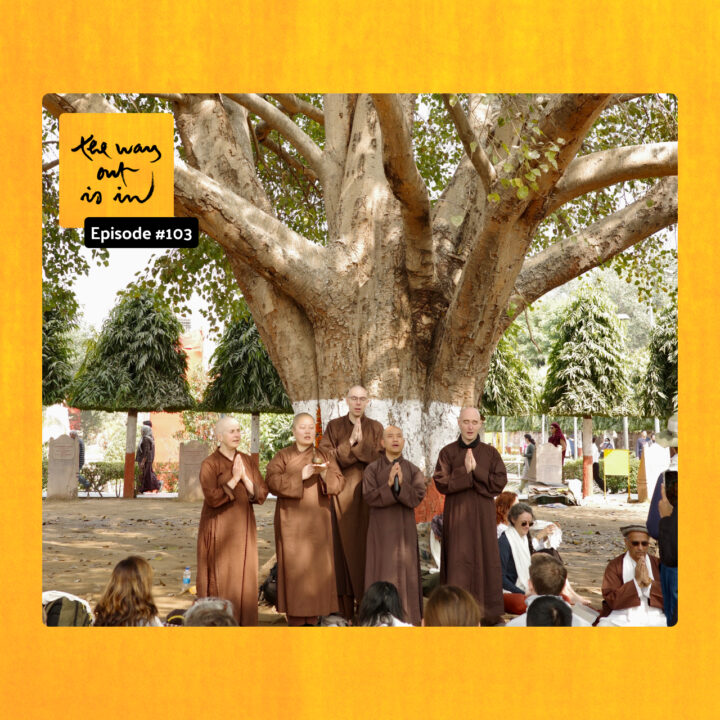
The second in a series of six episodes recorded during the In the Footsteps of the Buddha pilgrimage, this instalment was made in Bodh Gaya, India, in February 2026. In it, Zen Buddhist monk Brother Phap Huu and leadership coach Jo Confino are joined again by Dharma teacher Shantum Seth to discuss the journey of the Buddha, Siddhartha Gautama, before he reached enlightenment under the Bodhi Tree in Bodh Gaya. It covers Siddhartha’s early life, the various ascetic practices he tried, his finding of the middle way between extreme asceticism and hedonism and going through various stages of meditation and insight, to becoming the awakened one, and his first teaching.
Together, the three participants further reflect on the relevance of the Buddha’s journey to their own spiritual practices; the challenges of maintaining mindfulness and presence in the modern world; the importance of the sangha in the Buddhist tradition; and how the Buddha’s teachings emphasize the interconnectedness of all things.
About the pilgrimage:
In 1988, Shantum Seth was invited by Thich Nhat Hanh (Thay) to organize a pilgrimage to the sacred sites associated with the Buddha’s life across India. Subsequently, Thay encouraged Shantum to continue guiding such journeys each year, offering pilgrimage itself as a mindfulness practice—one that the Buddha had suggested.
Shantum has been leading these transformative journeys ever since, offering people from around the world the opportunity to follow In the Footsteps of the Buddha with awareness and insight. After 15 years at the United Nations, Shantum left to volunteer with the Ahimsa Trust, which represents Thay’s work in India and promotes the practice of “peace in oneself and peace in the world”.
Through Buddhapath, his expression of Right Livelihood, Shantum continues to guide pilgrimages and share the wisdom and culture of the places he visits in India and across Buddhist Asia, cultivating community through these deeply meaningful journeys.
To learn more about upcoming pilgrimages, visit www.buddhapath.com, or follow Shantum on Facebook and Instagram at @eleven_directions.
Shantum Seth, an ordained Dharmacharya (Dharma teacher) in the Buddhist Mindfulness lineage of Zen Master Thich Nhat Hanh, teaches in India and across the world. A co-founder of Ahimsa Trust, he has been a student of Thich Nhat Hanh’s teachings for the past 35 years, and, since 1988, has led pilgrimages and other multi-faith, educational, cultural, spiritual, and transformative journeys across diverse regions of India and Asia.
He is actively involved in educational, social, and ecological programmes, including work on cultivating mindfulness in society, including with educators, the Indian Central Reserve Police Force, and the corporate sector. Across various Indian sanghas, Dharmacharya Shantum is the primary teacher of different practices of mindfulness from Thich Nhat Hanh’s tradition.
Co-produced by the Plum Village App:
https://plumvillage.app/
And Global Optimism:
https://globaloptimism.com/
With support from the Thich Nhat Hanh Foundation:
https://thichnhathanhfoundation.org/
Recording by Ann Nguyen
https://ann.earth
Sound editing by Joe Holtaway
https://joeholtaway.com
Publishing by Anca Rusu
Produced by Clay Carnill
https://claycarnill.com
Executive Producer: Catalin Zorzini
List of resources
Interbeing
https://en.wikipedia.org/wiki/Interbeing
Plum Village Tradition
https://en.wikipedia.org/wiki/Plum_Village_Tradition
Old Path White Clouds
https://www.parallax.org/product/old-path-white-clouds
Kaundinya
https://en.wikipedia.org/wiki/Kaundinya
Sister Chan Khong
https://plumvillage.org/about/sister-chan-khong
Bodhi tree
https://en.wikipedia.org/wiki/Bodhi_tree
Bodh Gaya
https://en.wikipedia.org/wiki/Bodh_Gaya
Sujata
https://en.wikipedia.org/wiki/Sujata_(milkmaid)
Mahavira
https://en.wikipedia.org/wiki/Mahavira
Kumbh Mela
https://en.wikipedia.org/wiki/Kumbh_Mela
Maulana Azad
https://en.wikipedia.org/wiki/Maulana_Azad
Dalit
https://en.wikipedia.org/wiki/Dalit
Dharma Talks: ‘Redefining the Four Noble Truths’
https://plumvillage.org/library/dharma-talks/redefining-the-four-noble-truths
Dharma Talks: ‘The Noble Eightfold Path’
https://plumvillage.org/library/dharma-talks/the-noble-eightfold-path
Quotes
“We think we’re practicing for ourselves only, but there are invisible connections that we may not see. So your own practice, your own transformation, your decision-making can shift a whole lineage that precedes you. Without even doing much. It’s just some decisions; it’s almost like the turning of the dharma wheel, something in our whole lineage. And it’s true for a lot of my Western monastics; they might be the first in their whole ancestral lineage to be on the path of love and understanding. So you’re not doing this for yourself only, you’re doing this for your whole lineage.”
“Everyone on this pilgrimage, in this room right now, sitting, I invite you to plant that seed to see that this journey is not yours alone. There’s a deep interbeing and it’s a weaving of past, present, and future.”
“I got involved in activist politics, organizing big demonstrations, going to jail, organizing in a big way. But then I burnt out and found that I was very angry. And that anger was actually infusing my action, and I realized I was also part of the problem. So I had to find a way of being peace, not just fighting for peace.”
“In the Indic civilizational system, at least in some traditions, and especially in the Brahmanical system – I don’t call it Hinduism – we have four stages of life. The first is what we call brahmacharya: the celibate life, when you’re a student. The second stage is the grahasthi, where you become a family person and have children and build up the family. And the third is vanaprastha: sort of a forest dwelling, but more like social work; your children are getting married and you get involved more in society, like a philanthropist. And the fourth stage is sannyas, where you actually leave the family, break your ties, and become, in effect, dead to the family and take the path of a monastic. So the Buddha is saying, ‘You don’t need to wait till you’re an older person. Start now. Don’t waste your life. The path of awakening can be walked when you’re young, too.’”
“Having children is courageous; you’re taking on responsibility for future generations, and that’s not easy. I feel that’s why we need a sangha of parents, friends. They say it takes a village, but it takes the global humanity, eight billion people, to create a civilizational shift. And that’s what we’re trying to do, to make the world a better place.”
“Courage is a moment-to-moment act. It’s not just a moment; it’s each day we get up and say, ‘Okay, it’s a blessing we have this life for these 24 hours. Can I, in some way, make it better? Can I not make it worse? Can I enhance the life of people around me and keep being mindful?’ The word ‘Buddha’ just means to be awake. So how can we really be awake? We can be awake by being mindful: being attentive, breathing in, breathing out. That’s a moment of awakening, to be present. The Buddha became a full-time Buddha, but we can do it moment-to-moment, as little, part-time Buddhas. I think all of us can touch it – and that requires courage, too, to be diligent in our practice; it’s very easy to get distracted so we need to watch our mental state of irritation, anger, jealousy, whatever comes up. I have eyes to see – wow, that’s a miracle. That’s, again, a type of awakening. So I think this path is the path of courage.”
“You can share the same bed with someone, but if you don’t share an aspiration, it can cause immense suffering.”
“The problem with the middle path is that it’s not a single line. It is an appropriate response to a particular situation. The middle part requires attentiveness, mindfulness, moment-to-moment. You might think drinking water is an appropriate action, but if you’ve had a stomach operation, drinking water might kill you. So something simple like that has to be appropriately done; the middle way is appropriate to time and place.”
“We can’t start off on the middle path. We have to understand our suffering deeply in order to know the middle path, to know the two extremes in order to find that path.”
“That’s why retreats are so important: we step away from the world to realize what our deepest aspiration is. And then we can go back with a new set of eyes.”
Dear friends, welcome to the second episode of our special series of The Way Out Is In.
I'm Jo Confino, a leadership coach and spiritual mentor.
And I'm Brother Phap Huu, a Zen Buddhist monk, student of Zen Master Thich Nhat Hanh in the Plum Village tradition.
And this is the second episode, as I said, of our special series of our pilgrimage in India. We're here for 14 days, getting deeply in touch with the life of the Buddha, the context of his life, what he went through, how he reached his enlightenment, and what he taught. And we have a special guest. He's not a guest actually, he's a co-conspirator, Shantum Seth, who has been leading these, as he calls them, retreats on wheels for the past, well, more than 30 years. Yesterday we arrived after a six-hour journey in Bodhgaya, which is where the Buddha reached enlightenment. And it's 6:30 in the morning. We are sitting in the restaurant of the Royal Residence Hotel. I'm looking at Shantum and Brother Phap Huu, and they are both looking as fresh as a daisy. I am feeling like a wilted flower.
The way out is in.
Hello, dear friends, I am Jo Confino.
And I am Brother Phap Huu.
And we have, as I said, Shantum Seth with us. So we reached Bodh Gaya, and we visited the Bodhi Tree last night, under which the Buddha reached enlightenment. But we're gonna go back a bit, because actually I think it's really important to understand the journey that the Buddha went through before enlightenment, because he was seeking to escape the realms of suffering, which I'm sure all of us are trying to do too. So Brother Phap Huu, just sort of start us off, warm us up a little bit. So how are you feeling? What's going on in your mind this morning as we sort of, as we reach the second stage of our journey?
I didn't sleep too much last night, but I'm feeling happy in this moment just to sit here with friends among the table and in this space. Let's go back. Let's back over 2600 years ago. Yesterday, we spoke about when the Buddha was born and how he was very well-versed in the Vedas, so he had the training in the religion of Hinduism, and that's what he was brought up in. And just one point to be aware of is that after birth, his mother died from giving birth to him. So in some way, that is also a suffering that he experienced. And it was his aunt who brought him up, together with his father. And during his youth, there were many conditions that allowed him to start to contemplate life and to contemplate something deeper than just the everyday life. And one of it was him sitting under the rose apple tree. And it was in a ceremony of plowing of the lands, that the king and the royal family would be present as the first plow of the year, so it's like an inauguration. And it was under that tree that he saw the bird coming down and sweeping and eating one of the bugs. So that was recognizing how life is not as beautiful as we like to just see and believe in. And there is a constant birth and death, and to survive, sometimes we have to remove life. So as a young boy, nine years old, that moment already struck him. So that was also something for him to contemplate on. And so that is like him touching a spiritual dimension, asking a deeper question. And we also spoke about in the previous series, the moment that he went into the village with his attendant, Channa, which was very important, seeing the four images. And Siddhartha was an all-rounder. He learned politics very quickly. He learned spirituality very quickly, he had many teachers, and he was also very well-versed in martial arts, in sports, and his father was bringing him up to become an incredible warrior. So the father's ambition is for him to be a king that would conquer the land. And one of his spiritual and soulmate that he found was his wife, which was introduced through the royal family, Yasodhara. And she was like a companion of his, and she was someone who really cared for the villagers. Her heart was more expansive than the many other royal princesses. And she really cared, especially for the orphanage. And so she did a lot of social service. They probably didn't have that language back in the day, but she really care for the villagers. And between her and Siddhartha, they also had also a companionship and an understanding of what is our deepest aspiration. So in Old Path White Clouds, we can also see them practicing meditation together. And Siddhartha spoke to her in ways of his deepest aspiration. It is to understand suffering, and that is birth and death. How do we overcome the fear of birth and death, and how can we understand birth and death so that we can be liberated? So that it's not like a chain around us that is always pulling us down, and that it is making us doubting every action in life. So this connection is an important connection of companionship and understanding each other. In a relationship, we don't only take care of the day-to-day, but we have to have time to ask the deepest question of our loved ones, of our partners. And Thay, our teacher, in his years of teaching to the lay community, especially when families would come through Plum Village, in the summer retreat, Thay always challenged all the couples is, have you taken time to really sit together and to look at each other and ask about our deepest desires? Have we had time to ask the deeper question, what brings you true joy, my dear? What brings you true happiness? What are the sufferings that you hold in your heart that is not yours alone? Maybe it comes from your parents, your ancestors. How can I help you? How can I be supportive of your journey? And Thay would call this a peace treaty. As couples, we have to have a peace treaty of deep understanding so that I can support you. And Siddhartha and Yasodhara, in their journey of marriage had these deep moments. And they had a son named Rahula. And at the age of 30, Siddhartha realized that he cannot waste his youth anymore. And that he needed to embark on the journey of spirituality. And he knew he wouldn't get his parents' permission. And he had to do it in a very skillful way. So during one of the nights of a party, he waited until everybody was asleep. And he took a moment to look at his wife and his son and made the determination to go on this path, but knowing that he will return to share the fruit of the path. And sometimes people are like, oh, isn't that irresponsible of a husband? There's a chapter in Old Path White Clouds, Was Yasodhara sleeping? And I didn't come back to it, but what I remember from Thay's sharing is that Yasodhara deeply understood her husband and didn't want to be an obstacle for him to venture out into the unknown. So she pretended to be asleep, even though she knew that her soulmate, her loved one is leaving, and that she would be a mother by herself. And I take this moment just to honor all the mothers of the monastics and supporting your son, your daughter, your children to seek a path of spirituality it's never an easy feeling. I'm sure there is a grief in there and there's a feeling of abandonment, a feeling of also maybe lost, because I can connect this to my mother. I actually wanted to become a monk in 2000 when I was 12, and when I called my mother, she's not here. Right?
She's still sleeping.
Bless bless. She was actually very hurt of me even having the thought of abandoning home and becoming a monk in a different continent. I just remember in that conversation, she said, you're just having too much fun in Plum Village. It's like a summer fling. It's going to pass. You're too naive. Come back home. Go back to school. And next year, I came back to Plum Village and something shifted in her. And many years later, after a few years of monastic practice, I asked my mom, what changed, mom? What allowed you to allow me to be a monk? And she said, I saw what Plum Village meant to you when you came home. You never spoke a word about Plum Village because you had the fear of touching that pain in her, in me, my mother. And it was true. When I came home, I didn't want to touch that topic because I felt her grief and I felt her fear of losing a son. And in the Asian culture and in Indian culture too, it's very patriotic, so it is always the son who would quote-unquote carry the burden of continuing the lineage. So a lot of parents would try to give birth to a son and after a daughter they would try again and again and I was the only son of the family. So I think there's also many cultural… letting go that my mother had to practice also. Coming back to Yasodhara. I can only imagine and feel her grief and also the courage she had and the trust she had in Siddhartha. So there's a deep trust and there's deep love there. In love, we don't see that your journey is your journey alone. Your journey is also my journey. Your happiness is also my happiness. Your success is also me success. Your suffering is my suffering. So I believe that Yasodhara, she was practicing interbeing already before that insight became a teaching. And I would like to imagine she was crying in that moment of knowing that her husband was leaving. And then it was Channa that went with Siddhartha on the horse to leave the kingdom of Kapilavastu. And Channa was a very devoted attendant and if anything was a friend to Siddhartha. And after crossing one of the rivers, Siddartha looked at Channa and said, you have to go home. You have to tell my father and you have tell everyone that I am on the path of awakening now. I'm looking for a path. Don't be worried and when I am successful, I will come back home. And Channa, from his heart and his feeling, said, young prince, how will you survive in the wilderness? You've been pampered your whole life. I can't imagine you surviving on your own. Who will cook for you? Who will wash your clothes? And Siddhartha said, well, the first thing of spirituality is letting go of comfort. Welcoming the unknown, welcoming that discomfort. And Siddhartha, a lot of artists paint this image of him holding his hair, which is very long, and which is very glamorous. So the shaving of the head is also a mark of letting go of all desires and all of the glamor. So even in today's culture, hair is also a representation of social class also, so to cut the hair is a commitment, is a statement. And he said, take back some of this hair and give it to my father. And then Channa had to leave with a lot of anguish, and Siddhartha started his journey. And Siddartha was also knowing that how we represent ourselves is important. So he was wearing royal clothes. So he was looking for someone to change clothes with. And then he saw a hunter. And this hunter adorned himself in a spiritual robe, in a monk's robe, in order to hunt easier. So the animals were wise. The animals knew who were hunters and who were not. And Siddhartha saw that this hunter disguised himself as a spiritual person. And he knew that this was such wrong action. And so he asked the hunter to trade clothes with him. And the hunter felt like he hit the jackpot that day and said, if you wear these clothes, you can trade it for so much more resources and you don't have to hunt anymore. And the hunter wonderfully traded clothes. And so this was also an important, this is why monastics, we have to wear different clothing. It's important to distinction the monastics and the non-monastic. It's not about discrimination, and it's not about to be different and to be better or to feel more powerful than those who are, quote-unquote, living the normal life, but it is the body and mind are very interconnected. So how we adorn ourselves in daily life, what we wear, what we do, it penetrates our mind. So how we conduct ourselves is part of the spiritual path. We cannot say, I'm just training my mind, but I'm not going to be attentive to what I do in my physical action. And in one of the moments my mother had with Thay, every monastic that was ordained in the Plum Village tradition, they get a very beautiful moment with Thay. And a lot of monastics' parents, some of them they come because they miss their children or they are trying to understand what my kid is doing in a monastery. Is this a cult or is this some hippie land? Or they come with the intention to pull them out. And some parents of my siblings, my monastic siblings, when my brothers and sisters and sibilings would ordain, they would say, you ordain, you are betraying our family. So whenever I die, you cannot come to my altar. Like there's deep pain in some of the monastic journey. So it's not all fun and games as you may see how peaceful and happy we are. There's also a lot of baggage that comes with individual journey. And it is a moment for the teacher Thay to offer his gratitude to the parents, even though the parents may not support their children's decision. But as every parent, there is a wanting to love, so trying to understand that. And Thay always asks the question, do you see any change in your children? And when he asked my mother this, something very sweet that she shared that I never knew and she said Yes, there's some change in him. But actually, there is more change in me. She said the moment Phap Huu became Phap Huu, I became vegetarian, and every time I leave the house, the way I conduct myself, what I wear, cosmetic, and so on and so forth, she would always ask herself this question: how can I, as a mother, support my children in their deepest aspiration, that is a monk? So she then became simpler in the way she she lived her life. And I never knew this, and it was thanks to that moment with tea, and it impressed Thay so much that he shared it in a Dharma talk, and he mentioned to all of us who are practitioners, we think we're practicing for ourself only, but there are invisible connections that we may not see. So your own practice, your own transformation, your decision making can shift a whole lineage behind you. Without even doing much. It's just some decisions, it's almost like the turning of the Dharma wheel, something in our whole lineage. And it's true for a lot of my Western monastics, I always say you might be the first in your whole ancestral lineage to be on the path of love and understanding. So you're not doing this for yourself only, You're doing this for your whole lineage. And I think each and every one of us on this pilgrimage, in this room right now sitting, I invite us to also plant that seed to see that this journey is not yours alone. And there's a deep interbeing and it's a weaving that is happening of past, present and future.
Hmm, wow, pretty impressive for 6:30 in the morning, brother. Thank you for sharing so beautifully. And you're inviting everyone really to just sit back and to recognize what the Buddha's journey means for us, because it's very easy to externalize. We're just listening to a story about the past, but actually it's about bringing it into the present moment. And I think probably all of us in our own way can touch into moments of courage on the spiritual path. It's very hard in this world, which is where spirituality has been repressed and suppressed, that often people are judging the spiritual path, that they want to stay stuck on the path of a sort of capitalist, individualist, sort of get everything for myself that I can, sort of mode of operation. And actually, the spiritual part can be a real challenge because often it's going against the mainstream, going against the trends of society. And so what you speak of is what it takes for us to follow our heart. And as you say, to ask the deepest questions of life is, who am I? What is the purpose of life? What is it to fully love? So Shantum, just in relation to that, you've been on this path a long time. What is a moment of courage that you've experienced that allowed you to go beyond what was maybe expected of you, to actually what you saw as something that you maybe was difficult but that you also couldn't resist.
Now, thank you, Brother Phap Huu, for what you shared, and thank you Jo for the question. I have to reflect on it a little bit because I feel there are many, many moments of courage. We need courage to live this life in an authentic way, in a constant mode. But I would say that sometimes we get a sort of shock in our lives, and it was when I was about 23, when I driving a sports car and totaled it, driving at 110 miles an hour. And those of you in England might understand, it's the MGB sports car, it was an iconic car at that time. Belonged to my boss, Mr. Clark. And I woke up in a hospital, I should have died, I wasn't wearing a seat belt, and then I woke in a hospital thinking, what have I done for this world? And I'd already experienced discrimination myself, personally, I'd been beaten up three times for being brown or black in England. I had been working with shoe workers who are so-called Dalits or so-called untouchables, so I could see discrimination by caste, by race, it made me understand the discrimination of gender through that, through my own suffering. So I thought, okay, I've got a second life, let me see what I can do to change the world and change it now, as you're a 23-year-old, you want to change it now. So I left my job and I said, okay. And the way I knew at that time was through politics. So I got involved in activist politics, and organizing big demonstrations, going to jail, organizing in a big sort of way. But then I burnt out and then I found that I was very angry. And that anger was actually infusing my action, and I realized I was also part of the problem. So I had to find a way of being peace, not just fighting for peace. And then I went for a search for nearly six years, meeting different teachers from different traditions, starting, of course, in my own Hindu tradition, and then Christians, Quakers, Sufis, all around the block. And I think it took courage at that time, too, because I felt, for example, at one point I was doing a lot of chanting and I was feeling very blissed out and I was feeling wow, this is hallelujah. But then I still remembered I knew they're suffering, people who don't have food, they are discriminated against in many, many ways. So it required me to say, no, this is, as Brother Phap Huu was saying, their suffering is my suffering, it's not as independent of this world, of this society. I mean, it's a long story, but basically I started veering myself towards the Buddha Dharma. I found it suited my personality type. And in that search, I went to many teachers, you know, with the Burmese, Korean, Japanese. In India, we didn't have much Buddhism, the Tibetans. And on that search I found Thay, Thich Nhat Hanh. I had to retreat to Ojai in America and I was at that time a manager of a performing troupe so we'd been invited to the U.S. And I just went on to search. And I think all those moments require courage because when you see somebody also who you feel could be your teacher, it requires a letting go, also saying, OK, yeah, he's wiser than me, he's somebody I can feel that he's walked the path. It wasn't just him, other teachers too, but it was him who I really felt that spoke to me both from my political background and trying to combine my spiritual background. And so this confluence and my first teacher had been Gandhi, my university thesis had been on Gandhi, and my politics had been based on Gandhi and Thay reminded me of Gandhi. So in that sense, I would say that requires, I was very anti-gurus. I've been brought up in India, and I can see that well, for want of a word, the corruption of gurudom. And I was not very keen on that, but here I could see a teacher. Guru means actually the one who dispels darkness, guru. So anyway, that I would say would be another point of courage. And then… Many points, I think marriage is a point of courage. That's the time when you choose somebody in your life to be your partner for life. It's a bit like a monk saying, okay, I'm choosing this path. And when the Buddha was young, and when Brother Phap Huu was saying that the Buddha was 29, when he chose this path of a spiritual seeker. In the Indic civilizational system, at least in some traditions, and especially in the Brahmanical system. I don't call it Hinduism necessarily, I call it Brahmanic system. We have four stages of life, and the first stage is what we call brahmacharya, which is the celibate life, when you're a student. The second stage is the ghresthi, where you become a family person and you build up your, you know, you have children and build up the family. And the third is what is called vanaprastha, it's sort of forest dwelling, but it's more like a social work. You get involved in social work, your children are getting married, you now get involved more in society. More like a philanthropist a little bit, and the fourth stage is sannyasa, where you actually leave the family, break your ties, and you're now, in effect, dead to the family and you've taken the path of a monastic. It's in the Indian tradition, in the Brahminical tradition. So what the Buddha is doing is he's saying, you don't need to wait till you're an older person. You start now. Don't waste your life. The path of awakening is when you can be young, too. So I felt that for me, when I talked to Thay, Thich Nhat Hanh, we said, I discussed about being a monk or being a lay person, and he was very keen I'd become a monk. I mentioned that he even shaved my hair, gave me a robe, you know, but I said, you know, at that time I felt in India our path is, there have also been people who can help society by being ghresthi, by being family people. I was also finding that many, many people whose suffering is based on livelihood issues and on relationships, a lot of suffering of people. And I thought, if I can't go through it myself, then what am I going to be? Thay was somebody who could understand human psychology much better than I could. But I needed to go through to see whether I can still be a happy person through a marriage path, through a path to a lay person. And he said yes, it's a more difficult path, I don't know whether he was trying to tempt me, but everything, I love tofu, I love Vietnamese food, he said you get this lovely Vietnamese food every day. I said thanks, Thay, that's a big temptation. So I think those points are courageous, having children is courageous, you're taking on responsibility for future generations and it's not easy to just have that responsibility. And I feel that that's why we need a sangha of parents, friends, they say it takes a village, it takes the global humanity, eight billion people of us to create a civilizational shift. And I think that's what we're trying to do, to make the world a better place. So I think courage is a moment to moment act. It's not just a moment, but it's each day we get up and say, okay. It's a blessing we have this life for this day, these 24 hours, can I in some way be, make it, for want of a better word, better. Can I not make it worse? Can I just enhance life of people around me and also keep being mindful. I think, you know, that word awakening, and the Buddha, the Buddha just means to be awake. So how can we really be awake? And we can be awake by just being mindful. So just being attentive, breathing in, breathing out. That's a moment of awakening, to be present. And the thing with the Buddha became like a full-time Buddha, but we can do it moment to moment, little part-time Buddhas, but I think all of us can touch it, and that requires courage too, the practice, to be diligent in our practice, very easy to get distracted and watch our mental state of irritation, anger, jealousy, whatever comes up. I have eyes to see, wow, that's a miracle. That's again a type of awakening. So I think this path is path of courage.
Thank you. One of the things, Brother Phap Huu, you talked about is about, in a sense, you've talked about being married to the monastic life. I found that in my marriage, Thay said once that you can share the same bed with someone, but if you don't share an aspiration, it can cause immense suffering. What's lovely about this pilgrimage is that we've got several couples who are part of this, and I think there's something extraordinary about two people being on the path together. I know with my wife, Paz, that support we get, we offer each other and give to each other, but also give ourselves, each other the freedom to experience life in our own way. And I think what you're talking about, you know, the Buddha was courageous in his way and it's for each of us to find courage in our way. That there's no one path, that actually we need to know what it is but to act, as you say, Shantum, with courage, to know in the depths of ourselves what our path is and to follow that without fear and favor. Because if we don't follow it, we will always regret it in some way. That actually we have one life that we know of and that actually want to live it to our fullest, and I think Thay encouraged everyone to sort of really follow that path. But I want to come to another form because sometimes courage does not lead us to the correct answer in one form. So brother, I want come to Siddhartha's journey into asceticism because he was looking for the answer and he went to an extreme, which was an ascetic path of sort of eating very little and sort of in a sense going to the extreme of physical and mental feelings in order to find an answer. So I'd like actually both of you to share a bit about this part of his journey where he actually, and of course there was a hole trend in India for asceticism, that you had to go to the extreme feelings and experiences and physical experiences in order to find the way. Why did Siddhartha decide to take that path and what did he learn through it? And I think this is really important because often we think we're following the right path but we need to know when actually it may not be correct for us.
Lucky, I read the chapter this morning.
True. Fully up to date.
Encourage plays a big part in this. Before the Buddha went into asceticism practice, he already had two teachers. And in the previous episode, Shantum spoke about one of them, one of the great teachers of that time. And the Buddha, within just five weeks, was able to master the teachings of that particular teaching. And it's a state of mind that you get into. But then once you leave it, you still feel that you haven't transcended suffering. It's, in a way, that was spiritual bypassing. And the Buddha realized that the Buddha's like, yeah, that's only my happiness. That's only in my mind that I'm liberating, but it's not connected at all to society and the environment around me. So in that moment, the Buddha realized, I don't want to waste my time anymore keep looking for teachers. I will become my own teacher. That means he has to go into a practice and trust his own feelings and emotions and sensations. He was already, he already had the insight before that, that when he saw those who were practicing asceticism, he felt that that was a wrong practice because it's quite violent to the body. But then he, in this moment, because he hasn't found a teacher that has shown him the way, so he's gonna try that practice to see that part of overcoming birth and death is being free from desires. And that means he wants to come back to the body and feel the body literally breaking in a way and see if he can be free from all of the pains of the body. And be free from sensual desire, and all the complexes that come within us. And so he sat not so far away from where we are, and he started this practice, and he still, in the beginning, every day would go into the village and beg for food. So all of the spiritual teachers they rely on society to provide them. And what is culturally beautiful in a lot of the Southeast Asian countries is that when a lay person sees somebody who is embarking on the spiritual path, there is a support for them unconditionally because this is someone who has given, given the race in the world and go the opposite way to find a path to offer to others. So this still today in 2026, that practice and that understanding still exists. And some of it has been corrupted like what Shantum has shared. And one of Thay's aspirations is also to restore back that faith in setting up Plum Village and particularly when he made the decision to ordain monastics again. And that was in 1988. And that was his revolution and his revelation that Thay realized that the lay people are not enough because they all go back into the world and the habits of the world will sweep them away. And Thay realized that only a monastic community can be his real continuation. And this was also, I'll come back to the Buddha because we went here. In the early days of Plum Village, Thay was supported by a lot of lay community, the lay disciples. And when Thay started to shift his energy to just monastic, a lot lay students were jealous of that. I don't know if Shantum was jealous…
Were you jealous?
I realized it…
No, no, you can speak.
Now I realized that as lay people, what Brother Phap Huu was saying, we would come and then would go away and actually what Thay needed was a full-time sangha around him. And we realized, many of us lay people realized that and that also Thay's own aspiration as a monastic, that is his full-time life. And we couldn't understand fully that he could transmit that easier to people who would follow that path, but he was a revolutionary for us, transmitting to lay friends like us teachings of the monastics. So really this four-fold community that the Buddha talked about, the four-fold assembly, Thay is one of the revolutionary teachers of our time who has really emphasized the four-fold community. And at that time there were the two-fold community and Thay. And as Brother Phap Huu says, the first monastics actually ordained in 1988 in India.
And this is important because I feel, you know, as a tradition, Plum Village is bringing every, our work is every day to bring the spiritual awakening. And in our 21st century, in 2026 still, I think people don't really understand the true path of spirituality. Like I said, religious corruption has really damaged that faith, and the monastic community of the Plum Village tradition, one of Thay's aspiration is to restore that, and not to restore it by just speaking, but by being a community to show that it's possible to live together, it's possible to be happy. It is possible to move through suffering, not as an individual, but as a collective, and the insights that can be born from that. And so, coming back to Siddhartha now, Siddartha wanted to conquer his fear. And so he went deep into the jungle, into the forest. In the story, it explains that when he was in meditation, everything that he heard, it felt like there was something, a beast would come and eat him or so on. And the Buddha was slowly just conquering the mind, conquering the fear of the mind and of the perceptions that a sound can make, a beam of light can be indication of something. So we start to see that the journey of inward, the way out is in, and he really went in in. And fortunately, he was lucky, because during his time with one of his teachers, the last teacher, he had a very wonderful spiritual friend who is also a monk, Kodandana?
Kaundinya.
Kaundinya. And Kaundinya was very, he admired Siddhartha a lot. And when Kaundinya also mastered the practice of from the previous teaching, he also set forth with four other friends, so five of them, went in search of Siddhartha, knowing that Siddartha is not just a friend, but also a teacher. So that's very unique. So sometimes friends can be teachers and sometimes teachers are also the greatest friends. And I always felt this relationship with Thay and the mentors that I've had in Plum Village. And Thay has really worked our hierarchy in our community. There's a lot of reverence to the ones that have come before us. It's actually a practice to offer respect because we have to understand that there are those who have come for us. And even if they are not the greatest practitioners, but they have maintained the spiritual lineage. So it's to guard our minds, to think, oh, but I'm better than him. Why should I respect him or her or them? And I think in our modern times, sometimes we wanna be so free from all that, but then I feel that there is some mistransmission there also. And that's a part of us that we do have to practice reverence. And that's how moving through the path and the journey of life that supports you to be humble also. To keep your humility at the forefront. And so when these five friends met Siddhartha, they all practiced together and they would take turns to go into the village to beg for food and share the food among each other. And in Siddhartha's meditation of asceticism, one of his awakening started to come alive, which is that many of the teachers were talking about isolating ourself from joy, from the joy of meditation, and is to go to an extreme of suffering, therefore we can touch the deepest happiness. His realization is also that body and mind are so interrelated. This is very important. This is when he started to peak into the middle way, that extremes are extremely dangerous for our spiritual practice. And what he was doing was an extreme, was violent to the body. And when you're violent to body, you're gonna be violent to the mind. It's going to penetrate into your way of thinking, into how you see the world. And if the mind is to support the understanding, which is another language for awakening, then that is not supportive. So in our language, we say body and mind are deeply interconnected. The two are always supporting one another. And so this was a realization for him. And the second realization of not just body and mind are deeply interconnected, is that we have to have the right to see joy and ease in meditation. So a lot of the meditation that the Buddha, that Siddhartha was being invited to go into a different state of mind, into a different stage of Jhana, was in a way an escape, was to be in a concentration, no perception, no materialism, like everything is a cutoff. So we're cutting ourselves off from everything else. And that is, in a way, it's very selfish. And so he realized that there is joy in meditation. And why are we so afraid of that? Why are we so afraid of being happy? Why can't happiness be the path of enlightenment? Why does it have to be an extreme kind of suffering then you touch happiness? It's almost like only when you go to hell can you touch it… heaven. And Thay, he said, the Kingdom of God or the Pure Land of the Buddha is in the very here and now, as well as the 18 realms of hell are also in the here and now. So this is when Siddhartha, the young man, I would say this was his beginning of awakening already. And so from this, he moved out of the practice, another courage, be free from what I set forth. So how many of us have started a path? We see no success there, and we're like, yeah, but if I try a little bit more. But when you know it's a wrong path, you have to have the courage of letting go. And so Siddhartha took his courage, and he walked down to the river to bathe himself. And he was naked at this time. And on his way to the bank of the river, to bathe himself, he saw a crop, a dying body, a dead body of a woman and he looked at that body and he contemplated death. And then he asked permission from the body and he took that cloth to be his robe. And so he went into the river and he bathed himself and it explains that he felt so refreshed, the sensation of life is coming back. And then he was washing his new robe in the river and in that moment he needed to get out and that's when he felt that he had no strength and he fainted as he was trying to pull himself and he fainting on the bank. And this is my favorite part is that in that movement a young girl named Sujata who was instructed by her mother to go into the forest to bring food and offer it to the gods of the forest. But then she sees an ascetic who has fainted and bless her for common sense, said, this is a living person I need to feed, I need to help. And she gave him milk. And in the writing, the moment Siddhartha felt the moisture come on his lip, he motioned to the girl, give me more. And he drank it all and he felt life coming back just through milk. And he got up with all his strength and he asked for more food. And Sujata started to become a companion of his and he would meditate in a cool forest and it was by himself in this time because his friends felt that he has betrayed the path. And Sujata, every time she was given food to give to the gods, she wouldn't tell her mom but she would be giving it to Siddhartha. And for me, this is a very beautiful moment, because… Again, it's a woman. It's a young girl who comes into the path. And in our world where it's very patriarchal and masculinity and men and so on and so forth, but in every story there are these incredible friendships and companions that are women that supports. And for Thay it was Sister Chan Khong, Sister True Emptiness. I would always say Plum Village wouldn't be there without Sister Chan Khong. So whenever I speak about Thay, I always speak about Sister Chan Khong also because without Sister Chan Khong, Plum Village wouldn't be Plum Village. And Thay wouldn't even be a successful monk without Sister Chan Khong. And then connecting to the children is seeing that they are so important in continuation. And this moment for me brings me to my first journey in Plum Village. Plum Village in the summer retreat is the only time that the monastics would also set up a program for kids so we felt so loved. We felt that we had not only one parent but the community was our parent, and it becomes a very safe environment. And Thay, I was fortunate enough to be around him in that time, and his presence was a spiritual father for so many of us. And you know, kids are so naughty, right? Kids don't really want to be with adults, but Thay had this aura. He had this peace and this presence that all of us kids wanted to be around him. And particularly for walking meditation, we would all try to hold his hand. So we're all like, which one of us is going to get to hold Thay's hand for walking meditation. And Thay was a very mindful teacher, so he was aware that there were so many kids, so he would be very generous. Every hand, two kids he would hold and after about five minutes he would combine the two kids, hand together, and let them walk forward and he would take the next two kids. And this just shows just the compassion of a teacher and the awareness of surrounding and knowing that teachings and transmission are not through just words but it's through these acts of presence and kindness and love.
Hmm, beautiful, thank you. Yeah, Shantum, I want to come back to asceticism because it's, and I want to make it also relevant to all of our lives because there are moments where we all take an extreme path, where we think actually our life is not working and maybe I have to do something that sort of takes me to the edge. But as Brother Phap Huu says, you know, when we are extreme, that can be very dangerous and we can get lost. And this comes back to the Buddhist teachings of the middle path, which we can come back to actually, because we'll come back to our moment in Deer Park. But can you tell us about, in a sense, the history of asceticism in India? How it came to be a path and in a sense, why…? Because I imagine there's still people who practice that. Why is that still the thing? What is it that people, why do people take that path, what are they looking for and what is your experience of that, of seeing that in the world?
So as we discussed earlier, the Buddha tried many different traditions, whether it's the yogic tradition, the upanishadic traditions, and there was a tradition of asceticism at the time of the Buddha, and it was a particular teacher called Mahavira who started a tradition called the Jains, and they have a belief that there's a soul, and that the body entraps the soul. And so, if you can really conquer the body, then you can come in touch with the soul. In one of the sutras where the Buddha talks about this whole period, it's called the Ariyapariyesana Sutta. He talks about meeting the two teachers and then going to the ascetic period. And he says that you can't burn wet wood. So the body is like that, you have to dry the body out. Asceticism has always been very attractive to people on the extremism is always quite attractive to people. That's the real Mikkyo, he's really doing the thing. And you're right, many people in India still practice these things, not only amongst the Jains, but in other traditions of asceticism. I go to a big festival, which happens every 12 years and every four years, called the Kumbh Mela, and I meet many people who are practicing really strange forms of asceticism in some way. But it also becomes a little bit of, I would say, exhibitionism of a sort in some cases, but there's also an authenticity of people who are trying to practice asceticism who really believe in the concept of a soul. So there's both the exhibitionism part, but also really sincerity in terms, and if you believe in that, then if you believe in idea of a soul, then you can get caught in that. And that's where the Buddha's path was realizing that when he went through this, and it was very extreme, he talks about how he used to keep his tongue on the top of his palate and then stop breathing, and then he said, just like my head is being tied by a leather band and then it was constraining it and so the pain is intense, a sharp sword is going right into my skull, that sort of pain of using internal practices like that. First, which didn't succeed, it just really got painful. Then he tried external practices, like eating what is really barely in the hollow of one hand, eating strange food like the excreta of cows, his own excrete, and then he describes his own body, emaciated body. His ribs were like the rafters of dilapidated building, his buttocks were like hooves of a camel, his head was like a shriveled gourd, but his eyes were like sunken wells. And when he touched his stomach in the front, he could touch his backbone. When he urinated or defecated, he would fall down. So weak and extreme. So I mean, people like talking about their suffering and I think the Buddha was not that different. He talks in quite detail about what happened at that period. And… He felt nobody could have gone to that extreme and these five fellow ascetics were also practicing and had the confidence that Gautama, which is the other name for the Siddhartha Buddha, would be the one who would find the way. And that's why they followed him from Udaka's camp, as it were. But when he's by the river and he feels a gentle breeze in his face, and he remembers his meditation when he was nine years old at the first plowing, which Brother Phap Huu alluded to, under what we call a jamun tree. In India, a jamun is an Indian plum. And he realized this mind and body link. And this idea that, so this was an important realization that the mind and body are one. What happens to the mind, happens to the body. And so it is not to torture the body as it were, to get rid of the body, as an entrapment for the soul and the mind. He then decides to teach, decides to eat. And then he goes to the village, collapses under the banyan tree, and Sujata is offering this rice and milk pudding, the kheer. And she sees this god. She's going to offer this kheer to the gods, the tree gods. And she thinks, ah, this is a god, and offers it to this dying ascetic. And slowly as Brother Phap Huu said, … he sits up, takes a little more. Now these five ascetics of his are watching this. They really think he's lost it. He's giving up the path. He's eating now. He's nourishing himself with food. And worse, he's talking to this young girl. So they leave. And actually, Siddhartha Gautama, not yet the Buddha, doesn't even realize they've left. And he then talks with this young girl, Sujata, eats. And one of my friends says, this is really the moment of awakening, you see. It's this one friend who says that. But it's interesting, he says he's now come in touch with his feminine. He's let go of the macho practices, the machos men who've left. He's now in touch of the village women and his own feminine. And that integration allows him to awaken. She says, it's a feminist friend of mine, but I think it brought the conditions for his awakening under the tree, under the Bodhi Tree, that's another, that's a people tree. This was the banyan tree under which we're sitting right now. So I feel this ascetic period is a very, very important period because he really felt that he'd gone to the extreme of physical death and then found that is not the way and then come to a path which we then describe as the middle way. But you're right, Jo, that this is a path that is still being continued, still being practiced, still being propounded, professed by teachers in India. And India's a… India herself is a great teacher, I feel, and in that we have every thing you can think of is being taught as a practice, whether it's balancing three coconuts on your head or dangling a bell off your penis or whatever, we heard wonderful ideas, we had ideas of, even at that time, we had these animal esthetics, you know, you do everything by crawling on four legs, four, your hands and your legs and knees, and you don't take food to your mouth, from your hand, you take your mouth to the food. So they are dog ascetics, they are not just the ascetic. Every… You sit in the middle of a fire and stare at the sun, they're fire ascetics. You know, the five fire ascetics. There are different parts of asceticism too. But very wonderful, I'm sure, for them. Luckily, I am really happy the Buddha did that, so we don't have to do it. And I think it's very important that we have that gratitude, because otherwise, not that he did it, because if he hadn't found the path out, maybe some of us who were on a spiritual path or interested in a spiritual path, may still be doing that, as many are. But I think I'm very glad the Buddha found the way that, and that's why his first teaching in Deer Park was a reference to this, to the five ascetics saying… It is not the part of asceticism, and it is not a part of extreme materialism and hedonism. It is the middle path. But the problem with the middle path is that it's not a single line. It is appropriate response to a particular situation. So the middle path is not always, we know what the middle parts is. The middle part requires attentiveness, mindfulness, moment to moment and, you know, appropriate, like, I was telling some friends yesterday, if you, you know, you might think drinking water is an appropriate action, but if you've had a stomach operation, drinking water might kill you. So something simple like that has to be appropriately done, and then the middle way is appropriate to time and place.
And sometimes we only find the middle way by going to the extreme. So you described you sort of totaling your car at 110 miles an hour, that that was an extreme moment that awakened you. So sometimes, you know, we can't start off in the middle path. We have to sort of understand our suffering deeply in order to know what the middle path, to know the two extremes in order find that path. So I think there's also something that what the Buddha showed us is that we can find the middle path, but we can't start at the middle path. You know, we have to have these experiences of life. But what I've learned from is we have to learn from them. It's not saying we avoid them, but if we have them, that we need to know to learn them in order to find the middle path. The middle path doesn't exist as an entity. Oh, turn left and there's the middle path. We have to find that. Brother Phap Huu, is there anything you want to add around the middle path?
Well, I just want to add on what the two of you have been talking about and mentioning on. I think this is one of the pains of teachers is that they've gone through it and their students still won't listen to them. Or like parents, we know what suffering is and in some way we know our children need to go through it. So it's also important like direct experience. So Buddhism is also very much about direct experience. We have to have direct experience in suffering. So even though that like our teacher or the Buddha himself has found the path and is teaching the wonderful Dharma, but that's only one part of the journey and we still will suffer and we have to go through suffering. But it's to know that there are those who are awakened or those who have found the path and to have faith that there is a way through the suffering. And there was this one time, like I saw Thay, many times he was disappointed in us, because Thay would teach us one thing, and then we would totally not follow his guidance. Like, for example, one of the hardest practices, and it's very fundamental in Plum Village, you don't walk and talk at the same time. So Shantum, I'm joking. But, you know, like Thay just gave this incredible Dharma talk about the power of walking and why if you want to talk, just stop and talk and connect. And if you walk, just walk. And even as his attendant, like, Thay would be walking and us at the back would be like… And Thay will turn around with this disappointment and look at us. Doesn't need to say anything. And we just go zip, and we knew, you know, we're not following the teacher's guidance. And I remember one time Thay gave this example. He's like, Thay loves chili. He always has chili in his pockets. But sometimes Thay said, this is very spicy. Don't eat it. You will suffer. And then you have your skeptical students. Is it though? Maybe it is for you, Thay, but maybe not for me. And then go through suffering. And so sometimes also, there is also, I think, of teachers and mentors, like just learning to also just accept. You can guide someone, and if they don't follow, you still do your best. If you have compassion, you come back to them and say, okay, did you learn anything from your suffering? Can we talk about it? So I think there's also that middle way is also to know that it's part of the training, it's a part of life, but particularly, about extremism I think like, in our modern times, we still have this practice. It's another name. It is addiction. Drugs, alcohol, social media, scrolling, all of this is also a kind of extremism to not be in touch with ourself. So that's how I wanna bring it to everyday practice of our daily life. There is an extreme to everything. And in our contemplations of before we eat is always say to practice moderation. Moderation is the key for everything. Even Dharma to be moderate about it. Sometimes in the monastic training, we would send monastics, like you need to leave the monastery for a home visit or something. So you come back and you see the wealth you are in. You see the spiritual community that you have. So you don't take for granted what you have and I think that's why retreats are so important. We step away from the world to also realize what is our deepest aspiration. And then we can go back with new sets of eyes.
Thank you, brother. And what you're both saying about the power of teachers to show us the way, not that we have to follow their way, but that there is a way. And what we haven't mentioned is at the start of our journey, Shantum took us to the house where Mahatma Gandhi lived for his last 144 days. And just going through, seeing the simple life he lived. He could have had everything he wanted and he had just this small room with just a simple bed and a simple room, very similar to Thich Nhat Hanh's sort of hut in Plum Village in France. And then just going through that museum and just seeing his life and that at a time of extremism that he found a path of nonviolence and that he held to that path regardless. And in these times, just to know that there was someone who helped shape an entire nation, one very diminutive man, you know, very small man, but who found greatness and that we need these people. We need the Buddha as an example. We need Thich Nhat Hanh as an examples. We need all these great teachers examples to give us faith, to say actually we have to find our own way, but actually people have found a way. But Shantum, let's move on, because Siddhartha recognized that asceticism was not the path. And as I said, we're in Bodh Gaya, where he reached enlightenment. So it would be good to just understand what was the journey he took from that moment of recognition that actually this was not a path. And his journey to Bodh Gaya.
I'd just like to comment on your earlier comment about Gandhi and I think also how the reflection is with Thay. These teachers show us a way, but they don't disempower us. Where my dissonance with gurudom comes is when we disempowered ourselves into the hands of the guru, whereas people like Gandhi and Thay were really saying, and the Buddha. The Buddha path is that. We have the teachings, and we know how to walk the path. And for me that's an important distinction when I said that, you know, this corruption of gurudom, it's a type of disempowerment that I'm really wary about.
Thank you.
What Thay saw and what Gandhi did, both, they saw in us as their companions on the path, you know, students, they knew what would be our contribution, a valuable contribution to the world in whichever way that they saw it. So Gandhi had people like Mr. Patel, Mr. Nehru, Prime Minister, the people who started educational institutions Maulana Azad in India, whereas Thay saw, okay, in the monks he saw certain things. He saw a young Phap Huu, said, yes, this person could be the continuation. Has spent a lot of energy as an attendant offering him his transmission, Brother Phap Ung, many, each one in their own way, sent him to Deer Park in America, let Phap Huu stay in France. And I feel in my case he said, yeah, do the pilgrimage, this is the path that the Buddha suggested, why don't you do this every year and take people with you. So he could see in me, okay, this is something, as an Indian, you can do and you're interested, you know, bring the Buddha Dharma back to India. So, just to contextualize how Gandhi and Thay and the Buddha would in some way mirror each other. The Buddha was doing the same thing. 60 of you go in different directions, in different parts. But coming to the question of his journey into Bodh Gaya. So after he has this meal, I can hardly call it a meal, but a sort of delicious rice and milk, kheer, which we'll be tasting this afternoon, in the village where Sujata was. He finds a tree, a tree which is the people's tree by a river bank and sits under it and has now known that he's tried all the different types of traditions around and he's found that they haven't found a way out of suffering, ultimate suffering, they find temporary release, et cetera. But he has a great confidence that he will find a way. Now this is very important in Indic civilizational spiritual thinking. We know if we have the right practice, we will find the way, we can awaken. It does not depend on the grace of God or anyone like that. That is something which is deep in our Indian psyche. That if we practice well and we know the right practice, we will awaken. And if our career and our path is to awaken, then we do that. So he's sitting under the tree and he then goes through, we estimate seven weeks of… I mean he has this deep determination that I'm not going to get up from here until I awaken. And night after night, it's raining, it's storming and he goes through this process of what people call Mara, and coming to him, Mara is a type of internal doubt. He can have anything. And he feels that he can just let it go. That is not, there's all distractions of mind and temptations of mind, and then he sits night after night, and then as he gets this sense of calm, freedom, he then starts seeing that he, how it's described is that he sees his past lives in the first watch of the night. What I see it is, and how I've understood it through my own teacher, Thay, is that he then sees his interbeing nature with everything. That he then is the tree, is the deer, is the somebody who was born in the past. And so this understanding of his past lives is actually a way of understanding his interbeing nature with everything. And then the second watch of the night, he understands the law of causality, karma, that every action has some result, and that result is then a cause for something else. It's just not a linear form, but it's a multi-dimensional form of karma. Everything we say, think, do has some consequence, and has also come from somewhere else, whether it's ancestral or whether it's… So there's no starting point. There's no beginning. And in the third watch of the night as the morning stars rising he then develops what we now understand as the Four Noble Truths. And that is, of course, the awareness of suffering as a human experience, the understanding of the cause, the understanding then of the dissolution of suffering, that suffering can be abandoned, and then the path leading to that abandonment of suffering and the presence of joy and happiness. And so from this Buddha who we see as an ascetic emaciated type of person, comes somebody we see with a smile, with flesh, and a sense of humanness.
Thank you, Shantum. So the Buddha is enlightened. Brother Phap Huu, what does that mean? Because it can be deeply misunderstood. And as Shantum said, Thay was very much about not believing in one enlightenment, but we can have moments of enlightenment at any time. And this is such a deeply misunderstood representation of how our lives can be, that actually we're not aiming for one moment where everything opens up and stays open up and we are in heaven, but actually we can find this and then let it go, then find it again. Tell us a bit more, what is your understanding of enlightenment and how we can understand this moment of the Buddha and represent it our own lives?
Coming back to that moment, in the moment of doubt, where we use the storytelling of Mara, there's this moment where I appreciate a lot, because Mara asks the Buddha, because he's his own teacher now, he's practicing alone, and says, but who will witness your enlightenment? And in that moment, he put his left hand on the earth. And he said, earth is my witness. And I feel that very profound and very relevant to today with our crisis, climate, and then what it means to be home. Our practice is a lot about coming home. And we know that our home doesn't only belong in Vietnam, India, France, London, so on and so forth, but earth shall always be our greatest witness of all actions. And in a way, it's also like the earth is your mother, is your father, is your foundation of manifestation. So earth is always witnessing us how we are in this life. So I kind of feel like that is so profound that Siddhartha said, earth is my witness. That brings it to a very humanistic dimension of Buddhism because he didn't say the gods are my witness, the heavens are my witnesses, but he said earth because we can feel earth. We have to take refuge in earth. We cannot exist without earth. Any element that is not there to support us, we cannot be. That is the arising of his awakening of interconnectedness of life. And we know that in the sutra, it speaks about that moment of enlightenment is a moment of great joy and it is also a moment of deepening of practice and we always, our language of meditation is the practice and people get so annoyed with it because they ask us a question and we said, you need to practice. But just give me the answer. The answer is to practice. Feel what you need to feel. Be uncomfortable, look deeply, maybe touch the shame, maybe touch and be aware that we're ignorant and then, oh, see the joy of the potential, recognize that the different mental formation of us were so much more than just one emotion, were so more than one mistake that we make in this era and that every day, every moment is a new opportunity. And that's why the practice is so difficult because it's a mirror that reflects oneself. A lot of folks come to Buddhagaya or to a church or to any spiritual place to worship, normally we're asking, please give me. Show me the way. So there's always this externalism that we are continuing to look to take, to extract from others, but the teaching of meditation is always, well, come back, come back and understand the noble truth, understand our actions. The greatest joy of all of us being here today is that the Buddha now, from the children, gave him the title. So the Buddha is a title. They said, well, you are, if you, we see, dear teacher, that you are awakened. You have found the path. Let us call you Buddha. Buddha is to awaken, a person who has awakened. And the Bodhi Tree is a tree of awakening, where the Buddha sat and he became awakened. So the Bodhi tree got a new name. And Thay always wants to bring it into the very here and now, saying that all of us, we have awakened nature inside of us. And the joy is that the Buddha wasn't selfish. In one of our walks with Shantum, maybe at the Deer Park, if I remember correctly, Shantum saying that the Buddha could have just said I'm done, I found the way. Y'all can suffer. I'm just going to enjoy life now. But his heart was to build a community, to teach his friends, to help others find the way, so it is a heart of service. So Buddhism at core is to be of service to the world. A monastic is to be of service, to help other understand the path, see and touch suffering, and to transform it. And as lay students of the Buddha, we also have to take on some of that responsibility to shine the light a little bit everywhere. And so after awakening, he spent time with Savasthi, Sujata, and other children around, but then he knew he had to make his journey to find his five friends, which were at the Deer Park. And that was the moment that he gave the first teaching. And what was… What was very sweet was that five ascetics, they were talking among each other saying like let's be mean, literally. Don't look at the Buddha, don't give him any attention because he's abandoned the path. But when the Buddha came into their presence, they couldn't help themselves but to give him space. One went up and get water to wash his feet, to give him to wash his hands, to refresh himself from the journey, and they all sat around him. His friend just said, had to ask the question, the elephant in the room, why did you abandon us? Why did you leave? And Siddhartha, now the Buddha, had a lot of confidence and said, because I have found the way and I would like to share them to you. And it's the Four Noble Truths and the Eight Noble Paths. And everybody talks about that moment of the turning of the wheel of the Dharma, but I see the multiple layer of importance in that moment. But my most important moment was building the community there. That was the establishment of a sangha, of a group of individuals that will practice and follow the path together. And because I say this because our teacher Thay, he always emphasized the Third Jewel, the Sangha Jewel. Because the Buddha Jewel is more of a historical element and we can all worship and we can all touch the earth to him and give our faith to him but that's more of a devotional practice. And Thay said our practice has to be a living practice. So the sangha is where we are all alive and living our life and so if we as a community is embodying the practice, then suddenly in the sangha, the Buddha is alive, which is the awakened nature, and then the Dharma is being continued to transmit because the Dharma is not only spoken or recitation, the Dharma is practicing, being together, sitting in silence, eating a meal in mindfulness, being in touch with the reality of the world, and still having the courage and the determination to find a way, to relieve suffering. There's this line in a lot of the mantras or gathas, a practitioner makes a vow every day to bring joy to one person in the morning and to relieve the suffering of someone in the evening. And that may seem like such a big task, but it can be simpler than you think. A kind gesture, a way of looking, deep listening, a support, just a gesture of, even on the airplane, somebody who we see cannot lift their backpack, their luggage, step out of your way, help someone. And in our times, it's like everybody only cares about themselves. And I've made it my practice to, especially at the airport, if somebody wants to rush and go in for us, go ahead. We're all gonna get on the airplane. We're all gonna arrive there. And if that luggage is not right where we're from, it's okay, it can be over there or back there. It's this constant construct of our feeling of safety, feeling of privilege in a way that we keep fighting one another. So the practice is to relieve suffering, is to be kind. It's not to change their whole life, because everybody has their individual journey, but our kind actions, or our action of non-self, can maybe shift someone's whole journey in life.
Thank you, brother. It reminds me of a few weeks ago, so Plum Village holds retreats for climate leaders. And I host a monthly meeting for previous participants who have been to one of these retreats who live in the Americas. And there was one climate leader on the last call. And she was sharing how depressed she was at the state of the world and about climate change and the fact that we weren't able to shift anything. And I was talking about not discriminating between a big change and a small change. And she then said, oh yes, it's funny, I was in a cafe yesterday, and there was a woman with two children in a sort of double pushchair. And she was struggling to get out the door and I just went and held the door open for her. And then she was able to pass through and she looked at me and she said, thank you so much, I'm having such a difficult day. And thanked her. And as this climate leader told that story, she had such a beautiful smile on her face. And it was such an important moment that she's struggling to save the world and feeling she's failing, but she was able to help that one woman. And it reminds me of that story of the girl on the beach and there's been this great storm and thousands of starfish have been washed up on the shore. And she's picking up one at a time and throwing them back in the ocean. And this man comes on the beach and goes up to her and says, you know, why are you bothering? You know, there are thousands here. You can't make a difference. And she picks up one and throws it back in the ocean and says I can help this one. So that feels a bit like that sort of sense of awakening. It doesn't have to be a big thing. It can be just moment by moment. Shantum, I have one final question for you, which is a sort of personal thing actually, because we went to Bodh Gaya last night, and we're going back again today, and when we showed up, there were thousands of people there. There was sort of two levels of security you had to go through. You get to the Bodhi Tree and there's people constantly milling around. And I find it very hard to connect to this moment. So when I walk into Plum Village, literally when I walked just into the environment of Plum Village, I can immediately feel the energy of peace, of mindfulness, of connection, of groundedness, of touching the earth, as Phap Huu was talking about. And last night, it was very hard to feel any of that. So we're going back today. So how can I transform this moment of going back today to feel that connection? Because of course this is relevant and a metaphor for today's life, isn't it? That we want to every day touch something that is meaningful to find a sense of connection of peace, a connection of presence. And yet we live in a world which is thousands of people rushing around. Everyone looking to gain something from a moment and so how can I show up today amongst all these people, amongst all this mayhem at a very powerful site where the Buddha reached enlightenment and yet feeling like what am I even doing here with all these people.
So as Brother Phap Huu says, and as Thay says, and the Buddha says, peace is found within oneself and it's based on a practice and the practice of being present with our steps, with our breath. The external circumstances are there, whether it's a climate crisis or whether it is a cacophony of different voices around you, but can you find peace in yourself? And then can you, in a way, be that drop which creates ripples around? So we then co-create as a sangha of practice. When we went, we did walking practice. I think the energy we emanated has an energy that emanates into the surroundings. But Bodh Gaya is such a place that really is called the navel of the earth, especially for Buddhists. It's where everything emanated from. So what we are touching into is a deep, deep devotion, aspiration. Every Buddhist, Buddhist with a big B, I'm saying, you know, the Buddhist with the small b too, but the Buddhist of the big B have to come to Bodh Gaya. It's part of their sort of aspiration of life. So just feel into the devotion of what the people are coming. There's just deep love, there's the Buddha saved their life in some way, or they've been born into it, it's maybe just religious devotion. And I just tap into that and I think, wow, you know, I'm so happy to be with my own global community. Where will you get, you know, a Thai monk sitting and then somebody chanting in Thai, and then somebody blaring, you know, through the loudspeakers in Tibetan and then a Vietnamese, you know, guy with his, with his sort of, you know, jukebox or whatever you call it, that music box, you know, with chanting of his teacher, Koreans, now people from the West, America, Mexico, Europe. And Indian Buddhists, not just Buddhists also, others, but coming with that, it's like a sort of a vortex of energy which is co-created. Of course, we have to recognize that the other tree that is there, what we call Thay's tree, because Thay gave a talk under that tree, which is closer to the toilet area, but it's a beautiful tree. That reminds me much more of what the Buddha would have sat under. But you go to the main Bodhi Tree, and it's been surrounded by gold railing and covered with plastic, maybe to protect the gold, I don't know. And everyone wants a leaf of that tree. But the tree is practicing non-discrimination, interbeing. It's babies of that tree which are created around. And we have to touch that, we have touch that… The tree is our teacher. The tree's our spiritual ancestor. The Buddha sat under the tree. The tree gave sustenance to the Buddha. And we say, wow. And then the Buddha said if you, when Ananda, his attendant, asked him, if you're not there, how do we remember you? He said, just plant a Bodhi tree, and actually the Bodhi in Latin is ficus religiosa. So it has religious significance in itself, just in the name, but it's a fig tree. So I feel when I arrive there, it's important to practice and to know and to honor a teacher who came. But one of the great teachings of the Buddha… when we were talking about his awakening, was that even time and space are just concepts. They're human constructs. Everything's happening in the present. So can we really embody the Buddha in this moment? Be 2600 years ago now. And be now in 2600 years ago, if you think in linear time of how human civilizations developed at that time. And then we have a mosque, very close. And for some reason, the speaker is pointed towards the Mahabodhi temple, with this Azan, which comes five times a day. Embrace it. It's a call to prayer for the Muslims. But I'm Muslim, I'm Buddhist, I am Hindu, … Human beings who have found a path in a certain way. On the other side there is the Jagannath temple, a Hindu temple which also has its loudspeakers focused on the Mahabodhi temple. Okay, my Hindu brothers, you know, you have to do your thing. So I think the Buddha is saying non-discrimination, but find peace within oneself, find happiness in oneself and the courage to practice. I think you started with that courage. And I was reflecting when I said about what is the courage that I had when I got out of the car crash? And actually, it is a funny thing, it's just a small thing, but I was very caught in making a lot of money. That is my trip in life as a young man. Luckily I was successful young, and then the courage was that money will not be my first motivator. I'll always have enough. And I said, all I need is seven feet by four feet and a bowl of rice. And I never realized at that point, because I really hadn't come across Buddhism, but I realized that is what the Buddha was exemplifying, the simplicity of life, you need seven feet by 4 feet, he didn't even have rice in his bowl, he just had a bowl. I was wanting a bowl full of rice. And you find happiness, peace, awakening in that. So if you can go to Bodh Gaya with that mind of just being present, but with gratitude. I'm not a particularly devotional type of person, but we sit under the tree, and I look at the tree and I say, thank you. I see the squirrels and I see, oh, their ancestors were sitting with the Buddha. The birds, yeah, they were there when the Buddha was, and I can hear the rustle of the tree and I say this is what the Buddha was hearing, you know, and I don't have to come back to the Bodhi tree, I can go to another tree, if you come from, I don t know, Canada, you can sit under your maple tree, or if you are in England, you can sit under your oak tree, that's your Bodhi Tree, but sometimes you have to come to the Bodhi tree here to realize that. So, I would say that this is each step, each breath, and with the sangha, just smiling, being together is so wonderful. I mean, we create our own Dharma hall under the Bodhi tree. Wherever we go, we just create a Dharma practice space. So I would say that just, if you find it difficult, Jo, to just hold my hand, or Brother Phap Huu's hand, and we will guide you calmly through…
Can I give you a hug as well?
Yes, yes, of course. The Buddha was teaching hugging meditation, I gather. So at least I was.
So, dear friends, we need to stop now. We need to have breakfast and to leave. Thank you, Shantum. Thank you, Phap Huu. Thank you to all the pilgrims who are sitting with us at this early hour of the morning. We hope you've enjoyed this episode and gained something from it. If you have the many, many other episodes you can find on Spotify, on Apple Podcasts, on other platforms that carry podcasts and also on our very own Plum Village App.
And this podcast was brought to you together with the Plum Village App and our other friend Global Optimism and with the support from the Thich Nhat Hanh Foundation. And we would like to offer our special thanks today to our sound engineer Ann, who is also on the program with us, as well as to our other Joe, who will be editing in London. And to our two producers: Clay, aka The Podfather, and Cata, the founder of the Plum Village App. And to Anca, our show notes and uploading, and to Jasmine and Cyndee, who take care of social media and getting the podcast to reach far and wide. And all of you who listen, so thank you so much for being on this journey with us, and see you next time.
The way out is in.