

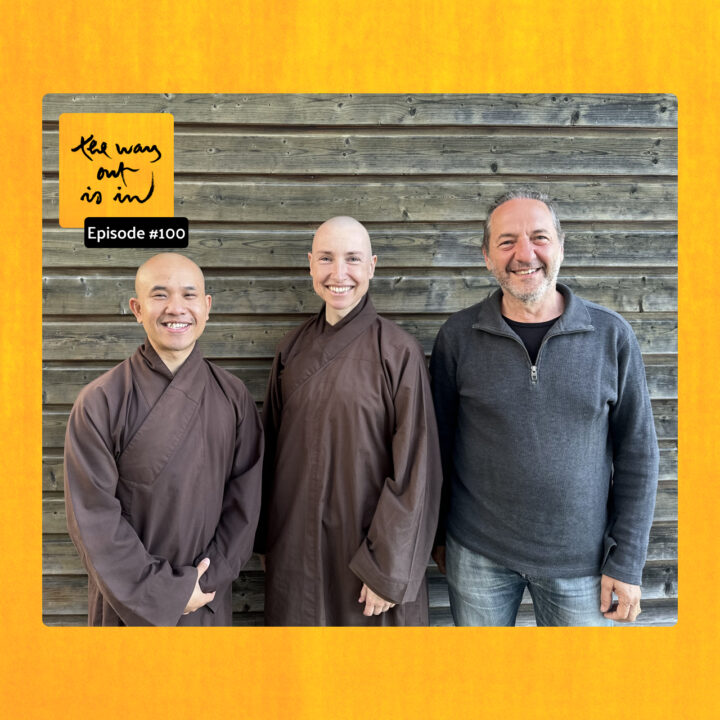






Welcome to a new episode of The Way Out Is In: The Zen Art of Living, a podcast series mirroring Zen Master Thich Nhat Hanh’s deep teachings of Buddhist philosophy: a simple yet profound methodology for dealing with our suffering, and for creating more happiness and joy in our lives.
In this installment, Zen Buddhist monk Brother Phap Huu and leadership coach/journalist Jo Confino are joined by Zen Buddhist nun Sister True Dedication to celebrate the legacy of Thich Nhat Hanh (Thay)’s teachings, and how they have impacted both them and the broader community.
This milestone instalment of the podcast – the 100th episode! – coincides with the centenary of Thich Nhat Hanh’s birth. As well as discussing the purpose of the podcast series, the contributors reflect upon Thay’s compassion, and commitment to relieving suffering – and the monastic tradition’s importance to the preservation and transmission of these teachings.
The discussion also takes in topics such as the evolution of Plum Village; the development of an online monastery, to make Plum Village’s teachings more accessible; and the need for ethical values and mindful living in the face of global crises, and Plum Village’s aim to be a community of resistance, embodying a way of life that is in harmony with the Earth and with each other. All this and: how has the podcast transformed the lives of its hosts?
Co-produced by the Plum Village App:
https://plumvillage.app/
And Global Optimism:
https://globaloptimism.com/
With support from the Thich Nhat Hanh Foundation:
https://thichnhathanhfoundation.org/
List of resources
Course: Zen and the Art of Saving the Planet
https://plumvillage.org/courses/zen-and-the-art-of-saving-the-planet
Interbeing
https://en.wikipedia.org/wiki/Interbeing
Plum Village Tradition
https://en.wikipedia.org/wiki/Plum_Village_Tradition
Linji
https://en.wikipedia.org/wiki/Linji_school
Sister True Dedication
https://plumvillage.org/people/dharma-teachers/sister-hien-nghiem
Bodhicitta
https://en.wikipedia.org/wiki/Bodhicitta
‘The Five Mindfulness Trainings’
https://plumvillage.org/mindfulness/the-5-mindfulness-trainings
‘The 14 Mindfulness Trainings’
https://plumvillage.org/mindfulness/the-14-mindfulness-trainings
Dharma Talk: ‘Redefining the Four Noble Truths’ https://plumvillage.org/library/dharma-talks/redefining-the-four-noble-truths
Zen and the Art of Saving the Planet
https://www.parallax.org/product/zen-and-the-art-of-saving-the-planet/
How To: ‘Begin Anew’
https://plumvillage.org/articles/begin-anew
Living Gems
https://plumvillage.org/gems/
Stephen Batchelor
https://stephenbatchelor.org/
Being with Busyness: Zen Ways to Transform Overwhelm and Burnout
https://www.parallax.org/product/being-with-busyness/
Calm in the Storm: Zen Ways to Cultivate Stability in an Anxious World
https://www.parallax.org/product/calm-in-the-storm/
Quotes
“What you [the hosts] give voice and humanity and friendship to is what a spiritual life being lived feels like, sounds like, looks like. You’re both wonderfully descriptive in how you talk about both your own spiritual lives, and seeking, and your own experiences – and those of the people around us, here, in the community.”
“Thay’s bodhicitta really sets him apart from many other leading spiritual figures, perhaps in that he was relentless in his creativity and his determination to relieve suffering and to find universal paths out of it. And something else that set him apart was that he didn’t offer the Buddha Dharma for Buddha Dharma’s sake: he wasn’t interested in the success of Buddhism per se; he wanted humanity to be a better species and he wanted human actions to not bring so much suffering to humans and to the planet.”
“Thay transcended even Zen and Buddhism. He was an extraordinary human who wanted to share and develop practices and ways of being in the world, through mindfulness, through the Five Mindfulness Trainings and the 14 Mindfulness Trainings: concrete ways that we can cultivate ourselves to be better humans – an unusual legacy for a Zen master.”
“Thay wanted every moment of his presence to manifest right action in the world. He wasn’t interested in small talk.”
“A monastic only retires when he transforms and lets go.”
“This is it. Stop searching, stop running.”
“A lotus will be a lotus. And a rose will be a rose. And a magnolia will be a magnolia. But if we try to be everything, then we’re going to be nothing. And then we don’t know how to nurture the lotus, because the lotus is very particular; it needs mud. A rose is very particular, too; it needs a different setting.”
“This is not an era of change, it’s a change of era.”
“The primary direction that Thay gave us was to be a community of simplicity, of peace, of awareness, and of embracing suffering. Be that community. Which, by the way, is a really tall order.”
“One of our first missions as monastics is to embody a way of living that is happy, harmonious, and different. And then to hold that light for future generations, outside of the rat race. A lot of monastic communities throughout history have emerged from this kind of intention: to not follow the path of getting a job, getting a mortgage, becoming householders, getting a pension, and being part of the machine. We step outside of that in order to cultivate different qualities.”
“The algorithms, the screens, the politics, the lobbies, the economics are all taking us towards the worst of human nature. So we have to be able to say, ‘Well, we’re going to stand for the better parts of human nature.’ And that’s going to be important: for us to lift up in the world, and to know that we have had ancestors, over the millennia, who were interested in cultivating non-violence, compassion, tolerance, inclusiveness, generosity, well-being, health. And we have to take our society in that direction and not give up on it. Because otherwise it becomes a dog-eat-dog world where we’re all scrambling over each other in a race to the bottom of the brainstem. So, one of our roles in Plum Village is to help people not give up on the ethical values that are needed now more than ever.”
“When people leave Plum Village, they don’t leave with nothing. They leave with the world. They leave for the path. And we’re there to support that through the sanghas, through all our online offerings. And here is a community that’s navigating this, evolving this, updating it, exploring it. The world passes through Plum Village, and, from that, we grow so much.”
“We’re a light in the world. So wherever there’s darkness, light is there. We just have to search for it, or stop, pause, and know that that light is there.”
Dear friends, if you have a deep love for the Earth and wish to learn how to bring the energy of mindfulness to your climate response, Zen and the Art of Saving the Planet is a seven-week online learning journey where we as a community will learn how to cultivate insight, compassion, community, and mindful action in service for our beloved Earth. Inspired by the timeless wisdom of Zen Master Thich Nhat Hanh, this course includes Dharma talks and practices, community sharing groups and live interactive events with monastic teachers. I'm looking forward to teaching at these live events together with my monastic siblings. We'll learn together for seven weeks from 1st of March, 2026 into our closing event on 19th of April. Join us by heading to the website today, plumvillage.org/ZASP, that is Z-A-S-P, and we look forward to walking on this path with you. Thank you very much.
Dear listeners, welcome to this latest episode of the podcast The Way Out Is In.
I am Jo Confino, a leadership coach working at the intersection of personal transformation and systems change.
And I am Brother Phap Huu, a Zen Buddhist monk, student of Zen Master Thich Nhat Hanh in the Plum Village tradition.
And today is a day of anniversaries because this is the hundredth episode of The Way Out Is In. Da da da da! And also it just so happens to coincide with the hundred birthday of Thich Nhat Hanh. So this would have been his hundredth year. And another celebration is that Sister True Dedication is back in the hut. And we have so many requests for Sister True Dedication to come in and it's very hard to entice her back, but today she has relented and joined us. Welcome, sister.
Thank you so much, I'm happy to be with you both.
The way out is in.
To celebrate, I brought a pack of 100% cocoa chocolate in a 100% recyclable box because I thought 100 and 100 and on the back, it says, happy planet, happy people. So I thought this was a perfect sort of way to celebrate this event. And then I opened it and tasted it and realized it tastes a bit like mud. And then Brother Phap Huu reminded me that actually we had some four or five years ago and had exactly the same response. So I've learned absolutely nothing. So Brother Phap Huu, 100 episodes. That's like 160 hours of your voice in people's ears. How does that feel?
Um, everybody has options. You don't have to listen to this podcast if you don't like it. No, it's… It has been incredible how far we have come with this podcast and it is incredible to know the community that has been forming thanks to the podcast. It feels like we have the way out is in family.
Yeah. And there's so many people who come to Plum Village now because they've heard the podcast. And it's such a wonderful Dharma door, as they say in Plum Village, a way of bringing these teachings into the world. Sister True Dedication, why are we doing this? Why are Brother Phap Huu and I coming? What's the purpose of what we're doing?
You mean, the purpose of having the podcast?
Yeah, what's your impression of it?
Well what I feel you both give voice and humanity and friendship to is yeah, what a spiritual life being lived feels like, sounds like, looks like. I feel your both wonderfully descriptive in how you talk about both your own spiritual lives and seeking and your own experiences and then those of the people around us, here, in the community, and I feel yeah, we're just along for some good crack, you know? I mean, we're just here for, I think, to enjoy listening to you both talk about the practices, the teachings, Thay, our community, and helping us, yeah, just get a really human down-to-earth tea house, coffee house take on it. That's what I feel you both offer, and with such calm and depth and richness and I know that for many people, this is a soundtrack to their lives, whether it's on their walking the dog or doing exercise or their commute or maybe washing up and cleaning the house. I don't know, I think you guys are everywhere. And I think it's just a beautiful way for mindfulness and a mindful community to be a way of life and not something that people do to get done and then move on to the next thing. I feel this is you cover such a rounded range of topics. And we love it when you laugh. We love it when you laugh.
Oh, no, we're not going to laugh.
… looked really serious then when I said that.
And one of the things, if we were starting this again, and Paz came up with this phrase about Brother Phap Huu that he's a Dharma jukebox.
Which you can pop a coin in and you can press any button and Phap Huu just… this lyrical prose just flows out of him. And brother, what is that about you? How is it because we do not plan any of our conversations. We don't script anything. We sometimes just come up with the idea. We haven't discussed this episode, what we're going to talk about. How are you able to touch into these teachings in a way that just, I can throw anything at you, and you just flow with it? What is it about you that allows you to touch this place? And also sometimes, and not always, but sometimes you like go into the groove. You know, you go into a place where sort of, Phap Huu sort of disappears, and the sort of teaching sort of comes center stage. What's going on, brother? He's getting all shy.
Well, I'm trying to put into words, in my mind. I think the first thing I can always come to is my breathing when I don't know what to say. Just trust the breath. Don't stay in the realm of the mind. And when I listen to you, Jo, I'm listening also with a curiosity, like what I would tell the younger me who is eager to understand what the practice is and what a community is. And, on top of that, I've been in Plum Village now for 25 years. So a lot I have soaked in through the years and Plum Village in our way of training, it is very much direct experience. So everything I've heard, everything I have seen, everything I felt like the fruit of practice are also, a lot of it belongs to the community, and some of it I've tasted with my own breath, my own step, with my understanding. I would say I really enter into the non-Phap Huu state, no self, and that is all the wisdom that this tradition has accumulated and transmitted and cultivated. I just see myself as a foundation to lay it so people can see it. And I think I'm a very simple person, so I try to speak very simply so that everybody can understand and so I can understand myself what I'm trying to say. And a lot of it is also just store consciousness, like just allowing the store consciousness to review itself because my consciousness really is the Sangha's consciousness because I've lived more than half of my life in this monastery, with this bald head and this brown robe.
Thank you, brother, and it's very interesting because I describe myself as a simple person because I'm not an intellectual. I'm no sophisticated. I sort of, I need to understand something at its most simple level, and I think that is what most attracted me to Thay's tradition, to Plum Village, was because Thay brought these very complex, difficult sometimes to understand ideas and brought them to a level that even I could understand. So I think maybe that's part of the secret source of these episodes, that it helps, we can only talk about what we know or what we've understood or what we're learning. But before we get into Thay's life, I want to water the seeds of Sister True Dedication. Because one of the traditions of Plum Village is to water people's positive seeds and to recognize the beauty in people because often people aren't given necessarily the feedback they deserve or… So, Sister TD, you're our most regular contributor outside of just the two of us. And one of the things I love, and Phap Huu and I always laugh about this, when you're here, we just sort of sit back and cruise, we go into cruise control because we know that you're gonna handle it, you know that, you know, yes, Brother Phap Huu can handle whatever I throw at him, but you're also at another level. You know, it's like sometimes you just sort of, I don't know, you just are able to bring the Dharma in such a pure form and in a way that people feel very inspired by you. And I speak to quite a lot of people, and they often refer to you and your inspiration, and they refer to talks you've given and things you've said. And it's quite amazing. And many of our listeners, well, most of our listeners will not know just how much you do for this community. You know, in so many forms, and not to go into the detail of it, but you are a sort of an absolute pillar of this community and the fact that you are a pillar of the community and are able to share the teaching so beautifully is quite extraordinary. But Brother Phap Huu, anything you want to add? Because I know there's nothing more painful than to be told how wonderful you are.
No, I agree with everything you said, Jo, and I think just a wonderful continuation of our teacher.
So that is a great segue. So this is also the year of the 100th year of Thay's life if he was still living, he'd have been living 100 years. And it's a cause of great celebration because it also shows how wonderfully this community continues. So Thay passed away, I think four years ago now, but his continuation is this extraordinary community. But before we get to that, I'd really like to ask both of you, what is it that made Thay a great Zen master? Because what actually, what was it in particular? Because there are many monastics in the world, but there are not many who reach a place of just this extraordinary ability to be present for life, to be compassionate, to want the best for everyone, to hold spaces, to, in every fiber of his being, be the person that the teachings are also, as my wife Paz always said you couldn't put a cigarette paper between what Thay said and who Thay was. You could really trust him completely. And I felt because I could trust Thay, I could trust the Dharma, and because I could trust the Dharma, I can trust Thay, and that he allowed me to fully flow into the teachings. But you two spent many years with Thay, had this extraordinary front row seat to his life. So Sister True Dedication, what is it about Thay that… What was the essence of Thay that allowed him to create and have this enormous influence in the world?
Well, it's clear that Thay had an extraordinary bodhichitta, that mind of love, that wish to serve. Because as well as his freedom, his awakening, his peace, and his wonder being alive, he could have chosen to live in a hut on a mountain, right? And enjoy his ease and awakening. But he had such a wish to relieve suffering. And I find that really extraordinary in him that he never gave up on using every day, every minute, every moment to relieve suffering in all of its dimensions, including by modeling a way of being while relieving suffering. So I think Thay's bodhicitta really sets him apart from many, many other leading spiritual figures perhaps in that he was relentless in his creativity and his determination to relieve suffering and to find universal paths out of suffering. And I think that's also something that sets him apart which is that he didn't just offer the Buddha Dharma for Buddha Dharma's sake, kind of thing, he wasn't interested in the success of Buddhism per se, he wanted humanity to be a better species and he wanted human actions to not bring so much suffering to other humans and to the planet. And that's one of Thay's, I think, most extraordinary insights is that we should be ready to let go of all our views and all our attachments, even our views, and attachments to Buddhism. And so he transcended even Zen and Buddhism and it was just I think an extraordinary human who wanted to share and develop practices and ways of being in the world through mindfulness, through the five mindfulness trainings, the 14 mindfulness trainings, very concrete ways that humans could cultivate ourselves to be better humans and I think that really is quite an unusual legacy for a Zen master. And in terms of Thay's person, I think what I always found so extraordinary about Thay when I was in his presence, when we were sitting drinking tea, learning and studying with him or taking action with him, Thay was so much his own person. He was such a free spirit. He was so unshakably himself. He had totally broken through, broken free from any kind of people pleasing. And I remember Thay saying once that the smile of mindfulness, so you often hear in many of his teachings or even the Plum Village songs, the importance of smiling. And in quite a few talks, he would really say, it is not a diplomatic smile. This is not a fake smile. This is a smile to make other people happy. It's a smile of freedom. It's the smile at ease. It's smile between you, yourself and the world, like the cosmos. And I think Thay had that incredible freedom from not wanting to please anyone. And he was so much his own person. And like in terms of, I mean, he was an extremely polite and humble person, but he wasn't, he would walk only at his own pace. He would enter every room on his own terms, like he would encounter all these extraordinary, sometimes influential, powerful, and famous people, but as himself. Like he never yielded, he never gave ground. And for me, that was his Zen master part. That was his total freedom. He had broken free from this social mores pantomime, and he just was a straight, serious, no messing around, human who was in the business of relieving suffering and in the business of helping humans be better humans. And that just fascinated me. And it was really interesting because I often, you know, you might want, oh, you want approval from your teacher or you want him to sort of chuckle or be happy or you wanna make him smile or all these kinds of things. You could never do that to Thay. You can never elicit a little kind of reaction from him. Like, and I remember right until the end, even after his stroke, when I visited him in Hue, and he just kind of, the looks he was giving me, it was like, go forth, my child, come on, what are you doing sitting around next to my wheelchair for? Like, off you go, come one, you know. He's like this sort of huge mountain glacier, like, just go and get on with it. And it was, it's not, yeah, like he wasn't interested in just sitting around and doing nothing, which sounds completely ironic, right? Thay wanted every moment of his presence to be manifesting right action in the world. And he wasn't interested in the small talk.
Hmm, beautiful. Thank you, sister. And brother, so you talked earlier about being simple and I talked about this being simple and some people have said, you know, Thay's teachings are too simplistic. And I find that very hard to digest because from my perspective, he's made them so accessible and it's like he's taken all this complexity and brought it down to the essence and then shares it in a way that is so, that can just enter my system so easily. So what is it about Thay that, because he could have just studied sutras and given very complex treaties and translations, but he chose to sort of speak to people's hearts. Can you tell us more about that?
I think that is one of the greatest gifts that he has given to me personally and then to so many of friends and folks who have had the chance to read his book or be in touch with his Dharma talk or come to a retreat. Because I can just say outright, I wouldn't even be a monk if it wasn't for Thay. Buddhism was never in my priority list in my childhood of like, oh, Buddhism so cool. Buddhism was not cool. Like only when I came to a retreat, when I was like, whoa, this is, this is something very profound. And in my own experience, we all seek understanding. Like it's just something that we want to be able to grasp. When I heard him speak, even though I didn't understand the depths of it, but his tone and his way of just showing up, it wasn't colorful. It wasn't like he didn't need like a stage with like thousands of flowers and an altar behind him, a big Buddha behind him. He just wanted to show up as a simple person. And that for me is something that he goes back into the ancestors looking at the Buddha, how simple the Buddha was. And of course, Buddhism has so many different branches in this religion and in the schools of Buddhism, and all of it has its purpose. And some of it has become quite a performative way of showing up as a tradition. Not saying that form is not important, form is super important in some of rituals. And I think that some of us humans in the 21st century were so alienated from spirituality because we have become allergic to rituals, which I think some of the rituals need to be brought back in the way of being because there are wisdom in respect and in how to honor a space and so on and so forth. But what Thay was doing what I felt for Buddhism as a whole was to go way back to how the Buddha taught. And in all of the Buddha Sutra, the Buddha has always said, my teachings is to understand suffering and to be free from suffering and to transform suffering. That is the core of the teachings, the essence of it. And to understand that layer, that means to understand what is happiness, to understand what is peace, to understand and what is wellbeing. And Thay on a level of teaching, it seems simple because he himself has been able to transform and therefore what he says it's spelled out because Thay is like, there's no myth to this. This is what you do and this is what you can do. Like one of the power I feel of when I listen to him is he gives us the agency of like, if you put these practices into your daily life, like you authentically do it, you won't be a same person. You will be a different person. What I have seen through my own self is, sometimes I don't want to practice. I want there to be a Thay. I want them to be giants where they will do all the work and we can just suffer and we can just follow our habits of consuming, of like being pitied, but like all of these little suffering that we are attached to, because there's a giant there who is doing all the work. And when I look back at his writings, his teaching, he keeps telling us, you do it. You can breathe, you can transform. You are the future of today, right? It's like what you're searching for is in the very here and now. I've also encountered, you know, the accusation of like, oh, Plum Village teaching is not deep enough. I don't even want to argue, I just smile, because if that's what you think it is, sure, so be it. But that doesn't even carry the wisdom of Buddhism, which is openness. You have to be curious, like, why is it, why is smiling important? Like what Sister True Dedication just spoke about. Why does Thay come back to the 16 exercises of mindful breathing as our bread and butter of our day-to-day practice? So, Thay, when I was with Thay, what I knew, he was always aware of his impermanence. Because he was growing older, so every day cannot be a day wasted. And so the teachings that he's giving to us are the teachings will transform you, that will be a foundation for your spiritual life. And it doesn't mean that's it, but he's given us the greatest foundation that a teacher can offer to a student. And he used to tell me that, you know, the teachings I offer are things that I have put into my own practice, for years before I actually share it. So in a way, he's done all the homework. And living in this community, which we are not perfect, you know, it's only been four years since our teacher's passing. Like we, most people know Thay as when he is awakened in a ways. He's free, like Sister True Dedication has shared, he is so well versed in his teaching. He knows how to enter that freedom of not pleasing people. He can cut through, and that's gonna take us time to really hone that muscle in us and to have our own understanding, to be unapologetically a mindfulness practitioner or a Buddhist, you know? And what he kept telling us, to his students, that were not pleased with even being in Plum Village, there were, so many… Every year we have monks and nuns and lay people who leave the community, change tradition. And it's a part of life. It's like the stream that just flows and I hope that all the rivers go to the ocean. But I remember one time a monastic who wanted to leave our tradition to go to another tradition. And as a teacher, sometimes you give up. There's not much you can do. And you can't force someone to stay if they wanna leave. But I remembered Thay, it's like his last plea. And it really touched my heart and he said, if I was a younger monk and I had a teacher like me speaking towards himself, he wouldn't have to waste all of his youth searching for a Dharma that he can apply every day that will know that it will bear fruit of understanding and wellbeing. And he's like, you don't think that that this is an institution or like a university because this monastic was looking for a university setting, Thay said, what are you going to do with that diploma? As a monastic, what do you can do with a piece of paper? Our highest career is the understanding of suffering. And that is very deep because every present moment is a different suffering. Every era, every year that we enter into, it's going to be a new year that we're meeting and we're gonna have to encounter new sufferings that we have to deepen our practice to find a way in and a way through. It sounds simple, but it's never done, meaning that our practice doesn't have an end. Like even Thay said, a monastic doesn't ever retire. A monastic only retires when he transformed and let go. And even then, does he retire? Thay said, no, we just keep continuing. We continue through the next generation and through all of the actions that we have left behind. This idea even of simplicity, I actually want to challenge it like, is our Dharma simple? And I've met some of the most sophisticated person who I think is very intellectually knowledgeable, has a lot of diploma, but can't sit still. Can't show up in a way that let's go of his or her or their view and just listens with an open heart. So simplicity, I actually think, is a very difficult practice. And it is a, I feel personally, it's a cultivation that we need more in our times because life is so complicated already. So why does spirituality, why does the teaching of mindfulness have to be even more complex than that? And I think it's one of our human mindsets, it's like the grass is going to be greener somewhere else. And we always are in search, you know, we are a species of never enough. We are a specie of like wanting more, like our craving, the level of craving in humans is just unmeasurable, and that's why we're such victims of habits. We're such victims of consumerism, of simplicity. We're a victim of that even because we don't know what is enough. We don't know this is it. You know, there's this calligraphy that he likes to write. It's like, this is it. Stop searching, stop running. And I just listened to… I just listen to a video of Thay this morning. And I saw a very young Sister True Dedication in 2006 and asking Thay about mindful eating, and there was another question, and the question asked Thay, like, what is different about our tradition, compared to other traditions? Should we learn from other traditions? Should we do this dance and try to be every tradition? And Thay just, his answer was so simple. He's like, a lotus should be a lotus. And a rose will be a rose. And a magnolia will be magnolia. But if we're gonna try to do everything, then we're going to be nothing. And then we don't know how to nurture the lotus because the lotus is very particular. It needs mud. A rose is very particularly. It needs a different kind of setting. An orchid doesn't need as much soil, right? So like every, every tradition, every way of being, we have to just also understand like, this is who I am. This is my tradition. And I'm gonna be in this tradition wholeheartedly. And I think this Plum Village has become a tradition of one of the branches of Buddhism. It's very young, we're only 40-something years, but it has already grown so many new gardens in different continents. We don't have a practice center everywhere yet, but we have sanghas in every continent. And I'm just so grateful that a master and a human being like Thay, like what made him who he was is all the causes and conditions, right? It's the suffering. It is the… It is the bodhicitta. It is also the ancestors. Like Thay always gives honors to his ancestors. He always told me like, Phap Huu, is the ancestors, I'm fortunate. He always says, I'm lucky. Because there are brothers and there are teachers that were in his era who were also very great, but they weren't lucky to survive the war or they weren't lucky to survived as a monastic. Many of that era of monks and nuns during the Vietnam War, many of them died during the war. Many of them disrobed after the war, many of them got mental illness because of the crisis, because of the trauma. And so Thay always considered himself lucky, and therefore he never took a moment for granted in life. And I think that was one of the luck, I guess, I would say for us who had a chance just to sit beside him, that you're sitting with someone who is so free, is because they have known what is destruction and what is lost. And so therefore, every moment is such a gift. Thay once said this, and it's very helpful because he said, even if you clone me, even if you clone Thay, that person will not be Thay, because that person hasn't gone through two wars, hasn't lost students, hasn't lost his community, hasn't been betrayed, hasn't been labeled as a traitor, hasn't been exiled from his own country, hasn't found himself in the West as a cell in a body that is very unfamiliar and then have to go through all of these challenges, that person would never become Thay. So who Thay is also the numerous conditions, causes and conditions through history, through his history that has allowed him to be who he.
Brother, thank you so much, and you talk about his focus, and I remember once when I interviewed him, I said, Thay, there's so much pain and suffering in the world, you know, how do you deal with it if you can't, if you want to help, but you can't do everything? He said, well, Jo, I've learned to do one or two things really well, and then I trust that other people will do what they need to do. And I said well, what have you learned to do, Thay? And he said, I learned to sit and to walk. And at the time, I was very young to practice and I thought, yeah, right, whatever. You know, like, you've learned to sit and walk, you know, great. But of course, on reflection, you realize the whole basis of everything Thay did was the quality of his sitting and walking because that was the foundation on which he was able to build all his teachings and et cetera, et cetera. Sister TD, I want to come back to, because we're going to talk about the, you know, what since Thay is passing the legacy and the future, but I want you to stay in a little bit of history and personal history. So you were at Cambridge, you were then at the BBC, you were leading what, you know, often people would call, you might say, was a very sort of, sort of strict, sort of intellectual sort of standard path. And then you touched Thay and became a monastic. And I'm just wondering if you can remember the first moment where you saw Thay, listened to Thay teaching and what you noticed or what impact it had on you in that moment that sort of helped you to see maybe another way of showing up in your life.
Just a small question there.
I always ask small questions, it's my skill.
So I'd like to talk about a moment that I really vividly remember in a Dharma talk. Actually it was in 2006 and it was August 2006 and that would be 20 years ago now, deep history. And I had already taken a break so I took this sabbatical from the BBC in order to be able to have more time in Plum Village and just that spring they tried to offer me a promotion, like, come back and confirm you're coming back. And if you do, you'll get this promotion. And they say, we need your reply in two weeks. And I had said no, because I just couldn't bear to leave Plum Village. So I was in Plum Village at that time. And from where I was standing in Plum Village, I just thought, go back into that toxic environment of the newsroom, which was intellectually stimulating. You feel like you're at the center of the universe cause it was in Westminster, which if you're British can feel the center of things, I don't know if it does anymore. And so in that summer, I wasn't sure what I would do with my life. And then in this Dharma talk, I'd come late because I was a volunteer and I'd been cleaning something and I had come late into the Dharma hall and I was sitting on a bench at the back. So in the Assembly of Stars, the large meditation hall of Lower Hamlet, there's no more sitting space on chairs. So I was on a bench right at the back. And I was like, okay, but I'm going to be a good person, I'm gonna show up for this Dharma Talk. So I was a little bit like not sure what was going on, you know sometimes in your life you're not able to show up for each moment fully and so I sort of half-hearted but I showed up and there I was right at the back on this bench with my back against the glass. And I noticed this like, yeah, yeah attitude in me. And you know, and because this was then maybe my, no, by this point I've now spent nine months in Plum Village and I've been on many different retreats. And I was just like, yeah. And then suddenly from my still consciousness was. Yeah, but what if Thay is the real deal? And I realized that I hadn't let myself consider the possibility that Thay was the real deal. So as soon as I was like, yeah, but what if this is the real deal? And here you are sitting half-heartedly at the back when a legend is teaching. And then I was like, but I think I know he's the real deal. And Thay's talking, and I'm sure saying something very deep and profound. And then I was really reflecting on the years. So I'd then been coming to Plum Village for four years and all of the experience I'd had in the community. And I hadn't seen a single second where I thought Thay wasn't the real deal. I had no evidence to suggest he wasn't the real deal, that he was living what he was teaching and preaching. He was embodying it. He was a man of virtue, of humility, simplicity, warmth, humanity, compassion, all the rest of it. And then I was like, but if he's the real deal. There's nothing else. If he's the real deal, you… you… You'd give up everything in your life in order to learn from this real deal. And so that was my first moment when I gave myself permission to kind of open up the crack of the rocks of my being and realize that it would be possible to give myself fully to this path and this learning. And I don't know what are the words for it. It is, if you find the magic water at the magic waterfall, you just go there and drink and you sit under the waterfall and you soak yourself in the waterfall. And for me it was, why would I do anything else, but be next to the wisest human on the planet? That was my experience at that time. The wisest, most virtuous human on that planet. Why would I do anything else? And it absolutely shook me to the core, like shook me the core. I think it must have been one of the last Dharma talks. Once I got back to where I was living the next day, I was sobbing my eyes out, because I just suddenly realized that I had found what I was looking for, but I'd somehow been in denial to myself. And I can't remember what your question was now. What was your question, Jo?
My question was really that, was what was the moment that Thay touched you and what impact did it have? So the essence of what is it that you spotted?
What it was, I felt, I just want to say he's a person of light and integrity. That's, I have found light and I found integrity in human form and I just want to learn that thing for my own healing, for the healing of my ancestors, for the healing of my country, for healing my friends. That's what I want not a drop of it to be lost and wasted. And I love the fact that it came to me when I was least expecting it, when I was most kind of sloppy in myself. And it was, yeah, it caught me unawares, but it was so clear, like it was abundantly clear. And I remember after then ordaining and then I'm in the monastery and I'm a novice. I remember these feelings of my own wish then to share Thay with others. We would have some days when there might only be 60 people in the Dharma hall listening to him give a live teaching or a Q&A. And I remember thinking. This can't be the case, this can't the case. I've got to like shout to the high heavens, people, there's this really cool human doing these really cool teachings. And it gave me a lot of motivation to try and help with the website and the social media and all these things. Because I just, I felt like it was our responsibility, those of us who had found Thay, like how can we share him with the world? So that also came pretty close after that, because there was that sense of such total faith and conviction, which I still have. Especially after having studied his life in more detail and worked on his biography and things like that, that there is only extraordinary happenings in his life and how he came through them, the courage and the relentless not giving up in the face of adversity and obstacles. It's just extraordinary. And the rest of us are just trying to catch up. Catch up. A long, long way behind.
So, Brother Phap Huu, just coming to that. So one of the things that Thay felt very important to teach was that the Buddha was not a deity, the Buddha was not a god, the Buddha was a human being. And so just bringing that to Thay. So, you know, we also don't want Thay to be seen as a sort of deity that he sort of was perfect in every way. So can you tell us a bit about Thay angry?
Barely see it. And if he is, you don't know.
But, you know, because Thay, as you say, Sister True Dedication, he had this extraordinary integrity, but you were very close to him through very difficult circumstances, which were very painful to him. It's not that he was always floating on a cloud. He was deep in his own pain sometimes.
Yeah, I think a big source of his pain is his own community.
He's been angry with us.
He was angry with me, yeah. He used to say, don't make Thay spit fire. That means like he will have to be a little bit more harsh and critical with us. But he was, there is time when the Zen master has to shout, when the Zen master has to, in the Linji tradition, which we are part of the tradition to give the Linji stick, meaning to realign all of us. You young novices and bhikshus and bhikshunis, like wake up, you're wasting your youth. So there were moments like he would say like, we are literally wasting our youth. We are not seeing the importance of our roles and our responsibilities. I think one of the human side that, when I saw him disappointed in us, he always had to come back to practice acceptance that we're young, we are human beings, we all have our suffering and our difficulties. But when I met him, I think he has already overcome like so much of the first communities that he's developed from Vietnam and then later in the West, which a few communities I don't think were successful. Some of his students that he had in the earlier days left him, didn't continue to be his students. And do we consider that a success or not? You know, give or take, we can measure it however we like, but the growth of a teacher needed to take place, meaning the way that he shares, the way he is with us, the way the he guides us, was an evolution of a very human being, like knowing that, ooh, that teaching doesn't work that way. Oh, my students, they're too stubborn and too smart now. I have to teach a different way. Like, when I first came in, we didn't have so much sangha-building structure. And then later on, shining light as a practice was really developed. How do we support each other on our path? How do share about our critiques to another, but in a very truthful and loving way? It's not coming from hate. It is coming from, you're my sibling now. Like we're gonna live together. I want you to see your weaknesses. Because your suffering is my suffering and your happiness is my happiness. So a lot of Dharma doors, as we would say it in our tradition, new Dharma doors were invented to build the cells for a healthy body. Every time that there was a shortcoming in the community, Thay would see it as an opportunity, like how do we find a way to develop it into our strength, for example. So that just shows that we weren't perfect, right? Like there was lot of moments like our meetings weren't very successful, they led to more suffering and that became a deep concern of Thay. He would do his own homework and study. It's like, how do we make meetings more engaging as well as the outcome will lead to more wellbeing and joy and happiness in the community. And so therefore he knew, okay, there's a step to that. Everybody needs to learn to speak. Everybody needs learn to open their hearts. Everybody needs to learn to listen so that happiness meeting was really developed and then Dharma sharing continues to be evolved. It used to be called Dharma discussion and then we changed it to Dharma sharing so there's an evolution in also our mechanism as a community. I've been there when he was sad, and… You be with your sadness, that's what you do. You don't bypass it. But his way of being with his sadness, which I would say is a masterful Zen master is he doesn't leak that onto us. He doesn't make it my responsibility as his student and as his attendant to then change that for him. Right? Like I never felt like this is my suffering and here you take care of it. As most of us, I think we do that. It's like, this is my difficulty. This is my challenges. And then I want everybody to suffer with me. But I think what I saw was like Thay's own ability of holding onto that with such tenderness and such care and to transform it and to move on forward. And I remember there was a moment in our community where a lot of our siblings were all disrobing and there was like a real shadow and a real discomfort in the community like, are we doing something wrong? And everybody was judging each other. There's a lot of critiques and it was like a slump we were in. And I just remember him calling us and he said, move on now. It's okay. You have siblings that left, but you're still here. Like, what is this? What is this like being in this slump? Like accept it and we move forward. And I think that has always been his journey in life. Like sometimes there was no time to even grieve in his setting, but he always found the grieving in the action. I think that for me has always been very powerful, like meditation or taking care of suffering, it doesn't mean you stop everything and then to be in suffering and then, then you transform, then you continue with life. It's more like the journey continues and you can continue to take care of the ill-being as you are taking care of the wellbeing, you're interbeing the mud and the lotuses at the same time. So one characteristic as a very human teacher was a few times he was disappointed and he said a few strong words and some of the students became very afraid of him. And he was very careful and he was first skillful and he would come around and he would ask them how they're doing. And I just remember one of my brothers who was with me and we were both, we did something that was that really saddened Thay. And he, he said, he can't trust us if we, if we… And that's a big deal, right? He's like, I wish, I was yelled at and said like, how could I trust you guys? If the simplest thing you go behind my back and you do things that I didn't ask to be done. And I was so young, so I was kind of like, ah, okay, yeah, we all make mistakes, but my older brother was like… Like that was such a heavy blow to him and he couldn't eat for a few days and his sleep was also very disturbed by his shortcoming. And I just remember Thay so skillfully, he gives space, he didn't come right away to try to fix it. Like two or three days and he came up and he asked the brothers, like, very simple, how are you doing? And the brother said, Oh, Thay. I can't, I haven't been digesting well, I haven't been sleeping well. And Thay just said, me too. I haven't been eating well, I haven't been sleeping well too. And it just shows that it's painful for the teacher also when there is suffering, it's not like it's out of him, you know, like he's so connected to this community, to his students. And I remember hearing him say that, and that wasn't a people-pleasing, like I really know, like, Thay was suffering together with us as we have made a mistake.
Thank you for sharing, brother. Sister, I just want to sort of place Thay and Plum Village in this moment of time because we've entered a polycrisis, this interconnected series of crises of climate change and biodiversity loss and inequality and polarization and the collapse of institutions we've relied on, et cetera, et cetera, and there's a lot of despair in the world. And I sometimes think of sort of Plum Village as a sort of point of light in a dark sky, that of course, if Plum Village disappeared tomorrow, then the world would go on, but something very essential would be lost. And you've been doing a lot of work around climate, you co-wrote Zen and the Art of Saving the Planet and you have created this course where hundreds and hundreds of people each time take part in it. There's a real thirst for these teachings at the moment. And I'm just wondering if you can sort of place Thay's teachings in this, in this moment. People are saying this is not an era of change, it's a change of era. And what is, what is in a sense, how can Plum Village and the teachings come in to support these very difficult times?
I think our main role is to be a community of resistance. A lived residential, simple, happy community of resistance to the mainstream direction, whatever that means. And some people might say, oh, but that's not enough. We want you in the streets. We want your occupying forests that are being cut down, climbing the trees. We want you walking thousands of miles across the continent to make your point that you stand for peace. And the primary meridian, the primary direction that Thay gave us was be a community of simplicity, of peace, of awareness, and of embracing suffering. Be that community. Which by the way, is already a really tall order. And what that means for us is we are hundreds of people here in the countryside. In our high season, we go up to well over a thousand people and we live our hours and our days with an energy of mindfulness, an energy of siblinghood, of fraternity, of solidarity. We live lightly on the Earth as ecological, organic, vegan as possible, no toxins, no alcohol. We look deeply and step outside of the rat race in order to have a fresh perspective on it. And I think that distance from the world is really important to cultivate a fresh outlook and to not feel that everything, that inertia and that momentum of everything is so unstoppable. You can cut up your credit cards. You can give up all your possessions, you can come and live in the countryside and be a real human. And I swear the world does look differently from, the world does look different from here. It just does, because we're not in the system as much. So I think that's one of our first missions is to embody a way of living that is happy, harmonious and different. And then to hold that light for future generations. Outside of the rat race. And I think that is, as monastic communities throughout history, I think a lot of them have emerged from this kind of intention, that we will not follow that path of becoming householders, getting a job, getting a mortgage, getting a pension, getting an.. and being in the machine. We step outside of that in order to cultivate different kinds of qualities. And so actually, you asked me about Plum Village in general, and now I'm answering about the monastery itself. And I guess for Brother Phap Huu and I, like we give our blood and soul day and night to take care of this monastic community as one of Thay's greatest legacies, which is how can we have a monastic community that can survive for seven generations? And that's what we're really day and nights investing our energy and time into. And then it is that that monastic community that is then the refuge for everyone who can then come and take sanctuary here to be able to step outside whether it's for a week or three months or a year to be allowed to step outside and get, share this perspective with us where we can have a different take on these different crises that are happening. And all the crises are human crises, and if we don't understand human nature, we won't be able to get to the bottom of those crises. Where is the rampant consumerism coming that is fueling all of this wild economic imperialistic, extractive, exploitative behavior by nations and corporations? That's a human nature problem. And here we are studying what it means to understand our own human nature and how humans are. How do we transform greed and craving? How do transform habits? How do you transform the tendency to hide ourselves in consumerism? We are learning that at a individual, personal, human communal scale here in Plum Village and that is helping us have courage to speak to the problems in the world because we see it clearly. Difference of culture, language, beliefs, views, creed and how that leads to violence, to discrimination, to destruction, to oppression. We're seeing it on a small scale here and that helps us be able to speak to a path of non-violence in the world. So in terms of what is our role in this moment, I think our role is to continue to be a community that embodies a different way of living and being an doing. And it's really hard. I also want to say that it's really hard and the world also creeps into Plum Village. I mean, it's not like we're like out. It's not in many respects when outside of the world, we are also taking refuge in society because we depend upon society also to have the resources to be able to continue to operate. So there's still an interbeing between us and society. But that distance I think is really, really healthy. And that's what makes it… I think it is the distance that can give us a different perspective. And we need some really radically different perspectives. And I think now more than ever, the world needs those perspectives from indigenous communities, from communities whose voices haven't been heard. You know, we've been hearing only these dominant, often white male Global North voices for far too long. And that's exactly what's got us into this mess. And we need to create space to learn more from these other ways of seeing the world, other values. And I do feel when it comes to values and ethics, we have such a strong ethical code in Plum Village, not just the monastic code, but the code of the 14 mindfulness trainings and the five mindfulness trainings. And we're living in a world when we open our screens every day where that code is just being ridden roughshod over by global leaders, by imperialistic powers, by economic powers, by those who already have far too much. And I grew up in a young generation which was on the back then of the generation before us, which is the end of the 20th century tearing up. Let's tear up all these books of codes of conduct. Let's kind of be free. Let's experiment. Let's break free from the old. But I can see that in the years and decades to come, we will need a young generation that has moral courage, that has a moral code of the kind of humans we wanna be in the world, how we wanna relate to other humans, how we want to relate to others species, how we to relate our more than living world. Like, we need to have that courage to say there are things that it's okay to do and things it's not okay to. And we need to be able to stand firm on that. And it will need to ever updated and so on. But I think that moral clarity will be an important role for Plum Village to play and to be able to provide these contemporary codes of ethical conduct that bring out the best of human nature and not the worst. Because right now, the algorithms, the technology, the screens, the politics, the lobbies, the economics is all taking us towards the worst of human nature. And we have to be able to say, well, we're gonna stand for the better parts of human nature. And that's what I think it's gonna be important for us to lift up in the world and to know that we have had ancestors over centuries and millennia who were interested in cultivating non-violence, compassion, tolerance, inclusiveness, generosity, well-being, health. And we have to take our society in that direction and not give up on it. Because otherwise it just becomes a dog-eat-dog world and we're all scrambling over each other to the race to the bottom of the brain stem. So I think Plum Village will, one of our roles is to help people not give up on the ethical values that are needed more than ever.
Thank you, sister. And I just want to take that on one more step. So, for example, I was coaching a young woman this morning who had come to Plum Village once and she'd gone through this extraordinary transformation, you know, just recognizing that she was seeing life through a very narrow prism and sort of, in a sense, Plum Village, as it does, it shattered that prism and opened up a whole new vista. And of course, like many people who come to Plum Village, she goes back into the world and and finds it very difficult firstly to maintain the practices that she knows are helpful to her. So she comes back saying, I would really like to be able to do this more. I really like that more. I'd really like to be present more. I'd like to slow down. And then as you say, people get shredded back into the machine. I'm just wondering how Plum Village, in a sense, can support people in the long run, because it's very easy to come and have this deep experience, but unless it's held or curated or nurtured, then people can often get sort of sidelined or dissipate, dissipates over time. So I'm just wondering how Plum Village and the teachings can support to continue to develop this understanding. And what was really interesting is the thirst for it. So this particular person I was coaching was saying, you know, I came back and people have seen I'm different. Said my partner has seen me different and is really interested and my friends are really interested. So it's like there's this enormous thirst for these teachings, but also a difficulty in just holding onto them. It's like sand running through fingers. They grab hold of it, but then it seems to disappear.
So when folks leave Plum Village, we make sure that in any week that anyone spends in Plum Village, they have a chance to encounter the five mindfulness trainings. And that is Thay's gift to the world. And so people are getting on the train, getting back on the plane, going home, with this code of ethical conduct of the five mindfulness trainings. And from my own experience of going back out into the world after my first retreat with the five mindfulness trainings, that is already enough to be our teacher, day in, day out. These five principles of non-violence and non-attachment to views, of generosity with our time, energy, and material resources, that's the second, our respect for people's commitments and to have sexual relationships that don't harm. And the fourth is to be able to practice deep listening, right speech, and to handle our anger. And the fifth is to be able to have a way of consuming that is more awakened. And that's a whole journey for each one of us. Every single product kind, you know, what you put in your ears, what you're putting in your mouth, what you watch, what you read, like you slowly awaken to the effect of all of these things on your consciousness. And that is a daily journey. And in Buddhism and in Zen, we say the mindfulness trainings are your teacher. So that is that ethical kind of code of conduct, that ethical mirror, that ethical path that is there for everyone when they leave after their retreat in Plum Village. And then each one of us becomes an artist and a pragmatist and you just gotta work out which bits of these can I possibly do this week or like how can I make progress on this and that? How can I keep my balance? And Thay would say, you gotta reorganize your life. And you might have to sit down with your partner and with your friends, your housemates, your family, and you say, this is what I wanna try and do. I want to try and have half an hour of peace a day and please help me keep to that. I wanna to try to limit my Instagram and Netflix to however many hours a week, please try and help me. And it's gonna take reorganization and that is our resistance, that's our agency. We're finding our freedom from the system to live the kind of life we want to live. And then as well as the five mindfulness trainings, we have this incredible network of several thousand sanghas, small communities in towns and cities all over the world and also so many groups online. And that is also another way to be able to have spiritual friends, to just check in with, to talk about our mindfulness practice, how we're doing, living in line with those trainings or not, what has been confronting and what is difficult, because it's a messy old thing, this human life. I mean, it's not easy by any stretch of the imagination. So then we start finding a way of having friendships where we're talking about these things, how we nourish ourselves, when we went over our limits, how we've learned to listen, how we learned to be generous, how we responded differently in certain settings. And it's through that spiritual friendship, the spiritual community, that is where we also learn and grow and transform our life. And I really remember this shift for myself coming back, back into politics, back into political news. And I decided that I was gonna reduce my alcohol consumption. And this is quite a thing. You've got to really, it takes a long time. You've gotta be really strategic about it. Instead of meeting people in a dance club, you have to meet people in the park at the afternoon, because then there's not that whole question of, will you or won't you have the tequila? You know, you've got to be able to say, we're going to meet in the park. And then you find all these different kinds of ways of spending time. And then, you end up talking about different things, because what you're talking about in the park is completely different from what you talk about in the club after a few tequilas, as you know. So you've gotta, it takes time. And for each person, it's such a creative journey, but only we can walk it for ourselves. Only we can walk that path. And it's this gradual, gradual artistic realignment of our life with our values, step by step, relationship by relationship, day by day, weekend by weekend, hour by hour. What you are gonna do with that hour and what you're not gonna do it that hour. And it is a whole journey. And with that we become the resistance, we feed different seeds in ourselves. And those different seeds, more of awakening, of compassion, of understanding, of alignment, then we start getting to a point where we can ask the big questions. Am I living in the right setup, with the right people, in the environment? Am I following the right livelihood for me? Am I fulfilling what I want to do with this one wild and precious life? Like, if I die tomorrow, could I be okay with it? And so that is what emerges when we've got our life a bit more in alignment. And then that courage will come from inside people themselves. Just as it came for me one day in the newsroom, I'm suddenly like, what on earth am I doing with my life here? And it was just so clear. And then, that clarity, once it comes, it's there. And then you have all the courage and strength in the world, even when everyone around you is saying, don't throw away this great career, don't through away whatever. Whether it's a mortgage or a salary or an opportunity or anything else. And you're like, nah, man, I know what my life is. I'm accountable to it. I don't want to miss a single day of it. I know when I'm going to do with my time and energy. And that confidence comes from our mindfulness practice. That comes from this alignment with our ethical values. So when people leave Plum Village, Jo, they don't leave with nothing. They leave with the world. They leave for the path. And we're there to support that through the sanghas, through all our online offerings. And then here is a community that is navigating this, evolving this, updating it, exploring it. The world comes through Plum Village and through that we grow so much.
Sister, thank you so much. And we've talked in previous episodes of the fact that some people come to Plum Village thinking, oh, I'll do a week and be transformed and job done. And they get disappointed when that doesn't happen. And I've learned also that this is a slow accumulation of wisdom. And it's like, you know, I love this idea of, Thay talks about, you now, a tree can only grow at the speed of a tree. It can have the right nutrients to help it, to grow strong, but it can't double the speed. And I think people are so, there's so many people who in this fast world want a fast solution. And I love the way you've described that, that it's a slow accumulation. And then at a moment, something will open up. That could only have opened up if you'd done the sort of the work before that. So that's beautifully spoken. And Phap Huu, just taking on that understanding of the development of Plum Village. So, as they say, you never enter the same river twice. You never enter same monastery twice. Thay passed away four years ago. We did one episode where we talked just about, after first, I think two or three years, what had changed. But I want to sort of take a sort of broader sweep here because… Because Plum Village, as you said earlier, is a young community. Sort of, most people when they came across Thay or his teaching is through talks or books where he might have been writing them when he was 60, 70, giving talks when he 80. You know, you're seeing him almost in the last sort of decade or two of his life. And most of the monastics in Plum Village are much younger. And so some people may come and say, oh, Thay's not here, you know, the teachings aren't quite like Thay, or the same quality, or whatever. But also what's interesting is that it's only after Thay's death that the number of people to Plum Village started rising so quickly. So there was that sort of fear, I mean, I felt that after Thay's passing, would people still want to come Plum Village, would Plum village still prosper? What's happening is it's growing and more and more people want to come in the summer retreats, you know, it's a bit like Glastonbury, where if you don't get in there in the first half hour, the booking opening, you know, that's… it closes. I think my question is how you see Plum Village developing, and you're the abbot of Upper Hamlet, so you're in a sense helping to nurture that. What is it for Plum Village to be on its path? So 40 years, you know, then Thay passing, and you've had four years to sort of, as you said, to stabilize, to recognize that with the loss of the Zen master, you know, how do we show up? So you've sort of had that time to sort of, in a sense, balance that out and just say, okay, this is who we are, this where we are, this is what our contribution can be, and sister's talked a little bit about that. But what is it to move, to be in the flow of Plum Village? How do you see Plum Village moving forward? Another small question.
It's a hard question because I think the real answer is I don't know, because I really don't know like vision-wise. I think we're enough at the moment. I think like what Sister True Dedication shared like just now it's not a simple task and, you know, just living together as brothers and sisters, having enough harmony. You know, most family is what, four people? We're a family of 120 monastics here and that's 120 different ways of understanding the Dharma itself. You know, 120 ways of cooking a meal for each other. So I guess to be out of the rat race, I am not looking for a better community. I am not looking for a better, more quote unquote, stable community. Like I shared, we're not perfect, and I know it, I'm not perfect. There's still so many things that… I'm sure we can be doing better. I'm sure we could be developing personally, transforming personally, having better responses, and showing up better. I see that I wanna show up better, you know? And at the same time, I'm very happy that this community exists. Like you said, Jo, even if Plum Village is not here, the world will continue. But if Plum Village wasn't here, I would probably be a drug addict or something out there. I'll probably be like, I'll be like an, like, I don't know, an unhappy drunk person or maybe a not so kind husband or a not-so-kind partner or not kind and loving son, but I'm here and I think I'm walking a path that is contributing to my own ancestral lineage as well as the lineage of Buddhism. So I'm not trying to understand who we are going to become because we are already a community. We are.. I take, I don't take this tradition for granted. The Dharma doors that I have received from Thay and from this tradition, if apply, it really darn works. The problem is most of us don't apply it. Like I remember like there was times like we, we had, we had some dispute and we're like, let's just practice beginning anew. You know, it's something we teach in every retreat and we just listened to each other. And the way we listened and the way that it created a space for people to share. There was understanding, there was a way forward. There's transformation. So just to be a community is enough. And in the enoughness, there's so much more to grow. I guess like, cause I've been asked this question so many times and I think people want some spectacular answer and I don't have a spectacular answer. I just want to say like, we are here, we're doing… Plum Village is here, Thay has given his soul, his breath, his spirit, his energy to this community that aren't we lucky we didn't collapse when Thay died? As a lot of traditions would have collapsed. We didn't all go our own ways. In a lot historical Zen traditions, when a teacher as prominent as Thay is not there anymore, many of the students, they leave because there's a fight for power, there's fight for position, there's the fight for leadership and then if I don't get that piece of the pie, all right, I'll go do my own. And that could have very much happened within our community, we're just so lucky. Like I… So lucky that Thay didn't develop our direction in that way, like to look for one person that will lead this whole ship because it's a very big ship and we are sailing very high tides at moments. All I care about is that we are a living practice community. I think that is the most important thing, is that we are actually participating in the Dharma fully with our best capacity. And I can see it, we're doing it. We're giving our best. Like at every retreat that we have offered. And we're just starting 2026 and I look back at 2025, like over 7,000 people have been in Plum Village for seven days, Jo. Like that's, that's incredible. And everybody offers their best in these retreats, right? And not everybody are speakers, not everybody can facilitate, but everybody is contributing in one of the elements in the monastery, cooking, leading in wash-up, registration, administration, welcoming people at the welcoming desk. There's just so many layers. And all of this is a part of the retreat, is how we show up for everyone. And even among us, this is how we learn, this is how we practice interbeing as a community. This is how I really get to feel, I am one with this body of this monastic and then lay community that gets to be a part of it also. And as a monk, like my biggest dream is that the monastic lineage doesn't die out. And I think that we are… It's challenging because the desires and the energies of habits that also drag us out of the spiritual path is very real. There are monastics and even myself, sometimes I wanna leave, Jo. Like sometimes I'm tired. I'm so tired of being with humans. I do want to go into a little hut somewhere and just like, I'm just going to cook for myself. I'm going to clean my own toilet. I'm gonna do my own bed. I don't want to deal with any human beings. But is that fulfilling? That's probably like instant coffee. That's probably like instant noodle. It just fills you up for a little bit, but it's not the nutriment that I know that is what gives me life and energy. So, you know, not looking into the future, just looking at the very present moment. The lineup of retreats that we have for this year is a lot. We're already planning for 2027. We're going to plan for 2028. I'm already, you know, envisioning, as sister said, it's just how do we just be a refuge for so many walks of life to come through? And… I just trust that process because I know the Dharma is legit. Like sister said, like Thay was the real deal. This Dharma is the real deal and I trust that and I have evidence that people have transformed. I have seen, you know, from day one to day eight, from the day they arrive to the day that they depart, it's like, you are so much more alive now. You're so much lighter, like it's real. Sometimes we're like, oh, if only we can do like a data collection of all this. But then, then you're going to be chasing that, you know, like let's just enjoy that transformation. And then people keep returning and that's a good sign and we still have people that want to become an asset that's still a good signs. Yeah, just to not chase, just you see like what is working, what is not working. How do we tweak some of the, you know, some of the doors that are not opening, giving the WD-40 or olive oil or something so it can just open up and just have new streams of energy in. So that is an ongoing process and I enjoy it. I really enjoy it. So, you know, I don't think that's the answer you're probably looking for but that's what I have to say in this moment.
No, it's beautiful. Thank you. And sister…
Sorry, Jo, just look at that rainbow behind you. That's an incredible rainbow.
Beautiful.
I can't see one.
Behind you.
Dear listeners, an incredible rainbow just appeared. I heard people haa, I hope the podcast got that…
So sister, just to take on a bit from what Brother Phap Huu was saying, there's some secular Buddhists who say actually, we don't need the monastic order. You know, it's anachronistic, actually, you know, this is not necessary or necessarily helpful. What would you say to that idea? What is it about Plum Village being a monastic order, that gives it value and sustenance in a way that if it was a secular community it might not experience?
So I think Thay would say we need everyone, you know, we need the fourfold sangha meaning, we also need all lay practitioners like Buddhism entering into society, into our daily life is where some incredible shifts in collective consciousness can happen. And in terms of secular practice or you know, the sort of Buddhism without Buddhism, Buddhism without Buddhist beliefs or this kind of thing, all of these I feel have their place and their role to play because Buddhism is about a really deep, rigorous, practical inquiry into how can you practice, how can practice with form, without form and so on. Specifically for Plum Village and Thay's vision, at first Thay wasn't sure that we needed monasteries, that he needed monasterys. So, and that he needed monastic students. So right through until the mid 1980s, Thay didn't think we needed monasteries in Buddhism for it to have a role in the world. And at that point, so Thay having been born in 1925, Thay is 60 years old. Thay's 60 years when he says, hang on a minute, we need the stability and the commitment of the monastic vows, the monastic code. And that's what it was about because there are a lot of people coming to study with Thay maybe for three months at a time, six months a year. But then they would go off again. Maybe they could stay with Thay for two years but then, they fall in love they need somewhere to settle their family they need children, they have to find money to live on. So Thay saw a lot, of his early and very dear students leave him because they need to go on and get on with their life. The difference with a monastic is you say, this is my life and I give up everything and I won't have dependents, whether it's a partner or children who I need to provide for. I won't be a householder. So we're not householders in the sense that there are many lay teachers out there in the world who are householders. You live, you get on with your daily life and you're studying and cultivating your Dharma body, but that might be secondary to all these other, in Buddhism is traditionally called like worldly concerns around caring for your house and your mortgage and your pension and all these other things. In the monastery, there's this total surrender to live a collective life without possessions, without a personal career, without a personal agenda. You come in and you live a life of simplicity and you make a commitment. And here in Plum Village, the commitment can be five years or life. And that is something, and that's longer than many marriages. And, you know, of course there are folks who don't even make the five years, but there are many who do and many more also who are committed for the life path. And that means that from five in the morning for a sound of the bell to 9.30 at night, the evening bell, we are living a life of simplicity and service and cultivating the Dharma in all of its aspects, whether we are cooking and pot washing and gardening and landscaping and caring for the meditation halls and the hamlets and doing laundry for the community and everything from A to Z that has to happen in the community. But we do it not as individuals, not as householders, but as cells in a collective body. And our mission, should we choose to accept it, is to do all of these actions in the energy of mindfulness, presence, harmony and diversity. We are forever working with different people. We eat breakfast with strangers every day of the year, more or less. You know, this is our life. So it's a… We become citizens of the earth. We don't become a little pocket of a corner belonging to kind of one creed and one value. Like we're actually here to learn about human nature. And that's this surrender that happens with the monastic commitment. And so what Thay saw when he created Plum Village in the 1980s was for the Dharma to continue, we need deep investment, daily investment in the Dharma as our priority in life. Priority, Dharma number one. Dharma number one, before you think about where the food's coming from and who's paying the bills and everything else, your steps and your breath from the moment you wake up in the morning are the most important thing you're doing that day. And then over time, that becomes the transformation of our dharma bodies as we are more and more in alignment with our values. And in the lay pathway, we're doing that with the five mindfulness trainings out in the world, in our families, our homes, our workplaces, and our communities. And in the monastery, we have a few more than five, several hundred precepts that we're following and that are helping us train our body and mind and helping us cultivate transformation and healing, but also maybe understanding, wisdom, maybe letting go of some of our views. And that, over the decades, we get to really transform some deep rooted habits. We get to really look at some deep things that maybe haven't healed for many generations. And as a monastic, we have time and the right to make it a priority to transform these habits, to heal these wounds, and then to be able to a live a life of service. So that's the big difference with the monasteries. Then this lineage of transmission from generation to generation, we have our monastic precepts as the kind of container to then share that practice, that cultivation to the next generation, to the generation beyond that. And so it's like this unbroken chain. And some people say that the monastic community, the bhikshu sangha, the Bhikshuni sangha are the world's oldest enterprise, you know, the world's oldest organization, because we've been operating for more than two and a half thousand years with this same code. So it's a very ancient lineage. And then each generation has this challenge to keep it going. Just like every generation of parents has the heavy burden of nurturing your children to grow up to be good humans. You know, we also then have that responsibility to nurture the next generation of monastics to carry this forward. But there is a power in the collective concentration and commitment of the monastic surrender, the monastic togetherness. And we feel it, we feel in this beautiful monastic community right now, somewhere between 120, 150 of us here. I mean, these are a lot of cool humans and we really live day and night together. And learn a lot from each other and grow together. And as an organism, as a monastic organism, then you develop experience and insight and understanding with what we call the collective insight. So it's not just individual insight. And I think Thay was really interested in experimenting with that. He was fascinated. At one point, he wanted to have these songs where everyone would be breathing in and out at the same time. He was like, you know, what if we could experiment with this synchrony of monastic concentration together? But that is what we are trying to create. And I think that is also the simplicity of our robes and our lack of possessions and our shaved heads. We reject that whole screen perfect culture. And so we are, like everything about the monastic identity is a resistance to the mainstream. And it's very powerful. And I know there are many young people that are craving such an alternative, such a different path that is not the path of accumulation, of violence, and of just getting, getting, getting, but it's a path of being, being, being.
As a final question, I just want to talk about experimentation, because Thay, you talk about experimentation and change. And, you know, we mentioned a couple of times in this episode about Dharma doors, which are sort of ways for the teachings to reach as many people as possible. And the podcast is one of those. Last year, we had more than two million listens, where people are able to follow the entire series of episodes and deepen their understanding. But one of Thay's visions was an online monastery and sister and also you, Brother Phap Huu, you are in the process of creating that. So while there's always been Dharma talks on YouTube and books, in this tradition there have always been ways to touch these teachings. But you're now bringing this whole new Dharma door to the present. So sister, can you just to finish by just as we see the evolution of Plum Village, can you tell us a little bit about that and how you see it sort of coming into fruition and brother also maybe just that flow of experimentation and where that might lead us.
So I'll never forget when Thay announced that we were making an online monastery and it was in a monastic retreat in 2010 or 2011, I think it was 2010. And all of us had come to this monastic retreat thinking, here we are, we can have our deep, like, you know, romantic time with the Zen master, 10 days of just monastics practicing together. We will probably study some really deep and maybe secret sutras or something like this. Day one, the first talk, Thay is like, we will start building this, this week, today, right after this talk, you will get into your working groups and we will make an online monastery. And it was actually soon after our monastery in Vietnam had been closed down and the monastics forcibly dispersed. And I see this is Thay's, like, formless resistance. It's like we cannot be disappeared from the face of the earth. Place is important to us, but we will take on whatever forms we need to take on in order to share the message we have to share. So there's something super smart and strategic, I think, about how Thay was like, we're gonna do this, and we're going to do this now. And there's another part of Thay which is the endless modernist, or I don't know what, he loved modernity, he loved technology, he love new tools, new formats, he loved for his own life the art of publishing. From the time when he was in Tu Hieu and printing with these print blocks, the sutras with the Chinese characters and he'd build the print blocks and press the sheets to kind of make the copies of the sutras with this hand printing process. And then as a child learning to use the typewriter. And then he was fascinated by typing, fascinated by doing his own printing and then founding these publishing houses. Thay was fascinated with how knowledge spreads, how do you disseminate wisdom, like that curiosity and that sense of discovery he had to wanting to have a life of learning, learning not only from the wisdom of the East, but then from the sciences and literature of the West. That was his thirst when he was a young monk in his 20s. And so then fast forward to different trips to Silicon Valley in 2011, 2013, and Thay is wanting to be a part of this. He's like, well, in this brave new world of the internet, what would that mean for us? And how can technology enable us to share the Dharma with people who can't get a visa or a flight or make the time to come to Plum Village? There is no obstacle to how these kind of teachings and practices can be shared virtually. And Thay had a very big and huge vision, which sounds a bit more like almost a virtual reality when he was describing it. But we're very excited that this year we are continuing to build this and it will be launching towards the end of this year, early next year. And there are many elements to it. So on the one hand, we have our living gems archive of Thay's teachings. So for the first time there will be an ad-free, non-youtube experience of Thay's talks where any one of us can watch the talks in English, French or Vietnamese, the three languages that Thay taught in, and then you can watch it with subtitles in any one the other three languages. So, for many of us that suddenly unlocks the rich resource of Thay's talks in Vietnamese that for those of us that speak English, otherwise we can't navigate those unique and rich talks. So that's one part of the online monastery. And then the other part is these curated journeys through different aspects of the teachings. And we will continue to grow it over the years to come. But there'll be many, many courses and journeys where folks can have an experience of being here and studying with us and practicing with us and learning with us as though you came to the monastery. But actually having that journey to be able to be at home and integrate it into daily life at home and see the fruits and the impact and the results there, in your home, wherever it is, whether you're in Siberia or Timbuktu or Patagonia or Alaska, wherever you are, to have that experience of being able to practice with a community and to learn and study the teachings. And Thay, when he was sharing about this, he was so funny. He's like, it's great, maybe for some of the things we make a recording and then you can be teaching the Dharma while you're sleeping. 24-7-365, exactly. So Thay, he has a spirit of playfulness and creativity and there are no barriers and just, he opened the door wide open for us to explore.
Brother Phap Huu, any thoughts at 100 years of Thay, 100 episodes of The Way Out Is In?
I would say that he created an amazing garden. I think Plum Village, I see it as a garden because I remember I asked him once, like, Thay, what is an abbot? He's like, an abbot is a gardener. You nurture flowers, you nurture weeds, even weeds, some weeds are good. You just nurture the land so that every Dharma door can manifest as well as human beings can feel a part of this garden. And the garden is vast and the garden is particular to different season, different nutriments, different caring and tending to. And, you know, when Sister True Dedication was speaking about the online monastery, it's also, I think it's our contribution to like the TikTok, the YouTube, the Instagram, the mainstream consumerism, because we all need food, so we just want to give a different source of food. And Thay, as a teacher, also had that dream because he knows that people have to eat something, right? And spirituality sometimes is quite, it's maybe like that 100 percent cacao right there that you have brought that none of us has touched. It's just tasteless. It's good for you but it's tasteless and I think in a way like that was Thay's bodhicitta, besides peace and and restoring humanity during the war, he was looking for, as part of a monk, it's like, how do I make Buddhism flavorful? How do I give it different dresses so that it can walk into the world and still has the essence of mindfulness, concentration, and insight? And I think this is where, for me, as still a young monk, where I get energized, you know, like when we do a music album journey, it's like you get to see the worldly part being transformed into a nutriment that it's so powerful and it can help people in particular moments, right? And so, Thay's way of the gardening of spirituality, it's not like, this is spirituality and the boundary stops here. It's a hard stop, but he's like, this is the spiritual garden and the garden can also transform some of the worldly seeds and make it into a flower that still is a flower but has also different nutriments. And that, I think this is where the podcast comes from. This is where we also get energized when we spend hours and hours, years actually of looking at how do we even bring this realization of the online monastery, like what is it true to us that we wanna offer and how it's gonna evolve. And it's very interesting because I just wanna share like a glimpse, like there were so many different ways of how to bring Plum Village online. We are already online, but taking it to another step. And there was a lot of like, oh, we should make it very short so it's biteable Dharma. And I was trying to do that and I felt so limited and I thought like, this is not the true Dharma. If it's a five minute clip, that is literally TikTok, but TikTok is like 10 seconds, right? How could you share the Dharma in five minutes? Like, that is Mc-mindfulness as some of it has become, right? And I think that we've touched that quality of Thay. It's like, no, we need to be unapologetic about the Dharma. The Dharma is the Dharma. And this is it. And you can take as long as you want with it or as fast as you went with it. And I felt like this is really a path of resistance because there's a mainstream way, like it's very commercialized, it's is very biteable and in a way it felt wrong. You know, like as being a part of this journey, there are moments where I got to realize like, ooh, that feels very dishonest to the Dharma or to the legacy of the Dharma. And then dishonest to the way what Thay has given us. Because if you look into Living Gems, all of his talks are at least an hour. Some are two and a half hours, but that's, sometimes it just takes that much to expand and to understand very simple teachings though. And as this garden continues to grow, like I'm very excited with the potential and I still wanna develop some thick skin because there's a lot of challenges that we meet, there's lot of like obstacles that we need, like, oh, you Plum Village monastics, you are walking down the wrong path of the Buddha Dharma, like you guys are playing music and we've been criticized, we've been told that we're breaking precepts because we offer musical performances and so on and so forth, and I'm not going to lie, that does have an effect because we are human being and I question it. And I always want to get no, Thay has said this is my kind of Buddhism, and we've got to be steadfast with it. We've got be courageous and lead forward with that. And as part of the online monastery, there's so much talent also within this community that we want to also create right livelihood. We also want to create a space where even within the monastic and the non-monastic where talents can come out as an offering. I think in our times of incredible injustice and incredible despair, you need a vessel to give that energy a space so it can be transformed. And I think art plays a big part, whether it's painting, whether it's drawing, whether it is creating a commercial. There's so many ways that we can help change the collective consciousness. And I think that to add on to everything that Sister True has shared, like as the mission of Thay, he really believed in the collective awakening. And I think Plum Village is one of the ancient wisdoms that continues to flow in this life to offer that nutriment so that collective awakening can awaken. And one of the beauty I see in the Plum Village, simplicity that we started is that we all can do it. It's if we're ready to change. And you don't have to take the decisions that we've made to become monastics, but there is a way of living out there that is less, but it's very full in other aspects, right? It's very full in community, in knowing that you belong to a sangha, or a tradition, or a group of people that are not gonna walk down that path. And the monastics, we can't do it alone. And we really call on the lay community to also take drastic change as human beings. And I think us, as lay people, we took on one drastic change and that's to become a monastic. One of Thay's dream was that in every city, there are real living communities of practice. And it's been very difficult. I haven't really seen a lot of successful communities. And a part of it is because the system outside, it doesn't allow communal living to manifest easily. You know, there's so much expenses and then it becomes the mine, yours, who's paying the bill, and there's a lot of separation that comes into it. But I trust the seed and I trust the skillfulness of the wonderful people that come through Plum Village and can dream of a society in mainstream that has different value. And we may see it in our generation, we may not, but we know we are sowing that seed and we are being part of that era of change, Jo, as you said very beautifully, it's not about changing the era, like this is the era of change, right? We are seeing our civilization collapsing. Like this is, this is a moment where we have to come back to ancient wisdom, you know, and to reexamine our direction as humanity to be in harmony with, first of all, each other as humans, and then in harmony with the living elements that is so crucial for our own lives: water, air, food, the environment, the cosmos, right? It's just like, we are so, it's so disheartening to realize that sometimes… Like everything that Thay has done, and I was like, dude, we're back at it. Here comes another collapse, here comes more suffering, here comes more war, here come more greed. Right now, like with AI, like right now, one of the most horrific things that I've been reading is, and I've been seeing, is the permission to use AI to create pornographic images of real people, of real human people, and to make it your own fantasy. It's like how far have we gone off the rail of ethics and of respect for our own bodies and other people's body and our sexual energy, our breath energy and our spirit energy. Coming back to, you know, where this is all coming out because I've really been chewing on this and just like meditating on what response will we have for all the teens that are coming this summer to all the parents that will be coming this summer and to all of the people that are creators that are working in AI that come through Plum Village and knowing that what seeds we need to water, what seeds we need to plant. And I uess be like, Jo, as you said, we're a light in the world. So wherever there's darkness, light is there. We just have to search for it, or we just have to stop, pause, and know that that light is there. And I think one of the biggest quotes that I'm staying with right now by Thay is like, the hardest part of being in the present moment is knowing that injustice is there, and suffering is there but not let our light fade and die away by that but you have to dig even deeper, you have to practice even more to not let that light dim away. And when we become Dharma teachers we're given this lamp and Thay always transmitted to us and he always says this lamp is a lamp of wisdom from so many generation to shine through darkness of every era. Your responsibility is to keep it alive so that it can be a flame for yourself, but a flame for others so that they can also, if their torch is not lit up anymore so that can borrow that flame, they can receive that flame so that flame can continue. And I think a part of our aspiration is this, it's just to be that light, whether it is small or big, sometimes maybe it's a bonfire, it's like very strong and sometimes it's just a little flame, but it's still there, it is offering some warmth, it's offering some light. So I see that that is a reality, that is real and to continue to also protect that flame so that it doesn't get blown away by the winds of the world.
Brother Phap Huu, Sister True Dedication, thank you so much. They're big sufferings of the world, they're also small sufferings, so please, dear listeners, have a little compassion for me. I brought this 100% cacao as a celebration of our 100th episode, and I don't think there are going to be any takers for it… and a lot to bring Sister True Dedication in, so we always want to treat her like a sort of… not exactly a royal princess, but as a welcomed participant. And I feel I've failed with the chocolate. But the nice thing is it says on the front, it says 100% recycled. So I think I might just go out and bury it. Since the chocolate tastes a bit like soil, I might go and bury it in the soil outside.
No, Jo, trust the community. Just bring this to the teahouse and they will… Somebody will enjoy it.
Disappear within minutes.
Somebody loves bitter like they love suffering.
So that is the beauty of a community that even this chocolate will be consumed. So, dear listeners, we hope you've enjoyed this 100th episode and we can now let go and next will be 101, so that's great. Goodbye 100. Thank you, Thay, for all you've given us and all this wisdom that we're able to pass down through to the next generations. If you've enjoyed it, we have actually 99 others that you can listen to. You can find us on Spotify, on Apple podcasts, on other platforms that carry podcasts, and of course, not forgetting our very own Plum Village App.
And this podcast was brought to you by the Plum Village App with collaboration of Global Optimism, as well as all of the donations through the Thich Nhat Hanh Foundation. And if you continue, would like to see us continue, please continue to support and we would also like to give our gratitude to Clay, AKA the Podfather, one of our producer, as well Cata who created the Plum Village App as well as the co-producer of this podcast. Together with our other friend Joe, another Joe. Who is our sound engineer and editor, today with Georgine on sound. And together with Jasmine and Cyndee, who are our social media guardian angels. And Anca, our publisher and show notes keeper. And really to all of you who have journeyed through with us for five years now to arrive at this 100th episode. So thank you so much.
Can I ask, before we finish the recording, can I ask you guys, I want to know how you think you've each changed through these last 99 episodes.
Oh, this is a bonus, dear listeners.
Yeah, I just want to know. I think it's changed both of you and I want to hear a bit.
What I… So I'm very bad at studying. And I have found this is my studying. This is my study time. Because what I find is that when you, when, to own it, when I speak, sometimes I'm surprised by what I say. So I was interviewing Stephen Batchelor, who's a sort of secular Buddhist teacher, and he was saying most of my study is through my writing. It's through my writing that I learn what I know and what I explore. So for me, the podcast is an exploration. And by listening to Phap Huu and in the dynamic of listening and learning and sharing, that sometimes I can surprise myself. And so what I find is that I've deepened my understanding of the Dharma without knowing I've deepened it. So it's almost, I say to people, you know, the podcast is the most impactful work I've ever done and with no effort, you know. And I wish my whole life would be like this, you know, just show up, have a chat, go home, have a cup of tea and then it goes out into the world with all the support of the team. But in the effortlessness of it, I have been able to find the depth of it. Whereas if I'd been working hard at it, I may not be knowing it. So I love the way that I'm learning without knowing I'm learning, I'm understanding without knowing I'm understating. But then sometimes when I'm coaching people or speaking to people, I suddenly realize I know something at a deeper level than I had before and that gives me confidence. And also, you know, who else, you know, who would not want to sit opposite Phap Huu?
A lot of people.
And just hang out talking about the Dharma and listening to Phap Huu's wisdom and it's like washes over me and washes into me, what flows into me flows out of me and leaves this beautiful trace that then, without knowing, just deepens.
Thank you, sister, for this bonus of heart in this episode.
This is the 101st episode.
I think I've definitely changed. What it has offered me, first of all, it's given me such a workout place of using language to describe the teaching and then to describe my own journey and then the experiences of the community into a way that for people to grasp it, to feel it through just listening. And I'm very lucky because I know when I'm 80, I'll be able to speak very easily. I'll feel like Thay. I don't have to prepare for a Dharma talk anymore. I'll just be like press a jukebox like Paz has said. I go up there, the bell is invited and I just yap, yap, yep, yap. Or I just go into noble silence at that time because I've spoken everything I needed to say. And then as you just asked, I also realized that it's been a wonderful place for me to vent, to vent about the Dharma, to vent about the things that, you know, that it is not enough time to share in a retreat or in a year even because there's so many, we have so many Dharma teachers in Plum Village and we all are sharing the teaching space and just how lucky it is to express all of this. It has been like a Dharma vent.
Yeah, but I think also for what I've seen for Phap Huu is, you know, often the teachings here are through Dharma talks, which are sort of you have to hold a talk for the whole time. And just what I have seen for Phap Huu is just you developing your voice, you know, similar to what you're saying, it's your language, but also it's, it's allowed… I've seen it allowed you to feel more comfortable in yourself, which then feeds into everything else you do. Then everything else you do feeds back into this. So I feel it's almost a circular flow of energy that allows you to show up in ways that allow people to feel safe and held and that you then become a refuge because then people start to, you know, a bit like Thay. You know, the Dharma is, we can trust the Dharma, but it's very helpful to trust the person who's sharing the Dharma because then it has a sort of double potency.
Yeah, I really appreciate how the both of you are so candid always. I think because somehow the intimacy of this space here in the hut and the… Yeah, the venting, but then the frankness, like the unfilter. There's no filter and it's just to be able to share it as though we were sharing really frankly and candidly with friends over a cup of tea. That's what I feel. And then how both of, yeah, finding your voice, Jo, finding your wisdom. I really enjoyed this part of growth like I remember the conversations before you even began so anyway It's been a joy to watch it and to be a small part of it.
Sister, ask us again at the 200th episode. In five years, if we are still doing this.
Yeah. Amazing.
Well, uh…
Impermanence.
And the impermanence is also to have sister return hopefully time and time again. Sister, you're very welcome. I'll bring your favorite chocolate next time.
Thank you so much.
Chocolate?
The way out is in.