







If you wish to support our podcast, please follow this link. Thank you!
Welcome to a new episode of The Way Out Is In: The Zen Art of Living, a podcast series mirroring Zen Master Thich Nhat Hanh’s deep teachings of Buddhist philosophy: a simple yet profound methodology for dealing with our suffering, and for creating more happiness and joy in our lives.
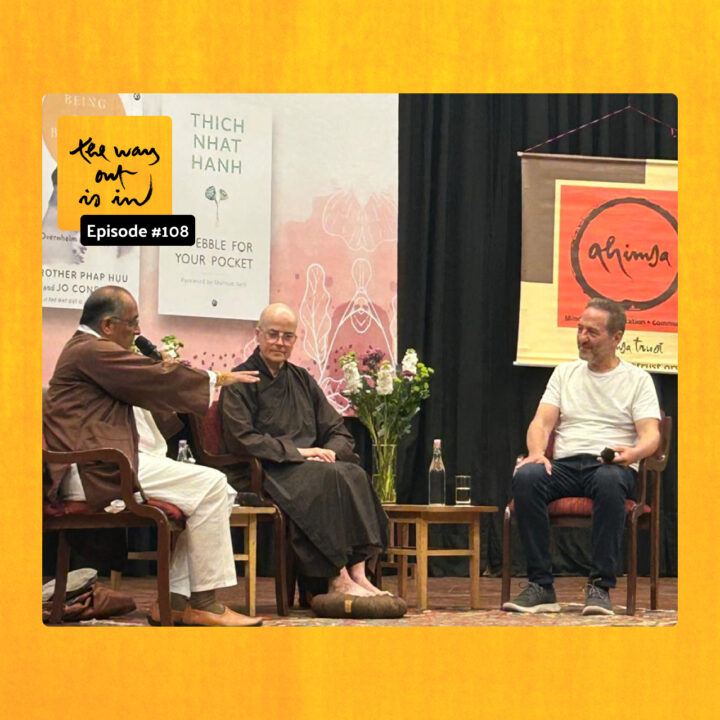
This episode was recorded live onstage in New Delhi, India, in February 2026, at the end of the pilgrimage In the Footsteps of the Buddha. Leadership coach Jo Confino was joined by Zen Buddhist nun Sister Tam Muoi and Dharma teacher Shantum Seth to discuss what it means to renew Buddhism, and Thich Nhat Hanh’s vision for doing so – including his emphasis on simplicity, equality, and making the teachings accessible and relevant to the contemporary world.
They also reflect on their 14-day pilgrimage in India, and how it deepened their understanding of and connection to the Buddha’s teachings. This includes Sister Tam Muoi’s insights about the strong sangha formed among the diverse group of 60 pilgrims from 16 different countries. She also reflects on her personal connection to India and her healing journey of reconnecting with the Buddha’s teachings in their land of origin.
Shantum Seth, who has been leading pilgrimages in India for over 30 years, explains the transformative power of these journeys in allowing people to connect with the Buddha as a human being and experience his teachings’ relevance to their own lives. He also shares plans for the Ahimsa Trust to establish a Plum Village center in India, to continue Thich Nhat Hanh’s legacy and bring the Dharma to a wider audience, especially a young one.
Shantum Seth, an ordained Dharmacharya (Dharma teacher) in the Buddhist Mindfulness lineage of Zen Master Thich Nhat Hanh, teaches in India and across the world. A co-founder of Ahimsa Trust, he has been a student of Thich Nhat Hanh’s teachings for the past 35 years, and, since 1988, has led pilgrimages and other multi-faith, educational, cultural, spiritual, and transformative journeys across diverse regions of India and Asia.
He is actively involved in educational, social, and ecological programmes, including work on cultivating mindfulness in society, including with educators, the Indian Central Reserve Police Force, and the corporate sector. Across various Indian sanghas, Dharmacharya Shantum is the primary teacher of different practices of mindfulness from Thich Nhat Hanh’s tradition.
Sister Tam Muoi (Sister Samadhi) is from the UK and was ordained in 2012 and became a Dharma teacher in 2022. Having encountered the practice whilst living in France, she became engaged in the French lay sangha and was ordained into the Order of Interbeing in 2004. She is actively supporting the recently created Being Peace Practice Centre in the UK and is deeply committed to the work of healing ancestral harm, and to participation in trainings and retreats exploring White Awareness. Read more here.
Co-produced by the Plum Village App:
https://plumvillage.app/
And Global Optimism:
https://globaloptimism.com/
With support from the Thich Nhat Hanh Foundation:
https://thichnhathanhfoundation.org/
Recordist: Ann Nguyen
https://ann.earth
Sound editor: Joe Holtaway
https://joeholtaway.com
Publisher: Anca Rusu
Producer: Clay Carnill
https://claycarnill.com
Executive Producer: Catalin Zorzini
List of resources
Interbeing
https://en.wikipedia.org/wiki/Interbeing
Plum Village Tradition
https://en.wikipedia.org/wiki/Plum_Village_Tradition
Advaita Vedanta
https://en.wikipedia.org/wiki/Advaita_Vedanta
A Pebble for Your Pocket
https://www.parallax.org/product/a-pebble-for-your-pocket/
Ashoka
https://en.wikipedia.org/wiki/Ashoka
Bodh Gaya
https://en.wikipedia.org/wiki/Bodh_Gaya
Bodhi tree
https://en.wikipedia.org/wiki/Bodhi_tree
Dehradun
https://en.wikipedia.org/wiki/Dehradun
Jamun Village
https://ahimsatrust.org/jamun-village/
Jeta Grove
https://en.wikipedia.org/wiki/Jetavana
Nalanda University
https://en.wikipedia.org/wiki/Nalanda_University
Old Path White Clouds
https://www.parallax.org/product/old-path-white-clouds
Pushyamitra Shunga
https://en.wikipedia.org/wiki/Pushyamitra_Shunga
Sarnath
https://en.wikipedia.org/wiki/Sarnath
Sister Chan Duc
https://plumvillage.org/people/dharma-teachers/sr-chan-duc
Spittoon
https://en.wikipedia.org/wiki/Spittoon
The Stone Boy and Other Stories
https://www.parallax.org/product/the-stone-boy-and-other-stories/
Dharma Talks: ‘The Noble Eightfold Path’
https://plumvillage.org/library/dharma-talks/the-noble-eightfold-path
The Way Out Is In: ‘The Three Jewels (Episode #89)’
https://plumvillage.org/podcast/the-three-jewels-episode-89
Vulture Peak
https://en.wikipedia.org/wiki/Vulture_Peak
Xuanzang
https://en.wikipedia.org/wiki/Xuanzang
Quotes
“Often friends would tell Thay, ‘I try to do walking meditation. I find that difficult – but I love the sitting.’ And Thay would say, ‘Well, then sit. Do the practice that you enjoy.’ It’s so important to touch joy in whatever practice we do. It shouldn’t be hard work and creating more battles on your cushion.”
“Suffering is where we start. It’s your own suffering you have to handle. But also look at the suffering in the world. It’s not separate: other people’s suffering is your suffering; other people’s happiness is your happiness. That’s where we start. And then, know that all these things are interconnected. Nothing exists independently.”
“India is a great teacher because she’s confronting you all the time. That’s why we call her Mother India, I guess. She also challenges every preconception, and so, ‘Everything you say about India, the exact opposite is also true.’”
“It’s dangerous coming to India because you’re going to go back different.”
“Don’t believe something just because a teacher says it, or because it’s written in scripture, or has come from centuries-old tradition. Try it. And see how you feel.”
“Thay was a very revolutionary teacher because of his aspiration to make Buddhism relevant. He had seen the damage done by dogmatism, by fossilization. And so he was always thinking of new ways that we could make Buddhism appropriate.”
“Our precepts – the behavioral code for all the monastics and also for the lay friends – are rewritten every five or 10 years to update them. It’s quite extraordinary that Thay had the courage to do that; he faced criticism from many very traditional countries.”
“Something important about the Buddha Dharma is that it is very much about what we experience in this world. We’re not talking about something which is going to happen after some sort of transcendence. And that’s why I think the Buddha Dharma is relevant to our Earth: we have to care for this little planet of ours, we have to care for our rivers, we have to care for our climate, to care for each other. And it’s not about an outcome in some past or future life; the karma happens right here and now. Every action has a result and that result can be seen in this life and in this community.”
“You sit, you enjoy your breath, you get a little sense of being a Buddha for a moment. Maybe you can become a part-time Buddha, maybe a full-time Buddha. ‘Buddha’ just means ‘to be awake’ – and with mindfulness practice, being mindful is a type of awakening.”
Hello, dear friends, and welcome to this latest episode of the podcast The Way Out Is In.
I am Jo Confino.
And I am a Sister Tam Muoi.
And this is a very special episode because we normally record these in Thich Nhat Hanh's small, modest, Sitting Still Hut in Upper Hamlet, France. But today we are in New Delhi in front of a live audience and at the end of a 14-day pilgrimage with a group of 60 pilgrims going in the footsteps of the Buddha. And today we're going to focus our attention on what it means to renew Buddhism.
The way out is in.
And we have a special guest today, who is Shantum Seth, who is a deep practitioner and a student of Thich Nhat Hanh, and he's been leading pilgrimages for the last 30 years plus, and also is one of the founders of the Ahimsa Trust, which has the aim of bringing Buddhism and Plum Village lineage to India, and sort of rejuvenating the practice. So welcome, Shantum. But before we get into renewing Buddhism, I think let's just spend a moment reflecting on our 14-day pilgrimage. So we have been spending 14 days, literally, in the footsteps of the Buddha, and following his path through life, and then into his transition into another realm. It's been an extraordinary journey, and for me, personally, I'm really interested in the idea of proximity that sometimes we have to get very close to things in order to feel them and understand them. And so I've been engaged with Thich Nhat Hanh for about 20 years, nearly. And people talk about the life of the Buddha, but I've never really felt it. And we have the knowledge that the Buddha reached enlightenment under the Bodhi tree in Bodh Gaya, and that's just been a thought. And then there are many sutras which start off and the Buddha was in Jeta Grove. And that's been a thought. But the pilgrimage has connected me to these places and to the life of the Buddha. And to the fact that all these events took place 2,600 years ago, but are still present today and alive today. And so Shantum, I want to thank you personally because it's been a wonderful way to actually not just intellectually understand the life of the Buddha but to really connect and to bring the past into the present moment. And I think when we connect the past and the present moment then it changes our future. And Sister Tam Muoi, just give us a sense of what's been your insights from this trip because we had a sharing circle last night for the participants at the end. And everyone, we've been on a physical journey, but also an emotional journey and a spiritual journey where people have had sort of deep insights, have recognized things they didn't recognize before. And where we've traveled as a sangha and what came out most strongly was just the beautiful connections of what it means to travel with a group of like-minded people who deeply care for each other. So lots of people go on tours, on sort of tourist tours, and there's just small talk, and people might not like each other, people might get on, but on this trip, it's, as Shantum says, it's a retreat on wheels, where actually the practice is part of the journey, the sitting meditations, the time spent sharing. What have you… What's your insight from this journey?
There were so many beautiful things and many, many insights coming up throughout the 14 days. Just while you were speaking, I was thinking of one that was very touching in our closing circle, when many of those nearly 60 people on the tour, they were all invited to write a small poem, an insight poem. And many of those poems that they shared, as we sat in a circle in the Jeta Grove, it was very lovely because I think all the monkeys thought we were having some kind of monkey parliament. And so they all joined in and came and sat on the branches. They wanted to listen in, maybe like the devas at the time of the Buddha. And many those poems, the friend shared, we came on this pilgrimage as strangers. We didn't know each other, from the 16 different countries, and in fact we made a sangha and that really is the magic of sangha. And it's something that's so important in our tradition. We know that the Buddha taught of the Three Jewels, the Buddha, the Dharma, the Sangha, and in some traditions sangha is not so important but Thay, our teacher, Thich Nhat Hanh, it was such an important part for him to practice as a community, and certainly, we feel in Plum Village, in our monastery, back in France, that in this present-day time, community is so important. It is of huge importance in the present day when so many people are suffering from loneliness, alienation, dysfunctional families, families split across the globe, where we don't get to see our family members. And maybe those family relationships have broken down. So to have, as Thay used to say, a second chance, to come together as a sangha, as a group who practice together, where we have deep connection. And when we have an opportunity to have deep connection, to have safety, that is where the healing can start. And so it was very beautiful to see that happening in a kind of a miniaturized way, over two weeks, among 60 people traveling on the pilgrimage, it was also happening, making a sangha. I think something else that really touched me deeply about the pilgrimage was when we went to Nalanda, Nalanda is this extraordinary university. I think it's the oldest university, one of the oldest. And it was there before Oxford and Cambridge, I mean, I remember that. And we went to that site. And it's funny because I had the great privilege to be on this pilgrimage as a lay friend in 2008 with Thay. And I remember walking around that site thinking, well, there's a lot of bricks here and trying to imagine what it was like. But coming this time, as a monastic, I felt, oh, this is my home. This is a monastery. This is where monastic brothers and sisters would I mean, many of them. What is it, 10,000? My goodness. And 1,000 teachers, all living in Nalanda. And I just felt so at home there, a real homey feeling. So that was very nourishing. And also, I think something, I mean I don't want to talk too long because there are so many wonderful things from this pilgrimage. I think the highlights for me were Detta Grove. It's such a beautiful space. It's like a park now. But so many of our sutras, as Jo mentioned, we start the sutra, thus have I heard one day the Buddha spoke in Jeta Grove. And of course you think, oh well, Jeta Grove. But there we were sitting in Jeta Grove. Oh my goodness, this will never be the same again. And to be all of us sitting there, particularly when we're in a circle, when we were meditating, when we were transmitting the five mindfulness trainings, which the Buddha also transmitted those five precepts there 2,600 years ago. This is an unbroken line of teacher and student for 2,600 years. And we are all part of it. It's extraordinary. So that was very, very touching.
Thank you, sister. And Shantum, you have been leading these journeys for 30 plus years at the invitation of Thay or a direct order from Thay, saying… You know, Thay would always give us orders, which we then had to follow, and one of yours was to bring these pilgrimages and allow people to come to India to really touch the life of the Buddha and to connect to it. So, in your experience over these 30 plus years, why is it important for people? And what are the general learnings people have when they come here and they take these journeys?
You're right, Thay requested me, I wouldn't say ordered me, suggested to me at the end of his first journey in 1988 that he said, you seem to enjoy this, something which is the path of practice that the Buddha suggested himself in the Mahaparnirvana Sutta. And why do you do this every year and invite people to take you, invite people to go with you? So, and he just finished his book, Old Path White Clouds, on the life story of the Buddha, and he wanted to offer this book back to the Buddha in the sort of the form of the Bodhi tree. So that's what he did. And then later he came again and he did the Hindi translation and then he offered that to the Bodhi tree. So he was always coming really partly to pay his sense of gratitude to the Buddha. But I think what happened when I started doing these journeys, I'd been to these places as a child, I had been brought up in Patna, so my parents had taken me to these sites as a kid and I'd been sort of brought up thinking of Buddha a little bit like a god. And I think what happened to me in the first journey already was that I really came home to me that the Buddha was a human being. That is very, very important to me. And so I think meeting the Buddha as a human being and going to the places where he was allowed me to touch that these teachings are relevant to me and my life. And I'm sort of a, I would say, agnostic, non-theistic type of person, and I also have a skeptical mind. So I felt this sort of understanding that there's somebody, a human being, who's done this, so he's given a sort of transmission to me. But I didn't realize the power of the pilgrimage until a few years later, so I started doing these journeys. And then I started finding that people were really getting a transformative type of experience. Something quite deep was happening. And I realized that this sort of curation of a retreat on wheels, as you mentioned, was important. And then the formation of the sangha, not traveling as a group of individuals, but really traveling as an organism. And then when 15 of us travel together, you start seeing with 15 pairs of eyes, 15 pairs of ears, you have a different type of experience. And so you really benefit from each other. So I started seeing this sort of transformative effect people were having. And going to the actual place where the Buddha sat, say for example, Vulture Peak, where he said, oh, let's go and watch the sunset. Now we go and sit and watch sunset of Vulture Peak. And he's realized that you can see the sunset with Buddha eyes. We have our flesh eyes, but we can also see with a different type of eye. And that sort of slow transformations are taking place in each one of us. And then meeting the people he met. We know the stories about the Buddha's life, whether it's the great merchant and donor and Anathapindika with the Sujata who give the keer, the rice and milk pudding. But when you go there, like this time, you meet Sujata, she's still the 13 year old girl in the village and we eat keer in the village. And realize that this sort of telescoping of time bring it into the present is very important because the Buddha was only the Buddha in the present moment. We think of him as this historical character. So that's important. But what he said was that the Dharma, the teaching, is what I offer you as a continuation, and that teaching is continued for 2600 years ago. Thankfully to the lineage of teachers, including who came to Nalanda, this whole lineage of teachers, we have to be really, really grateful to them. And I think when we sit at the place where he sat, in the cave, you realize you're breathing with the Buddha, you're meeting the friends, and then those sort of sights that the Buddha saw, the old person, the sick person, the dead person, and the monk, we see them now. They were wake-up calls to him. They sometimes aren't for us, we just… But, you know, it does bring up those sort existential questions, you know. And like on this pilgrimage, you know, we had Brother Phap Huu's father pass away. You know, it brings up to us what is the loss of a loved one? What is death? And I think for me, curating these journeys in that way is to allow people to come up with those sort of deep questions. And I call this a path of awakening. But that's just lots of cause and conditions. We sit under the Bodhi tree and that's not up to me, but we try and provide the conditions that people can have little moments of insight, awakening and that allows them to touch a deeper sense of what our own reality is as human beings. Why I do these journeys is because I really feel, I see the transformation. And this is not just a tour, it's something which is an inner journey at the same time as an outer journey. So we go to these outer spaces into this, what I think of as a sacred geography, where the Buddha was born, died, gave his first teachings, awakened, and then other places where he spent 24 Rain Retreats in Shravasti, and other places, Vaishali were the first nuns were ordained, Kapilavastu where he spend his childhood. But the transformation that takes place, and friends who come is very palpable. And I get letters 20 years later, 30 years later, or 10 years later saying, something happened on the journey and I can see now the effect of it. In many cases, like we said in the closing circle, you could already see it now. So I think this journey continues. And for me, it's a great benefit. I'm sort of lazy sometimes, I say, I'm gonna do it. But I realized that I give a date and people come and I benefit so much. So I always say, I start by saying, I'm so grateful you've come. And I really feel a sense of gratitude that people are coming on these journeys and they're transforming me too. They're helping me in my path.
Thank you, Shantum. And you bring up that idea in Buddhism about ripening. So I had this sense on the journey that the real benefit of the journey will not be on the the journey, but will be after the journey. That sometimes it takes time for things to sink in and our store consciousness to work through it and to reach deeper understandings. So I love that idea that these things can, like the teachings, they go in but they can deepen and deepen and ripen and a lot of that takes place below our conscious level. It's like, it's that journey is now in my system and will work its way through my system. And sister, one of the things about the journey, especially at Jeta Grove and Bodh Gaya, is seeing all these lineages of Buddhism coming together. So especially at Bodh Gaya, you go in and there are all these different chants. There's the Tibetans, and then there's the Koreans, and there's the Vietnamese, and Plum Village, and all these groups coming together with their pink robes, and their brown robes, and their saffron robes and their mustard-colored robes. Which doesn't really happen very much in the world. And I just wonder what it was like for you to experience that, where, where… You know, one of the things about the Buddha was he was very appreciative of that and foresaw that there would be different streams of Buddhism and that actually one of the benefits of that is not that there's one teaching only in one form and you either like it or you don't like it, but actually within Buddhism there's so many different streams that actually whatever is comfortable you can find a refuge. So what was it like to experience that all that? Different energies and different colors and textures of Buddhism in one place?
As we walked mindfully onto the site of Bodh Gaya, I was walking next to Thay Phap Huu. And he said to me, oh, this is the United Nations of Buddhism. That was such a wonderful way of summing it up. And it makes me think of a story that Thay used to tell, exactly along the lines you were saying, is that there's not one way to practice. And often friends would ask Thay, oh, but I try and do the walking meditation. I find that difficult, but I love the sitting. And so Thay would say, well, then sit. Do the practice that you enjoy. It's so important to touch joy in whatever practice we do. It shouldn't be hard work and creating more battles on your cushion. And so Thay would give a beautiful analogy of, he would say that all the different lineages that we have he said it's like many different restaurants. You can go to the Chinese restaurant, you can go to the Indian restaurant, you can go to the French restaurant. We all get hungry. We need to eat. And we can choose which is the type of food that we like the best. It's important to be nourished. And so in Bodh Gaya, while there were a lot of different foods on offering, and people find the lineage that they're comfortable with, that they feel nourished by, that suits them. And something that really struck me that I enjoyed a lot… It's a very noisy place, Bodh Gaya. So that has its own challenge because as I'm sure many of you really appreciate, when we sit and meditate, you imagine sitting under the Bodhi tree. It's going to be completely silent and so wonderful. No, not at all. It's gonna be loudspeakers, many different languages, different kinds of chant. So the way I practiced with that was just contemplating as I did sit under the Bodhi tree and my ears were assailed with sounds of all different kinds, I was thinking there is not a single word being pronounced here that isn't a word of love and compassion and joy and understanding. There is not single word of anger or criticism or judgment. This is all loving speech and loving chanting. And it gives the most beautiful, it's like a bath of loving sound. It's a very compassionate place to be. And of course, there's a lot of jostling, people finding their space, wanting their space. But it's all done in a very loving, loving way. And it's a beautiful atmosphere to be sitting there. We had the luck to find a very beautiful spot to sit. Because, in fact, there's not just one Bodhi tree, there are, I think, a few Bodhi trees there. And the Bodhi tree that Thay liked to sit under was one that's a little bit away from the center, and it has a lawn all the way around it, and it's quite quiet. And so we had the chance to all go and sit under the Bodhi tree, just maybe 40 meters from where the Buddha was supposed to have sat. And we could sit and meditate and listen to a talk and to really be present there under that Bodhi tree.
Thank you, sister. And of course, Jeta Grove was exactly the opposite. And one of the things people experience when they come to Plum Village, France, is that as soon as they walk onto the ground, that they have an experience of peace and calm, and also a sense of coming home. And there's this deep understanding that this has been cultivated over 40 years through this continuous stream of practice. And that it's like it's seeped into the ground, it's seeped into the building, seeped into the trees themselves. And at Jeta Grove was very similar. There was a feeling of tranquilness and it really helped me to understand that the practice doesn't just disappear into the ether, that it sort of builds and deepens and that Jeta Grove, while there wasn't practice there for many many centuries, but it's now this continuous people going and praying there and sort of venerating the practice and practicing in this place like we did there, builds an energy. And Shantum, am I making that up? Is there a sense that you experience in some of these places that where people continue to practice this day that the practice seeps in and deepens?
So I feel we can create a space of awakening or a Plum Village anywhere in the world. But when we come to places like the sites associated with the Buddha, it reminds us, and also there's a collective intentionality and energy that is created in these places and we sort of step into that vortex. And pretty much like what you were saying in Plum Village, you create an energy and you walk into that space immediately, your steps become lighter, your breath becomes more visceral, your sight becomes more awake, you start seeing the clouds. So I think, and you become more mindful of every ant hole. So I think these places create that energy, that vortex of energy, but we don't always have to go just to these places, but sometimes you have to the Bodhi tree to then realize that the oak tree or the jamun tree or whatever tree you have at your home can be also your Bodhi tree. I think the other thing which is so important, which we forget sometimes, is that India is the great teacher. On these journeys, I really feel India is the teacher and we're seeing India through a Buddhist lens. Part of my role, I guess, is partly not just a teacher of the Dharma and the Buddha's life, but also being a cultural interpreter to India. Because the first times people come, they're like, you know, all these judgmental mind comes up and things. So I just, I ask people to be, you know, not be reactive, but then we have discussions about these things. And for me, the first few days is very much about building the community, then after that to try and see India beyond the trash and the poverty, but to touch also the wisdom and the beauty of this country, not to ignore it, but to see the causes and conditions that bring these sort of conditionalities. So I feel that when we can really face ourselves in the relationship with what we are seeing, hearing, feeling in India, and then we have a community to share that with and also to understand ourselves, that is very important. I think The Buddha helped us in that. He just told us, look within. Suffering is where we start. And it's your own suffering you have to handle. And also look at the suffering in the world. It's not separate. Other people's suffering is your suffering. Other people's happiness is your happiness. And that's where we started. And then, to know that all these things are interconnected. There's nothing which exists independently. So we have a co-responsibility of how we tread through India, how we come as pilgrims to a place, how we walk this earth. And it's, you can just see somebody walking and he or she can be your teacher. And just the way they walk, I've seen the monastics walking and people just stopping on the street as you're on the pilgrimage, they just stop and start looking. And bow. And so I feel that these sort of experiences are so important for us that we can see our mind, how it works, rather than just being sort of caught in this. And so I tell people, for example, for begging, I say, you know, when a beggar comes to you, don't give. First of all, you don't exactly understand the conditions of it. There is need, but see what's coming up for you. Is it compassion? Is it guilt? Is it fear? Is it anxiety? Whatever. And then let's look at that. And then we process all that stuff in the next few days. So these sort of, that's why I say India's a great teacher because she's confronting you all the time. That's why we call ourselves Mother India, I guess. But we also challenge every preconception you have and so people say, well, we have a classic thing that everything you say about India, the exact opposite is also true. So not everything is a bit like a koan. And I always say it's dangerous coming to India because you're gonna go back different. But if you're open to that, but you try and see it with a context of wanting to be, looking at your life more raw. And I think that's what I feel is part of this journey for all of us. And then we can do it as a community, it's much better.
Thank you, Shantum. And we wanted to talk this morning about the renewal of Buddhism. And so one of the things that surprised me or probably shocked me was how few Buddhists there are in India. Because, in a sense, this here, in India, is where the teaching started. And you can see it flourishing to this day in places like Tibet and Bhutan and France and Sri Lanka and China and Japan, they're all these traditions that are flourishing and are deeply embedded within those societies and have a place. And you said the other day that in the census, I think in 1951, there were only 180,000 people who said they were Buddhists out of a population then of 360 million. And that in their last census, which was in India, in 2011, Buddhist amounted to 1.3% of the population and so to me that was unexpected because there was no at Bodh Gaya or Jeta Grove, there's no Indian lineage showing up with their own sort of robes and practice and so I just wonder what happened, just briefly what happened that meant that in the very birthplace of Buddhism, it's sort of, in a sense, diminished. And it's, I think, important to know that before we talk about the renewal, because sometimes we need to understand why something, the cause and conditions with which something diminishes before we can start to see how it can regenerate.
So the census in 2011 was 0.8 percent, but you're right, the country of its birth, Buddhism had disappeared and actually there's been a renewal which we can talk about, but it's one of the sort of mysteries of history, what happened? Nobody has a completely clear idea and there's not just one cause, of course. I would say they're both internal causes to Buddhism and also external causes. I think internally we became more and more cut off from lay people. The Buddha always said, be like fish amongst the water to the monks, so we were always in touch with lay people, throw our arms around, we knew the suffering of lay people and so we were actually helping in that sense. But we were also getting a lot of patronage from kings, from merchants, and especially royal families. And when the patronage changed, then a lot of the economic base of monasteries were cut. And we also became quite corrupted in a way. There was so much wealth coming into monasteries at one point. And also a sense of entitlement. When we were at Nalanda, there were monks going around and being carried up and sitting in chairs and getting jobs in any court they wanted. And also going more and more metaphysical. And of course, some of the greatest teachings came from Nalanda, so that was another, it's not just that there was the compost, there was also the wisdom of the lotus coming out of that compost, which is, we have some of greatest teachings, wisdom, culture teachings from Nalanda. That's just an example. I think externally, I think the main issue was a sort of conflict with Brahmanism, which had a much more hierarchical structure of caste and things like that, rather than the Buddha Dharma which had a much greater sense of equality. And this clash is always there. I mean, even soon after the Ashoka's time, there was a guy called Pushyamitra Shunga who had a real antipathy towards Buddhism. In fact, it's said that he even offered coins for each monk's head. So it wasn't just at the end. But by the time Xuanzang comes at the eighth and seventh, eighth century, he's already seen the decline. And by the eighth century especially with Shankaracharya who adopted a number of Buddhist practices into the revival of Brahmanism, I think Buddhism took a deep dive. And it is a sort of adoption partly. And then we actually made the Buddha into an avatar of Vishnu, which is a little later. So, this sort of traditions of ahimsa, of non-harming, of a non-dual system of awakening, these were sort of adopted into some sort of Advaita Vedanta types of teachings. I mean the core of this problem with the Brahminical system, because the Jains didn't disappear, for example, they were still supported by merchants, but the Buddha Dharma is very clear that there's nothing like a soul, like an atma. It is anathma, so there was the idea that there's no intrinsic existence in any entity. That cut to the very base of Brahmanism and also didn't support too much of the ritualism and things like this. So I think the last straw, as it were, was when the Islamic invasions came in the later part of the 11th, 12th century and many of them came from the North West and they were iconoclasts. And they'd been seeing images of the Buddha because the whole of that area, what we see is Afghanistan, Uzbekistan, all that area was all Buddhist. So then they actually did destroy some of the statues and some of these institutions. But by that time it was just, there was some Buddhism left in the east side, where we see as Nalanda today, and Odantapuri and other places which is in the east. So I was saying that, when the way we say Buddhism died, diminished, but it still existed, it continued, without the name Buddhism. I mean, you look at the secularization of education, if you look at things like diet, the effect of vegetarianism from Jains and Buddhists. You look at trade, which is happening. The merchants were some of the main supporters of Buddhism. You look at the oldest temples, all the rock-cut edicts in India, they're all Buddhist. So we might say Buddhism died, but it continues in our culture in a sort of ambient type of way. But we have to learn also from our mistakes as people who are interested in the Buddha Dharma that we don't lose contact, become too rarefied, and also become rather corrupted.
Thank you, Shantum. That's a perfect segue into Thich Nhat Hanh's teaching because sister, I mean the thing about Thay was… exactly meets the antidote to what Shantum described as what went wrong. So Thay has made sure that the teachings are very available to people. He hasn't put it in devotional chanting, it's in very deep, profound but very simple teachings that are relevant to people's lives. He has made absolutely sure that the sangha is clean, by which, I mean, there's no special treatments for rich people, that people do not come in their wonderful garments to show off. People come normally by the end of their retreat, they're in sort of stained, dirty clothes. It's very, very down to earth. My wife, Paz, has always said that, you know, you can see the teacher in the sangha and you can the sangha in the teacher. So the people who come to Plum Village are from all walks of life, but in some ways are very down-to-earth, very compassionate. They're not trying to… there's no hierarchy. And also, there's no… You know, actually I remember once when Thay was coming to England and there's a popular paper in England called The Daily Mirror. And they wanted to do an article on Thay coming and doing his teachings and retreats in England. And they got in touch with Plum Village and asked for a whole range of pictures of Thay with celebrities. And basically when you searched through the archive, you couldn't find a single one. And so they just canned the article. And for me, I thought that was brilliant, because this was such a classic case, the newspaper wanted not an article on the teachings, but actually on the celebrity culture. And Thay never lived by that. And also, Thay also talked very much about renewal of Buddhism. You know, his whole history in Vietnam was to be, not to buy into things just because they were, but to say actually Buddhism needs to be regenerated and rejuvenated and re-understood and reimagined for every generation. And that if the teachings aren't brought up to date and made relevant to the current generation, then Buddhism will diminish. So in a sense, this is a perfect sort of opposite of what happened in India, is Thay's absolute determination to make sure it's down to earth, it's simple, it's available, it's relevant and there's true equality. So can you just talk a bit about how you see that and why it's so important?
Thay, when he was a young monk, he ordained at 16 years old, as a young monk, really his deepest aspiration was to renew Buddhism. So, in fact, he was turning towards exactly many of the things that Shantam talked about, the corruption which happens, unfortunately, over a certain amount of years. The fossilization of the dogmatism that can take place in organized religions. And so Thay living in a war torn country where there was so much suffering, already he'd suffered from the colonialism of the French and so the kind of guerrilla warfare going on, the terrorism, he'd grown up in that situation. And then the war with America, there was so much suffering. But he could see that Buddhism wasn't helping. It wasn't turning towards that suffering. And he had the chance to read and to study about ancient dynasties of Buddhism in Vietnam, where, in fact, Buddhism had had a real impact on the culture, on the people. And he dreamed that this could happen again. So there were many causes and conditions that enabled this to happen, one of them being that he was made a refugee in the West. And so similar to the Dalai Lama, I mean the spread of Buddhism from the Dalai Lama is because he was a refugee and not allowed to stay in Tibet. Same thing with Thay. If Thay had been able to practice in Vietnam, maybe, well, I wouldn't be sitting here today, and many of us. But Thay was made a refugee because of the war. He was accused by the South of being a communist and accused by the North of being a CIA spy, and so he found himself in a very desperate situation, without a sangha, of losing all his sangha, his supporters, the people that he practiced with. He had to recreate his sangha. But he did this with people from the West. And Thay being such a skillful, curious, intelligent practitioner, he wanted to understand what is our suffering? And he spent a lot of those early years with the anti-war demonstrators in America, and also many of the people in Europe as well. Quakers, for example, who were activating, they were activists against the war in Vietnam, and also anti-nuclear activists. And these became his new sangha. And so he made himself a very good base for a sangha. And he had this deep desire to not go in the direction of corruption because he'd seen how this was really diminishing Buddhism in Vietnam. So he was very inspired to walk this path of simplicity. For example, in Vietnam, when there are ceremonies, the Buddhists, particularly those higher in the hierarchy, will be required to wear embroidered robes, and lots of gold, and all this kind of thing. Thay always refused. We will wear a simple brown robe, and this brown robe, the same color as the peasants in Vietnam, so that we stay in connection with the poorest people in the land, similar to Gandhi in India, I guess. And I remember even once in Vietnam for a very, when he was allowed back, 40 years after being a refugee. And he was performing some very beautiful ceremonies in memory of all the dead of the Vietnam War. And the Buddhists there were really begging Thay to put on the tantric robes, these huge, heavy, golden robes. And Thay was saying, no. He just didn't want to. But I think in the end for one ceremony he agreed, because he saw how important that was for the people. And so he wore it for one ceremony and then off. I think that was the only time he has worn something other than a simple brown robe to really reflect the simplicity and our connection with the farming people.
Thank you, sister. And anything else about Thay in terms of renewal? So how is he, how do you see that in the current state? So Thay passed four years ago and Thay's legacy was not to have another leader of Plum Village but to have a sangha, in other words that you make decisions through consensus. And, you know, Thay was the great Zen master. And, in a sense, before that, before he passed, if there were questions or issues that came up, people would come to Thay for the answers. And then, of course, Thay's passing means you all, as monastics, had to, in sense, suddenly grow up and suddenly realize actually you need to find the answers yourselves. So I'm just wondering how you see renewal post-Thay because there's always this pull sometimes to… people say, oh, this is what Thay would do. Or this is Thay's teaching. No, Thay didn't say this. Thay said that. Thay will do this. Thay wouldn't do that. So I'm just wondering how you see renewal now without Thay. How do you personally maybe see how the teachings can be relevant to this generation, which is very different from one generation ago. We've got increasing dependence on social media. We've got AI. As you said, we've got people who are feeling alienated in, you know, the sense of loneliness. Plus we have this background of the polycrisis with climate change, with desperate loss of biodiversity, with more polarization, with the spectrum of war coming back, with this othering. Ten years ago, you know, if we had said that the world looks like it is now, people would say, absolutely no way that's going to be. So how do you see the teachings being relevant now to this generation and what you see coming into our consciousness? Sorry, that's a really easy question. Maybe it's too easy for you.
And quite long, with many points. So one thing I wanted to pick up on is that for many years before Thay had his stroke and lost the ability to speak, he was already getting on, getting older. And friends would ask, so what is going to happen? They hardly dared to say, but Thay, you will pass away. How will Plum Village continue? How will our tradition continue? And Thay was very happy to answer that question, because people, of course, there would be the not-so-hidden agenda of who are you passing on to. And Thay would say, it's the sangha that is my continuation. And don't wait for me to pass away, to transition, to become the continuation, my continuation, because you're already continuing me right now. So don't wait for that time. It's already happening. So as practitioners, as monastics, we were already ready for that. We knew we were going in that direction. It was very helpful because, of course, it was the burning question for many people. And we knew how to answer. And we know how to practice with that, that it is the sangha that continues. And this is exactly what the Buddha said as well. The Buddha was also asked, as he was nearing his transition, Who will you transmit as your teachings to be the leader of the community? And the Buddha said, be as a light unto yourself. Be as an island unto yourself. And there were even teachings about don't believe something just because it's a teacher that says it, that it's written in a scripture, that it has come from centuries-old tradition. Try it. And see how you feel yourself. So for our generation, I think this is one of the reasons why Buddhism is very attractive to people in the West particularly, to young people, kind of post-industrial generation, is this is a very scientific way of looking at things. Try it and see. If it's helpful for you, practice. If it's not, try something else. And Thay would always teach in that way. Thay is a very revolutionary teacher. Because of this aspiration to make Buddhism relevant, to make it appropriate, he had seen the damage done by dogmatism, by fossilization. And so he was always thinking of new ways that we could make Buddhism appropriate. For example, our precepts, this is the behavioral code for all the monastics and also for the lay friends, it is rewritten every five or 10 years to update it, which is quite extraordinary, that he had the courage to do that. Because, of course, he faced criticism from many countries that are very traditional. And the monastics, they follow the same precepts as us, but Thay wanted to renew them. He didn't want us to continue repeating precepts about what to do with your master's spittoon, for example, because, well, what's a spitton? It's just no longer relevant. But he did want to include precept about the Internet, because that's extremely relevant, and that is important. And so they were updated in that way. And in fact, we're just about to start updating them again to do that. For example, the precepts, the five precepts for our lay practitioners, the third precept is about sexual responsibility, about that our sexual behavior should be responsible to take care of our commitments and other people's commitments. And that has recently been updated because it is about the subject of our sexual life, our sexual energy, to make a commitment not to discriminate against any gender identity. And to, I can't think of the exact words now, but basically, it's about being inclusive to the whole spectrum of gender identity, and Thay was also extremely motivated that there should be equality between the monks and the nuns within the monastic community. And that we should, all of us, should receive teachings from the best teachers. And so one of our, in fact, our senior teacher, Sister Chan Duc, she is a British woman and she teaches the whole community, the monks included, and gives classes, because it's recognized that she is our senior teacher, and she holds enormous wisdom, erudition, and can speak Pali and Sanskrit. And she is carrying on the eruditions that our teacher Thay had. But then other of our monastics, they carry on different aspects. And it's extremely important for Plum Village, that we stay a very inclusive community for those who may be not able to afford to come to the retreats. Then we have a subsidy program. We really favor young people. We favor people from the BIPOC community, recognizing it's sometimes more difficult to have an income to afford the retreat. And, of course, to all gender identity to the LGBTQ plus community and many other marginalized communities. Thay recognized that in all marginalized communities, there is so much suffering. And we want to continue that tradition of the Buddha, which is the only thing that we teach about, is suffering and the ceasing of suffering, the healing of suffering.
Thank you, sister. And also sort of the monastics are currently developing monastery and virtual monastery and I think this was started off during COVID where suddenly people couldn't come to Plum Village and you transition very quickly to online and that was a deep sort of learning and actually now, next year, we're going launch the online monastery, which is, again, another Dharma door. I think Thay was always looking for ways to reach broader audiences, new audiences to help that transfer to new places. And of course, this podcast is one Dharma door through which the teachings transmit into the world. But just how important is it? Because a lot of people think technology is only bad, but Thay was very much recognizing the balance that technology is just technology, it's how we use technology. He went to Google and to all these sort of technology companies in Silicon Valley to talk to them about what it means to be mindful and create products and technologies that allow mindfulness. But just tell us about this new iteration, because actually it's going to allow Plum Village to reach many, many different people and often in many places where either people can't afford to come or places where there's no sangha even.
Well, this was a dream of Thay, even in the beginnings of the internet, was to have an online monastery. He came up with that phrase even way before any of us knew, what does that mean, an online monastery? I think there was even an idea at the beginning that we could have like CCTV cameras up, which would be just watching the monastics going about their life. But luckily, that idea got dropped. But as you say, during the COVID time, that was a huge motivation for us to get online. It was incredible, because suddenly we had all the monastics busily learning how to do Zoom, how to be tech experts. And it was really an extraordinary time. And we reached so many people in that way. And just before I came on this pilgrimage, we did another online retreat. We recognized what a success that was during the COVID time. We sort of dropped it a little bit after that time because we were so happy to be back together again, live, face-to-face, but we remembered what benefits that brought. So we just did an online retreat and that attracted 700 people from a little bit all over the world. And it's so inspiring to sit with our circle sharing family, which, in fact, is like a grid sharing family, on your Zoom. And you have someone from Shanghai, someone from Finland, someone from India, someone form the south of Italy, all human beings together and sharing their difficulties and realizing our human condition. It's so touching. And many people say, oh, but on the internet, it can never be the same as Plum Village. But in fact, try it, because all the people who do online retreats, they just cannot believe it how we can be so connected through the screen. So of course, there are so many toxic things happening on the internet, but there are so many extraordinary things too. And so this vision now for the next step in the online monastery is that we want to create like a virtual Plum Village, so that when you go on, you enter the online monastery it will be like entering onto the site of Plum Village between four pine trees. And there you can decide, or do I go into, for example, the eating area, the dining room, where you can learn about eating meditation, or you can go and choose how to sit, of course, to go into the meditation room, learn how to do sitting meditation, and many other subjects. And there will be many short video films. There will be some things for free, some things to subscribe to, many, many variations. And the extraordinary thing is that we will be able to reach people a little bit everywhere. And certainly in that online retreat we just did, it was very moving to hear from people taking care of elderly relatives where they could never think of coming to Plum Village. Of young mothers with children, they could never get away until the kids grow up. But there they could take part in a retreat. And of course, we have retreatants from places like Africa, where they could perhaps never think of being able to pay the travel to get to France.
Or even get a visa.
Or even get a visa, exactly. So the online retreat is an extraordinary leveler. It's giving the opportunity to practice to people a little bit everywhere.
Thank you, sister. So Shantum, you want to mention something around this, but then I want to get on to how you plan to renew Buddhism, but Thich Nhat Hanh, you said earlier we were talking about whether Thich Nhat Hanh invited us to do things or ordered us to things. I always think that Thich was very skillful, and I remember as a journalist, I was at the Houses of Parliament where he gave a talk and he looked me directly in the eye and talked about the importance of responsibility in journalism and that actually every story we wrote had to be supportive of a more compassionate society. And it did actually change the way I wrote. And there were occasions where I might have a good story, but I didn't print it because I realized it would create harm for no benefit. So it changed the direction of my journalism. And Thay invited you, in brackets, ordered, end brackets, to see how you could renew Buddhism in India and bring Plum Village to India. And in fact, you know, this podcast and the retreat that follows it is part of, in a sense, well, the official launch of Plum Village India, that Ahimsa Trust has been developing this idea and has had land for many, many years. But, in a sense, it's now entering a new phase. So taking what Sister Tam Muoi said about sort of that Buddhism has to be relevant for this generation, maybe we could start off by saying, what would be relevant to India in this generation? So how is, how can Buddhism be present on the sense that it diminished and now it has a chance to maybe renew. What is the Buddhism that you feel India could benefit from?
I think Buddhism is very relevant not just to India but to the world, especially when we realize that each one of us suffers in our own way and those conditions of suffering are universal. And in India, many of us have our fair share of suffering, both in terms of material needs, but also in terms anxiety, our despair, our anger, our loss. And then, of course, the existential questions of old age, sickness, and death. And we have 65% of our population is under 35. It's a huge demographic bulge at the bottom with a lot of sort of potent frustration and current frustration. So we really have to work with that community, the young community. And we have to make it relevant to them. So I think a lot of the work we're trying to do is to try and bring mindfulness, which is really, I mean, it's in every practice, every so-called religion, but in the Buddha Dharma, it was emphasized even by the Buddha in the first teaching he gave in Sarnath on the Eightfold Path and on mindfulness. And I think bringing mindfulness into our society, whether it's through education or whether it is to police force or whether it's to corporates. I think that's part of the work that we're trying to do and I've been doing for a number of years to make it relevant. And each person has their own suffering so, you know, people in the corporate world have their own, and young people have their own, so trying to sort of tweak that message in that way. So I think one really important thing because the Buddha Dharma is very much about what we experience on this world. We're not talking about something which is going to happen here after some sort of transcendent idea. And that's why I think the Buddha Dharma is relevant to our Earth. We have to care for this little planet of ours, we have to care for our rivers, we have to care for our climate, to care for each other. And it's not about something coming in some past life or future life. The karma happens right here and now. Every action has a result and that result can be seen in this life and in this community. So I think that's one of the important things. The other is that we've been very lucky in India to have these teachings grow from our land. So the Buddha is not just our spiritual ancestor, but he's our land ancestor. To recognize that that is part of our DNA, that's what happened to me. I was searching for six, seven years as a burnt out political activist, looking for a way of being peace, not just fighting for peace. And I went to every, I went many, many teachers in India, I went even the Sufi people, I went the Quakers. And slowly I drifted towards the Buddha Dharma. And I feel that when you realize that, and when I got that, I really felt that it was like a water, sort of germinating a very deeply held seed in my consciousness and I realized that all my ancestors must have been also practicing the Buddha Dharma at one point. And then it just boomed and so I felt that this is within India it's very very easy because it's also part of our own genetic DNA, I would say, or part of our consciousness. India has always been a country where, because of its geography mainly, or partly because of the, you know, we've always had abundant harvests in the Gangetic Plains, and we've had many, many different tribes of traditions that have developed in India. So it's not to say that Buddhism is the only one for everyone. There are many people who have different traditions. But for me, brought up in India in a sort of education, which has a scientific temper, which has, a bit like what Sister Muoi was saying, you know, try it, test it, whether it works for you is fine. I think many of us in the middle classes in India are brought up in that way. And then when we come to faith or practice of religion, suddenly we have to sort of let go of that. So I think the Buddha Dharma really allows us to have a scientific temper with our spiritual tradition. And a spiritual tradition is very important. I think we need that value. And a lot of these traditions talk or try and give us a deeper understanding of who we are. What is death? What is life? I mean, the basic questions of fundamental existential questions. And the spiritual path allows us to touch that. And the Buddha path, as I see it, allows us be free from those those sort of knots and traps of suffering. And again, when the Buddha was asked, what do you teach? He said, I teach the embracing of suffering and the ending of suffering, or the overcoming of suffering. And so I think it's very important to touch that. In India, I just feel we're just lucky because we have it within our conditions, but if you go to the Buddhist sites like we've been going, there are no Buddhas. You know, they're not there. When I talked with Thich Nhat Hanh many years ago and I said how do we try and bring the Buddha Dharma back to India in a way that is relevant to us, he said do it through the field of education. And that's why we've been working with educators. But we also work with parliamentarians, we work with media people, because it's about shifting a consciousness and it's shifting not just individual consciousness but collective consciousness. And one of the great insights of Thich Nhat Hanh was that he said the Buddha-to-be, this is where we have a different consciousness, will be a sangha. It's not some individual person. And that's what he was teaching even in his own life. So I think we need a shift in our collective consciousness in India. Education is one sort of tool. But I feel that whatever we do, and then to have a place like that, like a Plum Village, so that's why we're very keen now to have the Plum Village in India. This is something that Thich Nhat Hanh also suggested. And it's a collective enterprise, it's not me, I'm just a volunteer, we're just a group of volunteers and we have a community in India. And I think the time has come that we can create a place like that where people can touch peace in themselves and arrive at a place which has this ecological sustainability, a sense of knowing that we are safe, we have an ethical base, things like that which are very, very important. And I can see the value of it, because I've been to France for so many years, to Plum Village. And I realized that we need a place in India, as Sister Tam Muoi said, people can't afford to go to Plum Village. You might as well have Plum Village here. And so I think that's how to bring it in. Sort of reminded, when Thich Nhat Hanh came last time, and we asked him to inaugurate it, it was in 2008 when he came on his last visit to India. And we bought the land just before he came, so he donated it. And we asked him to inaugurate by planting a banyan tree. And we talked, and I said why we chose a banyan tree, not on the Bodhi tree. And I said that, you know, in a banyan tree, you have all these aerial roots that then become, I mean, and they become the trunks. And sometimes you've even lost the central trunk, the original trunk in a banyan tree, but it just spreads. And that's what's happened to Buddhism in the world, that central trunk has been lost in India. But we see it in Thailand, in Vietnam, in Cambodia, and these are those trunks, or those sort of the sustenance coming from there, for me too. I mean, I've got my Buddha Dharma, I study with Burmese teachers, I study it with British teachers, I study them with Korean teachers, Japanese teachers. I've had, fortunately, the fortune of learning from many, many traditions, Tibetan teachers. But so the banyan tree in a way symbolizes what the Buddha Dharma is like today where it's spread everywhere. It has lost its rooting. And so I feel that we need to just, you know, cultivate that back here. And we're calling Plum Village India, Jamun Village. Jamun is an Indian plum. But it's also the first, the tree under which the Buddha practiced the first time when he was nine years old as a child. So we know that you can practice as a kid and, in fact, we'll be doing the launch of a couple of books today which are children's books by Thich Nhat Hanh, A Pebble for Your Pocket and Stone Boy, which are books relevant to children. And we really feel that it's very important to bring these teachings into schools, into children. But not to sort of say, okay, I want to become a Buddhist, like a card-carrying Buddhist. Many of us are culturally something else, maybe Hindu. I would say, you can be a Hebrew. Whatever, it doesn't, you don't have to change all your cultural trappings. But if you find a practice that's relevant to you, then keep that. And I would say there are different ways of bringing the Buddha Dharma back. When you talk about 180,000 Buddhists in 1951 and now millions, I estimate about 25 million, the official census says about 10, 12 million. Ninety-nine percent of them have been people who have been inspired by Baba Saheb Ambedkar. He was brought up as a Dalit, the so-called untouchable, and he faced the sort of the the real discrimination of being somebody who was at the bottom of the caste hierarchy. And he said that, I will never die a Hindu. And so, I think it said that in 1934 and 1956, six weeks before he died, he embraced Buddhism. And that became a very strong, and has been a very social political movement because of the discrimination that people felt. And that has been one of the greatest revivals of Buddhism. And now we're finding many people who came from that are looking for, what does it mean to be a Buddhist? And how do we handle our anger? How do we handle our fear? How do you handle this discrimination? Do we respond with anger or do we respond with a different type of a sense of being, with compassion, with whatever we can? And we're finally the second, third generation of people of that, really finding the teachings the Plum Village tradition very, very helpful. So, we have to find relevance to the middle classes, who are people like in this audience today, who are coming up from a scientific temper, who are looking for a spiritual path, and have sort of a little jaded by the whole religiosity which they see around. And on the other side, people who may have already taken on the label of Buddhism and saying, what is this Buddhism? And trying to find a relevant way to bring their life and to give some meaning. And we open, it's something, you know, when we start something like this, I'm not looking at it as like we're starting a Plum Village for the next five years. I'm looking at the perspective of 300 years. And in fact, I was sitting under the banyan tree some weeks ago and I was thinking, why 300? 2600 years. You know, we've received this 2600 years, let the vision go further and see what is relevant and people will come afterwards and make it relevant to that time. And I think that's a sort of work in progress. We just do a little bit, make it as much as you can. And I think what is also happening is that the people who are volunteering and practicing the sangha is really benefiting them. It's not some sort of proselytizing thing, if it helps you, you come. You sit, you enjoy your breath, you get a little sense of being a Buddha for a moment. Maybe you can become a part-time Buddha, maybe a full-time Buddha. Buddha just means to be awake. And with that mindfulness practice, just being mindful is a type of awakening. And if you can really create space like that, then you go back to your workspace and you work in whatever tech job you do, or whether you work in a restaurant or hotel. This is the India International Center. I remember when Thich Nhat Hanh came here, we stayed at one of the guest houses here, and the whole place became a Dharma hall, a Dhrama center. Some of the staff at the India International Center still remember that. And whenever they came, I remember the door used to make a little noise from the kitchen to bring the food, and they made it so quiet, we would all eat in silence. And they realize that the whole culture embraces things. So we can bring it into factories, into workplaces, and that's what we want to do. We're not saying become Buddhist, but just bring the culture of peacefulness, compassion, non-aggression, inclusiveness, non-discrimination into everything we do. And I hope that's a way of bringing the Buddha Dharma back in a way which is relevant to India today.
Thank you, Shantum. And finally, sister, you came on pilgrimage in 2008 with Thay. What does it feel like, you know, listening to Shantum, having been on the pilgrimage after this event, I think on Tuesday you go to Dehradun where the land is for the new Plum Village Center and you're going to give a retreat there to probably 150 or more people. What does it feel like, just personally for you, in terms of this experience of India, this your, you know, you have through your family connections to India historically, that you're going to be teaching the Dharma in India, and that you are part of this sort of wish to bring Plum Village, and how these practices can help renew Buddhism in India. How, if you sum all that up, how does that feel for you?
One thing I was wanting to add when Shantum was talking about India has 65% of the population, is under 35, it made me think when I was, I spent three years in our monastery in New York State, upstate New York. And we went to do some teaching at New York University. And we saw the woman who is in charge of all the chaplains, the university chaplains. And she told us something that I've never forgotten. She said, at this moment, there is such a thirst amongst young people for spirituality. They are searching for a spiritual dimension of their life, but they're no longer interested in organized religion. But they want this spiritual dimension. And I think that's what Shantum was talking about. Is what can we offer? We're not expecting, well, we're certainly not trying to convert people. We're no expecting people to become monastics, but if you feel like shaving your head and wearing a brown robe, you're welcome to. But we really want to offer this spiritual dimension to anybody, but particularly we're thinking of young people. And this is something, part of the vision of Thay was to start the Wake Up Movement, which is a movement for young people between 18 and 35. And at the beginning, the first retreat was just a few people, maybe 25 people, but now every young person's retreat in Plum Village, we're now getting about 700 people from all over the world who come, young people. And those people are changing the demographic of Plum Village. It used to be more elderly people who came to Plum Village, but now we can say that between a third and a half of the people who come are young people. And often, people remark when they come to Plum Village and they see our monastic community, and they think, but you're also young. I mean, I'm one of the exceptions. We are very few of us who actually ordained older. But most of our monastics are around 30 years old, which for any monastic tradition today is quite rare. And it's so inspiring to see every year young people wishing to ordain. For example, we're going to be having about 18 people who are interested in becoming monastics for the next time we have an ordination day. And these monastics are coming from countries from all over. It's quite extraordinary. And this is a reflection of the Plum Village sangha. It's international. It's intergenerational. And then to come to your point about, for me, something very meaningful before I came on this pilgrimage, I was really hoping that I could come as a monastic, particularly, because being British, I hold a lot of very painful history, a lot things that are shameful and are very, very difficult to hold in the history of the British and this extraordinary country, India. And over the years, I've done a lot of my own work, reading to find out about this. And in fact actually going back even more, turning back the video reel, why I became, I think why I fell in love with India was that my dad was in India in 1946. He was called up for the Second World War, but luckily the war ended, but he had to do his two years national service as a young man from a very modest family. And so he was a private in the British Army. So the first thing that happened was he was, well, he was gonna be sent to India, which was still a colony at that time, part of the British Empire. So he got on a boat and it took two weeks to get to India. He'd never had a holiday away from his home before, so that was already pretty exciting. And he was just blown away as a young man. I think he was about 18 or 20. And he just loved it. And he was very lucky because he was training to be an engineer. So he was in a group of soldiers who were surveying India. So he traveled by train the whole east coast of India, the whole west coast, up on the northwest frontier in the Himalayas. And then after that year, he then went to Palestine and then went back to England. And when I grew up as a child, I would always ask my dad when he'd come up to read me a bedtime story. I said, put the book down, tell me about India. And he would tell me so many extraordinary stories. He'd been so marked by this extraordinary country. So of course, the first thing I wanted to do when I was old enough was to come. So I first came to India in 1980 and touch that love for this country. And since then, I did a lot of reading, a lot of work about the history. Why was my dad in India? And this was really heavy to hold, this history. And during this pilgrimage, I've been very grateful to Shantum because from time to time, he offers a very healing remark talking about the British, how they were off. Well, some of them were archeologists, and they were able to contribute a lot about valorizing the sites of the Buddha and saying, so you see, it's not all bad. So I'm very glad to know that it's not all bad. And coming back as a monastic, I feel this has been a healing journey for my father as well, and my ancestors, and that as a monastic, I want to learn from India, from this beautiful tradition from the Buddha. I feel there's somehow a full circle of coming back to the land of the Buddha to learn, to heal my own suffering and the suffering of our ancestors.
Thank you, sister. And thank you, Shantum. I just want to close with an appreciation of all the people I've met on this journey, all the beautiful people. That… you know, in England or France, people are so tightly held, and meeting people in India, there's so much aliveness and talent and beauty in people. And it's just a reminder of, you know, I've only been to India once, probably, but also briefly a second time, but just how much we have in the West to learn. You know, there's always this sense of how the West can help developing nations, and I've always thought it's the opposite, that actually it's this spirit of places like India, the joy that's held here that will save us in times of difficulty. And just arriving here at the venue, just meeting two or three of the people before the start of this and just seeing this extraordinary work people are doing with marginalized communities in India, especially with girls' education and just actually the amount of hidden work that's done. You know, in the news we read about all that's going wrong, but just hearing people's individual stories just very briefly and just how many people are doing such important work with marginalized community and just giving their love and commitment, their compassion, but also their direct action. And I think that is Thay's legacy, not to beautify Buddhism in a certain form, but engage Buddhism. How do we bring this practice into everyday life? How do it to support those who are less able, less well-off, who have less resources, less possibilities than us, and how we can bring those resources we have to bring to bear on those who may be suffering deeply. But who also offer so much joy and understanding as well. So, dear listeners, we hope you enjoyed this episode. There are many, many other episodes. You can catch us on Spotify, on Apple Podcasts, on other platforms that carry podcasts, and on our very own Plum Village App. And also, just to thank the whole team. I won't name you all right now, but the whole team, the sound engineers who have been here and the cameramen who are recording this event, recording it so that you can hear it. Thank you for your care and attention and preparation in allowing this to take place so that we can share it. And also the team back in France, UK and America who bring this onto the podcast and allow everyone to listen to it. So thank you all so much.
The way out is in.