

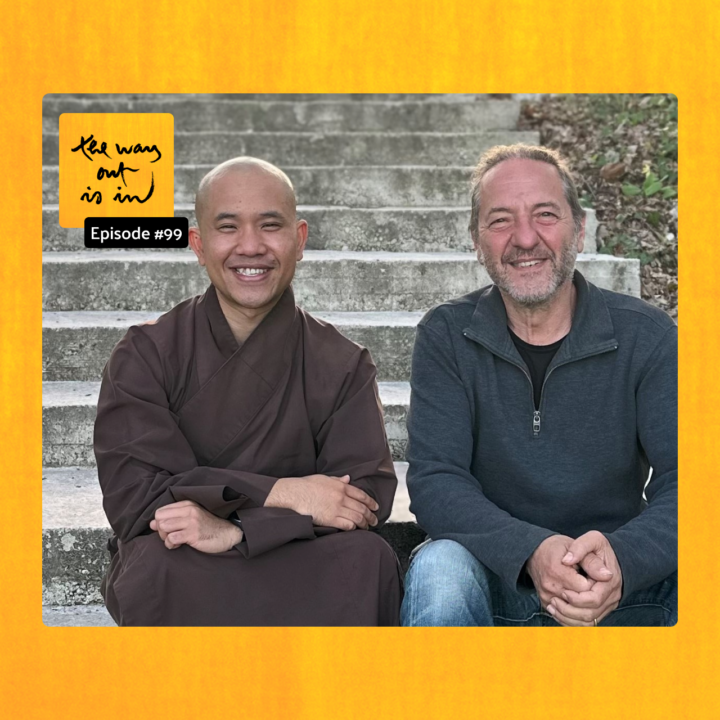






Welcome to a new episode of The Way Out Is In: The Zen Art of Living, a podcast series mirroring Zen Master Thich Nhat Hanh’s deep teachings of Buddhist philosophy: a simple yet profound methodology for dealing with our suffering, and for creating more happiness and joy in our lives.
In this installment, Zen Buddhist monk Brother Phap Huu and leadership coach/journalist Jo Confino discuss what it means to walk a spiritual path.
The conversation provides a deep and personal insight into the life of a long-term Buddhist practitioner, as Brother Phap Huu reflects on his 25 years as a monk, including the joys and challenges of living in a spiritual community; the role of a teacher on the path; the importance of finding one’s own inner teacher; the practice of celibacy; the transformations that can happen through spiritual practice; the lessons learned from 17 years as Thich Nhat Hanh’s attendant; and much more.
Co-produced by the Plum Village App:
https://plumvillage.app/
And Global Optimism:
https://globaloptimism.com/
With support from the Thich Nhat Hanh Foundation:
https://thichnhathanhfoundation.org/
List of resources
Course: Zen and the Art of Saving the Planet
https://plumvillage.org/courses/zen-and-the-art-of-saving-the-planet
Interbeing
https://en.wikipedia.org/wiki/Interbeing
Plum Village Tradition
https://en.wikipedia.org/wiki/Plum_Village_Tradition
Fragrant Palm Leaves
https://plumvillage.org/books/1998-neo-ve-cua-y-fragrant-palm-leaves
Dharma Talk: ‘Redefining the Four Noble Truths’ https://plumvillage.org/library/dharma-talks/redefining-the-four-noble-truths
Taming the Tiger Within
https://www.parallax.org/product/taming-the-tiger-within/
Sister True Dedication
https://plumvillage.org/people/dharma-teachers/sister-hien-nghiem
Sister Chan Khong
https://plumvillage.org/about/sister-chan-khong
Brother Phap Ung
https://plumvillage.org/people/dharma-teachers/brother-chan-phap-ung
Quotes
“A good teacher is to show that each and every one of us has a teacher inside of us.”
“It’s enough of a journey to transform ourselves before we choose to transform other people.”
“You’re already the person you want to be.”
“A lot of us are defined by our past, and we let that become our whole narrative. But I think that Thay stepped into transforming his past and seeing himself in the present moment and not being caught in a prison of ‘what was’.”
“Thay was very optimistic – not an ignorant optimism, but optimistic with the insight that there is awakening everywhere. We just have to tap into the right conditions, into the right path, so that those seeds can blossom into trees and into a garden.”
“Every human being that comes into the spiritual path is different. We all have different stories, experiences, histories, upbringing. So we can’t bundle everyone into the same boat. But each and every one of us have to see and accept each other’s differences, suffering, and limits, and be patient with each other.”
“When we talk about becoming a monk, we talk about stepping into freedom. And that freedom is the choice that we have made to not chase after, in our language, worldly successes. Those successes come with different layers of desires and hooks that would trap us. And the aspiration is ideal, but on the path itself, we all have to encounter our own demons within us.”
“Be beautiful, be yourself.”
“There’s a saying, particularly for monastics, that, when you wear the robe of a monk, your home is everywhere. Because our home is the present moment. The present moment is our daily destination, so that is where we will never feel lost. But that is insight and that is practice.”
“If we are a teacher who thinks we have all the answers, I don’t think we will really connect with everyone. We won’t connect with the ever-changing present moment, the ever-changing generations.”
“When we see that our whole career will become a spiritual career, the deepest aspiration is to be free from all desires. And sex is a desire. Physical contact is a desire. Emotional connections could become a deep attachment, which is a desire. And, in our practice, why do we want to be free from that? Because only when we are free from it can we be of service to the world. Our deepest aspiration is to be of service to the world, whatever world we encounter in our lifetime. But if I have a family, if I have a partner, that becomes my world and that becomes my holy life, my holy family, my community – and, of course, my son or my daughter or my children will become the focus of my devotion. But monastics want to meet the world, at any moment, without being tied down and bound to these relationships.”
“Sometimes, the mind is not the answer, and the heart is stronger. And we have to lean into the heart and be stubborn with the mind.”
Dear friends, if you have a deep love for the Earth and wish to learn how to bring the energy of mindfulness to your climate response, Zen and the Art of Saving the Planet is a seven-week online learning journey where we, as a community, will learn how to cultivate insight, compassion, community, and mindful action in service for our beloved Earth. Inspired by the timeless wisdom of Zen Master Thich Nhat Hanh, this course includes Dharma talks and practices, community sharing groups, and live interactive events with monastic teachers. I'm looking forward to teaching at these live events together with my monastic siblings. We'll learn together for seven weeks from 1st of March, 2026, into our closing event on 19th of April. Join us by heading to the website today, plumvillage.org/ZASP, that is Z-A-S-P, and we look forward to walking on this path with you. Thank you very much.
Dear friends, welcome to this latest episode of the podcast The Way Out Is In.
I'm Jo Confino, a leadership coach working at the intersection of personal transformation and systems change.
And I'm Brother Phap Huu, a Zen Buddhist monk student of Zen Master Thich Nhat Hanh in the Plum Village tradition.
And today we are going to have personal reflections about walking the path. So we've talked in the past about what it means to find our spiritual path, but today we're going to say, what does it mean to walk our spiritual paths?
The way out is in.
Hello, everyone, I am Jo Confino.
And I am Brother Phap Huu.
So, brother, it was your 38th birthday recently. And so firstly, happy continuation day, as we say in Plum Village. Yay! Another year gone, another years older, 38. But 38 is maybe not the most interesting number. The more interesting number is 25, because that is how long you have been in Plum Village, so you came here at age 13. And so today is a wonderful opportunity to actually reflect on this path you've walked, about what is it actually like to walk 25 years. What have you learnt? Where are you still learning? What are you enjoying? What are finding difficult? So let's get, I was going to say down and dirty, but that's not the best phrase. But let's stick with that. Let's get down into the reality of living a life on the path. And obviously, with you, with lots of us, who are lay practitioners, we might meditate every day, we might have a short walking meditation, we may be mindful, but you're a professional. You have been, 25 years, you have been pretty solidly walking this path. And so it was really helpful for those who are watching and listening to actually understand what is it like to be a full-time mindfulness practitioner. Very small question.
Very small question.
So let's start with the present moment. So after 25 years, how do you feel?
After 25 years. I think it was Sister True Dedication, on my continuation day, she's like, Brother, you spent a quarter of a century in a monastery. How does that feel? And I'm just like, not many people can say that. I feel pretty unique. And how do I feel in this moment? I feel a lot of gratitude, I would say, like I would never imagine I would be a monk like growing up, and then the life of a monk as a student of Thay or Zen Master Thich Nhat Hanh, it's… sometimes I can't believe I'm living this life, because at levels where it's so ordinary, it's everyday wake up, meditation, eat food with the community, go to classes. It's very routine. And then on some days, like, I'm like, okay, I am a teacher to hundreds of people right now. And then there are days where I'm like I have to get into the grit of what it means to have a community and sometimes be responsible for the community, which being a monk is like I'm living a solo, celibate life, I don't have a family, but this monastery and this community, I feel like I am so deeply connected to everyone and I've married this community in a way. That also means I get to learn to be a father, a mother, a partner, a younger sibling, still a grandchild to some. And then at some levels, yes, I get to sit on the cushion on days. And then at some levels I'm sitting at tables with our lawyers for many hours, and some days sitting with friends who have lost faith and then are refinding it. Those who have… are rediscovering Plum Village, those who are questioning, like, are we still the same because our teacher's not here anymore? And then meeting a whole new generation of people just wanting to have a spiritual life. And then the suffering that comes, because the world suffers a lot, so all of that comes to Plum Village. And sometimes it feels like we're like a liver in a way, like we're here to help filter or help detox many things, not give the answer, but just help things come through. And there's a lot of expectation, there's lot of demands. And then some moments I'm just like, oh, I have a lot of freedom. I still have a lot of freedom. I still a lot agency for the life I'm living. And then there are moments, honestly, Jo, it's just like, sometimes I wanna run away and not have to do anything with people in this community and with the expectations and so on and so forth. And then, there are days I just wake up and I'm just like 24 brand new hours, and I can call myself a monk in the Plum Village tradition, and that is very unique because I have seen so much in this community. I've seen the coming and going of so many beautiful human beings that have come through Plum Village. I probably met, I don't know, over 5,000 people. And I probably got into a lot of long relationships, in companionship with over 200 people. It's pretty rich. And some I have lost friendship and then some I have regained friendship. There are new friendships to be made and I'm sure there will be friendships that will be broken and it's just a part of life. And I think what I can say is that life is very impermanent. I started off with a lot of innocence, I would say, because Plum Village was my pure land. It was my kingdom of heaven. It was this sacred place that was so precious to me. And wherever there's light, there's darkness, right? Wherever there's dark, there is light. So I also had to witness a lot of breakups. I had two wonderful mentors and they both disrobed. I had to wonderful abbots that were before me, which I learned a lot from, they both also disrobe. So I've also been a part and holding a lot of the loss of the community also. And it's only 2020, we're coming to the end of 2025, but I've always lived with this ignorance that Thay would always be here because he was so healthy. He was such a northern star for so many of us. And now that he's not here, just realizing, did I really live deeply these moments with my teacher? Did I really take advantage of the opportunity that I had? Yeah, so there's like also some guilt that, oh man, I should have been a better student. I should have spent more wonderful quality time with him. One regret is like I didn't take enough photos and I didn't take enough videos. Well, this was before the iPhone eras too, but I just felt like there was so much richness of his life that it's so ordinary, but so extraordinary. And I wish people can see that so that they can also break free from concepts and idea of what a Zen master is and then have all of these notions around it, which I think sometimes we deify Thay or we glorify him to a level of a saint. Which he never wanted to be, you know. For some, that's a kind of faith we have towards him. And I see him as someone who's very ordinary, but someone who is very special. And then personally, like, yeah, I'm sometimes very exhausted. Sometimes I ask myself, I'm like, what is my level? What is my energy level right now? And just recently, I had to go and renew my carte de séjour, which is like our resident card in France. I had to redo the photo and I just realized how old I am now.
Just wait till you look in the mirror at my age, brother.
And then, you know, just seeing our eye bags, right, it's just like, huh, does that represent like our worries or our burden or our fears? And just accepting that, I think, accepting everything. So this is all very true. Like let's just start off there and then I think we can go deeper, deeper, deeper. Yeah.
So, brother, that's very helpful because what you've done straight away is puncture any notion that a Plum Village monastic just gets up in the morning, sits all day, finds a peaceful place to sit under a tree, eats quietly, and then sits again and then goes to bed. Actually, you know, the monastics here and you do everything. You sort of organize the retreats, you hold the streets, you maintain the monastery, etc. etc. So that's now, but let's go to this young 13-year-old that showed up in Plum Village. And most 13-years-olds, I was collecting stamps aged 13 and you made a choice to come to Plum Village. So just give a sense of what was really going on there?
Actually, my parents made that choice. I really wanted to play just video games and, you know, 13, like I was falling in love, wanted a relationship in school, middle school and everything. And I just remember like my parents telling me that I'm going to Plum Village. And I had a moment, like I was rebelling, like why, why did you make this decision for me? They said, well, you've been there before, we know you like it. That's true. And you're going to go because one of your younger cousins wants to tag along and it's going to be her first time. And we think it'd be good because you know the place, you know the monastics, so you can bridge her into the community. And of course, as a obedient young Vietnamese son, I said, absolutely. There was no choice anyways. And the funniest story was before coming, I didn't know I was coming to be a monk. It was very clear I'm coming for one month and then I'm going back home. And I was staying with my father's friends in Paris and before coming to Plum Village, we had to stop in Paris so we spent like, I don't know, I think two nights there and just to visit the Eiffel Tower and so on. And, a memory that I still have is so funny why I have this memory, but in a lot of Vietnamese households, whenever we think of the temple, we think about it as a cultural heritage, as a spiritual place, as a place where we nurture the good seeds in us, but also the monastery and the temple is some, it's very out of the ordinary, so you suffer there. It's like you don't get to eat meat, you don't get to watch television, you don get to enjoy the worldly amusement. And so before coming, the night before coming, my father's friends who were taking care of three of us, three teenagers, made a feast of just meat and seafood. And they were like, you're not going to be able to eat any of this for one month. So stuff yourselves. And, you know, like that was the last time I ever touched like meat and seafood. But I've seen how much we have also changed in our views on, on a retreat now. And this is very much thanks to Thay and Plum Village. And thanks to the way that the retreats have been structured and it's more like every Sunday going to church and it's boring and you just have to check it off your list, but it's actually transformational. Like these retreats really shift you and change you, and there's a lot of joy, there's a lot fun, there is a lot of togetherness, and I think that was something that was the most special feeling I had when I came. So 13 years old, arriving in Upper Hamlet, this I will never forget because, like I said, I didn't want to come that summer, but when we arrived at the parking lot and we got off the van after being picked up at the train station, I just remembered the feeling of arriving at home. So strange, so weird. And I felt like a fish coming back to water. I put my luggage down, I didn't care to register because I kind of knew that we're gonna put up a tent and I kind of knew the routine of it. And I just remember going and seeing lay people and monastics that I've met in previous summer. Even as a 13 years old, like that relationship still stayed. And just hugging everyone that I knew. And that was a very special feeling because I don't think I do that even with some of my family, but Plum Village, all the way in France, in the countryside, and people from all over the world shows up in Plum Village. And you've met maybe them one or two times in a retreat, but then you see them again, and for some reason you feel like this is your family. That was a really strange encounter of being in this spiritual path. And Thay always speaks about the community as a spiritual family. And I think that for me was one of the strong roots of this tradition, where I probably, because of that feeling, I wanted to be a part of this. And as 13, like children and teenagers are really loved in the community. So I was spoiled. And I had two cousins that were nuns. So we get even a little bit more attention and care. So that was very special, in school and at home in Canada, like our parents and my uncles and aunts, but then that's it. And then in the monastery, you have so many people that look at you, even if they don't talk to you, like, but the way they look at is kinder and it's more accepting, and that makes you just feel like you belong. So 2001, halfway in the retreat, the big calling was like, you wanna be a monk. And it wasn't a dream anymore. It wasn't fantasy. It was like I'm ready to do whatever the heck is gonna ask me to do just to be a monk.
What was that moment? So, you know, 13 years old and there's a sudden recognition or realization that you could see the path. Do you have any sense of what tipped you over into that understanding?
I think the feeling is falling in love, like this is the love of your life and you're ready to sacrifice, you're to do anything, whatever it takes to be with the love of your live. And I was still a young teenager and I was with other teenagers in the summer retreat. And among us teenagers, like we were very worldly, like we're talking about dating life, we're taking about, you know, like other teenagers in the hamlets, oh, like that person's really hot, like da, da, dah, dah. We were still, you now, we were not being holy in a holy place. But like for me, I didn't care. Like none of that mattered to me. And I was being a teen with everyone, playing and geeking around and doing this and that. But I guess like my eyes were on the prize, which is like, I want to be a monk. And that became so clear when, you know, like this is who you love. That's all I can say. And the biggest obstacle was my parents' permission because I was under 18 and I have to have their blessing and they have to write a written letter to the community to allow me to be a monk. My father was really supportive. He was, let's say in the family, the spiritual seeker. And he's the one that bridged us to Plum Village. And it was because of his own journey of suffering that he found the teachings and Thay, Sister Chang Khong, and then Plum Village. And just to let everyone know, like being a monk in my family wasn't new. So my father is the ninth child of the family, and he's the youngest. And in my father's side, I had two uncles that were monastics already. And then one auntie that was a monastic. And then on my mother's side, I have… She has a sister that's a nun, so one of my aunts is a nun. So it's somewhat in our lineage, in the blood. So me wanting to be a monk wasn't so shocking to the family, but it was shocking because of the life that I was given. My father and mother's family were survivors of war. So circumstances sometimes make you choose that holy life, that life of monastic, because it's easier or you're avoiding the draft to be in the army. But the life that I was given, which is in Canada, having education, having more abundance around, more material wealth around, more opportunities to look ahead. I think that was quite difficult for some to understand why would I give that up when my family and particularly my parents have gambled being a boat person and sacrificing and giving you this opportunity. I think all the stars aligned and they offered me this one opportunity to say, this is it, do you want to be a monk? I had this very long conversation with my mother. And for me was just trying to get her to say yes to be a monk, and in the end she did. She said, absolutely, as long as it makes you happy, because all mothers want to support the happiness of their children. And that was a moment of validation, like this is going to happen. After that was, I surrendered right away. Once I was given that permission, I did everything I can to understand what it takes to be a monastic. And the journey began from there.
Thank you, brother. I love the way that you are not seeking to exactly name what exactly, in words, what is that convinced you. And when I first met my wife, it was an instant recognition. I saw her, and I knew I wanted to be here with her for the rest of my life. And it would diminish it to try and explain that. But there was a recognition, there was a knowing, there was a sense of this is where I want to be. Although I had to get her to accept me first. That was harder.
Same. I had to get the community to accept me.
Yeah.
That took six months and a half.
So, brother, a lot of people will say, you are so lucky because you were Thich Nhat Hanh's attendant for 17 years. And he almost treated you as a father. You know, he was like a father to you. So you're one of the few people actually who had the opportunity to see Thay throughout that very long period, not just… A lot of us will either read a book, watch a Dharma talk, but it's such a narrow view. So I'd like to ask, firstly, when you first spent any time with Thay, what was the feeling, what was it like as a young teenager to sit with someone considered to be a great Zen master? Because you said he's not a deity, he's very human. And at the same time, he's not ordinary.
Absolutely, we can say that again. He was extra ordinary. And his extra ordinary was, he was, for me, definitely the embodiment of mindfulness. Like everything he teaches, like I felt it. It wasn't the opposite of what we see when he's giving a Dharma talk and then behind the scenes, let's say. And even before being a monk, like Thay knew that there were a few teenagers that wanted to become monastics in the community. And that was a very special moment in the community. I wasn't the first young one. There were other young teenagers that have already been ordained, but it was still very rare, someone this young. So from that moment when he heard that myself and there were other teenagers in the community, he would take extra attention to see us. Like, he wouldn't call us in his hut, but if we walk past or he walks past us, it's a very subtle acknowledgement of like, I know you are there and I'm very happy. It's very simple. But his profound presence was very warm to all of us. To say, oh my god, Thay just looked at us, guys. You know, it's very funny talking about it because he was in a way also a celebrity, but beyond a celebrity because there was so much reverence towards him and to be seen by him, it is hard to explain, but it's very warm inside. You're just like, oh, does that master sees me? That's kind of cool, you know. So coming to like having chances to be with him, I am lucky, I will say I'm very lucky, because I had very good brothers teaching me how to be with him. And one of my brothers, who's not a monk anymore, Brother Phap Dung, he was my second body, meaning I was his second body. So he took me under his wings, showed me the way in the hut, showed me the way of Thay's schedule, his habits, and the things that he needs support in. And the one thing that he said, and it stayed with me till today, is he said that when you wanna be a good attendant, you have to learn to just be attentive. That's it. That's mindfulness one-on -one. And for me, I've translated also, if you wanna love someone, you need to see them, you need to understand them, you need be there with them. And in that relationship, the one you're caring for becomes you. And the one who is caring for you, they are also you. So there is this interconnection of the two. And I think because I was able to enter into that space, Thay and I, we clicked really quickly. There were many other monastics who also had the opportunity to be his attendant. And some loved it and some dreaded it. Some just didn't have a good time because maybe of the understanding and the views we have about a Zen master and we try to like own up to meet his level, I don't know, like the different perceptions we all carry, but I was just like, no, I'm here just to help him have a very flowing day. And it's a privilege, it's just a privilege to be able to offer support to someone that has transformed so much of their own trauma, suffering, struggles and now, so generous, teaching it to everyone. And one of the qualities that made me feel at ease was like Thay knew he was our teacher and he knew that he was revered by the world, but he didn't act that way with us. He acted as just somebody in the same house. That we, if I'm going to have tea, you're going to have tea. If I'm gonna eat food, you are going to eat food. Like in a more traditional temple, like a young novice can't sit at the same table with a high venable like Thay. Like if a high venable of the status of Thay, we would stand behind him and be an attendant, meaning if he needs more rice, we give more rice. When they're finished, then we eat after. And Thay was transforming that way of being in the monastic culture also. So I think that for me, like I was picking up all of these little shifts of culture that he was leaving as a legacy for all of us. Because when I was ordained, I knew, I understood that Thay knew that the monastics will really be his continuation. He had to give now 120% of his life and energy and teachings to the monastic because after he dies, after he transitions, we are the one that will hold this monastery forward. He was already imagining and seeing how Buddhism will continue to take shape and take form in a non-Asian and a country where Buddhism isn't the core of its religion or its ethics or its way of life. So I was also a very curious kid, so I was always paying attention to every little thing that he did.
Thank you, brother. I want to talk a bit about presence, because my experience of Plum Village is, so I've been living here just over five years, I don't really study very much, but I learn so much. And it feels like, I feel like sometimes I'm a dry sponge and just by being in Plum Village, I'm sort of soaking up the energy of mindfulness. It's like it seeps into my system, but it doesn't come through my mind, it just comes through all of me, almost. So, you spent a lot of time with Thay, so, and I think you've talked in the past that actually a lot the time there was silence. It wasn't that you were trying to get something out of him, you were giving him space. And I'm just wondering what you soaked up just by sitting with Thay. Let's say he didn't say anything. There was very little spoken, but what was it that you breathed in?
Well, this is bringing back a lot of memories, because we're sitting in his hut right now, and this is where I sat with him a lot. I think this is when I understood that communication is more than words. It is more then spoken words or written words. And when we love someone, we have to also imagine ourself as them, in a way. And what I was seeing around Thay was, you know, the world was always asking questions. The world is always demanding a response, a teaching, a light so that we can overcome different crises of the world. And because I wanted to support him, so I understood that, that if the world is always having that energy that wants to extract from him, the ones that are around him, like myself, privileged to have that opportunity, I want it to be the one that is not gonna do that is not going to demand him to give me answers. But I wanted to just allow him to be him because at the end of the day, like Thay is also with perceptions, with a body, with feelings, with hunger, with thirst, with fatigue. And so I don't want to add onto that layer. I think that was where myself and him, we started to really like get along so well. Because I think he didn't have to be afraid that I was asking anything from him. And then I was coming always with like, I don't need anything from you, Thay, like we're good. Just tell me how I can help you. And then naturally that became a friendship. That became a companionship. That became a teacher and student relationship that is very profound. And I want to stay in the friendship because I also felt like I was his friend. And that's very unique to say. Not many people could say that, right? Like I felt that I was as friends because sometimes Thay would ask me after a Dharma talk, he's like, do you think what I said was good? And I was like, Thay, like, that teaching alone for many of us, we'll come back to it for our whole lives. And I felt that because he felt comfortable with me, that he could ask these very simple questions that didn't have to put me on the spot, but I would answer to him very, very generously. I'm like, dude, I wouldn't say dude.
I'd love to see that.
No, we do have mindful manners. We have, you know, we always respect our elders. But I was like, oh, Thay, that was amazing. Or sometimes like Thay would ask me, like, you know, this is my audience. What would you say? Those were moments when I would, sometimes I would zip it. I'm like, I have no idea. Thay don't put me in that position. But there was an ongoing like just communication of many levels. And that is what I'm very… I'm very happy that I got to live these moments because it has taught me that we can always be who we are at the end of the day. We don't need to throw our, quote unquote, normal way of being because we have become A, B, C, D. Or the world sees us in this particular way. So we should be responsible. We should be a particular way. But Thay knew exactly when to be the teacher, when to we a Zen master, when to be a friend, when to a support, when to be a mentor. And when, like, let's just be humans among each other. That for me was very, very special.
And I'm wondering what you learned through being Thay's attendant, so that's, you know, how you supported him. I'm also interested in, you were not, there's so many people in the West who grow up and feel they have to make a mark, that they have stand out, they have to shout almost to the world, I'm here, they have to prove that they're worthy, they have to prove they're enough, they have to prove that they can be successful. And you were, as Thay's attendant's, you were the opposite of all […]. You were being very present, you were being very mindful, you're being quite quiet, you are not trying to usurp Thay, to be better than Thay. You know, and so I'm just wondering what is it that you learned for yourself through this process?
Well, first of all, I loved being the quiet one in those early days. I love being behind the stage and just preparing for the star to manifest, in a way. What I've learned, in a short answer, like everything I am to today, everything that I'm able to offer even in these podcasts was thanks to the great amount of opportunity that I got to listen to him, live with him, as well as indirectly learn from him through his examples of being. And down to earth, though, what I have learned is that the practice that we all have, it is our responsibility to practice. The teachings that we have received, each and every one of us individually, we have to put it into practice. Nobody could practice for us. And I saw Thay even as a prominent enlightened Zen master still had to apply coming back to the feelings, coming back to the steps, coming back into the insight that we are one with this river, that anger is here, frustration is here. My students are not behaving the way I wish that they would see how lucky they are. And no matter how grown up we become, there's still an inner child in all of us, and that inner child needs care and tending. And Thay was a person that, what I've learned is he didn't let the past define him, but he's learned so much from the past. He thanks the suffering of the causes and conditions of the world that he has been able to experience such layers of suffering. And then now, because he's found a way and he's found a way to transform himself and to walk forward, he keeps going forward. It's very rare, if we listen to his talk that he talks about his suffering of the past. Maybe in his books like Fragrant Palm Leaves, we can hear like his struggles. But in his Dharma talk, he's always showing us our greatest potentials that we all have in us, which is our enlightenment, which is our capacity of reconciliation, our capacity of love, our capability of forgiving. So I see that a lot of us, we are defined by our past, and we let that become our whole narrative and story. And I think that he has stepped into transforming his past and seeing him in the present moment and not being caught in a prison of what was. But thanks to these conditions that now I am here and what I can lead forward. And that is something that is very, it takes a lot of training, Jo. It takes a a lot remembering of our potential. Like even, I think I can share for both of us like how many times like whenever I am at my lowest I'm like I would complain, and I would say oh, the community doesn't understand like, this is what I had to go through, this is da da da, da da. And then we… Then I paint this story. And, of course, there's some truth to it, but then we're blinded by that. And so when I was with Thay, like he's very optimistic. I would say that. But he's not an ignorant optimistic person, but he is optimistic with the insight that there is awakening everywhere. We just have to tap into the right conditions, into the the right path, so that those seeds can blossom into trees and into a garden. And another thing that I've learned from him is that every human being that comes into the spiritual path is different. We all have our different stories, we all have our different experiences. We all our different histories, our different upbringing. So we cannot bundle all of us into the same, like, I don't know, boat in a way. But each and every one of us, we have to see and accept each other's differences and accept each other's suffering and accept each others' limits and be patient for each other. He was very patient. I wasn't patient, but he was super patient.
Thank you, brother. I want to ask you about walking this path of life. And part of the reason is because a lot of the Western capitalist mindset is the path of life is success or failure. You have to strive, you have to put enormous amounts of effort, that there is a destination, that things are very binary. It's either going well or it's going badly. That we want it to be linear, we want to constantly get better, and that we want to have fun, but we want to… with that, a lot of people see success not as a deepening of our spiritual practice, but as sort of a financial success, or to marry someone more beautiful, have a bigger house, and we know all this. You have not been, in a sense, so tainted by that. In a sense, from age 13, you've just had two or three robes, you've owned nothing, you've earned nothing in the sense of financial, you haven't needed financial success. So you've been very free in some ways of the web that people get trapped in. So I would love you to describe what is it like to walk this path?
When we talk about becoming a monk, we talk about stepping into freedom. And that freedom is the choice that we have made to not chase after the, in our language, the worldly successes. And because those successes come with different layers of desires and hooks that would trap us. And the aspiration is very ideal, but the path itself, what we all have to encounter is our own demons within us. We all have different journeys. I particularly, I would say my first three years were like honeymoon, like everything was amazing. Like I was just, I was rolling. I was on gear five, like anything that the community is doing is needed, I'm fully there, I'm like at the frontline. And then you meet, you have to meet your demons. You just have to your manas. You have to make your desires. You have meet your limits. You start to question so many things. And just like a teenager, we start to rebel. There's an age of rebellion in the community where you start to take this life for granted in a way, and you start forget of all of the beauty and all of path that has to offer for you. We get a little bit tunnel vision, and these are the moments though that this is when you have to practice, right? This is why you're here, this is why we have committed to this path, to be even be free from these moments of despair, these moments of difficulties. And a lot of it comes from the suffering that we haven't been able to understand and transform. And walking the path in the Plum Village tradition, though, one of the biggest learning is learning to be with so many other human beings. Like this is a community not for the lighthearted, not for those who cannot handle other people's noise, other people's habits, because we're living in a residence of, for the monks, like now we're like 50 monks, we're live with 50 other men that all have our different ways of being. But the shared aspiration is there to walk the path of awakening, enlightenment, to be of service for the world, to transform our own suffering, to build this community. But then we meet all the individuals, the inner individuals, and that is the richest part of this life and also the most challenging part of his life. I think, Jo, you once said, like, oh my gosh, like if Plum Village does a reality television, it would be like probably number one hit because you get to see so much going on in the community. And then sometimes you always ask me, so what's going on the monastery? And I always have a story to tell you. And you always say, well, never a boring day in the monastery. Because the world comes here and the world, not just like people from different countries, but it is the world of the past, the present and the future comes into this space. And being in a community is also the encouragement because if you're by yourself, I know I wouldn't succeed as an individual. I can't do this by myself. I would give up. I would fall into the path of desires, personal comfort or maybe running after material securities and so on and so forth. I know this because I've discovered that that was the fear of my ancestors of not having anything. So there's a part of me that is always looking for that. So walking this path and really walking this path is really getting to know yourself like at a very deep level. And there are sometimes you're just like, wow, why do I have these thoughts? Like, why do I think this way? And I think, like, for me, personally, the flowers, I wanna talk about the flowers. It's so easy to talk about negatives, but I think one of the flowers that I have really got in this community is finding my voice. Being able to speak, learning to speak. Learning to share my views. Learning to sharing my inputs. Because naturally I would yield all the time. I would be more inferior to others. If someone is louder, I would give up. If someone is bigger than me, I will give up. If someone looks more successful than me, I would give up. If that person is white I would yield to them like very naturally. And in this monastery and in this training, like just these two words, be beautiful, be yourself, has really allowed me to find my voice, to find my way in the way I sit, the way that I show up. The fruit of this podcast is a part of that. Giving an opportunity to learn to be a teacher. I've been a teacher now for over 13 years. There are moments I cried, I didn't have an answer. I didn't know how to help someone who was really struggling. And then being humbled by all of this, by being humbled, by sometimes there are sufferings that you don't have a response for and all you can do is just cry. All you can is just humble yourself and say that we will look for a path forward, you know. And then on the other side of community is like recognizing that siblinghood is really possible, even if we're not from the same family. Like I have brothers and sisters in this community, like I know I would take a bullet for them any day. Like I would, ready to sacrifice myself, you know. Like I was… And that, I wouldn't say lightly, like I would really put myself out there. And I think that is the kind of richness that this spiritual life has really given me. And there's a saying, particularly for monastic, is when you wear the robe of a monk, your home is everywhere. Because our home is the present moment. So the present moments is our daily destination, and that is where we will never feel lost. And that is insight and that is practice though. And then on the other side of learning is that I have learned to accept also my vulnerability. I've learned to be honest with myself. And there was one year where we all, like as the monastic community, we just cried together. It was like after Thay's stroke and we were discovering like, how are we going to do this now without Thay, you know. And I asked the question to the community, and I asked, the question was why after like, I don't know, 17 years, I still don't feel like solid and firm that I can hold this? And there's so many times I wanna leave. There's so times I would rather give up than disappoint anyone. And that was my real question, that was a question that I was like asking the ancestors. And we have this tradition and this practice, at the beginning of the lunar calendar, we would ask an oracle for a sentence. And I don't remember what the oracle said, but it was a moment where everyone in the community was pitching in. And I just remember that, like, across me, like Sister True Dedication started crying. I'm like, stop, stop crying, don't cry, don't cry, because I'm going to cry. And then Brother Phap Ung, as you know Jo, like Brother Phap Ung was one of my role model. He has been my underground mentors for many years. He was never my official mentors, but Thay always said, we were all given one mentor every year, but we have many underground mentors. And he was my underground mentor. And he shared, just his words was like, Phap Huu's question probably represents so many of us in this moment. And I think that just acknowledging that I felt I'm not alone. I'm like, oh god, okay, I'm not the only one that is thinking this way. And that we all have these questions and we all this responsibility of now that we have to hold this legacy that Thay has manifested and created. And it was a very tender moment. I remember that we all just cried for like, I don't know, 30 minutes. And it was hilarious and it heartwarming. It was a moment of deep bonding and a moment just also accepting that we have fears in all of us. So being on this holy life, like as […] would call it, this holy live, we are also very human though. Like holiness comes from humanism in a way, and you can't remove the two. And I like to go and double down on the humanism that we could show up for. And I did have this perception when I was young, as a young monk, I was also a go-getter professionalist. I wanted to be this super, superman monk. I don't even know what that means, but I always wanted to solid as a mountain, you know? Like so many times the situation will just do an Aikido move and just flip you over. And you just have to accept that flip. But if you know how to fall, it's less painful. And that is also what I've learned, how to suffer.
That's a great sort of segue actually to my next question, which is, so I coach people and it's a beautiful thing. I mean, I find it the most privileged thing to really listen to people's deep pain, to build a container of trust and to support them in helping them to see that there's a pathway through their suffering. And of course, you do that on sort of a much bigger scale. There are thousands of people who come through Plum Village. And so you hear many, many stories, but also you see patterns. You see that actually, while they're individual stories, actually everyone's telling the same story. So what is it that you… So firstly, actually two parts. What is it like for you to be able to support people that people come in often maybe suffering a trauma, maybe depression, maybe hopelessness, maybe restlessness, maybe uncertainty. And after a week or two, or if people stay longer, that people genuinely start to see deeper into themselves and to sense into that they have the capacity to shift their own lives. You're not here to give them the answer, but you're here to help them find their own answer. So what is it like to do that year in and year out? And what do you notice? You know, because you said everyone suffers, so obviously that's the core story, isn't it? Everyone suffers, and there's a way out of suffering. That's the Four Noble Truths. But just talk a bit about your experience of 25 years of seeing people come through and go through transformations. Sometimes, not always.
Scary to be someone's teacher or to be seen as a teacher. Because I, you know, my sister, my blood sister studied English to be a teacher and I always felt that was very noble of her because I never would think that I would be a teach. And now I am a teacher and she's not, you know, in that role, I've learned through a quote, and this quote, I always see it in the toilet.
Sure you want to go on?
No. Cause like, you know, like, we would have like gathas or like words of wisdom from Thay or from many other teachers and they would become postcards or would become a calendar design. And after the calendar year, they would cut those pages and then put it in a frame and put it in toilets or rooms. And there's one toilet I always went to. This is really funny, but… And the quote was, a good teacher is to show that everyone has a teacher inside of them. I love that quote because I don't want to be there and handhold you all the time. And I never felt Thay was handholding myself personally, but Thay was just offering his life experience and offering everything that he has put into his own words, individual, spiritual, community building, and as a teacher, understanding suffering, like he just offers it generously. And then he becomes free because he cannot, you can't put your happiness on whether they will succeed or not, but you do your best. And that's your non-self element, like a good teacher is to show that each and every one of us has a teacher inside of us. And a good teacher only shows us the teacher that is there inside of us. And I've learned to step into that freedom more. And I say it is the freedom because I've also had the idea of like, if they're my student, they are going to be A plus. As typical Asians, you know. A plus, you get food at the table. A minus, you're eating on the ground. B, over there. D, you are washing up.
E, get out of the house.
This is speaking to the Asian stereotype. But as a teacher, I guess expanding your hearts and mind is the biggest practice because everyone has a journey and everyone has their capacity and their levels of understanding. And the most wonderful learning of a teacher is you have to relearn all the time. Why did that person didn't understand what I said? Was it my attitude? Was it my way? Was it my body language? Was is the quotes I was using, did it not fit? And so it's very humbling, sometimes humiliating even, because we've done things maybe with our greatest intention and it goes nowhere. So there is an element of a lot of letting go in this practice that I have learned. And at the same time, it is a responsibility because there is an interbeing when you teach someone, when you are guiding someone, when you see somebody takes refuge in you, there is that co-relationship that manifests by itself. So there is a truth to that. And one of the transformation I've had is that some people, some of my friends that I have been able to accompany, just having these words, okay, that's all I can do, and there's not more I can. And being humbled by that. Because sometimes we think that the Dharma can fix everything. Like we think that meditation is a pill that changes everyone. And for some it just needs more lifetimes, dare me say. And we should be humbled by and not too proud also. So I have learned to also lower myself sometimes, you know? I don't need to be a monk. How can I just be a friend? How can just be a support? So being a teacher is actually the biggest student that we have to activate inside of us. Because if we are a teacher that we think we have all the answers, I don't think we will really connect with everyone, and we won't connect with the ever-changing present moments, the ever changing generations. And I have seen myself grown a lot as a teacher.
Thank you, brother. And that's that sense of don't try to save other people, save yourself first. You know, that actually it's enough of a journey to transform ourselves before we choose to transform other people. And I love Thay's quote about, you know, you're already the person you want to be. And that what we're allowing people to see is to lift the veils of their perception, the veills of their judgment, and to see the the inner self and, and it's for people to make that choice. That for some people is too painful. It's too difficult. It's the wrong time. And that sometimes things ripen over time. It might be that someone comes to Plum Village for a week, doesn't feel they get much, but a year later, five years later, something comes up in their life and it lands in them. So I think there's something around that sense of not expecting everyone to change when they're here. And people not expecting Plum Village to change them.
Yeah, and particularly one realization I had with our generation where spirituality is becoming more and more of a refuge for so many. So I have a younger brother who is very tall, has very long legs, but he can't sit still for so long. And as a novice, I was like militarily trained by my elders to sit still and sit upright. And I was telling this younger brother, I'm like, I was coming in with more curiosity, like sem, sem means younger brother, and I say this to all of my non-Vietnamese too. I'm, like, sam, can I ask you? Why you can't sit still for 30 minutes, 45 minutes? And he was like, oh, brother, I know, sometimes I'm ashamed, but, you know, I'm the first generation in my whole family that's even meditating. And I'm from Sweden, like I'm probably one of the first Vikings that have, that is even Buddhist. So please be compassionate, give me time, like my body's going to get used to sitting, you know? And that was so humbling. And that also very enriching to know, like everybody doesn't grow up in this culture. Not everybody has sat on the floor their whole life, not everybody knows how to fold their feet while sitting. And this is an example where like, as an older brother, I wanted everybody to be in particular formations, and when this younger brother shared with me this, I just, I couldn't stop laughing. And it just expanded my mind and my heart, which is like, if we're going to have friends and those coming from many different traditions here. And maybe he's right, maybe he is the first person in his whole ancestral lineage that has welcomed Buddhism, has adorned himself into the robe of a monk, shaved his head, and is living this life. Okay, that's a big step already. Let's be patient, let's give it a lot of time and space so that this could become his bread and butter.
Thank you, brother. So I want to talk about celibacy, because I can think of a long list of reasons why I would not want to become a monk, and being celibate is probably number one. And at the same time, there's a part of me that thinks, oh, my life would have been so much easier if I put sex away and put it in a cupboard and didn't think about it. And of course, you know, Thay talked a lot about sexual energy. And about the fact that actually there are ways of handling that. And I'm just wondering for you, you know, you said, when you first arrived as a 13 year old, it was like, they're hot, you know, there was that, or the dating, the wanting to be dating people. How have you managed that energy? Because it's a strong energy. I mean, I feel it sometimes very strongly and I don't know what to do with it. So what have you learned that has supported you and allows you to stay focused and see celibacy as something that supports you as opposed to something that denies you?
The environment is very important. That's why most monasteries are in mountains, are away from the desires and the temptations. And it's really true. If we look at all of our root temples of many traditions, they are all on the mountains. All of the patriarchs are like, all right, if I'm setting up a community, like we are as far away from the village as possible. There is truth to that. The environment is really important for us to sustain this deep aspiration. And a lot of people has also asked us, why do we have to be celibate when we're a monastic? So I wanna fold this into this conversation now and just to explain it. And not everybody may accept it, but this is the tradition of the monastic life in our tradition. When we see that our whole career will become a spiritual career, at the deepest aspiration, it is to be free from all desires. And sex is a desire. Physical contact is a desire. Emotional connections could become a deep attachment, which is a desire. And our practice, why do we want to be free from that? Because when we are free from, only then can we be service to the world. Our deepest aspiration is to be of service to the world, whatever world that we can encounter in our lifetime. But if I have a family, if I a partner and I have family, that becomes my world and that becomes holy life, my holy family, my community, and of course my son or my daughter or my children they will become my whole devotion. But monastics, we want to meet the world at any moment where we could not be tied down and bond to these relationships. Because imagine if I was in a relationship, people would be jealous, my partner would be jealous of you, Jo. It's like, why do you keep getting on this podcast with Jo? Like, why can't we have a conversation? Why can't you speak to me like you speak to Jo? For example. But I'm free from that and because I'm free from, that I have time and space to also cultivate and ask different questions, right? When we are in a relationship, we're in a household, we have questions about our families, about the house, about… We have the same thing about the monastery, but it's broader. It becomes a refuge for the world. So this is where the devotion and the intention of monastics, why we take a celibate vow is that we want to define, help define our deepest aspiration and make us realize that. Or else, we can always tap […], then we will not really be true to this. And as you have shared, sexual desire is probably the world's kryptonite. It breaks relationship, it breaks family, it break trust, because we are unable to tame our energies. And what I've learned in the monastery, the beauty in Thay's way of teaching us, because he has so many young students, was that he trained us to look at our sexual energy not as an enemy, but as a source of creativity. And this is really important because sexual energy is an energy, just like anger is an energy, our restlessness is an energy. We are made of streams of energy, and it is how we channel our energies. Do those energies grow stronger and become our weaknesses, or can we put them into the right places? And a lot of our precepts are mindfulness trainings from monks and nuns, it is to always guard our sexual energy and desires. Because, for me at least, this is the second kryptonite of the monastic life. The first one, I would say, is pride. That's where a lot of us, we give up, or we leave the community, we leave our life. And the second, I will say is sexual desire, falling in love. I've witnessed a lot of attachment in the community. I've witness a lot of love in the community. I've fallen in love in my monastic life. And even Thay, our teacher, knows that this is a part of the journey, like not wishing it for anyone, but he said that when you're in a deep attachment, you lose five kilos from dealing and overcoming all of this. It becomes a night and day practice. We've had situations where we had to move a monastic to a different center, because if they're in the same environment all the time, even though they make the vow to continue the monastic path, but if every week we see each other twice, that seed, that water will keep being nurtured. So we've taken extreme measures where we would actually move someone to another monastery to support their greatest aspiration. So this has really supported myself as a young person growing in this community. And then being true to it, you know, having friends in my monastic life where I can talk to them about it. I can talk to them about my sexual energies, my attachment. Especially I was growing up here as a young boy into a teenager and a young adult and so on and so forth. And like not bottling it up, you now, and hiding away from it. And, of course, not speaking of it like being unmindful about it, because even talking about it is a kind of watering these seeds, right? But we have to have a place to lay it out and to also learn from it. So this has become a big part of our training. We have second body systems. Whenever we go somewhere, we always go with two persons. We set up our monastery where we share a lot of spaces. We are given rules. We're not supposed to be with an opposite sex in the forest by ourself or in hidden places where things can happen, right? And our community is still continuing to learn about the safeguarding and knowing that these desires can creep in and can burn down the whole monastery. So we are very alert about it. And we do our best and we continue to learn and we take it very seriously.
I think when I go home, I'll just check Paz, my wife, is not jealous of the time we spend together. Brother, I'd like to ask you about moments of difficulty. So there've been moments in your monastic career, I don't know if career is the right word, but in your time as a monk, where you've thought of giving up, where you thought, actually, I'm not sure if this is right for me anymore. And of course, I'm sure this is mirrored for many people that they'll be in a marriage or in another situation where they've made a commitment, but suddenly something comes up that becomes so painful that it breaks that commitment. So can you just talk, not the detail, but what it was like, almost the feeling of what it like to question whether this was still the path and what it is that helped you through it.
I'm trying to go back to 2016. I think the feeling was confusion and tiring. It was, it felt like a leak of energy all day, all night. Like you're just questioning everything you are. And you start to lose trust on the path you've chosen. And that's heavy, that's somehow very heavy because the mind comes in and starts to tell you like, oh, you've wasted your life, you should have never become a monk. Like, you should have got a career. Now you're gonna start from square one. And all of these leaking of energy of the mind comes into action. But the moment of recognizing that you suffer was very humbling. I couldn't call it by its name for a long time. I was just… I kept thinking that, okay, this is part of the journey, this is part of journey, like, I'm gonna overcome it, I'm going to overcome it. And then there's just a moment where you just realize like… Darn it, I suffer and I need help. Like those words were so hard to say, please help me. Because pride was there. There was a lot of confidence that I had to let go of because it wasn't there, I was faking it, to be honest. And I was recognizing that I can't fake it anymore. And that moment of just acknowledging that I need help was a liberation, was a real liberation because I'm not going to try to shoulder this by myself anymore. And then comes the help. The help comes, but the mind also wants to block it because the mind wants to tell us that we know what to do. That the ask for help is just, it's just a bridge for you to know, but I'm not really asking for help. But deep down in the heart, like it's crying for support. And I remember catching my own way of thinking so many times, trying to think, oh, I know what he's gonna tell me, I know what she's gonna to tell me. And then just to surrender, just as, actually, just listen Phap Huu, just like open your hearts, open your mind, allow, allow other people's support to come in. And that was, it sounds so beautiful, but it was so hard because the pride was there and the confidence and the thinking like, I should be the one helping them, not them helping me. And then after you receive the help, now the doing. I made a commitment and I spoke to my sister, my blood sister. I told her, like, Kwan, I have leaked my energy for a year and a half and I'm going to be here. I really want to be a monk, like the end game is I want to a monk. And I'm going to go back to the fundamental practices and almost like start again in my own heart, right? And I will do, I will invite the beginner's mind again. And after six months, if for whatever reason I want to leave, like let's talk about it, I'll share it very openly to the whole community. And I remember like the first two months were so difficult. And like sitting on the cushion, in meditation, I was having a war inside. There was a battle. There was a part of me that was screaming saying like, get out of here, like leave. Like you've already known that you want to leave. And it reminds me of this book called Taming the Tiger that is out there, and it's taken from quotes of Thay's teachings through his life. And I felt like this was a tiger that I needed to tame, this restlessness and this escaping the present moment because my aspiration was telling me I wanna do this, but all of my desires and perceptions were telling me to leave. So I want to tame those. So every time it comes up, I would recognize it, I would see it, I would call it by its name and I would tell it, sit with me. Come, come and be a monk with me. And the more you do it, the less you have to call on it, the less you had to tame it because it gets back into that habit. It gets refreshed. And I was fortunate because I surrendered and I let go and I really flow with the river of the community. I did wanted to leave. I was like, dude, I should just buy a ticket. I can just, I know where the keys of the cars are. I'll just grab a car key, go to Sainte-Foy-la-Grande, jump on a train and adios, amigo. But I was committed. There's a part of stubbornness that we have to train ourself that knowing that the mind is not the answer sometime and the heart is stronger. And we have to lean into the heart and that you have to be stubborn with the mind on that. So that was like a real tug of war and I'm very happy that I went through it. And yeah, not saying that those feelings are totally gone, like there are moments where we meet difficulties, we meet a moment of struggle and you just go, god, I wish I can just leave. And I think we all go through this. Wherever we are, whoever we are. And I think the biggest beauty that we can offer ourselves is just to smile to that and just saying that we're human, we're tired. Just naming it, it's like, I'm so tired. This is why these feelings and these perceptions are coming forward.
Thank you so much, brother, and you speak such a truth that we all like helping other people, but the most difficult thing is to ask for help because it looks like we failed, it looks we've been found out, but actually that vulnerability is our greatest strength, is our pathway through. I know we could talk all day, but I have one last question, which is how you would describe where you are on the path? And the reason is, so I've been going through this process, I'm doing a book at the moment where I'm interviewing 21 long-time Buddhist teachers. So they've all been, they're the sort of group of teachers who've been primarily responsible for bringing mindfulness and meditation for the West. So they'd been full-time practicing for between 40 to 60 years. And I ask each of them, I say, where have you got to on your practice? And none of them have become fully enlightened. But what they describe is, I feel lighter in spirit. I feel more joyful. I feel that I'm less attached to my worries, I feel that I still fall into the same holes I always have, but I'm able to get out really quickly, I'm about to laugh about it. And there was one very well-known teacher who said to me, he said, I feel so much more easy about life, but if I don't get my morning cup of coffee, it ruins my day. And I love that because it's so human. It's just saying none of these people say, oh yes, I've got all the answers. I can now sort of be on my pedestal and teach everyone what the truth is. You have been in the monastery for 25 years. Are you fully enlightened?
Nope.
How would you describe where you've got to? And then sort of alongside that question is, you know, what is your aspiration? Not necessarily for the next 25 years, but, you know, because you've go this extraordinary quality that so few monastics have, which is you started off so young. So you're 38 and you've been a monk for 25 years, it's extraordinary. And so you know, touch wood, touching Thay's wooden desk, you'll live a long life. And that means it's this extraordinary time ahead. And a lot of people, when they look at Thay, they say, oh, Thay was so amazing. But most people were seeing Thay in his 70s or 80s, when he had already been a monastic for sort of 60 plus years. And so, of course, it takes 60 plus years to become that. So where are you? How would you describe the journey up till now? And how might you describe your aspiration for going forward?
In the present moment, I would say that my inner child is less afraid of the world. And that is such a great feeling because I am not moving around the world with trying to hide myself, but I can step into spaces, even in uncomfortable spaces, with who I am in this moment. And, just for an example, like when I was a young novice, going into town was really scary for me because we're in the countryside and there's not diversity here. So we were already a colored person and then a monastic and then with these robes, so we definitely look like aliens, like in this region of France. And it was very hard for me to receive all of these looks, you know, of like, I don't know what they're holding in their hearts and their minds. Maybe it's just curiosity, but that was always heavy for me. So I was always trying to prove my worth. I was trying to feel at home in my own skin. So now I am more at home, in my own skin. My inner child is at peace and has accepted a lot of its suffering and its journey that it had to go through. So that gives me so much freedom to be in this present moment. And looking in the present and the future, I would say that I don't want to jinx it because it's scary to say it, but I really get Thay's mission. I really feel his hope that he's given us of the importance of Plum Village, why having a monastery is important, why the monastic order is so crucial, why exploring suffering of today is important to teach the teachings that come from 2,600 years ago and what it means for the world. And this is thanks to not just him as my teacher, but thanks to the living community that continues to come through Plum Village, continues to come to this podcast, and just knowing that we all need refuges. And we're all refugees in a way. We're refugees of our fears and our sufferings and of our belonging for who we are. So we need a refuge. And I think originally when I came in, my understanding was, oh, I'm gonna be a Buddhist monk, a Vietnamese Buddhist monk. And now it's more than that, you know? And luckily, I can say we have a tradition, we have root that comes from Vietnam, that then goes all the way back to China and India. Right? Like, it's so wonderful to be able to say this. And that I can only imagine where this will continue to blossom into the future. And this is what gives me a lot of energy to still do this and to not go individual and like live in a cave somewhere and not have to deal with humans anymore and community anymore but it is because of the community that we will continue to transform our world. And I would say I believe that like to my core now. It's not just an ideology anymore. It's just the words of the great giants before us, but it has somehow landed in my own heart. And I wanna give it as much space as it needs to keep expanding. And I would say like I'm walking my path. I'm not walking Thay's path. Like I'm concretely walking the path that my ancestors and the stars and the universe have allowed me to walk. But I'm grateful for all those have come before us and those that are walking beside us now and then for the future. And that gives me goosebumps sometimes. I just imagine a happier and safer environment for everyone.
And brother, I see this in you. You know, in the last year, it's like you've fallen into yourself. And I don't mean that as a sort of, I mean that in the sense of I feel the depth and I feel that you are shining out in a different way than even a year ago. It's like you're more you and you're expressing yourself from a deeper place. And I find that such a heartening thing for us all because, you know, I feel that in my life sometimes that actually if we stay true to our path then it really is a miracle because we get to see things more clearly with more pleasure and that we speak with an authentic voice and an authentic presence and I really see that you more and more entering that zone. Thank you for this deep sharing today. It's lovely to actually just share this journey with you. So thank you so much.
We hope you have enjoyed this episode. You can catch many episodes. Actually, this is our 99th, so you can catch all the other ones on Spotify, on Apple Podcasts, on our own Plum Village App, and also other platforms that carry podcasts. And we just want to take this opportunity to thank everyone who has made this podcast possible. So we want to thank Global Optimism, our co-producer. Cata Zorzini, also a co-producer who is the creator of the Plum Village App. We want to thank the Thich Nhat Hanh Foundation for their support for this project and the whole team. So thank you all so much.
The way out is in.