







If you wish to support our podcast, please follow this link. Thank you!
Welcome to a new episode of The Way Out Is In: The Zen Art of Living, a podcast series mirroring Zen Master Thich Nhat Hanh’s deep teachings of Buddhist philosophy: a simple yet profound methodology for dealing with our suffering, and for creating more happiness and joy in our lives.
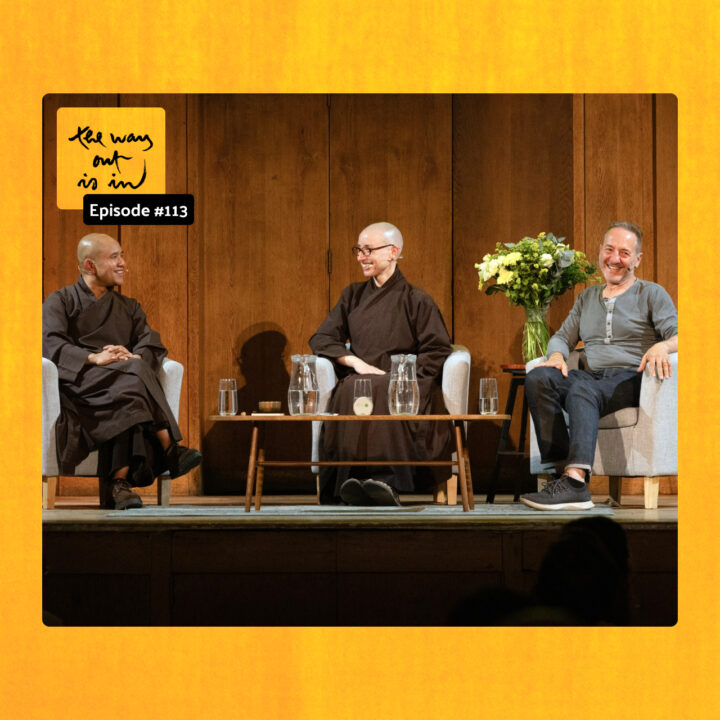
This is our third live recording of the podcast made in London, England, in July, 2026, before a sold-out audience. In it, Zen Buddhist monk Brother Phap Huu and leadership coach Jo Confino are joined on stage by Zen Buddhist nun Sister True Dedication to explore the idea that the answers to life’s issues are often found within ourselves, rather than externally, and that we are already the person we want to become.
The discussion includes reflections on the challenges of recognizing one’s own worth and the societal pressures that contribute to feelings of inadequacy; how mindfulness, presence, and community are essential in cultivating self-acceptance and personal transformation; the role of kindness in daily life; the power of the present moment in fostering personal and collective change; practicing self-compassion; and much more.
The conversation concludes with questions from the audience answered by the three speakers.
Co-produced by the Plum Village App:
https://plumvillage.app/
Plum Village UK:
https://plumvillage.uk/
And Global Optimism:
https://globaloptimism.com/
With support from the Thich Nhat Hanh Foundation:
https://thichnhathanhfoundation.org/
List of resources
Sister True Dedication
https://plumvillage.org/people/dharma-teachers/sister-hien-nghiem
Koan
https://en.wikipedia.org/wiki/Koan
Interbeing
https://en.wikipedia.org/wiki/Interbeing
Plum Village Tradition
https://en.wikipedia.org/wiki/Plum_Village_Tradition
Meredith Monk
https://en.wikipedia.org/wiki/Meredith_Monk
The Way Out Is In: ‘Stepping into Freedom – Live Recording with Q&A Session (Episode #67)’
https://plumvillage.org/podcast/stepping-into-freedom-live-recording-with-qa-session-episode-67
The Way Out Is In: ‘Cultivating Joy and Togetherness in the Midst of Hardship (Episode #95)’
https://plumvillage.org/podcast/cultivating-joy-and-togetherness-in-the-midst-of-hardship-episode-95
Quotes
“Given everything that’s happening in the world, the person I’d like to become is this impossible person – a person who can find an answer to heal and stop all of the suffering, all of the injustice, all of the violence. We know that the pain and discomfort we feel in ourselves is not only a personal, individual discomfort; we’re feeling the pain of the world, and that’s reflected in our bodies and in our feelings. And so, when we can’t accept ourselves, or think we’re not enough, it’s also because we’re not enough in the face of all of this. How could we be?”
“All the suffering of the world is reflected in us in a really concrete way: we watch something on a screen and we have a bodily response. We feel the anxiety, we feel the tension. We felt the heat in the heat wave last week. And that’s doing something to us at an emotional level; a kind of existential fear is triggered. So that suffering is really visceral in us. But what’s really interesting is that there’s also the other side of this: if the suffering of the world is reflected in our bodies and in our minds, the beauty of the word is also there in us.”
“I understand how hard it is to not feel enough in the face of what I would like to do, or need to do, to respond to the world. But, at the same time, all of the goodness of the world is refracted and expressed in unique ways in each one of us. For me, that’s the key to unlocking the door to accepting myself.”
“Coming home to oneself and embracing the pain and the suffering is the first act of mindfulness.”
“Today we’re so afraid of our own pain, of our own suffering, and of our own capacity that we don’t engage anymore. We’re all in our little worlds. And part of the journey of becoming isn’t an individual matter, it’s about becoming as a whole society.”
“We really live in an era of optimization, and we need to pause for a moment and recognize how many parts of our lives we’re trying to optimize. That may be one of the sicknesses of this era. We can’t allow things to be as they are. So with all the mess going on in the world, the injustice and the violence and the inequality, we pick up these habits from the capitalist grind. But we’re not really offering a different energy.”
“Whether you’re in a shop, on the Tube, at work, or on a Zoom call, when something happens, if we have a default response to allow us to come back to our in-breath and out-breath, and take care of our nervous system and arrive back into ourselves, that’s already an act of kindness. We’re rescuing ourselves. We are giving ourselves a breather, literally.”
“Thich Nhat Hanh was very clear that what our society needs – what we all need – is a different way of being and a different quality of being. And he spoke about the preciousness of time. Time is not money, time is not success, time is not work. Time is life. And we know how short this time is that we have with our children, with our loved ones; the time we have is so short and so precious.”
“How we are being in time, how we are allowing the fullness of any moment to reveal itself, whether we’ve just had bad news or experienced a strong emotion, we can be with that in a certain way. And that is already action, that is already a response, and that’s already patterning something different into society.”
“I don’t really discriminate between micro-resistance and systemic resistance. But I do believe that, when we come together in community – like in moments like this, in the weekly sanghas that many of you are part of we’re reinforcing that capacity of breathing together as an act of resistance, walking together, listening deeply. And then that is penetrating into our lives. It makes us change makers, whether we call ourselves a change maker or not. That’s the Buddhist understanding of action, it’s acting at every level and it’s available to all of us. The closer we are to our truth, to our body, to our breathing, you will be surprised by the kind of courage that manifests.”
“Thay would say a smile can save someone’s life in the right circumstances.”
“Kindness for me is real and it’s a force that can shift and change.”
“Breathing is a life jacket. When those emotions really come, our teachers say you are more than one emotion. Come back and breathe. Don’t let that emotion take over your whole being because you’re so much more than just one emotion, you bring up another emotion to embrace it.”
“My dad would say, ‘One, two, three, smile.’ And we would smile, but we hated it also. But he has transmitted that reminder that even in the midst of agony, that smile is your right.”
“We don’t need to set aside time to be more true to ourselves, to be more true to our values, to be more free, and to be more awake to what’s going on. We can simply do it on our way to work. And what’s life for if it’s not for that? To feel that freedom, to feel that agency, and just to arrive fully into the richness, the mud, and the beauty of this life that we have a chance to be in.”
“Engaged Buddhism means bringing everything you’re learning into the here and now.”
Good evening, dear friends. Welcome to this very, very special recording of the podcast, The Way Out Is In. My name is Es Devlin. I'm an artist who has only in the past few years discovered Plum Village. And I feel very honored to make a short introduction to this evening's podcast. The title of this podcast is You are already the person you wish to become. And we all are. You all are, I can see. The three people you're about to meet on stage need very little introduction. Please give a very warm welcome to our special speakers this evening. Thank you.
So, dear friends, welcome to this latest episode of the podcast series The Way Out Is In, which we are recording before a live audience in London on a Friday evening. And so we are very delighted to all be here. And before we actually get into the topic we're going to discuss, we are going to invite Brother Phap Huu to do a short meditation. And the reason is because it's Friday evening and you've all probably had very busy weeks and your minds are probably full and what we want to do is to help you to relax, to steady yourselves, to feel grounded, so that as we discuss this evening's topic, it's a chance for us all to learn. So we're all in beginner's mind. We're here because actually we want to learn how to be more present, more at home, more peaceful, more confident in our lives. And so the best way to do that is to slow down, to stop, to be present. And that is the core of the teaching, to be mindful, to be focused. And when we do both those two things, then we might generate an insight. And would it be lovely if each of us were to leave this evening with a small, modest insight that may just niggle at us over the coming weeks and just help us to reframe an aspect of our lives, just to think about things maybe a little bit differently that might grow us and develop into something more significant. So, Brother Phap Huu, over to you.
Thank you, Jo. Hello everyone. I invite us to sit a little bit upright if we can so we can allow our body to enter into concentration, having our two feet firmly on the ground and making sure our arms, our hands are not holding onto anything. We can really rest in this moment. There is nowhere to go. There's nothing to do. What a gift. And if closing our eyes can be helpful to stay focused and just bring your attention to my voice, allowing my voice to guide us into our body, into the breathing. As I breathe in, I'm in touch with my in-breath, just as it is. As I breath out, I am in touch with my out-breath, just as it is. I can feel my in-breath. This is in-breath. I feel my out-breath. This is out-breath. Let the breath be natural, we just have to be an observer, present. If the breath wants to be short, let it be short. If the breath wants to be long, let is be long. As you breathe in, you fully take refuge in the whole length of your in-breath from the beginning to the end. As you breathe out, fully take refuge in your out-breath from the beginning to the end. I am one with my in-breath. I am one with my out-breath. As you breathe in, allow yourself to breathe in a little deeper. As you breathe out, give permission so that your out-breath can be slower and calmer. Deep, in-breath. Calm, out-breath. As I breathe in, I'm aware of my whole body. As I breathe out, I allow my whole body to rest. Aware of my whole body. Resting my whole body. Aware of my face, my eyes, my lips, my jaw. I can relax in this moment. I can offer a gentle smile if that helps. Aware of my two shoulders. If there's any tension, I can drop my shoulders. My two arms, my hands. Aware of the whole upper body. Offer tenderness, allow the upper body to be soft. Our legs resting, our two feet firmly on the ground. Dear body, thank you for always being there. In this moment, please rest. Breathing in, I know I am breathing with community. Breathing out, how wonderful it is to be breathing in community. In, aware of community. Out, how grateful I am to breathe together with community. I listen, I listen this wonderful sound of the bell guides me home to the here and now. Thank you, dear friends, for breathing together, how wonderful it is to just sit in stillness.
Yeah, actually we were going to have an episode of the podcast which is called Silence and just not say anything the whole time. It feels that would be perfect to do tonight, that would give us a break. So I have to tell you, it is a real joy to have Sister True Dedication here and Brother Phap Huu and I are always sort of scheming to see how we can convince her to come and join us because it's very rare that she will take the time because she's so busy doing so many things to get her to come. So getting her to come to London is for us a big deal. And so we had to sort of plan it, so I sent her an email just sort of saying, oh sister, we're doing a podcast in London, would you like to join? No response at all. So we thought, but we thought well she probably read it, so it softened her up a little bit. And then I think Phap Huu, you were on a train.
Yes.
… with Sister TD, she had no escape, the emergency window was fully locked. And I think by the end of the train ride, you had convinced her to come. So sister, thank you for agreeing, for volunteering to come and join us this evening. How are you to be here? Is this your greatest wish?
No, I'm very happy to be in London. I'm happy to be with you all. I'm happy to be in community. So thank you for the uncomfortable position of being up here rather than being down there. But I'm happy to be in conversation and also I've already said to you both to be learning from the two of you this evening.
Well, we would say the opposite, that when Sister TD is here, we can relax, we can just sit down, she will tell you everything you need to know, we'll just add little bits and pieces to it. And Brother Phap Huu, how are you feeling? You've been a few days in London, how has that been?
I feel very grateful to be here. This is our third podcast live in a row. So London is a special place for the podcast The Way Out Is In because it has only been live in London.
So today, so when we came up with the title, we came up with, oh, it's gone now, you're already the person you want to become. And the reason I love that title is because it's quite provocative, because we spend so much of our lives believing we need to be somebody else. Feeling that we're not good enough in our looks, in our behavior, in our thinking, in our emotions. And so, of course, the podcast is dubbed, The Way Out Is In, because most of the time, we're looking for the way out is out. And we're look for answers to issues, suffering, pain within our lives. And yet, it's very difficult to find things outside of ourselves. And The Way Out Is In is because actually, if we truly were already the people we want to become, then it would allow us to relax, to take life a little bit more gently, to build our confidence, to build our sense of ease in the world. And I know, as a child, if I had been told this, because I thought nothing about me was OK, and if I'd genuinely been told by people, you are already OK as you are, you're already the person you want to become, I would have found that so helpful. So Sister True Dedication, I'm going to come to you first, because we are ourselve, we live in this body, we live this mind, why is it that we find ourselves with such a level of discomfort that actually we don't feel at home with ourselves a lot of the time. We feel that we're looking outside of ourselves. What is going on? I thought I'd start with the easy question.
I have to confess that when I accepted to do the podcast, I didn't know what the topic was. And I've been feeling really uncomfortable about the topic because I am a real beginner, I feel, in this practice. But as all of us, students of Thay, this is one of his lines from his teachings and so I am studying it as a koan for myself as well. And I do ask myself this question: Why do I not feel? Why is it so hard to feel that I am what I want to become? Why am I… ? And when I ask that question, I often frame it in terms of I haven't achieved what I want to achieve yet, right? I haven't realized or understood what I want to realize or understand. But over the last few days, I was thinking about it more deeply and I realized that given everything happening in the world, the person I'd like to become is like this impossible person. A person who can find an answer to heal and stop all of the suffering, all of the injustice, all of the violence. And so I think for many of us, we know that the pain we feel, the discomfort we feel in ourselves is not a personal, individual discomfort only. We're feeling the pain of the world, that's reflected in our bodies, in our feelings. And so when we can't accept ourselves or we think when not enough, it's also because we're not enough in the face of all of this. How could we be? So sometimes I feel in like the well-being industry when you say you're already beautiful, how can that have ethics in it? Because if there's ethics all of us have a role to play in acting to relieve the suffering of the world. So I think there's a real grain of that in why I find it so hard to accept that I am enough. But what's so interesting about this is not only do we have all of the suffering of the world reflected in us, and I mean this in a really concrete way, we watch something on the screen, this screen or that screen, and we have a bodily response. We feel the anxiety, we feel the tension, we fell the heat in the heat wave last week. And that's doing something to us at an emotional level. There's a kind of existential fear that is triggered. So that suffering is really visceral in us. But what's really interesting, I have learned, what's very interesting is that there's also the other side of this, which is that if the suffering of the world is reflected in our bodies and in us, the beauty of the word is also there in us. The sheer wonder of this human body. It's just incredible through how much time has this body traveled to be here now. I used to ask myself the question, the warmth of my body, how old is it? If the body had got cold at any point, the chain of life transmission would have disappeared. So this body we have is so extraordinary. It's completely ancient. It's like, it's a transmission through millennia and millions of years. And it is a wonder of life that we can do all the things we talk about. That we can breathe, that we walk, that we can enjoy a cup of tea with a loved one, that we can laugh, that we can cry and sing. These are the wonders. So my practice is I understand how hard it is to feel that I'm not enough in the face of what I would like to do or need to do to respond to the world. And at the same time, all of the goodness of the world is also, in each one of us, is refracted and expressed in such a unique way in each one of us. And for me, that's the key to unlock the door to be able to accept myself. And it's a bit of a cop-out because I can then accept myself because I'm not exactly me. You see?
So… I remember. We are not ourselves alone. I remember when I was at The Guardian, I was coaching a deputy headteacher of a very big public school. And he was going through a lot of suffering. And I asked him to write down with me all his positive qualities. And he was unable to write down a single positive quality. He had a very responsible job. He was well-liked. He, you know, but he could literally could not get himself to write down something. So I said well, why don't we write down what your students say about you, what your teachers say about you, what your own kids say about you, what your wife says about you. And he wrote down three large sheets of paper, but she was unable to do it for himself. So Brother Phap Huu, what is it about us that Sister True Dedication says that is easier for us to look at the problems of the world, easier for us to look at our suffering and pain than to look at what's working. And there was a talk by one of the senior monastics in Plum Village and he says, when he asked people to name a moment of joy and happiness, they sort of think hard and try and think up something. Then he says, okay, can you name a moments of suffering and pain? And they say, oh yes, I have… And they have so many to name. What is it do you think about us, as Sister True Dedication says, that makes it difficult to actually acknowledge our positive qualities, to say, actually, I deserve to be alive, I deserve to present, and I am worth something?
I think this is a question for all of us to reflect and ask ourselves, are we able to, on a daily basis, actually name things that we see are doing well for us? And the word worth that you mentioned becomes a lie for me. Sometimes we feel, or I feel, like I don't have the right to be happy. I don't have the right to be joyful. And sometimes it's because of the reflection of society and the trauma that we're also in collectively, the… We are holding so much pain and suffering in this very moment. And to be able to say that I'm happy sometimes can feel like a privilege. And I've learned that we can hold both the joy as well as the pain together and they don't fight each other, actually they support one another. And as a child of immigrants, I grew up with the idea that if my parents have sacrificed so much for me, I need to also sacrifice. I have to work harder, I have to achieve more in order to be worthy of what they have given me. But I think their sacrifice was for me to have the right to say, I am loved, I am seen, I'm a part of this society, that my well-being, my joy, my happiness, it shall also reflect out. And so this has been a journey for myself of learning to embrace the pain, the suffering inside, and not pushing it away, because I was really good at that. I have a sickness of people pleasing, and a lot of us, we agree, and I think it's because sometimes I feel that if I can make others happy, then I'm worthy. And I never have asked myself, am I happy enough? And recently I've been having some doubt coming up a lot in my own personal life. In the season, we just held a retreat in Plum Village where we held 900 people, all long-term practitioners. It was very powerful. But I'm in a position where I've been put on a… people are taking refuge in me. And I'm like, am I worthy of this? Am I good enough? And it's bringing up all of my fear when I was a kid. And I was very afraid of elders. And so my whole journey was to not be an elder, to stay young all the time, to be, to be jolly all the time, to be lovable all the time. And I've been recently embracing more of who I am becoming. And it's not a force, but it's a natural presence that I am slowly embracing. And it is learning. I'm unlearning many things. I'm unlearning to be loved by everyone. I am learning to show up in my best capacity on days when I can offer my whole presence, I will. On days when in my heart I feel there's toxicity, I'm gonna take care of that because that's also taking care of everyone. So I think when we are asking to come inwards, which meditation is inviting us every minute, to be in touch with yourself, that means you have to embrace everything that is there. Both the mud and the lotuses. And sometimes we have to be very mindful of we want only the mud because we can also build an attachment to our own suffering. We can build an attachement to that identity that I am like that, so don't expect me to change. And I've met myself there too, and I've meet my siblings there too. And in the becoming, it's a verb that we're always becoming. Because we don't stop. You know, I think we have to look again at the word master. We call our teacher a Zen master, but that's a mistranslation in the English language to the classical Vietnamese language. Thay, our teachers, are known as a meditation teacher. The idea that you arrive at masterhood, then you stop, and you don't practice anymore, or Buddhahood even… The path of becoming is a continuous journey. It's a continuous of our own evolution, of our understanding of ourselves, our understanding of our pain, our suffering, and embracing it with joy. I can now say that I embrace a lot of my suffering with joy, because it has given me empathy. It has allowed me to relate more to those that are outside of me, because we cannot be by ourselves. We are always interbeing with all of the conditions that are around us. So for me, just to shine that light when we look back at ourselves and we recognize an ill-being, something that is painful and suffering, and we're not able to embrace it, just always remember that this is not ours alone. And when we're able to embrace it, we're embracing it for a whole lineage. Because when we embrace something that is difficult to embrace, we're not only doing it for ourselves, and we're doing it for the next generation also. I'm hosted by a family, and there's three children in the house. And they're very alive, and they remind me of the joy of life. And I'm very mindful every day when I'm interacting, because I'm engaging with them and I'm transmitting something to them in every moment that we're eating breakfast or we are talking about football as we are all engaging in many levels. And sometimes we forget that these little interactions will carry threads for another person for their whole lives. So, coming home to oneself and embracing the pain and the suffering is the first act of mindfulness. When we speak about mindfulness, the Buddha said, mindfulness of suffering. And that is the great equalizer. It doesn't matter if I'm Asian, if my sister is white. And so on, but we are, what equalizes us, it's not about the status, it's about we're all gonna go through a journey of life and suffering, happiness and joy and pain and transformation. That is the great equalizer when we're embracing that reality, that truth. And so for me, that journey of coming home all the time and to smile to my pain has been a gift because a lot of my ancestors didn't have that opportunity to smile to their pain. And so now I can do it, and I do it in a way that I wanna transmit it also. Even on the tube. My journey on the tube, I'm usually really scared because whenever people look at me, they're giving like, what the heck is this? And if you hear a kid go, mom, is that a Jedi? I would say, yeah. But this time around, this time around, I'm very confident. So when somebody looks at me and has this awkward look, I would turn and I would look right at that person. And I will offer kindness and a smile. And 98% of the people have all engaged back and go… And there's a few like, oh… But it also shows that if we're able to generate that energy out, people will receive it. And I think today we're so afraid of our own pain, of our own suffering, and of our own capacity that we all don't engage anymore. We're all in our little worlds. And part of the journey of becoming, I don't think of it as an individual matter. I think it's about becoming as a whole society. How can we, as a collective, in our own pathways, how can we continuously become a deeper person to be alive, to be present, and see that we're not alone on this path.
Thank you, brother. And you mentioned kindness a couple of times, and so we're going to give a little example of that. So today at lunchtime, I was told that the new book I've written had not, the books had not arrived here at this venue, and so they wouldn't be available to sell. And it's just so interesting to see our reactions. So normally, you know, we're so human and vulnerable. So I immediately fell into a bit of a pit of sort of, oh no, that's such a shame. And I realized, you know, I had three responses. I could just get very angry. Like, why haven't they been delivered? Why hasn't it worked out? I could be very critical of myself, which is saying, you know, I'm coming to talk tonight about being present, and yet I'm sort of upset and unable to deal with it. But actually, I chose the third path, which is just say just to be kind to myself. It's very human, you know, I've written a book, I wanted to be available. It's okay to feel that. And just to calm myself. And I realize, and sister, I want to ask you about this, that every day, and I've been experimenting with this the last couple of days, which is saying, actually, how equanimous am I? You know, how much do I want something to be the way it is? How much do I want something to be different? Why do I get upset about this? And just realizing that most of the time, I'm actually not very equanimous. There's something I want more of, something I want less of. And I'm not very kind to myself a lot of the time. So if we want to be the person we want to be, kindness is a really important part of that, to actually just say, actually I do have issues. I've had issues since I was a kid. I have ways of working that I'm not happy with, but not to self-flagellate myself, not to beat myself up, but just to be kind to myself. And a lot of people I coach, they're so unkind to themselves. They just won't accept their way they are. They just want it to be different and they just keep attacking themselves. How do we start to work with that? I can sit back and relax now.
Well, I think we have to recognize, like, in each culture or country wherever we find ourselves, like Brother Phap Huu was saying, there's a society consciousness, there's a collective consciousness going on that is acting on us all the time, and is telling us all of these things, that we're not good enough, that we need to work harder, work smarter, work more efficiently, the kind of sickness of optimizing. Like we really live in an era of optimizing and we just need to pause for a moment and really recognize how many parts of our lives, all of us in this room, we're trying to optimize them. You know? And I feel we've, like this… I think that may be one of these sicknesses of our kind of generation, this era. We can't allow things to be as they are. So with all the mess that's going on in the world, the injustice and the violence and the inequality, we pick up these habits from the kind of capitalist grind. But if we could just optimize, then everything would be better. But we're not really offering a different energy. And it's interesting that both of you have really picked up on this word kindness because it is about how we could have a different way of being in a situation. You haven't done anything yet, but the mindset or the heart set is, I will be kind. I will, my first response will be, well, to breathe in and out, to recollect myself. And yeah, to bring some love and kindness into any moment. And I think that's already part of the resistance to reclaim a way of being where we are showing up differently and choosing to respond to a lot of toxic energies around us, the hustle, the grind, the doing more, being better, being different by saying in this moment I can choose completely freely to be kind, no matter what the outcome is of whatever's going on. Now, I'm someone who finds it easier to be kind that way first, and then second to be kind to myself. But there is a feedback loop, there is progress with our energy of mindfulness. Because whether you're in a shop, whether you are on the tube, whether you are at work or you're on a Zoom call, when something happens, and if we know a default response to come back to our in-breath and out-breath, and really just take care of our nervous system, and really arrive back into ourselves, in fact, that's already an act of kindness. We're rescuing ourselves. We are giving ourselves a breather, literally. And all of us have these seeds of kindness, of compassion, of patience. And we also have the seed of wisdom that things don't always have to be different and optimized and better and more efficient. And I think Thay was really busy with this, although he didn't have any of these kind of words to talk about it. But I think Thay was very clear that what our society needs and what we all need is a different kind of way of being and a different quality of being. And he spoke about the preciousness of time. And time is not money, you know, time is not success, or time is not work, you know? Time is life. And those of us with children, we know how short this time is that we have with our children, with our loved ones, the time we have is so short and so precious. So how are we being in time? Buddhist reference. How are we being in time, and how are we allowing like the fullness of any moment to like reveal itself, whether we've just had bad news or whether we just had a strong emotion, we can be with that in a certain way. And that is already action, that is already a response, and that's already patterning something different, like into society.
Brother, just picking up on that. So a lot of people say I don't have the time, you know, and people's lives are genuinely very busy. And sometimes you, Thay, Sister True Dedication would say, but you have enough time just to breathe three times. You have enough times to take one minute just to slow down, to stop. So I want to focus on time a bit. So a lot of people think they have to meditate for half an hour now, or they have to take two days off to recover. Can you talk about just moments of time? And I want to be very practical here because how do we use moments to come back to ourselves rather than say I don't have the time, because we all have a moment here, moment there. How can we start to use time differently?
I would actually say that in our era, right now, it's important to actually set aside time to learn to be still, to learn be off our phones, because that's also a resistance to where we are at right now. And being with our children, we want them to be freer from their devices, because the device has a headlock on all of us. Even the monastics, we see it entering into the monastery. And it takes a real effort to resist from these forces. And I think that just as we need to brush our teeth in the morning, in the evening, we eat breakfast, lunch and dinner, we need to drink water to stay healthy, we need to check in with our well-being, I encourage us, it's not, for me, I would dare to say, it is not an option anymore. It's important to find ways, skillful ways if we have the time to actually set aside 20 minutes every morning. We just lock in and we say, this is a time for me. Me, my breath, me, my feelings, me, my morning. It's a commitment. It is a way of shifting society. It's away of shifting the system. We've been working a lot with climate activists and a lot of change makers, and the question is, how do we shift the system? And we are always looking at the tools. We're looking at technologies out there. But on the spiritual side, there is a technology and that's inwards. Because the way we're engaging in the work field, at the front line, wherever we are, the way that we are showing up really matters. It is really creating a culture. And like Sister True has shared, the culture that we're in is really hustle and do more. We don't have time. I think that is an illusion, that's an excuse, to be honest. But if you actually find yourself giving yourself permission every morning, 10 minutes, 20 minutes, if 30 minutes is available, you will see how the day will shift for you. It's just like when we do yoga, we do therapy, we exercise, just a little bit, and we see the shift because it will affect the choices we make, what we eat, what we drink, how we're engaging. Because for us, spirituality, when we say we sit on a cushion and we breathe, it's not excluded from everything else in life. I'm able to be present on the tube is because I'm present on my cushion. I'm able to find that foundation of stillness is because I've been training that muscle inside of me. So that is for… my encouragement to everyone to reflect again about spirituality and meditation practices because I think that the West has really made it more like, like a specialty, like it's kind of exclusive way or like it has become something that I feel like, dude, in Asia, we just do this. We just go and we sit. It's a part of the culture. It's a part of a way of being. And in Plum Village, we've been reflecting how can we continuously offer a spiritual dimension as a culture more than just a religion, because it's gonna be a way of life. It's not just you come for devotion or you come to be a Buddha. Why be a Buddha if you're not part of life? So it's a way of like re-examining also the question of meditation. Because when we speak about meditation in modern society, I feel it's othered, it's like, it's something outside of daily life. But what we are saying that, no, it can be anywhere. So that when you're on the tube, you're driving, you're at a red light, instead of being angry at the red light, you can actually smile and breathe at the red light. Don't close your eyes, but you can really tune in, and you can really just be present. And wherever I go with my teacher, I had the greatest honor to travel with him around the world. Everywhere you sit, you can arrive. You can be at home. And it doesn't mean you're always slow. You're always having to have this aura that you're trying to be a meditator or anything like that. It's just a way of being. It's just someone who is so present that you are like, how do I sit like that? And that was my first experience in Plum Village as an eight-year-old child. My dad said, this is a great monk, but I don't know if he's a great monk or not, but I saw the way he walked. And I just saw that this man is walking with inner peace. And then I learned about his history. He's gone through two wars. He's been exiled. He's being discriminated against. He's been given so many labels, but he doesn't let any of that change who he is because he has his path and there's a commitment there. So for us, when you find a path that's the same, then you have no fear, because the path is clear, you know how to move forward. But the question is, do we have the courage to take on that path. Because that path is going to confront us. It's going to say, if I want to change, I have to look at my habit energies. I have make some drastic decisions. I will do this less in order to offer this more. So this is meditation. This is a deep-looking… We all want a better world. We all want a more just society. We all want to love our children more, our partner more, our community more. But those are all just wishful thinking. Insight for us is not enough. Insight has to go with action. And action takes a letting go. Because when we're going to do something, that means we're sacrificing something else. And this is the invitation for all of us when we reflect on our daily life, when we look at London as a city. Kindness for me is really real and it's a force that can shift and change. I came and I was moved by the kindness that I felt at the monastery. Growing up in a household of boat people, there was so much fear. There was so much discrimination that they were caring that was directed towards them. And then that becomes feelings and emotions that become violence, verbally, physically. And as a child growing up in that environment, that's the life you know. You are taught to be afraid, you are taught not to question, you're taught to not dare to be happy even. But then when I came to the monastery for my first time, and people were genuinely kind, I was scared of that kindness. Because I asked myself, what is behind that kindness? I couldn't trust that. And there's a part in the retreat that you just have to accept that kindness is actually real. There are people on this planet who are walking this Earth, that kindness is like the light in front of the car that shows them the way forward. And that has made me why I wanted to be a monk, because I felt that kindness. If I can just offer a little bit more of kindness to my community, to my Asians who are growing up in the West, who are finding our own feats, to all the immigrants who have to call home in a different land, but still have that inner home and that kindness within us, I trust that. I trust that so much. And that for me has been a beacon and my resilience that I have become angry many times in the monastery. And I have to breathe, breathing is not a joke. Breathing is a life jacket. When those emotions really come, our teachers say you are more than one emotion. Come back and breathe. Don't let that emotion take over your whole being because you're so much more than just one emotion, you bring up another emotion to embrace it. And my father was very kind, and there are moments when we were angry and we were crying. My dad would say, 'One, two, three, smile.' And we would smile, but we hated it also. But he has transmitted that reminder that even in the midst of agony, that smile is your right.
Thank you, brother. And sister, I just want to come back to this point about suffering because I know in my own life that my generosity, my kindness, my thinking of others comes, has come through my suffering. It's through the suffering that I recognize what's important to me and then how I want other people, how I can be with other people. So because I've suffered and I have found a way through some of my suffering, all I want to do is help other people through their suffering. When I see someone feeling lonely, I want to be present for them, for example. So I want come back to just Buddhism 1.0 for a second, which is we all know that it's only through our suffering that we learn and we are able to transform. And yet, we're constantly avoiding our suffering, looking for the distractions of life. So I just want to come back to that core point of, what is it about us that finds suffering so difficult? And how do we meet it in a way that we intellectually may understand it, but when we look at it, we just want turn the other way?
Thank you, Jo. Yeah, because this is why we can't, we feel we're not the person we yet want to become, because we feel there's so much mud and junk inside, right? I want to become someone who is not angry, jealous, stressed, anxious, whatever it might be. And so we can't… So we're just, my own experience has been that the first encounter with the breathing and the meditation was, I just didn't want to encounter myself. I didn't want to encounter the mud, because I had the sense that if I recognized it and named it and acknowledged it, it would make it more real. So it was much easier just to be in denial, right? And so I think a lot of us, that's, the default state. And I think it's something to do with some of our human tendencies. We just can't bear it. And actually when I was first suggested by a friend that I should go on a retreat in this place called Plum Village, France, I was so scared. And I was like, I can't, I, can't, I can't. And this person kept trying to make me agree to go, and they kept trying in different ways, and I said I'm afraid of what I would encounter there, in myself. And there are some people who sign up for retreats and at the last minute they cancel because they're afraid of what they might encounter. And so I think the first, the Buddhist 101 of suffering is the message that we can overcome our fear of our own suffering. So that's been my experience. I was very scared of my pain, especially of my despair. And I have learned that not only can I greet it and acknowledge it, but there's a whole series of practices that I can train in, that I can apply, that I can do, that equip me to be with my pain and suffering in a, to use the modern language, in a safe way. So it was as though I had to learn all sorts of, what do you call them, like, orienteering skills for like my inner landscape. I had be able to do some abseiling, some climbing. I had to… that scary thing, potholing through all the caves, right. I felt I had learn all these sort of really visceral skills, how to breathe, how to be in my body, how feel the pain in my body, how to embrace the pain with kindness and compassion. And that's what's for me very interesting, especially about our tradition of mindfulness and meditation is that when we are breathing with a strong emotion that could be fear or anxiety or despair or sorrow, when we breathe with it, it's not a kind of brutal scientific breathing, it's a really gentle breathing. And I was really struck when I heard our teacher talk about, Hello, my dear little anger. I'm here and I will take care of you. Hello, my dear anger. This really stumped me. I don't know, I'm a normal human being, right? I get angry with my anger. And… And I'm in a total feedback loop with my anger. And I just, and I just find it… And have found it really hard to unlock it. And then especially when I became a nun, it's like, I'm not allowed to be angry, I shouldn't be angry. I'm so angry that I'm angry. And it was terrible. It was really terrible. And I had to learn and hear just, yeah, the gentleness of the voice of our teacher saying this, hello, my dear little anger. And it took me a few years also to learn not to get, for example, lost in the story of the anger. I'm angry because of this injustice or this was unfair or this was wrong or unkind or mean. But to have this like inquiry with my anger and, at a certain point in our collective practice, I really came to realize that it's not about the story of what happened, but it's about what my anger has to say to me. Like, my anger is saying, I cared about that project, or I cared that this should have happened in that or that way. Why did I care? Because I have love and I have creativity, or when we think about global topics like war and injustice and what's happening to the planet, if I'm feeling anger, that anger is coming from my real love, my real wish to protect, my real wish to save. And I started to realize that I've got my nice big block of anger that I'm trying to call my little anger, hello.
Is it more like…?
Well, yeah, it has its substantial vibration. And then sort of before it or sort of behind it are all these other things that I actually felt before the anger. And I discovered sometimes it can be feeling shock, feeling betrayed, you know, feeling hurt, or feeling care and love. And in the split second before the anger came up, these feelings came up. And so when we talk about, yeah, being with pain and allowing ourselves to be who we are in any given moment, that is with all the complexity of what it is to be human. We all have both the seed of awakening, the seed of mindfulness, of compassion and care. And we all also, any human being has the seed of anger. Any human being has the seed of fear and despair or regret and anxiety. They are all there, like in the garden of ourselves. And when we can learn how to be with them, we kind of create the biggest zone of agency. So my zone of agency around my anger has genuinely kind of grown. I mean, I still get angry. I really get angry, but yeah, the zone of agency around it is different and I have really interesting inquiry and exploration around how it has come up. I find it in my body, I calm it, and then I find my freedom and my kind of choice. Because in this conversation when we're talking about are we who we want to become, right? The kind of qualities that in the heart of hearts most of us want to be is I want to be a free person. I want to be a person that really lives my life deeply, that lives so wholeheartedly whatever time I am given on this planet. And so the question then is like how do I have that freedom? How do I live wholeheartedly? How do I bring an energy of kindness, presence, and generosity into this world that is not being that way? Like that then becomes the kind of challenge and this practice of cultivating the energy of mindfulness through breathing, through sitting on the tube or a bus, through walking, like that is the key to unlock being who we want to be in any moment. And because we're in London, and because many of you live here, I really want to say there are distances that we are all walking across the city. And we can choose some of these distances, 200 meters, 500 meters. And you say to yourself, I will walk from that lamppost to that zebra crossing and I will walk as a free person. And the extraordinary thing is, no one is stopping you. And so we get to choose to do it and what that might mean is we might take off our headphones or just switch them onto silent or ideally so that we can hear the birds that might be there, so we could hear the wind in the trees, so we can here the vibration of the city. And we, you know, I had this practice and I walked from a part of St Paul's, one side of St. Paul's to the zebra crossing on the other side when I used to walk to work. And I chose it because I always found it a very beautiful, it was the best part or one of the more beautiful parts of my walk to work. And I would say to myself, you know, I'm here, I'm here, this is my life. This is my live. And it's something about waking up into the moment that we find ourselves in is the first step of freedom. Because a lot of the time, we're so busy on the A to B, and the sense that we've got to rush, that we're not yet at our destination, that we lose that 500 meters of our life thinking about something else. And I can't tell you how many, I mean little insights but real insights, I got dozens, hundreds of little insights about my life on that stretch of London. I fell in love with the city there because I realized that this is my life and I love this city. I love the humans, I love the trees, I love this, the energy and the hope that's there in these buildings, also the suffering that is there in these buildings, the exploitation, right? There is so much effort there, but it's not without the injustice. We can stand in Trafalgar Square and you have Canada House, South Africa House, you got India House down the way. How can… In South America, in Africa, you don't have these gigantic buildings, right? Why not? They're made from something else. This has always been, well, for 500 years, such a metropolitan city. So many countries have always been represented here. So diversity is like built into the bones of the city, but also injustice is. And it's possible to walk through London, and the stones under our feet can be really special. The buildings made with extraordinary craftsmanship that would never be possible to build in our time, it'd be just astronomically impossible. So we have this heritage and we can be in all parts of London and that makes us more alive. We're more awake to actually where we are and like where we're positioned in this stream of life. Now it's our chance, how amazing. There is no more colonialism of that kind. But what are the kinds of injustice that we are a part of that we could shift in this moment? So being the person we want to become is also arriving exactly into this moment and all the possibilities of this moment to build a different and better kind of future, to show up differently, to ask new questions, to bring a new energy to our place of work, whether it's the House of Commons, whether it's a newsroom, whether it's a business, a school, a hospital, wherever we are there's something that's possible in this moment that wasn't possible for the generation before. And we can pattern new ways of being into it. And so to have these kind of practices, we walk and you really walk. You can take the hospital corridor or you can take their school corridor. And the way we walk down that corridor, we're fully arriving into that moment. And when we're arriving into that moment, we can, with not only being there with everything around us, but we're really first of all there with our body and with our self, and with all the feelings that we're carrying. And so when I would step into St. Paul's churchyard, beautifully paved, and if I could feel that I was rushing, I did sometimes like pull myself up to a hard stop, which sometimes caused problems for the bankers behind me. But, you know, I was determined that I should feel free in each step, and I had seen Thay walk, and I'd seen that it was possible to walk in peace and freedom. And I just wanted that to be possible for myself in the heart of the city. And during the Iraq war, I would carry my peace umbrella. So I had a white umbrella in the city of London. And everyone still had black umbrellas 20 years ago. And I had my white umbrella that said peace on it. And so I'd be walking with that. And because I was walking in such freedom, sometimes people would comment and make questions and things, or agree. And so you can have action in a moment which is just as Brother Phap Huu…, it's just a part of our life. We don't need to set aside time to be more true to ourselves, to be more true to our values, to be more free, and to be more awake to what's going on. We can simply do it on our way to work. And what's life for if it's not for that? To feel that freedom, to feel that agency, and just to arrive fully into the richness, the mud, and the beauty of this life that we have a chance to be in.
Ta-da!
I love London too much, that's my problem.
Luckily we're not doing this podcast in Paris. So I just want to ask you to build on that for a moment. So over the years, you have got increasingly clear about being a community of resistance. You use the word resistance a lot. And in my life, I've always been the outsider on the inside, which is a fantastic place to be because you're not, you haven't been co-opted by the system. You're in the system, you understand the system but you always have the outsider's view. So that's been a skill of mine for a long time. But for a lot of people, but there was also the other side of that which I desperately wanted to not be an outsider. I wanted to be on the inside as an insider. I wanted to be included. I found being an outsider, which I've had all my life since a child, I never felt included, so I always want to be including. But I also know that if I were to truly feel included, to give up my outsider perspective, to give out my resistance, that I would lose my freedom, my actually worth. I wouldn't be able to be present anymore to do the work I do, because it could only be from the outside.
Can I just stop you there? Is that true?
Is what true?
That if you were truly inside, you couldn't do the work that you wanted to do.
Well, is it complete true? Probably not, but it was a sense that actually, when it's very easy to be co-opted in a system, so when you're in the inside you want to be part of things and therefore it's easy to take the group approach, the group thinking, the group think. And so it's really easy to say, actually once you're on the inside, it is scary to then threaten to… not to threaten the system, but to challenge the system. Whereas as an outsider perspective, an outsider mindset, it was much easier for me to challenge the system because I felt I could look and observe the system as it was rather than be on the inside and lose that perspective. So… And you may want to come back to me on that, which I'm sure you do. But just sticking with the point about what it is to resist. Because where my mind was going is a lot of people feel very powerless. They feel that actually they're not able to make the changes they want. That they feel that they're on the outside of society and actually they see what's going on, for instance the climate change or many other issues, but they have no power to change it. And that the people with the power are sort of just locking them out. And so I want to really ask you about what it means to have the confidence to resist. So that is… So I interviewed a few weeks ago someone called Meredith Monk who is a multidisciplinary performer in New York, very famous in her field, in her eighties. And I said, you know, if you were to be able to speak to yourself as a young person, what would you say? She said I would just say be more confident, because the confidence was in her, but she wasn't able to access it, so she wasn't able to really show up in her power. So I sort of want to ask about, in order to be able to resist, be in a community or in a resistance movement, how do we find the inner confidence to challenge as opposed to feel co-opted?
Mm-hmm. I think the closer that we come to ourselves, with kindness, then the more courage we can find. Because often we'll be asking our friends or asking other people and we kind of outsource a lot of decisions about our life or our work to other people. But when we are spending enough time with ourself and we know how to literally breathe and be with our body and that our body can be some kind of ally, then we start to feel our, you can call it intuition, our integrity, our values, our dreams. We can feel them, we can hear them a lot more clearly. And then it's a question not about kind of external confidence, but about inner trust. And I do want to talk a little bit about the body here, because for how many of us is our body our ally, or are we in allyship with our body? And there will be plenty of you here who really are. And there'll be others where we have let our body down so much, the way we eat or don't eat, the way we sleep or don't sleep, those of us who are lovers of caffeine, how our body might feel about that. Lovers of chips, salt and vinegar. Our body's got things to say and we're not really listening to it. So that's the kind of first disconnection and the first lack of trust, the first lack of confidence. Because when we come home to find our strength, our body is telling us, SOS, where have you been? And what have you being doing to me? So then we come back to our breathing and all we feel is this discombobulation because, actually, we listen to our lungs and our body, and there's just a whole lot of conversations that need to be had, right? So, for me, it was quite a journey to befriend my body, to be kind to my body and then to find my body as a true home, that when I would come back to listen to myself through breathing, I could find courage and confidence, literally, in my breathing body and in my mindful steps. And the resistance that you're speaking about is at many levels. Like all of us can be a force of resistance in our place of study or place of work. Like, we can choose to show up in such a different way in meetings with our colleagues. And I had this, and I don't want to bore everyone because some of you may have heard these stories before, but when I was working in the newsroom, there was so much bullying and toxicity in the BBC newsroom. Politics department.
And in The Guardian newsroom.
And in The Guardian newsroom. And I just… I had already been to Plum Village, and I just felt I wanted the news to be something else. That was my deep wish. And so I showed up in a way, how I listened to my angry colleagues who were swearing. When one colleague was being bullied by the others, I was a, I don't know, 23-year-old young woman who insisted on not wearing a suit. So I had a big red skirt. And I remember going and sitting, physically, in between the one who was being bullied and these three people who were really picking on him quite aggressively. And I just thought, if I put myself there, it'll just already change the situation. Or when it was at the time of some of the fiercest attacks in the Iraq War, and the bombings were being live streamed onto the deck of screens in the newsroom. And a bunch of the senior journalists in their suits were all standing around and watching it like it was a computer game and jeering and everything. And I came back to my breathing, at my desk, the worst desk in the office, because I was the junior. And I come back to my breathing and I was aware of what was happening and I decided I was going to intervene. And I followed every step. And I had trained myself to follow my steps to the water cooler, secretly. And I followed my steps, walking across to this group of men. And I said, someone just died there. Are you not ashamed of yourselves? And they woke up, like their eyes, not a single word. They all just turned around and went back to their desks. Now, I didn't lose my job, and the point is, all of us, there are moments in our lives every day when we can do something that can take a lot of courage, but we're just helping other people also be their better selves and reminding them that they don't want to be that person. What is that doing in their consciousness when they're behaving like that? So that's why I have so much faith in this coming close to yourself and being with the breathing, being with the steps. And each one of us in all of these difficult situations of our everyday, regular life, we can have that zone of freedom to choose, how can I respond? What would be the way that I'd like to respond? And maybe not all the time, because we're all human, but there will be times when we can respond with a bit more resistance and a bit more agency and a bit more compassion and a little bit more space and awakening in how we interact with everyone, how we speak, how we listen, what we do. And that's available to all of us. So for me, I don't really discriminate between the micro-resistance and the systemic resistance. But I do believe that when we come together, like in moments like this in the weekly sanghas that many of you are part of, coming together in community, we're reinforcing that capacity of breathing together as an act of resistance, walking together, listening deeply. And then that is, as all of you will have experienced, that is penetrating into our lives. And it makes us change makers, whether we call ourselves a change maker or not. That's the Buddhist understanding of action, it's acting at every level and it's available to all of us. The closer we are to our truth, to our body, to our breathing, you will be surprised the kind of courage that manifests.
And when we manifest it, we give permission to so many other people to manifest it. I mean, I see so much, we see it in Plum Village, that even in the sharing circles, when one person shares from the heart deeply, vulnerably, then it opens it up for everyone. And if everyone stays close, nothing changes. So I think it's so important for us to recognize that each moment of resistance we can conjure up, we don't do it just for ourselves, we do it for so many other people. Brother Phap Huu, I'm aware we want to leave time for questions, but I have a final question for you, which is about coming back to time. You are already the person you want to be, is something we look at in the future. And also a lot of our issues, problems, suffering comes from the past. And the present moment sometimes feels like this tiny moment in between the past and the future, so can you talk a bit about, you know, because it's such a core teaching, about what it means to expand the present moment. Because actually rather than, I want to be the person in the future, is actually that future is created in this moment. If I truly am in this movement, then I'm more likely to become the person I want to be because I'm already being that person and that can only grow. And I just think, you know, it's taken me a long time to start, even to start to really understand what the present moment is and to expand that and sort of contract almost the past and the future as being the places I spend most of my time. I just say, actually how can I be in the present and how does that actually help me to become the person I want to be?
And the Buddha has said that the present moment is the only moment that we can truly be alive. Most of the time we're in the present, but our mind is being carried away by the past, the stories that we tell ourselves again and again, or the procrastinations that we keep doing and the dream that we have towards the future. And dreams are not bad. Dreams are an incredible source of energy for us to put ourselves in a path. But the present moment, it is very expansive because when we come home to the present moment, like we truly come home to it and we give ourselves time to really embrace the present moment, we say embrace the present because we have to keep learning to be in it because we have the tendency to run away from it. And I speak from my own experience. And… When I am coming home to the present moment, what is expansive is that you see that you are not an individual person. And that is the insight of emptiness in Buddhism. Emptiness doesn't mean we don't exist, but emptiness here, it means that we are a manifestation of so many conditions that have come to be for us to be. We are good doers. And the practice of Zen is to learn to be a deep-be-er, to be alive, to be in the present. And in the present we will discover the richness of who we are. We didn't come from nothing, our whole lineage of ancestors, even not the kind ones. And in that present moment, we have an opportunity to carry them forward, to heal, to restore humanity in our own self, in our own lineage, as well as in the present moment, it is where we are curating, planting seeds, tending to the garden of tomorrow. And this doesn't mean we can't think, this doesn't mean that we're not allowed to project towards the future, but it's not to be carried away by it, but to be grounded in every thought that we are creating, that we are looking at, we are thinking. It is to be a thought to help transform suffering, as well as heal and take care of the present to build the future of tomorrow. And one of the discoveries through our collective meditation – and I say collective meditation because this insight is not mine alone – is that some of the present moment looking, we are planting a seed that we may not even see in our lifetime. But we have to have the courage and the dare to dream. And we want to plant the seeds, we want to create the conditions so that that seed will be nurtured. And so the next generation will take it and see the beauty of our effort. And because they will be in the present moment, they will see how it needs to be tend to, how it needs to be cared for, and then move it forward. And the present movement is Engaged Buddhism. One time somebody asked Thay, Thay what is Engaged Buddhism? He said, Engaged Buddhism means everything that you are learning, you have to put it into the very here and now. And that means you also have to be free from the past. Even the wisdoms that are from the past that comes to us, we receive it and we are asking the question, and how do I skillfully use this tool, this insight and apply it into the very here and now? In the monastery, we have a particular way, but in London, we will have a different way. And that is the freedom that this mindfulness gives us, because to be mindful is to be in the very here and now, and not to be attached even to the outcome we want. The here and now is where we are going to make decisions, where we're looking deeply at the decisions that we're going to take, and already with the data that we have from the past, we can make a more insightful decision, but also trusting our deepest intention. So the present moment then becomes an act for the future also. And when we are truly in the very here and now, I get to touch this on this practice where I channel my spiritual ancestors into the present moment with me. And I had to learn this new spiritual technology and how wonderful that all of us can access this, our spiritual and our genetic ancestors, as well as our land ancestors. When we are in the here and now, the vibration, the history, it also can guide us in what to do and what not to do. But you have to be present to listen to that. You have to present to hear your own insight come forward because you are also of the potentials of all these insights. So the present moment is an art though because we are so good at running away from it. When we are present, that is how we love. When we're present, it is how we tend to the suffering that we're holding. If we're not present and embracing it, how could we transform it? We're gonna dump it to our children then. Then we're gonna dump to the next generation. So we have an opportunity, each and every one of us, as a change maker, just for our own family, for our lineage. And that beauty is when you transform, so many are transforming. And I speak this, not to be magical or anything but I… the many times that I wanted to run away, when I got angry, when I get frustrated with my beloved community, I was just like, I'll just go do it by myself. I'll go live under a tree and not have to deal with humans anymore. The Buddha did that, by the way. There was a dispute in the community and he went to be with the elephants and the monkeys and then it's all right, I go back to humans. After being restored by their joy and their liveliness. I see that in the present moment, to be a student of Thay, who has given his legacy to all of us. And when I say all of us, like everyone who is a part of the sangha, not just the monastics, his mindfulness way of sharing the Dharma is to give us agency to be a change maker. And he always said this, and it's not about tomorrow, it is now. We have to do it now. Breathe in now and be present. Feel what needs to be felt. Don't run away from it. Embrace it because that is you, but you are also so much more. You're also the hope and dreams of the previous generation that have given to you. That you are, you are their continuation. So when you can dwell in the very here and now, the opportunity of who you want to be is there. You have to choose. If you want be a kinder person, that is up to you. Mindfulness allows you to touch that, to give you that capacity, because all of us have this quality in us. And we have to take the determination to water those seeds every day. And the present moment to teach us when we suffer, it is okay. Because we're of the nature to suffer. We're of the nature to go through the ups and downs of life. But mindfulness tells us that we are also much more than suffering. There are days and moments when we can be just aware that, but I have food on my table. And I'm gonna eat this food as if it is a gift from the whole universe to me. Or are we eating our projects? Or are we eating the screen? Can we actually taste the broccoli that is there? Can we look at the children, our parents, our partner, and just be there because the present moment is giving you that opportunity. I've regretted times that I took for granted my life with my teacher, my life with my father, my life with my siblings who have also disrobed and left the communities. Because we live with this idea that, oh they're always gonna be here tomorrow, I'll see them tomorrow. I'll take that opportunity tomorrow. In the last year, Plum Village, we've held at least four funerals for monastics. And life is really impermanent. We can't bargain with it. And death really does come really unexpectedly. So the present moment, dear beloved community, it is where we get to be so profoundly deep and who we are. And who we are, we're always evolving and changing. We don't stop here. The beauty is that we're of the nature of impermanence. Do not be afraid of impermanence. Because impermanence allow us to change, allows us to look deeply, to reflect, to make new decisions, as well as to bring back the joy that we had into the here and now. So the here and now is a gift. That's why it's a present moment. It's a present for all of us. But I think that we've lost that art. We've really lost that art. And when we sat together at the beginning and we all sat and we breathed together, that is a thundering silence, it allows all of us to just dwell in the here and now and maybe for some of us the noise, and he was really loud, it's asking us to listen. There are things you need to heal, there are things you've been ignoring for so long. And if you keep ignoring it, you will be regretful. So mindfulness is agency and you cannot blame anyone at the end of the day, at the deathbed. And I can share this because we, Sister True and I, we were tending to our teacher when he had a stroke and he was going through sickness and death. He met death at the door. But because he knew how to breathe, he knew how to be present, his whole body started to heal. He started to breathe very deeply. I don't think we share this, but in the time at the hospital, one of his lungs collapsed because of an error in surgery, and we were furious with the doctors. It wasn't a kind Sister True Dedication, it wasn't, it wasn't a kind Brother Phap Huu, we were shooting out arrows with our eyes and with our voices. And that night, because Thay was so frail, that he could die. And we said, Thay, we have this machine. Every time you breathe in, the machine is going to help you breathe deeper. If there's anyone in this planet that knows how to breathe, it is you. You are the best breather on this planet right now. And he was in a coma. We were there, you're my witness. Every 30 minutes we would put the machine on and you can feel Thay's breath goes deeper with the machine. He's very aware of what is happening. He's very mindful that his lung has collapsed. And by the morning his lungs have re-inflated. The doctors came in with their x-ray machine. How? He's 88 years old, how is this possible? How is he able to do this? And we looked at them with victory. And we said, there's some things that is more than medical science. But it's the well-being. When you are healthy, when you're present, don't take this moment for granted. Because when you are in a state of suffering, that mindfulness muscle will come into action. And it will know how to breathe. It will know to take care of the body because you have been training, and you have taught yourself, this is how I am alive. That's when I was like, I bow down, I said this Dharma is legit. I don't question it anymore. I'm gonna do it. I'm committed. I am so committed. And Thay… And I share this because when he was in a coma, my friends, it was so weird because you can feel his presence. Even the doctors in the ICU came into his room to take refuge in his peace. There was a doctor who, one of her patient passed that night and it was a very difficult moment because she gave, she poured her heart out to support this patient. But in the end, she felt like she failed and this patient passed away. And she came into Thay's room with the attendants and she just stood there and breathed, because she had so much grief but she didn't know where to put it and how to hold it. And she came into a room of a man who was in a coma but has practiced for 70 something years and she can take refuge in that energy. And we were told this by our main doctor the next day that, do you know, one of my colleagues came in and took refuge in your teacher and your presence. And none of us knew, because doctors and nurses were coming through all the time and we were just happy that they were there. So the power of presence is a way of being. Who you wanna be, be present. And that will show you the landscape you want to paint of your legacy.
Thank you, brother. So we have time for some questions and what the request is is if you can, have a question, what we'd like you to do is have the question relevant to this conversation rather than something else. And if you could just make your question brief because we haven't got a lot of time and just give us your first name, ask the question then we will do our best to, well we're not going to answer it but we're going to give a response to it. There's someone at the back here, it's more difficult to see people on the top, but we will do our best. But let's start off with this person. If you can just give your first name, can you put your hand up?
Okay, will do. Hi, my name is Terry. Firstly, can I just quickly say thank you for 200 hours of this series of podcasts for the most interesting, insightful and useful conversation. It's absolutely superb, this series, so thank you for that. And my question is: In that 200 hours, has your appreciation or understanding of the term the way out is in changed or deepened, and if so, in what way?
Thank you.
Good question.
Has our understanding of the way out is in evolved?
So, I can go first. I would say absolutely. You know, I spent my whole life, early life, looking for answers outside of myself and never, never actually transforming myself. Always looking for answer from other people or other situations. And through the podcast, you know, it's like through the writing of the books is that the best way to understand oneself is to actually engage with the practice, is to actually… Because what we are being asked to do is not just take things for granted, the whole purpose of… The Buddha said, don't believe what I'm saying, actually, is it changing your life? So I think just to be sitting with Phap Huu and just be really getting to grips with life. I'm about to say topics, not topics, with life, and just to really sort of be saying, what is this really about, and to find out what is deep within, so answering for myself, what's deep within me. Because when we talk, when we start to engage, we sometimes say things that surprise us. And so it's a bit like self-therapy, almost, you know, you start to really listen to the words that are being spoken, listen to the energy, listening to the engagement with each other, and it's very natural. Sometimes I don't even know that change is happening and I find that with Plum Village, when people go to Plum Village they change but they don't really know why but they're in the environment of the Dharma. They're like fish swimming in the sea of the Dharma and we soak it up. It's not like we have to intellectually understand it because Thay would always say an intellectual understanding is not very helpful, in fact it can create a distance. But when it's a felt experience, when we understand something, when we wrestle with something, when we get the insight from something, it doesn't go away. It settles into us and then opens a space for another development. And I always remember, in one of my interviews with Thay, he said, if I were to live for 100 more years, I would continue to learn and develop my practice. He said, even if I took one calligraphy, like, I have arrived, I am home, there's so many layers to that. So I think one of the beauties of this practice is there's no end to it. That's why I love, it's called a path. It's not a destination, it is a path and we walk and every step we walk, we deepen our understanding and that allows us to take the next step. So one of the things I love in Plum Village is the idea of ripening, that things take their time. You can't tell a tree to grow quicker than it can grow. But if you nurture it, it will tend to grow beautifully. So I feel through the podcast, I'm sort of, it's a bit like, I am ripening. I'm ripening my understanding without even knowing I'm doing that.
Yes.
Okay, another question. Yes, someone down here. We've got two people, one here and then the next question over here. So let's go to you first. Just your first name and…
Indi, thank you for being the soundtrack to my life. I feel like I've had so much really amazing advice from all of you. And because of that, I feel like you've given me a tool set which has helped me to cope with so many things. So my question is, recently I've experienced a lot of people I know who are not on the Buddhist path having a very difficult time with hope and hopelessness, sadness, we've lost some friends to sadness. And I'd like to see if you have advice on how we can share the tool set that you've given to us with people who are not on the Buddhist path.
Beautiful, thank you. So sister, for someone who has no interest or understanding of Buddhism but who is feeling hopeless, how do we reach people in a way that they can start to…
How can they feel enough…
How do we reach people? What can we do? How can we show up?
So one thing I've learned is that we can't always, you know, we can't even share the teachings on enoughness, right, because people feel allergic or feel that who are we to share anything with them. And that is even for those of us that have shaved heads and robes, if people are allergic, they're allergic. But I think the main thing we can do, and this isn't trite, but it's really our quality of presence. And so, when we've got friends and family who are struggling, finding ways to make time, to be with them, whether it's a meal, a walk in the park, a tea, or doing something they like. We have the phrase in the monastery that we're all trying to learn how to be someone who knows how to create a happy moment for ourselves and others. Someone who knows how to create a happy moment, for ourselves, and others. So that takes some understanding, we got to know what they like, what they don't like, got to choose the right time, right day of the week, the right travel route, whatever it is, you've got to set things up and we can improve the quality of an encounter by taking them. And then we want to take them somewhere that in our language we say will gladden their mind, right? Whether you take them to a park or Kew Gardens or some silly thing to just be there and you're following your breathing, you're listening to them. And sometimes people don't wanna even talk about their source of hopelessness and sorrow and despair. They just need the practice of what we call change the channel. But actually what's happening during that hour together or hour and a half together, they're feeling our presence. We've got hopefully nowhere else to go and nothing else to do, and so we're just there for them. And we'll feel it in their voice, we'll hear their sorrow or their grief. You know, maybe at some point we gently ask a question and maybe they're not even ready to say anything and to be heard. And we let it be, but we're also holding that pain by just still being with them, and then we might choose some other topics or care for them, and that showing up, really being present, I think is the best way to help the people around us who are suffering and they don't need themselves to do it. And if they are, you know, really struggling and like the whole kind of toxic rant or like really difficult, then we use this word of Bodhisattva. We are a Bodhisatva for them. We're helping them offload because maybe in their life no one else has really actually heard what is so awful about what's going on for them at the moment. And we just say, OK, for the next 30 minutes, 20 minutes, I'm going to be that friend that's just going to offer unconditional listening. And then at a certain point, when we start realizing that's enough, we then skillfully change it. But what we've done is we've helped them create a kind of circulation in their consciousness. They've been able to hear to themselves what's going on, and then the quality of our listening would have helped them hear. And this is so beautiful, and any one of us can do it, and it's total secret underground stealth practice. Thank you for the question.
And sometimes it's just a smile. You know, Thay would say a smile can save someone's life in the right circumstances. Sometimes we don't have to say anything, but the more we trust ourselves, have confidence in ourselves and our ability to be rooted and clear in our mind, then that gets transmitted. And you know, Thay's great skill was, sometimes you could see it just in his steps. Or even when he was giving a Dharma talk as he erased the words on the board. You know, just his presence, as you say, didn't need to say anything. But you, it's like when you have trust in yourself, then people will have trust in you. And if you don't have trust in yourself, then why on earth would they have trust? So this is why the way out is in. The more we build our own container or crucible to hold the energy of life, then more people will be prepared to put their heat in it and to trust that it will be held. I think we had a question. Yes, over here, in the middle. If you stand up, please.
Hello, friends. I'm Archie. I'm an educator. And in September, I start my journey towards gaining qualified teacher status. Before I can do that, I have to do a maths test, which I am really fearful of not passing and failing. But I find fear really difficult to sit with and invite in and reckon with. Do you have tips on how I can invite it in? And not be so scared.
That's such a beautiful and practical question. Thank you. Brother Phap Huu?
I failed all my tests though. Partly true. Sorry, sorry, this is fear.
So, Archie, you'll be in good hands when you…
Trust me, trust me.
Just take Phap Huu's advice.
I had a lot of fear giving my first Dharma talk because for us in the Buddhist community, the Dharma talk podium, it's a moment that you're gonna be very vulnerable with everyone, because you are presenting your insights and your experience of the Dharma to hundreds of people, and the judgment, and the radio station that we are creating in here is really loud. So I think the first thing I would, that I practiced was to know that this fear is only real because I'm afraid that I'm gonna fail. But it's not true, because I haven't done anything and that I am, in the Buddhist way, he said, I'm just shooting arrows at myself. I'm giving myself more fears, more worries. And I am continuously repeating those stories that, what if I failed? Then what will happen? Dot dot dot dot… And we have a podcast in here that's really good at that. So we have to learn to identify that and to really ask, what is it I'm afraid of and where is this fear coming from? And it has a source. And for me, it was, am I good enough? That was my source. And what I've learned is to come back and, first of all, just to embrace that fear, because that fear is not outside of me. That fear is a part of me that is saying, I really care about this. So turning it into a positive now. Instead of just being afraid, I'm afraid because I really care for this. Now, changing the peg, changing our direction, and I'm going to put all of my energy to prepare. And when, before I give the Dharma talk, my nervous system was very alive, and my head was judging myself. So I learned to let go, even of the tests or the Dharma talk, because the Dharma talk was like a test, and just to come back to walking meditation, come back with something that's very practical to ground yourself, because the fear is just one emotion, and you're just going to keep watering that seed unless you ground yourself and say I have prepared, I have done enough. And when I show up, I'm going to show up with my whole presence. And when you are there because you're fully there, you're not being clouded by the worries, your presence is going to be very different and I trust you're going to pass the test.
Let us know.
So that is how I really embrace all my emotions, particularly fear, to not just be afraid of it and ask, and why am I there? Ask, because I care. Like sister said, why am angry? Because I love. Then you turn it into a direction of power and of great cultivation. Good luck!
We've got time for… One or two? Let's do two last questions. One is… Was there anyone up the top?
… in the center.
Yes, there's someone there. And then the gentleman at the… Is there someone at the front? Oh, yes, and then that person right at the back. And we'll have those as the last two questions.
Thank you so much for this wonderful event. My name's Lillian. My question relates to childhood, which you all briefly mentioned upon in this talk, I think. I'm currently six months pregnant, and I've been thinking a lot about raising children, and, of course, trying to promote that you are enough and that you already are what you want to be. But I wonder how to balance this with expectations and the fact that there's always a lot of very real kind of comparison with others, especially as children. Just trying to balance all of that. Thank you.
Thank you.
I feel there's a lot of wisdom in this hall from all of you who are parents. I think we can trust our bodies, so for you for the next, not just three months, but the coming years to trust in the wisdom of your body, because all your ancestors are also there in your body with you. So first of all, you're not alone as a nurturing body over the coming months and years. Your whole, a whole lineage is with you. And then, as Brother Phap Huu was saying, yeah, it's our quality of energy and organizing our life. And that is something like Brother Phap Huu was saying, just like we brush our teeth, we have to have some time when we are sitting with ourselves every day. Organizing your life as a parent in such a way that you have some times where you're really able to be there for yourself. And then your ability to be there for yourself will then help you be there for your child and for the caring network around you and your child. And then the practice of nurturing, I think, is also of letting go. We're mentors, Jo's a mentor as well, Jo's also a father. And there's something about being able to let go and trust in the next generation. So we give our best, we show up as best we can with our quality of presence. And of course, providing materially, we also provide for our younger monastics. We do everything we can to create those conditions, and then there's a lot of trusting and letting go. And the thing they will learn most is from your own quality of presence. Which is very possible. You see, you don't have to win at being a parent. You just show up for yourself and for your child.
And to trust that each human being has their own path and not to, as soon as we set an expectation, what we're doing is we're trying to contain and corral our children and just say how can I be present for my child to express themselves fully in this life. And to recognize, especially with our kids, we don't want them to suffer at all. We want to protect them, we want to make sure they never ever suffer and yet we know that it's only through living their life and being allowed to live their life that they will find their path. And, you know, we need children now who are resilient in difficult times. And my father told me, you know, he said, life isn't like being handed a rose it's like peeling an onion layer by layer with all the tears that come with it. So to balance the wish to protect our children with the wish to give them the opportunity to develop the resiliency, that is likely to be pretty important in the years and decades to come, rather than try to protect them. And then, when you're not around to look after them, or not in situations where you can look at them, that they don't know what to do. So we want to give them the capacity to really be rooted in their own lives. We've got one final question and then we want to respect people's time because we know some of you have to go.
My name's Karen, I'm completely new to this. My wonderful daughter encouraged me to come. I'm also a grandmother and therefore a mother and obviously was a child. I think the things that you've said in the last 10, 15 minutes have really gripped me, to be frank, and taken me back to the beginning of your story where you talked about a community. A community is very, very important to me. I'm an northerner, so I'm gabby, like I am now. So my question is really, how can we take this strength that everybody has in them as a child? A child is wonderful. I've observed my children, my grandchildren now, they are totally free. They don't have any bias, they don't have anything. If you just let them live, give them the nurture, give them the food, give the enthusiasm, give them their… you know, you catch them when they fall. Surely that is the strongest thing we have to offer society. Your community and your environmental things really ring a bell with me. And I would just really stress to everybody in this room, just remember, we were all children. We all fell over. We all cursed and fought with our brothers and sisters. We all kissed our mommy good night. And we all picked up the soil or the mess that we made when our mommies asked us to or our daddies asked us to. And in this day and age, we can still do that. So can I just ask, can you really imagine anything stronger than that community from the minute your child is inside of you as a woman to the minute you have to watch your mother die or you have see the suffering outside of the community where you live, which unfortunately we've seen too often. Surely there is nothing stronger than that and something that we can all understand without looking at the horrible world outside, without picking up a phone. When you're in the room with an animal, because animals have the same instinct, that surely is one of the strongest things we can offer to each other.
Okay, no, that's very clear. Thank you. Phap Huu, power of community. What is the… Why… Because what's being said is that community is the most important thing. And obviously Plum Village is based on community. So what is it about community that allows us to go through life with more serenity, more care, more love than if we're doing it on our own?
Because in community, there's so many teachers and there's are so many members that we can learn from directly. And we can also borrow each other's joy and happiness. Because when we live alone, which most of us are in, I think of my family also, when we're in sorrow, we think that we are independent and that sorrow is ours alone. But in community, we can feel the resilience that we all share part of these sufferings. And we can also rely on others to remind us of the goodness within us. The times that I have to lean into community to not give up has been the most humbling time because the pride comes forward. The pride is like, no, you're too good for this. You practice for so long, how, why would you suffer? But the truth is, you do need help. And in community, it's also very difficult because you will keep meeting yourself when you meet difficulty and you ask for help. As a kid, I agree, we know how to ask for health, but the more we grow up, we build these mechanisms where we think that we have to be alone and that we could do it by ourself because that's what I was educated, that's what I see in movies, in screens, and so on. But I think a community is an organism that shows us that we are a better humanity when we know how to listen to one another, when we are helping one another. Generosity, community allows us to be very generous, not on just resources, but on how we show up, how we love each other. One of the most heart-opening moments for me was in 2020, I went back to Vietnam to visit Thay because he was really weak. And I visited my parents' countryside. And I was walking on the street and a woman in a convenience store that's made from just leaves said, Are you the son of your mother? And it's in Vietnamese, so I'm just gonna… I can't translate all that. And I said, yes, that's my mom. And she said, did you know when you were a baby, I breastfed you? And I was with two friends and they're like, say more. And I was in complete shock. And of course, for this auntie, she is embedded in community. She's like, well, my son and you were of the same age. And so when your mom was so busy, I took care of you. And when you were hungry, you drank my milk. Simple as that. In that moment, I just bowed so deeply to her. And I touch such gratitude that I'm so much more than just me. And she didn't ask for anything in return. She just wanted to share her joy of breastfeeding me when I was hungry. How beautiful is that? And so we, as humans, we know this insight that our greatest joy is being with community. It's in our survival instinct. But it's only recently, in not so many years, but we have boxed ourselves up. And Plum Village, the greatest legacy, I would say, of Zen Master Thich Nhat Hanh is him emphasizing building community with siblinghood, that we learn to see one another as family in a garden of humanity. Yes, we're all different. We come from different backgrounds, but we could show up and support one another, whether we are spiritual or not. But it's the act of showing up, that is community also. You have little communities, there's many communities, and there are large communities, and we all are part of a community. And I think this, as a mother, you're a community already. You're not by yourself. Another being is in you. And the beauty of community is it's gonna activate something beyond you. So as a mother, be open to that journey. Thay was a community builder and he had to learn. In the early days, he was very strict. If you come in late for his Dharma talk, he will stop his talk and say, why are you late? And as he became more of a teacher, he said, love works better. Being more kind, being more supportive, has a deeper impact. So in community, you also keep growing because you're gonna meet where you feel like, oh, that wasn't the best. And so don't be afraid of failure also in community. I think that is a beauty and a hard lesson that I've learned. It's failing as one, succeeding as one. And in community, the beauty is when somebody is happy and successful, you learn to celebrate their joy. This will take care of your jealousy. I've learn Jomo, the joy of missing out. And it's so good because you cannot be everywhere at once. And there's so many good things that are happening. And when you're in community, you see somebody blossoming, it's like, I'm supporting you. How can I support you to keep blooming? How can I also see that that is my joy? That is community. We have a lot of work to do as one large community, but let us all play a part in this effort of changing the system. And this transformation can be slow, but it is happening. I can already feel it in this space and in the questions and in the energy that we have all come together. So thank you so much, dear beloved friends and community.
Thank you so much, friends. Can we have another huge round of applause for these amazing speakers?
Dear friends, this is Clay, producer of The Way Out Is In. Thank you for joining us for this special live episode recorded live at Conway Hall in London. Before we close, we wanna offer our deep gratitude to everyone who made this podcast episode possible, the entire Plum Village UK team and its volunteers, the staff and technical crew at Conway Hall. Thank you. Thank you. And everyone who worked behind the scenes to welcome our guests, prepare the space, and just bring the evening together. And thank you to everyone who joined us in the hall. Your presence and participation helped bring so much energy and purpose to this conversation. Our gratitude also goes to Es, the MC, Cata, our co-producer, Joe, our sound editor, Anca for show notes and publishing, Jasmine and Cyndee, our social media guardian angels, our beloved hosts, Jo Confino and Brother Phap Huu, and of course, Sister True Dedication, who we're already scheming to get back on the podcast again. If you enjoyed this episode, please follow or subscribe to The Way Out Is In on Apple Podcasts, Spotify, or wherever you listen to podcasts. You can also find our complete archive and guided meditations in the Plum Village App. This podcast is co-produced by the Plum Village App and Global Optimism with support from the Thich Nhat Hanh Foundation. To help us continue making new episodes, just like this one, please visit TNHF.org/donate. Thank you for listening. Thank you for being part of this community. See you next time.
The way out is in.