

Honoring the life of our beloved teacher Thich Nhat Hanh, we explore the teachings of Engaged Buddhism in the Plum Village tradition. Drawing on Thay’s vision for a global spiritual ethic in Good Citizens, we extend an invitation for each of us to bring this practice into our daily lives. Together, we can continue Thay beautifully.
The Art of Engaged Buddhism
Engaged Buddhism is Buddhism that penetrates into life. If Buddhism is not engaged, it’s not real Buddhism. This is the attitude of the bodhisattvas, beings whose whole intention and actions are to relieve suffering. We practice meditation and mindfulness not only for ourselves; we practice to relieve the suffering of all beings and of the Earth itself.
Engaged Buddhism was born from difficult circumstances; we wanted to maintain our practice while responding to the suffering around us. Engaged Buddhism isn’t just Buddhism involved in social problems. It means we practice mindfulness wherever we are, whatever we are doing, at any time—walking, sitting, drinking our tea, or making breakfast.
We practice not only for ourselves but also to preserve ourselves so that we are able to help others and be connected with all life. Engaged Buddhism is not just self-help. It helps us feel stronger and more stable and also more connected to others and committed to the happiness of all beings. With the insight of interbeing—that we are inherently interconnected with all other beings—we know:
When other people suffer less, we suffer less. And when we suffer less, other people suffer less
Thich Nhat Hanh
Breathe like a Buddha
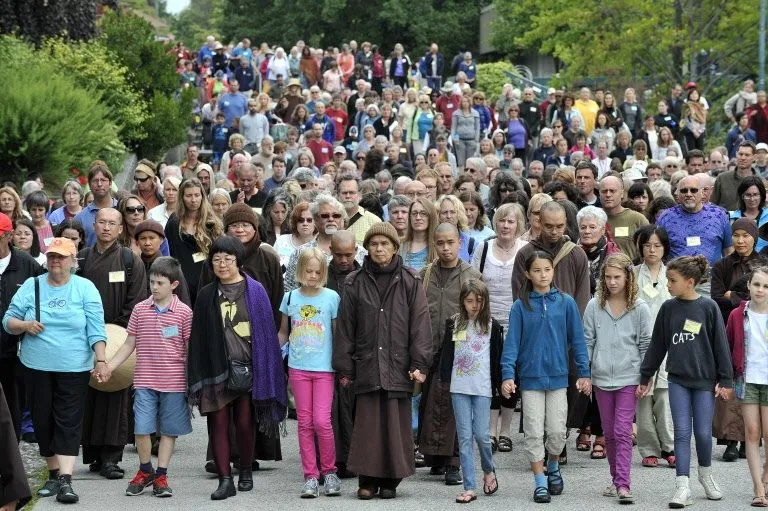
The foundational practice of the Buddha is mindful breathing. Awareness of our breath is the first practical ethical action available to us.
When we look at all the suffering around us—poverty, violence, or climate change—we may want to act immediately. But to do something effectively and ethically, we need to be our best selves.
A simple mindful breathing practice:
Breathing in, I know this is my in-breath.
Breathing out, I know this is my out-breath.
Breathing in, I’m aware of my whole body.
Breathing out, I’m aware of my whole body.
Breathing in, I’m aware of tension in my body.
Breathing out, I release all the tension in my body.
Breathing in, I am aware of a painful feeling arising.
Breathing out, I release the painful feeling.
This is a gentle, nonviolent way to release tension and pain. Mindful breathing strengthens our presence, allowing us to handle suffering in ourselves and in the world.
Applying the Practice: A Message from Sister Chan Khong
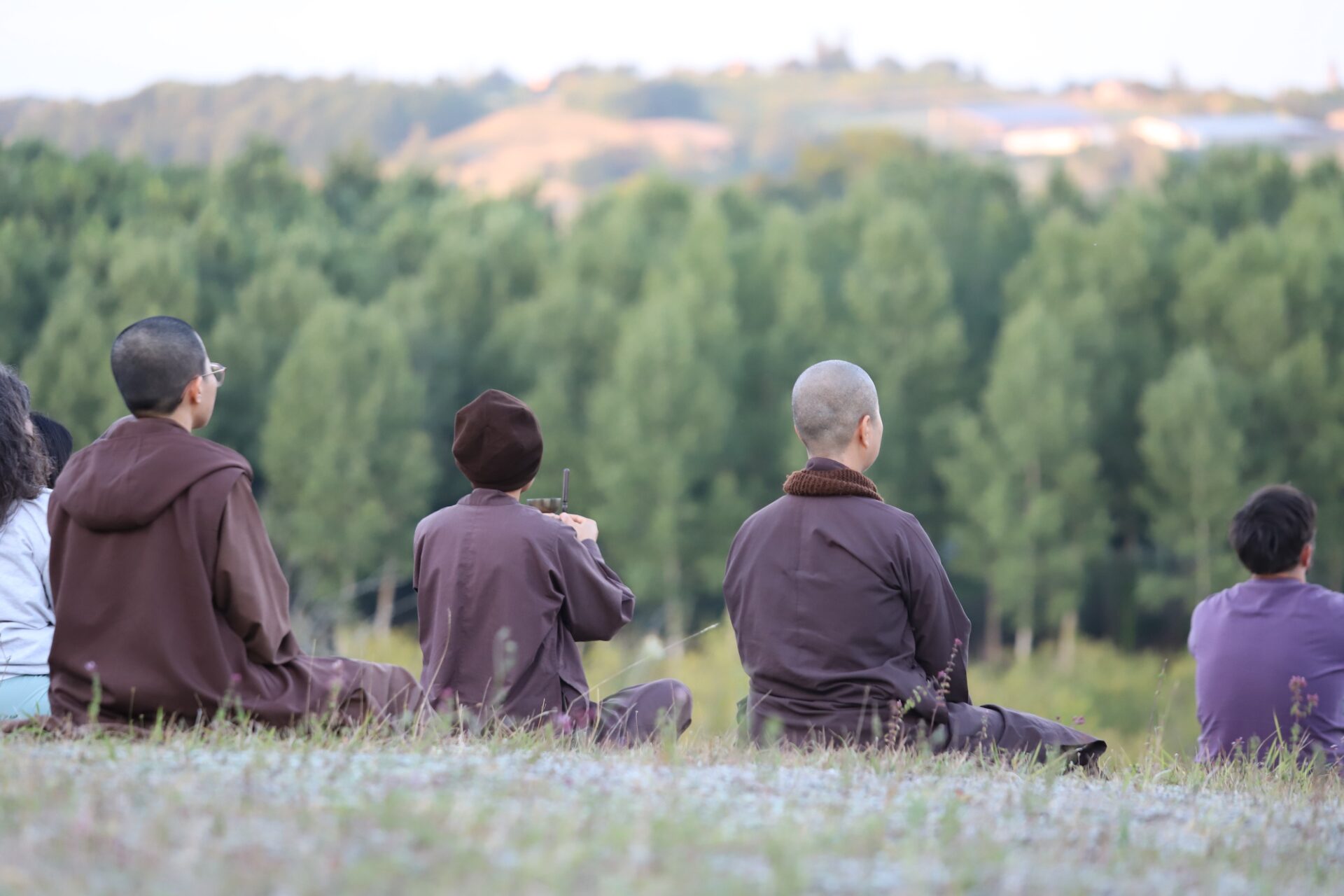
Thay taught me to always remember to come back to my breathing, and dwell only with the breathing, from within. In this way we can be our best: we can be stillness and give rise to a clear mind. Then, deep awakening and compassion can manifest, right in that moment, in our own hearts, and it becomes possible to see it and touch it even in the heart of our so-called ‘enemy.’
Whenever you receive devastating news, or witness injustice, or feel helpless and full of despair, please remember first of all to come back to your mindful in-breath and out-breath. Don’t do anything or say anything until you have touched that calm, that peace, that love. Mother Earth needs you right now. She is calling out for your help. You are her beloved children, and she needs you to be love, to be light, to be peace.
You have light in you. You have the energy of the bodhisattvas in you. With a spiritual dimension in your life, you will be able to keep balance and live deeply in every moment, cherishing this life you have to live. And with that energy, you can take action to protect the planet and protect each other. Together, you can do it. Do not be a lone warrior. Find your allies and build community wherever you are.
The Role of Sangha (Community)
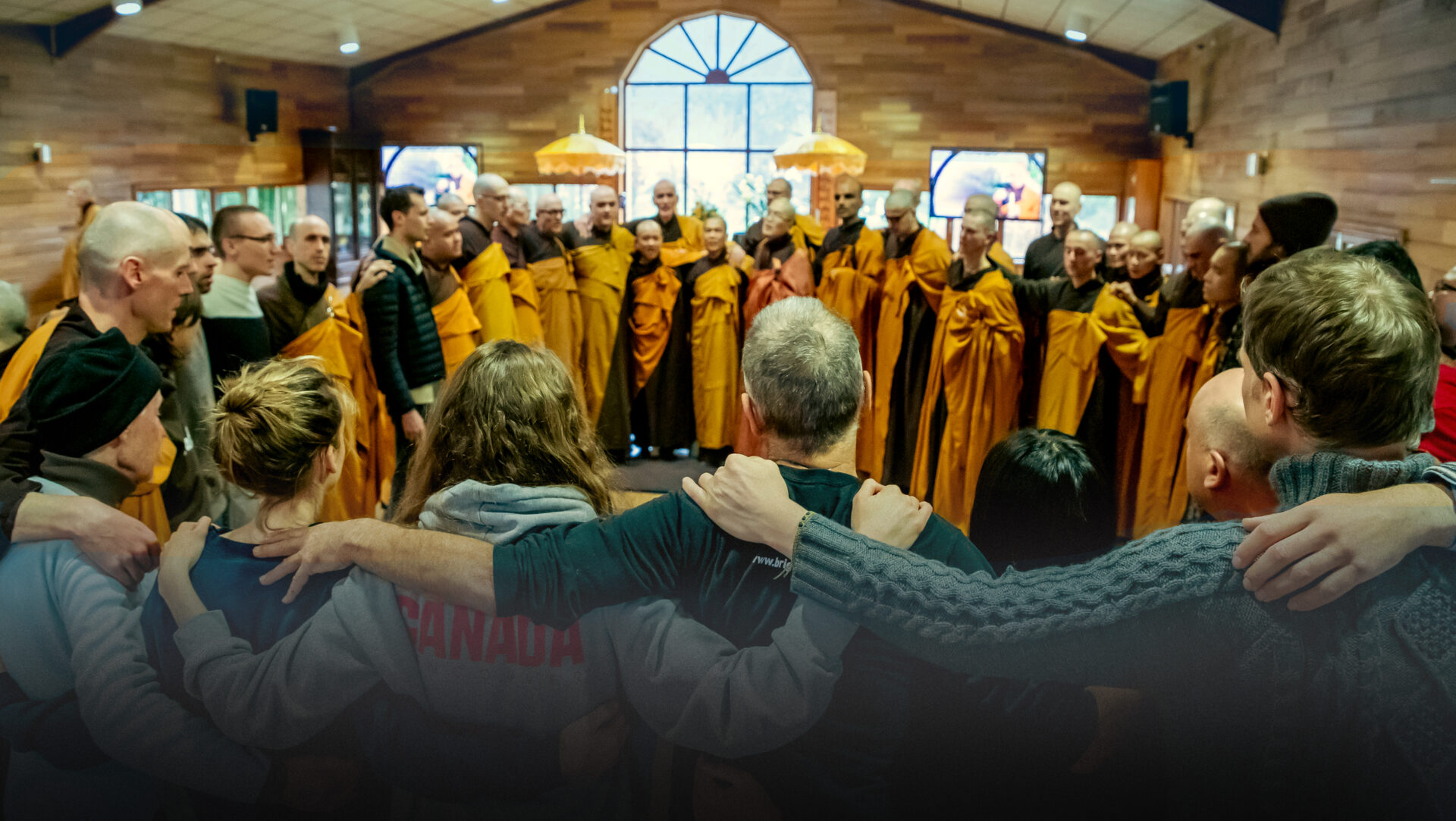
Taking refuge in the sangha is not a declaration of faith. It is a practice. You know that the sangha is made of elements that are practicing mindfulness. They generate the energy of mindfulness together. Allow the sangha to embrace your pain, to transport you, and not to worry. It’s very, very important.
You have the capacity of building a sangha, too. When I first came to the West, I was all alone. I came in order to call for a cessation of the war in Vietnam. I was alone. I was not allowed to go home because of what I had said. I knew that I should be supported, so I began to build a sangha. And now, our sangha is big; it is everywhere in many, many countries. But we should always remember that peace and well-being begins with ourselves.
For me, the next Buddha can take the form of a sangha. When we join the sangha, we are determined to abandon the old way of seeking individual happiness. Individualism is the characteristic of our civilization, and it has created so much suffering. Learn to live as a sangha. Look at the sangha as your body. Surrender yourself to the sangha. Take the joy and happiness of the sangha to be your joy and happiness. You’ll be free from most of your suffering, and we’ll be able to flow to the ocean as a river.
Resources
- Good Citizens (Parallax Press)
- Zen and the Art of Saving the Planet (Parallax Press)
- Reclaiming your Sovereignty (Dharma Talk by Thay) p.6 PV Newsletter


Share Your Reflections