

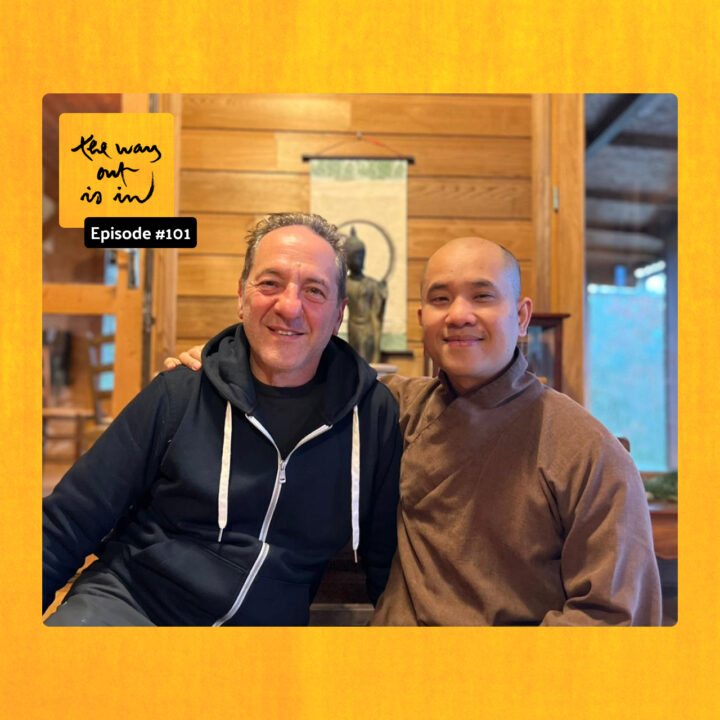






Welcome to a new episode of The Way Out Is In: The Zen Art of Living, a podcast series mirroring Zen Master Thich Nhat Hanh’s deep teachings of Buddhist philosophy: a simple yet profound methodology for dealing with our suffering, and for creating more happiness and joy in our lives.
This special episode – the last of two question-and-response (Q&R) installments – marks the publication of the second book by Zen Buddhist monk Brother Phap Huu and leadership coach Jo Confino. Calm in the Storm: Zen Ways to Cultivate Stability in an Anxious World is intended to help readers meet the current polycrisis with love and stability, but also forcefulness and resilience.
According to Plum Village tradition, Jo and Brother Phap Huu recorded two episodes responding to questions by listeners which connect to the book’s themes. In this second part they answer questions on dealing with anxious thoughts, raising children in uncertain times, reacting to the anger of those around us, managing fears and hypochondria, and much more.
Co-produced by the Plum Village App:
https://plumvillage.app/
And Global Optimism:
https://globaloptimism.com/
With support from the Thich Nhat Hanh Foundation:
https://thichnhathanhfoundation.org/
List of resources
Being with Busyness: Zen Ways to Transform Overwhelm and Burnout
https://www.parallax.org/product/being-with-busyness/
Calm in the Storm: Zen Ways to Cultivate Stability in an Anxious World
https://www.parallax.org/product/calm-in-the-storm/
The Way Out Is In: ‘Calm in the Storm Q&R, Part One (Episode #97)’
https://plumvillage.org/podcast/calm-in-the-storm-qr-part-one-episode-97
Interbeing
https://en.wikipedia.org/wiki/Interbeing
Plum Village Tradition
https://en.wikipedia.org/wiki/Plum_Village_Tradition
‘The Fourteen Mindfulness Trainings’
https://plumvillage.org/mindfulness/the-14-mindfulness-trainings
Ursula K. Le Guin
https://en.wikipedia.org/wiki/Ursula_K._Le_Guin
The Sun My Heart
https://www.parallax.org/product/the-sun-my-heart/
Quotes
“If Buddhism is not engaged, it’s not Buddhism.”
“We have to study the meaning of calm, because when we say ‘calm’ or ‘sitting meditation’, that may look like non-action. But what we have seen in some of the most impactful work is that, when people take the time to be still, to listen, and to embrace and hold feelings and emotions and these projects in a calm manner, they are able to direct, lead, and not be carried away with the force field of anxiety, of fear, of restlessness.”
“Mindfulness is only true mindfulness if it’s generating love and compassion.”
“We can say so many things about Buddhist history and Buddhist philosophy, but what the Buddha transmitted to us and really wanted was for us to ask the question, ‘How can I put these practices into daily life?’”
“When everything is changing, the most important thing is to also know what needs to remain the same.”
“Our mindfulness should not be a blockage to other people’s engagement with us – but, at the same time, we do have to have boundaries. We do have to have clarity.”
“Mindfulness is to lead an ethical life. If you’re practicing mindfulness and you’re continuing to cause harm to the earth, to living beings, to yourself and your loved ones, maybe that is wrong mindfulness. As Thay said, ‘Is the burglar mindful?’”
Dear friends, if you have a deep love for the Earth and wish to learn how to bring the energy of mindfulness to your climate response, Zen and the Art of Saving the Planet is a 7-week online learning journey where we as a community will learn how cultivate insight, compassion, community, and mindful action in service for our beloved Earth. Inspired by the timeless wisdom of Zen Master Thich Nhat Hanh, this course includes Dharma talks and practices, community sharing groups, and live interactive events with monastic teachers. I'm looking forward to teaching at these live events together with my monastic siblings. We'll learn together for seven weeks from 1st of March, 2026, into our closing event on 19th of April. Join us by heading to the website today, plumvillage.org/ZASP, that is Z-A-S-P, and we look forward to walking on this path with you. Thank you very much.
Dear friends, welcome to this latest episode of the podcast series The Way Out is In.
I am Jo Confino, working at the intersection of personal transformation and systems change.
And I'm Brother Phap Huu, a Zen Buddhist monk, student of Zen Master Thich Nhat Hanh in the Plum Village tradition.
And today, dear listeners, we are going to have a second bite of the apple and what that means is we're doing another question and response session to mark the launch of our book, Calm in the Storm. And we love this actually, don't we, Phap Huu, because we get the chance to just listen to what people's concerns are and then respond to them in the moment. And we don't know what we're going to say. Phap Huu doesn't know what the questions are, so it's going to be a little bit of a surprise.
The way out is in.
Hello everyone, I'm Jo Confino.
And I'm Brother Phap Huu.
And dear brother, this is sort of partly a way of thanking the thousands of people who have already bought the book, rather than just read it, which we hope you do, but also to listen to your concerns, listen to you questions, and be able to respond. And we've already done one of these. And the sort of, in a sense, the rules of engagement are that we don't have answers. We just will talk from our own personal experience. And as in the great teachings of the Buddha, you know, don't take our word for it. This is just the way we see things, but obviously just see what resonates with you and make up your own mind. Brother, how are you today?
Today. Good question. I am very mellow, which is good.
We're going to get you out of that very soon. So, brother, anything else to say before we dive in?
No, let's go in.
Okay, he really is mellow today. So let's start off. So here's one question. Sometimes when I try to remain calm, it makes others around me even less calm and angrier. I guess my question is, what's up with that? Congrats on the book. So it's fascinating, isn't it, brother, that sometimes when people are angry, that they want us to be angry. And if we don't respond to their anger with our own anger, then it looks like they're being ignored. But what's your sense of why is it that when we can remain calm, that other people get more restless and even angrier?
Well, that's a good question to ask them. Like why are you angry that I, that I'm not responding? But on a practitioner side, I would recommend our practice is not to be angry at them for being angry at us, or else we add to the fire in a way. I think that we live in a society where we, it's like a calm response in a way like the way we offer energies, we expect a kind of energy in return and calm and peace and let's say Zen. Could be not normal in in a more busy life or busy society so it could be triggering for people and it's in a way it's their own responsibility to be mindful of energy that they are offering out. I always come back to what is the practitioner, what is the responsibility of a practitioner? Because sometimes we cannot control people's reactions or people's, in that moment, what they are carrying in their heart. Maybe it is not what they expected, and then it brings out different mental formations in them. Mental formations is like emotions and feelings. The most important thing I shared is just to come back and to check in with how we are responding to that. And then to be very mindful, even when we are peaceful or calm or quote-unquote very present, like how are we present though? Is our presence in a way to show off? Is our peace and calm has pride with it? Like everybody is chaotic, but I am peaceful and I'm calm. And that can carry an energy of arrogance, that can an energy of I am better than you. So we do, I always reflect, I'm always checking, I'm like, how am I responding to the same environment in a way? And it's kind of like driving, you know, like, well, this is North America. I don't… North America and Europe, some countries in Europe, you know, when we're in the freeway and everybody's driving a little bit faster than even the speed limit. But if you go too slow, that can also cause an accident and traffic in a way. So it's not really flowing with the river in a sense. So, our energy of calm and peace, like… It could also still be in harmony with the surrounding energies. And it's very hard to imagine that, but I've experienced this a lot in my own journey and in the community. Like sometimes when, like we're in some very intense meeting and then somebody senses, okay, we all need a breather, everybody needs a joke, right? And everybody's laughing, then you have that one person who's like, trying to be all serious, and it just kills the vibe, in a way. Our mindfulness should not be a blockage to other people's engagement with us, but at the same time, we do have to have boundaries. We do have to have clarity. Like, no, I'm not gonna engage in that kind of energy. And there are energies we don't engage in. And there's energy where, because I know what is my well-being, I'm like, no, I'm not going down that route because if I do, it's going to become toxic or it's gonna become new mental formations that formulates and become new knots for us to unlock. So like this response, it is very multi-layered and it's not a direct answer because every situation is very different.
But brother, what you said right at the beginning, I thought was really interesting, which is about asking people about their feelings, because, you know, one of the practices that I find most powerful in Plum Village is deep listening, which is not to, as you say, pretend that you're not affected by things, because actually anger does affect us, but actually just to be able to really listen to someone's suffering, to listen to why they're angry. And just the ability sometimes to listen to them and to ask them questions about it is going to calm them. That we don't necessarily have to be calm ourselves in order to help them to become, but we can just actually listen to people's anger because I think behind anger, there's always other emotions. There's sort of often fear or concern about something and even sometimes love. I mean, you know, people get angry because they normally, they love something and they care about something. So it'd be good if you can talk a bit about sort of what often underlies anger. So when someone is expressing anger, what else might be going on that we can be attuned to?
I think I always attuned to not knowing what they're going through. It's very helpful. So it's, in a way, I am allowing myself to be open and to be curious to their present moment experience because maybe it's a friend or someone that I'm very close to, and I may think I know them so well. And there's always surprises. There's always something that somebody may be in that moment holding in their hearts. Maybe it's a day, it's a month of the year that every time that comes is around that time this particular pain comes up. And part of meditation is to look deeply and to understand. And to understand we have to be open. We have to be curious, we have be skillful. It's the word we always use in our tradition. It's like be skillful with what people is experiencing and how they are reacting in order to be there for them in a way. And sometimes maybe there's nothing you could do and you shouldn't try to fix them and you should try to even relieve their anger because it might be something that they are processing. And if you force them to to overcome their anger, to become angrier. So it's like our teacher always says that love is understanding, right? So if we want to support them, we offer our understanding and understanding comes in many, many forms. Mindfulness is the first door to it, which is like just to know that, okay, this person has a lot of emotions and energy in this moment. What can I offer them? Is it a question, like you said, like, how are you? What are you holding? How's your heart? Like, there's many ways to ask, then how are, you know? Is there anything I can do? Do you need some space? I'm there if you ever need, but I can clearly see having space is probably important right now. These are all the words that I've learned through my years. And I think sometimes, especially for those of us in the practice realm, we may judge people very quickly. Like, okay, you're angry, let's take care of it right away. Sometimes maybe that person is taking care of it and we're not aware of it. So having the sensitivity to this it's a skillset you kind of develop and it's part of mindfulness. It's a part of awareness, what you see, how their body language is and what is behind that, like I share is like the stories that they may be carrying. And maybe it's the wrong perception, but maybe it is not the right time to try to fix that wrong perception. Our teacher always encourages us, especially for those of us who are angry and I've been angry and have shared it in the podcast a few times. My responsibility is not to respond. Even if somebody asked me, how can I help? I said, actually right now, the best way to help me is I advise you to give me space. You don't want to unleash the demons in me. Thay used to have a joke with us, he's like don't make me spit fire. And I've seen Thay spit fire. It's scary, it's scary.
And brother, I love that idea that we shouldn't try and fix people. And sometimes we have to let the emotion run its course. And of course, that's not just with anger. I see that a lot in group work. If someone's very upset, that people will immediately crowd around them, sort of give them a hug, give them tissues, sort of say, oh, don't worry. Whereas actually the most important thing is for that person to feel that emotion at that moment. And it's only if they feel that emotion that they get and get through it. And if you try and stop it, I think also what you're saying is don't watch your own emotions. Are you fearful of anger? Do you find anger very difficult? Does it trigger you and therefore you want to close it down in the other person, if someone is very upset, is it difficult, is that expressing difficult emotion for you and you would actually just want to calm them down for your own benefit. So thank you. That's all about mindfulness. And often listening to what's not being said or the emotion that's not showing up because often below a surface emotion is another emotion. Let's go on to the next question. Here we go. And this relates in that bit. So when does staying calm become a timid act or a form of escapism from the problems which have external causes such as unhealthy or controlling work environments, versus when does stay calm become an act of regaining freedom and cultivating stability in a busy world? That prompts us towards anxiety. I ask this in the light of McMindfulness debate, where mindfulness is criticized for being used as a tool to pacify the masses and control them. How do we discern the practice of mindfulness in the backdrop of these concerns? And actually, brother, it's a fascinating question, because it's, you know, when is mindfulness being used just to, in a sense, dampen ourselves down, force us to accept, Oh, it's all okay, that's just life. If we accept it, that's the answer as opposed to recognizing that actually sometimes we need to deal with things.
One truth that I have experienced in engaged Buddhism and engaged mindfulness is that even the calm and the stillness is very engaging. It is action. When we say, be calm in the storm, that doesn't just mean sit there and do nothing. It is being calm in order to do, being calm in order see clearly, in other to not stir the pot even more, or when the storm is raging, we have to know how to come back to our own self to recognize the outer storm and the inner storm. And for us to be a practitioner of mindfulness, you cannot be passive. You cannot bypass things. You can only bypass things for a little bit until you realize I'm actually not doing anything in life. I'm offering nothing to myself and I'm nothing to the collective. Here, our teacher has once shared in an interview and they asked Thay, Thay, what is the difference between this Buddhism and that Buddhism? And Thay, his one answer just… You know, strikes a deep chord in my trust in this tradition. He said if Buddhism is not engaged, that's not Buddhism. And I think what we have to, in a way, study the meaning of calm, because when we say calm or we say sitting meditation, that may look like a non-action. But what we have seen in some of the most impactful work is when people take the time to be still, to listen, to embrace and hold the feelings and emotions and the projects in a calm manner so that when they direct, when they lead, it is not being carried by the force field of anxiety, of fear, of restlessness. And that doesn't offer anything. I mean, the quality is lower, excuse that phrase, because that's not true. Every offering is an offering, but the offering, when there is calm, the impact and the quality, I would say the quality of calmness, it has a penetration of beyond just the work, right? It's the way we show up for each other. It's the way we speak in that moment. It's the way we are embracing the storm or taking care of the difficult situation. I've witnessed those who've taken care of the same situation who makes it 10 times more difficult. I have a very clear example. Oh my gosh. I hope these siblings are not listening to this podcast but our previous years ago, our previous, years ago, meditation hall coordinator, the meditation hall responsibility, in my opinion is very noble work. It's very… It's not heavy work, but it's very, you have to pay attention to the detail and it's every day because the hall is being set up every day. If a monastic is not there, you've got to change all the names again, da da da. And we had one, two brothers who did it, and one of them was always anxious, always anxious. And every time I set up, he becomes very worried, over-worried, and he transmitted to the younger brother. And then when we had a turnover of responsibilities and we had another brother in, another two brothers in. And their attitude, it's the same job, Jo, setting up for sitting, for Dharma talks, for classes, for ceremonies. And of course, there's always support. There's always elders to guide the way, right? And the two new brothers, they take it with full responsibility, but they have such clear mind. Every time they need a setup, they just ask to make an announcement. We need five people to stay behind and help us set up the hall, no fuss, no anxiety, no restlessness in it. So it's the quality of that person in their way of preparing themselves to be of service. And that is a training. And of course, this brother has been in the monastery longer, so there's quality that they have developed that. It's the same responsibility. It's the same hall. It's same mats and cushions, but the quality is so much different.
Thank you, brother. And this whole idea of McMindfulness, which actually I hadn't heard of that before. But there's a talk about quality. There's a major difference between, in my experience, the quality of mindfulness that is being taught in Plum Village and the quality of mindfulness you might get just from an app. And you know, I remember when my job in New York, there was a campaign by the sort of HR department said, bring your whole self to work. And I was thinking, oh my God, if people brought their whole self to work, they'd probably be sacked straight away, but that sense of, you know, in their idea, bring your whole self to work was just very narrow, which is a lot with mindfulness. Mindfulness is about concentration. It's about sort of coping. Whereas mindfulness in the Plum Village tradition is about engendering love and compassion. And I always remember I interviewed Thay once and I said, Thay is What do you think about business and mindfulness and all these businesses now training in mindfulness? And he answered by asking a question. He said, well, a rhetoric question. He said is a thief picking a lock being mindful? And the answer is no, he's just concentrating. And Thay said mindfulness is always, that mindfulness is only true mindfulness if it's generating love and compassion. So can you just talk a bit about, because mindfulness is a way that's… used so often now, but actually it can mean many things. How would you describe mindfulness in the Plum Village tradition?
Well, rather in the Plum Village tradition, I'll go to the source, the Buddha. Mindfulness is mindfulness of suffering. It's to be aware of suffering that is present and suffering that could manifest through our ignorance. And that's why we engage in the practice of our awareness because if our actions, our body, speech, and mind doesn't have the quality of awareness, we can continue to create more and more suffering and offer it to the world. But understanding suffering in Buddhism, Buddhism is not all about suffering like a lot of folks would identify it as only, but when we speak about suffering, we also speak about happiness. So when we're mindful, when we are engaging with the practice in everyday life, we know every actions, every way of being is a contribution to the world, it's our karma, it is our karmic energy that we are offering. And in the Plum Village tradition, this is where I can go to our tradition, our fruit of practice is in the present moment. And in present moment it is creating the future, it also creating the past. Some of the fruits that we will experience, we can feel it right away. Just as if we practice three mindful in-breath and out-breathe, like real attention of the breath, and we know how to do it, it has become a quality of breathing that can restore our oneness from our busyness, from our storms into the calm, into the oneness. Those three breaths have the power of grounding us into the present moment. And right away, that is the fruit you feel right here, right then. And if you keep practicing this and cultivating that quality, later on, you are engaging in a conversation and you recognize your emotions are rising, you are feeling less focused, ah, you know what to do. Come back to your breathing, come back to your mindfulness, and then that is the of the cultivations of the practices, right? So when we speak about mindfulness, I am kind of happy that mindfulness has become a verb in the world, it's become more mainstream. But of course there's a danger to that also because it gets diluted and it becomes in a way light Buddhism or light mindfulness, which I've heard people calling Plum Village light mindfulness which I think is a wrong perception. It seems simple because of the language. And because what we're teaching, even in this podcast, we don't really bring up scriptures and we're not bringing up sutras because this is not an academic podcast. But just in these very fundamental understanding of the present moment, it's a three month course, Jo, and it's lifetime of practice. Like we can say so many things about the Buddhist history and Buddhist philosophy, but what the Buddha transmitted to us and really wanted for us was to ask the question, and how can I put these practices into our daily life?
And brother, there's something about, you know, this question about, is mindfulness timid? I mean, I find that the reason I find enormous strength in it is because our minds are pulled in so many different directions. And so often when we're responding to things, we're respond not to that particular thing, but to all the other causes and conditions that have brought us to that moment. And I find that mindfulness, what it allows us to do is really to say, What is it that's impacting us? What is it right this moment that we are finding difficult? And to be able to focus our attention on the actual issue at hand rather than bringing all of our problems into that moment.
And mindfulness, it is to lead to an ethical life. If you're practicing mindfulness and you're continuing to cause harm to the earth, to the living beings, to yourself and the loved ones, like we, maybe that is wrong mindfulness. As Thay has said, is the burglar mindful?
So, brother, let's go on to another question. And it's very short, but actually it's a deep question. It's saying, I am wondering what to do about anxious thoughts that keep coming back. And the reason I think this is an interesting question is because there's such a desire in people to rid themselves of their thinking, to say actually I just want to solve this, I just want to get this out of my mind, I never want to suffer from this again, as opposed to just the recognition that actually sometimes because of what's happened in our lives we're going to those anxious thoughts at some points throughout our life, that there are going to be moments where that anxiety gets triggered. The premise of this is what do I do about anxious thought that keeps coming back? Is it true that actually part of it is just accepting that actually we are going to have those thoughts that actually and not to fight them, not to see it as success or failure whether we have them or don't have them but just to make friends with them?
I think the first step is just acknowledging that we have these anxious thoughts and being able to recognize it and the difference of a practitioner is, and they're not being carried away by it. A very simple, but very difficult practice that I've heard again, and again, and again, and again in our tradition. And it comes also from the time of the Buddha. The Buddha says, whenever we have particular thoughts, we just have to learn to change the peg. We have to have new thoughts. If we've had an evil thought yesterday, in this moment, you create the most compassionate and the most beautiful thought to something very true. And the Buddha has always told us, suffering is always there, hell is here. It's not when you die, then you go to the different realms of hells, but hell is present everywhere in earth, on earth, around our society. And if we live in a city, you know, you see a homeless person. That could be a practice of real generous practice, generosity, but also practice of having a thought where this person could have shelter, could be cared for, could be loved. And it's a training, that's why we have to learn to cultivate the mind. And Thay, in the modern time, well, before screening, Thay would say, why keep listening to that CD? Change the CD. It's like our anxious thoughts and the stories we carry they are like tapes and video recordings that without our awareness, it will keep playing just like white noise in a way, like the fan keeps going on and we get so used to it that we become it. And mindfulness is when we start recognizing particular thought patterns, we get to start to ask the question, oh, where do these thoughts come from? Where do these feelings come from? Why do they always come up at this time? They develop habits, they create habits, they create habits and actions, right? That's why the language that our teacher always used to say, like every thought is an energy. And where do you wanna direct that energy? If you keep watching that, you're gonna keep hurting yourself. It's a practice of recultivating and curating new thoughts. And new thoughts can always be produced. We're living, we're a living human being with the mind consciousness active, with the store consciousness ready to receive, ready to help ripen new views in life. So it is, meditation is not about coming to the state of no thoughts. There could be moments when we enter into these places of just such ease in the mind. But it's not the aim. It's not to have a view. Like in the 14 Mindfulness Trainings, Jo, like the second training is about non-attachment to views. It is not about us not having views. Views create a just society. Views inform us of our actions, but it is about the attachment to view. So the attachment to our anxiety, attachment to the stories that we keep carrying. And I've been hit when I was young, right? And Thay once gave this teaching and it really spoke to me. He's like, if you're going to keep entertaining that pain and that suffering, then you're going to be slapped. Even though that physical slap is not present anymore. But that abuse that I have received will keep coming up unless I accept, I acknowledge that that is pain. That is something that has happened. It has created suffering in my life. It has allowed me to also be also very empathetic though because I know what suffering is. And then how can we turn the mud into the lotus?
Beautifully spoken, brother, and just to add to that, so I'm doing a book project at the moment where I'm interviewing 21 long-time Buddhist teachers from across all traditions, so they've all been practicing for between 40 to 60 years. To a person, they are saying what you're saying, which is even after 50 or 60 years of practice, and these are full-time practitioners, these are not people who sort of once a week sit, these are people who have devoted their life to these practices, that the same old thoughts still come up in their mind. It's not that they've eradicated anything. You don't eradicate them, but as you say, you don't become so attached to them. You can watch them almost a bit like meditation. A thought comes in and it's like a cloud and you see it come in and you'll see it go by. And my experience as a young man, and I see it in so many people, I coach, is that people, they want to get rid of it. They say, I never want to feel that. And if I work hard enough, if I do enough work, then I'll never have to feel it again. And so then when it comes up again, they use it as an excuse to beat themselves up. That, you know, I've been practicing now for a week or a month or a year or five years. Why am I still feeling this? And I think what you say is so important for people to recognize is that just because you feel something doesn't mean you have to attach yourself to it because that is the damage that's done.
You know, this, like what you just spoke about, I think many spiritual teachers and many artists in the world have created stories about befriending our own dark thoughts inside of us, right? The yin and the yang, or even the Buddha himself about the story about Mara, you know, before enlightenment, there was no particular ghost outside of the Buddha, but it was all the inner world. Like the desires came up, Mara was like, to the Buddha. And this is like in story form, like challenging the Buddha, bringing like armies and then when they shot all the arrows, the Buddha's mind just saw it as, ah, this is just perception and all those arrows became flowers. And then beautiful women, desires, coming to tempt us with our sexual energies and our craving for the world and all of this is in a way, the practice is to befriend all of us. One of my favorite manga, for all of those who reads manga, like I love Naruto and not many people maybe in the, sorry, Jo, in the older generation.
Why are you saying sorry to me? I'm so youthful.
You may know of this, but it's one…
I don't even know what manga is.
Manga is…
I thought it was like something, a fruit. It's not mango.
Manga is Japanese cartoon and it's one of the most like creative and they they bring in the craziness of the world and the most beautiful elements of the world into stories, right? And Naruto is one of my favorite because he grows up with a demon inside of him, one of the nine-tailed foxes. But the beautiful story of it, it's not about him getting rid of that demon. It is how that demon had became his strength, have befriended him, have shown up in a way to support him. And it just shows like through so many culture that the story of we all have the light and we have the darkness inside of us. So we have anxious thoughts, but we have compassionate thoughts. We have violent thoughts and we have caring thoughts. Yes, there are times we have evil thoughts, and so many times that we can have so much loving thought. And the more this character, Naruto, became a more loving person, that demon loved that side of Naruto. And I just think that it's so rich about this deepening and these deep questions that we all have to ask ourself. Thay, our teacher, always says, like, we have daily concerns and then we have ultimate concerns and some of our daily concern is like, you know, paying the bills, having shelter, having food, education for our children, but then we all have deeper questions inside of us. It's like, what is my legacy that I leave behind not in terms of material wealth but as I am remembered or what I'm transmitting, as well as the forces inside of me that I have, and each and every one of us has different forces. And how can we truly embrace it in order to transform it? And that transformation has this very unique look. It's not from right, it becomes left, or from left, it become right. In Buddhism, you can never cut off one side. You can't other each other. They always co-arise. So no matter wherever there's goodness, there's always gonna be darkness. And that's a truth we all have to embrace and we all have to accept, or else Buddhism wouldn't be here, or else the spiritual tradition wouldn't continue teaching these teachings, these spiritual practices for us to hone as an art of a way of being.
So brother, you have made something age appropriate for your youthful 38-year-old. So I'm gonna tell a story about that maybe someone of my age may also relate to because I loved reading Ursula Le Guin. And she tells this story of this young mage who is very arrogant and he lets this dark spirit into the world and it pursues him. It's always pursuing him and then it hurts him very badly and he goes to his teacher to recover and when he recovers his teacher says you must go and hunt down rather than be a victim of this dark energy you have to go and face it and so he searches for it and searches, searches for it and finally he comes across it and he meets it and he realizes it's himself. It's another part of himself. And then they hug and they become the best of friends. And for me that's so true that we imagine that these forces are trying to hunt us down and kill us. But actually they're trying to hunt us to let us know they're there and for us to befriend and to love. And I'm gonna do another story that is of my age line.
Lord of the rings.
Very close, so close.
Oh, very close. Very close. Dune?
No.
Older?
Yeah.
Wizard of Oz? Okay, go for it. Go for it!
The Matrix.
That is not that old.
Well, it's old enough.
Okay, yeah.
So there's that wonderful, and many of you may have seen The Matrix, but there's these… what are called agents who are sort of in this computer program. And so the people believe that these agents can kill you and that they do kill people. And there's this hero called Neo and these other people who are part of the rebellion, and some of them get killed by these agents. And once Neo sees through The Matrix and realizes it's not the truth. One of the agents comes to fight him. And he just, Neo just fights him off almost without thinking about it. He's like thinking about something else and he's just holding his hand up and just fighting off this sort of very, what would have killed him. And he's like a bit of fluff on his shoulder. And it's because he's seen through it, because he knows it's not real. And one of the things about Buddhism, the teachings about Plum Village, that's so helpful to me is to know that these emotions are not me. That if I believe an emotion is me, it can kill me, literally. I mean, there are people who commit suicide because of an emotion that they believe is them. And that it's the whole of them, and at that moment, they're unable to handle that. But if we're able to see through to the truth, that emotion is just a feeling, and it's not something that can hurt us, and in fact, it's something that actually, strangely enough, can heal us.
Anything else to say about that, brother?
I love it.
Do you have any other references for young people?
No, I love how we went down this route. Unexpected.
We're clearly in a different frame of mind today he says you started this by saying how chilled you were. I think we better quickly move on to another question before we go down another rabbit hole. Okay here's one, brother. As a soon father-to-be what advice or guidance would you give someone such as myself to help raise children in a world of so many uncertainties and tribulations, the rise of technology, artificial intelligence, hatred and negativity, fear, consumption and greed. As an adult, I grew up not knowing or seeing any of these things that we all experience on a daily basis today. You know, that's such a beautiful question. You know, here's a man who's about to bring a child into this world and it's a world he obviously doesn't really recognize anymore. It's not a world he grew up in and I think there's so much for people of my age. Or even a bit younger, but who have children and don't really understand the world anymore. And so don't understand how to support their children in dealing with things that they often feel they never had to deal with. So how, as he says, how can we, as an adult I grew up not knowing these things, what can I, how can I approach this?
Well, first of all, congratulations on becoming a father. You are already a father, even though your child isn't born yet. So congratulations to you and your whole family. I think before thinking about the outer world, just knowing that your child is human and that human needs beyond the food nutriments, it needs the quality of parents love, parents care, intentions, all of that the child soaks in from the moment it is already in the womb of the mother. It is already receiving so much data and I feel like the quality of the child's whole life forward, its first years as a baby, as a child, creates the whole foundation for his or her or theirs wellbeing into adulthood. And recently I've heard somebody shared like in this statistic of trauma, like the trauma that children, like real, like deep trauma of suffering, of abuse, or yeah, things that can impact our whole upbringing. As a child when we receive it, that has a deeper layer into our whole projection of life forward than as an adult, because adult we have different mechanisms and, I hope, in order to receive and to cope with in a way. But let's talk about the good qualities. I think the child, I have a nephew that I don't get to have much time with because I am a monk and I don't live with my family. But when I was home to just welcome my nephew into the world, every time I had the chance to carry him, I offer a prayer in a way. I kind of offer my whole intentions for him into the word, knowing that he will fall into suffering. It's a part of life, knowing that he will meet difficulties, whether it is through friendship, through family, through parents, or through AI, through computers, through the changing of the climate, maybe the shifting of our whole world, in a way, in this very collective moment, we can see new things are happening. Some of it, some deep suffering of the past is resurfacing in different ways of thinking and so on. And I can't let that fear become that present moment with this child because it's a miracle that I'm holding my nephew. And the practice of the present moment and the practice of knowing that this is the only moment we are alive though, it's very important And I'm not ignorant to say like, to think that he's not gonna suffer, but what I am offering him in this moment, it's my deepest prayer for him and my deepest presence and my deepest love that I can generate to offer to him. And I think that even though it was short, but now whenever we see each other on video calls, there's a very deep connection. And as a parent, one advice I would offer is that don't have the view like my time with my child is not my time. And then work time, partner time, child time, and then where's my time? And I think that is a rabbit hole of suffering because then suddenly that beam of joy suddenly becomes a burden, becomes a responsibility rather than our beginner's mind of just having this feeling that I'm going to be a father. This is in a way that this is your beginner's mind. Like how do you keep this beginner's mind always alive? And one of the teachings that I always hear Thay share to parents, is that you have to already see yourself in the child. Once you have that deep understanding and this understanding is continuously developed. There's going to moments you're like, no, no, that's him and I'm me. And then there's moments like, okay, my joy is your joy, your joy is my joy. But the deeper that that truth becomes our whole existence, then there is no more barriers of difference between me and my children. When I reflect back on my own childhood… Beyond like all the sacrifices that my parents have given and have made for the life I have had, and that is like an intellectual knowledge I have. But the qualities that keeps me like grateful for them, it's as simple as the time my father took us into the forest, took us to Chuck E Cheese, my mother would take us to Canada's wonderland, and she wouldn't go on any ride, but she would wait and she knows that because we are so joyful, so our joy is her joy. And those are just, those are memories that nobody will ever take away. And these are the deep love that till now, like I'm always grateful for my parents. And of course we have differences, of course, we have a different way of being, different views, and I've accepted that. It's enough. My parents are who they are, and that's more than enough for me, you know? And it's thanks to all of the times when I was a young kid and all of love and the quality that they gave me, and we weren't rich, but we were rich in just time together, a lot of time together.
Thank you so much, brother. It brings to mind when I was working at the Guardian, I ran a project called Living Our Values, which is about holding the Guardian to its own values and making it responsible for its own ethical standpoint in its editorial line. And every year I would interview the chair of the Scott Trust, which was the body that owned the Guardian. And at the time, and this was many years ago, when the internet was coming in and it was like disrupting the whole industry. And I asked her about that and she said something, I always remember she said when everything is changing the most important thing is also to know what needs to remain the same. And so as you were speaking, that sort of just brought that very strongly to my mind, which is that parents have always, times have always changed. They've always been revolutions or new technologies or new ways of seeing the world, new philosophies. But actually the love doesn't change. And actually as a parent, you know, what we want to give our kids most is a refuge. And in a sense sort of Plum Village is a parent in that sense, it offers people a refuge somewhere they know that they can come to, where they know that when they come here, they'll be held, to know that love is unconditional. And in a sense, just that is enough because in a world which is changing all the time, where there is impermanence, it's good to know what we can count on. Related to that, brother, I just wanted to ask about, how do we work with things that are changing that we don't understand? So, and I'll give you an example. You know, I have a couple of friends who have trans children, and they find it so difficult to know how to respond. It's something that they never experienced in their own upbringing. Something that is, for many people outside of their actual experience of life, and then suddenly having to work with sort of life experiences that they have no relationship to at all and yet it's their own children who they love and care for and it can cause an immense amount of sort of confusion and upset and misunderstanding. What is it, how do we, how well let me ask that slightly different, how can we be with people? Regardless of who they are, but people we really love who we just do not understand how to be present for them, how to love them, and sometimes feel a sense that we failed or that we've done something wrong. You know, it brings, it conjures up so many different emotions.
I think when someone is in the state of change and they really want to own up to their change because they're tapping into who they are and what they are just asking for, it's acceptance. It is the acknowledgement that there's a change that needs to be made and that acceptance is the greatest support that they can ever have. It's more powerful than words. It's powerful than explaining because I feel, as human beings, we all seek love. We all seek acceptance. We all seek acknowledgement for our own beings, whether it is racial differences or like sexual orientation differences or even status in the world or life choices that we make and in Plum Village, like in the monks and nuns life, we, I've seen monastics that their parents still today don't accept them for making this choice. And it's a big transition to all of their ancestors. And some of the families till today would never stay in Plumb Village. They would always book a hotel close by and just visit their son or daughter only, and not be with the community. And I see the practice of the monastic who has that relationship with the parents. Because they're a practitioner, they practice to accept the limits of their parents. But I've also seen the transformation when a parent starts to open the hearts and try to understand their children's journey. I can only share on the receiving end of the monastic that receives that openness. Like they, it's like they have received supplements that they've been lacking for years and they progress so much further on the path. They progress so much further in their own acceptance of who they are. Because if the more we fight against, then I think it also confuses them. And I speak because I also have friends who are parents of trans children and I always… My realization of one of the biggest need is love, right? And of course we, to come to that love, that takes a great letting go of the views that we've held onto, right? What is, what our children should be and should not be because sometimes we bring in our own childhood things that we were never able to do, and then we want our children to do it for us. And so they're not given their own life, they're given the life of us. And we expect them to do the things that they have never been able to. Right? And this is across all culture and generation, and I've seen it within my own circles of upbringing. And that kind of pressure and suffering. And then the support and the, I feel like when somebody is seen, is loved, is held unconditionally, especially for who they are, then they just feel like they can move through the world with so much more grace and ease. So I think this is just a response. Like, I think every family has, let's say, different views, but the view of the Buddhist and the view of a Buddhist practitioner has to be the view of acceptance. And awareness is aware of who we are, and what we are becoming, and our whole true nature in a way. And in a deeper practice, like labels are just means of seeing and acceptance. And at the end of the day, we're all human beings of emotions, of feelings, of capacities, of energies, of creating mistakes, of also being maybe some of the biggest change makers of our times. So to not limit ourselves from the labels also. And I practice this a lot every year, like there are at least three to five brothers leaving the community and they transform into something else. And my deepest wishes for them to always be a monk because that's my family in a way. And when I accept that they're gonna leave and they're going to transform, I feel so much lighter in a way. And I always ask questions like, you know, how, let's try to understand where we are at, you know. Is this the transformation you need? Is this, the new path that will offer you for you to meet your whole potentials in the world? And I try to ask questions of not trying to cut them or block them from making that choice, but also just to reflect in a way. And then when they've made that decision, like, why do I have to suffer by blocking them? I'm changing that, right? Of course, this is very different than the question that you asked, but it's just one very small layer of practice that freedom of thought and liberating and not controlling other people with the views that we hold onto, because that could be suffering for us and for others.
Thank you so much, brother, and it brings up this memory, which is one of my strongest memories in Plum Village, which was about a decade ago, and one of the young novices, it was the ordination ceremony, and his parents had come. And a couple of days after the ceremony, there was a sort of sharing circle at the and this new monk's parents were sitting in the circle and then the father spoke up and it really touched me so deeply, he said, I'm a general in the US army and when I heard that my son wanted to ordain I was so totally against it I thought he was throwing his life away but now after being here a week and seeing how he's held in the love of this community I've changed my mind and I now accept his decision. What a journey he took over a week from showing up, that's the first bit of courage, but recognizing he was totally against something, but actually being able to witness what the community was and from that place to change his mind. And I just thought, you know, his son, you know what a gift that was to his son to know that he was given a blessing. And often when people want to get married, they ask for the blessing of the other parents or of their parents. And it's very traditional and in a sense it's very old fashioned, but the energy of about it is if you get someone's blessing, it gives us so much space. It allows us to take, to move forward with confidence. So let's see what other trouble we can get ourselves into today. Okay brother, here's one. Many meditations put out by Plum Village say smile on the out-breath.
Oh really?
You see this is the beginner's mind practice. Is that all you do? But what do you do when you feel you can't even muster a smile to yourself? So let's broaden that out a bit, not just on the out-breath. A lot of in Plum Village is about, you know, just smile, just learn to smile. But if someone feels they can't smile, what can they do?
Don't smile. And it's okay to not smile for that session, for that day, for that week maybe, but maybe a little bit more than a month we got to check in. I… I always know that some of the meditations that we offer, it's limited because there's only so much that we can put on online and some of things that we choose to put online. But the Buddha and part of the meditations, we always wanna be able to recognize our feelings. Like, am I neutral today? Am I not happy, am I happy, or am I neutral? And if you're not happy be with that and understand why you're happy. And it's okay to not be happy, you know? But that shouldn't be the whole, your whole life shouldn't not be not happy. And then when those of us who mostly can smile on some days, and we're not ignorant to know that there will be days when I can't smile. There will be a day when it's better to be in grief. It's better be in pain even, in suffering. Because when you're in the suffering, then you are connected to the present moment. And we can go even deeper. We could still smile to the suffering. We could smile to the feeling of being angry. I've caught myself a few times just smiling because I'm so annoyed. There's sometimes I just smile because I'm like wow, I just went through that, you know and the smile it's for me. It's my life jacket and not giving up in the world because we all have dark thoughts that I've explained and one of my practices to not give into the dark thoughts is to be able to generate that authentic smile. And the smile, maybe sometimes it can't formulate on the lips, but that smile is in the heart. It's in the knowing that all things shall pass, right? The suns and the stars will still be there. The moon will continue to shine through the dark nights. And it's in a way like that smile, it's there in this sleeping. It needs recovery. It needs to take a rest. Just like any athletes, they have to know when to rest. They have to when to not engage because they're about to enter into huge competition. And so in our way of life, like… There are days, there are moments we know like we can't bring that happy energy to that place because what is needed is calm, serenity, formality even and practicing mindfulness is being very engaging to read the room. In the last 14 mindfulness training recitation, we have this moment where the question is asked, is there anyone who is not able to be present, but has asked to be represented, please represent them. And it's a very formal setting, Jo, and this young novice just ordained, just like a month ago, and he goes, yes. There is brother dot dot dot for health reasons cannot be at the Sangha restoration, at the Sangha recitation. Da da da da. And it just threw the whole community off. We're just like, whoa, where did that… That was like a curveball. And of course, there wasn't anything wrong with it, but I did have to call him out afterwards. I'm like, young brother, come here. I know you're a very joyful person. But in this moment, this is a ceremony. This is where we need to bring in the energy of reverence. These precepts are our teachers. Like, we're not skipping down the middle of the hall here. We're not doing jump ropes during this ceremony. We're being asked to enter into a solemn moment right now. And the brother was like, yes, I just realized after the way I said it. Like I think this is just also being aware of everything that is in relation to us. So when we can't smile, when we are mellow, accept that. I don't have to transform it right away. But now where we're at, I'm not mellow anymore, Jo. You see like there's transformation but the acceptance of it, right? I'm gonna try to fake it. But then I want to be respectful of everyone's energy. So I don't want to put people down. I know what I'm getting into and this is very engaging. This is why I come back to that question at the second or third one is like, when you're practicing mindfulness, you are actually very engaged into energies of everyone. And this is how you know how to read the room, how to make a comment, make a joke, be very serious, be very solemn. Like for, also for us, as a parent. Sometimes I feel like my dad is my friend. And then sometimes I know he's my dad. And sometimes we feel like we're just companions in life. You know, there's many ways of being together, but there is a moment for also very particular roles to come into play at certain point. Like you said, when somebody gives a blessing, if a parent gives a blessing to their child, that child doesn't have to sneak around anymore, can move with confidence. I really like that line. It's then we can move with confidence into the journey that we're about to embark into.
Thank you, brother. And I just want to come back to one thing because it keeps coming up. So in so many questions, but in people's lives, is that we have this binary view of life that we're either succeeding or we're failing. That if we can't smile, that means there's something wrong with us. And if we can smile, it means there is something right with us. And I find that so limiting because actually, as you say, we're different all the time and accepting ourselves is almost the most difficult thing for people to do. It's just to say, actually, I'm not perfect, but also I don't need to be perfect. There's no such thing as perfection. And that, as you say, the fact that I'm smiling is fine, I don't need to smile, but I know there is smiling in me. And also, one thing I found, brother, is that sometimes when we feel we don't have a smile for ourselves is to give a smile to somebody else and I often find this that if we're feeling that we're going through a difficult time that one route through that is to reach out to somebody else and show a kindness that sometimes if we can't show a kindness to ourselves if we show or see we can show a kindness to someone else then we actually already see that there's still kindness in us. Let's move on. Okay, I love this one, brother. He said, referring to Calm in the Storm, he said, this is an urgent theme, also for me, but I just spent 10 minutes thinking of a specific question to ask and found none. The thinking has made me feel a bit calmer, though. I just want to listen to everyone else's thoughts in this next episode. Thanks to everyone involved for the amazing work. I sort of, I love that because what he's saying is… I don't have a question, but just the fact that I have spent 10 minutes thinking of what to ask and found none, I still feel calmer. So what's going on there, brother? What is it? Interbeing?
Deep interbeing. Our friend was in an inner journey and he realized actually I have no question but I know there's going to be questions from other friends and it may echo the questions I have in my heart. As simple as that. It's just wonderful community realities that is really in action just through the questions that are written on the Instagram posts.
And just the fact that he spent some time slowing down and reflecting was what he needed to be calm. And I think that that's true for so many of us is not to try and, again, we're talking quite a lot about that, not trying to get a solution to it, but the fact he slowed down, stopped, put his mind to actually what would I like to ask, and then felt calmer. I love it because he didn't need to find an answer. There was no formal question that he wanted an answer and then he would feel calmer, but just the slowing down, stopping, reflection was calmness.
Yeah, and it comes this image in a book, I think, The Sun My Heart, which is a book that Thay wrote. And he speaks about when the storm is raging, what you have to do is close all your windows and the door. So our friend was probably like, oh, this is an opportunity. Let me dive deep and think of a question and by coming back to his own heart and his own awareness, realize, hmm, no question, and this is a peaceful feeling.
So brother, I want to ask another question here, which carry, which is a segue from this one, which is about closing our windows and doors. So the question is this, in this modern and stormy society, there are also a lot of campaigns about health and healthcare, such as tests, warnings, prevention, intervention, etc. How can someone with, for example, hypochondria cope with this kind of amount of input without getting overwhelmed and anxious.
What is hyperchondria?
You fear being ill. So that's such a great thing because of course that's true of everything. If we see advertisements for all sorts of things, how do we stop ourselves being pulled into consuming? If we're seeing, and this is particularly true in America where there's constant advertisements for medical interventions and what might be wrong with you and how you should need check ups, and how you need this, and how you need that, that actually can bring up feelings of anxiety for someone who fears getting ill. So this is perfect what you were just describing about, how do we close, I suppose not close, how do protect ourselves when the world is constantly telling us to do or be something that we know is not helping us, but that we find it very difficult to avoid?
Yeah, this is meditation. This is the Zen way. You got to go against the stream. Close the windows, stop looking at social media. Have moderation. So the key word is moderation. And the insight of impermanence is really important for us in acceptance of the full package of a human being. And that means we all are going to get sick. We're all going to get ill, get old, and die. But that's the truth. And the beauty is we all will go through that no matter how healthy we are. One thing to be very mindful of is that the advertisement industry is a trillion dollar industry. All of the baits are always there. It is working with our, in Buddhism we say our manas, which is our avoiding of suffering. And that is to escape into a feeling that we are going to do something to be better, to be loved, to be recognized. And meditation or the practice of the Buddha, the practice of the way, it is to stop the first wing of meditation. It is to stop. Stop running. Stop looking into the future of what we should become. The practice is knowing that this is me right now, and it's okay, it's enough. Like I have pain, I have aches all the time. I have worries all the, I have fears all the. I have questions, I have curiosity, but I'm not a victim to them. I could become a very good gatekeeper of knowing what arises and what shall pass. I know, because I'm also a victim of advertisement, that we are so driven by a consumeristic world. It's never gonna tell you you are enough. It's never gonna tell that you shouldn't subscribe here. That you shouldn't join this podcast, join that. You know, if you ever need a break from the Way Out Is In, please take a break, please take a diet. Go on a long fast, three years if you need to. I won't be sad. I don't know about Jo, but…
I'll be desperate.
But it's okay. I just kind of feel like Thay has used the word mindfulness is free will because you break yourself from all of the temptations of the world, of debates that are dangling in front of you. If we know that that fear is particularly strong, then we know we have to see what are the sources of feeling that fear even more. And this is where we have be disciplined. A part of Zen is discipline. You know, like having some firmness with yourself. What is precept? Precepts are boundaries. Or in the modern Plum Village language, Thay has translated it into mindfulness trainings, because they're all trainings to keep us in the right path, to keep us on the path so we need boundaries or else we'll fall off the cliff. And I know of friends who are creating very clear boundaries for themselves with when to not enter into the internet sphere, because it's the black hole. And then I know parents who, for however long they can, they will moderate their children's screen time, knowing that at one moment, they're gonna be out of the cage and it's gonna be beyond the strict rules, but it has to be that child's own awareness. And it comes back to also… knowing what is good for us and what is not good for us at the end of the day. And the human mind though, it's like sometimes we know what is it for us, but we don't have the ability to stop. And this is where the two wings of meditation are are always in action, stopping and looking deeply in order to then have action. Because we speak of the two because a bird cannot fly with just one wing. You cannot have just stopping but not looking deeply. You cannot looking deeply but not having the ability to slow down and to pause and to take drastic decisions. Well, that's why we monastics, our monastics we've chosen to take a drastic decision. And in some patriarchs, we say our path is we go against the stream.
Thank you, brother. I think just to add one thing, one element, which is about asking for help. So I mean, one of the things about, you know, the Plum Village community is it's a community. That not only can you ask your siblings for support, but your siblings are keeping an eye on you. And if they see that you're going off the rails, that they can sort of tap you on the shoulder and say, this is what I'm noticing. So I think when it comes to something like hypochondria, which is a fear, it's not a reality of illness, it's a fear of illness or other fears, is just to be open with them, with friends, just to ask for help, just to share your fear. Because I think with so many fears, people keep them to themselves. Everyone sort of thinks they need to look as perfect that they can't, they can't show up with their vulnerabilities. But actually, if you have a fear, if you just keep it inside of yourself, it sort of builds up and it builds up, and it build up. But if we're able to have friends that we can share our fears with, or people who know that we have our fears and can just check in with us, it's such relief. And there is that phrase, a problem shared is a problem halved. And I think when we try to solve any of these issues on our own, it's just so difficult. And Thay talked a lot about this, didn't he, Phap Huu? That it's sort of, you know, it's very hard to meditate on your own. It's very hard to heal on your on, and that's why we need to be part of communities. That's why he developed all these sort of sanghas around the world that people can go regularly and ask for help. So can you just? And let's just finish up here, brother, just talk a little bit about that sense of, you know, the teachings and Thay's model for, you know dealing with our fears.
Dealing with the fear is we have to be able to name the fear. Our friend has been able to their fear very clearly. And then when we know of the fear, then we also have to build a new muscles. Is that like you said, like, this is just a fear is not yet reality. And the Buddha has taught us about the second arrow. Which is our own perception, our overthinking, our over worrying. And that energizes more the non-reality present moment. And the practice is to say like, this is not true. Like honestly, I've said this in my meditation, like that's just a perception. Are you sure? Is a question. Ah, this not true, or this is just partially right. It is not whole, fully right. And we have to also like speak these mantras in a way so that it becomes and it replaces the fear. Like Thay said, Thay, in our tradition, we always say replace that habit with a new habit if you just say, okay, get rid of that habit, it's gonna be very difficult. But if you offer a new habits to it, then it's wonderful. You have a replacement to it. And I think in a way like, you know, now there's so many different sources of things that we can listen to, we can read, we can watch, that can infuse more of that fear. So we have to be very mindful of that. And then what are the things that we could watch, we could listen to, we can hear, that can help offer us a balm around those fear so that we can cultivate another way of looking, another way of understanding and to nourish the mind. And Dharma talks, podcasts, melodies, sound in nature. And this is really the practice that for for many of us when we first start the meditations or start in training in monastic life is like whenever we recognize some of the habitual energies that overtake us, every time that comes up, we know we're going to do something else. Every time that particular energy comes up, I am cleaning my room or else I'm just going to sit and I'm gonna procrastinate, I'm gonna entertain that thought, I'm going to overdo my thinking, right? And that's why then you have gardening, you have grass cutting, you have, there's so many things you could do in the practice, in life that becomes a practice. And I think this is a human discipline that training that we so need today, like particularly, I become a victim to doom scrolling, right? Especially on hard days, like we don't have alcohol to go to. Bless, bless, bless. But then you have this super computer in this little, this little device that you can just go down 20 different rabbit holes, right? And sometimes I just recognize myself. I've wasted an hour and 15 minutes when I could have went for a walk for an hour. And it's such discipline. It's such training. And we are so much more than our fears and our emotions.
Thank you, brother. You know, I know people who are hypochondriacs and who have been practicing a long time and it doesn't, again I think it's just a, you're not trying to get rid of your hypochondria. It's just that that fear is a fear that for whatever reason has been deeply ingrained in you and so it's not seeing that as again a success or failure, saying that is a part of me, but I don't need to, as you say, exasperate. I don't need to feed it, that actually there are ways that I can take care of it, going for a walk, speaking to a friend, having a nap, many, many ways. So brother, thank you for another beautiful, you started out mellow and then…
I'm gonna enter into mellow state right now.
Going from mellow to mellow, with a burst of energy in between. So, dear listeners, thank you for listening. We hope you've enjoyed it. If you did, there are many other episodes and you can find us on Spotify, on Apple Podcasts, on lots of other platforms that carry podcasts and not forgetting our very own Plum Village App.
And I'm too mellow to offer a meditation, but there are other, there's so many meditations offered by so many of our monastic siblings on the Plum Village App that you can always tune into. And this podcast is a co-collaboration between Global Optimism and the Plum Village App with the support of the Thich Nhat Hanh Foundation. And we would like to offer our gratitude and our thanks to Clay, AKA the Podfather, our producer. Our co-producer, with Cata. And our other friend, Joe, who is on sound engineer today; Georgine, present sound engineer. And we have Anca, our show notes and publishing; and Jasmine and Cyndee, our social media guardian angels, as well as all of you who continue to listen and support the podcast. Thank you for being there.
The way out is in.