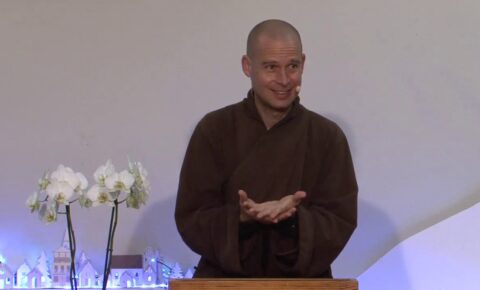

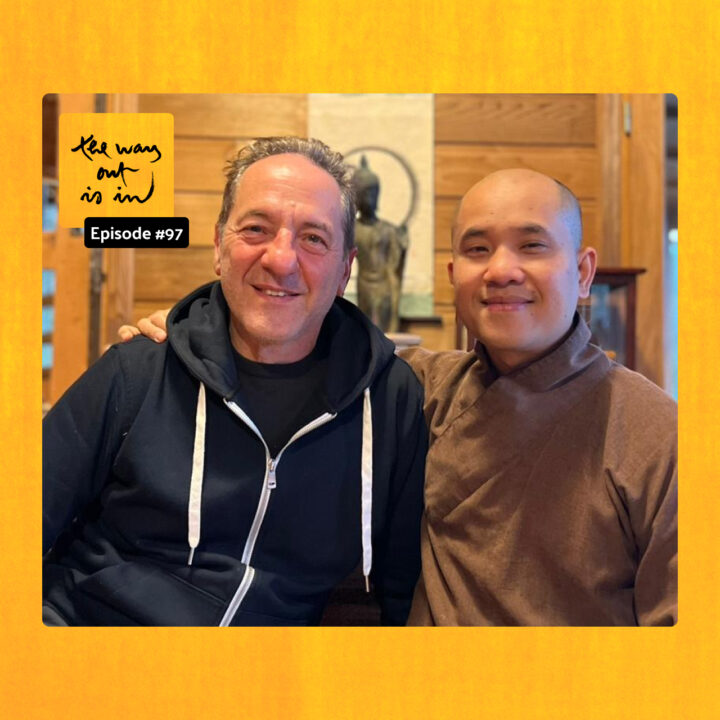

Welcome to a new episode of The Way Out Is In: The Zen Art of Living, a podcast series mirroring Zen Master Thich Nhat Hanh’s deep teachings of Buddhist philosophy: a simple yet profound methodology for dealing with our suffering, and for creating more happiness and joy in our lives.
This special episode – part one of two question-and-response (Q&R) installments – commemorates the publication of the second book by Zen Buddhist monk Brother Phap Huu and leadership coach Jo Confino, which was published earlier this year. Calm in the Storm: Zen Ways to Cultivate Stability in an Anxious World is intended to help readers meet the current polycrisis with stability and resilience, but also forcefulness and love.
According to Plum Village tradition, Jo and Brother Phap Huu recorded two episodes that respond to listeners’ questions which connect to the book’s themes – from balancing kindness and anger in challenging times to staying compassionate with a world where there’s little deep listening; how to best support young people; caring for oneself while serving others; and much more.
Enjoy!
List of resources
Pilgrimage: ‘In the Footsteps of the Buddha’
https://plumvillage.org/event/pilgrimage/in-the-footsteps-of-the-buddha-2
Being with Busyness: Zen Ways to Transform Overwhelm and Burnout
https://www.parallax.org/product/being-with-busyness/
Calm in the Storm: Zen Ways to Cultivate Stability in an Anxious World
https://www.parallax.org/product/calm-in-the-storm/
Interbeing
https://en.wikipedia.org/wiki/Interbeing
The Order of Interbeing
https://plumvillage.org/community/order-of-interbeing
Plum Village Tradition
https://en.wikipedia.org/wiki/Plum_Village_Tradition
The Way Out Is In: ‘The Three Jewels (Episode #89)’
https://plumvillage.org/podcast/the-three-jewels-episode-89
Sister Chan Dieu Nghiem (Sister Jina) https://plumvillage.org/people/dharma-teachers/sr-dieu-nghiem
Dharma Talks: ‘The Five Skandhas of Grasping and Non-Self’
https://plumvillage.org/library/dharma-talks/the-five-skandhas-of-grasping-and-non-self%E2%80%8B-dharma-talk-by-br-phap-lai-2018-06-08
The Way Out Is In: ‘Joanna Macy’s Message of Hope’ https://plumvillage.org/podcast/joanna-macys-message-of-hope
The Way Out Is In: ‘Active Hope: The Wisdom of Joanna Macy (Episode #25)’
https://plumvillage.org/podcast/active-hope-the-wisdom-of-joanna-macy-episode-25
The Way Out Is In: ‘Grief and Joy on a Planet in Crisis: Joanna Macy on the Best Time to Be Alive (Episode #12)’
https://plumvillage.org/podcast/grief-and-joy-on-a-planet-in-crisis-joanna-macy-on-the-best-time-to-be-alive-episode-12
‘Three Resources Explaining the Plum Village Tradition of Lazy Days’
https://plumvillage.app/three-resources-explaining-the-plum-village-tradition-of-lazy-days/
Śāriputra
https://en.wikipedia.org/wiki/%C5%9A%C4%81riputra
Rāhula
https://en.wikipedia.org/wiki/R%C4%81hula
How To: ‘Begin Anew’
https://plumvillage.org/articles/begin-anew
Quotes
“Do we control the world? We’re controlling our actions, if we’re mindful. But most of us let our actions control us. We let worry control us; we let the news control us; we let fake news control us; we let stories control us. We let energies that may be untrue control us.”
“We have to have the ability to generate joy and to be in touch with simple happiness and, even in moments of bitterness and difficulty, to come back to the present moment and ask the question, ‘What am I grateful for? What things surrounding me can I devote myself to, because I’m grateful for them?’”
“Thay always reminded us to take joy and happiness seriously, and, in our modern times, people who come to Buddhism and spirituality, in particular, become allergic to the words ‘happiness’ and ‘love’ and ‘smiles’ because they’re not celebrated enough in the world. Because it looks too hippie-dippie. They seem too easy, in a way. But knowing that joy is always accessible is enlightenment, is healing, is love.”
“Each and every one of us, when we start the journey of practice, really have to take seriously how to generate joy every day, with no exceptions. Don’t take it for granted.”
“Compassion is the foundation for not burning out, for not becoming hateful, for not becoming toxic. It is the foundation of understanding and love.”
“When you don’t have enough joy, lean into other people’s joy. You’re not alone.”
“The whole purpose of mindfulness is to more deeply understand ourselves, and then to more deeply understand how we relate to the world.”
“When you know how to listen, you’re already a teacher in the dharma – not through your spoken words, but through your way of just being. So don’t underestimate the practice of deep listening, because that can open the doors to people’s hearts as well as allowing them to touch healing. Because deep listening allows us to be vulnerable; it allows us to cry the tears that need to be shed to water our fields of pain and our seeds of love, understanding, and kindness. That is all deep listening; meditation is deep listening.”
“Wherever there is darkness, light is already there, because the two coexists – and wherever there is light, there is darkness.”
“Accept despair and let it deeply touch and tenderize your heart. Because that’s what despair can do. Rather than seeing it as “the end of a journey, see it as something we touch deeply and which can begin a new journey.”
“There’s something about taking the longer view and recognizing the great arc of time and not becoming so caught up in this moment, as though it’s the only moment. Recognize that life will continue in many forms, and trust in that.”
“We have to use both wings of meditation – stopping and looking deeply – in every crisis that we find ourselves in or find ourselves facing.”
Dear listeners, before we start today's podcast, we just want to let you know that Phap Huu and I, along with four other monastics, will be going on a pilgrimage to India next January. And we'll be doing that in collaboration with Shantum Seth, who is a longtime Plum Village practitioner, but has also been leading these pilgrimages for 30 years. We are going to be visiting all the key places that follow the Buddha's life journey, listening to stories about the Buddha's life and also the Plum Village teachings. If you would like to come and join, you can go to www.buddhapath.com. We will be not only visiting these sites, but doing a special series of the podcast following the Buddha's life, which we will then be publishing on our return. So if you would like to join us, please go on the website and find the details, and we look forward to joining you there.
And dear friends, if you have a deep love for the Earth and wish to learn how to bring the energy of mindfulness to your climate response, Zen and the Art of Saving the Planet is a seven-week online learning journey where we as a community will learn how to cultivate insight, compassion, community, and mindful action in service for our beloved Earth. Inspired by the timeless wisdom of Zen Master Thich Nhat Hanh, this course includes Dharma talks and practices, community sharing groups, and live interactive events with monastic teachers. I'm looking forward to teaching at these live events together with my monastic siblings. We'll learn together for seven weeks from 1st of March 2026 into our closing event on 19th of April. Join us by heading to the website today, plumvillage.org/zasp, that is Z-A-S P, and we look forward to walking on this path with you. Thank you very much.
Dear friends, welcome to this latest episode of the podcast The Way Out Is In.
I am Jo Confino, a coach working at the intersection of personal transformation and systems change.
And I am Brother Phap Huu, a Zen Buddhist monk, student of Zen Master Thich Nhat Hanh in the Plum Village tradition.
And today, dear listeners, we are commemorating the publication of our second book, Calm in the Storm, Zen Ways to Cultivate Stability in an Anxious World. And we are doing that by hosting two episodes, which is to answer your questions. And the reason we wrote the book was because we recognized that we are entering what some call a polycrisis, where there's suffering not only on a personal scale, but on a societal scale. And we wanted to write this book to help everyone to meet this moment in a way that creates stability, resilience, and also a place where people can act with forcefulness and love.
The way out is in.
Hello everyone, I'm Jo Confino.
And I am Brother Phap Huu.
And brother, as I said, we are commemorating the publication of our second book. And we like to, in the tradition of Plum Village, to do questions and responses. So can you give us a little bit of just before we get into it? Why did Thay, Thich Nhat Hanh, used to hold these question and answer sessions? And that will give our listeners an understanding of why we're doing it now.
Well, from the point of view of Thay, as a Zen teacher, it's an open space for people to feel personal with a teacher. And in the whole tradition, when you ask a question, it's also like a true question comes from the heart, which is more about the individual's journey, the individual's joy and happiness and suffering relating to the practice. What here is not about intellectual knowledge, it's not about a competition of comparing each other, but it's like a real question also opens the heart. And I always think of it as asking a question from the heart is also a kind of communication to oneself. It's like because there is the eagerness to understand or the willingness to learn something that they don't know. So in the form of a question, I think there's a spirit of humility also. And there is also the spirit of openness and vulnerability, because sometimes a question we may think is so simple and is so naive, but it is what it is, you know. And a good question can really support so many people. Because in one question we think we're asking for ourselves, but it could be asking for a whole community, a whole age group, a whole class group, a whole religious community, and so on and so forth. So for me it's also about opening up to the unknown.
Great. Thank you, brother. And one of the reasons we call it question and responses rather than question and answers is because we don't know the answers sometimes even for ourselves, and we certainly can't know the answers for other people, but the way we will seek to respond to these questions is from our own experience, not a conceptual question where we're going to give intellectual answers. It's saying actually, what have we learnt on this journey? Where what sort of suggestions do we have? But, obviously, you know yourself as the listeners. And so it's really to provide, I would say, some guidance and some understanding that you can then take and interpret in the way that you need to for your own life. So let us begin. So I'm just gonna pick questions and before we start, thank you everyone for these wonderful questions. It's just a beautiful range of questions, very little repetition, but just opening up really large spaces to look at. So, brother, first question. How much do we truly control in this world?
What world are we talking about?
Yeah. So I love the question because at some level we're all trying to control our environment, aren't we? We're trying to make the world around us safe. We're trying to sort of manage things, we're trying to put borders in place, we're trying to create certainty. And of course, does that, do we actually have any certainty? Can we ever say I'm sure?
It seems like we create more suffering than we create more peace and harmony. From the point of our tradition, when we speak about the world, we actually speak about oneself. We speak about the present moment as the only moment, the only moment that is existing in our own reality, which is the world. So when the question is, how much do we really truly control in this world? Honestly, we don't control anything. We are a manifestation of a species that has a period of time on this Earth. And that period of time is a whole journey of opportunities and potentials, as well as moments of darkness and suffering. And in the light of our tradition, even contributing something that could create suffering, which is not the most beautiful thing we want to be known as, but it has a contribution to the whole fabric of the world. So when we speak about the world in our tradition, we speak about yes, what you could have the potential to become aware of. I like… We use the word more of awareness, of cultivation rather than control because honestly, we can't control the three times, which is the past, present, and future at the level of the whole cosmos. But each and every one of us, we are being responsible for our actions in every millisecond that we are present. And with mindfulness, we have the opportunity to then be in harmony with that moment and to have attention and attentiveness where we want to put our body, speech, and mind. And that is what we're gonna contribute to this life. And it's gonna remain for a very long time. It's our legacy. So when we speak about do you, do we all control the world? We're controlling our actions if we're mindful. Most of us, we let the actions control us, we let the worry control us. We let the news control us. We let the stories control us. We let the fake news control us. We let all of the energies that may not be true. Our mind is a world in itself. The mind has many channels. The mind is influenced by all of the conditions from birth, from family members, from status, like what kind of family did we come up in? If we're in a very loving family, we will have a different way of being. If we live in a very strict family, or if we live with a lot of poverty, or we live with a lot of wealth, but we are very spoiled. We also have a very different attitude. So the practice of mindfulness and the practice of Buddhism is a very humanistic practice of coming back to our humanity and selecting how we are going to contribute into the world. And that gives us agency. That's the power of that. And it's scary because then we all have to be very, very responsible for our own way of life. And the present moment cuts through this ideology of fate, of like destiny. I'm born to be destined for. You know, Buddhism, the Buddha himself, when he looked into the five skandhas of a human being, and he looks into the oneness of a human, he sees that we are empty. And we're empty of one thing, and that is an individual self. We are full of everything, so therefore we are empty. And because we are empty, we are so full. So this question is in the light of Buddhism, you are no self. So you contribute nothing, and at the same time, you contribute everything.
Wow.
We can stop there. The QA can end there the question and response.
So just to add a couple of things to that, brother. So I remember when I did a master's degree, that on our first day, the senior tutor came in, and she said, people come to, normally come to a master's program to increase their knowledge and certainty in the world. And the best I can offer you is to feel comfortable with uncertainty. And it's a bit like your answer. I could have stopped, I could have just stopped the master's degree at that moment. Because for me, it's like control is trying to be safe. It's trying to say, it's trying to put very strict borders around things. But that is very brittle. Because if you have a belief that you're trying to make, to take control, it means that if you fail, you feel a failure, and you feel very brittle because you don't have the ability to adapt. And so for me, there's a true beauty in uncertainty that we don't know what's going to happen. And then we can respond to causes and conditions as they arise. And also, why do we need to control? You know, what is it that that we're really trying to do? And that is to… because we fear. There's fear. I mean, control is fear, isn't it? And so when, as you say, when we work on our fear, then we start to become in control of our own emotions, as you say, and then we can face whatever comes. And we don't need to grasp, we don't need to be attached to things, we can be flexible, adaptable, supple, and then I think we're of much more use in the world to everyone around us, because if other people are trying to meet control and we are supple, then we are of help. And I think one of the stories in our book is about Thay's story of, which we took the title from, and he talks about the story of if there's a boat in a storm and it's threatened with capsizing and everyone is panicking, then the boat is almost certainly going to sink. But if one person is able to stay calm and to transmit that calmness to everyone else, then there's a hope that the ship can be saved. And for me, that is about not trying to be in control of the situation, but in moments of panic or emergency or great suffering, that we want to be present to what is and see how to respond in that moment. Great. Okay, we're off to a good start. Next. So this one is about, so the book is Calm in the Storm. So this is about being calm. So thank you, Brother Phap Huu and Jo, for this opportunity to ask a question. In times of overwhelm, I try to remember to trust in myself that the moment of despair will pass and that the outcome is going to leave me with a deeper sense of myself and my understanding of the world. But that's so hard. And I'm afraid of growing bitter and losing hope. What is your resource or a place in yourself that you offer yourself to find hope and strength in the very moment of hardship? And I like that question, brother, because what the person is asking is say they know the practice, they know that it's important to trust in oneself, that the despair will pass, that emotions come and go, and that the outcome, however difficult, is going to lead to some learning and development. And yet this person say, it's so hard, and that they're afraid it will create bitterness and they'll lose hope. So the question is: what is your resource or a place in yourself that you offer yourself to find hope and strength in the very moment of hardship?
We have to have the ability to generate joy and to be in touch with simple happiness and coming back to the present moment and asking the question, even in this moment of bitterness and difficulty, what am I grateful for? You know, what are the things that that are surrounding me that I could, I can devote to because I'm grateful to that. I'm grateful to a condition. I speak of this because, I say this because I am privileged, which is I live in a community. And a community is one of the greatest gifts of the world. We, in Buddhism, we call it a gem, a jewel. A sangha, sangha means a community, is a jewel because in moments of deep suffering we tend to isolate ourselves as well as we tend to suffer alone and that loneliness becomes a very dark hole. So what I have learned in my own self is knowing what joy is, like really know what true joy is, not the excitement, not the instant joy which is important like there are some resources, like let's say music or like a television show that that you grew up and you love. Like I love watching some very good heartfelt movies, like this one I love is called Remember the Titans that is a very uplifting movies. You know, and that could be a good source of changing the peg, meaning like changing your despair, like giving your mind and your way of, your whole body and spirit also being uplifted of history, you know. So our teacher always reminded us to take joy and happiness seriously and I think that in our modern times and particularly people who come to Buddhism and spirituality like they get allergic to the word happiness and the word love and smiles because it's not celebrated enough in the world, you know, because it looks like too hippie-dippie, it's too easy, in a way. But what I've learned, actually, knowing that joy is always accessible, is enlightenment, it is healing, is love, you know. So each and every one of us, when we start the journey of practice, we really have to take this seriously: how to generate joy every day, no exception. Like don't take it for granted. I don't know if you ever done martial arts, but I did martial arts, and one of the first stance that we had to learn was the horse stance. And it is a very foundational practice. You establish your legs and your core. And every day, no matter what belt you're on, white to black, everybody's doing horse stance because that is the building block for everything else. So our teachings and our way of training in our spiritual dimension is deeper than just sitting and being still on a cushion, but it is sitting still and tasting joy in sitting still and accessing the willingness to recognize happiness, and it's not wishful thinking, it's real. I will confess, like I was a very happy person coming in, and it was so easy for me. And I kind of bypass it because in my mind it's like, no, no, no, that's not the real work. The real work is like to actually get bitter and overcome it. Journey in life is we all will get bitter. We all will suffer. So in this question, it's also having the awareness of when you are bitter, you know you are bitter. It's like breathing in, I know this is an in-breath. Breathing in, I know I am bitter right now. I am so annoyed. I don't have any more space. If I stay here, I'm going to become toxic. So that is mindfulness. And the next path of mindfulness is how are you gonna take care of those emotions? Are you gonna allow it to become the toxic energy that we give out, whether it is through our way of thinking, our way of speaking, our way of looking, our way of behaving, right? Or we could be very gentle and kind to ourselves, say, Oh, I know I'm bitter. I want to take care of this energy. Because if it keeps leaking out, it will make this whole space bitter. So this is a practice in itself, right? And as a practitioner, when you recognize that is already joy. Breathing in, I know I'm bitter. Breathing out, I smile to my bitterness. Breathing in, I know I am overwhelmed. Breathing out, I need to be mindful to not keep watering this feeling of being overwhelmed. And we have to have the ability to also look deeply into it. Like, why am I bitter? Why am I annoyed? And maybe when we just start, we don't look at it when we are bitter. We may have to look at it when we're calmer. Like what triggered me? What was the source of overwhelm? And if you keep developing your practice, you can actually have this conversation with your own bitterness while you are in the state of bitterness, still in a conversation or still being in a meeting or just receiving a kind of information and so on. Because our mindfulness can already shine the light to the surface of being the energy we can call it bitterness or anger or frustration. And we can say, Oh, why am I frustrated? Is it a story that I'm carrying? Is it this person's behavior again? And then in that moment, you have an opportunity to say, Oh, do I dwell on that person because I don't like them? Or do I dwell to understand why they are the way they are? And suddenly you're free from your bitterness, you're free from your anger, because now you're a meditator. You're looking through it to understand where is this source coming from? Why is this person saying this, doing this, right? Suddenly your mind becomes more expansive and invite compassion up. Compassion is the foundation to not burn out, to not become hatred, to not become toxic. But it is the foundation of understanding and love. So on a like, that's the Dharma, that's like the Dharma side, like on a practical side for myself, I love, I have a lot of hobbies that I can come to, and that is, you know, calligraphy, sports, exercise. I'm very good with being with people. I can be with people. I actually know how to surrender to be with people and not make it about me also. But just to be in and infuse yourself with other people's joy. Sometimes you don't have enough joy, lean into people's joy. It's not about you only, you're not alone. Like watch your children, watch your siblings. Like there are so many elements around us that we could put our energy to. And then of course there's the practice, right? There's touching the earth, there's walking meditation, there is prayer meditation, there is deep looking meditation. We can read a book or watch a Dharma talk, watch something to help us, as our teacher would say, change the peg, change that bitter channel, give yourself another channel.
Thank you, brother. And just to add a couple of things, when people are normally asked to come up with a historical figure they respect, people will often say Gandhi or Nelson Mandela or Martin Luther King. And when I look to those people, what I see is that they met despair and pain and suffering and overwhelm countless times. And they never gave up. And that's because they had a true faith in life, and also that they were wholeheartedly committed to their vision, regardless of actually what happened. So, you know, if they had at any point along their journeys have said, this is too much for me, I'm suffering too much, I'm just going to give up, then they would not have created the extraordinary change in the world that they did. So I think one thing is, and this is something we cover quite a lot in our book, is about how to be resilient. And I like the image of someone who is standing in the sea, and a big wave comes along and it knocks them over. And they stand up, and the big wave, another big wave comes in and knocks them over. And they have a choice. They say, oh, actually, this is too much for me, I'm going to get out of the water. But if they stay there, firstly, you can move around in the water so you can find places where there's less of a wave. So we're adaptable. We can change the way we approach things. But also we learn to the very fact that the waves are coming in, we learn to build our stability so that we learn to on how to stand, on how to face the wave, so that it doesn't knock us over every time. And just thirdly, I think often we're looking for a solution in life, we're looking to say, if only I sort of deal with this, then I want it to stop. And so there's a big expectation that we'll solve something. And my experience is that, you know, these problems will come up in our life throughout our life. And that if we sort of become comfortable with our suffering, become comfortable with the uncertainty, as I mentioned earlier, then actually we can meet any problem that comes along with much more equanimity and much more presence. Okay, here we go. Let's change the peg. So here's one, Brother Phap Huu. I have been you asking artificial intelligence tools, what would Thich Nhat Hanh say about X or Y? Do you have any guidance about using AI like this?
Well, the good news, dear friends, is Plum Village in the last two plus years have been creating something so that all of us who want to ask my teacher, our teacher, Zen Master Thich Nhat Hanh, don't have to ask AI. And we have built a whole platform called, and it will launch in early 2026, something called Living Gems. And it is an archive library, searchable. Imagine you can ask Thay any question. And from that platform, it will pull out Dharma talks from over 30 something years of his teaching. We have uploaded and mastered audio, visual colors, over 2,800 Dharma talks of our teacher in English, French, and Vietnamese. And a large majority of you have never been able to listen to his teaching in Vietnamese. With AI coming forward, we were also asked like we should make an AI Thich Nhat Hanh, and we're like, no, because that's not him. That's not his living experience. And it's more just information that AI receives and comes up with as a response. But what you will be able to search and you will be able to receive is his real teachings and you get to see him, you get to hear him, and for me is you get to see the way he speaks and the way he offers his Dharma. So this is something that we have created and is very exciting for it to be launched into the world. Not too far away. But coming back to AI, because I think, you know, this is probably the question that we all have today. I think in your question, AI is a tool. So let's just keep it as a tool. We still have to use our own awareness and our own human understanding to ask AI the right questions for it to get the right support, right? Yeah, what's tricky about leaning into AI is that you might believe that this is true. And in Buddhism, even the Buddha said, Don't trust my words. So, dear friends, please don't trust AI at that level. The Buddha always gives us the tools to also measure and reflect even his teachings. He said, When you hear a teaching from me, you have to not just blindly believe it, but you have to ask, and how does that help me understand suffering? Because first of all, friends, mindfulness is to be aware of suffering and the roots of suffering, the way out of suffering, and the way to happiness. Period. Mindfulness first and foremost is to shine the light to suffering. So when we listen to AI, we also have to prop it properly. But like I said, as an individual, AI cannot practice for you. AI cannot breathe for you. AI cannot hold your emotions for you, right? We, as an individual, we still have to be diligent in our own practice and deep looking.
Thank you, brother. And just to reiterate that, the real danger is that we subcontract our intelligence and our knowing and our intuition to a machine. And I think the whole purpose of mindfulness is to more deeply understand ourselves and then how we relate to the world. So what I love about what Phap Huu said about this new Living Gems project is that you will hear what Thay had to say about this, but Thay would not tell you, as an individual, how to respond. And if you use AI to firstly try and pull together all of Thay and tell you individually what you should do in a different particular situation, takes out all the mystery, the complexity, the actually the joy of finding out for yourself, because you know, we are on a lifelong path. It's not about having an answer for this moment from someone else. This is about accumulating wisdom and understanding that will support you, your whole life, and then support all the people around you. And to sort of ask AI what the answer is for you with all your, all the cause and conditions, your whole lineage, all your ancestors, all your knowledge, all your friends, all your teachers, everything that's gone into making you, and then to ask a machine to try and give you an answer, just feels like it may give you something that sounds right or sounds good, but actually it doesn't have heart in it and it doesn't have you in it. So, brother, related to that, I wanted to come to a question about deep listening. And so I'll just read the question. It says, I'm exercising with deep listening and have the wish that this kind of listening spreads itself far wider than it does now. How do I stay patient and compassionate with a world where there's little deep listening? Now, this is a wonderful question because it sort of relates to AI that with all the distractions, all the busyness people have, that we've really stopped listening not only to ourselves, but to other people. And how do we help this? Well, actually, brother, first of all, it'd be good if you can just say what does deep listening actually mean within the Plum Village tradition. And then this person says, How do we help this spread far and wide?
There's a word patient in the question, and patience is a virtue in our spiritual tradition. We see that having the insight of patience is a virtue in itself, because there are some things you cannot fix right away, particularly our society. To expect everyone to have the ability to listen deeply, now that's probably wishful thinking. But what the practice could do is that it can give you the ability to listen deeply. I think what is important we always have to come back to in the way of Zen in meditation, it's not about the other, it's about you. And in the you there is the other, and in the other there is you. So if we are practicing to feel successful only when others can listen deeply, then we have to re-evaluate why we're meditating. And this is a very easy trap that all practitioners fall into because they will become anxious as well as frustrated because my practice does not influenced other. But I'm not so sure because everyone is conditioned very differently. We always say those who have met the Dharma are very lucky in life. We, in a way, it's like the 1% of the world. But this is rich in the understanding, the ability to come back to. So when we say listen, meditation is all about listening. There's two wings of a bird in meditation, because meditation has to have two wings. If it's one wing only, then it is unstable and it is unbalanced and it will not fly anywhere. And the first wing of meditation is listening. It is stopping. Why do we stop? We stop to listen. And what are we listening to? That's a very big question. But we start first with our breath, then we come to our body, and then we come to our concentration of generating joy, generating happiness, and then looking at our emotion, particularly our painful emotions. Have we listened to our pains? Have we listened to our suffering? Have we listened to others' suffering? So deep listening always begins with oneself. Why do meditators meditate every day? It is to listen. What am I listening to? I'm listening to my mind. I'm listening to the stories I carry. Can I let go of these stories? Am I patient with myself to know that I'm not ready to let go of this story because I identify so closely to this particular story. So listening is the key to understand. And then the second wing of meditation is only when we listen can we see and understand it? And only through understanding can we be enlightened, can we understand the sources of pain and agony? So starting with oneself, the deep listening, it is also connected to our well-being. And well-being is also a very layered word. But well-being in listening is, do we have the ability to listen? I've been practicing for a long time and I know I could listen, but there are days I know my well-being is not there, and I can't listen. I'm too full. My cup is too full. Then I have to empty my cup to listen. So our practice is also to listen to our own limits and capacity. But the beauty of the practice is you can keep pushing your capacity. There are some days that I'm exhausted, but I need to listen. And I will go to a four and a half hour heart storming session with my siblings. I'm exhausted. I could feel I'm ready to go into a deep eight-hour sleep. But here I am, and I'm listening and I'm expanding my heart. And actually I feel more energized. It's almost like weightlifting. You know, they always say, if you want that gain, those last reps gotta hurt. It gotta kind of like make you feel like you can't, you can't lift anymore, because then only can your muscles expand from it's being pushed, right? So our capacities are also like that. So sometimes it's not about just feeling good, sometimes I need to listen even though it's painful, and of course, we have to be very mindful, and what I've discovered in the deep listening, there's so many things happening. I've really developed as a solid person, honestly, is through deep listening. If I cannot listen, then how am I growing? Because if we just choose to listen to the good stories and the pleasant sharing, that's not really pushing our limits. That's not actually allowing us to be uncomfortable. In a storm, you're uncomfortable, right? The storm is windy, it is wet, it is muddy, it is… it's just uncomfortable. But when you have the ability to be in the uncomfortable feelings, then you are a wise person. The wise calls those that know how to be alone, meaning they are not alone, they're not being carried away by the past, the present, the worries. They are the ones who know how to dwell happily in the present moment. And this is really crucial for us to also be patient with our own ability of growth. So give yourself patience. That means we have to give others patience. But there is something that happens when you do offer deep listening to someone: they are being loved. And please know that because I you know the question is like, when will the world have this ability? Well, it's already there, but they are not water, these qualities are not cultivated, they are not being rained down on rather than we're rained down on other ways of being, being angry, being anxious, being frustrated. So the way we show up, when you who know how to listen, you're already a teacher in the Dharma, not through your spoken words, but it is through your way of just being. So don't underestimate the practice of deep listening, because that can open the doors to people's hearts as well as allow them to touch healing. Because in deep listening, it allows us to be vulnerable, it allows us to cry the tears that needs to be shed so that it could water our fields of pain as well as the seeds of love, understanding, kindness. So that is all deep listening. Meditation is deep listening.
Thank you, brother. And just to reiterate that one point, so as a coach, I listen to people. And as a monk, you listen to people. And my experience is that people can only share deeply when they feel they're in a safe space. So listening isn't just that fact that you're not saying anything. It's like you're listening with all of yourself. And you're listening not in a neutral way, but you're listening in a way that has within it the wish for the other person's happiness. And that when… Because actually people just want to feel loved, recognized, feel that they're worth, they're worth something. And when they're being listened to, that without having a word spoken actually offers them those qualities. And also, brother, one of the ways I've noticed that often we want to be listened to, but we don't like to listen to. And there was a classic moment where you and I were both present at one of the climate retreats that we offer. And there was one of the climate activists was speaking saying, you know, whenever I go to a meeting, as soon as I open my mouth, I feel I'm being judged. But right now, sitting here, I realize that actually, I'm judging the other people as well. And so she recognized that actually what she wanted wasn't what she was giving. And the other thing is, and it, of course, it's a wonderful part of the question about the wish to expand these teachings to the world. But there's something about, you know, we are expanding it to the world by being it. And in a world where there's very little listening, for those who can deeply listen, that can have a profound effect. And it brings to mind the story of there's been a storm. So that's another reference to a storm, and thousands of starfish have been washed up on a beach. And there's a man who comes down to the beach and sees this young child walking along the beach. And some of you may have heard this story, and she is picking up one starfish, throwing it in the water, picking up another starfish and throwing it in the water. And the man comes up to him and said, You know, why are you bothering? There are thousands of starfish here. You know, you can't make a difference. And she picks up one, throws it in the sea, and says, I can make a difference to that one. So I think one of the things I've learned in the teachings is not to be judged, not to judge, make a judgment between small things and big things. That sometimes the small things in life are the most profound, and the big things may be not so profound. So a little transformation is just as important as a big transformation. So I think there's something about taking the judgment away from saying, I want this to come to the whole world, which of course we do, but to recognize, as Phap Huu said, you are the world. And therefore, if you truly listen, actually that spreads out in a way that beyond what you know.
And in our tradition, particularly with our founder of the tradition, our teacher, he did imagine where teachers would teach students how to listen. He would rather, maybe this is an opportunity with AI now doing so much of the homework, what we need to learn in school is how to listen to our emotions, how to listen to being bored, how to listen to each other rather than just writing and, you know, learning math, and which, you know, it has its part in the world, but our teacher imagined an education where this could be taught and it doesn't even need to be spiritual, like the ability to connect deeply to one another.
And just finally on this point, do we really know our loved ones? So Thay did one of the practices I developed was beginning anew, which I've been practicing for the last 19 years with my wife Paz, and there's an episode on this, which we can put in the show notes. I think it might be 30 or 31. But the main point is that actually each person, whether we've been married to someone for 10 years, 20 years, 30 years, is still a mystery. And if we think we know that person, then we don't open up to the many layers. And Phap Huu has already mentioned that in every area of life, there are so many layers. You could take one of Thich Nhat Hanh's calligraphies like I have arrived, I am home. What does it mean to really arrive? What does it mean to really be home? You know, as Thich Nhat Hanh said, he could look at that for decades and still find new avenues. So I think the deep listening is also about educating ourselves. It's about not taking anything for granted, about recognizing that we're all impermanent, that the person I married 20 years ago isn't the same person today and won't be the same person tomorrow. So listening deeply is is actually about being present for life, I think. Okay, let's move on. So let's talk about a couple of storms. So I'm going to read a couple of questions, brother, which is really about our political, the political times we live in. And we don't need to go into the specifics of the politics, but I think it's going into how people can work with their feelings in these times. So I'll read two. One is about, here we go: When we fight for just causes, how do we balance our kindness and the anger we may feel at the injustices? That's one. And then the second one, which is related, says, I'm not sure how much you keep up with American politics. Well, we do. But many are feeling heightened anxiety and fear of our government. Masked agents patrolling our cities, deportations, detention camps, racism, protests, tensions between people and groups, political violence, etc. Things are rapidly escalating, and we have at least another four years of this ahead of us, if not longer. Many are resisting this fascism, but it seems increasingly futile. Do you guys have any specific advice for people in these challenging times? So, brother, before you answer, I want to just broaden it out as well, because of course there's the politics of our times, but there is we, you know, this book talks about the polycrisis. So on top of political and social fragmentation, we've got the climate emergency, we've got the crisis in biodiversity. So I think both of these are saying if we look at that polycrisis, which can generate grief and despair and powerlesslessness, how do we meet these challenging times? And of course, the book is completely about this, so you'll get lots more in that. But for now, how do we meet these challenging times?
Listening to the question, a teaching from Thay comes up, and he says that in Buddhism suffering and happiness coexist together. And one thing that he recognized in the teachings of Christianity that he wanted to help show the interbeing of, which was when the question was asked something like Show me the light, where is the light in the darkness? As you can tell, I don't really study Christianity. And Thay said that when that question is asked, when the one who answers or the one who is looking deeply at this question looks deeply at the darkness and said, If darkness is there, then light is already there because the two coexists and wherever there is light, there is darkness. So my recommendation for all of us is to not only dwell on the bad news, which there's plenty, there is a lot, more than we can digest. Generation of lifetimes to transform and to heal, but even in the darkness there is light. That means there are people around us that are doing their best to relieve suffering from the level of helping each other as neighbors, looking out for each other's back, community, tenderness of care, the way we show up, the way we just help somebody. If we see them, a single mother having so much grocery, just coming and helping. Like we have to build this kind of kindness and this kind of light at a level of like down to earth where everyday people can offer. And that for me is where we get power. That is where we feel that we have a place in this world. This is where we can not control the world, but contribute to the world. And that's how I feel encouraged to be on this this Earth in a way, you know. It's like after a retreat that we offer, when somebody comes up and said, You've given me seven days of healing and of love. And Jo, I didn't do anything besides just show up. And just you know, maybe sit beside or walk beside, or just see once or twice in a retreat and offer a smile or offer an attention, something very simple. That is a level of offerings that each and every one of us can give in this moment or in any moment of history of despair. The truth is it's sad, but even during the Buddha's time, there was so much war and conflicts and destruction, and even the Buddha couldn't even help his own home country to be invaded. There's a limit to the politics that we can have an impact, but there is no limit to what we can offer to our human community, our nature community, our loved ones that are next to us, or prayers. That's why prayer is such a power. You know, there's this Dharma talk in this Rains Retreat that we listened to, and Thay was talking to the community in 2012, telling us how he practiced when he touched the earth. And it's one of the most simple but beautiful quote that I wrote down, and he said that every time he joins his palm and he brings it to his forehead before he prostrate, he asks the three jewels, which is the Buddha, the Dharma and the Sangha, to give the community strength to build a collective, global, healthy ethics to serve the world of injustice and suffering. And then he would prostrate. That's a prayer. That is an aspiration, knowing that a thought can be a beam of light with concentration, with deep looking, and with a practice that he will do it in the best capacity that he can. And we have to ask ourselves what is our capacity in this moment, knowing that we are continuing to grow and to expand and maybe sometimes take a few steps back to rest, to heal, and then move forward again. So to combat darkness and suffering is to know that the light is already there. Maybe it's weak. Maybe we have to give it solar power, more sun. That is the joy. That's the vitamin D of drinking tea, drinking coffee together, you know. And sometimes come together, sing, dance, remind each other of the resilience of our human species. You know, there's a very hard practice, is that our civilization will end. It is ending, it's collapsing. And that is a truth we all have to admit. What we're trying to protect is of yesterday. We're seeing it crumbling, but only in the death can there be birth. Only in the destruction can we rebuild. And this is the Zen way of looking at civilization. We are a continuation of many civilizations. Where we are at now was because there were collapses of civilization. If we are not skillful, if we keep rocking our own boat, for sure it's gonna flip. And our next generation will have to do everything in their capacity to rebuild the boat so that it can sail. Sail the rivers to the ocean of understanding and love. But I believe in a spiritual community and in a spiritual practice. The light is a spiritual practice. To work for justice, you have to have kindness. I believe that we all enter into this path is because we have kindness, it's because we see injustice, therefore we want to bring justice forward. That is an act of love, that is an act of kindness, that is an act of compassion, that is a will of volition. But what we need is a community to support that, to remember our square one, why did I start it? We call this the bodhicitta, the beginner's mind. Where is my beginner's mind? What sources of nutriment is it lacking? The beauty of the practice is that it's easier with a community, but by yourself you can also refuel yourself with motivation, with aspiration. And sometimes it says we have to touch suffering to have aspiration towards happiness. But our teacher always says, there's enough suffering. Stop creating suffering. We're already in hell. But there's also the kingdom of God that is here, the pure land of the Buddha that is here. So these are the mindfulness that we have to wake up to. Like, you know, when I see, when I see a child with so much light in his, her or their eyes, I don't get despair. And I know the future may be very challenging, but this is a flower right now. And I want to nurture that flower. I want to give it the love it needs so that it becomes the resilience for that child, so that that child will also transmit this act of kindness and this act of compassion. So don't, I don't divide between justice work and kindness. It has to be there. Compassion has to be there, love has to be there. I think our Western way of thinking, which is very dualistic, we put everything in compartments. We say, how could I do this with this? How how do I add this with this? For us, we're empty, remember. And all of it is there. We just have to bring it forward. You could be angry and kind at the same time. I've been I've been angry and kind. You can be feeling betrayed as well as digging deep for compassion to understand that that person's betrayal is because that's all they have to offer in this moment. It's sad, it's painful, but it is what it is. And I'm not gonna let their betrayal ruin my life. Right? So this is… Like Buddhism is very deep. It's a very humanistic, down-to-earth practice, and it's always gonna push our boundaries because that is where we grow. All of that silence and all of that meditation is for us in this moment to expand our hearts, expand our mind, to look deeper and to understand and to also call upon. There's so many times I've called upon my ancestors, I don't know what to do. And just listen, those that have come before us, they've struggled, they've been discriminated more than I have ever been discriminated. They've been put into conditions where life and death was uncertain, and most of us were much luckier than that. We rely on their stories to be motivated. And we're all, as one of our dear friends that have come to Plum Village, he said that we're all living ancestors too. We're transmitting our stories also right here, right now.
Beautiful brother, thank you. I'm reminded of the last interview I did with Thich Nhat Hanh, and we were talking about the possibility of civilizational collapse. And I said, you know, how could we possibly avoid it? And he said, We need to show people a truly happy person. And at the time I sort of, you know, with Thay, it's like, there were sometimes where the answer was so simple that I sort of dismissed it as naive. But then when I look deeply, saying, Why are we destroying? Why are we creating so much destruction? It's because we're so unhappy. And we're projecting our unhappiness on the world and we're destroying things because we cannot find our own happiness. And so the idea that actually, you know, for anyone listening to this is that your happiness counts. You know, if you're able to truly find happiness, then you will transmit that to other people. And then other people will be touched by it and will respond to it. And the last thing we need is in a world where there's a lot of despair is to add that despair. And you know, Thay would give the example of a garden. He said, if there's a tree dying in the garden, then yes, of course, you are sad for that tree, but look at all the trees that are still okay. Look at all the trees that are still beautiful. Find that beauty. And in fact, you know, we did a couple of podcast interviews with Joanna Macy. And Joanna Macy's work is really beautiful. And again, we'll put in the show notes the episode, the specific episode, but she talks about, you know, accept the despair and let it deeply touch and tenderize your heart. Because actually, that's what despair can do. Rather than seeing it as something where we end the journey, see it as something where we touch something deeply and can start to begin a new journey, as you say, brother. And I remember when it was a year into the all the pain and suffering and death and warfare in Gaza and in Israel and in Lebanon and in Iran, I was feeling very despairing, and I went to Sister Jina, who's one of the elder nuns in the community. And I said, Sister Jina, I really need some support at the moment because I'm feeling this sort of deep despair. And I explained the reasons why. And she said, and she just gave it a simple answer, she said, and this too shall pass. And again, at the time, at that moment I was like, I want more than that, give me more than that. But it spoke of a deep truth. And I notice in in the listener's question, he says, things are rapidly escalating. We have at least another four years of this ahead of us, if not longer. And we have decades and centuries and millennia in the future. And so that's why I think it's not helpful to, it's a misunderstanding of the present moment to say, but in the present moment it's terrible because actually, the present moment in the understanding of history of what's come before and what will come in the future, and that this moment is just one moment in time. And I give the example, which came to my mind ages ago, which was, you know, if you were living the life, let's say, in the fall of Rome, when when Rome was being looted, you would think that was the end of days, that that the world was coming to an end. And yet, however many, you know, years later, it's just a footnote in history that some people in the West might study in school. So I think there's something about taking the longer view and recognizing the great arc of time and not to get so caught up in this moment as though it's the only moment, and to recognize that life will continue in many forms and and to have trust in that. And the last thing about the question about anger, and brother, I don't know if there's anything else you want to say about anger, but again, in one of the climate retreats we gave, there was an an elder from an indigenous community in Canada who'd been who'd been fighting the tar sands industry for many many years and he was in our retreat and at one point he said I've realized now that what motivated me to challenge this industry and to keep fighting all these years was anger, that anger was my motivation but now I've just become an angry man and I realize, remember, brother, that you and I were in a sharing group that you were leading and there was someone else who said the same, they said I've just become angry and of course then the anger doesn't just… is not an internal thing it leeches into our anger with our loved ones, leads to anger in any sort of relationships, anger at the world and that then can be an energy that eats itself. But brother, I don't know if there's anything else that you would like to share about anger.
I think anger is always an object of meditation. It is spoken from our ancient teachers that anger is a source of energy. And if we allow anger to stay for a long time, it becomes a corrupt energy. But if you see it as just a bout of energy, then we have to learn to channel that anger. It's like recognizing that energy and then moving it so that it could be more useful. And we don't use the energy of anger in Buddhism to combat anything. We use the energy of anger as an awareness that I am having reactions. I need to understand my reaction. And when you understand your anger, you're also bringing compassion up. Anger and compassion, they're very linked together. And you allow compassion to lead the way forward, and anger as the energy to move. And when you practice this enough, you will see how anger doesn't have to be alone. Anger, as a practitioner, shouldn't be alone. It should always be accompanied by or with. And the accompanying energy will transform the energy of anger. But if you allow hatred to then accompany anger, that becomes very destructive, very violent, it creates war. Or if you allow greed and power, then manipulation will come. But if you use the other sources, love, understanding, so on and so forth, then compassion is a very fierce kind of understanding and energy that allows us to go forward. So I think this is what is important for us to not try to suppress anger, but it is a practice of understanding it. And also an element in this question is also learning to accept the present moment. Accept that we are in a time of pain and sorrow. Because when we accept it, that already gives us release. We're trying to move through it, move with it, move around it, dance through it. But if we don't accept it, then we're fighting and we're adding, the Buddha calls it the second arrow. We're not looking at the first arrow to heal and to tend to, but now we're adding more arrows with our fears, our agony, our even our wishes may not be helping because that's not practical anymore. So we have to use the two wings of meditation, stopping and looking deeply in every crisis that we find ourselves in or facing.
Thank you, brother. I want to change the peg to a question about young people, and it's from a teacher, and I think you're well versed in these issues that we're gonna raise because of course you host the family retreats, which have a lot of teenagers, and also the Wake-up retreats, which have people from sort of eighteen to thirty-five. So you have a lot of experience about young people. So let me read it. Dear Brother Phap Huu and Jo, first of all, thank you so very much for working on this podcast together. It offers me so much solace, and Brother Phap Huu's voice and presence itself makes me soften and slow down. I'm a teacher and I interact with young teenagers in my job. They are so incredibly scattered and anxious, and I don't think the system of our school helps with this fragmentation of their time and attention spans. They have access to so much stimulation and exposure and are afraid of being bored. They are also averse to anything that requires you to slow down and pay attention. On most days I try to focus on my state of mind and how present and intentional I am being. But some days I feel so helpless and overwhelmed with the state of things. These children have been through a pandemic and have faced the worst of the internet age, especially with AI. I remember hearing that you also deal with young children in Plum Village. Would you have any advice on how to introduce stillness, introspection, and comfort as a teacher with limited time and access to them?
Well, we don't deal with children. If anything, we're very grateful that children come to the monastery. So we get to be with children and teenagers. So I think language can help already. I always look at being with children or young people as one of the greatest joys and privileges to have a transmission or to create friendship. You know, this question, I can give you a perspective from a monk, but really it is, there should be a global discussion and a way of looking deeply together. Because why are we in the situation we are in? Why can… I don't put this on the kids also. Why can't adults sit still? Why can't adults listen to each other? Why can't adults, you know, know how to handle their emotions? It is because we don't know, that's why the children do what they do. That's why they look for a source out of the pain and the suffering in the present moment. So this is really the kind of spiritual dimension that, as one tradition of the world, we're not trying to offer any crazy views about spirituality. We're just like meditation and mindfulness and Buddhism is just like we actually all have this wisdom of knowing how to be with pain and suffering, and we just gotta come back to it. And it takes a lot of unlearning. This summer, one of my interactions with a parent who was in my group, my circle, they were so enjoying being Plum Village, but their teenagers were having mixed feelings. So some days, very happy. So they were able to touch the joy, but they had a burning question and they wanted to ask me, but they were too shy to ask me. So the parents asked on their behalf with them present. And the question was, but Plum Village is also so boring. But what can I do? What should I do? And I think my first natural response, and it was a real response, and I kind of said it jokingly, but I was serious, and which was learn to be bored, like just learn to be with the feeling of like I have nothing to do. And they're so young, right? And I'm just like, you have no idea. As you grow older, you're gonna wish for these feelings, for this state of reality where I don't have to worry, I don't have to put myself in a position that I'm taking care of A, B, C, D, E, F, G. Actually, being bored is a privilege, you know. But then I challenged them and I said, look, tomorrow's lazy day. You have the whole monastery to yourself in a way. What could you do? Make it a game, like how you play video games. Like we have, you go through stages, you upgrade yourself, so look at your days in life as a way to upgrade yourself. Not through a screen, not through the satisfactory feelings of having likes or having admiration towards you, but in… You're here with your family, your brother's here, your parents are here, you've made some new friends. Like, that's rich. Are you bored? Or is it just an idea that you're bored? And it's up to you. I just say that, and I can't make your life more joyful. I'm not here to entertain you. But you know, I think for all of us, as ones wanting to see our younger generation have a different way, is we have to be it. You know. Someone asked Thay, like, Thay, my kids are so addicted to video games. How can I help them? And Thay said, because you're not there for them. Period. And you won't sacrifice your success, your time to be with your kids, to do some projects with your kids. That's why they have to navigate towards video games. That's why the industry is so rich. And it's a shortcut for our responsibilities. Here's where you can focus your attention. I grew up with video games too, but I did remember the times my dad would take me and all of my cousins and my neighbors to the forests. The imagination of a kid. A forest is a fantasy. I remember like playing, you know, dungeons, what was it? Dungeons and Dragons and just imagining, you know, our imagination was definitely very activated. And I don't think we're gonna return to that era, but there is maybe for video game developers, I know there's a lot of community building also, but like if the video game industry is able to do that, like how can we… What can we also offer besides that? And I think Plum Village is one answer. Retreats are one answer. Retreats is a boundary. This is what we're doing here. No video games, no, no this, no that, but we're gonna learn to be together. We have time to meditate, to hang out, to walk. Some nights we can do a bonfire, right? We're giving another way. So I think that this is the response. Like this is the response. It's not an answer, but it is a deep looking. But we found a response of when we're giving conditions that was beyond that simple joy and happiness, then we don't rely on that. That was my experience to Plum Village. I was addicted to video games. I love Nintendo. And I came to Plum Village, no television, no Game Boys, no Age of Empires. But it was the best time of my life. I would always reminisce like my days at the monastery, super weird to think of as a kid. And it was so sacred to me that even like in school, when they asked, like, well, what did you do during your summer? Like it was so sacred. I just said I went to camp. I didn't even want to say it was a monastery because I also felt like they wouldn't understand. But it was something very special in my heart, right? So I think as the education boards, as parents, as community builders, yeah, there's a lot of homework for all of us.
Thank you, brother. And I just want to go back to one thing that this listener wrote, because they said on most days I try to focus on my state of mind and how present and intentional I am being, but some days I feel so helpless and everyone with the state of things. So I think this comes back to what we discussed earlier is that and this isn't my experience of a, you know, I coach a lot of people who are leaders in climate and biodiversity and social justice. And they all have this guilt. They're all trying to save the world. And they're all taking on, in a sense, a belief that it's their responsibility to save the world, which by its nature is overwhelming. By its nature will lead to burnout, because actually no individual has the capacity to save the world. And so one thing I've just learned and I work with people on is to say actually you are enough, and what you're doing is enough. So that sense of, you know, this person saying, I am most days, just to come back to it, so most days I try to focus on my state of mind and how present and intentional I am being. That is enough. You know, just the fact that you can be, and again, coming back to the title of the book, you know, calm in the storm. Yes, there is a storm in the world, but if one person is calm, that makes a difference. So I think there's something about people giving themselves a bit of slack and to say, actually, if you're being intentional, if you're being present, if you're doing your best, then that is enough. And that your job is not to save all these kids, because, as you say, brother, society is creating these conditions. And you can only do so much and what you're doing is enough. And I always remember in one of my interviews with Thay, I was asking him, I said, you know, how do you deal with that there's so many problems in the world, how do you prevent yourself from feeling overwhelmed? And Thay said, Well, I've learnt to do one or two things very well. And then I trust that other people will do what they need to do well. And I said, What have you learned to do? And he said, Well, I've learned to walk and I've learned to sit. And I always thought, again, yeah, all right, whatever. And then, you know, afterwards you reflect and you say, Well, the quality of his sitting and the quality of his walking meditation are the foundation of everything he's created. And and if Thay had said, actually, my job, I see all this suffering, I'm gonna go and save the world, then you probably wouldn't have Plum Village, you'd probably have, you know, you would have burnt out many, many years before. So I think there's something around just allowing yourself to be where you are, allowing yourself to do your best and to know that that is enough. Okay, let's deal with a bit more busyness. So yeah, this is a good one, brother. How can we tell when we should stay in a situation and focus on our own equanimity and when it's beyond our capacity and we should leave? And I love this question because sometimes we think we've got to solve something. We've got to keep at it and at it and at it, when actually it may have been that the better answer was just to stop and say, actually, I can no longer do this. And we see this in all sorts of situations in life, don't we? We see it in cases of domestic violence, for example, where a partner is being hurt by their spouse, and they think, well, if I stay, I can make it work. I'll give them another chance. But actually, sometimes the answer is just to be safe and leave that situation. Sometimes it's better to say, actually, I can no longer deal with this. And I know this myself in my own way, that it's very hard. Should I keep plugging away this? Maybe I'm near the end, maybe it will work out. And if I give up now, then that's a failure or I'll feel humiliated because it didn't work out as I wanted. Such a… It's a very… There's a lot of sensitivity in that.
My response would be, yeah, and please don't, this is just my response and we all should have a different response, but my equanimity when it's very present, I don't become toxic. And I just don't leak my, yeah, my hatred towards someone. But if I think I'm starting to hate someone, and as a monk, you know, that's totally against my vows, then I know like I'm over my limits. And I don't feel like failure to it. I just feel like, God, I wish I had more capacity. And that means I gotta go back to the daily practice. I gotta nurture myself, I gotta develop my expansiveness more. And the Buddha, no, it wasn't the Buddha, it was Sariputra, by the way, one of the Buddha's favorite students. So yes, the Buddha did have favorite students. So even he couldn't practice full equanimity. But his immense equanimity was his generosity of teaching and his transmission of the holy path. But Sariputra had a chance to speak to his mentee, which was Rahula, which was the son of the Buddha, which was a monk, and he taught him that the aspiration of a monk's love, of a practitioner's love, is that our capacity is to take in so much salt that the water never becomes salty. And he gave an example. He's like, you know, I have this cup here, Rahula. If I pour a handful of salt in here, would you be able to drink this? And Rahula said, Of course not, it'd be too salty. But if you pour a handful of salt in a lake that has no impact, if you pour kilos of salt into a lake, it still wouldn't make the whole lake salty. So our practice is to keep expanding ourselves to become that immense lake that it doesn't become salty. So that's my response.
Thank you, brother. And one which is related, I think, but directed specifically who says, when does Phap Huu go inside to care for himself versus when does he reach out to another for help and support? Part of the reason for asking that, brother, is, you know, you're the abbot.
That's my secret.
So while you're not the boss, you have a a certain position. And we know a lot in the world, that when people rise up through a traditional sort of career path, that they say the higher up you get, the more lonely it becomes because you bear more and more responsibility, but it's then harder to be vulnerable with the people who work for you because you have to appear sort of strong and that you know the answer. And Plum Village is very different from that. And at the same time, you're in a position of responsibility, and you are the abbot, and you're also an elder in the practice, even though you're not old. So let me just repeat it one more time. When does Phap Huu go inside to care for himself versus when does he reach out to another for support and help?
I'm always caring for myself, to be honest. And whether I'm good at it or not is the question. But yeah, I feel like, you know, that that question is a book and it's to be written. But I think in a very quick elevator answer, caring for myself is a daily routine, really. And I have every opportunity to care for myself, even when I'm in service. I feel like I'm somebody who, if you don't give me service, I will go down a path of addiction. I will go down a path of laziness, of like just wanting to look for desires and pleasure. But the service allows me to care for others, which is caring for myself. So at a deep level, the two of it play on each other just like they coexist, right? But you know, on the human side, like knowing yourself more and not being attached to it is important. And what does that mean? That means like in the past I used to sleep a lot and I could easily sleep. I can still easily sleep, but I wake up really early now. And this morning I woke up at 2:30. I've been up since 2:30. And I know I cannot go back to sleep. And so how do I use my source of energy then? And how how do I care for myself during the day? But I still have to be in service. I still have a class to give. I still have different meetings I need to meet. I have this podcast to offer with you, Jo. And the bodhisattva, you know, we have to like my understanding of the bodhisattva is we receive energy from service. So we receive love and care from the ability to do. And so in the doing, there is the caring. And then when I'm resting, like when I do give myself the hours of enjoying and freeing myself from maybe administration or sangha administration or human administration, then that is also for the service for so many, because I'm caring for myself. So the two of them go together. And one thing is I love exercising, so that that's my go-to, that's when I really care for myself. And I like like a hardcore exercise.
What do you do?
Kettlebell. I do a lot of kettlebell workout now. So there you go.
Right. Thank you, brother. So, brother, let us stop there. That was very rich conversation. And for those listeners and those on Instagram who ask questions, we haven't answered all of them, but what we've done is try to put different themes together, and there may be more for another episode, so we'll see if that happens. But we hope you found this useful. It's also lovely for us to connect more deeply with you and to sort of listen to your concerns and to feel that sort of deep interaction. So normally we're sitting in Thich Nhat Hanh's Sitting Still Hut in Upper Hamlet, sort of picking a topic and going deeply into it, and it's very lovely once in a while to feel your energy. So thank you for that. And if you've enjoyed this, you may want to purchase our book, which is published by Parallax Press, so that's Thich Nhat Hanh's publishing house, and you can buy it directly from them if you're in the States, or you can buy it from any physical or online bookseller. And if you do buy it or have bought it, it would be lovely if you could leave a review so that other people can maybe find the book easier. So thank you all very much. And if you like this episode, there are many more episodes and you can find them on Spotify, on Apple Podcasts, on other platforms that carry podcasts and on our own Plum Village App.
We didn't have time to do a guided meditation this time. But please know that there are recorded previous guided meditation in the On the Go section of the Plum Village App. And this podcast is co-produced with Global Optimism and the Plum Village App with the support from the Thich Nhat Hanh Foundation. If you feel inspired to support the podcast moving forward, please visit tnhf.org/donate. And we want to thank our friends and collaborators, Clay, aka the Podfather, our co-producer; Cata, also our co-producer; our other friend Joe, audio editing; today Georgine on sound engineer; Anca, our show notes and publishing; and Jasmine and Cyndee, our social media guardian angels. And thanks to all of you to continue listening and supporting us. See you next time.
The way out is in.