






If you wish to support our podcast, please follow this link. Thank you!
Welcome to a new episode of The Way Out Is In: The Zen Art of Living, a podcast series mirroring Zen Master Thich Nhat Hanh’s deep teachings of Buddhist philosophy: a simple yet profound methodology for dealing with our suffering, and for creating more happiness and joy in our lives.
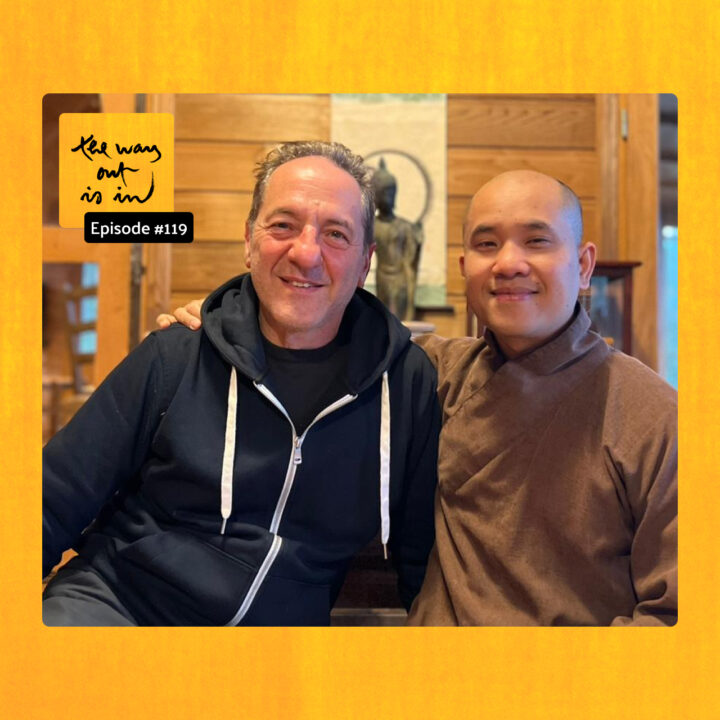
Spiritual practice is a continuous journey, not a quick fix. In this episode, Zen Buddhist monk Brother Phap Huu and leadership coach Jo Confino explore its shadow side, addressing common misunderstandings and misconceptions.
They also discuss the dangers of using spiritual practice to avoid difficulties or self-criticism; the misunderstanding of sudden enlightenment; the importance of community in spiritual growth; the balance between compassion and firmness in leadership; the need for humility; the role of knowledge in the practice; and more.
The discussion concludes with reflections on the ongoing ordination process taking place in Plum Village France, and a short meditation guided by Brother Phap Huu.
Co-produced by the Plum Village App:
https://plumvillage.app/
And Global Optimism:
https://globaloptimism.com/
With support from the Thich Nhat Hanh Foundation:
https://thichnhathanhfoundation.org/
List of resources
Sister Thang Nghiem
https://plumvillage.org/people/dharma-teachers/sr-thang-nghiemSister Jina
Sister Jina
https://plumvillage.org/people/dharma-teachers/sr-dieu-nghiem
Interbeing
https://en.wikipedia.org/wiki/Interbeing
The Plum Village Tradition
https://en.wikipedia.org/wiki/Plum_Village_Tradition
‘The 16 Exercises of Mindful Breathing’
https://plumvillage.org/library/songs/the-16-exercises-of-mindful-breathing
The Way Out Is In: ‘Shining Light (Episode #63)’
https://plumvillage.org/podcast/shining-light-episode-63
The Way Out Is In: ‘The Three Jewels (Episode #89)’
https://plumvillage.org/podcast/the-three-jewels-episode-89
The Way Out Is In: ‘Engaged Buddhism: Applying the Teachings in Our Present Moment (Episode #9)’
https://plumvillage.org/podcast/engaged-buddhism-applying-the-teachings-in-our-present-moment
Quotes
“In classical language, whether Chinese or Vietnamese, Buddhism represents spirituality as a path. And we have to walk that path. For us, the path never ends; it is a continuous journey. Sometimes I feel that people therefore misunderstand enlightenment. Because, sometimes, the language or translation of a teaching means that its transmission of a teaching that was relevant hundreds of years ago may not be helpful in today’s ways of being or of thinking. Such as, that quick-fix energy.”
“You need many conditions for a moment of awakening to ripen. It is not sudden, because it is a continuation of life’s journey, of understanding, meditation, looking deeply, stopping, being with, and of having teachers to guide you.”
“All of my childhood insecurities, my needs, my habits: they’re still flowing in me. I don’t think there’s one thing that I’ve completely eradicated. And there’re moments where old patterns come up sharply. But I’m so much better at recognizing them, working with them, and overcoming them – not in terms of getting rid of them, but calming them. Befriending is a powerful thing, because it’s our suffering that helps us to stay grounded. It’s our suffering which helps us to see more clearly; it’s our suffering that allows us to be more compassionate and more caring.”
“The Bodhisattva path means holding both learning and unlearning at the same time.”
“Every way of life should be a meditation.”
“‘This is it’ carries the past, but it is also building the future.”
“In concentration, our heart is at peace. This is a brand new day and I vow to live it in mindfulness. The sun of wisdom has now risen, shining in every direction.”
Dear friends, welcome to this latest episode of the podcast The Way Out Is In.
I am Jo Confino, executive coach and spiritual mentor.
And I am Brother Phap Huu, a Zen Buddhist monk, student of Zen Master Thich Nhat Hanh in the Plum Village tradition.
And today, dear friends, we are going to look at the shadow side of spiritual practice.
The way out is in.
Hello, dear friends, I am Jo Confino.
And I'm Brother Phap Huu.
And brother, I'm really keen to have this episode topic today because we often talk about the positive sides of spiritual practice, how we can deal with our suffering better, how we can be more present, how we can understand impermanence, how we can find more love and understanding in our life. But everything in life tends to have a shadow, and we also know that people can misunderstand the spiritual practice sometimes and also sometimes use it in a way to avoid the very way that they can improve, and they use it to actually criticize themselves, to bypass difficulties, to find ways to avoid situations. So I am really interested in helping listeners to really start to understand their practice in both directions. What is it that's working for them? But also, are there any situations in which maybe they're using spiritual practice to avoid things? So… You have so many people, thousands of people, coming through Plum Village. You've been here for more than 20 years. You've seen pretty much everything that goes on. What's your sense of the sort of mistakes people can make or the sort misunderstandings people can make when they come here?
I want to be very mindful of everything I'm about to say. One misunderstanding is that we can change our whole life in one retreat, meaning like we would come here with the expectation to be enlightened or to have a breakthrough. And we build up this ideal, okay, I'm coming to the monastery or I'm going to a retreat so I have to make every minute count which, in some ways, it is the practice of the present moment, be deeply in the present moment. But we are carrying this collective 21st century mindset of a quick fix to our life and this expectation that we put on ourselves. Because in classical language whether it's Chinese, Vietnamese, we see spiritual… we see spirituality as a path. And the path, you have to take steps, you have to walk the path. And the pathway for us never ends. The path for us is a continuous journey. And so therefore, sometimes I feel people misunderstand enlightenment. And because language sometimes, the translation, or the transmission of a teaching that was relevant a few hundred years ago, that may not be helpful in today's modern way of being or our way of thinking such as, once again, that quick fix energy. In our Zen tradition, which Plum Village has two streams, Master Lin Chi from China and Lieu Quan, Dharma line from Vietnam. And in the teachings of the Zen tradition during Master Lin Chi's era, some of the teachings were about sudden enlightenment. And it's a moment where you have a breakthrough and you suddenly have an understanding where you can call that an enlightenment. Our teacher has retranslated enlightenment in… for one moment of awakening, you need so many conditions for that moment to ripen. So there is no sudden, because it is just a continuation of life journey, understanding, meditation, looking deeply, stopping, being with, having teachers to guide you. So you can't say suddenly you're enlightened, because all of the conditions that have been transmitted to you make that moment for you to have a breakthrough. So this is something that I've been teaching, particularly in this Rains Retreat and in previous days of mindfulness that I have been guiding and leading. Because I do feel that there is this immense expectation because of where we are as the world…. Like, there's so much suffering. And we do need to wake up. We do need a moment where the coconut has to crack so that we can drink the coconut water and be nourished, right? Sister Thang Nghiem in her previous Dharma talk in Plum Village, she gave a Dharma talk about being in a community, you have other members that help you crack your coconut. Right? And sometimes it is because of the daily life of the interaction with one another that we have frictions and from frictions we're able to develop communication, understanding, love, and then the coconut cracks and you see yourself, you see your habits, you see your limitation. And so therefore that coconut can be a metaphor of enlightenment, that coconut can't crack on its own, right? You need to have so many different conditions to support it. So I would say like that's one example. I've also seen the side of just looking for bliss and a surface kind of peace, I would say, you know, and that means then we're not, then we are afraid of being triggered. You know, and somebody have once said to us, like why do I have to hear about particular things in the monastery? Shouldn't it all be dot, dot, dot because what I heard, it triggered me. And one of the monastics said, well, we never promised that. We never wrote on our description that you're not gonna be triggered in a retreat. But, you know, the First Noble Truth is to understand suffering. And of course, you're in a retreat, we're not going to like, we're not there to give suffering. But sometimes in conversations, in interactions, something comes up, you know? And so then, therefore, you have a moment of suffering. Then you fully like just look at that pain and then you make your whole experience of just that one moment, right? That's also a trap. The other is I also see we become mindful of our own way of being. And then we become a mindfulness inspector to the world. We start to criticize, we start to judge, we start to compare, we start to look for the faults, and it may trigger something inside of us or touch something inside us, maybe a wound that comes from afar and now it comes up and therefore we have to play a particular role and therefore we become quite arrogant I would say. And I've met arrogant friends who use the teachings and weaponize the teaching against oneself and then against friends, against community. And I think that's very unskillful in a way of then helping the collective awakening because everybody meets Saddha very differently. You know, and another area is once we have touched joy and happiness, which are essential in the 16 exercises of mindful breathing, like we go there first to cultivate joy, to cultivate happiness. And then we have to then also come and take care of our pain and suffering and our deep pain and suffer to not bypass it. And there, either you choose to avoid it or some people choose only suffering. And then we get so addicted to suffering in a way. And we can only talk about our suffering. I have myself checked in with myself like, oh, you know, there's some stories I always tell. Am I so attached to that story? Or is that story a means to support a teaching or a recommendation? That's very different. But if I just want people to know like to love me, you know? So I have to use, I have to be presenting myself like broken in a way to receive that love. And the essence of the practice and spirituality is beyond a religion for us in understanding deep Buddhism, it is a way of life really. It is to be with courage to meet the present moment, whether it is happiness, joy or suffering. And I think sometimes we don't know how to celebrate the joy. And I've seen people have this reaction. A very dear friend of mine was in a retreat this spring, and this is his second retreat. And through the retreat, he was so happy. And he stopped me on the way to lunch and he asked me, brother, am I practicing wrong? Because I'm just so happy. Last year I was crying like buckets of water, buckets of tears, but this year I'm just happy. So it must be I'm practicing wrong because I'm not touching suffering. And I looked at him and I said, well, brother, I see that you've transformed. And who told you that you're not allowed to be happy? Who told you that you're not allowed to be in joy? And that you actually are having a great time. Suffering for you is not present right now. And I said, you have to celebrate that and remember this moment. Because suffering will come. Suffering will arrive when it's conditions manifest this. And we have to book these moments like we have to lock it in like these moments of joy and being neutral, in peace, in a way, because that's a ground for us to look deeper into different theories of change, understanding, you know, our ancestors, our own habits, like whatever it is, but when we are more calm and at peace, our clarity gives us a deeper insight. Then when we're going through it with pain, because that may be layered with a kind of feelings and emotions that can also drive our deep looking. But when we are at peace, calm, present, in the state of really being able to name our present moment how we are, that clarity can give our lens a clearer vision so we can see deeper. So, you know, this shadow side of spirituality, I mean, that's just on the personal development, right? Like we can talk about community, we can talk about authority, power, I mean all of it. It's a part of the monastic training too. And let's see where this conversation goes, but it's a beautiful conversation to look in together.
Thank you, brother. And one of the things that I find people have a misunderstanding is they think that it's a linear path. But they think that it is always going to get better than how it is. And one other thing, so that when people might have a setback, so exactly what you described, it's like you have a breakthrough, you have this happiness, and then if a difficulty comes up or you forget it or you lose that insight for the moment, then people feel they're failing. And one of the things I talk to people about and it came to me quite recently was that when I was at school in my maths class, we had this graph where we plotted different points and then we drew a line which was the mean average, which meant that actually what was the average over time? And some of the points were above the line, some points were below the line. But actually, it wasn't that you judged it from one point, but you watched over a period of time what was shifting. I just really need to pick up on that sense of people just thinking that it's just a constant progression and that when there's a difficulty, then, oh, they've done it wrong, or they've forgotten, or they're not practicing well.
You know, that way of explaining reminds me of playing video games. It's like leveling up, you know, like you're always leveling up. I say that there is a leveling up in our practice of just embracing and being okay to accept what is here, you know, and I think that's hard though, that's really hard because our way of understanding progression in life is a report card, right? It is a promotion, right? It is all of these things that we get more and more and more and more. And in our understanding of just life, like, it's very organic, it goes with the season, it goes the age, it goes with the experience, it goes with the maturity of our ability to hold and to accept. One example that I am very grateful for, the shining light that I get in the community and thanks to friendship, they're able to see my habit and say, you are doing exactly what you said five years ago, brother. So very simple… Whenever I was young, on the very first day of anything, like whether it is school or it is a taekwondo class that I was part of a dojo and I'm entering into a space of strangers. I don't have my friends, I don't have the familiar setting. My fear really activates and I always cry on that very first day. And the only place I didn't cry was Plum Village, strangely enough. Blessings to the Three Jewels and the community's environment, setting, and the energy that they lay out, that we can feel even as a kid. But that experience, I have looked at it, I have practiced with it, and it is less strong, but I wouldn't say that it doesn't manifest, you know? And there are moments in a setting, in community, that inner child comes up again. And, you know, those who… we say we understand our pain and suffering, then we have an opportunity to step back from it, because we know, okay, if I step in, then my fear is being activated. Yes, you can do that when you're still trying to develop your foundational practice and you don't want to stir your pot too much, where you're going to have to night in, day out, like struggle with that present moment. There is a path of mentorships in our communities. Like you can ask your mentors, like, that's a suffering. Should I dive deeper into it? And your mentor will say, no, you're still fragile. Know is there, but don't step into it yet. Build your foundation. Because you have so many other seeds, so many other potentials in you that I want you to focus on. Unfortunately, in my own intuition, I felt the strength when I was ready to, okay, I'm going to dive into this now because it needs to be met and it needs to be felt even though my nervous system and my physical body were shouting and said, don't do it, don't do it. But you have the trust and the faith in your ability to be with your breath, to be firm with your own fear that arises in you. And you can hold it because you are also a practitioner so you're different than the past so you could activate that meditator, warrior and you say, and it's okay. You're a different now. But I've met people in the monastic community as well as in the lay community, lay meaning everyday life people, where they know they're suffering and they choose to never go there. And that's also a danger in a way, then that becomes a bypass for us to avoid that and then when it shows up, then we can just totally freeze and collapse in a situation. So a practitioner in our own spiritual growth has to have the middle way, which is like knowing our ability. Could I go there? Or in this moment, I'm not strong enough. And it's okay, and I wait when I'm strong, when I am present, when I'm supported and I can come and meet that, that difficulty, that pain. And just to come back to your sharing, Jo, which is so, so true. And it was my own trap in my own mind when I was in my mid twenties, when I met my crisis moment. My story was like, okay, I'm… this ain't working cause I'm still suffering. And I wanted to give up. I just wanted to throw everything away because, all right, if after X, Y, and Z years and I'm still having so much doubt, I'm still not capable of overcoming this, then what's the point. Right? And that's just your habitual mind finding a reason to blame and not taking agency. It's like, no, no. What's different now is actually I can see my suffering. And what's different is I know the path is to ask for help. But are you courageous enough to ask her help? Can you remove, can you ask your pride to step down and for you to step into a vulnerability of just sharing to your close siblings, friends, I'm suffering and I need help? And I remember one time I told Thay about like one of my sufferings. And like I was so prideful and I was telling him like how great I am by transforming, transforming it. Oh my gosh, like we were sitting literally in this hut. And Thay was on this rocking chair that is still present. He's like patiently listening to this young monk yap about his progress. And I was just waiting for a congratulation. And Thay just said these words: Well, that's why you practice. And I felt so defeated. I was like, wait, was my storytelling not that epic? Like, maybe I need to add a little bit more salt and pepper and MSG to the story to make it sound even better. But I just am so grateful for him saying those words. And that's why you practice. Like don't forget why you're practicing. You're not here for me, your teacher, a Zen master to give you a confirmation because then you'll be stuck and attached to that moment. And that becomes a prison for you because then you think you've succeeded. And I think we collectively are also so eager to share about our insights. Thay knew he had a lot of young monastics in his community and a young person, we are driven by our ambition, our curiosity, our energies, and also our seeking of love. And I just remember this one time, he says, don't show off your insights. It's still very young and fragile. You have to protect it. It's young, it's new. You gotta keep cultivating that insight. And so therefore I have this reaction because of that teaching from Thay, when someone, and I know it's not the insight of enlightenment, but somebody say, I have an insight. I'm like, whoa, whoa, hold it down. And I've heard that, you know, in the, even in like tea drinking, it's like, oh, I just had this insight. And I was like, are you sure you want to tell us? I just have this habit energy of reacting like that. And sometimes it is an insight, I'm like, please tell me your insight. But it's, I think a mistake would be to practice to look for confirmations.
Thank you, brother. And just that sense of it's a lifetime, it's a path for a lifetime. And I think when people have an insight, I think the mistake is that people want to eradicate their suffering. They almost want to… I remember when I was a young man, I just thought if I do a deep dive into find my demons, I can just eradicate them and by the age of 40 I'm gonna be happy and free. And I think a lot of people have that view of, they just want to get rid of it, as opposed to befriend it, because I am now about to be 65, and I don't think I've eradicated anything. I think that all the childhood insecurities, my needs, my habits, they're all still flowing in me. I don't think there's one thing that I've completely eradicated. And there are moments where old patterns come up sharply. But I'm so much better at spotting them, so much better at recognizing them, it's very much better at working with them and overcoming them, not in terms of getting rid of them but just calming them. And this comes back to your sort of quick fix idea, this idea that we just want to end the suffering. But actually befriending is such a powerful thing, because actually, it's our suffering that actually helps us to stay grounded. It is our suffering which helps us to see more clearly, it's our suffering that allows us to be more compassionate and more caring. But I just want to come back to what you said about being a warrior, because I'm working with a lot of people at the moment in my coaching who are lovely, lovely people but find it very, very difficult to stand up for themselves. And this is even in very senior positions that there are people who want to make everyone happy. They don't want to challenge. They don't want to be tough on people. They want it all to be okay, to be calm, to be happy. And I'd really like your perspective on this idea of, I know we've talked about it before, but what it means to be compassionate, but to be really tough in the sense of… I remember when I used to work at The Guardian, everyone was so nice to each other, but it meant that the undercurrents and the emotional difficulties were always suppressed. And it meant that when a difficult situation came up, it often was just pushed under the carpet and became more and more difficult until the moment where something will explode. And it just wasn't dealt with at the time. And I just, because that's such a misunderstanding about spirituality, that it has to be soft and kind at all places, in all points. And I know Thay was quite tough, wasn't he? I mean, tell us about Thay and also about, you know, you're the abbot of the monastery. You want everyone, all the monastics, all the monks to be happy, but I imagine you have to be tough sometimes too. And I just wonder where you see that.
I would say first, we always train in our loving kindness and our compassion, because compassion is a pathway for empathy, it is to feel the pain and the suffering and to be able to address it with compassion, with kindness, which is different than addressing suffering and pain or a mistake with harshness and punishment. And so our teacher, Thay, he had many hats that he had to put on. And he was such a compassionate leader because he knew that every student that came through the monastery and made a vow to live this life and be his student, that we're all coming from very different backgrounds, different upbringings, different traumas, different aspirations. And that meant he had to absolutely always be so open and activate his unknownness in a way so that he can listen to his students. And for Thay, as a practitioner though, for so long, and he's been through so much in life, his eyes of recognition is much stronger than we are, that we have. He's able to see us how we are just by the way of our way of interaction, walking. He used to tell us, oh, when I see the way you walk, I can know if you're practicing or not. Or when I can see the way you sit, I can feel and I can have a grasp on what you're holding in this moment. And it's because he's been through so much and he's interacted through thousands, hundreds of thousands of people, so he has a lot of data on this and he is also a very sensitive person and he's able to pick up energies really quickly. Yes, Thay was a mountain of solidity, and that mountain of solidarity also has to have a foundation. So when the community is not doing well, he has to call it out. He has to tell us that he's disappointed in us. He has had to say words, use words, and I was on the receiving end of some of these gatherings where Thay was so disappointed. And he said, it gives Thay fear because as my student, you are not practicing what I'm telling. So how could I have trust into the future, into the feature generation of Buddhism? And I remember receiving those quotes and comments and I was like, oh, it's like a knife into your heart. And you're like, oh, you're the last person I wanna disappoint. But it's true, right? And you gotta say what is true. And Thay, as a teacher, is a human being, and he has the right to feel disappointed and to be upset at us. And as a teacher has to find ways to shine that light. With younger students, he would never say that. I was already in my senior position of vice abbot and abbot, so Thay was very selective in who he's interacting with and what choices of energy and words he would use. You know, and Thay used to tell us, you know, Thay is like a doctor. For some students, you gotta give them syrup so that they can drink it. If it's too bitter, they won't drink the medicine. And then some students, they're too smart, so you gotta give them the stick. You gotta be firm or else they will manipulate his kindness. Right? And sometimes I think Thay's openness to us is very powerful. I might have shared this already, but it comes to this conversation we're having now that makes a lot of sense. About two years in my monastic life and I was attending him and he had a sister come into his hut here and he said to the sister, he said, it's not fair. It's not fair that you copy and paste your dad's experience that you've had with him on me. You're not giving me an opportunity to be your teacher. You're not giving me an opportunity to guide you and to heal your trust to a father figure. And I was able to witness this and I've never seen someone who is so accomplished in life. Being… In a way, that's a plea for help. That that's like give me a chance, like give Thay an opportunity. And I was really moved by that and I was really emotional because like Thay was being so vulnerable to us, which in my mind like he's this great Zen master that, you know, we just learned from. But here he is like asking us to give him some kindness also so that he has a opportunity to support us. So firmness can also be with softness, you know, because that was a very firm request, but through a very gentle and authentic saying that I need your help or else I can't transmit anything. And now, in my position, as I continue to grow in this area, it's a constant reflection of like how can I meet each individual where they're at? And recently I was nominated by the Bhikshu Council representing the whole Upper Hamlet to speak to a brother who is going through a difficult time. And we have shined light into habitual energy and characteristics that has made him suffer and made us suffer. And even the mentor asked not to be in that position because this is a position from the whole council. So I have to represent that. And honestly, it took me a day to plan and to prepare myself for this because it's not easy being very firm and very strong. And I chose the position. I chose where to have this conversation: in Thay's hut, sitting in front of the altar and inviting us into Thay's space where he guided all of us. And in this moment, it's not about me, right? It's not about Phap Huu, it is about… I am a transmitter right now. And in it there is love, but in it I have to be very clear and very firm. And there were some strong messages that I chose to use that was repeated from the collective shining light. Because I feel that it's not kind if we don't show the true side of how the community is holding you. Then we're… Which is hard for me because I am easily someone who wants to avoid difficult conversations and a difficult moment with an individual because I have to be ready that this person may become very afraid of me and may not like me. But in this moment, I have the practice non-self. It's not me, it's a representation. And that firmness is also coming through because I really want you to see your habit energy so that you can wake up. And if we're gonna be too nice about it, then we're not supporting and doing any service to this individual and to the community also. And what I can say is that I did hold my grounds in a way because I'm easily leaning towards compassion and choosing very kind words. But I was listening deeply to the community and this is not a… This is a moment for this person it's a break it or make it moment. It's like, we really feel that this person either will continue to grow or they're going to continue to suffer. And of course we want the growth, right? And that means it's like deep tissue now. Right? Even if that person is in agony from receiving the deep tissue, you have to give the deep tissue because that blockage is too deep. And I really felt that my brother received it. And I felt that I was able to be firm, but at the same time in my heart we're still praying that that they will make it. Because it's a tough conversation. It was a really tough conversation.
Brother, thank you for sharing so deeply, because it's such a great example that if you don't say that, actually there's a cruelty in allowing someone to continue to suffer in their way. And so we think that kindness is being sort of supportive, but sometimes it's actually a cruelty not to tell the truth. I want to ask, brother, about the intellectual side of the practice, because Thay, I always remember he said very clearly that some of the worst practitioners in his experience were people who were studying Buddhism at university or doing their PhDs or were teachers of Buddhism but in a university context. And how we can use the mind that we can become very knowledgeable and that we can talk about the practice endlessly and talk about the history of Buddhism and what this one said or this teacher said, what that teacher didn't say, but that doesn't necessarily make someone a good practitioner. And I'm not someone who studies much. And I find the fact that I don't study much means that often I'm present for what is because I don't have the… I'm no trying to work it out in my mind or just think, oh yes, I read about this person said that or that person said, I feel that I'm just present for life and that allows me to tune in very much to what's going on and what's around me. But at the same time, Thay was a great scholar, so it's not like he was sitting there not studying. And I know you've talked in the recent past about the fact that, in a sense, you have not been a great scholar. You've been more sort of intuitive learner, you've been in Plum Village, and, you know, you much more than me because I'm not direct part of the community, but I feel, you know, just by being in Plum Village, you soak it up by being with so many people and seeing the patterns of suffering I learn about life. Through my coaching practice and that deep insight into other people's lives, I start to learn more about myself. But I know you also talked about the fact that actually maybe you want to be studying more in the future. So I'm really intrigued by when knowledge is helpful and also when it can act as a block.
I see the blockage is when knowledge doesn't allow you to listen anymore to everyday life, the present moment, because knowledge… We need philosophers and I'm very happy that I have soul sisters, friends that are doing PhD in Buddhism and bringing especially some of the tradition that they've learned from Plum Village into the academic space and translating Thay's insight into an academic language, so that it also has a streamline into that space, right? But… Not but. Somebody has reminded me on the podcast, don't say but too much. And I'm so grateful to all the comments because I do read them, dear friends. And the Bodhisattva path is holding both learning and unlearning at the same time. That's the importance right there. We can't say we're not learning, whether we are a bookworm love, or a historian, or a Dharma geek, nerd, which we all need, all of them. And then some of us are just like intuitive learners, right? Those who don't have a keenness to these areas, but their way of learning is direct experience. And in Plum Village, this community, like that diversity is there. And I've learned to celebrate everyone. I'm like, I got my nerds on this side. I got science nerd over here. I got the ones who love baking cake on this end. I got the musicians. I got the gardeners. And it all like in nature, like in the ecosystem of a community, it all makes sense. Whether it is learning or a job, a career in terms of physical work, if we get stuck in it and we think like that is the only happiness and it blocks us from listening to everything else then it becomes a blockage to growth and it becomes as shadow, right? And part of the danger, particularly in seniorship in the path is we think we know more. Right? We have experience and we do have the knowledge of the past but if we are attached to that, then we can't touch the present moment. Coming back to, you know, the very here and now, our core teaching to dwell happily in the present moment. I just started a class for the monastics yesterday, Thursday, and I'm teaching community leadership and flowing as a river. And that means I have to bring some of the things that I've learned from Thay. And I said, the first thing I wanna say as a disclaimer, there are some things I have to reference Thay, because he had a vision for the community. But I want us to be very careful about this because I don't want us to be attached to that vision of the past. Thay has given us a field and a pathway and a lot of his vision is still very much aligned with the present moment. And some of it, it needs tweaking because society has changed, has evolved. Right? Our way of understanding the monastic culture is also constantly growing and developing, as well as holding its foundation. So I've met friends also in the Dharma, in our tradition, where they are so attached to how it was with Thay. That's very dangerous when you weaponize it against the community or you use it to make life difficult, right? So we have to be careful about this. And this is where knowledge is to help us grow and be open. But when knowledge blocks things and knowledge doesn't allow us to listen to the present moment, then that is very dangerous. And I have a very concrete example that I've been meditating on, on helping someone. And I don't… I'm reflecting how do I help them, you know? And because I felt that they have also grown so much in the Dharma and is so sure with everything now that it's not listening to the voices around and has become also a presence where people are afraid. Is that person there? Then I don't want to be there. And every time that happens in the community, that is a red flag for me. Because they are not mindful of the community interaction and the community's friendliness or, like, connection with. And being an individual scholar is much easier because you don't have to deal with humans. But in our community, we're constantly dealing with one another. And I think we have set up a lot of safeguarding as well as community way of looking. Yesterday, we had a Dharma sharing, just a teaching body. And teaching body is, I would say, monastics in there are 18 and above years. And one of the sharing and we really said this is not a meeting, this is a sharing for us because we're always, it's normally always a meeting and it's a checklist of like who's going to step up, who's going to teach this, who is going to guide this, it is very mission orientated. But this time it is a sharing. And one sibling shared and it really touched me and she shared that, I'm so happy that we are one body. I would be in fear if it's one person telling the community what to learn and telling the communicate what to teach. And that was only when Thay was there because he is exceptional. But even Thay would open his channel to ask for input, to always check in with us. Is my teaching relevant? Is the suffering of today, has it changed? What does Thay need to know? How is it for the families now in the early, at that time, in the early 2000s, what is the suffering? What is the internet doing to all of us, right? And if Thay was here today, he would be asking and contemplating on the growth of AI, for example. We have to always have a pulse on the present moment manifestation of realities. And that sister just sharing like, I'm so happy that we are a body and we have this space to share from our heart, to give feedback, to ask for help. You know, that is healthy. And that's where intellect and practice goes hand in hand, because you need mirrors to reflect. And I think to have that, you know, Thay did so much work on developing this community and that way of being.
Thank you, brother, there's such a great teaching you're giving about the power of humility. Because humility doesn't mean you don't have experience, but that sense of openness to change. And you know, we see this in families as well, don't we, that a parent dies, or their parents die, and the siblings say, well, my mother, our mother would have wanted us to do this, or our father said this, so we should do that. And how that, as you say, is weaponized and how people use that rather than actually, as you said, to stop. They stop listening to each other, they try to score points with each other. I want to just come onto the practice of meditation, because this is a place where there can be so much understanding. Because in a sense, you can say, well, this is the most simple thing in the world. You have a cushion, you sit on it, and you sit there for half an hour, and then you get up and have breakfast or whatever. And yet there's so much misunderstanding about what it means to meditate that some people will only think it's a good meditation if they had no thoughts at all or they had few thoughts. Some people will only think, it's a good meditation, if they only have happy thoughts. What, from your experience, are the key misunderstandings about the practice of sitting?
Wow. That's a podcast on its own. Well, no, I want to keep it very simple. Sitting meditation is such a safe space that we can learn to befriend ourselves. It's safe when you have the ability to know how to come back to the breath, to guide yourself, to feel what needs to be felt. You are intentionally stopping your mind from interacting with the noises, whether it's the outside noises or the inner noise, because you're going to guide it. You're going to direct your mind to a concentration, which is your breath, your body, and then your emotions, your feelings. The sitting meditation gives you an opportunity to hold and to examine. Right? And sitting has so… it's a foundation for everything in our way of understanding sitting meditation. It is to meet your fears, it's to meet you habits, your restlessness, and then sometimes it is just to be there and sit and do nothing. To be bored. To feel your body that is tired and is aching, and the resting is already healing. As well as sitting meditation is a space where you can look deeply into something you've been carrying. You have a mindset that you have activated to bring understanding to, and sitting meditation also is not to be carried away by even our own deep looking. We have to know how to come back to the present moment and to be alive again. Sitting meditation, when it doesn't help, it is a way to avoid. And sitting meditation doesn't help when you are punishing yourself and violently making yourself be still and hold something that actually maybe walking meditation is more helpful. Being with the body is more, movement in the body can be more supportive right now. And that's why in Plum Village, like Thay has shared the importance of walking meditation as the importance of sitting meditation. And going even further, you know, Thay said every way of life should be a meditation. But we find ourselves sitting so much in life. And the power, when you know how to sit on a cushion, then you can sit anywhere. That's… That's the incredible spiritual dimension that you develop for yourself, that it's visible and invisible, depending on you. You don't need to carry a cushion everywhere in the world. Thay did, because he had attendants, we carried it for him. But you can find yourself sitting, waiting in the hallway for your interview for your job, and you can be anxious, you can carried away, or you can come back and calm yourself in that moment and hold the fears that you have, but then activate and bring up your happiness, your wish to receive this position, because you can offer something there. Right? So sitting meditation for us, why we train in it is also, it's the kind of mind work. It's like gardening. You sow the seeds and you cultivate it. You know when to water it. You know when to let it rest. Don't do anything to the land. The land has its own magic that's gonna go on. And then when the right season comes, your insights will be ripened and you get to harvest it. And the sitting meditation, walking meditation, deep quote unquote meditations, they are the preparation for. And insight comes in its own ripening. You can't push it. But Thay in our Dharma has invited us to see the simple ripening of your awareness in just your way of drinking a glass of orange juice. Can you feel that the whole universe is there? That's an insight. Right now, maybe it's intellectual, but you're training it. You're training like this juice that I have in this cup, in my two hands, didn't just come from nowhere. And now it's gonna come into my body. It's gonna become my energy, and my energy will become my actions, body, speech, and mind. So I'm gonna transmit this orange juice through my way of being. And how do I wanna transmit it? That's the fruit of your understanding through your meditations. So, you know, that's how I see it. That's how I feel it. And now honestly, like every time I go to sit, when I can, I can just enjoy doing nothing. That 30 minute or 45 minute, depending on the day in our schedule, no one can bother me during that time. There's no, there's no pings on the phones. There's no, you know, distraction because collectively everyone is tuning into the present moment. And I get to bathe into that energy of rest. It makes me so happy when the kids can even enjoy that. So previous recording, we got to listen from Benedict and his three boys came to every meditation. The monastics, we were just so surprised. And what I was imagining for them was to sit together with their parents with no distraction, in silence. Sometimes I see the young one just laying down next to their parents. And that is so beautiful. So something as simple as sitting, we had that art of knowing how to be just together, without all of the distraction or the entertainment. And just, but you can't, I'm quite positive, it's very hard to replicate that at home. It's only possible because of the collective in Plum Village. And that is also the gift that we are offering to the world when we do sitting meditation, that permission to not be distracted. I was watching the three boys during our meals because we have a very strict rule in our Rains Retreat, during lunch, even when you're done eating, you're not allowed to stand up because it becomes our meditation hall. So we all have an agreement that even when we're done, we're going to sit and be peaceful and others can be eating. And once again, I saw the three boys just at peace there and still, and of course they were playing with one another, but they were very respectful to the collective. And that is by the energy of sitting together. The power of just sitting in silence and the concentration that we are entering into that moment, that is eating together. So what can sitting do? It can do so many things. And for me, what gives me joy is when I see moments like that.
Thank you, brother. I just want to ask you about happiness in the present moment, you're talking about the present moment. But one of the misunderstandings I constantly see with people is they want to get to somewhere, I will be happy when I'm able to sit like a mountain, I'm going to be happy when I can have my… fine-tune my practice, I can only be happy when I am more compassionate, I'm going to be happy when I'm able to be in the present moment. And it's very much future orientated. And people find it very difficult to recognize that actually where they are right now is the best place for them to be because it's where they're are. And if we're trying to be somewhere in the future, then we can't be that because we're not there and then we're not at home. So I just really like your take on that sense of there is nowhere, as Thay would say, there is nowhere to go, there is nothing to do. And yet people are just constantly thinking that there is somewhere to go, there is something to do in order to almost come back to this present moment. And there's a wonderful story, I can't remember if I've spoken about it before here, and there are variations of it, but I was once told that there's this Portuguese fisherman and it's the afternoon and he's having siesta on the beach and this American tourist comes up to him, you know, why are you sleeping on the beach? He says, well, I went out in the morning, I caught the fish, I sold them at the market, and now I'm resting. And the American tourist says, well look, this is crazy because actually, you could go out a second time. And then if you go out the second time, you can double the amount of money you're making, and then you can buy a bigger boat, and you can go deeper into the ocean where you can get the really big fish. And make even more money and then you can maybe buy another boat and then you can get to the stage where you can just spend the afternoon relaxing. And it's such a great story for me because it's like we want to get somewhere, but we're already there. How do you see that?
I mean that fisherman had an insight of like well, I'm already happy. What are you talking about getting a bigger ship and working more? Then I can't lay there and sunbathe. Thay has this calligraphy 'This is it'. This is it, the present moment. This is it. And this is it for him is an insight. And he's had many moments of this is it, you know. Sometimes we may be just walking, and Thay would just stop and say, this is happiness, this present moment, with the community in Plum Village, with the nature surrounding us, supporting us, this is it. And this is it carries also the past, also it is building the future. And so I think that happiness for a Zen master, if you're to ask him, he's like, well, you can touch it now. You have to train though. You have to unlearn this concept of what happiness is and a lot of it, like you explained, it is promised in the future. Do more, achieve more, beat that person. Oh, you can do better. Oh, if only I had that moment that I can outshine, right? And we all have our version of that. I have my version of that. I… coming back to the three boys, there's so much a part of this podcast. And there were a few adults that were also in admiration of the three boys in the week in Plum Village. And one of the adults said, wow, if only I could have come when I was this young. And I said, yeah, but you're here. Let's not forget that. Let's not forget that you are here now. And for so many people, we'll never have an opportunity to be here. And so the present moment, it's a very difficult training. It sounds easy. And happiness for a Zen master would say, you can cultivate it, you can generate it. Don't you have two eyes? Isn't your lungs working? Your two hands, your feet, your heart is still beating. There are those that you can say are my friends. There are those that you can love, and there are those who you know will love you. Like, isn't that happiness? But that's a training, because our mind is so quick to forget and to chase after. All of us monastics, we have the same thing and that's why every day, we chant the same things every morning. The Dharma body is bringing morning light. In concentration, our heart is at peace. This is a brand new day and I vow to live it in mindfulness. The sun of wisdom has now risen, shining in every direction. We do this every day, like almost every day except lazy mornings. And I love this line, today is a new day and I vow to live it in mindfulness. And I had a brother, and we always joke with each other because we said every day we have to make our vows again because we forget it quickly. Every day, he's like, oh, it's a brand new day. Let's make our vow again. Let's be nicer. Let's be kinder. Let's be more mindful. And then, one time we both made a mistake and we're like, it is okay because tomorrow we're about to make a new vow. And it's so true though, you know, because tomorrow it's gonna come but in this moment I know that I've made a mistakes and I am going to practice and begin anew and I'm gonna have a opportunity to refresh myself again. And so happiness is for all of us to define it and discover it. And for some, they arrive at a moment where this is it. We're in our Rains Retreat and we always have a question to everyone to activate our inspiration and sometimes our motivation, our boost for the season. Someone asked me, I think one of my younger siblings asked me and I said, I absolutely have no aspiration. My own aspiration is literally that I'm here and I wanna be here fully. Cause in this moment, I don't feel like I need to construct something that is to move me in this practice. But I do find my mind being carried away by 2027 already. And I have to train myself, like, no, you're here. And then I do get carried away by my fears. I do get carried away by my worries, my anxiousness. Somebody, one of the sisters literally just told me yesterday, I created an event and in my mind I thought it was so wonderful. And it's like, oh, we have some feedback for you and we're gonna write it and we're gonna send it to you. And in that moment, I was like, absolutely, send me the feedback. But I was so angry. I was, like, I got out of my way on a lazy evening. I created this whole event for the whole sangha and I did something. Oh, and now I did something that didn't make them happy. And I'm about to receive a feedback, right? And I was like dreading it… in line for food. And I was like, but what if it's good feedback? What if it is some flowers and then some things I can do better. You know, and the mind gets carried away so easily. And so my happiness was okay, you know what, yeah, give me feedback. I have a community, that's why we're here. That's why I have siblings and they can see things, they can hear things that I may not be able to hear. Right? And I need to be open. And speaking of it now, like, just present moment, you know, I'm happy that I have arrived to receive whatever I'm about to receive. I'll give a report later. If it's mud or flower. Now I'm excited, I'm curious as heck to what I'm about to receive. And that is life.
And, you know, brother, I remember speaking to Sister Jina, who's one of the sort of elder sisters in Lower Hamlet. And this was, I think, on my second visit to Plum Village. And I said, sister, don't you get bored with Thich Nhat Hanh repeating the same teachings over and over again, thousands of times, and doesn't Thay get bored with repeating himself? And she said two things. She said, our habits are so entrenched, that actually it does take thousands of times to break our habit. And also then she said, and are you practicing? Because I think it's been like, we constantly fall off the horse. This is not a constant thing where we remember everything we've learned and we sort of learn from it and don't repeat the mistakes. I mean, we're constantly repeating mistakes. But this is where compassion and kindness and tenderness becomes… because often in the spiritual practice we're very tender or caring about other people, but we're not tender with ourselves. And with the fact that we're no perfect, we're not meant to be perfect, and that when we make a mistake, we can also just find it amusing. Find it the… It's funny that we don't learn. It's funny that rather than berating ourselves. We always have a choice how we want to respond. So brother my last question is we're two days away from the great ordination in Upper Hamlet and there's going to be six, I think, aspirants who are going to become monks and nuns.
Nine total. Six monks, three nuns.
Oh nine, wow. So this is a big moment where people make their vows and become monastics. You have seen many people, many men and women come through this process of making a commitment, becoming aspirants and then becoming monastics. What… because we're talking here about misunderstandings on the path or the shadow side. What are the main sort of misunderstandings that young monastics have? Because I know one of them that I see a lot is the wish for perfection, the wish that they are the perfect meditators, the perfect mindfulness, that everything, and they almost, they lose sight of where they are and the fact that they're starting the journey and feel this pressure to showcase how good they are. So that's one thing I've noticed, but what are you aware of? And how does that also, sort of in a sense, help our listeners to understand mistakes as well?
I think you said, you know, one of the biggest things is our ideal about monastic life. Like we can, we may have a set concept of how we are going to be like as a monk or as a nun. And then reality comes and, you know, a tsunami comes.
The wave comes and you're like rolling through the waves and it turns you, it smacks you, then you lift up again and it smacks you down again. I'm not saying this to scare anyone. We all have our honeymoon season, we always say when we become a monastic and I recently, I'm back in my honeymoon season with monastic life, so it comes and goes. And it is, I would say the misunderstanding is we think we're gonna be a monastic to be enlightened for ourself. But Plum Village and the Buddhist teaching is about a collective awakening. And I think this is where Thay and Plum Village, as a tradition, is a little bit different. Like, sure, you could be great, but you're gonna still line up behind me to get food. You know, like you're still gonna be part of that river, collectively. And the ones who are here just for them, they won't make it. They all have left or they all have to transform that in order to swim in this river. And Buddhism has many schools and many traditions. So for those who want a solo kind of way of being, don't become a monk in Plum Village. I'm saying this as real as I can get, like you are gonna suffer because we are about collective. You're sharing rooms with four people. We share the same toilets, the same showers. We can hear each other gossip in the toilets, in the shower. There are those who respect noble silence. There are does who are still yapping on the corners. But that's the practice, you know, like that's as real. And then there are those who've been here for a long time and are still going through ups and downs. And we have a moment where some of us, we need to take a step back in order to rebuild ourself again. And this idea was like, oh, but the practice we should be enlightened, then why are my monastic seniors not as happy as I thought they would be, for example. And the simple answer is because we're all human beings and we're all doing our work, you know. But when you look from a bird's eye view and you see the sangha as a river that's flowing to that ocean, then you feel you're not alone. Or you look from above and you look at all your community members and we're not all perfect. We have our strengths, we have our weaknesses, we have our habits, we have wisdom that we can offer. When you look from above then you see a whole forest that you can take refuge in. And the joy of having so many members is you can learn this element from this member, that element from that other member. So every Rains Retreat on Thursday is a monastic day. And we have this time eight different classes running at the same time, so it's like a university, and each student, besides the teachers, you can only select one class that you're gonna follow through. And it's a lot of joy, and suddenly you have a buffet, it's like, who do I wanna learn in this season? And I know some of them are gonna go to every class, like every different class every week, because they just wanna be with so many different teachers. And like look how rich that is, you know? And one thing that I would say is that being in community in the Plum Village tradition as monastics, our way of life in community is almost like a sometimes it's like a steroid boost for your growth, because like you're always in action with each other. You're constantly being encouraged to practice. But if you're by yourself, you know, yeah, you can have a schedule, but then what about the other nine hours, right? But here it's constantly like you are being seen, you're being checked. And we have mindfulness inspectors, and there's many of us. Our eyes are there, our ears are there, our consciousness is holding a lot of things. And we support one another in very discreet ways also. And I've stepped up more into the space of like encouraging some of my siblings in some areas where I feel that I can help them see a tendency, for example, and say, hey, bro, I just want to share this to you. And it's still hard for me to say that because sometimes I still see myself as a kid. I still literally see myself a 13-year-old in Plum Village. And I have to remind myself, no, no, this is part of your responsibility now. And this morning, we just did shining light, our first session. And shining light is a 360 where the community gets to share our input to an individual in their growth of a year. And one of our novice brothers was so sweet and he is literally like five voices said like, bro, you are the role model of a novice monk. But he still wants to be better. And I'm like, bro, don't be better. Like you are already it. Is what we've been talking about like I gotta be better, I gotta achieve more. And a lot of our reflection from a lot the senior monastics were like trust your process, brother, you've only been one year in. It's wonderful to have the intention to continue to grow, but you're great. Like I don't know that you know that you're great. Why don't you slow down? And one older brother is so funny. He's like, could you slow down so I can catch up? It's like if you're going to be even better, how can I even teach you? Give me a job, please.
A race to enlightenment.
So I think there is not one answer and everyone is so unique and different and I've met so many uniqueness in our community. But the beginner's mind is what we always look for in any individual wanting to become a monastic and particularly the ability to be in community. You have to have that ability. And it's a fine art. And there are some that we have recognized, we know they will suffer. And we would say, we think that this maybe, maybe Plum Village France may not be it. Maybe a smaller center or something like that, or a different tradition, or a a different way of life. Maybe late life maybe serves better sometimes. And a lot of us, we've been here long enough that we have data points that we can check in. We're like, mm mm mm. Nope, I see the way you serve the food. That's gonna be very hard for you to let go in other different moments.
Thank you, brother. There was a recent climate retreat in Plum Village and in my family circle, because we have groups of around 20 people where we meet throughout the retreat time. There was a woman from Mongolia and she was completely amazed by Plum Village because she said back home in Mongolia, you know, Buddhism is the main religion. But it's so devotional. That people go to the monasteries, they give money to the monks, they make donations, they ask for good luck. But she said, I've never come across engaged Buddhism. And so I just actually, I know I said, last thing was the last thing, but I just want to come back to this as the end because it's so easy and you hinted at this. You said, it's so easy for the spiritual practice to become, as you say, selfish, to become I want to be a better person. I want be more happy. I want this, I want that. But Thay was, you know, this idea of engaged or applied Buddhism was saying the only reason that I am going to create a vessel or in which I can hold the heat of the world is in service to the world. And to think that the spiritual practice is about one's, and I know you mentioned this, is one's personal property and personal attainment, it's only because then I can be of service, because how can I be of surface to the world if I haven't done the inner work? And this comes to, of course, the age-old thing that actually so many people are trying to change the world outside of themselves, and they're not trying to change the world inside of themselves. And that when we use the spiritual practice to understand ourselves better, then we can be in service. If we cannot help someone else to be happy, we haven't found our happiness. So just to close the session today, is there anything you want to say about that? Because it's such a profound part of Thay's teaching. And you know, I was recently in Bhutan, and of course I get a very sliver of the reality. But, you know, I would go, I went to visit monasteries, and people would come and donate, you know, walk around and donate money to each of the monastics and then have a blessing. And that's of course their tradition and it's not to have a particular view, but it made me so happy that people come to Plum Village and they don't prostrate to the monastics. And I know that Thay, you know, that people used to come when Thay was alive and want to prostrate before him and touch his shoe. And he just wanted to let go of all that and to take away all the devotional stuff and just say, actually, this is the path of life.
What's really unique about the era that we are in, where Thay says we need a spiritual dimension and Plum Village plays one part of it, you know? And every other tradition will do their best and I believe that to my optimism. And we need rituals, I would say, but our rituals is not of a devotion for outside. The ritual is to keep the reverence, the connection with one another. You're right, Thay was afraid of people not seeing the community, but only seeing him. That was his fear. And he's like, no, no, I'm of the nature of impermanence, but what will continue beyond me is the community. And part of Mahayana Buddhism which Plum Village is a part of is the bodhisattva's path and bodhisattvas are engagers. Right? It's like they have understood the suffering of the world but they've chose to return back to the world, to be a part of the suffering in order to lead us into the other shore, the shore of understanding, the shore of freedom, of love, the shore of community building, the shore of holding our deepest potential into realities, you know? And I see Thay is absolutely a bodhisattva. He went through so much. He understood the core essence of the world in a way, why wars are there, why there are terrorists, why there is poverty, and that cycle of samsara goes on and on and one. But he chose to then establish Pum Village, to bring, invite people in, come here, let's look inwards. Let's cultivate peace inward. Let's motivate our understanding so that then we can be support for the different islands in the world, you know? And Plum Village has allowed me to understand what reverence is, you know? Like when I see my siblings and I see them bow to me, I bow back. And this bow is not of a devotion or mandatory, but it is, oh, I see you on this path with me, you know? And when I still see my elder brothers and my elder sisters, I'm still humbled by them because they've been here before I was. I can't be a part of Plum Village if they weren't here. There's a precept we said in our trainings, it's like, even if you have seniors where you think that you have overpassed them in ways of the Dharma, in ways of the practice, and you are not grateful for their presence, you break a precept. Because it's not about you beating them. But you do some transformation for them. Like I have some of my siblings that I hold in my heart where I'm like, I accept you. You know, I accept some of the suffering that you still have. And some of it that I still feel trickles into the way of life sometimes. And I want to hold that for you because maybe I can transform some of that for you. And I think like this is where engagement is, you know? Engagement for us is in every day, whether we're an activist, we're a monk, we're a nun, we're a lay practitioner. But Buddhism, when we say engagement, it's into every day confrontation, interaction, community building, work, cooking, toilets, studying. Like how are we engaging with our mindfulness and our kindness so that we can cultivate joy and happiness and transform and hold suffering. And I think that this is noble task and that's why community, Thay, our teacher, he was guiding us to see the sangha as a refuge and you wanna have reverence in the community because then you will be at the foundation of action with reverence and that makes a very big difference into the world.
Thank you so much, brother. Do you have the energy maybe to offer a short meditation?
Let's do a short meditation. So dear friends, thank you for listening in. I'm gonna invite you to forget everything that we just said and find a posture where you can be still, whether it is sitting, standing, laying down, and allow yourself to be pleasantly at ease. But if you're sitting, to be upright, with our shoulders relaxed, and start to feel just a different sensation in our bodies, whether there are tinglings in our fingers, our wrists needs a little movement, our shoulders are maybe a little bit tense, but we are aware of it, and we are giving permission for our shoulders to relax and maybe our face needs some relaxation. So maybe just a gentle smile, just to yourself, to this present moment. And as you breathe in, just feel that in-breath. And as your breathe out, feel that out-breath. Just be aware and we can say this is in-breath. And this is out-breath. As you breathe in, I invite you to intentionally breathe just in a little bit deeper. And as you breathe out, breathe out a little bit longer. Deep in-breath. Long out-breath. Breathing in, become aware of your whole body. Breathing out, relax your whole body, giving permission for your body to be still, to be alive, to be present. Breathing in, aware that this is the present moment. Breathing out, this is a wonderful moment. Allow yourself to be present and to know that you are a wonder of life. In. Present moment. Out. Wonderful moment. Thank you, dear friends, for breathing together.
Thank you, Brother Phap Huu. And it's, as we've said, we're sitting in Thay's hut and just feeling the energy just settle, just, I don't know listeners, if you can feel it, but just in this room now everything is just so calm and quiet and at peace. And so I really hope that you can also experience that. Dear friends, we hope you enjoyed this podcast. I feel like I almost ought to whisper now. I hope you enjoy this podcast, if you did, there are many more you can catch us on Apple podcasts, on Spotify, on other platforms that carry podcasts, and also on our very own Plum Village App.
And this podcast was brought to you by the Plum Village App and the Global Optimism team, as well as all of the donors that have been supporting us to keep this podcast going forward. As you know, there is no sponsorship and no commercials, so if you would like us to continue, please support us. And today we would like to offer our gratitude to Brother Nhat Nhan, who is our sound engineer and recorder, and to the whole team behind. We have Clay, aka our Podfather, Cata, our co-producer, and Jasmine, Cindy, and Anca, who does all of the behind the scene work publishing this and making sure it manifests on all of the different platforms and on social media. So thank you to the whole team and of course to the whole Plum Village community and to all of you who continue to show up and to listen to the podcast. Thank you for being there and see you next time.
The way out is in.