

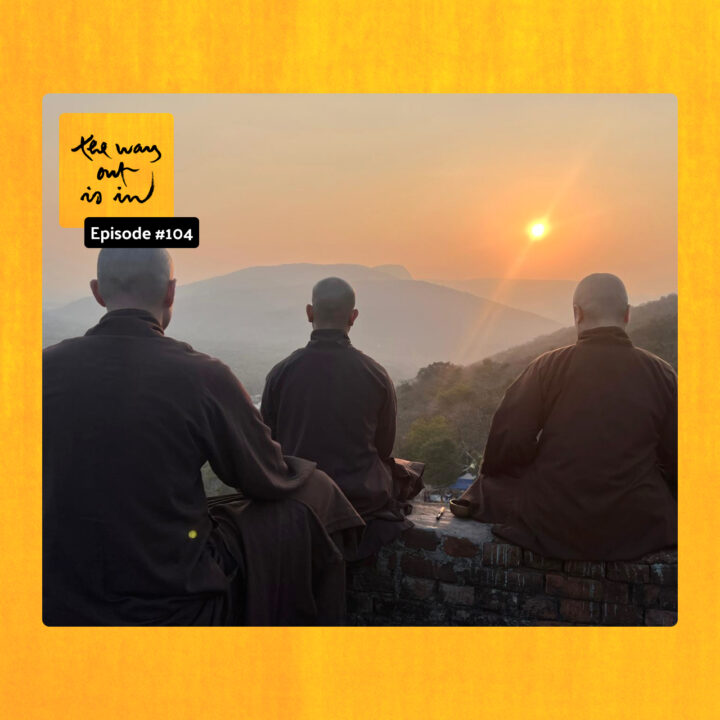






If you want to support our podcast please visit this link. Thank you!
Welcome to a new episode of The Way Out Is In: The Zen Art of Living, a podcast series mirroring Zen Master Thich Nhat Hanh’s deep teachings of Buddhist philosophy: a simple yet profound methodology for dealing with our suffering, and for creating more happiness and joy in our lives.
The third in a series of six episodes recorded during the In the Footsteps of the Buddha pilgrimage, this instalment was made in Rajgir, India, in February 2026. In it, Zen Buddhist monk Brother Phap Huu and leadership coach Jo Confino are again joined by Dharma teacher Shantum Seth to discuss the foundational initial teachings of the Buddha: the Four Noble Truths, the Noble Eightfold Path, Non-Self, and the Fire Sermon.
Together, they also share personal experiences of encountering the Buddha’s teachings, practicing Thich Nhat Hanh’s wisdom in daily life, highlighting the transformative power of mindfulness, community, the realization of non-self, and more.
About the pilgrimage:
In 1988, Shantum Seth was invited by Thich Nhat Hanh (Thay) to organize a pilgrimage to the sacred sites associated with the Buddha’s life across India. Subsequently, Thay encouraged Shantum to continue guiding such journeys each year, offering pilgrimage itself as a mindfulness practice—one that the Buddha had suggested.
Shantum has been leading these transformative journeys ever since, offering people from around the world the opportunity to follow In the Footsteps of the Buddha with awareness and insight. After 15 years at the United Nations, Shantum left to volunteer with the Ahimsa Trust, which represents Thay’s work in India and promotes the practice of “peace in oneself and peace in the world”.
Through Buddhapath, his expression of Right Livelihood, Shantum continues to guide pilgrimages and share the wisdom and culture of the places he visits in India and across Buddhist Asia, cultivating community through these deeply meaningful journeys.
To learn more about upcoming pilgrimages, visit www.buddhapath.com, or follow Shantum on Facebook and Instagram at @eleven_directions.
Shantum Seth, an ordained Dharmacharya (Dharma teacher) in the Buddhist Mindfulness lineage of Zen Master Thich Nhat Hanh, teaches in India and across the world. A co-founder of Ahimsa Trust, he has been a student of Thich Nhat Hanh’s teachings for the past 35 years, and, since 1988, has led pilgrimages and other multi-faith, educational, cultural, spiritual, and transformative journeys across diverse regions of India and Asia.
He is actively involved in educational, social, and ecological programmes, including work on cultivating mindfulness in society, including with educators, the Indian Central Reserve Police Force, and the corporate sector. Across various Indian sanghas, Dharmacharya Shantum is the primary teacher of different practices of mindfulness from Thich Nhat Hanh’s tradition.
Co-produced by the Plum Village App:
https://plumvillage.app/
And Global Optimism:
https://globaloptimism.com/
With support from the Thich Nhat Hanh Foundation:
https://thichnhathanhfoundation.org/
Recordist: Ann Nguyen
https://ann.earth
Sound editor: Joe Holtaway
https://joeholtaway.com
Publisher: Anca Rusu
Producer: Clay Carnill
https://claycarnill.com
Executive Producer: Catalin Zorzini
List of resources
The Way Out Is In: ‘In the Footsteps of the Buddha (2/6) | Enlightenment under the Bodhi Tree (Episode #103)’
https://plumvillage.org/podcast/in-the-footsteps-of-the-buddha-2-6-enlightenment-under-the-bodhi-tree-episode-103
The Way Out Is In: ‘In the Footsteps of the Buddha (1/6) | The Buddha: Down to Earth (Episode #102)’
https://plumvillage.org/podcast/in-the-footsteps-of-the-buddha-1-6-the-buddha-down-to-earth-episode-102
Interbeing
https://en.wikipedia.org/wiki/Interbeing
Plum Village Tradition
https://en.wikipedia.org/wiki/Plum_Village_Tradition
Old Path White Clouds
https://www.parallax.org/product/old-path-white-clouds
Sister Chan Khong
https://plumvillage.org/about/sister-chan-khong
Rajgir
https://en.wikipedia.org/wiki/Rajgir
Bodhi tree
https://en.wikipedia.org/wiki/Bodhi_tree
Sujata
https://en.wikipedia.org/wiki/Sujata_(milkmaid)
Magadha
https://en.wikipedia.org/wiki/Magadha
Poem: ‘Please Call Me By My True Names’
https://www.parallax.org/mindfulnessbell/article/poem-please-call-me-by-my-true-names
Dharma Talks: ‘Redefining the Four Noble Truths’
https://plumvillage.org/library/dharma-talks/redefining-the-four-noble-truths
Vinaya
https://en.wikipedia.org/wiki/Vinaya
Dharma Talks: ‘The Noble Eightfold Path’
https://plumvillage.org/library/dharma-talks/the-noble-eightfold-path
Duhkha
https://en.wikipedia.org/wiki/Du%E1%B8%A5kha
Dignaga
https://en.wikipedia.org/wiki/Dign%C4%81ga
The Anattalakkhaṇa Sutta https://en.wikipedia.org/wiki/Anattalakkha%E1%B9%87a_Sutta
The Way Out Is In: ‘The Three Jewels (Episode #89)’
https://plumvillage.org/podcast/the-three-jewels-episode-89
Kosala Kingdom
https://en.wikipedia.org/wiki/Kosala_kingdom
Kashyapa
https://en.wikipedia.org/wiki/Kashyapa
Kalachakra
https://en.wikipedia.org/wiki/Kalachakra
Joan Halifax
https://en.wikipedia.org/wiki/Joan_Halifax
Quotes
“Suffering is all around us. Hell is in the here and now. We have to collectively have the determination, as the Buddha did, not to deprive ourselves from food, from nutriment, but to understand the sources of our suffering – as well as the sources of the path of liberation.”
“The teaching of the Four Noble Truths is the understanding of suffering. We all have suffering. This is the shared experience of us all. We are all equal because we all suffer. In spite of status, class – whatever labels humanity may have for one another – suffering is a truth that none of us can ignore or can escape.”
“We only have so much time on this planet. But there’s so much we can direct our attention towards. What are the seeds we are watering every day? The diligence of watering our consciousness and the seeds that become the action.”
“We have to see the Buddha a little bit like a doctor. We have to see suffering as a disease, a universal disease. You might think it’s very obvious that we all suffer, that we all get angry, that we are all separated from the ones we love, that we have sickness and old age. But it wasn’t a universal idea. Some people said, ‘This life is bliss.’ So when we start with the primacy of suffering, that in itself is a revolutionary moment.”
“As somebody who really is imbued with the Buddha’s teachings, I feel that all human beings experience suffering. And that in itself is revolutionary, saying, ‘This is where it starts.’ Because a lot of it is about escaping from the present, escaping from this world. Most teachings are around something which will come hereafter – but the Buddha is saying, ‘Come back to now; feel, understand your mind, see that your mind is creating your reality.’”
“Thich Nhat Hanh always emphasized that people talk about Buddhism being about suffering. But he said, ‘No, it’s the third noble truth. It is about the releasing of suffering and the transforming of suffering into joy and happiness. That’s very important; don’t get stuck in the suffering. That’s why the first noble truth is a noble truth, because you use the suffering as a compost for happiness.”
“Siddhartha touched the reality that life and death are just a game of hide and seek. They are just labels.”
“Acceptance, and being with all the conditions in the present moment, is a superpower. You cannot escape the present moments – except by being in your suffering and your wishful thinking. But once you arrive in the here and now, and you embrace these realities, you are free.”
“This is because that is. This is not because that is not.”
“‘Thay, what happens when I die?’ Thay said, ‘I haven’t died yet, I don’t know. But what I can tell you is what happens when we are very much alive.’ Let’s come back to that present moment, to that insight.”
“Thay spoke so eloquently of the second teaching, the Anattalakkhaṇa Sutta; the sutra on non-self. Under the tree, the Buddha looked at the Bodhi leaf and said, ‘Ah, in that leaf is the sunshine, the earth, the rain, the seed, everything. And if you take one of those elements out of that leaf, the leaf won’t exist as we know it now.’ And that was his deep realization.”
“One Buddha is not enough.”
“The Buddha is the sangha.”
“I’d been a political activist looking for a way of being peace, not fighting for peace. I had a lot of anger in me and I really felt I touched peace for the first time in that walking meditation – as a visceral experience, not as an idea, not as the concept of wanting peace, but as something that I could embody.”
Dear friends, welcome to this third episode in our special series live from India, in the footsteps of the Buddha.
I'm Jo Confino, a leadership coach and spiritual mentor.
And I am Brother Phap Huu, a Zen Buddhist monk student of Zen Master Thich Nhat Hanh in the Plum Village Tradition.
And today, dear listeners, we are going to be talking about the three foundational initial teachings of the Buddha, which on their own could lead us to a lifetime of practice.
The way out is in.
Hello dear listeners, I am Jo Confino.
And I am Brother Phap Huu.
And I'm Shantum Seth.
So, good morning. So before we officially start, I have to say I'm at big disadvantage because Brother Phap Huu has been getting up at probably 5 am, every morning for the last 25 years. And I haven't. And so I'm feeling sort of like death warmed up. Although, the teaching today is partly about no birth, no death. So I can't be death warmed up. I can just be tired. And I was also thinking that Shantum and Phap Huu look very, very fresh. And I feel rather sort of downtrodden. So if this, I'm glad this is just audio because if it was video, I would need a whole army of makeup people to, I have huge bags under my eyes. So audio is wonderful. So, brother, how are you today?
Amazing.
That feels so rough to say that. So before we get into the teachings of the Buddha, I just want to give everyone a sort of, just a quick flavor of what we've been doing, because India is not a place where you just talk about facts and figures. It's a country that is so alive and full of color and texture and sound, a cacophony of sounds. So we're just going to talk very briefly about what we've done the last couple of days. So we started off going for a second visit to Bodh Gaya, and listeners may remember I questioned Shantum last time is how can I go back because the first time felt so busy that I felt very difficult to connect to the essence of the fact that this is the place and under the tree where the Buddha reached enlightenment. It's an extraordinary spot to be in and I hadn't touched it and Shantum gave some very good advice and we went back. And I had this wonderful experience of connecting to this place, this moment, this history, these teachings, this extraordinary sort of turning of the wheel that has changed so many lives in human form and probably beyond. And what was extraordinary about it was it was just… had every sort of Buddhist lineage there. There were the Koreans and the Japanese and the Tibetans and the Vietnamese and others all in their different colored robes, all coming to pay homage to this place. So that was extraordinary. And then there was an afternoon which I unfortunately had to miss, which was, actually, Shantum, can you just tell us about this, briefly about where we went to next?
So before the Buddha arrived at the tree, and of course there was no temple at the time, it was just a Bodhi tree by the riverbank, he'd been across the river in the village of Uruvela, and he'd just finished his ascetic period. He'd collapsed on the path and under Banyan tree, the young girl Sujata had offered him the rice and milk pudding. And what is nice going there was when we went to the village, we sat under a tree, which was a child of the Bodhi tree that Thay, Thich Nhat Hanh had planted himself in 2008. It's doing very well. And we sat on that tree and we had kheer, the rice-and-milk pudding made by some young women from the village, about the age of Sujata, a little older, and all 60 of us sat under that tree and enjoyed that. And we walked through the rice fields. Well, in this season it's the wheat fields, because it's winter season. And we walked exactly where the path, the little bunds, the little levees between the fields, where the Buddha would have walked. And when the Buddha walked, he told his monks and his lay disciples, please leave enough space for a cow to pass through when each one of you walk, and we did, or tried to do that, of course some people want to take photographs, that is part of the sort of congestion, but otherwise it was just a beautiful trail through the wheat fields, and just looking through and the sun was setting, it was just angelic, really beautiful, and you could realize that the Buddha was walking with us, you know, it is exactly the same scene. The river was still flowing, The fields are green. People walking through the path is the same. And I think that's why when Thich Nhat Hanh wrote this book, he just called it Old Path. And I looked up and I saw the White Clouds. I said, yeah, this is the Old Path White Clouds, and it's exactly in the footsteps of Buddha.
Great, thank you, Shantum. And Phap Huu, can you then just briefly describe where we went next, because we went to the cave where the Buddha meditated, well, when he was still an ascetic, and then Bamboo Grove. So give us a flavor for our readers who may never have come to India or these places.
I think it was, yesterday, so we traveled from Bodh Gaya to Rajgir, and this is… we arrived at the foot of the mountain. And as we arrived, we started to walk together collectively as a community up the mountain to where one of the caves still exists today, and we can come and sit in it, and this is where the Buddha, he sat, as he was determined to deepen his understanding and find a way in and a way through the cycle of birth and death. And each and every one of us had an opportunity to come into the cave and sit in there in silence. And what was special was just our own mind, because what a space can allow you to feel and touch. And everybody probably had their own experience in that cave. And for me, just sitting in that space, not sitting alone, with a community, which was also very special, I was really embodying and feeling the young Siddhartha and the determination that you had to have, because I can also realize I would be so afraid at night of just sitting in here alone. But then this is literally like feeling as you are in the womb of Mother Earth, because this is a mountain, it's a cave, and you are inside, and you do feel this protection. I felt this protection when I was sitting in there. And what is beautiful is the nature and the view that you get to see from the mountain. I was looking at the rice field, the coconut trees, the paths, and the people that you can see. I was really embodying that the past and the future are very in the here and now. This is it. Like this is what the Buddha saw. These are the fields. These are the sounds of the birds. These are the blue sky, the clouds that we can feel, and it's not an imaginary practice anymore, this is very present. And we sat also as a community outside of the cave, and we had a session of just recounting the history, and the main important part of that was to give gratitude to the Buddha for going through this extreme practice so that all of us, we don't have to do that. That's the important part right there. And it's to understand that in that moment the Buddha realized that he had to go deeper in his own path because the teachers that he have found and studied under only allowed him to touch spaces of concentration, of deep bliss and deep separation from all of the material world, but the moment you open your eyes and you enter back into everyday life, it's not an engaging practice and it doesn't allow you to walk with that liberation, be with that liberation in everyday life. And so the young Gotama Siddhartha realized that I shall now search inside rather than just keep searching for teachers outside. And someone in our community asked me, do you think that the Buddha needed to go through this extreme practice in order to touch liberation? And that question is a very dangerous question, because the reality is yes. But then that yes may mean that each of us have to go to that extreme ascetic practice. And that extreme suffering. I was very careful in my response, and I said, and because of his liberation from that, we have to learn from that. And it doesn't mean that we have to experience that same journey. And that's very important because I have met thousands of people through Plum Village and through our retreats. And I always feel that there is this desire for deep suffering. And Thay always say, suffering is all around us, my friends. Hell is in the here and now. Just look in, the suffering is there. We collectively have to have the determination, as the Buddha did, not to deprive ourselves from food, from nutriment, but to understand the sources of our suffering, as well as the sources to the path of liberation.
Thank you, brother. And Shantum, we then went yesterday to the Bamboo Grove, which is extraordinary because it actually is the first official Buddhist monastery in the world. Can you just give us a little bit of flavor for listeners about why is the Bamboo Grove important? What was important about the fact that the Buddha had a formal home for him and his monastics?
As Brother Phap Huu was saying, we came down from the cave, it's now called the Dungeshwari cave because many of the local Hindu people believe that there is a goddess Durga, but amongst the Buddhists we call it Pragya Bodhi, meaning before the awakening. The Tibetans called Mahakal, the great deity of time. We came down and we drove another two hours and came to the city of Rajgir. By this time the Buddha had already, I have to recap a bit because what happens is that the Buddha goes after this, after his awakening to Sarnath, gives his first teaching, comes back to Bodh Gaya and maybe we'll touch on that later. And then he's now traveling with a thousand monks from what is Uruvela village up to Rajgir. So when he arrives there, there's a large congregation. And he's with a teacher who's well-known in the area. And Uruvela Kassapa, maybe we'll come back to that later of what those teachings are. And the king comes to meet him and meet them. And the king is very happy to meet the Buddha. And he says that five of his wishes are now complete, and which is to be king, to be able to receive an awakened person, to be able to be visited by an awakened person, to be able to hear the teachings and then to be able to understand the teachings. He says, please come to my home and I would like to offer you a meal. At the end of the meal, he offers the Buddha this wonderful grove, the Bamboo grove what we call the Venu Van. Venu means bamboo and van is forest. He does this by pouring water over his hands from a golden vase saying, this land is given to you, to the sangha, what the Buddha has said. And the Buddha, of course, had left being a land holder. And he must have been in a little bit of a quandary. Shall I now become, you know, the holder of more land? But I think by this time he was touching the sangha energy of saying, this is being offered to the sangha, and we need a place to stay. And so the rain retreat was coming, so he accepts that with a sort of shake of the head, probably like the figure of eight like we do in India. And it is said that within one day, 60 huts are built, which really were just bamboo sticks put in the earth, put in ground, sort of bent over the top and then taj put on top. And that's how the Buddha and all his attendants, all his disciples lived. And a lot of very, very important things happened in the Bamboo grove, including meeting Shariputra and Mahamaudgalyayana, who became his two primary disciples, meeting Amrapali, the great courtesan, and then people also from different communities and castes within Rajgir started coming and being attracted to his teachings. So it became important that there was a center, a place they could meet the Buddha. The Buddha wandered all through the year, but in the rain retreat he would pause. So you can imagine the Buddha just walking every few days, not spending more than two nights, three nights in one place. But then if anybody wanted to come and study with him, so I think the Buddha realized that is the tradition in India already. In the monsoon season, in the rainy season, you don't go for your sort of wanderers, wandering. Because they were shramanas, as I said, they were wanderers. That also is a time which has now become tradition within the Buddha Dharma, where it becomes a time when you can stay with your preceptor, you can have the rain retreat. In Plum Village, we have the winter retreat because it's more appropriate to the weather there, but you actually have deep practice and then you go out and teach. So you need your own practice space. And I think the Buddha realized all that, that we need a space for practice, for community building, and then we have this strength to, for him too, to be able to have that energy to teach. Because teaching also takes a lot of energy. And so the Bamboo grove is wonderful because you have the Karanda Tank where we know the Buddha would have bathed and the tank is still there, it's a pond. We heard about the squirrels nesting place. We still have squirrels running around, the chipmunks. And then we have the peacocks dancing place. I didn't see any peacocks yesterday, but peacocks do come there. So it's the sort of place where you can imagine the Buddha walking with his community, and also with that realizing that we are so blessed, we are so blessed to have places like this where we can touch the historical Buddha. That we know, oh yeah, he had to have a shower or a bath every day. There it is. It's not as if he just never bathed or he didn't eat. He didn't sleep under a shelter. And I think that sort of realization is very important that we know there was a man who did that. And he was always wandering and working out and so the Bamboo Grove becomes where he spent his second rain retreat, third rain retreat, fourth rain retreat. Later he comes back in the 17th, 20th, so this place becomes a home and Rajgir, just to mention, was the capital of the Magadha Kingdom. The Magadha Kingdom was one of the most powerful kingdoms of the time and King Bimbisara was the king at the time, and the king once he became attracted to the Buddhist teachings and the Buddha knew that. He knew he was from a royal family, he knew if he influenced the king it would have a sort of ripple effect to the whole society. And so I think he probably deliberately chose that. He also had a meeting with King Bimsara earlier when he was still a wanderer. And so he sort of picked up on that and went to visit. So I think that this idea of having a place in the most powerful city, capital city, it's like the president of a country or the prime minister of a country saying, here, have some land right next to the White House to come and sit and meditate and help you awaken and help others awaken to a type of liberation and a path of awakening for the society.
I think that having a place next to the White House for people to meditate would be an excellent idea at the moment. Brother Phap Huu, before we get into the teachings, as Shantum was saying, you know, the Buddha introduced the Rains Retreat, three months where everyone, all the monks would come back together to practice. And that is something that is still practiced in Plum Village. It's normally from towards the end of October to towards the end of January. Can you just, for listeners who haven't yet been to Plum Village, just how important the Rains Retreat is, you know, the fact is that also you are holding that every year as the Buddha held that space?
This tradition originates from the Buddha Sangha. And one of Thay's greatest joys through his life was the Rains Retreat. And the image we always have is birds coming home to their nest and being together. And throughout the years, the bird flies into many different directions and the birds have missions to sow seeds everywhere. Seeds of mindfulness, seeds of love and compassion, as well as to travel and to create otherness elsewhere. And this tradition also comes from the place of compassion, because during the rainy season, when the monastics, they would have to travel to, go village to village to ask for food. That means that they would walk over muddy fields or destroy some of the crops, as well as a lot of the insects would come out. So it's also a compassionate act to really practice not killing, as well the health and the care of the order. Because during the rainy seasons, if you are poured down, you can get sick. So the Buddha is also a very intelligent teacher and is always reflecting the well-being of the community. And I think this is very important, because the Buddha is not just a teacher, he's also a spiritual father, a spiritual parent, and his expansiveness of leadership is not just the Dharma, it's very concrete, the well-being of his disciples, as well as the community. And originally, this practice is only reserved for the monastic. One of Thay's pride, if we can say his pride or his joy, is that he extend the invitation for all the lay friends to come and practice three months with the monastics. And it's a strong determination because in the Rains Retreat, we create an invisible boundary that you cannot leave the monastery grounds. At the beginning, everybody gets very excited. They're like, yes, I get to practice, I can't wait, I've been dreaming of this. After a month and a half, they realize how stuck they feel and their inner world starts to be louder and louder and they look for escapes. You can always leave the monastery. We don't have like a gatekeeper or anything like that but the intention that we set is the boundary in our minds also. So it's also a foundation of feeling as well as deep truths to ourself. What are the energies that are pushing us away from the here and now? What are that desires that come up? Because it's the only time in most of the monastery, the consistency of a practice can be sustained because it's a vow we make. We stay in the monastery for three whole months. And for Plum Village, we're a little bit more fortunate because we have three hamlets, three monasteries. So we would travel twice a week in the monastery to be with one another, to hear the Dharma from a teacher, to practice Dharma sharing, to practice walking together, to practice eating together. So there's more of a connection in a lot of different practices. It's more solitude practice, but Plum Village, Plum Village tradition, and our teachers' initiative in building the sangha is also about bringing us together in a more harmonious way so we can deepen our roots in the community. And that means we learn to be together in a more selfless way. And in Plum Village this is the time we all change roommates. So once a year we change roommates and we have this opportunity of room change. It's a wonderful practice of letting go. You see how much stuff you have accumulated in one year. In principle, a monk and a nun only has three robes and a bow. And now we have five notebooks, a laptop, a smartphone, headphones, and you just see how we accumulate, as well as winter clothes, et cetera, et cetera. And it's very beautiful because it's also a moment of seeing who needs what, and we can let go. And it is a very shared garage sale. No transactions. It's just, you need it, here it is. This is what I would like to let go, so the culture, there's many layers to it. And one of the most important is that the elders are home. And the elders offer their presence, as well as the elder offer their teachings. It's the most consistent time where we can deepen our understanding of the Dharma and the precept training. All of us, as practitioners, we always have to come back and re-engage from our foundational practices. So it's almost like coming back to square one and we have an opening ceremony where we all come together and we just invite each other to remind ourselves why we are monastics. Sometimes the winds of the world sow the seeds of pride, sow the seeds of desire in us, desire of power, desire of fame, the desire of being seen, and so coming back into the home and just concentrating on the practice is also a mirror to oneself, asking the question why am I practicing? As well as some of us, we have extended ourselves so much in the nine months to recharge ourselves, to be reminded of the power of sangha, the power of community.
Thank you, brother. And I'm always impressed because we have a house just outside the boundary. I think it's a hundred meters outside the boundaries. We have pancakes on offer and lattes and all sorts of goodies. And sometimes during the year, some monastics will come and visit for tea. And I always feel that all these flavors, smells, are wafting over the boundary line. And we have never had a monk who's sort of sniffs the air and can't help but cross the boundary and come to our house. So, it's invisible, but it's very solid. So let's get on to the teachings, because as I said, the first three teachings of the Buddha are truly foundational and could exist in and of themselves without anything else. So the Buddha gave many, many teachings, but these first three were very important. So Brother Phap Huu, if you can just start off, and I know we've talked about it before, we have previous episodes on this, so we'll have those in the show notes. But just briefly, just remind us of the Buddha's first teaching.
After the Buddha has found his path and touched awakening, he was given the title Buddha, the one who is awakened, and the one who was walking the path of awakening and liberation. And so the Buddha from Bodh Gaya, the Bodhi Tree, traveled mindfully towards the Deer Park because he heard this is where his friends are now practicing. And he arrives and he offers the teaching of the Four Noble Truths, which is the understanding of suffering. We all have suffering. This is the shared experience of all of us. So when we speak about equanimity and the word equality in the teachings of the Buddha, this is what it means. We are all equal because we all suffer. None of us from different status, different society, different classes, whatever labels as a humanity we may have for one another, this is a truth that none of us could ignore and could escape. That is suffering. And the second noble truth is that there is a route to suffering. There is the causes and conditions. This is why we suffer. And the causes are birth, death, old age, impermanence, and then the ignorance that comes from that, and we will tap into that in this episode. And then once you see the roots and the causes of our suffering, we start to see the ending of suffering, the cessation of suffering. We see the source of it. That's insight. That's, our teacher also said, that's a moment of liberation. There's happiness. You see why you suffer. And the fourth noble truth is the path leading towards well-being, the path leading out of suffering. And this fourth noble truth is not just an insight now, it's action. We now walk that path. We're determined. We look at our daily lives and we make a vow. Because I suffer, I would like to now live in a different way. And here comes the second teaching in this is the Eight Noble Path, the Eightfold Path, and we begin with right view. The view that we always have to cultivate, and that is the view of non-discrimination, the view of interbeing, and the view of non-views is right view, that needs probably a whole retreat to understand. To support all that, we cultivate the practice of the three karmas. Our aspiration is to have right thinking, right speech, right action, the deeds we enact every day. And then after the three karmas, we have right livelihood. This supports the fourth noble truth, which is the path. We have to really meditate and look at our way of being, what is happiness for us, what does success mean for us? What is our legacy that we are leaving behind? That is our livelihood, our everyday action. And to support our livelihood we have to practice our diligence, right diligence. What are our attentions, what is our right attention we are giving to every day? We only have so much time on this planet. And there's so much attention we can direct our energy towards. And our teacher used the language of what are the seeds we are watering every day? So the diligence of watering our consciousness and the seeds that becomes the action. And then comes the three trainings that is universal in all Dharma doors and Buddhist schools: right mindfulness, right concentration, and right view. So it comes back to the first noble truth. And right mindfulness is the foundation as in the light to shine to all of the other paths. And this is our bread and butter in the Plum Village tradition. And mindfulness here is not just sitting on a cushion. It is not just walking in silence. It has to be applied with ethics, with flexibility, with understanding culturally, environmentally. Groups of people we are with. Mindfulness is to show us skillful means as well as allowing us to also be a little bit more expansive when needed, to be more disciplined when needed. And so in the Rains Retreat, we come back to discipline. We, our mindfulness inspectors that we have in every hamlet becomes more attentive and more engaged. If a monk or a nun misses a sitting, they would note it down and ask, my dear, were you busy today? And just that question alone touches something in each and every one of us. We may touch shame, we may touch our laziness that we have allowed to push us away from the path of practice. So mindfulness is the foundation of the energy that helps shine the light to the other eight noble path. That is the set of the first teaching that the Buddha offered to his community. And we also have to know that in this moment, when the Buddha was teaching this discourse, this is when the sangha was formally created, his first set of students. And in this set of student, the Buddha himself also told the monks that not only should I be the one ordaining those who have the heart to practice, any of you, if you encounter a person who wants to become a student, you have the right to ordain them. And it was in this moment also in Old Path White Cloud where the ceremony was created. And it very simple back then. You just have to recite, I take refuge in the Buddha, the one who shows me the way in this life. I take refuge in the Dharma, the teachings that allows us to walk the path of liberation, I take refuge in the sangha, the community that lives in harmony and awareness, and you are ordained. And fast forward now, we have a lot of precepts, the trainings of the monastics that is our backbone of the monastic order. But in the original sangha there wasn't yet any precepts. And only by the monastics mistakes that they would make in their lives that the precepts were added. And I wanna share this because that's how organic and alive the community was. As the community had their shortcomings, the Buddha would have to set rules. So it is a very direct experience tradition. It's not from the moment the Buddha was enlightened, these are the laws. Later on, the precepts, the Vinaya, the laws of the order came into place.
Thank you, brother. And for listeners, when Phap Huu talks about the mindfulness inspector, when I first heard that, I thought, it's like a policeman in uniform patrolling the monastery and arresting people and throwing them in jail, but they are very compassionate. Shantum, can you just give us some context for this teaching? So, you know, now we hear the teaching and it's like, yeah, that sounds pretty good. That sounds true. But at the time, you know, and this comes up time and time, the Buddha was a revolutionary. So in what sense was this teaching different from anything else that any of these other gurus or wanderers were talking about. What made this a foundational practice that has lasted now 2600 years that has really, that we feel deep truth in, but at that time many had not heard this?
The medical profession had been developing at that time, and we have to look at the Buddha a little bit like a doctor. We have to looked at suffering as that disease, that universal disease. And you might think it's very obvious that we all suffer, we all get angry, we all are separated from sometimes the ones we love. We have sickness, old age. But it wasn't a universal idea. Some people said, this life is bliss, such as ananda. So when we start with the primacy of suffering, that in itself is a revolutionary moment. And as somebody who really is imbued with the Buddha's teachings, I have experienced that and I feel that all human beings experience suffering. And I think that in itself is revolutionary, saying this is where it starts. Because a lot of it is about escaping from the present, escaping from this world. Most teachings are around something which will come hereafter. And the Buddha is saying, come back to now, feel, understand your mind, see that your mind is creating your reality. So the first thing I would say is revolutionary is that the primacy of suffering.
The way out is in.
He hadn't gone in yet. He just only touched the experience. Then he said, okay, now like a medical doctor would say, is there a cause for that? And that too is quite interesting because that's when he says, as Brother Phap Huu was saying, is the way you view things. Now, some people might say it's about desire, clinging, these are words we use, but really it's the deep misunderstanding that things are permanent. And that is something where he was also revolutionary because the common thinking at that time was there was an entity, like a soul, which had intrinsic existence. When he was in the cave, practicing, and he tried to come in touch with that Atman, the soul, he found there was nothing like that. Everything was impermanent, everything had fluidity, his form or his feelings or his mental formations or his consciousness or his perceptions. So there was nothing which had intrinsic entity. So that in itself, he realized, was the deep cause, the right view, the way of looking at things. So the cause was actually, yeah, the way we understand things, the ways we live our lives. So the first noble truth, as they call it, was duhkha. The second was samudaya, which is the cause. And then he has the third which is called nirodha. And that is the sort of medicine, or saying there is a medicine, not the medicine, but there is the medicine. And that's the good news of Buddhism. And Thay always emphasized that. He said, you know, people talk about Buddhism being abut suffering. He says, no, it's the third noble truth. It is about the releasing of suffering and transforming of suffering into joy and happiness. That's very important. You don't get stuck in the suffering. That's why the first noble truth is a noble truth, because you use the suffering as a compost for happiness. And then the medicine is the fourth. And then this combination of practice and ethics. And then that develops into a sort of wisdom which then goes around in a circle again. And I remember a calligraphy, which I have at home, which Thay did in Germany many years ago, and luckily at that time he used to use flip charts. So luckily I took that paper off. And he's done it as a circle, all the eightfold path, and I liked his spelling of livelihood, L-I-V-E-L-Y H-O-O-D. And so that's, I would say, the sort of base of where this comes from. And then why other teachers were attracted to him but also had a lot of clashes with him. It wasn't that everyone said, yeah, this is the right path. And even till today, there are many, many traditions. Not everyone is a Buddhist. And in fact, Thay himself said something like, we are Buddhists, but Buddhists full of non-Buddhist elements. It's true, I've been brought up or born in a Hindu family. I have friends who are from different faiths, from Christian, Muslim faiths. So they all interplay into my life. But what I found is the part the Buddha gave has really helped me touch happiness and alleviate my suffering in many, many ways. So I would say that would be part of the context of the Buddha's teaching. This doctor, the type of framework that he makes, and then it becomes a universal teaching that exists till now. And that's why we're sitting around listening to these teachings.
Can I now say the way out is in?
Yes.
It's all about skillful means. Timing is everything.
Thank you, Shantum. So, Brother Phap Huu, let's go to the second teaching, so we've got this sort of now foundational understanding of the Four Noble Truths. Where did the Buddha take us to from there?
In his deep looking, as Shantum has talked about, about the liberation from the concept of the soul. And I just want to emphasize that it's not just 2600 years ago, it's still very 2026. Just this summer retreat in 2025, somebody came in our summer retreat and had an amazing experience. And before she left, she came to me and she said, brother, do you believe Thay's soul is here? And I didn't dare say yes or no. My answer would be no, if I was to be very frankly and directly, because that contradicts our Dharma. And it's about skillful means, because for many, there is something that we yet are not ready to accept our emptiness, which is the truth. And this is that teaching that we cannot be by ourself, we can only co-exist. This is because that is. This arises because of all of these conditions that are there, and we will cease to exist when the conditions are not there anymore. So we are not a creation. We are a manifestation, and this is that core understanding of liberation, the freedom that touches us from the cycle of birth and death. And this is just an insight. And for all of us to feel it, we have to practice and we have touch the truth of impermanence, as well as when we talk about impermanent, we only think about things that are dying, things that disappearing. But in impermanance, that's where birth is also possible. That's where insight is possible. That's how we can change. If I was this frail and vulnerable yesterday, thanks to the practice and thanks to the nature of impermanence, I can be solid and stable tomorrow. So when we talk about impermanence, I invite all of us to also open a space in our consciousness to see, thanks to impermanence, all the potentials of freedom, of liberation, of joy and happiness as possible. I'm sure many of us when we think of impermanence, we think our death. We think about letting go, we think about the disappearing of things, and we go very negative. And the truth of impermanence, it is the foundation of manifestation also. So in this insight and in this teaching, Siddhartha touched the reality that life and death are just a game of hide and seek. It is just labels. We… But where did we, where were we before we were born? Thay always asks us this question also. And if you reflect on it, you already existed. Half of it in your mother, half of it in your father, and then all the conditions that supported them. So we are just this lineage, this invisible little seed that was already in the manifestation of the whole cosmos. And when all the conditions come together, we have the opportunity to manifest. And understanding this, we also see the miracle of life. And we see that we are made of so many non-us elements. And this is the freedom that we can be free. This insight here is also the key to acceptance, the key to being at home in our own self. So in the journey of life, when we get older, we don't dwell in how we were yesterday. Oh, I wish I was like that. Oh, I was so healthy back then. But when the conditions are not there anymore, we get ill. And the understanding that this is a part of the journey, this is a part of life and this can be a teaching moment. And how do we accept our illness? How do we except our cancer, our declining of health? And this is also the co-arising of all the conditions to be. So when we have these acceptance, we are free. It doesn't mean we don't get sick anymore, but we are from the striving and the fighting of reality. And this is where that liberation comes into action. And I can share this because I had the greatest privilege of journeying with Thay after his stroke. I witnessed him in pain. I witness him trying to find his voice again, because he couldn't speak after the stroke. I witnessed him looking at his paralyzed hand with agony, with pain. His right hand was the hand that he wrote all the calligraphies and all of the poems and all the books that we have read. And I've witnessed him accept it. There was a day when we were exercising through different physiotherapy to see if he can gain any muscle movements. He looked at it and he shook his head. And then he had a smile. And I was watching him just meditating on his hand. And that smile was the smile in my interpretation, of acceptance. And after he smiled, he took his right hand and he placed it on his left cheek where he can feel. And so tenderly, he uses his left hand and he just massages his hand. And it was such a profound moment for all of us, his attendance, to just witness that, that there is no more superpower that we imagine in spiritual practices. But the superpower is acceptance, and being with all the conditions in the present moment. You cannot escape the present moments. You can escape it by being in our suffering and our wishful thinking. But once you arrive in the very here and now, and you embrace these realities, you are free. Thay accepted his condition, he knew that my way of teaching now is not through speech. My way of teach is just being, it's just presence. And he would come every day to sit in meditation with us, we would push him in the wheelchair. And I was going through a very difficult time also in that moment. I was having my own struggle. A teacher's suffering had an impact on me. I saw in him, which I didn't have at that moment, was his bodhicitta. Bodhicitta is the energy of awakening, of the beginner's mind. And I saw that even at 89 years old, Thay was so eager to be with the sangha. After coming back from our journey in the hospitals, the first thing Thay wanted to do was sit with the sangha. And I remember pushing him into the meditation hall, and the monastic and the community, we sit in meditation, we sit facing the walls, and I was pushing him down the middle aisle, and I also motioned for him to sit facing the wall, as all of us, we are practicing. But Thay motioned me to turn his wheelchair so that he can look at the community. And in that moment, there was this joy that I can feel from him as this community was sitting in silence. And Thay was just watching the sangha sit. And he had the smile. These are my continuation. I'm free. If I'm here, beautiful, great, but I have no more fear because this is my legacy. And I was like so like in my own thinking of what should I do with my life now? Thay is not well. Am I ready, are we ready to be without Thay? And I was in this cycle of fear and doubt. And just seeing his smile just gave me so much strength. I was like, we're in this together. The river of the sangha is here. We're not perfect and we're never gonna be perfect. We all have our difficulties but we're sitting together collectively. How beautiful is that? I borrow Thay's joy and I borrow his smile and I did feel the smile come up in my face. I was like, if someone who just came out of the gate of death is smiling now, all of us who are alive and well, let us offer that smile. And so, this direct experience I had with Thay allowed me to touch deeper the co-arising of realities. And this is, in a nutshell, interbeing and wisdom. And I love it when Thay says it. He goes, what is the Buddha-Dharma? This is because that is. This is not because that it not, period. Stop looking. Stop searching. If you ever ask Thay a question, Thay, what happens when I die? Thay was like, I haven't died yet, I don't know. But what I can tell you is what happens when we are very much alive. Let's come back to that present moment, to that insight. And this teaching, as we have heard what Shantum just spoke about, in all culture, there is this belief to look for a pill, a drink, a fountain of eternal youth, of eternal life. In also our culture in Southeast Asia, many people would go on journeys to look for this miracle pill, this miracle plant, this miracle fountain, so that we can live forever. And this, the Buddha touched the reality of truth, and that truth liberates us. And that truth is that other shore over there. And I think that most of us, we're so lucky, actually, to hear this teaching. And there's many rafts that guides us to this understanding. The podcast is one of the rafts. The many traditions are the raft. The many retreats are the raft. But our ignorance is deeper. Sometimes we don't want to believe in that. We're not ready to touch that truth because it is also ancestral. It is our culture that have also given us this belief that there is much more than the present moment. In the Buddhist teachings, in the many different schools, we have the Pure Land tradition in the Vietnamese lineage of Buddhism. And that tradition manifested from adaptation and skillful means. So because so many people believe that in the afterlife there is another realm that we will go to, so the monastic were very skillful to blend into the culture. You don't want to go actually, you guys, know what? That's all rubbish. Let me give you the truth. Then suddenly, the wall is built. What are you talking about? We won't follow you. So the monastics were very skillful. There is a Pure Land, there is a Buddha land. And for us to enter into that space, we have to review and reconduct our way of being, be kinder, invoke the names of the Buddha, to water the seed of compassion in you. The more compassionate you are in this life, for sure those doors will be open for you. Unfortunately, that has also become the idea of that's the afterlife. But that was the door to the present moment, actually. And so Thay, as a tradition, people also ask us, Thay do we have Pure Land Buddhism in the Plum Village tradition? Thay said, absolutely, but it's not in the afterlife, it is in the very here and now. And Thay also helps our Christian friends. He said, dear friends, the Kingdom of Heaven that you have been searching for and that you are longing for, it's here. Look at the flowers, listen to the sound of the birds, look at your loved ones. They belong in the Kingdom of Heaven. It is not after you die, it is in the very here and now. And hell? It's not after your die. Look at all the suffering. That is present, the suffering in our hearts, the suffering around us, that hell is in the here and now also. So these teachings, why they are like thunderstorm is because it cuts through the illusions that we cling into the soul after life and so on and so forth. And it is very strong, it's striking. Thay says, Zen is like a stick sometimes. It hits you, and it should awake you. And many of us, we need to be hit every day, but that hitting is not physical. That hitting is to come back and to meditate and to touch the reality of life.
Thank you, brother. So Shantum, and dear listeners, I don't know if you felt, as we felt in this room when Phap Huu was talking about Thay's joy in the sangha, even when he was partly paralyzed, what was the Buddha's joy, in the sangha? Because the Buddha, if he was on his own the whole time, he wouldn't have been the Buddha we know. He became the Buddha because of his teachings, because he became known, because people sort of were able to connect to his teachings in the same way that Thay did in his life. But in that moment, Shantum, where the Buddha taught this, what was the joy he brought?
Thank you, Brother Phap Huu, for your sharing. I think it's very clear the Buddha was teaching a path of practice. It wasn't a sort of formula, in a sense, saying, okay. And there was an interesting person called Dignaga who met the Buddha here in Rajgir, who said, I don't believe in any of these theories, you know, philosophies, et cetera. And the Buddha says, do you believe in your non-belief? And he got a bit stumped, and he said that too is a type of belief system. And then the Buddha said, I teach a path of practice. It's like the finger pointing to the moon, don't get caught in the finger. And so for the Buddha himself, this was a practice. It wasn't that he was also somebody who just found awakening one moment and just was on all the time. He had to practice too. And in that practice, you also realize that he is interconnected with everything. That everything was his companion on this path. And this great awakening that happened, which Brother Phap Huu alludes to is what the second teaching, what is called the Anattalakkhaṇa Sutta, the Sutra on non-self. Thay speaks of it so eloquently because the Buddha realized that under the tree, where he looked at the leaf, and he looked to one of these leaves, the Bodhi leaf, which I have in my hand right now. And he looked at the leaf in the tree, and he said, ah, in that leaf is the sunshine, the earth, the rain, the seed, everything. And if you take one of those elements out of that leaf, the leaf won't exist as we know it now. Whether we take out the clouds, or we take out the rain. And that was his deep realization. I feel that is E equals MC squared. And I like to think of E as enlightenment, and M as mindfulness, and C as concentration squared. Just to remember this is not just normal. But he thought of the tree as a sangha, the tree is his teacher. He thought of the birds when he talks in some of the stories about the crows in his teachings. They were his teachers. But he also realized that the closest teachers he could communicate with, or co-teachers would be human beings. And so he reached out to human beings, he could have just gone and sat in as a hermit and gone, you know, love and peace and hallelujah. But it was partly his compassion, his great compassion that he wanted to teach, but also I think he felt he needed it. Because the sangha is your collective, what you call mindfulness observer, or mindfulness, I can't remember the word, inspector. And when the Buddha spoke about the three jewels, he didn't talk just about the Buddha as himself. He also talked about the understanding that we all have the seed of awakening. So the Buddha cannot just be the Buddha as a human being 2600 years ago. It is also the potential of awakening in all of us. And seeing that potential awakening in others. And the Dharma, which is the teachings, but also the practice, and to practice together. But he talked about this sangha. And very few teachers, I would say, emphasize that as much as Thich Nhat Hanh, Thay. And this, Thay always reminded us. He said, there was a king called King Prasenajit and his last meeting with the Buddha. You know, he said, I've seen many teachers over the years. He was a great… he was the king of the Kosala Kingdom, which is the other great kingdom, besides the Magadha Kingdom, also patron of the Buddha, and he says, I want to bear my heart to you. I've seen many teachers over the years, over the last 40, 50 years, many of them lose track, whatever they do, but in yours I've see consistency and he said, when I see the Dharma and when I see the Sangha, I see the Buddha. And when I see the Buddha, I see the Dharma, and I see the Sangha. And when I see the Sangha, I see the Buddha. So this is a wonderful way that these three are inseparable. So the Sangha is key, even to the Buddha. And I think, as Brother Phap Huu was alluding, the sangha was key to Thay. It was his sustenance, his joy. So when you talk about what is the Buddha's joy, I felt he had a lot of joy in each moment. You know, when you are mindful, when your attentive, that is a… tap nirvana. That is a type of cooling down, that is awakening, these moments of awakening. What the Buddha was doing was not just being a part-time Buddha, but being a full-time Buddha. And we all get these little moments of awakening when we hear a bird call, when you see the sunrise, when we're sitting with friends, we get these little moments. And can we really practice in such a way that we can really create that, be more full-time, less than just moment to moment. And that's when the sangha helps. You walk into Plum Village and you see everyone doing walking meditation, immediately your steps go into walking meditation. You walk in the marketplace, in Delhi or in Paris or wherever you are, there's a different energy. You have to really be concentrated to walk. And I've seen Thay and the sangha walking through very crowded streets in Delhi, traffic coming, and you have to be really alert. Traffic in Delhi comes from the left, right, center, and from the unexpected directions. You have to really attentive, but you go at a pace, which creates an energy, and people stop. And you can be a teacher just the way you walk. I think that's what the Buddha was doing. He was creating joy in people and that was being reflected back to him, but he took refuge in the sangha. He couldn't do it alone. And that's why I think Thay's great awakening or great insight… he said that one Buddha is not enough. And the Buddha is the sangha. So that is a sort of insight of Thay, of Thich Nhat Hanh, but it comes from the Buddha because he knew he had to do it. So the joy was moment to moment to moment. And then when you add the moments, it becomes a continuum. So we are blessed to have these teachings. Now the thing is, can we practice? And that's again where the sangha comes in. We help each other, like Brother Phap Huu was saying. He had his downtime. We all have our downtimes. At that time, we just need to hold the hand of a friend. We just need to say, I need a little break. I need a little, you know, consultation. And I really feel that the word sang actually means coming together, in Hindi it means sang, it means the togetherness, the coming together. And it's deep in our tradition now.
And Shantum, just to put things in the historical context again. So one of the reasons that Thay's teachings are such a medicine these days is because we live in such an individualistic society. So most people don't believe in this interbeing. They're looking after themselves. They think they're insulated, walled in, that they can do what they want and it has no impact on others, et cetera, et cetera. We know the ills of modern society. And I'm just wondering again, just coming back to that point of the Buddha being a revolutionary. Was it so different then? Or, and why were these teachings, again, why did they become, you know, there were lots of teachers at that point, and many of those teachings are forgotten, and the Buddha's teaching still is like a shining light, a north star. What is it about his teachings in that moment, in that movement of history that made it different that that has that allowed in the context of history that has allowed it to… that the seed was planted then and it grew and many seeds are planted that don't grow?
Yeah, I think it was revolutionary then, it's revolutionary now. Most of us believe our suffering comes from outside, and we like to blame. And it's still the case. And then even the solution is outside. All the theistic religions, they don't blame it on a human being or don't believe the solace will come from a human, but from some entity that they believe in, in whatever form we think of God. And the Buddha is saying your mind is creating a reality. And you train your mind and the way you see things as they are. So when we talked about the interconnectedness of everything or the interbeing nature of everything, you realize that there is no outside inside. The in is out and the out is in. And this is a realization that we have to work it out for ourself, whatever ourself is, but there's no ourself. So that's why my brothers, my sisters, my family, my community are part of my collective suffering and my collective awakening. So most religions are based on the fear of death, or giving an answer to death and to our suffering. And the Buddha is not giving an easy answer. So actually the Buddha Dharma is not so popular. It's popular because people have been born into it, so they just become it. But I know in India, for example, I remember I used to teach at a friend's house, and she was the owner of the Times of India, which is a newspaper, which has millions of subscribers, and she'd invite me to her home to teach her friends and family, et cetera, every two weeks I'd go to her house. And then one day she says to me, Shantum, it's so boring. Walking, breathing, sitting, eating mindfully, where's the razzmatazz? You know, where is the… Because there were other gurus, other teachers, I don't consider myself a guru, but there were gurus coming to her house with throwing flower petals and, you know, dancing on stage, and it was the razzmatazz of love, you know and people love it. Just, ah, this is theater. And then, oh guru, you do it for me. And I try to say that, you now, this is our practice, to be attentive with each step. And can you really touch the Kingdom of God? The Pure Land right here and right now? And can we not be dependent on somebody else or something else or some other entity for our own happiness? And she looked at me like as if I was, you know, I mean actually she was trying to build me into a guru at that point. She was a guru builder. And we have a number of very interesting, very well-known gurus in India who she cultivated and she also opened up the Times of India magazine when Thay came, Thay did a six-page piece on the 2nd of October, 2008, which is Gandhi's birthday, when they invited him as the guest editor in 2008. You know, media has the power to create gurus and create entities and stars and, you know, in our society there's a lot of that. The pop star and individualism has become a disease, a disease of our society. And then people start believing it. They start becoming, thinking, oh, we are an influencer. But, you know, you just have to be careful that we are here because our parents are here, our friends are here. It's a community that builds. The food we eat is not coming out of nowhere. Somebody's grown it. And in that context, when we started realizing that we're a co-dependent being, and that's what the Buddha was saying in the second teaching. You know, that there is no such thing as an independently existing entity, the Anattalakkhaṇa Sutta, the Sutra on non-self. That, I think, was where he said, but practice it. I'm not telling you it's a theory. And it's easy to understand it, like I was saying with this leaf. And I'm sitting here with, unfortunately, this leaf is being used by Brother Phap Huu as a bookmark. I took it out. I don't know which page it was it. But anyway, but I feel that it's a practice to realize that we are the leaf. We are that entity of codependency originating moment to moment to moment. And that creates both a responsibility and it emanates from a love. It just transfers into love because you realize that the other person's suffering is your suffering. And the other persons joy is my joy or our joy. And that's what the Buddha was touching all the time. His joy was others joy and when he saw the suffering, he had deep compassion but offered a path of joy and happiness.
So would it be fair to say that the way out is in?
Hahaha
Oh, let me think about that one… Pretty much, so, yes.
Phew, thank god for that.
No, I didn't have to think about it, I know it is, that is the way, that's the Buddha's way. And we have to go in, whatever that in is, but we know that that in is just also a multi-dimensional in, it's not individuated in.
We have to change the title now to the way out is in the multi-dimensional in. That's going to become a mouthful. Thank you both. So let's come on to the third teaching. So Brother Phap Huu, would you like to introduce it?
This third teaching only happened because of the co-arising of his encounter with the community that was practicing fire worship. And he met the teacher, Kashyapa. And when the Buddha was coming there and he visited the place and Kashyapa recognized that this spiritual person has a kind of presence that is noble, that is sincere, that there's something sacred in him, and he welcomed him in. And we have to remember that the Buddha was not well-known at all, and he was just seen as a wanderer, as a seeker. But the Kashyapa was a well-known teacher. And during this time, I'll let Shantum speak more about the detail, but in this encounter of the Buddha and this community, the Buddha, I think from skillful means and from the understanding of a compassionate teacher, seeing those who are on the path of worship and spiritual practices, that in his observation, they will continue to keep searching. But the Buddha has found a way, and he wants to teach. But you have to come in skillfully, ninja mode. And the Buddha was very skillful. And one of his skillfulness was he was invited to a talk by Kashyapa. But the Buddha knew his presence alone would be an obstacle for Kashyapa to feel freedom, to teach to his 500 students. Because the Buddha seemed like he's very knowledgeable and he may not agree with what Kashyapa was going to teach. So the Buddha went for a walk at that noon time. And when Kashyapa met the Buddha again, said, oh, we miss you, you weren't at the teaching. And the Buddha was like, well, I knew that if my presence was there, it might've not been so easy. And Kashyapa in his own thinking, wow, this is someone who is so attentive and so aware and so skillful and compassionate. And in his time with the Buddha, he had a lot of opportunity to hear from the Buddha's direct teaching. He asked the Buddha, I know that your teachings and your experience are not just words that are just concepts, they are from your direct experience. Do you think that all ceremonies, rituals, and prayers are useless? So he asked the Buddha this very sincerely, as we know that all of their practices are very ritual-based, sacrifices of animals, prayers, day in, day out. And then the Buddha looks at Kashyapa with a lot of compassion, and the Buddha points to the other shore. And he said, look at the river. If a person wants to cross to the other shore, what should he do? This is his question to the Buddha. Well, if the water is shallow enough, you can wade across it. But otherwise, you have to swim or you have the row a boat across it. And Kashyapa said, yes, I agree. But if you're unwilling to wade, so the Buddha teaches, but if you are unwilling to wade, swim or row the boat. And if you just wait and stand on this shore, and you wait for the other shore to come, what do you think of such a person? And the reply is, well, that would be quite foolish. So if you see the other shore, you see that that is the path to enlightenment. And you're just going to keep praying. You're just gonna keep doing ritual. But you're not going to take the step. You're not ready to get wet. You're not ready to dive in to the nitty-gritty, which is ourself. That shore will never arrive. And in that moment, Kashyapa realized how he has been so, so foolish, he said, I've wasted half my life. Dear Buddha, please accept me as your student. And the Buddha tells him just so, Kashyapa, if one doesn't overcome ignorance and mental constructions, one cannot cross to the other side of the path of liberation, even if one spends his whole life praying. Once again, this, I think even in 2026, this is boom. And I have to be very careful who I say that to. Skillful means, skillful means. In that moment, Kashyapa cries and realized that the path is here now, my teacher is here now. And the Buddha is very skillful, he's like, well, if you're going to be a monk and be my student, what about your 500 other students? He's like give me a minute, give me a hot minute. So he goes and he talks to all of his students and he tells that I'm abandoning this practice now. The path is clear. I'm going to follow Gautama, the Buddha. And of course, all of his students who take refuge in him said, if you do so, we will do the same. Not only was his community ordained in a very short period, but then Kashyapa has other siblings, his brothers, then also come and sees what has happened. Well, first of all, when they shave all of their heads, all the hairs and all their ritual equipments, they place it in the river and it flowed down. And his brother was at the other end of the river and saw all of these hairs. And all these stuff flowing down, and realized it's coming from the source of where his brother was. So they all rushed towards his brother's center. And when they came, they came at a time that his brother and the Buddha was going on alms-round. So the place was completely empty. And so he said, the worst has come. What he felt and what he was imagining was the worst situation of the community. And slowly he saw the bhikshu coming back. In the power of the community, all of them also took refuge in the Buddha, Dharma and Sangha. And in this moment, the Sangha has now grown rapidly. I like to joke, the Buddha had bulk sales, disciples. His students came in bulk in like Costco packages or like the Metro packages. They didn't just come one, here's 200, here is 500. And as Shantum was explaining to us yesterday, the Buddha was very mindful of every encounter that he was meeting. Some of it, there was intention of finding those who have large impact of today's, the influencers, you go and you meet them and you let their social media influence other people. So the Buddha was also a very skillful teacher in this way. And once the students were all there, in one of his teachings to his new students, his new disciples, he talks about the flames. So he's using their belief of the fire. And he says, in all of us, we have flames that keep burning day in and day out. And the first flame is the flame of desire. The second flame is the flame of hatred. And the third flame is the flame of ignorance, illusions. In Vietnamese, it's tham san si. And I grew up hearing this in all chants. When we go to the temple, they would chant. And you always hear, we want to transform tham san si, that is our desire, our hatred, our illusion. And so the Buddha addresses to all these young monastics now, these fires are enraging our whole society, our whole nation, our whole humanity, and these are the sources of the suffering that keeps perpetuating more suffering and our more path of, in today's modern world, Thay would speak of it, in our way of consuming, in our ways of isolation, in the individualistic way of being that you had just mentioned. So here the Buddha comes with the teaching. In Thay's poem, Please Call Me By My True Name, he is saying, these are… let me bring it to you. These are the names of some of our suffering that I invite all of us to reflect the flames of our desire, the flames of our hatred, the flames of our illusion. And they come from our senses, our eyes, ear, nose, tongue, consciousness, taste. All of that are windows for these flames to come. They are the wood that keeps the fire going. So the Buddha breaks it down to the diligence. Look back at how we are cultivating our mental formations, the state of our minds, and all of that keeps enraging the flames of suffering.
Brother, thank you so much, and when people sort of recognize the Buddha as their teacher, just coming back to the moment that you recognize Thay as your teacher. So what was it about your meeting with Thay and with the community, what was the moment where you really rest and say, ah, this is my teacher, this my path?
I think for me, the sangha came before Thay. In my first retreat, I was in awe of the monastic community. I grew up in Canada and the only, like the temples were the Vietnamese culture and community setting for all of the refugees. And so even the monks were refugees and so we would only meet one monk. And they were very distant from us. And they would lead the ceremonies, and the ceremonies were very ritual-based, and I didn't understand much of what was happening. And in my first retreat, I met the sangha. I really, for the first time, met a group of monks and nuns that spoke my language, not English, but the language of the youth, the language of today, and I felt so close to them. My first meeting was at the train station, Sainte Foy La Grande, and everybody who comes to Plum Village has, in some way or another, comes through that train station. And this young monk came and picked us up, and the way he just joined his palms and he bowed to my father, my sister and I, and I just felt this reverence. I've never received reverence like that as an eight-year-old boy. And who am I to receive so much attention from a holy person? And then the image that really made me feel proud to be Vietnamese, like I didn't know what it meant to be Vietnamese. Growing up in Canada, facing racism, finding my true home, being shameful of my own roots, of my own food, I wanted to be a white person. Like Plum Village, the sangha, was the first time where I felt, you're Vietnamese and it's amazing. And when the monastics came up to chant before Thay's Dharma talk, that was my moment of like, how do I become one of that? How do I belong to that brown river right there, the bald and brown family? That was a feeling, I didn't, I couldn't put into words yet, but the feeling of wanting to belong, the feeling of feeling at home, or the feeling fish in water. And later, in the retreat, like we meet Thay, we meet this teacher, as a child, I met him through how he, the way he moved, the way look at us, the way held our hands, the way he pat our back. The way he empowers us. I think one of the unique thing that Thay, as a teacher, was he didn't make us rely on him. He didn't want us to see him as a deity, but he's always telling us, you can do it. You are enough, you are beautiful. You have suffering, yes, and guess what? You have so much beauty in you. You are a flower in the garden of humanity. And for anyone who is wilting and living in a world that's telling you, be better, do more, buy this, get that grade, be perfect, you'll only be accepted if … And suddenly you see, you're beautiful. That smile, wow, you are so fresh today. Wow, your steps are so peaceful. Like for an eight-year-old, I didn't even know where I was. I was like, what is this community? I was… I had to surrender to that. I had this barrier was like this is too good to be true. People can't really be this nice. Because I also was in a very sometimes violent environment and abusive environment. And so therefore I had this very good guard, and I did martial arts when I was very young. So I was always ready to like just have this feeling of like protection, and the spiritual path meets you in so many different ways. And it was asking me to put that shield down. And I did it as a child very easily because I was also innocent. So the mind is also… hasn't yet been painted so much yet, so I was receiving new data that humans could actually be really nice. And it wasn't through the words that they were saying, but it was really concretely through their action and the generosity of being together. And I think we felt this, as a community, on this pilgrimage, like we all help each other. And we're doing it because we can trust this among us. And Thay's wish is how can this be expanding beyond the sangha, beyond the community. And this is where Thay skillful means he doesn't use the word sangha, he used more the word community. We have to build community in all fronts. Activists, artists, teachers, parents, social workers, doctors. The community, we have to be that source of refuge. And I had this direct experience with all the nurses. So we, Thay was in a coma for six months. So during that time, it was the brown family and the white robe family, which were all the doctors and nurses. And we really had this amazing bond. It was really like, it still brings me goosebumps of how beautiful that time was and I know it was very unique. And when we left the hospital, the nurses, we had a goodbye and the nurses they shared to us thank you for reminding us of our aspiration of caring for others. You all start with this intention to help others but then it becomes a job, it becomes a profession. You clock in, you clock out. And one of them said, the way I watch you guys took care of Thay, I don't even know if I can do that for my own parents. Where does this come from? And I said, well, the real answer, it comes from love. The only source of energy we had was love. Our shifts were long. We had eight-hour shifts sometimes. And they were moved by that. And that was because they saw a community. And one of them came to Plum Village during our open house, and she shared to us that experience that she was able to just be with us and to feel that caring for one person, it takes a village to grow a child, and I also believe it takes a village to support those that are dying or that are transitioning from well-being to ill-being and to be at peace with that. And it touched again her aspiration when she was a young nurse. So this is the power of community building.
Thank you, brother. And so many people's experience coming to Plum Village is to come home to, as you say, it's a refuge, it's a place where we can let down our defenses, where we can be present and we can allow the love in and express the love without fear or favor. That we can just be ourselves and isn't that what we always want? And Shantum related to that. What was your moment of deep connection to Thay in seeing him as your teacher? Because as you said, I imagine, Shantum, if you had wanted to be a guru, you could probably have made it. You could have probably found that way, sort of guru Shantum. You know, you're well-known in India. You're sort of a very respected family. You're a deep practitioner. You know, all the perfect ingredients for gurudom. Yes, just to explain to our listeners, Phap Huu is now bowing down to Shantum, as everyone else will be. Well, can I kiss your feet first, Shantum? Can I wash them for you, please? But instead you chose Thay as your teacher, which was about humility and about presence and about this deep sense of connection and service. So what was it in you that chose that path when all the enticements, and of course the other side of the fire, is sort of this enticement to fame and sort of fortune and status that you could have actually gone down that path.
You're very generous to think that, though I did have the outward trappings of it too. I had long hair, a beard, and all the sort of external trappings when I was in America when I met Thay. I knew some yogic postures, I knew how to chant, and I used to practice things like fire dancing and all those sort of things which attract people. So yes, that was a path that was actually set a little bit in the mid-80s. But I knew I didn't know much, and it was… I needed to find a path and teaching. It wasn't just the razzmatazz of something. So I went around the block and I found that I was getting more and more inclined towards Buddhist teachers or Buddha Dharma. And I think partly because of the primacy of suffering that I spoke about, but also the practice of mindfulness that allows us to not just embrace that suffering but to transform that suffering. Also, I was very agnostic about the idea of an atman, of the soul, that transmigrates body to body based on karma, which is what I've been brought up in. And I found there was a path. So I went to many Buddhist teachers, but when I met Thay, I was actually volunteering to record his teachings at the Ojai Foundation, which is in California, at a retreat for artists in 1987. I was fiddling around with the knobs, trying to get the cassette recorder in place, etc. And I saw this entity sort of floating by up a little higher than me as I was at the base in this teaching oak tree and above that and I looked up and I just saw this person, brown entity gliding and I sort of pretty much involuntarily got up and bowed. I think that's what we do in India anyway, we respect people, we bow, but it felt like it was not quite real, it was like a floating person, not a walking person. Then he came and sat on the cushion and he came and sat a bit like a feather landing on a cushion. So that was my first impression of him. And the second day he taught some walking meditation practice. I'd been a political activist looking for a way of being peace, not fighting for peace. I had a lot of anger in me and I really felt I touched peace for the first time in that walking meditation, and as a visceral experience, not as an idea, not as a concept that I want peace, but something that I could embody. So I knew that this person had shown me a path, had shown me practice. But I still didn't take him as a guru. I thought, yeah, he can teach me something. I went back to India and I wrote a letter to him. And I only took three things back to Indian, a teepee, two avocado trees, a legal pad, yellow legal pad. And I wrote that book, so you can see I've sort of hippie, you know, in my hippie zone a little bit. But I was interested in this spiritual path and finding peace. So I wrote him a letter and said, if you ever want to come to India, please, I'd be happy to help you in some way. And this letter lay with me because you had to find an envelope, then you had to find a stamp, then you'd have to find the address. So by the time the letter got to him, it was about three months later, and I'd done a retreat with Goenkaji, I'd done a Kalachakra initiation with Dalai Lama. So I knew I was interested in Buddhism. So I met different teachers. Fortunately, somehow this letter landed on Thay's desk, and he didn't quite remember me from the Ojai Foundation. We just met briefly and he'd sort of given me a koan saying help bring the good Buddha Dharma back to India. Thank you, Thay. It still sticks in me. But he asked Joan Halifax, who was another teacher in America who was part of the sangha, and she knew me better because that was a community that she'd been handling. She said, yeah, he's kosher. So Sister Chan Khong rang up, and, you know, would you do this? I said, sure, I'd be very happy to organize something, help you. And I'd been to the Buddhist sites earlier as a child, but I'd never really been there as a pilgrimage. I'd have been with my parents. We always saw the Buddhas a little bit like a god. And then over the next few months, Sister Chan Khong and I would have conversations. I'd had a list of 22 things to talk to her about. And then after the first one, she'd start talking. And then as soon as the conversation, as soon she finished, she just put the phone down. And all my 21 points were like, oh, okay. So that is Chan Khong, and it was really because of her and Thay's sort of little nudge that he wants to do this, because he just finished Old Path White Clouds to come back to India on pilgrimage to offer the book. It was at that time that I felt Thay could be my teacher. Before that, I'd seen him as a teacher, but he was somewhere, I didn't think I would meet him again necessarily. I was going back to India, he was living in France. But when he came and we traveled 35 days together on a coach, like we're doing now, and I would sit with him practically every day or every two days, and the coach, he'd sit in the front, on the left. I still had my long hair and beard and slowly I realized that, you know, as I said earlier that Gandhi had been my first teacher and he reminded me that there was no separation between his walk and his talk. He was who he was and his wisdom and his presence and his articulation of the teachings were just seamless. So, I just felt so honored to be with a person like this. And that was not just honor, but I also saw in him a great humility. And I didn't realize he was a great master, and that when I accepted him as a teacher, really, I've always thought of him a bit like a wise friend. I had thought of them as a wise friends rather than a teacher-teacher. But in the 30, 40 years I was with him, I felt that he's just been so far ahead on his path. And I was saying, wow. And you know, and always changing, always adapting. Like, you know the frustrations of touching the earth. One day he said, Shantum, come and, you know, what do you do in India? How do you touch the earth? Then a few weeks later, you now, he teaches this. So I think what I found in him was somebody who not just became my teacher, but somebody who had deep, deep compassion. So it was a sort of combination. So that's where when Brother Phap Huu talked about of being a spiritual father, that's what I really felt, he became my spiritual father. And I remember both my fathers dying very close, my blood father and my spiritual dad died very close in terms of a few months of each other. And it was a very difficult moment, but then I realized, yeah, we have to grow. We have to be those two big trees which are supporting us and shading us are now not there, but we have the sangha, we have our families, and we take that space and offer it to others. So I think Thay was a very intelligent, very articulate poet, I would say, but he couldn't do it alone. I think Sister Chan Khong was completely instrumental in Thay reaching out to the world. I remember sitting having tea with him the time when we bought Deer Park Monastery in California. And we talked about, you know, having to look after cows in our tradition. You know, it's like a burden sometimes, you look after cows. How many cows do you have? And Thay says, that is an elephant. But Sister Chan Khong, yeah, we gotta get it, and now look at the value that Deer Park Monastery offers. The Thay himself, I think, would have been a hermit, writing his poems, writing, he was an intellectual, he was a poet, but I think the element that touched me was the activism, how to bring politics and spirituality together, his presence, the non-separation of word and deed. I think also a bit like Brother Phap Huu, the community, because we don't need the one guru. He really allowed us to create a brotherhood and sisterhood and friendship in our community, which is so invaluable, and not just for me but for my family, other friends in India. We have a sangha. I can see how, you know, I just had a friend going to Singapore last week and she went and practiced with the Singapore sangha. So nourished. She's come back so nourished. So I think Thay is now the sangha. And when we see the sangha, we see Thay. You know, and I have friends who can say, oh, I went to retreat and Thich Nhat Hanh was there. He had the same conical hat, he was a brown robe, and Thay was very, in his own way, very invisible. And so you see somebody… Oh, you see Thay, but actually you turn around and say, oh, it's Brother Phap Huu, you know, but it's… But you see Thay. I see Phap Huu and I see Thay. I see, you now, so many of my other brothers and sisters, and then I see my children and I see Thay. But Thay is just like the word Buddha. You know, Thay means teacher. I think the teacher in this case is the one who dispels the darkness, the word guru is the one that dispels the darkness, dispels the ignorance. So I see Thay as the one who dispels the ignorance, and this is what we've been talking about, what the Buddha was doing by teaching us on non-self. And impermanence.
Thank you, Shantum. And I think it's important actually for all of us who have come into contact with Thay to keep fresh that first moment where we recognized that he was a light shining on our path because it's like, for me, also that that light never goes away, never dims, and it does keep the path illuminated. And it allows us all to feel safe, to feel there's a refuge, to feel that we're supported, to feel that… to allow us to find our courage to take the next step. This feels a good moment to close. Thank you, Shantum. Thank you, Phap Huu. This is a beautiful sort of teaching and this is the wonder of Thay that how the teachings now continue to emanate. So dear friends, we hope you have enjoyed this episode. We'll be on the road again soon and so we'll bring you another episode from our next location. And if you enjoyed this episode, you can listen to many more. You can find us on Spotify, on Apple Podcasts, on other platforms that carry podcasts, and also on our very own Plum Village.
And this podcast can only exist from so many different conditions, and one of that is thanks to the support of the Plum Village App, as well as Global Optimism, and all of our friends who continue to support the podcast moving forward through the Thich Nhat Hanh Foundation. And if you would like to have more podcasts and support the monastic community, you can always visit www.tnhf.org/donate. And this podcast has a whole team behind it, so we would like to offer our gratitude to our other friend, Joe, who will be editing, and today, Ann, who is recording with us in India, as well as extending my gratitude to Shantum and Nandini, who is organizing this program, so without them, we wouldn't have this series. As well our two producers, Clay, aka The Podfather, and Cata, the founder and creator of the Plum Village App. As well as Jasmine and Cyndee, who takes care of the social media and the outreach; and Anca who does all the show notes and the uploading. Thank you so much and as always to all of you who continue to listen and support the podcast. See you next time.
The way out is in.