

Welcome to a new episode of The Way Out Is In: The Zen Art of Living, a podcast series mirroring Zen Master Thich Nhat Hanh’s deep teachings of Buddhist philosophy: a simple yet profound methodology for dealing with our suffering, and for creating more happiness and joy in our lives.
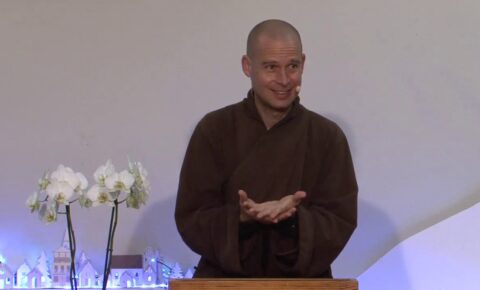
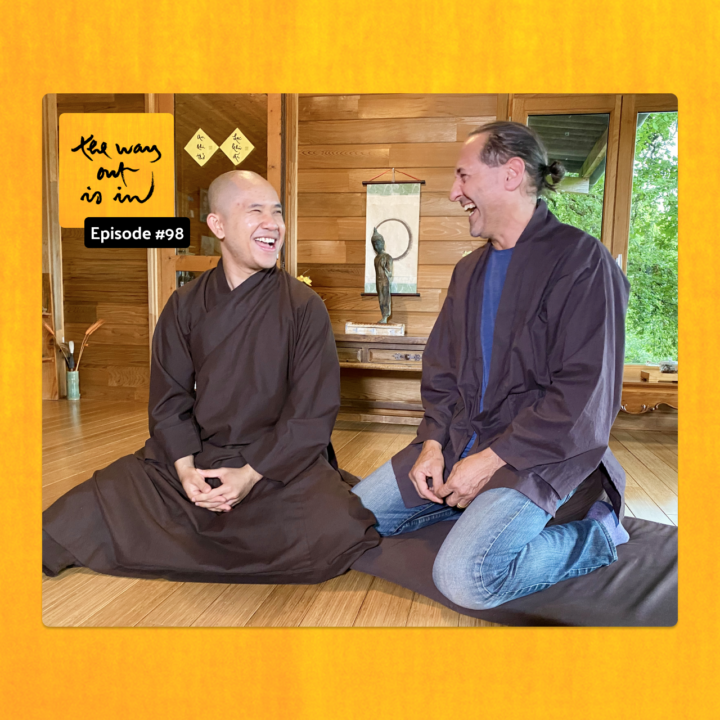
In this installment, Zen Buddhist monk Brother Phap Huu and leadership coach/journalist Jo Confino discuss the importance of creating inner space and stillness through meditation practices. But what does it actually mean to create more space in our lives? And why is this important, and how do we go about it?
The conversation emphasises that the practice of meditation is not just about achieving enlightenment, but about becoming more present, compassionate, and engaged with the world. It touches upon the difficulties of finding space in modern life, the benefits of different meditation techniques, and misconceptions around enlightenment.
The hosts also share personal experiences, including insights about how meditation has deepened their practice and allowed them to navigate challenges with greater flexibility and understanding.
The episode ends with a meditation guided by Brother Phap Huu.
Co-produced by the Plum Village App:
https://plumvillage.app/
And Global Optimism:
https://globaloptimism.com/
With support from the Thich Nhat Hanh Foundation:
https://thichnhathanhfoundation.org/
List of resources
Pilgrimage: In the Footsteps of the Buddha
https://plumvillage.org/event/pilgrimage/in-the-footsteps-of-the-buddha-2
Being with Busyness: Zen Ways to Transform Overwhelm and Burnout
https://www.parallax.org/product/being-with-busyness/
Calm in the Storm: Zen Ways to Cultivate Stability in an Anxious World
https://www.parallax.org/product/calm-in-the-storm/
Course: Zen and The Art of Saving the Planet
https://plumvillage.org/courses/zen-and-the-art-of-saving-the-planet
Interbeing
https://en.wikipedia.org/wiki/Interbeing
Plum Village Tradition
https://en.wikipedia.org/wiki/Plum_Village_Tradition
‘Resources for Practicing the 16 Exercises of Mindful Breathing’
https://plumvillage.app/resources-for-practicing-the-16-exercises-of-mindful-breathing/
‘Making the App More Inclusive: Introducing the ‘Access to Practice’ Folder’
https://plumvillage.app/introducing-the-access-to-practice-folder/
Robert Thurman
https://en.wikipedia.org/wiki/Robert_Thurman
Mahayana
https://en.wikipedia.org/wiki/Mahayana
Bodhisattvas
https://en.wikipedia.org/wiki/Bodhisattva
The Way Out Is In: ‘The Three Doors of Liberation (Episode #18)’
https://plumvillage.org/podcast/the-three-doors-of-liberation-episode-18
Sister Chan Lang Nghiem
https://plumvillage.org/people/dharma-teachers/sr-lang-nghiem
Quotes
“Walking meditation was our teacher’s favorite practice and it was really a life-changing cultivation for him. Because, particularly when we are very emotional – whether that be grief, agony, pain, anger, frustration – it is probably better to be in a state of motion.”
“The Buddha has said, What are we mindful of? We are mindful of our suffering. Why do we practice? To liberate ourselves and all beings from suffering. That is the greatest vow of a monk or a nun: to find liberation in oneself and liberation in all.”
“There are so many creations of senses – what we see, what we hear, what we smell, what we taste – to help us cope with our suffering. And when we are suffering, whether that suffering is very petite, a daily concern, or is a generational trauma, we don’t have language for how to be with that suffering. Therefore, we look for a way out – and the world loves giving us a prescription of, ‘If you do this, you will feel that.’”
“Sometimes silence is a chance for us to be in touch with deep suffering or deep experiences that our noise has covered up. As a meditator, space gives us the barrier and boundaries to listen and to hold. If we don’t create that space, we will be on autopilot for the rest of our life. Our mind is on autopilot; it has a way of thinking, a way of doing, a way of perceiving, of creating perceptions, creating judgment. So when we meditate and have the opportunity to listen to and then to guide the mind, it gives the mind a chance to not also be carried away by its own habits – which is thinking.”
“Thinking is not a bad thing. Like our teacher has always transmitted to us, thinking is a part of creating a view in life, a project, a mission, an intention. But most of our thinking is not productive. It is actually more daydreaming, it is more procrastination. It is more like a zombie, in a way, or a sleepwalker. It has no destination; it’s just on autopilot.”
“Many people feel they have to sit on a cushion, they have to have a shrine, they have to light incense, they have to light a candle – which of course can be very beautiful and give a good atmosphere for meditation. But you can also do it on a busy bus or train, or as you’re sitting on a park bench. It’s not about taking things out of your life; it’s about allowing life to be.”
“Sometimes we sit just to enjoy sitting and doing nothing, because maybe that’s the one gift that we want to give to ourselves – because we’re always doing, we’re always in fifth gear. Sometimes we need a radical act: to sit and do nothing, to give and create and redefine space for ourselves.”
“How can we keep mindfulness alive if we are not cultivating it? Sitting meditation is one of the concrete cultivation practices.”
“There is right mindfulness and wrong mindfulness. We could be a wonderful burglar with full concentration – but we would be creating suffering. So right mindfulness relieves suffering; it is about understanding suffering and heading towards the path of understanding and love.”
“One time our teacher told us that sometimes insight doesn’t come during sitting meditation, but when it’s ripe. Maybe when we’re most relaxed: when we’re not thinking about it, but are living the moment very deeply. And Thay told us that, a lot of the time, it would come while he was gardening or doing walking meditation. But sitting meditation is the cultivation; it is like a gardener tending the seeds of insights to help us have a moment of, ‘Ah, I get it.’”
“The practice is maybe just continuing to unlearn things, in order to learn again.”
“There is no way to peace. Peace is the way.”
“Sitting is already action. When we sit in this way and have new insight, that will become the thread of so many actions coming forward. So don’t underestimate the power of sitting still; yes, we have apps and guided meditations, but also build the capacity of generating your own guide. And that breath is there, that body is there. Then the community is there – and that’s the beauty of a tradition.”
“Whenever we speak about enlightenment, enlightenment of what? What do we want to be enlightened from or towards? Then, later on – like in my own growth – I see that enlightenment is a verb; it is a continuous enlighten-ing. You cannot be enlightened today, December the 9th, and expect that enlightenment to stay the same in 2028. Because things are changing; we are changing. The world is changing.”
Dear friends, if you have a deep love for the Earth and wish to learn how to bring the energy of mindfulness to your climate response, Zen and the Art of Saving the Planet is a seven-week online learning journey where we as a community will learn how to cultivate insight, compassion, community, and mindful action in service for our beloved Earth. Inspired by the timeless wisdom of Zen Master Thich Nhat Hanh, this course includes Dharma talks and practices, community sharing groups, and live interactive events with monastic teachers. I'm looking forward to teaching at these live events together with my monastic siblings. We'll learn together for seven weeks from 1st of March, 2026, into our closing event on 19th of April. Join us by heading to the website today, plumvillage.org/ZASP, that is Z-A-S-P, and we look forward to walking on this path with you. Thank you very much.
Dear friends, welcome to this latest episode of the podcast The Way Out Is In.
I'm Jo Confino, a leadership coach working at the intersection of personal transformation and systems change.
And I'm Brother Phap Huu, a Zen Buddhist monk, student of Zen Master Thich Nhat Hanh in the Plum Village tradition.
And today, dear listeners, we are going to be talking about what it means to create more space in our lives, why that is important, and how do we go about doing it.
The way out is in.
Hello everyone, I'm Jo Confino.
And I'm Brother Phap Huu.
So brother, we decided today to talk about creating space. And the reason being, you know, we wrote a first book called Being with Busyness, and it was all about the fact that actually most people have very little free time, a very little space, they always are busy, they're always thinking about something, doing something, thinking about what the past, thinking about the future. And of course, this practice is all about being in the present moment. But I just want to start by asking you, what is it that you think makes it so difficult for us to find space? So everyone says, oh, if only I had more space in my life. If only I could just relax. If only I didn't have so much to do. But as soon as they have some space, they feel bored, they feel restless. They feel they need to do something. What is it about our lives and our mind that finds it so difficult just to be in the present moment, relaxed, calm, happy, accepting, not needing anything? Why is that so hard, brother?
I think one of the first responses that comes up in my heart is because we are prescribed with a life that feels fulfilling with many things rather than a life that is fulfilling with less things. Because I remember growing up with that kind of mentality, like the dream of success or adulthood is to be able to do more, to be able to have more. And to be able to achieve more. So there's always this underlying source of energy that is pushing us in a way of grasping, of like trying to get more, get more. So that has become, if we enter into New York City or Paris, Bordeaux or Berlin, the collective consciousness of a city is noise, buzz. And there are so many creations of senses, what we see, what we hear, what we smell, what we taste, to help us cope with our suffering. And when we are suffering, whether that suffering is very petite, a daily concern, or that suffering is a generational trauma, we don't have the language of how to be with the suffering. Therefore, we look for a way out. And the world loves giving us a prescription of, if you do this, you will feel that. But our monkey mind… In meditation, we speak about the monkey mind, which is the mind that doesn't know how to dwell, the mind is always jumping from one branch to the next, or in maybe in the more Western way of looking we would say the grass is greener on the other side. So staying on our plot of field here whether there is some flowers, but there's a lot of weed, so we could imagine about tomorrow, about a future that looks so much more pleasing. So once again, we are reaching towards something besides the present moment and I think this is very built into our culture, I would say. Our capacity, though, as a human being, the beauty of meditation and a spiritual dimension, it is encouraging us that the art of stopping, we actually know how, ancestrally… Our ancestors knew how to do that. Our… Even beyond human ancestors, our animal ancestors knew how to rest, knew enough. But it is because of our habitual energy that is driven by forces of greed, as well as of belonging. I think belonging is a big one. And therefore, we're always in search. We're always looking for. Even us, monastics, when we ordain, there is a honeymoon season that we all go through where it's just incredible, this life of freedom that we have been dreaming of. We enter into it, we shave our heads, we let go of all of our worldly clothing, possessions, and we adorn ourselves with a simple robe, in our tradition brown. And I think for myself, I… I always remember that sensation of a very light head, very cool, cool in the winter with no hair, and just adorning myself in this robe, which is a definition we call the robe of freedom, feeling immense space and immense lightness. And that lasted for a few years, lucky for me, but then slowly slowly the mind, the manas, the greed, the monkey mind, the maras inside of me that's telling me there's something better beyond this, creeps in. And then also my own inferiority complexes or superiority complexes tells me to do more, get more. Are you sure? Is this what you want? Don't you want a more crazy life? You know, cause I was very young when I ordained, right? So our way of culture has also pushed us away from the present moment. And this is where we have, we have lost a sense of when we speak about space, we also speak about inner space. So we've lost a sense of having inner space for ourself to be able to listen, be able hear. And be able to see.
Brother, that brings to mind a memory that I used to live in a village outside of London. And I had two friends and they were both business entrepreneurs. They'd both set up companies, they'd both been very successful, they've earned enough money, didn't need to worry about money. And so they both decided together that they were gonna sell their businesses and to change their life, to make their life more spacious, more open. They sold their businesses, lots of money in the bank, and they sat there in this village and they didn't know what to do. And so they started doing courses. So one did dry stone wall building and another did pottery. And within six months, they'd bought new businesses. They'd started off new businesses because they just did not know how to fill their time. Because as soon as you want to fill your time, you can't leave your mind empty. I wanted to ask you, and then we can get into practice, but before that, what is the benefit of having an empty mind? I mean, why not say, oh, well, a busy mind is great. You get lots done. You feel connected. You feel that you're useful in the world. Why time? Why space? Why do we need it?
If we look at our course of life, if we're lucky, we get to live into 80, healthy, with a lot of health. So our time on this planet is very fragile actually. We are made of many conditions and we cannot escape death. We cannot escape sickness. We cannot escape the impermanence of reality. And that reality is also us. And we do know what is love. We do know what is being seen as well as being supported. Because of love, there is a big force that drives most of us to do what we do in the world. And unfortunately, the more busy we become, the less time we have for the very simple manifestation of love that we are so eager in doing for, like our children, our partner, our parents, our community. And so therefore, when a lot of people have said that, when it comes near to their time of letting go of death, a lot the times regret comes up. Regret about not about not having enough money but not doing the simple actions of love. And that is in the present moment. And the present moment is space and time, right? So why is it that we have to meditate and we have create a more simpler mind? It's because our way of doing and our way of being is structured by our habits and the habits of the world, like I have explained before. And when we want to live more simply, that takes a very strong determination, that takes very strong courage. Like you said, like suddenly you have half a day to rest. And of course there's gonna be a list of to-dos that we haven't yet have the chance to do. And most of us, because suddenly when we have this free space and this free, let's say freedom that we have, we are the one that is imprisoned by our own habitual energy and our energy of being worthy. And we are in search of finding a meaning. That's one response. And there's many responses. Or some of us being still is too scary. Sometimes it can bring up trauma. This year in the Lower Hamlet, they hosted a hiking retreat. And in one of the days of hiking, they, in the morning, the hike was in total silence. And you can hear the footsteps on the earth. You can hear footsteps on pebbles, on the rocks, on the sand, on leaves, and it was complete silence. And for some, that brought up war trauma of their ancestors, that they had to march through fields and not be able to say one word because they're in the lines of the enemies. And so sometimes the silence is the chance for us to be in touch with deep suffering or deep experiences that our noise have covered up. So for us, as a meditator, space gives us the barrier and boundaries to listen and to hold. If we don't create that space, we will be on autopilot for the rest of our life. And our mind is autopilot. Our mind has a way of thinking, has a of doing, has a a way a perceiving, creating perceptions, creating judgment. So when we meditate and we have the opportunity to listen to the mind and then to guide the mind, it gives the mind a chance also to not be carried away by its own habits, which is thinking. Thinking is not a bad thing. Like our teacher has always transmitted to us that thinking is a part of creating a view in life, a project, a mission, an intention. But most of our thinking is not productive. It is actually more daydreaming, it is more procrastination. It is more like like a zombie, in a way, or a sleepwalker. It has no destination, but it's just on autopilot. And the moment you come back and you connect to just your breath, for example, you are being invited to feel your breath. So in that action of being with the breath, you're bringing the mind to the breath. The mind doesn't have to think about the breath because the breath is already happening. But the mind can then stay with the breath and be guided by the breath. And in that moment of concentration with the breathe, the mind gets to stop its autopilot of thinking, of projections, of perceptions. And the mind has its own mechanism of insight also. To look deeply, to understand, to feel, to have breakthrough. So this is where meditation becomes also very challenging. Most of friends don't believe they can meditate because sitting there and doing nothing is actually one of the scariest things. And when we are offering a retreat for many people and a lot of beginners into meditation, the hall becomes so silent, Jo. So silent that we can hear every movement of individuals. If someone who is not at ease with their sitting, their bodies will have reactions. Fidgeting, pains that comes up, tension that arises, and only in the beauty of the silence of the space can we start to allow things to reveal itself. So for us, this is already a fruit of meditation, even though it may look like a very unpleasant thing, but it is revealing the tension, the pain, the agony, the restlessness that we are carrying inside of us. So for us, as meditators, it's not about erasing our mind, but it about creating a pathway for concentration, a pathway so that the mind can be grounded, because the mind also it's like a heart which is always beating. The mind is always there to perceive, to receive, as well as to give. But the mind also needs its care, needs a kind of a… How can we care for our minds so that it is not always in an environment that is overstimulated.
Thank you, brother. We'll go in a minute deeper into sitting meditation to start with, but one of the things I've noticed, so before coming to Plum Village, I was in New York for five years as a journalist. I was very, very busy trying to create as much impact on the world around sort of educating people about climate change, biodiversity loss, et cetera. And then I came to Plum Village and stopped. And I've been here five years, and I've had the most productive five years of my life. And I think some people feel that if they create space, that actually it just goes to waste, it's nothing. But what I've found is actually, I become more inventive, more creative, that actually I allow things to bubble up, that rather than trying to control things, that actually life, I allow life to show up and life often has better answers than me. So there are a lot of misperceptions about space. But I want to get into sitting meditation, brother, just to start off with. So that's one of, of course, the core practices. So why sitting meditation? So, you know, to be honest, I'm not a great meditator, but I'll get up in the morning, I have a cup of tea, but I will sit at the window and I'll look out at nature. So it's not a formal sitting, but it's a quietening of the mind. So can you tell us what actually is sitting meditation what isn't, what it isn't. And why is that the core practice as opposed to anything else?
Because we sit everywhere. I think there's studies like, I think, 60% of the day, most of us were sitting. And imagine if we knew how to meditate, how those moments of sitting on the bus, sitting on a commute, sitting at the bench in the park, how those sittings can actually give so much quality to our life. Now, most of us, we sit in order to look at one direction, and that is probably a show, a television, or a screen. Well, first of all, it goes all the way back to our first teacher of Buddhism, that is Siddhartha, the young prince that was looking for a way to break through suffering. And the Buddha himself touched deep enlightenment, deep understanding when he practiced throughout the day, space and time that he would curate so that he would just sit in full stillness and to allow everything to manifest, the pains, the suffering, the… The question, why do I have this body? You know, this question is that what is my purpose in life? Why do we suffer? Why is it that all of the ones that we love, that we all have to go through the cycle of grief? We have all of these questions that bubble in all of us. Our teacher, in our tradition, tells us that all of we have an ultimate concern. And that ultimate concern for some of us, it may be, how can I help my parents to be liberated from the chains of their traumas? Some of us how can I be an actor, an action for climate justice or for racial justice, for a peace movement or as simple as to be a loving mother, a loving father, or a loving brother, right? We have ultimate concerns because that becomes a part of our legacy. Because we have our daily concerns such as paying the bills, having food on the table, taking care of day-to-day relationships. But that is not as fulfilling unless we can also touch the questions of what is it that I really wanna offer in my time on this life, on this planet, in this life and on this planet. It's very interesting, like I, when I'm in motion, whether it's driving or whether it is walking meditation with the community or doing things, my mind has also had the habit of being on a few different wavelengths at the same time, but spontaneous questions would come up or a spontaneous deep looking that I have been holding onto for a long time would arise. But I know that by the doing… I won't give it the right proper attention it needs, because I'm in motion of cooking, of meeting, so on and so forth. The action of just sitting still, finding a cushion or finding a chair, positioning ourself in an upright posture so that we can be still and look deeply. Meditation, we cannot just say, I'm just gonna meditate and meditate on nothing. Well, that's emptiness, but emptiness here is much deeper than just the word nothing. Meditation always has to have an object, always has have a subject. That we want to put our attention towards. So to bring our breath is an option, to bring out posture is an option. And then sometimes some of us, we sit just to enjoy sitting and doing nothing because maybe that is the one gift that we wanna give to ourself because we're always doing, we're all always in gear five. Sometimes we need a radical act in a way, it is to sit and do nothing, to give and create and redefine space for yourself. Because space is always there. And there are many wavelengths that is around us. There's many stations that we can tap into. A conversation, something of yesterday, something of tomorrow, so on and so forth. And there are so many chapters that we get into. But sometimes a radical act that we lack so much is the act of just being still, to create space for ourself to look inwards. What is the inner world that we are carrying inside of us? What are the emotions that are present? What are the feelings that have been neglected? Looking at our body, can we sit upright? Like, why do we sit upright in sitting meditation? Because our patriarchs have taught us that the body and the mind are interrelated. If we want a clear mind and a mind that leads towards a collective awakening, we want to have an upright posture. An upright posture is not of ego and pride, but it allows us to fully be there. When we are attentive to our own body, we want to be upright. For a lot of us, we, even myself, I remember coming into the monastery, being in front of a computer to play video games for so long, I had this like natural tendency of hunchback, of like not being a part of the world in a way. And coming to the program of training to be a monk, the first thing they teach us is to sit upright. And to intentionally always become aware of our fore posture, our sitting, our walking, our laying down, and our walking. How can we show up in the world that carries our attention in the form of our body, as well as how can we be upright so that our heart is open and that the heart is tendered though, and it leads forward. It leads with kindness, it leads with compassion. And is open to embrace and to hold. When we are in conversation with someone and if someone is afraid and scared, you will see their body shut down. But when you're with someone who is open, who is present, their presence shows up in a way that is very welcoming. Of course, there are those who come with a lot of anger and those who come with a lot pride. That those attitudes also manifest in the body. So therefore, sitting meditation, for me for the first, I would say like three years, Jo, was just becoming one with my own body. I knew that sitting meditation would become a vital pulse in my whole life. I hate a sitting meditation though. It was one of the meditations I dread to go to because I would fall asleep all the time sitting still and doing nothing was definitely very new to my system. And then also like the mind is just so wild when we sit still. And… But now, thanks to the years of practice, I can activate my inner space anywhere now, Jo. And that is the beauty of creating a foundation where the meditation has the grounds to be present.
So brother, there's so many questions bubbling in my head, so I'll try and remember some of them, but the first one just related to what you just said at the end. When you say I can create inner space anywhere, what does that feel like? So for those people who are watching or listening and saying, oh, well, that sounds great, but what does that give you? So let's say, okay, let me give an example. You're the abbot of the monastery. You facilitate sometimes some very difficult meetings where there are lots of different opinions and you're helping the community to come to reach consensus. That, I imagine, can be very stressful. You're having to observe all the different energies in the room. You're have to listen to all the different viewpoints. You're having to imagine and understand what could be a pathway through. You're going to guide the community but not to control it or dominate it. So in that sort of space, there's a lot being held. What is it to have inner space in that moment? What does it give you? And how does it show up?
Hmm, I think I'm gonna try to explain it. I'm going to try to describe it because we're all human beings. So whenever we are in motion of connection, meetings are a big field of connection, of thoughts, and of ideas, and of judgment as well as fear. So for me, when I enter into these spaces, well, first and foremost, I prepare myself for it. I create my inner space before going into the meeting, you know, I would prescribe myself like moments of stillness to allow inner space to be there. And what it has given me, it has given me the ability to listen so deeply. And when I'm listening very deeply, I allow also my own feelings to arise. I allow my own biases that I can recognize. I can recognize the judgments that I have. And before having the inner space or having the strength of coming to the inner space, my mind would latch onto all the feelings that arises. Oh, this person saying this, what an idiot, they're so ignorant. This young bhikshu, he knows nothing. Just sit there and be quiet. You know, the mind goes, but actually now, when I am hearing things, I can recognize my mind trying to grasp and give it a label. And I said, and I can just come back to my breathing, not be carried away by my thoughts and come back my presence and come into the action of listening. And that allows me to be very free in a way. I am free from my thoughts of judgment towards this person. I am free because I'm giving this person my freedom of accepting what they are saying, allowing them to just share from their heart. And when I am in a position and a state of maybe, you know, discomfort and full of fear even, you know, rather than clinging onto that and seeing all of the reaction in my body, I have a place to come inwards too, and that's my breath. It is so fundamental. This is why in the Plum Village tradition, the 16 exercises of mindful breathing, in a way, it is our foundational practice. It is our bread and butter every day. It is what we train day in and day out. So for me, like, my feelings in a way have become my bell of mindfulness. Just like when we listen to the bell of mind in Plum Village, we're all invited to stop and come back to our breath. For me, in meetings, when I have a strong emotion come up, I would intentionally put my hands on my stomach, or sometimes I put my hand on my heart, or wherever there tension, you know, wherever there is a feeling of wanting to run away. I would intentionally put, you know, feelings there. So this inner space, it doesn't give you all the answers, but it gives you the space to be there for the uncomfortable feelings. And this is one of the key of insights. Most of us, most of us, me including, we like the pleasant feelings. We like a good situation. But we have to also be ready for the uncomfortable moments, the uncomfortable conversations, the uncomfortable views that those of us we are holding on to and when I listen to it, and like sometimes I get a curveball and I'm like, wow, even in Plum Village, we can have these views and these perceptions and these way of speaking. And sometimes even in the monastic family, I'm like, whoa. And then coming back to the present moment, that inner space allows us to guide our minds. And I always come back to, we're all humans and we're on the path. We're not enlightened yet. And some of us, we have more understanding than others and it's totally okay. And that has allowed me to continue to be very flexible. I think coming back to this question that you asked, what is it, how is it like, and… It gives me so much flexibility. This is one of the art that I have had to train myself in. And be very careful of my perception of what is right and wrong. Because most of the things that we project as in what is wrong is what we think is right and wrong, and when we listen in a more open way, we can also be surprised with what we don't know, or surprised with a new view that can come and enlighten us because we thought that the only way that would be successful is this. And then somebody coming from their own experience, whether they are younger than us, but then say, why don't we try it like this? We have these aha moments and in our community, we've had so many moments like this just in our own schedule. It's like sometimes there's a few things that we're just trying to tweak, you know, and because we're so good at regularity, of rhythms, one of our brothers always say it's like, being conservative feels very safe. And then changing is scary because we don't know if it would be good or not. But then when there's a collective insight and all of us can like pitch in a little bit how about this, how about that da da da. And then suddenly one brother from listening just says I see it. Let's do this and this and this. And we had this like last year and everyone was just like huh that is the way. And we call him our wizard, you know, he's like our wizard. And now it's like a joke in our community, he's a bhikshu with us and he's not an elder biku, like much younger, but even in yesterday's bhikshu meeting, I asked him, brother, any wizardry that you can offer to this moment? And we would be surprised when we listen and create space in this way where everybody feels that they are involved.
Thank you, brother. I just want to pick up one thing you said, which is we're all on the path. There's no final destination. There's not station we're trying to reach. So it doesn't really matter where you are on the path. And I think so many people fill their space with this belief they have to get somewhere to be happy, have to somewhere to be successful. Whereas, and I, when I work with coaching clients, so much for this. Be where you are because that's where you are and if you're trying to be somewhere else then you're already not where you are and you're already destabilized. So what I hear you also saying is actually wherever you are is where you are so don't fight against where you are you can't and you can only transform where you are when you accept where you are. You can't transform it in another place. But brother, something's coming up. So I want to talk about misperceptions of sitting meditation. So I'd like to go just mention a couple of them and then maybe you could talk about those and we could probably spend a couple of hours or a couple of days, maybe talk about how people misperceive sitting meditation So one thing is, and it comes back to my point, people think there's a good sitting or a bad sitting. So there's a… So they bring all their judgment on success and failure into their sitting. So if they have a sitting where they have a lot of thoughts crisscrossing their mind, they think they failed. And if they have a peaceful meditation where they think that their mind is going nowhere, even if it is that, they think that's a good sitting. So that is one big misperception about succeeding. And another one that just comes to mind is this idea of separation that… And we see this a lot with some mindfulness, not Buddhist traditions, but sort of apps or whatever, that you sit in the morning for 20 minutes and then you get on with your day. You know, you just say, I've done my sitting, I've my practice, and now I can go back into all my busyness. So anyway, I'm sure that there are probably so many, but just to start off with those two. So what is… What is successful meditation? And yeah.
I think just showing up and doing sitting is already a success because we can all choose not to sit with that intention and, and continue to be busy. Or continue to be lazy. And laziness is one of the hindrance to an awakened mind as the Buddha himself has taught us. So sitting meditation, the reason why I say just showing up is important. It's kind of like exercise. Like we all wanna be healthy. We all know that that we are made to move more than we do in 21st century. And we all look for encouragement, whether it is through apps or influencers that we follow and so on and so forth. But to do it is a drag. And sometimes honestly, I also see like sitting like, I have to go. Do I wanna go? No. Should I go? Absolutely. And I drag my legs, my whole body there. The fact that when you sit, and because I've done it for so long, I know at my core what it offers me. It offers me this place of deep being. Maybe a mistake is that we think sitting is to achieve something. I think that is probably one of the biggest misperceptions, that sitting meditation, only by sitting meditation will we be enlightened. I think that is a misunderstanding. Sitting meditation is a daily practice, just like when we are in the spring and summer and autumn, we want to prepare for winter. We want to collect wood, we want to collect branches to start the fire. And when winter comes, and winter may come with a storm, with its cold, with its winds, then we know that we have materials and ingredients to prepare the fire to keep us warm. So sitting meditation every week, every day if we can, I mean that could be a little bit ambitious for everyone, but setting up a good rhythm can enhance our ability of activating our mindfulness because we have the muscles. We have this, we call it the spiritual muscles. We have the mindfulness muscles, the concentration muscles that we can activate right away. And our teacher always says, don't wait into suffering and then you practice. Maybe suffering is an enlightenment that I need to look for. I need to go to search for a way to transform my suffering. And that is already an understanding. That is already mindfulness. But how can we keep mindfulness alive if we are not cultivating it? So sitting meditation is one of the cultivation concrete practices. And then we have walking meditation. We have service meditation. We have cooking meditation. We have tea meditation. Every day way of being is meditation, as long as leading towards the right path. There is something called right mindfulness and wrong mindfulness. We could be a wonderful burglar with full concentration, but we're creating suffering, right? So right mindfulness is to relieve suffering. It is to understand suffering and lead towards the path of understanding and love. One time our teacher has told us that sometimes the insight doesn't come during sitting meditation, but it comes when it's ripe and maybe when we're most relaxed. When we're not even thinking about it, but we're living the moment very deeply. And Thay, he himself told us that a lot of the times it would come while he's gardening or he's doing walking meditation where it doesn't look like is in a form of sitting meditation. But the sitting meditation is the cultivation. It is like the gardener tending to the seeds of insights to help us have a moment, ah, I get it. I understand why this person suffers like this. I understand I have these habit energies. But it is thanks to these moments of looking and resting that it can appear where we can look deeply into it. So meditation, think of it as just brushing your teeth. If every day you can brush your teeth for two minutes, right? That's the recommendation. Two minutes in the morning, two minutes in the evening. Floss if you can. Brush during the day if you can. There's a lot of encouragement, but concretely just one session before you sleep. All right, like that could be a very wonderful building block for our way of being. And then to your second question, with right mindfulness and sitting meditation, it is bringing the insight of interconnectedness into reality. When we sit and we meditate on the object of a tree, we take a tree as an example. We see that the tree is part of our being. Without the tree, we wouldn't have the oxygen to breathe. The tree plays a very crucial part for our healthy life. Then the forest, then the lakes, the rivers, the mountains, the sun, the door, the house, so on and so forth. And suddenly you enter into a oneness. And this oneness is not about feeling like la la and going like, whoa, I'm everything. No, it's like oneness because all of that suffering is me. All of the potential is also me. And when we are interrelated at a fundamental level of our understanding, we cannot live the same anymore. That's why those of us, we chose the path as a monk. Because when we've touched something so profoundly, we're ready to let go of everything. What mainstream has given us, that ideal of success, that ideal of freedom, of love, we're ready to let it go. And those of you who enter into the order of interbeing, into our tradition, you don't want to just come for a retreat once a year. You wanted to make it every day of your life. So how could you live the same anymore? Right? And suddenly, so many people naturally, they say like, I became vegetarian without even knowing, brother. I've just slowly let go of alcohol and so on and so forth. And it becomes because there's an insight in you that awakens and saying that now that I've seen it, how could I continue it? And there is an ignorance to meditation if we're using it to just bypass, just to feel good about oneself. The true reality of meditation is to touch the non-self element in us. If we just stay in the self, yes, then we will be very egotistic, we'll be, we just worry about ourself. And yes, we can continue like that, no problem. But that will create a lot of suffering. But the real, excuse my language of real, but the ancient teachings that have been transmitted to us is that these meditations doesn't separate us, but it allows us to touch deeper the insight of interbeing.
Thank you, brother. One of the things that I find very useful in that is not to focus only on meditation, which is what I hear you say, and I recently interviewed a very senior Tibetan Lama, and he said, transformation through meditation takes a long time, it's very difficult, but it's easier to change your attitude and your behavior. So what I take from that, and what I'll take from what you're saying is, it's neither one or the other. But they inform each other, but it's not separating out, oh, I have to have a good meditation practice and that's enough, but actually, I need to work throughout the day. That mind, that meditation, and meditation as you start off by saying, doesn't have to a formality. So many people feel they have to sit on a cushion, they have have a shrine, they have to light the incense, they have to light a candle, which of course can be very beautiful and give a good atmosphere in meditation. But you can do it on a busy bus, or a busy train, or as you're sitting on a park bench. It's not about taking things out of your life, but it's about allowing life to be.
Exactly. And this is where our tradition focuses so much on engagement, because we are always engaging with the world. And meditation has this wonderful condition, like you just mentioned, in a beautiful setting, in a meditation hall, with an altar, with a candle, with incense. If we have that, we are so lucky. And then please maintain that. And don't be stuck to that only, that this is the main thing, right? This is where our teacher comes from of his deep questioning of what can I do for the world when the world is burning on fire? Like, do I just stay in the meditation hall or can I take the energy of the meditation hall and adapt it to the world? And he chose the latter, but it doesn't mean he cut off from that. We have to have the two of them always in action because we also have our limits and our capacities. And we could be having one of the most bravest and courageous hearts in humans. But if we don't have the right conditions, if we are not healthy enough, we are being supported by a community, we are not being loved, then we will give up. We will find ourself choosing an easier path. I share this from my own experience and it takes courage to also take a step back sometimes. And taking that step back is in a way to revisit all of your pain and suffering in the here and now. And when I look back at myself and if I still carried on to the hero's journey I would destroy myself. I would not only destroy myself, but destroyed everyone that has supported me. And when we have the knowing of how to be still, how to sit and reflect, that can give us a way to healing. If we are not nurturing our spiritual dimension to understand and to look deeply, we will burn out. We will give up. When I was living with Thay, and he was here in this hut, like Thay worked day in, day out, Jo. Like the tables behind you is where he edits so many of the books, where he translated so many the sutras. Thay was someone who couldn't sleep much, and this was from the time of war. And he… But he knew how to practice total relaxation very well. But he would wake up early in the early mornings and translate or read sutras and help find and hand select sutras of the Buddha that is still relevant today. And he did so much, but he always had a regular practice. It was like with him, it wasn't even a struggle. It was a way of being. And this is where I aspire to be. That's who I aspire to be in that kind of capacity. And what reality it gives me is that even though he's always in a state of attention and mindfulness, but he's still so human. He's very caring. He is very attentive. He is interacting like a normal human being, like a Zen master doesn't speak in a very different way. We're still cracking jokes. He's still asking, like, did you eat? Did you have enough? The very simple human things that we do. And, you know, I want to speak to this because I think that sometimes we think that the more Zen we become, like the more rigid we are, or the less we speak, or so on and so forth, actually we know when to speak and when not to speak. We know when I am with my homies, I am just with my homies, you know. And then when I'm in my teacher, representing the whole community, I enter into another field of energy because that's what I'm representing. And all of this though, when I was with Thay, he carried that thread of just presence. And knowing when to, when we could be slow and then when we need to be fast. And I think one of the cherished memories I had was I was traveling with him and we were on the airplane. And I was sitting next to him and he just took my hand and he held it and he's like, it's so wonderful that we can go spread the Dharma everywhere. And then he looked at me and he said, do you think the Buddha would have taken these flights? And before I could even say anything, Thay said, absolutely. The Buddha would travel to the different continents to spread the teachings. And all of that for me is also mindfulness of like, this is the times we're in. Right? To not ignore it, to see, what can we do to support and then to cherish a student who's next to him. And then to imagine, ah, would our ancestors do it? And then to know that, ah, we are the continuation of the Buddha, so the Buddha is doing it.
I just had this wonderful image of the Buddha in seat 43 D.
Next to the toilet.
And being rather happy. So one of the things I want to come into is the accumulation of the practice. And we do talk about this sometimes, but I think it's really important to keep coming back to it because so many people want, it's like instant noodles. They want to sit for one or two times or a week, or come to Plum Village for a week and if they haven't transformed they say, ah, this meditation doesn't work. And I came across this, I was told this story the other day of, there's this book that was in the Tibetan lineage where it's a book of people's description of when they reached enlightenment. And there's a story of one nun, I think this was told to me by Robert Thurman, and there's this one, after 35 years, she was a bit fed up. And she sort of came back to her room and she'd been listening to the teaching and said, I've been practicing for 35 years and I don't really see a big change. And then she snuffs out the candle and reaches enlightenment. And what Robert Thurman was saying was, and it took 35 years. And that couldn't have been done in a year or two years or five years or 10 years. And… So I just wonder if maybe to make it personal, do you see a deepening of your practice? And for those people who maybe are new or have been just sitting a few times or maybe even a few months and are feeling like, you know what? I'm fed up with this. I sit there and I try and clear my mind, I try and watch thoughts come past me like a cloud in the sky, but actually, I don't feel any different. What would you say if someone was just sitting in front of you and said, Brother Phap Huu, I'm giving up, it makes no… I don't see a change.
I think the first thing I would tell them is like, ah, you're mindful that you want to give up.
And you're mindful that there's been no change.
Exactly. But the real reality is, how could we not have changed in one week, in one month, in one year, in 10 years? But maybe our idea of change is very different than the reality. And coming back to the reality in the present moment, when we have these moments of doubt. Doubt is another hindrance that in the spiritual path speaks a lot about, and then comes pride, pride comes with that because we're so prideful that we don't want help. When doubt and these feelings arises, first of all, I practice just smile to it and then ask are you sure? Are you sure we haven't changed? The way maybe we are holding onto this reality is maybe very different. Maybe in the past, you would have thrown it out. You wouldn't even ask this question. But now there's more of a tenderness, there's a more of recollecting. It's like, huh, what can I do different though? Why am I holding onto these thoughts? And that maybe is already different. Our maturity in holding the situation could be very different You asked about deepening. I still breathe and I still practice the same fundamental things the day I learned. When I sit, I come back to my senses of being in the posture. And I think one of the differences is I enjoy it so much more. And I can arrive into my sitting with less effort. It's more seamless in a way. And maybe I thought that I've always had was like, I need to sit to be mindful. And now sometimes I can say the sitting is mindfulness. It's just […]. But throughout my life though, where it has manifested without me realizing is in situations where it is asking so much more of myself, I can enter into a place of much more openness, much more clarity, even choosing not to say anything. Like I was very angry about something very recent about an email and that I received and I was cc'd in it. And it was about, I was involved in it, but it wasn't directed to me. So it was a very particular way. I'm like, why don't you just talk to me? And then all of my pride came out. Like, I was like, but why do you think like that? I'm the abbot, like you should be lucky. Like I'm a very flexible person, you know, and then I gave like all of this and I was really angry. I wanted to write an email and just saying, you ungrateful brother, that was like the punchline, exclamation mark, all in caps, you know. I really wanted to write that letter and I really wanted it to express my anger. And why was I angry? Because I think something of it stayed and some of it was maybe there's a part of it that was true. He was trying to point out. And I didn't take action, Jo, because I've learned that in our tradition, we have a mindfulness training that says when you're angry, don't act on it. Normally, I do. This time, I really held myself. And I still saw the brother in the schedule. I still looked at him. I still, he was at my birthday party. He came for a little bit of cake. And, you know, that was a moment. I think that was moment where I saw him as my brother. Because he's a very righteous person. And we need a few righteous persons, but he's not very flexible though. That's, I think that's…
That's almost the definition of righteousness.
I think that was what was irritating me, was that there was no flexibility in his way of looking at how things have evolved in the community. And I think one of the reasons why I'm the abbot it's because I have this ability of flexibility. I could do a little bit of Tai Chi and dance here and there, right? And I think that stiffness was what I was angry with. Not him as a human, not him as my brother. And it was thanks to the cake that I had that understanding. And then in yesterday's bhikshu meeting, because I was a part of it. And I was a part of making a decision that, in a way, breached the agreement of the bhikshu council, of the monks. And spontaneously, Jo, I was sharing about something else. And then I just took a moment. And I knelt up in front of the whole bhikshu order, that's like 40-something of us. And I just began anew. I apologized for doing something that I should have given more time and just consult more. But I took an executive decision that, in my mind, I was like, the sangha would have supported anyways. But I understood in our community of not being top down, right? We are trying to show a way of more democracy, let's say, or like everybody has an input and so on and so forth and you know, to everyone like, yes, there's democracy, but there's also like a tradition in the monastic lineage that we also hold, right? But I felt that I can do this though. I have, I can this, there's no shame there. And I knelt up and I began anew to the whole community. And I think the community was quite shocked about it, but then I felt so free, Jo, because I've been holding onto this. And it wasn't even anger when I shared. That's why I was so happy because there was no more anger there. There was just an awareness that I did something that breached the decision of my order, the order of my brothers. And for me to just apologize and ask for forgiveness is also submitting, like I'm not always right. And I think that that is a deepening in my own practice. That is a deepen in my selflessness. And then coming to the fundamental day to day, I would just say like, now I know my limits so much more. I know my capacity so much. I know, and I'm continuing to learn when to say no to a lot of invitations, when to say yes, and then asking questions, preparing oneself. So in a way, all of the meditations that we engage in, it allows us to be more of a wonderful human being in our capacity. And in one of Thay's latest Dharma talk that we're listening as a series here Thay says that Buddhism is, before thinking of it as a religion, Buddhism is a very humanistic practice. And I love that because that's what it is. I'm not here for no God. I'm not here for that game. I'm hear for like how to be a better human being.
Brother, beautifully spoken, thank you. And just an example of that deepening, and actually what it brings to mind as you're talking is that there's a part of us that would love to be better, would love be more grounded, would love to be more loving, would like to be more gracious, would like to be more generous. But actually there's another part of our mind that wants to remain exactly the same. It wants to remains stuck because it's what the mind is used to, what it's safe actually. And so there's a particular person I've been coaching for four or five months, and we had a session the other day, and she started by saying, oh, it's terrible, nothing's changing. And I said, okay, let's just stop there. Let's just look at how you were five months ago and how you are now and what's changed. And she said, well, I'm taking more care of myself. I'm not sacrificing myself to work so much. I'm spending more time with my husband and son. I'm going to the gym more regularly and going to the local park. And I said, doh. Actually, look how much is changing. But part of her mind was still saying, I'm stuck, even though she was changing in her life. And that was so moving. And also she uses the word but a lot. So she'd say, yes, it is better, but, and almost the but comes before the end of her previous sentence, it's or however. And I said, how about just saying and. I haven't changed as much as I want and, well, than but. And how about just sort of just allowing things to be, to take time? So anyway, it was just this wonderful example of what you were saying earlier about we often don't know that we're changing and we can see the different parts of our mind of where we're stuck and where we are open. But brother, what's coming into my mind is to ask you about the limits of sitting meditation. So, for example, there are people who have suffered trauma, and you mentioned this close to the beginning, that sitting still for them might be very difficult. There are people who may be physically, there are some people who are physically very supple and can just sit very easily. There are some where it's very, very difficult to sit. There are some people who, sitting comes very naturally. And some people who just love to dance or love to play music. Thay obviously came up with walking meditation. That sitting meditation, you know, one of the things I love about Plum Village is not saying there's sitting and that's it. There's some traditions where you sit eight hours a day and that it. So can you talk to me a little bit about the boundary? So when is sitting meditation actually not helpful? Rather than, because some people, they try to force themselves to sit. They're saying, and then that brings up, of course, failure again. I've got to sit, I've gotta prove to myself I can sit. So just talk a little bit about the, when are we free just to say, actually this week, I'm not going to sit or actually today I'm just going to sit five minutes rather than 20 minutes. And that's… And five minutes is enough.
Thank you, Jo, for being very inclusive in this question because I know there is many of us for whom sitting could be very limiting to us. And like you mentioned, the beauty of flexibility is that there are so many other meditations that we don't have to think that this is the only way. Walking meditation was our teacher's favorite practice and it was really a life-changing cultivation for him. Because when we are particularly very emotional, whether it is grief, agony, pain, anger, frustration, movement is probably better to be in the state of motion. And being in the state of motion is the same awareness of being with the feelings of the body, grounding the emotions into the feet that we are stepping onto this earth. And I particularly love slow walking meditation, one step, one breath, and just that concentration, that force, slowness has been a very supportive practice for me. And for those of us, if sitting meditation, sitting is not a chronic pain and difficulty, I do still encourage us to slowly build into this capacity, because like I said, I think most of the day we're sitting and wherever we may be sitting, that could be an opportunity for us to redefine space for us, inner space, outer space. The book that we wrote, Calm in the Storm, that's the image, because the storm can be there, but we can still be very calm in our way of just presence. In the Mahayana tradition, we speak of Bodhisattvas, the ones who are walking towards the path of enlightenment, but are still very much a part of the world. And we don't want to, even they say, we don't even want to be a Buddha, because being a Bodhisattva is enough. Those… An awakened mind is enough because it allows us to still be so much aligning close to daily life that we can have a much larger impact. But that… we do have to have a spiritual concrete practice to come to and this is when we can liberate ourselves from thinking sitting will make me enlightened. You suddenly feel so much more free. One of my older brothers in my Dharma family, he had a hilarious joke, because he was turning 35, and the Buddha became enlightened when he was 35. He's like, I'm going to get enlightened when I'm 35. I'm like, bro, good luck, but if you do, I'll be your student, you know. He's in his 50s now.
Still trying.
Still trying, still reaching for that enlightenment. It's a joke between the two of us, but when we see that sitting is a way of healing, a way of understanding, a way of resting, a way of guiding the mind, it's very different. And for me, just recognizing sitting in a moment of sitting with the community, that's moment nobody can say anything to me. We're all prescribed to be in silence for 30 minutes, like the greatest gift, you know. Nobody can bother us, nobody can interfere with that practice. So I think that we have the freedom to navigate and to see how meditation practices can be supportive in the moment. And Thay was so flexible that when he was teaching us and he was doing sitting meditation with us, he said that those who always fall asleep during sitting or those who have some deep fear that comes up, even though the community is sitting on one side, you're given permission to go to the back and practice walking meditation in silence while the community is still in sitting. And that is to emphasize on to be in a community of practice. So this is just like an element of how flexible Thay was with allowing people to meet their truths also during sitting. And our prayer is that all of us, we could meet the demons inside of us. The demons or the scary memories even in order to hold, embrace, accept also and then to transform. And that is part of the path of Buddhism is to, the Buddha has said, what are we mindful of? We are mindful of our suffering. Why do we practice? To liberate us and all beings from suffering? That is the greatest vow of a monk or a nun. It is to find liberation in oneself and liberation in in all.
Thank you, brother. One final question, because I also think we ought to end with a short meditation today. But the question is about enlightenment, because it's used a lot. And so I'm putting together a book at the moment where I'm interviewing 21 long-time Buddhist teachers and practitioners who have been practicing for between 40 and 70 years. And none of them have reached enlightenment. And none of them care if they do or they don't. But they all have benefited hugely from the practice. They feel lighter, they feel more engaged with the world, they feel less grasping. None of them have said, oh, my suffering has been eradicated, they's still the suffering, but they're not attached to the suffering. They don't get pulled off center from the suffering anymore. But a lot of people have a very strange idea that they want to, you know, this joke about, I want to be enlightened. And one of the things I loved about Thay is he said you can be enlightened in any moment. And that enlightened wasn't a final destination, but actually we can have moments of enlightenment any day, but that we don't need to hold onto it, and we don't need to expect it. So just to finish off, just so, because so many of people attach their craving mind or their grasped mind to, I want to get to here. And we've talked a little bit about that, but tell us a little bit about how can we see enlightenment in terms of the practice? So if we're sitting meditation or any other practice, if we have the idea that we want to reach enlightenment, how can we work with that in a way that gives us space rather than closes us down?
I have no idea, Jo. I'm not yet there. Well, I think I'll just add a little bit to the pot of this very big question. What I receive from this tradition is that whenever we speak about enlightenment, it is enlightenment of what? What do we want to be enlightened from or towards? And then later on like in my own growth, I always see that enlightenment is a verb, it is a continuous enlightening. You cannot be enlightened today, December, the 9th or the 10th, and then expect that enlightenment to stay the same in 2028. Cause things are changing, we are changing. The world is changing. Looking back, even at the Buddha, like after the Buddha became enlightened, he set up a whole community, Jo. At one point he had 1,250 monks with him. I can only imagine the chaos and I can only imagine their organization as well as the teaching that he had to give, that he had to meet with his students. What are their limits? What are the understanding? So the Buddha was continuing to be enlightened so that he can keep transmitting. And how could you be enlightened? Only when you are engaged. We all in our tradition, that we don't really do solo retreats. It's not part of our Dharma doors, not like an official. Of course, we do have sometimes some individuals would ask for a week. And we would support it. And the reason why is because our teacher feels that we could be enlightened or we could alone in the mountains, but when you go back to the village and you meet people and you haven't yet really been engaged with your anger, you're still an angry person. If you're there to understand yourself and to see what you need to work on, that's a very different story. So our practice, I think one of my realizations in the practice was I also thought becoming a monk I would be away from the world and then I would be a very particular person and then when I engage with the world, I'll be like levitating and people are like, Jo, you're below me. You know what I'm saying?
Yes sir, yes sir.
It's like, you know, it's like all of these stories that you hear or like, that's what I was thinking. But when I came to Plum Village and I saw Thay, he was just so down to earth. But his way of being down to Earth was very different, like the way he walked, he was free. The way he spoke, he were so compassionate. He was so generous with his teaching. He was so generous with his way of looking. If enlightenment makes us more distance from everyone, well, I don't want that enlightenment. I want the path that helps us be more free with people, be more freedom with our community, be more freed with the challenges that we will face, that we are facing and that is still to come, but also… And to be free in seeing the beauty in life, the insights that are already there, the insights that is continuing to beautify our humanity. And I think for me, that is the path that I am drawn to and that's why I'm still here. I could have left, I could've looked for my own happiness… be my own little island and cut off. And I think that the most beautiful thread of energies that I've always… that encourages me is the imperfection of many things. And when there is space coming back to our theme, like when there's space and there's real space inside, outside, suddenly creation comes, insights blossom. Sometimes we have to even filter our own garden, right? We have to maybe pluck it all out. Give it a new fertilizer. Replant the same seed, but it will grow very differently, because we're letting go of the way we were. And I think that that is also enlightenment. Sister Lang Nghiem has this line that I always come back to because I think it's so crucial, and it's to speak about our pride, and she always says, part of the practice is maybe it's just continuing to unlearn things, to learn again. And that is bodhicitta, that is the mind of love, that is the beginner's mind. The beginner's mind, for me, I have felt that it is one of the highest minds in Buddhism, in the practice, because the beginner's is the mind of acceptance, of being curious, of coming back to that same meditation, but you understand it very differently. And I think that today how I look at my relationship with my parents are very different. The way that I look at my relationship with the ones that have hurt me before, very different. And then my way into 2026 as it's coming, without fear, with, I know, I'm not blind from the suffering. I know there's a lot of suffering, but there's something that gives me the foundation of just moving forward. And that is… There is no way to peace. Peace is the way. There is not way to enlightenment. Enlightenment is the Way. There is now way to space. Space is the way. So I think the inner space that meditation gives us is an art and it's a very needed art. And I wanna come back and just end with this. Sitting is already action. When we sit in this way and we have new insight, that will become the thread of so many action coming forward. So don't underestimate the power of sitting still. Yes, we have apps and we have guided, but also build that own capacity of generating your own guide. And that breath is there, that body is there. Then the community is there and that's the beauty of a tradition. There's a whole tradition that is here also.
Thank you so much, brother. And it reminds me of one of my favorite Thay sayings, which is, there's a saying saying, don't just sit there, do something. And Thay subverted it to don't-just-do-something, sit there. And brother, one small thing, an example of Thay, you talked about Thay's humility. So we… I was here with my wife one winter retreat, we were then in the winter. And we were going on a walking meditation in Lower Hamlet and it had been raining and halfway through the walk, and for listeners who haven't been to Plum Village, as normally we get to, there's a body of water and we sit down and the ground was wet and Thay had a small sort of bamboo type mat and he was sitting on it and Paz and I were standing a little bit away and Thay beckoned us over and I didn't know quite what he was wanting. And so I came over and he put his hand out to ask me to come and sit on his little mat, which was very small. And I came and sort of perched on it and then he looked at Paz and invited her to sit on. And that was such an act of generosity in what you say, not of superiority, but just saying, actually, I've got a small mat, but there's enough space, come and sit on the mat with me. You know, this great Zen master, just showing this, just kindness. And in that one moment, I think we can see so much of who Thay was. So brother, I've really enjoyed this episode actually, more than I was imagining, because I'm not a good sitter in a traditional way. So I've come away feeling not too much guilt, not too shame, just a sort of recognition of how wonderful life is and this practice is. So, um… We can't have an episode where we talk about sitting meditation unless we end with a short guided meditation. So for people just to guide us back to this present moment.
So dear friends, I invite us to find a still position, whether we are sitting on a chair at the office place or on our couch in our living room or on a bus, on a train, on an airplane, or if we're going for a jog, going for a walk or cleaning our home, just give permission to be still, even in a standing position. Or some of us may choose to lay down. And I invite all of us to be attentive to the body and just feel the sensation in the body. Finding our center, if we are sitting, to sit upright, with our shoulders relaxed, with our head, our neck, our back all aligned. We can rest our hands on each other's palms or on our knees, letting our arms hang. Not holding onto anything. Just give us this little millisecond of becoming aligned in our body. And now I invite us to be mindful of our in-breath and be mindful our out-breathe. We can breathe through our nostrils, deepening the in-breath, feeling our abdomen rising, and allowing the out-breath to happen naturally. If breathing through our nostrils is difficult, we can breathe with our mouth, whatever is most easy for us. If the in-breath is short, let it be short. If the out-breath is long, let is be long. We don't need to force the breath. Just be natural with the breath, be aware of the natural breath. And as you breathe in, I follow my in-breath all the way through, from the beginning to the end. As I breathe out, I followed my out-breath all the through, from the beginning to the end. Full refuge in in-breath. Full refuge in out-breath. As I breathe in, my breath becomes more stable. As I breath out, there is stability in my presence. Stable breath. Solid presence. Breathing in, there is stillness in my breath, in my presence. Breathing out, it allows me to embrace everything that is happening. In my body, in my mind. Stillness in the in-breath. Reflecting, accepting in the out-breath. Breathing in, I give space inside of me with this in-breath. Breathing out, this space offers me freedom to be in this world. In. Space. Out. Freedom. Breathing in, I feel fresh with this in-breath. Breathing out, I see myself as a flower in this garden of humanity. In. Vitality. Out. There is life. Breathing in, I smile to the in-breath. Breathing out, I smile to the out-breath. So simple and so wondrous this breath.
Thank you, dear friends for breathing together with us and for listening to today's episode. If you enjoyed this podcast, we have many other episodes in our playlist of… This is probably our 98th podcast, 97th or 98th. And just for all of us, next spring, we will be offering a new cohort of the online Zen and the Art of Saving the Planet for those of us who want to interact with the teachings that can allow us to be more engaged with our everyday action and meditation on how it impacts the planet, please join this. It's a seven-week journey with so many teachings from over 10 teachers in this tradition as well as so many of our teachers' wisdom from the archive has been brought into this online course. So you are welcome to register and it will start in March of 2026.
We'll put the details in the show notes and speak to you next time.
The way out is in.