

Welcome to a new episode of The Way Out Is In: The Zen Art of Living, a podcast series mirroring Zen Master Thich Nhat Hanh’s deep teachings of Buddhist philosophy: a simple yet profound methodology for dealing with our suffering, and for creating more happiness and joy in our lives.
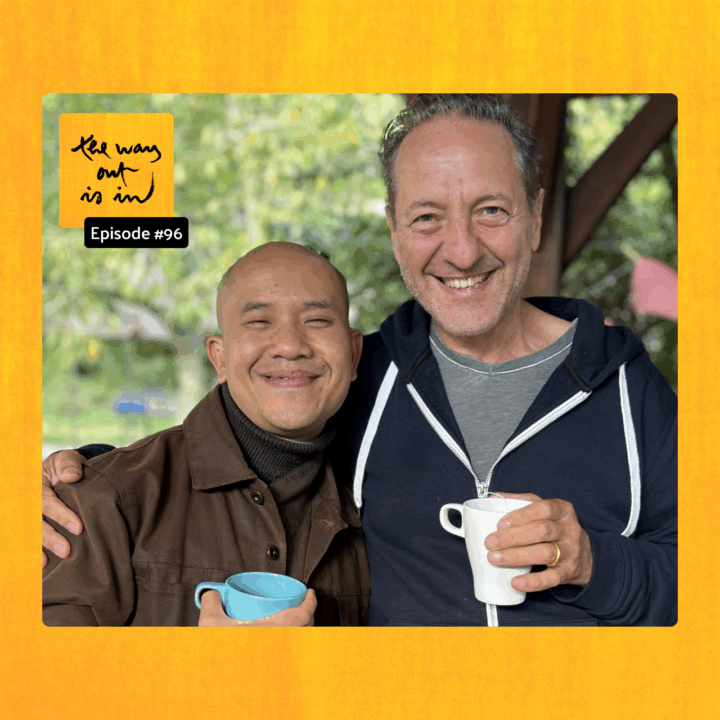
In this installment, Zen Buddhist monk Brother Phap Huu and leadership coach Jo Confino explore the lifelong journey of self-forgiveness and how to forgive ourselves. How do we find the capacity to let go of past hurts and come into the fullness of our lives?
The conversation also touches upon themes like self-love, self-compassion, community, spiritual growth, impermanence, the coexistence of suffering and happiness, and the importance of ongoing practice.
Brother Phap Huu discusses the Buddhist perspective of the Dharma threading through time, embracing past, present, and future; how loving oneself begins with recognizing and accepting one’s stories and scars; the importance of treating oneself with kindness and compassion; acknowledging unskillful actions; practicing with the inner child; and much more.
In addition, personal stories shared by the presenters illustrate how forgiveness and self-love evolve over time, and that forgiving oneself is vital for genuine compassion and service.
The episode concludes with aspirations for the new year.
Co-produced by the Plum Village App:
https://plumvillage.app/
And Global Optimism:
https://globaloptimism.com/
With support from the Thich Nhat Hanh Foundation:
https://thichnhathanhfoundation.org/
List of resources
Pilgrimage: ‘In the Footsteps of the Buddha’
https://plumvillage.org/event/pilgrimage/in-the-footsteps-of-the-buddha-2
Being with Busyness: Zen Ways to Transform Overwhelm and Burnout
https://www.parallax.org/product/being-with-busyness/
Calm in the Storm: Zen Ways to Cultivate Stability in an Anxious World
https://www.parallax.org/product/calm-in-the-storm/
Interbeing
https://en.wikipedia.org/wiki/Interbeing
The Way Out Is In: ‘Healing Our Inner Child: Pathways to Embrace Our Suffering (Episode #10)’
https://plumvillage.org/podcast/healing-our-inner-child-pathways-to-embrace-our-suffering
The Way Out Is In: ‘The Three Jewels (Episode #89)’
https://plumvillage.org/podcast/the-three-jewels-episode-89
‘Looking Deeply: Healing the Inner Child’
https://plumvillage.org/articles/healing-the-inner-child
The Inner Child (short guided meditation)
https://www.youtube.com/watch?v=zauJYihF2fQ
Dharma Talks: ‘Taking Refuge in the Three Jewels’
https://plumvillage.org/library/dharma-talks/taking-refuge-in-the-three-jewels-sr-chan-duc-spring-retreat-2018-05-20
John Bradshaw
https://en.wikipedia.org/wiki/John_Bradshaw_(author)
Sutras: ‘Discourse on Knowing the Better Way to Live Alone’
https://plumvillage.org/library/sutras/discourse-on-knowing-the-better-way-to-live-alone
The Order of Interbeing
https://plumvillage.org/community/order-of-interbeing
Quotes
“What we have learned in the art of mindful living and the art of love and understanding is that we are ever-changing. We’re constantly changing. The Buddha has said that we cannot bathe in the same river twice. When we bathe in that river, the river is not the same and we are not the same.”
“The Buddha says that suffering is made of non-suffering elements – and that means you have happiness inside.”
“What I’ve learned from my journey is that healing is always a verb.”
“There is no way to healing; healing is the way.”
“Our practice of listening is very important. When we say we have to learn to listen, listen not to respond, but just to listen. Listen to acknowledge, accept, and witness.”
“It’s important to be in the present moment, but it’s also important to have an aspiration to bring into the present moment – not to see in the future, but to see coming alive right now.”
Dear listeners, before we start today's podcast, we just want to let you know that Phap Huu and I, along with four other monastics, will be going on a pilgrimage to India next January. And we'll be doing that in collaboration with Shantum Seth, who is a longtime Plum Village practitioner, but has also been leading these pilgrimages for 30 years. We are going to be visiting all the key places that follow the Buddha's life journey, listening to stories about the Buddha's life and also the Plum Village teachings. If you would like to come and join, you can go to www.buddapath.com. We will be not only visiting these sites, but doing a special series of the podcast following the Buddha's life, which we will then be publishing on our return. So if you would like to join us, please go on the website and find the details, and we look forward to joining you there.
And dear friends, if you have a deep love for the Earth and wish to learn how to bring the energy of mindfulness to your climate response, Zen and the Art of Saving the Planet is a seven-week online learning journey where we, as a community, will learn how to cultivate insight, compassion, community, and mindful action in service for our beloved Earth. Inspired by the timeless wisdom of Zen Master Thich Nhat Hanh, this course includes Dhamma talks and practices, community sharing groups, and live interactive events with monastic teachers. I'm looking forward to teaching at these live events together with my monastic siblings. We'll learn together for seven weeks from 1st of March 2026 into our closing event on 19th of April. Join us by heading to the website today, plumvillage.org/zasp. That is Z A S P. And we look forward to walking on this path with you. Thank you very much.
Welcome, dear friends, to this latest episode of the podcast series The Way Out Is In.
I am Jo Confino, coach and spiritual mentor, working at the intersection of personal transformation and systems change.
And I am Brother Phap Huu, a Zen Buddhist monk in the tradition of Plum Village, and student of Zen Master Thich Nhat Hanh.
And today we are going to be talking about forgiveness, but in particular about how do we forgive ourselves? How do we find the capacity to let go of past hurts and to come into the fullness of our lives?
The way out is in.
Hello everyone, I'm Jo Confino.
And I am Brother Phap Huu.
And brother, so this is the first time we have sat together in Thich Nhat Hanh's Sitting Still hut for six weeks. So what's been going on? I know a lot, but tell our listeners what is what have been up to?
What have we been up to? After our trip to London, we returned back to Plum Village, France, and I went into a 10-day monastic retreat. We do this once a year, and it is only for the monks and nuns in the Plum Village tradition. And all of the monastics from the European centers would come home to Plum Village, France, like the root temple. And this time, what was very special was we committed to practice 10 days together without our devices. So we all submitted our mobile device. And with everything that we are doing and what we are learning in this special time of growth, it's just wonderful to be together. No meetings, just a retreat. Like whatever we offer to everyone, we did that for ourselves. And we also created some new Dharma doors, which was very special. Instead of some days of a traditional Dharma talk, we created Dharma hubs. And what does that mean? All of our senior monastics, which is around 12, 13 of us, we would be in different locations, and a young… then the community can come and choose which Dharma teacher they want to attend to and be with for an hour and a half. And we did a survey before the retreat to check in with the monastic community, what are some of the things that we are lacking in our community? And would you believe it, the sense of loneliness was one of the biggest highlights of coming together and having space with each other, not in the spirit of service for others, but just to sit together, to get to know one, each other, beyond our status, like I'm an elder brother or I'm a younger sibling, Dharma teacher, and so on and so forth. So that was very enriching 10 days of that. And then we held some other retreats in our community, and then our most maybe stable in terms of like not moving around, our three months Rains Retreat arrived, and that meant that everyone would be home for three whole months, and there's a a wonderful shift that we enter into. And that that is also why we've been off doing the podcast because there's so much internal changes that comes with the Rains Retreat. It's a time to reset ourselves to review, because it's like it's near the end of the year where we review and we reflect, but also it's starting a new year and it's a recharging moment. It's like birds coming home to the nest and teaching, studying, practicing. We come back to square one. It's a wonderful, humble retreat, where we just return back to the core practices. And then, within the first two weeks of the Rains Retreat, one of our elder sisters, senior in age also, passed away. And her transition was very peaceful. We heard the news and so we dedicated a whole week in the Rains Retreat to hold a funeral for her, which was very unexpected but this is how life is. And birth and death comes unexpectedly. And we… There was a lot of grief and there was a lot of I think a lot of emotions that manifested with everything also going on in the world and this just allows us to touch impermanence deeper. And particularly for myself, I was actually sick during that week with a flu, but I still went to the main ceremonies and there are days that I would just lay in bed because I was too ill and I had a chance to reflect on my own death, Jo. And that was very unique and meditative to touch life very deeply. And then after our sister's funeral, then we had a novice ordination. So we ordained eight new monastics in our community. So we were able to go through grief and lost. But then we were present for birth in the community. So least to say, but it's been very rich in our community, I would say.
And that's just in the last few weeks.
That's just in the last two weeks. Yeah.
So, brother, just coming back to that, what you said about contemplating on one's own death, because I'm sure everyone would like to meet their death free from guilt, free from shame, free from a feeling of something unresolved. So, one of the reasons I was interested in talking about self-forgiveness today was because I was coaching someone recently, someone who's middle-aged very successful. But actually, their whole life has been shaped by an experience of bullying when they, or experiences of bullying when they were younger. And they have not forgiven themselves for their inability to deal with that at the time. And it has really shaped their life in terms of the decisions they made, the fears they have, the way they respond to various experiences in their life. And it was just a reminder that the stories we hold and sometimes the experience we've had when we were very young continue to direct our lives. And so that feels very relevant to all of us, and I've been reflecting on that myself. So I'd really like to look at how the teachings of the Buddha and the Plum Village tradition, how those can support us in resolving, in freeing ourselves from these traps, from these prisons, because I think we've all done things or had things happen to us where they've been very painful and they've been locked inside of us. So I would love to know a little bit about your experience of the Dharma in how that can help us to free ourselves.
The beauty of the Dharma is that it threads through time and space. And what does that mean? That means that in the present moment, which is part of our Dharma, it embraces the past as well as it is creating the future. It is co-creating with every action and every thought and every millisecond of our attention that we are living this moment, it is creating tomorrow. As well as the present moment is the foundation to review, to look at the stories that we hold. And, I think, for myself, the journey of love was to learn to come back and love oneself first of all, no matter what we've been through, and no matter what circumstances that we grew up in, and it's not our choice in a way, right? Because we're born in the family that we're born in and the physical body that we have, the capacity of speech and attention that we have, which then presents itself in the world, and we may be on the receiving end of harassments, of pain, of bullying, or if we're unlucky, we are the bully because that's all we know and that aggression that we have received, it's a way to then transform it in a more… in the samsara kind of way. Samsara means what comes around comes back to us, right? What we give comes back to us. It's it's the understanding of retribution of karma. I think for me, I think at the beginning, I naturally forgot all of my past wounds. And there is a mechanism of our mind, of our manas, which is to be afraid of suffering and then push it aside to bypass it and to cover it up. And this is why we could become victims and we could become slaves of our own habit energies that are covered with stories of the past that doesn't allow us to truly meet ourselves in the present moment and meeting the pain that we experience, the scars that we have. Because most of the time, the image of a happy person is someone that doesn't suffer. It is someone that has overcome their suffering and is ready to shoulder on the world in a very masculine way, I would say. And so therefore, especially as men, we don't we don't have the art of being tender to ourselves and being tender to the wounds that we have received and that are still there. And for the very long time, I would say that I naturally forgot about it. And in a way I was living in the present moment, identifying of all of the now wonderful conditions that I do have, which is very important because we don't also want to be just trapped in a story, but having the ability to deeply live this moment. Like who am I now? What conditions do I have now? What is my surroundings? Then learn to tend to the present moment, which is in a very indirect way, you are tending to the past. And our teacher always tells us that when we feel ready, we can invite our five-year-old child or seven-year-old, ten-year-old, thirteen years old whatever age of that wounded child that we still carry, we have to meet it. We have to invite it in a tender way. And allow it to, in a way, merge with the present moment. And this could be in a very meditative setting, whether it is in sitting meditation, whether it is in walking meditation, or sometimes it comes unexpectedly while we are in service, while we're in a meeting, and suddenly something gets active, something gets triggered, and that inner child awakes itself because of the pain or the wounds or the fears that it still carries. And I think for myself, it definitely manifested in the community after a few years while the child felt safer, and then it started to knock on my heart's door. It's just like I'm here too, you gotta take care of me. And we all have our journey of understanding ourselves and of accepting ourselves. So the first step in this practice is just to simply acknowledge the stories that we have, the stories that we are, as well as the sensations and feelings that arise with it. And practicing with the body, there are positions and skillful positioning of the hands that could help with accepting that. I learned this from one of my elder brother, Brother Phap An, who is at the EIAB. I was in his Dharma sharing during my early years as a novice, and he would instruct the lay practitioners of his own personal practice of how to hold his pain. And he would just cross his arms and shoulder and his two arms on his shoulder. It's like a self-hugging position. And he said, when it's very overwhelming, he would hug himself, like hugging his inner child. So that was a transmission that he offered generously. And originally I kind of cringed. I was like, oh man, that's not me. Like, you know, hippies could do that, but that's not me. And, you know, at one point I just realized like my body was shaking because of a reaction that I had in that present moment. And naturally, I just held my two shoulders in a hugging way. And I just embraced the present moment for what it is. Thay used to share his own practice was when he was feeling homesick from his years of exile. He would imagine, not imagine, he would see his mother's hand in his hand. And he would share with us when he was ill, when he had a cold or when he was going through a flu. When you're bedridden, you would really miss home. You would miss the warmth of your loved ones around you. And his practice was to then place his hand on his forehead as a comforting practice. It's very physical. So you're not imagining the feelings, but you're feeling the feelings. And it's very soothing and it soothes the mental formations, which is our emotions, as well as it is scientific because you are you are seeing your parents in you, and that is not a creation of the mind, but that is that is a real practice. And Thay would explain it, as his mother placing her hand on his forehead, which was the feeling of love. And so it comes down to love, and I think forgiveness, as you spoke for many, what is forgiveness? And I've contemplated a lot on this because I had to practice with it, and a big part of forgiveness is understanding, is accepting, accepting of actions that have been created and have been caused and have been received, and then in the arc of it, it is also acknowledging our actions, whether we were on the receiving end or we were on the side of giving the action and of acknowledging that and holding our truth that maybe I was unskillful, maybe I was ignorant. Or, on the receiving end, maybe I had no choice. There was no choice. It's not because I wanted to be harassed or to be bullied or be manipulated but I was, I had no power. And just to acknowledge that, there's a strength to that. And then forgiving is also letting go in order to move forward. And when I say move forward, I've learned of moving forwards as in not cutting off from what has happened, but moving forward as in embracing everything that has happened. But that doesn't confine who I am as a human being. That is not the whole truth of who I am. That is only partially of who I am and of what I have experienced. Because what we have learned in the art of mindful living and the art of love and understanding is that we are ever changing. We're constantly changing. The Buddha has said that we cannot bathe in the same river. We're not the same person when we bathe in that river. That river is not the same, and we are not the same. And it's harder to see that with oneself, though, because when we suffer, we identify as a self that suffers. And in Buddhism, we are empty. What does that mean? We are full of everything. We're full of life. We are full of creations. We are full of talent, of potentials. We're full of suffering, of pain. The one thing that we are empty of, that is an individual self. And the hardest part is understanding that and being remembered that we are more than just this pain. We are more than just this past. And so therefore, forgiveness is also maybe it's not so popular as a cultural phenomena, also. I think we lead our life more towards punishment and achievement, competition. Because I've suffered, therefore I will be better than you. How many revenge clip movies that we've seen, right? I mean, I will confess, like, there's such a satisfactory feeling when you see the main character who started by being bullied and then outsmarting everyone and then being better than everyone. It's such a satisfactory feeling. So we're very conditioned by othering each other, which is a part of our complex of human beings, but it's not our truest potential. And the Buddha and Bodhisattvas said our deepest potential is seeing friends and enemies alike. Whenever I read this line, like I will say, like, oh, I'm not there yet. That's that's the finger pointing to the moon, and, you know, the distance is so, it's so vast, but that is our deepest aspiration as a practitioner.
Well, brother, there's a lot in what you say. So this person I was coaching speaks very much to what you were saying because their experience as a result of that bullying was they felt powerless. And so they've spent their life trying to prove themselves. But in the proving of themselves, they haven't solved the problem. All they've done is covered it over. And so underneath not solving the problem is a rage that has been, that has not been dealt with. So one of the things you talk about self-forgiveness and about seeing the child, one of the things I've done for myself and I help other people sometimes is to go back as an adult to the child who was suffering. Because when we're a child and we suffer, we don't have the context or the capacities we have as an adult. So often we just get stuck in just fear and survival mode. But actually, it's possible to go back in our mind as an adult with capacities who's found an answer, found a way through, and to go back to that child who feels powerless and to empower that child and to help them to see that they're going to be okay. And I find that such a powerful way of coming back and healing the past in the present, because one of the things we talk about in this practice is we can't, we can't go back into the past and change it physically because it's the past. But in our mind, we can in the present moment touch into the past and help our child to sort of see that they are going to be okay. And that is a healing moment which comes back into the present moment and then changes their future. So, brother, I'd would like to talk about an example for myself, because it's very easy to talk about other people. But during this coaching session, what it highlighted is an experience I had when I was young, and I was about 12. And I was heading home from school on the train, and I was sitting next to a friend, and then opposite were two other friends who were sitting there. So we were opposite each other in the carriage. And we arrived at a station and the door opened. And these two kids who were younger than us, they must have been eight or nine, just came in and just violently started attacking my two friends opposite. And it all happened in about three minutes, and then they ran off at the next station. But I didn't, I was frozen. I didn't know what to do. And I remember I got home and I told my father, and he insisted on calling the police. And the police interviewed me, and my father during the interview said, and why didn't you get up to help? And that moment was such a moment of shame, that I was a coward, that I had not got up to help my friends. And that is, you know, you talk about scars. That is a scar. So this is one short moment of time. It wasn't the biggest thing ever to happen to anyone, but that has stayed with me as a deep form of shame, that I was not, I was not courageous enough to stand up to them. And even though I have, in a sense, forgiven myself on one level because I know that I was in shock, I'd never experienced violence, it all happened very quickly. It still comes up, and it comes up as a sharp pain. And you talked about things coming up in an unexpected way. But the difference now is that it's not a shame that envelops me and overwhelms me, but I'm able to be aware of the pain as it comes up, be aware that the feeling, naming the feeling of shame, recognizing that actually as a 12-year-old, it was okay that I didn't know what to do, that it didn't mean that I needed to carry on feeling shame, and that actually I could release myself from it. And one of the interesting things about that is that it's not that the pain goes away. The scar doesn't go away. It's not like saying, Oh, right, well, I'm forgiven myself, I'm never going to feel that again. It still comes up. And I think one of the things about forgiveness is, I think sometimes people want to do it once. I've dealt with it. And then if it comes up again, it's a feeling of failure. So can you talk a bit about just the journey of forgiveness? That it's not like instant noodles where you just say, you deal with that, I forgive myself and it never happens again. But actually these moments of shame or guilt, actually can continue all through our life.
No mud, no lotus. I was very touched when you shared about it because I can also, it's almost like there are channels in my consciousness that I can like come back to and I can identify particular moments of shame and moments of helplessness and moments of anger and rage that I still have. It's a part of me. And the beauty of my practice now is I could identify it really quickly. Like I could know when it's being touched off, you know, these elements. The journey of it that I've had is also not to be extreme with the ideal practice, like you said, like once you've forgiven it, it's not there anymore. Or once you have, quote unquote, transformed it, like you've enlightened from the understanding, Ah, this is where my fear comes from. It doesn't mean you don't have fear anymore. And I think one of the misperceptions about meditation is this idea of we don't feel anymore. We can just overcome our emotions and senses. Actually, Buddhism is a very humanistic practice. It's a teaching that the Buddha gave to the monks and nuns in the early days of understanding our suffering. So everything that we've talked about, like our shame, our pain, our anger, our feeling of wounds, they can be categorized as suffering. And that is a noble truth. That is where we all start. And if we look at the greats, suffering has made them who they are, right? Suffering has made who we are. And when we speak about suffering, we also have to talk about happiness and peace and joy. So, yes, I do identify myself with moments of suffering, but I also see the moments of love and of understanding and of care that I have received as a child or as an adult that still shapes who I am today. So it's really important as those of us who are going into the journey of forgiving oneself, of learning to love oneself, is not to just be bundled into this category of like, I need to just work through you, my suffering. Because the Buddha also says suffering is made of non-suffering elements, and that means you have happiness that are there. What I've learned from my journey is that healing is always a verb. It's not an ED, healed, and we're done. So I think the first tenderness that enlightened my healing journey, which is just to be kind to oneself and said, like, life wasn't that easy. You know, I had moments where that still haunts me, the way I behave with my father, for example. Like, it was graduation, finishing grade eight, and we all were going to a graduation ceremony, and because I didn't accept my own roots, I didn't accept my own, you know, background of like my family's status, we were poor, right? The kind of car we had and so on. And one of my shames was like, that I still hold today, is like I didn't allow my dad to drive me to the graduation ceremony, and because I was so shameful of what others would think, and I decided to go with a friend who was wealthier and to be in their car, so that when I leave, exit, into the community, into the audience, it's more prestigious. And that is a moment that I, that still in a way haunts me. I said, why couldn't I just allow my dad to take me to graduation? So simple, but so filled with social acceptance and all of the isms around it, right? Like all of the like what people think of us and so on and so forth. And today, every time I get a chance to talk to my dad, I try to do it. And when I'm with him, I try to just to be grateful, just to everything that he's given me. And I still had, even as a monk, you know, I still had journeys when I still had shame. I still didn't want to see myself with him. I still didn't want to be associated with him. And it's been such a journey to be a father and a son, like to be, to accept that relationship. Even my dad, who is a practitioner, in his own way of understanding our relationship, you know, one time he told me, Phap Huu, maybe our relationship is a friendship. And I at the beginning I kind of felt at ease with that. I was like, yeah, maybe that's what we are, you know, more than father and son. But now that we're talking about it, I actually feel like maybe that's a mechanism also of just bypassing something deeper. But I could say that no, you're my father and I'm your son. Period. And there's so much to unpack there, you know, there's so much to, there's so much to discover there, and there's so much to heal there. And so, for me, like this path of understanding, we think we know. But even in this conversation, this just came up, Jo. Like this, this is very present moment, dear listener. I didn't think I would touch this, but I see that there's still so much healing for me to do with my father, right? Even though like I, in some level, like he is my superhero. You know, he sacrificed his whole life for my mother, my sister, and I. And he's given me a life that I probably wouldn't have had if he didn't make that gamble on the ocean. But at the same time, there's still so much unresolved things that we still hold for one another. Right? The pain that and some of the suffering that that I felt, like I witnessed my parents dispute, you know, their aggression to one another there. And we had fear, like I can still vividly, traumatically in my body feel and remember when me and my sister would hide under the blanket when our parents were arguing and threatening each other with divorcing each other, you know, and the fear that the two of us we had, like what would that mean for our livelihood, right? What would that mean for us as a family? And fortunately, bless the ancestors and bless my parents, like they stayed together and we didn't have to experience that journey. But I know so many have experienced that journey, and what do I hold on to all of that? And some of it is deep empathy, the empathy that I have gained from that of seeing suffering and then meeting suffering in a tender way because I've experienced that and I've given myself that tenderness. So in my understanding of forgiving is also a verb, it's a continuous journey of understanding what we're forgiving, what we're letting go of. There are some of my relatives that that I've had a very difficult time with. There's a big part in me that I have forgiven them but there's wounds I still carry and those wounds it's inflicted towards me physically like my body I have reactions to and I'm still learning to forgive my own body on the receiving end. And when I saw that the journey of forgiveness there's two elements one is forgiving the other, which ironically was easier, and then the deeper journey is forgiving oneself for receiving that abuse, that harassment, that manipulation, so on and so forth, because I still live with that pain, right? I still live with those scars, and that scar is me, that pain is me, and so I want to forgive myself for having that, but then not seeing it only as suffering, but seeing it as the ingredients for my love, for my compassion, for my empathy, for my friendship that I want to give to others, for my care that that I want to offer to others. And I see it manifest through through the community, through my interactions, sometimes through work, through service, through the teams that I'm with. And then also still knowing that that inner child that is afraid is still there. And to hold his hand and to tell it it's okay because we are different now. We are mature, we are grown up. And I think for a long time I was attached to the image of the one that was the victim. And so a big part of it is to let go of that, not of the history of that, but of that image that I can turtle into. And I step into yes, and I was, I was on the receiving end, but at the same time now I am… I could be a mountain that is solid. I could be a flower that is fresh. I could be the still water that reflects, and I could have a lot of space for my own self and for others. So it's a long answer because I think it is a verb. Those who I've met who think of it as a one and done, they continue to suffer. Because we have to be humble to our sufferings because it is a continuous journey of healing and even in the joy that is healing. Like there's a time and I share with this in in my class this morning. I was in Toronto and I went to a park and I sat on one of the toys, and it's one of those bouncy thingy that you just like rock back and forth, and I was a fully grown man, Jo, like 30 something years old, and I was just like having so much fun on it, and I realized when I reflected at the end of the day what I've done, and I realized that oh, that joy and that freedom to be playful was healing, is healing and is forgiving. So our insights of our well-being now is also the process of healing. So deeper, as in Zen, we say the healing and the healed are always together. Right? It's a continuous path. There is no way to healing. Healing is the way. And it takes a journey though to arrive there. So I'm sharing you my story, but each and every one of us we will have to experience it for our own truths and our own experience and what it means for our healing to continue to evolve.
Brother, thank you so much for the depth of your sharing. I had this image of, you know, if all these little scars were to be made visible, we would be walking around with hundreds of scars. You know, we have hundreds of scars. And the other image that came to my mind was that, which was also a sort of a mini insight of why it is that we see others' pain and respond to others' pain more easily than our own pain. Because as you were sharing your experience of your father and graduation, you know, I just felt this outpouring of love for you and of a feeling for you, a sort of a warmth and a sort of a recognition of what you must have gone through and why you did what you did. But when I look at my experiences, I don't feel that same tenderness. It doesn't happen. And I think that is why it's very hard for us to find self-forgiveness. Because in many ways the shame or the denial blocks the tenderness. So I, you know, when I'm working with people, you know, and the way people speak about themselves is so harsh. And I said, and I say things like well, if you were talking, if you were your best friend and they were sharing what you've just shared, how would you respond to them? And they'll say, oh my God, I would want to support them. I would want to… I would deeply listen to them. I would sort of try and help them to sort of come to terms with it. And I say, but look how you're behaving with yourself. All you're doing is criticizing and attacking yourself. I think there's something around, and I love that word. I think is one of the most important words in my vocabulary: tenderness. Is what it means to soften to ourselves, what it means to allow our pain to show up, and as you say, to name it, and then to tenderize it. It's a terrible word. It sounds like a bit of meat that's sort of… that you keep hitting to tenderize it. And the other thing, brother, I just want to come back to, you know, Thay's work around the inner child. And I know we've had an episode about this, we've covered it before a little bit, but there's something for me around what it is like to recognize what it was like to be in pain as a child, and and to recognize that actually we don't need to compare it with other people's pain. Because what I find often is people say, Oh, well, yes, I had a hard time, but it's nothing compared with this other person or that other person. And I remember my first experience of that, which was actually very transforming for me is when I was working as a journalist in New York, I went to cover for the newspaper a weekend conference from this sort of therapist called John Bradshaw, who does work with the inner child. And I went to New Orleans for this weekend workshop. And there were about 300 people there. And we were like a bit like in Plum Village, we were put in small family groups. And what we were asked to do was to share our pain, our pain as a child. And I remember one person was talking about how they were physically abused, someone how they were sexually abused. I was the last one to go, and everyone was sharing something that I thought, oh my God, you know, how is it possible to share when against all this pain that they're feeling? And when it came to me, I just shared about how lonely I felt as a child, and how isolated I felt. Even though I was within the embrace of a warm family, I felt very alone. And everyone in that group leant forward and said, Oh my gosh, that must have been so difficult for you. You know, how how did you manage that? And it was the first time in my life that my pain had been recognized. And that I saw that actually my pain is my pain and I need to honor my pain rather than diminish it or dismiss it because it's not as bad as the pain of others. And I hear a lot of people talking these days about not complaining about what they're going through because they feel privileged. And that's a word with a lot of attachment to it. And, of course, when we're privileged, we have different responsibilities and accountabilities than when we're not privileged. But our pain is the same. You know, if we're in pain, there's something about honoring our pain, honoring the pain of a child rather than comparing it. And I'm just wondering if you can just talk a bit about Thay's. Why because Thay integrated in a sense this Western psychological understanding of our childhood with the sort of practice.
One of the elements of mindfulness is mere recognition. It's like just recognizing things as they are and identifying that this is shame, for example. And then the hard thing about us humans is then we create a story about it. Our perception comes into play. We hear a story and that somebody shares wholeheartedly, and our competitiveness comes in, like, oh, he's sharing about his pain. I gotta search for my pain to feel equal, right? So I think our practice of listening is very important when we say we have to learn to listen, listen not to respond, listen just to listen, listen just to acknowledge, accept, and be witness of. And, of course, when we listen, it will trigger and it will water seeds in us. And our resposibility is to take care of our emotions and feelings and not expect others to take care of our own guilt that we bring to the other person. So in this practice of inner child, of emotions and pain, we have to first work on our stability. The Buddha talks in a sutra, it's called The way to live alone. Live alone here doesn't mean not in community, but live alone here means we all have gardens within ourselves. Garden of emotions and feelings, our skandhas, what we hear, what we see, what we feel, what we create in our mind, our consciousness, our senses. That is our exposure to the world. And whenever we are exposed to it, it will come back to our consciousness and it will react. And a practitioner has to take care of these reactions within themselves. And it is not to suppress it, it's just to know this is a feeling that is arising. And then the artist, then you don't make it about yourself, but you can still be very emp empathetic. You can feel the other person's pain, but then you don't have to make it about yourself. And this is one of joy that I get to witness in myself is how do I show up and be present for others and not make it about myself. So many people make it about themselves the moment they hear suffering. And I smile to this because I've gone through this. Because how we are so co-created in our society about self, about me, me, me, and me. And our practice of mere recognition to be present and to listen to others, it is to be there for others. And if they ask us how we are feeling, how we are… what stories that we have, of course, we have an opportunity. But so many times that if we keep replaying this and we make this a habit energy, then this is when we will not even be true to our own stories. Because then we want to find a replacement for it. Like you just said, oh, but I'm sure someone else is suffering more than I am. So this is not important. Our practice is everything is conditioned, everything is situational. Sometimes medicine, if taking the wrong way, doesn't help, right? If someone who is taking for granted their whole lives, then they need that medicine's like, do you know what you have? Are you aware of all of the wonderful love and support that you have around you? Wake up. Don't take it for granted. See and take hold of it so that you can be of service for others. And then… But if somebody who is always acting with self-pity and not giving themselves the stability to love themselves because they are so well, and I speak about myself, like we're so good at people pleasing others, then we will not be able to just take a pause and say, actually, you know what? I don't need to go to that party today. I'm just gonna stay home and rest and be with the loved ones that are here, for example. Because if we keep being of service for others, then we're also not doing service for ourselves. So the Buddha always teaches there's a middle path, and mindfulness is the key to this, right? We have to be very attentive to where we give our attention to suffering and well-being, and it has to be the right medicine, the right doses of shame. Shame in the light of of helping us wake up could be very helpful. If we don't have shame, we could be very ignorant also. So this whole journey of practice, of understanding oneself, we… When I look at it, I just keep expanding myself to knowing when and how and and who even, because some stories can help an individual and some stories may not help an individual. And knowing the power of stories, so sometimes I share the stories to allow others to know that it's possible because I've suffered, they have suffered, but they have come out of it. But I also want to be very mindful of I don't want to be attached to my stories also because, you know, today is a new day and we are changing. And sometimes like this is shining light season for us, so next week is my shining light, and I'm asking myself like what are, what is the new me of 2025 that I have been able to touch? It's easier to go back to a story that I am used to, and I don't want to go back to that story. I don't want that to be the main plot in a way, because there are… There is a new realizations that I've had in this year, and I want to acknowledge it, even if it is not clear.
Anything particular, brother, that is on your mind about something this year that you have… So I can see changes in you in this year.
You can see changes in me?
… and so I'll share one thing, which is one thing I've seen in you is a real deepening of your presence. That actually that the more you get out of your own way, the more the Dharma that is brightly shining within you just flows out. And it flows out in a way that that is instantly recognizable to the people you're speaking with. And that is an enormous skill. There are a lot of teachers in many spiritual traditions who are unable to transmit the widsom in a way that can reach people. And what you're doing is not only is the Dharma inside you deepening, but the way it's being transmitted allows people to receive it. So in other words, and the only way that's possible actually is if there's a clear channel. And if there's always me, me, me in the channel, then the channel gets blocked. So it speaks to me about the fact that even though there are a lot of pressures on you, a lot of people might want you to be a certain type of person or represent this tradition in a certain way that actually you are sort of creating a clear channel that allows the Dharma to reach people and allows you to represent the Dharma and to live it more.
Thank you, Jo. I think one of my strengths that I stepped into this year is to be less afraid, I would say. And maybe that's where it's coming from because I trust it more.
Yeah.
And I trust the three jewels in me. The three jewels is the Buddha, the Dharma, and the Sangha. I kind of I feel like I'm not just representing it, like I'm embodying it. And that has been empowering. And it has also offered me a lot of reflection. And living deeper in this community, I, you know, with the passing of our sister recently, like, and with the elders that I have around me, I think in my younger self, I live more thinking this is permanent. And now I'm living more with the notion of impermanence of anyone can go. Anyone may leave the Sangha, may leave this robe, which we've had three brothers leave the Sangha this year. And I don't see it as a failure, I see it as just the journey in life. And we do the best we can. And when I live with these brothers I live wholeheartedly. And I don't regret the things I could have done for my brothers, even when they shared with me and they asked for my input. So I think that living deeply, it comes back to square one, but I'm living deeper. And in the opening ceremony of the Rains Retreat we had many elders that were present. And just knowing that one day I will say good bye to them because that is a part of life. And there's some fear there, because this is so comforting, knowing that they're there. But then knowing that life is impermanent, and they are of the nature of impermanence. So that has enhanced my wanting to offer. And I think it's the same with this podcast. As we were speaking, like, you know, dear listeners, like Jo and I, we offer this coming from the space of service of the Dharma, of sharing. There's no sponsorship to this podcast. There's no boss that tells us we have to do it every week. It really just comes from the space of wanting to serve, wanting to offer, because we know that it's a refuge for many, it's a sangha for many, and it's also a place for the two of us just to share from the heart of the community what's happening, what is new, what are the teachings that are growing in the two of us, and then bringing other members on. And I don't take this for granted also. You know, Jo, like I've also contemplated one day of us not doing this anymore, and hopefully that there's a continuation, there are new voices to this podcast, right? But just knowing that like all of this is not permanent and has been beautiful, mysterious, and sometimes scary.
Thank you, brother. And I just want to come back to the middle way, because you spoke so eloquently about that, of sort of not being denial of what's going on, but not indulging in it.
Yeah.
So and also you talk very much about being in service, that if we actually, and this is something that's helped me a lot, that I see my practice firstly in service to people. And then the benefit is also to myself, of course. But I don't see it as my own healing for myself. I see it as if I every time I heal something or every time I get an insight, I am then able to offer that out. And I've known that, you know, in the work I do in the coaching, I can only go to someone else's, the depth of someone else's pain to the extent that I've gone to my own pain. But also, as you say so eloquently, brother, not to get stuck in my own pain. Because if I, if we get stuck in our own pain, and you're a great teacher here, if you get stuck in your pain, then you cannot ask someone else or expect someone else to go beyond their pain. So, in other words, the level of your healing and practice is the extent to which the community can extend its practice as well. So just thinking through about shining light, and it's sort of we're coming, you know, towards the end of the year. So you're talking about sort of, you know, what has shown up for you in 2025? Any thoughts for yourself on on the journey for next year? So one of the things you talk about, brother, and you know, we always say, you know, it's important to be in the present moment, but also it's important to have an aspiration to actually bring that aspiration not to see it in the future, but to bring it into the present moment and see it coming alive now. So if you're seeing this journey of deepening and also of less fear and impermanence, how do you see the next year or the next years unfolding for yourself? You know, what is your aspiration going forward?
My aspiration going forward is to continue being comfortable in my role and in all of the trust that the community has offered me and trust in the community inside of Plum Village and outside of Plum Village. And I… Because I think sometimes being humble is important, like the middle way. But when you're too humble, then you don't step into the power of the wisdoms that the ancestors have given you, you know. Cause as part of this Zen tradition, I have to transmit. So I want to keep transmitting in a way that is deep and lovely. I think I'm going deeper this year also I'm doubling down on the Dharma in my classes, like in my Dharma talks too, I feel. And I think before I was more just speaking from personal experiences, but I want to like I want to transmit the Dharma, but in my way, right? I don't want to lose who I am also. I'm not a scholar, but I could say, like, you know what? Don't question this Dharma. You don't know it yet, and it's okay, but trust it. And I think my natural thing, oh, it's okay, just take your time. You don't need to trust it yet. You know, like that's my kind of fear side of like scaring anybody. But sometimes when I saw Thay, he was just so confident. He's like, this is the Dharma. You don't understand it yet? It's okay. Be open. Embrace it. Because I think of the culture of like quick fixes right now and the culture of like the well-being kind of like industry where like there's a whole competition around it now, you know, it's just like it pushes us to also like not show up in a particular way. So but we're a tradition. And I wanna remember that. We're a Buddhist Zen tradition that comes from hundreds of years. We are, I'm the 43rd generation of the Linji Dhyana school and the ninth generation of the Lieu Quan Dharma line. So like I have a whole lineage. And I think it's important to understand what that means, right? So I'm gonna go deeper into that. Like I had a sharing with with some Western brothers and they're asking me a question about change and evolution in our tradition. And I grew up in a Western culture and I grew up in like where everything could be, you know, standardized, like equal to all, like very open, which is important. But I think part of my own journey of coming home to my roots is also seeing the beauty of tradition. And, you know, I told the brothers, like, be very mindful of what we understand, because we're so young. And I said this, and I say this with a lot of humility. I said, especially to us, westers, be mindful of our colonial mindset. This wisdom is from 2600 years ago, from the East, that has so much richness in culture and experiences. Be careful sometimes. We want to just renew it. How do you renew it? Sometimes like westernize it. Are we sure we want to westernize it? Like, are we sure, guys? You know? So I think my older self was like, yeah, let's try to renew everything. Let's make everything like all for one. But actually, especially like with the funeral, I was so grateful that I was a part of a tradition. Cause we know how to hold grief. We know how to hold ceremonies. We know how to be in unison when we chant, when we say words that remind us that we are more than this body, that this sister is more than this body. She is now all of us. Right? And that is tradition, that is ancient wisdom that we so much lack today. So next year is 60-year anniversary of the Order of Interbeing, also. And I've been asked to write an article on engagement. And so I've been reflecting on it. And I think my younger self would be like, engagement means change everything. And I've always remembered Thay say that he dances between holding tradition and renewing tradition. He said we have to be both conservative and progressive. Don't be extreme to be one or the other. We have the dance of the middle way to hold both. Because if we renew everything, then we're not, then we lost the tradition. And then if the tradition doesn't evolve and change, then it becomes a museum. And then if we want change, and if we want change, does it have understanding? Does it have a path forward? Or is it we're changing just for the sake of we've been pressured to change? So, you know, I shared this to one of my Western brothers, and he was like, Oh my gosh, you just hit a deep core in me. And he just shared with me today after lunch, he said, like what you shared to me really hit me because you're right. Like I am of the first generation of my whole family that has become spiritual and is Buddhist. So when I asked my ancestors, they don't know anything about Buddhism. So I should be humble also to the path of the tradition. And when I say tradition, it doesn't mean old. Tradition is a path of practice. Like when we listen to the bell and we all stop together, that's a tradition, Jo. Like we're all coming back to engage with our mindfulness. And that was old and new. The bell is nothing new in the Buddhist community. But the practice of stopping when we listen to the bell is new because Thay made it a core tradition of the Plum Village Dharma way. So we are dancing between the present moment and the wisdoms of the past that has given to us. And I think it's very important that I could bridge what I've learned directly with Thay, and then I can be together with the new generation, where they have so much creativity, Jo. I am so blessed that there's so much talent in this community and there's so much heart. But sometimes I have to hold back. I said, whoa, whoa, whoa, whoa. Great idea, not right timing. And we have to be humble and mindful about it too.
Thank you, brother. And I've mentioned this in a previous podcast, but it's very relevant to repeat it again now that one of my brothers was setting up a community, helping to set up a community and it didn't happen. It fell apart. And I asked him why? He said well everyone came with wanting to set, wanting to be part of community but they all wanted it to be their idea of community. And it came from an in Western individualistic mindset that I want to live in community but I want it to be my community. And he said and he, you know, he loves Thay and Plum Village and he said and the difference is that Plum Village is held together by a living practice that stretches back two and a half thousand years and that is the energy that everyone can align with and that holds it that that in a sense is the container in which life and community can happen. And if you take that container away then you've just got a bunch of people. And the other thing, brother, just to come back and, you know, just finally to self-forgiveness, because my understanding of your journey, the little that I know, is that actually the reason you are able to just say what you said with such depth of knowing is because you've forgiven yourself for having sort of dissed on this on your Vietnamese culture. And you've talked in the past about, you know, that you felt like you're, you know, this idea of a banana, you want to be white on the outside, but you're yellow. And so this this idea that you in a sense rejected your tradition. And what I've seen in you is that sort of self-forgiveness for that wish to reject. And that actually because of that, that allows you to come fully home. And maybe if you can just share a bit about that, because I can't imagine you saying what you just said if you hadn't transformed a deep suffering in your childhood.
Thank you, Jo. We all have roots, and I've been lucky enough to explore my roots and to see its richness. And I think just that journey of being curious towards my roots have been very forgiving of my past way of thinking. And I also don't want to fall into the extreme of then trying to be Vietnamese because I'm not, I'm more than just Vietnamese, you know. And one of my healing process in this is now for next year, as in this year, and past years too, I do continue to, especially in the Wake-up retreat, I hold space for people of color. Those of us who grow up in the West but are not white. And we have a particular understanding of the immigrant journey, right? And we have particular suffering that we go through. And part of my power now is just to hold space for that in these retreats, right? And it's nothing special besides, you know, we share about our sufferings in a very unapologetic way. And just to know that there's a community here that has that understanding. And so I think the forgiving is a continuous journey. Like there are things that even in my monastic life, but I have said thing that in a way I've dissed my own Buddhist culture. And I could begin anew. I love Thay. He loves words. He plays on words. Instead of we have sinned and we have to repent. Thay used the words, we can begin anew. Because every day we're reborn. So we could begin anew. We can… He said that if you've had a dark thought, if you had a thought of evilness, of hatred, of discrimination, now you produce a thought of understanding, of love, of forgiveness, you replace it. Because our journey of life is moment by moment. All of this is our energies that we give back. And so I sometimes, moving forward is also coming backwards in a way, you know. Like I couldn't have done this years ago to have that that courage and that ability to also just convene a group of those of us who are of different culture and people of color. But now that I… there's some ease and there's like, I know who I am in some way, you know. I don't know fully, but I know that I am Vietnamese, but I'm not only Vietnamese, I'm also Canadian, I'm also Plum Village. I'm also every nationality that I have been in touch with. And then I don't become also I'm also not like fighting for it all the time in a way. Like I've met people who when they find their path of reconciliation, then all they want to do is just reconcile, and then they avoid everything that is around them. And I think there, for me, like there were moments I have to just like give myself space to take care of what arises and then not forget the present moment, to live with the community that I am in with, right? And then like, this one example to my journey of this is like our teacher has said that one day he imagined all of us, Plum Village monastics in the West, our robes will change. It's a new kind of set of robes. Color, it could still be brown, it may be dark green, it may be navy blue, maybe black, whatever color it may be. It has to embrace the element of humility, of simplicity, and it has to show that we are a monastic, you know. So it's hard for fashion designers because it's like okay, what does that mean? Right? But then he said, so that is the progressiveness of him. That is like we adapt to our environment. So we're in the present moment. And then he goes, but because we are rooted in the Vietnamese tradition, when we return to Vietnam, we wear our Vietnamese robes, we bring the straw hat, we speak Vietnamese, we do the Dharma in a way that accompanies the Vietnamese people's suffering and journey and happiness. We speak that, that Dharma language. And when I heard this, this was someone who is so free, and is walking the middle ground, is like we know how to show up, this is what Thay is saying. So when conditions will arise I will activate my Vietnamese side. And that's my power. And sometimes I can activate… I am a bridge, I've had the journey of this and that, East, West, young in the monk life, and now an elder, but not that old, right, in the tradition. So, in a way, forgiving could be so free, but that journey is always enriching. So when I go back to Vietnam, which I hope I can go back more to to enrich my own heritage in my own self, is then I will be humble to the culture that I don't know. And I don't want to, I don't want to be sure, you know. And I'm still humble to Buddhism. There's so much in this tradition that I'm learning, that I'm evolving and I'm relearning even.
Thank you, brother. And just to finish off, you know, and for our listeners, something that, you know, I've seen so important in Plum Village is the understanding of ripening, that brother, you could have not been where you are now five years ago. You could only be where you are now. And if you tried to be where you are now five years ago, it would have been hollow, it would would have collapsed. And it's just a reminder, you know, for anyone who's listening who is on a journey of self-forgiveness, is… And that's why I love you bringing up this word at the beginning, brother, is to be tender and to recognize this is not a race, it's not a competition, it's not a sprint, it's not a marathon. It's our lives. And to allow to have a deep aspiration, deep wish to find self-forgiveness, but not to be in a hurry to do it. Because if you go faster than you're than you're able to go, then it won't hold. And that if you hold the aspiration and keep practicing towards that, then sometimes it will show up in a moment. It's like you, today, brother, you know, sometimes you know, an insight comes, but only it might be years where you haven't had the insight, but then suddenly it will come. And it means that… But you need to have done all those years of work in order for the insight to come now. So we can all have a wish for self-forgiveness, but also know that it's not it, you know, classically it's not a destination, it's a journey, something we walk our whole lives with, and it's joyful. When to know that we can change and transform and it's not fast. Sometimes it's slow, sometimes it's fast, sometimes we feel we're going backwards, but it is at the end of it a very human journey. So, dear listeners, we hope you've enjoyed this episode. It's nice to be sitting with Phap Huu again. And, as a reminder, we're sitting in Thich Nhat Hanh's Sitting Still hut, which is his wooden cabin where he used to live in Upper Hamlet in southwest of France, and we're got a view overlooking the oak forests and sitting round his cozy kitchen table recording this. So it's nice to be back in the milieu of Thay's life and to feel his energy present and flowing through this podcast. If you enjoyed this episode, then you can find, I think ninety-five other ones, which you can find on Apple Podcasts, on Spotify and on the Plum Village App itself.
We didn't have time to do a guided meditation this time.
That's true.
But please know that there are recorded previous guided meditation in the On the Go section of the Plum Village App. And this podcast is co-produced with Global Optimism and the Plum Village App with the support from the Thich Nhat Hanh Foundation. If you feel inspired to support the podcast moving forward, please visit tnhf.org/donate. And we want to thank our friends and collaborators, Clay, aka The Podfather, our co-producer; Cata, also our co-producer; our other friend Joe, audio editing. Today Georgine on sound engineer. Anca, our show notes and publishing. And Jasmine and Cyndee, our social media guardian angels. And thanks to all of you to continue listening and supporting us. See you next time.
The way out is in.