

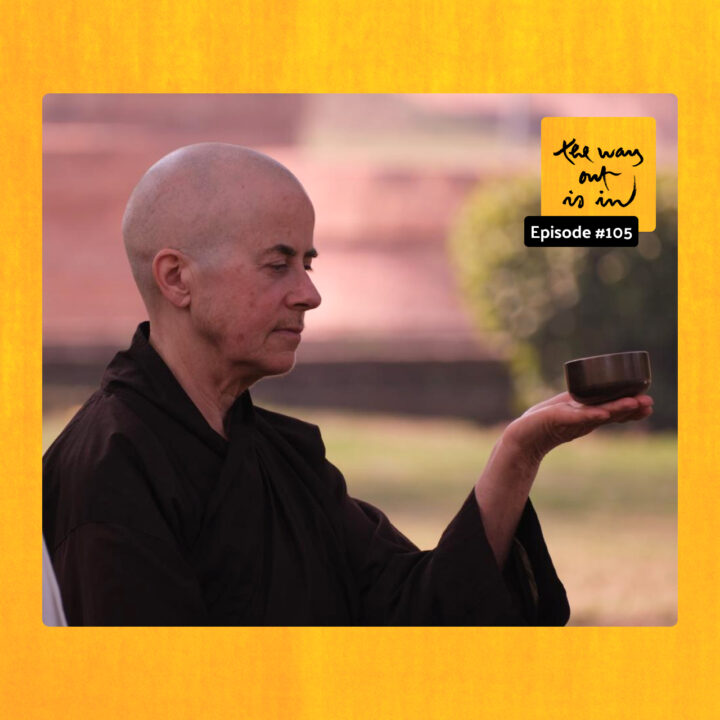






If you want to support our podcast please visit this link. Thank you!
Welcome to a new episode of The Way Out Is In: The Zen Art of Living, a podcast series mirroring Zen Master Thich Nhat Hanh’s deep teachings of Buddhist philosophy: a simple yet profound methodology for dealing with our suffering, and for creating more happiness and joy in our lives.
The fourth in a series of six episodes recorded during the In the Footsteps of the Buddha pilgrimage, this instalment was made in Vaishali, India, in February 2026. In it, Zen Buddhist monk Brother Phap Huu and leadership coach Jo Confino are joined by Zen Buddhist nun Sister Tam Muoi and Dharma teacher Shantum Seth to discuss new steps in the pilgrimage, like their visit to Nalanda University, an ancient seat of Buddhist learning, and Vulture Peak, where the Buddha gave some of his most important teachings. In Vaishali, the Buddha made the revolutionary decision to ordain the first nuns, which was a significant step towards gender equality in Buddhism.
Shantum Seth discusses the historical context and significance of these events and places, the importance of adapting Buddhist teachings to the present day, and a vision for Plum Village India to be a multifold community that embraces diversity and continues the legacy of the Buddha and Thich Nhat Hanh in a way relevant to the current times.
Sister Tam Muoi and Brother Phap Huu share their personal experiences and reflections on the role of nuns and the evolution of the Plum Village community, emphasizing the importance of embodying Buddhist teachings, skillfully navigating change, and continuing Thich Nhat Hanh’s legacy of inclusivity and gender equality.
About the pilgrimage:
In 1988, Shantum Seth was invited by Thich Nhat Hanh (Thay) to organize a pilgrimage to the sacred sites associated with the Buddha’s life across India. Subsequently, Thay encouraged Shantum to continue guiding such journeys each year, offering pilgrimage itself as a mindfulness practice—one that the Buddha had suggested.
Shantum has been leading these transformative journeys ever since, offering people from around the world the opportunity to follow In the Footsteps of the Buddha with awareness and insight. After 15 years at the United Nations, Shantum left to volunteer with the Ahimsa Trust, which represents Thay’s work in India and promotes the practice of “peace in oneself and peace in the world”.
Through Buddhapath, his expression of Right Livelihood, Shantum continues to guide pilgrimages and share the wisdom and culture of the places he visits in India and across Buddhist Asia, cultivating community through these deeply meaningful journeys.
To learn more about upcoming pilgrimages, visit www.buddhapath.com, or follow Shantum on Facebook and Instagram at @eleven_directions.
Shantum Seth, an ordained Dharmacharya (Dharma teacher) in the Buddhist Mindfulness lineage of Zen Master Thich Nhat Hanh, teaches in India and across the world. A co-founder of Ahimsa Trust, he has been a student of Thich Nhat Hanh’s teachings for the past 35 years, and, since 1988, has led pilgrimages and other multi-faith, educational, cultural, spiritual, and transformative journeys across diverse regions of India and Asia.
He is actively involved in educational, social, and ecological programmes, including work on cultivating mindfulness in society, including with educators, the Indian Central Reserve Police Force, and the corporate sector. Across various Indian sanghas, Dharmacharya Shantum is the primary teacher of different practices of mindfulness from Thich Nhat Hanh’s tradition.
Sister Tam Muoi (Sister Samadhi) is from the UK and was ordained in 2012, becoming a Dharma teacher in 2022. Having encountered the practice whilst living in France, she became engaged in the French lay sangha and was ordained into the Order of Interbeing in 2004. She is actively supporting the recently created Being Peace Practice Centre in the UK and is deeply committed to the work of healing ancestral harm, participating in trainings and retreats exploring White Awareness. Read more here.
Co-produced by the Plum Village App:
https://plumvillage.app/
And Global Optimism:
https://globaloptimism.com/
With support from the Thich Nhat Hanh Foundation:
https://thichnhathanhfoundation.org/
Recordist: Ann Nguyen
https://ann.earth
Sound editor: Joe Holtaway
https://joeholtaway.com
Publisher: Anca Rusu
Producer: Clay Carnill:
https://claycarnill.com
Executive Producer: Catalin Zorzini
List of resources
The Way Out Is In: ‘In the Footsteps of the Buddha (3/6) | The Heart of the Buddha’s Teachings (Episode #104)’
https://plumvillage.org/podcast/in-the-footsteps-of-the-buddha-3-6-the-heart-of-the-buddhas-teachings-episode-104
The Way Out Is In: ‘In the Footsteps of the Buddha (2/6) | Enlightenment under the Bodhi Tree (Episode #103)’
https://plumvillage.org/podcast/in-the-footsteps-of-the-buddha-2-6-enlightenment-under-the-bodhi-tree-episode-103
The Way Out Is In: ‘In the Footsteps of the Buddha (1/6) | The Buddha: Down to Earth (Episode #102)’
https://plumvillage.org/podcast/in-the-footsteps-of-the-buddha-1-6-the-buddha-down-to-earth-episode-102
Interbeing
https://en.wikipedia.org/wiki/Interbeing
Plum Village Tradition
https://en.wikipedia.org/wiki/Plum_Village_Tradition
Nalanda University
https://en.wikipedia.org/wiki/Nalanda_University
‘Female Buddhas: A Revolution for Nuns in the Plum Village Tradition’
https://plumvillage.org/articles/female-buddhas-a-revolution-for-nuns-in-the-plum-village-tradition
Mahayana
https://en.wikipedia.org/wiki/Mahayana
Flower Sermon
https://en.wikipedia.org/wiki/Flower_Sermon
New Heart Sutra translation by Thich Nhat Hanh
https://plumvillage.org/about/thich-nhat-hanh/letters/thich-nhat-hanh-new-heart-sutra-translation
Sister Chan Duc
https://plumvillage.org/people/dharma-teachers/sr-chan-duc
Sister Chan Khong
https://plumvillage.org/about/sister-chan-khong
The Way Out Is In: ‘The Three Jewels (Episode #89)’
https://plumvillage.org/podcast/the-three-jewels-episode-89
Pratimokṣa
https://en.wikipedia.org/wiki/Pratimok%E1%B9%A3a
Joan Halifax
https://en.wikipedia.org/wiki/Joan_Halifax
Sutras: ‘The Ten Great Aspirations of Samantabhadra Bodhisattva’
https://plumvillage.org/library/sutras/the-ten-great-aspirations-of-samantabhadra-bodhisattva
Vaishali
https://en.wikipedia.org/wiki/Vaishali_(ancient_city)
Notre Dame Academy, Patna
https://en.wikipedia.org/wiki/Notre_Dame_Academy,_Patna
Theravada
https://en.wikipedia.org/wiki/Theravada
Kapilavastu
https://en.wikipedia.org/wiki/Kapilavastu_(ancient_city)
The Order of Interbeing
https://plumvillage.org/community/order-of-interbeing
Sujata
https://en.wikipedia.org/wiki/Sujata_(milkmaid)
Kisa Gotami
https://en.wikipedia.org/wiki/Kisa_Gotami
Patacara
https://en.wikipedia.org/wiki/Patacara
Khema
https://en.wikipedia.org/wiki/Khema
King Prasenajit
https://en.wikipedia.org/wiki/Pasenadi
Bodhi tree
https://en.wikipedia.org/wiki/Bodhi_tree
Brahmajala Sutra
https://en.wikipedia.org/wiki/Brahmaj%C4%81la_S%C5%ABtra
Sariputra
https://en.wikipedia.org/wiki/%C5%9A%C4%81riputra
Nagarjuna
https://en.wikipedia.org/wiki/Nagarjuna
Vasubandhu
https://en.wikipedia.org/wiki/Vasubandhu
Padmasambhava
https://en.wikipedia.org/wiki/Padmasambhava
Xuanzanh
https://en.wikipedia.org/wiki/Xuanzang
Visakha
https://en.wikipedia.org/wiki/Visakha
Theragatha
https://en.wikipedia.org/wiki/Theragatha
Dharma Talks: ‘Redefining the Four Noble Truths’
https://plumvillage.org/library/dharma-talks/redefining-the-four-noble-truths
Vinaya
https://en.wikipedia.org/wiki/Vinaya
Dharma Talks: ‘The Noble Eightfold Path’
https://plumvillage.org/library/dharma-talks/the-noble-eightfold-path
Quotes
“Thay knew that the harmony of energies is so important to success, as well as to creation and to living organisms. You need all the elements. You can’t cut one off, because that’s discrimination. Thay continues to keep pushing boundaries in the context of Buddhism, of traditions. In very traditional monasteries and temples, the nuns can’t teach the monks. Even today, in 2026. In some of the institutes in Vietnam, in China, the nuns are still on one side, the monks on the other side. The nuns have to wear one color, the monks another. But Thay unifies all in brown.”
“‘If, ten years after I’ve transitioned, Plum Village looks exactly the same, Thay will be very disappointed.’ I really took that as his empowerment. We need to keep moving forward. We’re in a river. We cannot stop the river. The river needs to carry on flowing.”
“The precepts are your teachers. And when the time comes, keep renewing the precepts to make them relevant.”
“I can make change by embodying my practice.”
“The full inclusion of everyone can bring balance to a community.”
“Plum Village is not just monks and nuns; Plum Village is a multifold sangha.”
“If we don’t adapt to the current generation, even if we have all the amazing teachings, if they’re not relevant to people then the tradition will die.”
“Buddhism is very inclusive; there’s a lineage for everyone.”
“A great reminder is to embody the change – and not just to have a sign or shout about it, because that doesn’t have the impact of harmony.”
Dear friends, welcome to this fourth episode of our special series In the Footsteps of the Buddha.
I'm Jo Confino, a leadership coach and spiritual mentor.
And I'm Brother Phap Huu, a Zen Buddhist monk, student of Zen Master Thich Nhat Hanh in the Plum Village tradition.
And, dear listeners, if this is the first time you're joining our pilgrimage, we're on a 14-day trip in the footsteps of the Buddha, following the journey of the Buddha and really understanding the teachings from their origination. What is the historical context of them and what makes them still so important today?
The way out is in.
Hello, I'm Jo Confino.
And I am Brother Phap Huu.
And we are in Vaishali in India. And today we are going to explore the latest leg of our journey, which was… We went to visit Vulture Peak, and now we're in the ancient town of Vaishali. And this is where the Buddha did one of his most revolutionary acts, which was the ordaining of the first nuns. But before we start, we have a very special guest, we have Sister Tam Muoi, who is joining us on our pilgrimage. And sister, it would be wonderful if you can just introduce yourself to our listeners. So this is the first time we've had you on the podcast and I'm sure not the last.
I'm Sister Tam Muoi. Thay translated that as Sister Samadhi. That means Sister Concentration. I'm from the UK originally, but in fact I've spent most of my life in France because I came to live in France after my studies. And I've been ordained for 13 years and I'm really happy to be here in India.
So sister, you first came as a lay practitioner on this pilgrimage in 2008, and now we're 2026, and as you say, you're 13 years as a nun. What is it like to be back on this pilgrimage, and what is different about this trip?
Well, the 2008 trip was a legendary trip. I think we were 12 busses, one bus full of monastics, and of course, Thay. Thay was with us. That was the big difference, although today Thay's in all of us, so he's still here. And I think he's always in India. At that time I was already an OI member. So, we were a core community of OI amongst all these hundreds of people who came. And it was really a legendary trip to be in India with Thay and to see the way that Thay engaged with India, the wonderful things, the extraordinary things like sitting on Vulture Peak but also the difficult things like the children who would come begging. How he engaged, it was just so inspiring. It was like being here with the Buddha. It was very extraordinary.
And how about this time, what feels different now that you've been a nun for 13 years? What's the difference this time?
Big difference is now I'm a monastic. I feel like this is my home. And so visiting, particularly visiting old monasteries and also Nalanda, the university, I felt, as we were wandering around, I suppose back in 2008, it was a bit abstract for me. Oh, this is a ruin. This is an old monastery. Now when I wander around, I think, oh, this is Plum Village, all those years ago. And wouldn't it be great to have Plum Village as big as this place? And just wandering around, I felt like this is my home. This is a monastery, and this is where we live. It's very different.
Thank you, sister. So we have Shantum again with us, and Shantum is leading this journey and has been for more than 30 years leading these, as he calls them, retreats on wheels. So Shantum, we visited Nalanda University and then Vulture Peak. And it would be good if you can just give us a bit of historical context, because Nalanda University, for me, it was like… extraordinary that before Oxford and Cambridge, for instance, were even a glint in the eye, here was an extraordinary seat of learning with more than 1800 teachers and 10000 students. Tell us, tell our listeners a bit, what was Nalanda University and what makes it so special?
So, even though the Buddha visited the site where Nalanda is today and in fact gave the Brahmajala Sutra which said, if somebody appraises the Buddha or somebody disparages the Buddha, stay equanimous, it's one of the first sutras in the sutra books. But it's more important, I feel, as a place to really honor our ancestors, our ancestral teachers. And you're right, it started around the fifth century, though the original temple built was built on the relics of Shariputra, the foremost intellectual monk within the Buddhist community. And I have a feeling that the reason they chose that site is because Shariputra had lived there and then died there. And as the temple grew and the monastery grew, it grew into this phenomenal space where we had, it was basically an international postgraduate university in a sort of way. People from Indonesia, Korea, China, the sort of known world at that time. And we would look at it like the sort the development of Mahayana Buddhism especially. So the base would have been a person like Nagarjuna from the second century who may or may not have taught there himself, maybe not, he was from South India, but based on his teachings on what we understand as emptiness or shunyata, the understanding that there is no such thing as which has intrinsic existence and the development of interbeing. Other teachers like Vasubandhu then added the understanding of consciousness onto emptiness. Others like Dignaga added the understand of logic to that. And so these developments took place over five, seven hundred years. And out of that came, we called them the Nalanda Masters, but also people like Padmasambhava, who then went to Tibet and became Guru Rinpoche, was a teacher there. People went to Indonesia. So the whole development of Buddhism as it went out of India also emanated from Nalanda. And of course, our own tradition, which we call the Yogachara school, the manifestation-only school, developed from there. And the famous Chinese chronicler, Xuanzang, came in the 7th century, became a student and then teacher there, and then took 637 or 657 texts back to China, to Xi'an, translated them, and that became the base of how that strain of Buddhism came to Vietnam, to Thay, to Thich Nhat Hanh, and how me, as a student of Thich Nhat Hanh, in a way brought it back, well, I can't say I brought it back to India, but at least I'm a student now of that Nalanda tradition, but through teacher who got it through China and Vietnam. And then, of course, he also taught in the West. So, I feel we owe a great debt to our ancestral teachers in Nalanda. And, of cause, to Shariputra and the other great teacher, Mahamoggallana, who were two young men who made a vow that they would follow a spiritual path. And whenever they found a teacher, they would go together and follow that teacher. And when they found the Buddha, they said that is the one they were looking for.
So we've done Nalanda University and then we went to Vulture Peak. Brother Phap Huu, so why was Vulture Peak important to the Buddha and to Thay and what was your experience? Because it's very easy just to use the words in the footsteps of the Buddha, but actually, you know, the places like Vulture Peak, we were literally in the footsteps of the Buddha. There's not a hundred pathways up, there's a pathway up the mountain. And we walk that pathway. And so it'd be lovely just to sort of get that sense of what it really felt like for you, again, coming this extra time to be walking on the path of the Buddha. Here you are, a monastic, 2600 years later, walking those same footsteps to these same places. Where these great teachings arose. Just what does that feel like for you?
For me, it felt like the merging of the past and the present. What I've understood is that Vulture Peak was one of the Buddha's favorite places to see the sunset, and he would take time to be up there to just witness the miracle. And in the stories of the Buddha and in sutras, it speaks of the Vulture Peak, and for our teacher Thay, I know very concretely he loved the Vultures Peak. He chose that place to ordain his first monastic students in the West, which were all three women: Sister True Emptiness, Sister True Virtue, and Sister Chan Vị. And the three of them were ordained there, their heads shaven there, and Thay chose to do it in India as also that gratitude to the land, to the ancestors that are there. And being with Thay, he is someone who has always, not through poetry and not through just the mind of intellect, but to bring in these insights into reality, to make it concrete. We're going to go to a historical place, and Thay is going to ordain his first students in the West, in India. And that is also to ask for the strength of the Buddhas and the sanghas from the past to witness his determination, his aspiration for creating a new order of monastics. I remember in 2008, we spent an afternoon there, as well as we spent a whole day there. So Thay told Shantum, not asked Shantum, told Shantum, that we're going to spend a whole day with 12 busses on Vulture Peak. We're going come before the sunrise, and we're gonna leave after the sun has set. And It was my first time getting to do kind of like a camping trip with Thay, in a way, and I just remember his excitement. His excitement of letting his students enjoy the richness of this mountain. And we were up there with over 200 of us, 280-ish of us. We brought a hammock for Thay, I brought a lot of tea, because this is his most favorite way of celebrating. And the organizing team organized food to be delivered, and it was Dawali, and it would be very difficult to get food, so the organizing team with Shantum had to ask for our friends who are Muslim to deliver the food, because they're not celebrating that holiday. So there was a lot of behind-the-scenes going on, but I think it was very worth it, because we spent the day there, as the Buddha and his students would spend the day there. And with 280 people, there was no toilet up there. So Thay told everyone, this is it. We're gonna do it just like how the way Buddha and his students were. And I feel it's important to be in discomfort, too, like in our privileged world with running water, toilets always available, and just to really come back to nature and to see that we need to find a spot, we have to be aware. Can people see us? There's a lot of mindfulness in action right there and right then. And then after we have, especially go number two, to be respectful, to then take leaves and to cover it. So for me, that was very special. And I was on guard whenever Thay needed to use the restroom. I would stand there to make sure no one's peeking, if for whatever reason they're peeking. And Thay was always very discreet and he would motion to me and I know, okay, we need to go, to return back to nature. And what was also very special was we held a ordination for the order of interbeing. And there was only one gentleman that received that, but it was very beautiful because whenever we hold this ceremony, we're in the Mahayana tradition, and in the Vietnamese tradition, our day-to-day robe is brown, but when we do the ceremony, we would put on our sanghati, which is of orange, yellow, golden, all mixed together, and that is the lineage, the heritage of the Buddha's robe. And all of the monastics, we were sitting with Thay in our order of ordination at Vulture Peak. And I really felt like this is the Buddha Sangha. And the most powerful moment is sitting in silence. Thay gave us a lot of free time to be together, to sing, to have conversations. Thay would sit on the hammock. And from time to time, he would tell me, he's like, this is how the Buddha enjoyed it, my student. Just, this it it. This is how simple life could be and how profound it could be. And at the end, collectively, we would just sit in silence and to watch the sunset. And Thay said, this is the same sun that the Buddha saw. This is the the same sky that the Buddha saw. The sounds of the birds, the monkeys, these are the descendants from different generations and even some of the trees. So we are not just experiencing, but we are also expanding our mind to bring the Buddha's community into our present moment. And for me, particularly this time, it's my favorite sunset I've ever witnessed, and what was profound was I haven't been missing Thay on this trip, but when the sun arrived right at the mountain and it was coming down, this well of emotion manifested and I just missed him so much because I knew like he loved, this is his television, the only television that he would watch and he would enjoy so deeply and so I just felt his presence so real and the sun, the mountain and I just, I saw Thay, then I saw like the Buddha coming together, entering into the sangha that was, we were all on that peak, on the Vulture Peak. And I had goose bumps even, and I just naturally joined my palms. In our tradition, when we join our palms, it's not just a devotional act, but it is the coming together of body and mind and spirit. And it's helpful to have a formal practice in that moment to hold everything. And I felt I needed to hold that experience. And just vows just came forward. It was the first time I experienced vows and feelings, not in words. It was just feelings of gratitude, feelings of determination, feelings of commitment were just so present. And that was profound and renewing.
Thank you, brother. And it's so interesting that, and you talk about words, and when we move out of the intellect into the visceral experience of things, how different that is that you can talk… And that's why we're doing this podcast, because we want to bring a sort of flavor of this journey, and also to recognize that to fully experience it, you have to be present. And I had this experience on top of Vulture Peak when I took a photo, and we should actually use it on the promotion for this episode, but I took picture of you sitting there from behind, just as the sun was setting. And I couldn't really differentiate you from the mountain. And it was this really beautiful moment because in the practice, there's often like sitting like a mountain, feeling this stability and feeling this sort of groundedness. And at that moment when I took that photograph, I felt that you were a mountain. And it was a really beautiful sort of moment to say, actually, I'm not thinking about what it feels like to be a mountain, but I'm experiencing you as a mountain which was wonderful. Also, I think it's the first time in a hundred plus episodes that we've had mindfulness in defecation. So that's good too. We've got that one out of the way. Number two is done. So, Vulture Peak, and then we went from Vulture Peak the next day to Vaishali. And Shantum, this is, you know, we've talked a few times, but it's worth keep reminding ourselves that the Buddha was an extraordinary revolutionary of his time. And then Thich Nhat Hanh, Thay, was a revolutionary in his time, and what was incredible about this moment in Vaishali was that the Buddha ordained his first nuns. And it would be really good, Shantum, if you can just give us a sort of a sense of this was not normal, this was no ordinary, this was an act that actually revolutionized Buddhism. Can you give us the sense of what was going on at that moment? And also it's true that the Buddha was careful about this. He didn't say, yes, let's do it. It was a momentous decision because it would create a lot of opposition, because at that time it was extremely patriarchal. Women could not be monastics. They were very much secondary citizens and the Buddha very skillfully brought them into the fold.
I'd like to just pick up a little bit from what Brother Phap Huu was saying about Vulture Peak and Thay, because when we went to 1988, Thay spent five days there. When I was organizing it, people said, nobody spends even a night there, they go from Bodh Gaya and come back. And Thay wanted to spend there. Then when we spoke there, he said, this is where my Buddha eyes opened. And I feel for our whole sangha, that's a sacred mountain, and when the Buddha offered one of the teachings, which is called the Flower Sermon, where he just picked up a flower, and Mahakasyapa got awakened in silence, he was considered the first Zen master, so that whole tradition of Zen starts there. And then we have the Heart Sutra, which we chant regularly, which was supposed to have been given there. So, this tradition is very, very important and the mountain is an important aspect for many, many things, not just the teachings, but also as a witness of non-cooperation with the nastiness of politics that was happening in the country at the time. But it's important to remember that the Buddha was always contextual. And on the last journey, when he leaves from Vulture Peak to come to Vaishali, the king's minister approaches him and says that the king wants to invade Vaishali. And that's a republic. And how can we do it? And the king says, Buddha has never lied, so listen carefully. And so in that process, the Buddha says seven things, which are about the Republic of Vaishali, the first republic in the world. And very briefly, the seven arm, that do people meet and discuss things regularly? And they say they do. Are the decisions in harmony? And they say, yes, the decisions are made in consensus. Do they respect the laws? And yes, they respect their traditional laws and each time the Buddha says, oh, these people are very strong, they cannot be defeated. And do they listen to their elders and say, they care for their aged and they respect their elders. And do the people not oppress the power, the powerless and the poor? And they said, no, they take care of people and they protect women. And do they listen and act according to the advice of monastics? And again, it's said that they do and they respect monastics very much. And then the minister goes off. But what the Buddha does is he takes those principles of the republic and then ask Ananda, Ananda his attendant, please call the monks, I want to share something. And he develops what is called the principle of non-regression, which is given to the monastics, which is still used now. And he says the monks should meet every fortnight on the new moon and full moon, there should be concord and harmony in the meetings, so every decision should be made with asking everyone if everyone agrees, a consensual model. They should live according to the precepts, they should listen to the elders in terms of the monastics who have been ordained before them, not just by physical age. And they should lead a simple life. Monks should be quiet and calm, and they live in mindfulness. So it's interesting how he took that governing model of a republic and then brought it into the sangha. And this can be also done for corporations, for any workplace and even for your home. So I think to secularize or bring it into a more everyday context, the Buddha was using an everyday context to bring it to the monastics, but then also bringing from the monastics to us. And the monastical tradition is the oldest continual organization, if you can call it that, in the world, because it has inbuilt into it systems of building harmony and conflict resolution, etc. But I bring this up because actually this was done just before he comes to Vaishali. He walks from the Vulture Peak to Vaishali for his last rain retreat. But Vaishali actually is incredibly important to us because the first nuns were ordained there. In fact, when Thay came in 1987, he said we should start a center here. And I came and lived there for some weeks trying to find land and, you know, it didn't happen at that time. He was keen on a Plum Village then. We'd had a Plum Village in Vaishali. Now we have a Plum Village in Dehradun, but it's still India. So, the context of the time, and India has always been patriarchal in its modeling, and a woman's role is often linked to a man, whether it's a wife of a husband, the mother of a son, the daughter of a father, and the identity of a woman has been always a sort of connected one to a men. His father died, his mother now had no connection. Her two sons had both become monks. She'd always been interested in these teachings, but at this point she says to the Buddha, I'd like to be a nun. And the Buddha refuses three times. And then he comes down to Vaishali. This is in Kapilavastu, his father's died. So this is where he spent his childhood, in the north. And she then shaves her hair, comes down with, what we said, 500 women from the Shakya tribe, which is her tribe, and the tribe she's married into. And comes down and Ananda, the attendant, sees this group of women and he recognizes them, says, you know, they have sort of torn feet and dusty, their clothes are dusty. And says, what are you doing, Queen Prajapati? She was the queen. And she said, I've come to get ordained. And the Ananda is very, very skillful because he knows that she's been refused three times, but the queen is determined. She's basically the Buddha's mom, I mean, foster mother, you can imagine coping with that kid when he was a kid. So she doesn't go directly again. So Ananda goes then to the Buddha and says, do you think women can be awakened, can attain arhatship? And there are four stages of that in the text. And he says, yes, they can. And then he says well, you know, why are you refusing your mother? He is called a mother because his own mother died within eight days of his birth. So she became, she was actually the sister of his birth mother, so she brought him up. She said, why are you refusing your mother? And she'd also given him milk. She said, she gave you mother's milk. Give her the Dharma milk. Now, you know, that's pretty strong persuasion, so the Buddha thinks about it and I think partly even the first refusal is partly that because society is so strong. He knows, as you said, that there's going to be come back and there's gonna be, you know, women leaving their husbands from abusive relationships but also from the aspiration awakening. There's both. I mean… It's not that everyone's coming straight for awakening, but there's also this reason that we want to leave the homes and they're the mainstays of homes. There's going to be a lot of criticism. But he takes a daring step and says, yes, according to some texts, it says that he gives them eight rules, which would sort of, in a way, be skillful to say to the society that yes, but, and yes. So we have different versions by those who put in those eight rules are put in later or not. But in essence, Queen Prajapati says, yes, the doorway is now open to us, we walk in, and that's how the lineage of nuns developed. And I really feel that it is not just a revolutionary act, but an act of recognition of us as human beings. The Buddha was recognizing everyone as a human being, there was no gender discrimination, you know, this is that. And I think that today there's been a struggle in many traditions of Buddhism to renew the order of nuns, and we've regressed in some way, not in the Plum Village tradition. The Plum Village tradition, I feel is really a revolutionary tradition, and maybe Sister Tam Muoi will be able to develop on that, on how it is to be a nun in our community, because I really feel that I've seen how many, many traditions still have women as a sort of second grade and as Brother Phap Huu said, the first three, three most senior people in our tradition are nuns. And in many traditions, a nun is not supposed to be even a teacher monk, but here our senior most teachers are nun. So I feel that the Plum Village tradition has really moved. I feel India, to bring the Buddha Dharma back to India, it is very, very important to renew the tradition of nuns and our tradition is very well situated for that because in many of the Theravada traditions, the nuns are not there or lesser than. So I think if you want to renew the Buddha Dharma in India, we need the nun's order and we need our nuns to come and live here so they can inspire young women in India. Like we saw yesterday at Vaishali, we saw hundreds of women at the site in Vaishali, articulate, eager, really inquisitive young women from a school called Notre Dame Academy in Patna. And they just would be eager, and even one or two of them might take this path of following what I feel is the greatest wisdom culture of India and a doorway for women to be liberated.
Thank you, Shantum, and you suggested I ask Sister Tam Muoi the question of, sister, 2600 years ago the Buddha ordained the first nuns, first female monastics, and you are in 2026, the continuation of that stream. And so, visiting Vaishali yesterday, if the Buddha had not taken these actions, who knows, maybe it would still be very patriarchal, there would be no female monastics. What did it feel like for you to be present there and also just feeling that continuation of time from the past into the present? How does that feel for you, to be allowed to, within the Plum Village tradition, to be seen as equal to the monks and to break that patriarchal system?
The first thing that comes to mind is that if the Buddha hadn't ordained women, I wouldn't be in this tradition anyway. I wouldn't t even be here, whether it's a lay friend or a monastic. I wouldn't be interested if this was a tradition just for men. When I was in Vaishali yesterday, I was very, very humbled because I gave a little sharing. And I really had that imposter syndrome, who am I to be speaking in this historic place where so many of the female ancestors, this is where they were allowed to join. My heart right now just feels so full that because of what happened back then, because of the Buddha's deep understanding, his daring, because as Shantum was saying, to take that decision, he knew he was going to bring so much conflict and there was already some jealousy and backstabbing going on because of the popularity of, yeah, this new tradition. And the Buddha was attracting so many monks, all these young men leaving home was causing some difficulty. And yet, he decided to also take this huge decision to ordain women. And I thought, wow, I want to follow this person. It's so inspiring. And then Thay as a continuation, our tradition, I feel proud to be part of this tradition that is so empowering for women. And as Shantum mentioned, just as we arrived at the site of Vaishali, it was so lovely because we arrived in this very sacred site, this sort of large, open archeological site, and it was filled with all these young women chattering and alive and vibrant young women. And I thought, this is so appropriate. They were coming from a girls' school. And yeah, I just thought the female energy is already present here, which was very beautiful. And it also made me think of in Plum Village, in Lower Hamlet, where I'm based, when I first ordained, we had many sisters who perhaps were trained in more traditional temples. And they tended to be, well these were our Vietnamese sisters, they were quite quiet and maybe many didn't speak such good English and very humble and perhaps feeling that they should defer to their brothers. But now we have so many Gen Z sisters and they speak out, they speak wonderful English, we communicate all together, they step up. And I'm just so proud of our international female sangha, our nuns. And it makes me think as well of when, shortly after I was fully ordained to become a bhikshuni and therefore allowed to join those meetings of our bhikshuni council, and this is where all the decisions for Lower Hamlets are going to be taken. Before, when you're a novice, you don't yet come to those meetings. Which is fine, because already when you're a novice you're getting used to the change of becoming a nun, which certainly for a Western young woman is quite a conversion that needs to be done. But then when you get to go to that bhikshuni meeting, that is where we're going to decide everything that happens in our hamlet. And I was fully expecting that all I'll be told just listen, don't say anything for the first two years, I'm gonna have to really keep my mouth shut and listen. But Sister Chan Duc, our elder sister, she said to us, when you go to that meeting, she said, I never want to hear that when you leave that meeting you didn't speak out what you wanted to speak. She said, from your first meeting, you can speak out and say what you need to say, contribute, participate. And I was so amazed. I felt so empowered. I thought, wow, this is amazing. And then she said, and if you feel that what you've contributed is not heard, that your idea, it's not possible to put that in place yet, she said don't stop there. It means that you haven't been skillful enough. So the next time, you can reflect on it and think of ways to present this more skillfully, to look at your idea, to be more skillful, and come back again. And I thought, oh my goodness, I feel so empowered that we all have the right to speak out. Yeah, I felt a lot of gratitude to my elders for this.
And sister, what is it, you know, as Shantum said, there are still some lineages where women are not allowed to be ordained. So it's almost a stupid question because I know the answer already, but what difference does it make to have Plum Village where you have the monks' residence, you have two nunneries and you bring together this interbeing of the masculine, the feminine, men, women? What difference does it make to have this tradition sort of intermingling and no separation?
I think as probably all the listeners can imagine, it's so important to have the masculine energy and the female energy. Whenever there are organizations where it's all male or all female, it is not so great. We're so complimentary. And of course, our brothers, they have the whole spectrum, a very male energy, and very female energy. There's a place for everyone. And it's the same with our sisters. We have sisters that have very strong masculine energy and sisters who have very strong female energy and everything in between. There is a space for everyone and all of those different manifestations of energy contribute to our sangha and it makes it a very healthy place.
Thank you. So, Brother Phap Huu, sort of, Shantum has talked about the Buddha as sort of taking, taking this decision to ordain nuns, knowing that it would be a lot of blowback, that there would be, that it would cause concern and upset within the community. And Thich Nhat Hanh also, as we keep saying, was a revolutionary in the way he allowed nuns to be not just ordained but to be equal because there's one thing to be ordained but there's another to be treated on a par with the monks. So can you just give us a sense of what was it about Thay that recognized that actually whatever the consequences that this was his path that he was going to follow regardless.
Thay's greatest companion and helper is a woman, Sister Chan Khong, Sister True Emptiness. And I think for all the causes and conditions, she was his first student on the path of the manifestation of Plum Village. Without her, I really believe that we wouldn't have the teacher we had, which is Zen Master Thich Nhat Hanh. And without her, we wouldn't have Plum Village. She was as essential as Thay was. So for all of those who we know that this is our tradition, I always give gratitude to Sister Chan Khong. When Thay passed away and transitioned, the first person I called was Sister Chan Khong, because the grief that I'm feeling, I don't think could be compared to the grief that Sister Chan Khong is holding in that moment. So Thay, as a very smart man, he knows that the harmony of energies is so important to success as well as to creation and a living organism. You need all the elements. You can't cut off one because that's discrimination. And Thay continues to keep pushing boundaries in the context of Buddhism, of traditions. In a very traditional monastery and temples, the nuns can't teach the monks. Even today, 2026. If in some of the institutes in Vietnam, in China, still the nuns are on one side, the monks are on the other side. The nuns have to wear another color, the monks have to have another color. Thay unifies all in brown. And then when we come up to chant, Thay is very open. In the beginning, it was nuns on one side, monks on one side, and it was actually Brother Spirit, said, actually, for the harmony of the voices, it's better if the brothers are at the back and the sisters are at front. And it's just a blend and it's helping with the notes and so on. And Thay's very open, he's like, yes, let's do it. And Thay's openness to also listen to his students is very crucial in knowing the teacher who is Thay. And Thay, he's always keen to know the suffering of our times. So of course, listen to his nun students. He always wants to allow them to have agency for their life. And in a lot of texts, depending on traditions, it's always the nuns have to take refuge in the monks. The monks are the elder brother because that order was there before them. And unfortunately, with this, in the old ways, that belief that men is better is still seeped into the culture. And I experienced it in our community also, from different traditions coming to us, that come and join us, as well as when we come to Vietnam or we come another temple that still carries that lineage. And I'm always practicing not to judge and just to embrace, but I can't hold myself from judging to be very honest. And it just makes my vow even deeper to make sure that in Plum Village, we don't revert back, but we keep pushing forward. Like, Plum Village has also many eras, like the older generation, who came first and were the first, like Thay's first students. And the sangha was very young and raw. The kind of formal practices that we have today weren't there. And it was beautiful, too, because there wasn't brothers and sisters hamlet yet. So in some seasons, all the monastic would go to Upper Hamlet because we're offering the summer retreat. So the nuns and monks, we live together. And then some seasons we switch back and forth, but because the monastic aspiration is to live a celibate life and to live a life that we cut off, we transform our sexual energy, our attachment with one another. And we're all young in this order. Like one of Thay's merit is that he attracts such young men and women to join this path. And a lot of traditions that are in the West get jealous of Thay, even the churches. When we were in Ireland and we were staying at a monastery, and the elder priests and monks were like, how did you do this, Thay? Why are they so young? All of our orders were on retirement, we're about to die, and there's no continuation. And that was Thay's pride also, that he was able to bring in fresh blood to the body. And as the community started to grow, Thay knew that we have to separate in order to keep our aspiration alive. The monastics from time to time, causes and conditions, do fall in love with one another. And it's not because of appearance, it's because of the shared aspiration. Sometimes when you see somebody that you're so aligned with and you just feel so whole in a way. You know, living the holy life, we have the very humanistic elements in all of us. And we learn to love everyone, not as an individual, like, our practice is not to make that person ours. Thay always reminds us that all of you belong to the Three Jewels. Don't put that person in your pocket. It doesn't belong to you. It always belongs to the three jewels. And as a community, Thay ingrained in us respect, that the monks have to respect sisters, and the sisters respect the brothers. But Thay has, it's just like him reminding us to come back to our breath. Thay keeps reminding the monastic order to remember that we are one and we coexist together to make the living sangha powerful and a place of refuge. I'm just like Sister Tam Muoi, if our community is discriminating and loses that path, I would leave too. I would start a Plum Village 2.0. I'll call it something else, but I don't game like this. I wouldn't because it would erode my aspiration. And I think for me, I still keep that at the forefront and I'm still going to do my best in my lifetime, my lifespan to keep pushing boundaries. And like still today, and I, you know, in this podcast, just to sow the seed, you know, like in formal lunch, for example, because Thay was our teacher, so he always had the bell. But I imagine when we're in the sisters' hamlet, the sisters invite the bell, but already, like, in Plum Village, we have already done so much, like a lot of ceremonies, the sisters hold it. In the tradition, the sisters have to invite the monks to come to do it. And the sisters don't get to be at the high table. It's not a table, but at the higher position. But in Plum Village, the sisters, when we do incense offering, it's a brother and a sister. When we touch the earth, we always have representation of the two different elements. So this is important, and I know this is very important for us, young generation, to see that this continues to move forward and push forward. In Deer Park even now, in some sessions, instead of two lines, we make a U. So for those who are non-binary, we can still feel as part of it. And in the past Plum Village, we always say, men on one side, women on one side, now we just say, sit wherever you like. We're continuing to explore and to push and to be as open as we can. And it's very educational, too. And we have to understand that a lot of our siblings also don't come from backgrounds and an upbringing that is more transparent, like I had the chance to be in, and they have to be educated, and we want to take time to share, because our Dharma has to be, you know touching the present moment and touching the present moment, suffering. And this is, this is the teacher's legacy that he has left behind for us. One of the biggest regret, I would say, one of the biggest regret of Thay's stroke was, first of all, he has so much more to give to the world. He has so much more. I… He was telling me about the projects he wanted to push forward to bring mindfulness into leadership, into businesses, compassionate leaders who changed the world. So he just finished the happy teachers, the education, and he was ready to really put energy into corporations because it has such an influence. It's his way of systems change. And he was working on a new revision of the Pratimokṣa, which is the monastic law. Right now, the precepts are in balance. The monks have 250, the sisters have 348. So it's more than the monks. And that was also prescribed in the Nun's Order. But with the, in my perception, everyone can have their own interpretation, it's always in the fear of what society will project so the nuns have to have more rules than the monks. I don't vibe with that. We're equal, we all have sexual energy, we all have doubt, we all have anger, we all have frustration, we all have unskillfulness. So Thay was telling me he wants to make the monks and the nuns' precepts equal. 100 each period. And unfortunately this stroke happened. And… It could have only been him in this era, because he's so well respected. And they can't argue with Thay, because Thay is so strong. When we already renew the pratimokṣa that we are reciting today, which is very modern. It talks about the internet, it talks about driving a car, like the old pratimokṣa talked about wearing shoes, about leather or not. And Thay was like, hey, that's like, that belongs in the museum now, we can respect it every time we do this ordination, but we have to bring the present moment into our times. And already when we renewed that in 2003, there was already a lot of pushback from the traditionals. They said, who is Thich Nhat Hanh to revise the pratimokṣa? And it's such a humanistic pattern, even during the Buddha's time. Because when the Buddha was dying, was entering into nirvana, that's a more skillful way of saying it, Ananda asked the Buddha, who do we take refuge in when you transition? And the Buddha said, the precepts are your teachers. And when time comes, keep renewing the preceps to make it relevant. And in the first gathering, the first magha gathering of his students to reform and to realign all of us because the Buddha is not here anymore, Ananda reports this, and Kassapa, the elder, asks, which precept did the Buddha said for us to change? And Ananda said, he didn't mention any. So then Kassapa said, if he didn't, then let's just stick with this. And that became period. And thousands of years later, it still had that power because the Buddha didn't tell us which one to change so we don't change them. And of course, some of the wise of ancestral teachers did evolve them and change them, but each renewal was like hundreds of years later, and Thay was a little bit embarrassed of the tradition about that. He said, look at school, look at the education. Every few years, they renew the textbooks. We have to have that spirit. And even today, when I speak about it, I have mentioned it like about four times in our community because I'm like, I want to sow the seed, I want us to be courageous to be Thay's continuation. Because in the pushback in 2003, especially in Vietnam, because we are Mahayana and our roots are to Vietnam, they're like, who is Plum Village and who is Thay to change this? And Thay's response is, we are the Buddha student and we carry his legacy forward. And I pray, I continue to make vows that we continue to be as courageous as Thay, and we're still very young and we have to be a little bit more patient to grow our virtual body as a sangha, to have that courage and that harmony, to renew, to allow all of us to feel seen and equal. I think it is important to feel equal. Because the suffering and the habit of the world, it seeps into the way of being. And we have to recite it in a way. We have to say, no, sister, you're a human being. You have all of the potential to be a Buddha. And it needs to be recited, it needs be encouraged again and again and again. And one of Thay's most revolutionary in the monastic order is he created this ceremony that the monks would prostrate to the nuns on the first day of the lunar calendar. In no other tradition in Buddhism today that does that. The monks and nuns in the Plum Village tradition, we would come together without our ceremonial robes. We just wear our simple brown robes together. It's my favorite ceremony because it really makes us feel as one family and it breaks the hierarchy system. And Thay intentionally makes the monk practice first. So all of our sisters would sit and would allow the monks to see them as them, to see us as equal. And there's a very beautiful text that Thay has written, and it starts off as, when I look at you, I see the Bodhisattva Avalokiteshvara in you. Some of you are of the age to be my mother. Some of your are of age to my daughter. Some of are of the age to be my sister. But nevertheless, we are all students of the Buddha. That's like, we're equal. And I see in you the deepest aspiration and I pray and I vow day in and day out to protect that aspiration. And that's the commitment so that I don't fall in love with you. So that I can protect that highest vow that you've made. And that beauty is the beauty of the three jewels. And then the monks would prostrate to the nuns three times. And then after that, the monks will sit down and the nuns would recite the invocation of Samantabhadra in the brothers. And then they would prostrates to the monks. For me, that's like the renewal of our visa every year. It's like, the family renewal. We have to commit to this. And in 2005, Thay's first trip back to Vietnam, we had the Lunar New Year in Vietnam, and because of Thay's presence, all of the high venerables were with Thay. And we did the ceremony for the first time in Vietnam and Thay stood up, because Thay stood up, all the high venerables and all the monks stood up. And maybe the first in a long time in Vietnamese Buddhism did the monk community prostrate to the nuns. And I'll never forget that moment because I saw the tears of the high venerable nuns of how moved they were to be seen, to be respected. I feel that's a right, that's a human right for us all to be seen, all to be love, all to be respected for the commitment that we've made in this life. And Thay knew what he was doing. He did it from a place of trying to break that separation. And on the way back, walking back to his room, he was very happy. He was very that he was able to do this.
Well, thank you, brother. And I know I was speaking to one Buddhist teacher recently who was saying that in India he found some of the most wise people, like the women pot washers, who had no formal role, who weren't necessarily recognized, but whose practices were far deeper than any of the men. And so, sister, I just want to come back to about that fact really about sort of by being a nun in this sort of what is still often a patriarchal system, what is it that you want to show, in a sense, through your practice that sort of helps further break this patriarchal system because the Buddha and Plum Village have taken us to this point and as Brother Phap Huu says, there is always further to go. What is, how do you personally feel your connection to moving this forward even more? And the role of the nuns in Plum Village, given there are thousands of people come to visit Plum Village every year, what is it that you can show that may help move this further forward?
I think the way I feel that I can make change is by embodying my practice. So that means that if the sisters are invited to step up to teach, or if personally I'm asked to lead a practice, to facilitate something, then we just have to get over our shyness because it's not just for us, we're doing it, it's… We need to be visible, we need to out there, and we know very well that when young women come to Plum Village, if they were just to be taught by men, that's, I mean, it's great to hear the Buddha's teaching, but they need to see women teaching so they think that could be me. And so I encourage our sisters as well. Some of our sisters can be quite shy. And I really honor their courage because many of our sisters, they're not speaking their native language. I'm very lucky because I can speak my mother tongue. It's not so easy already to speak in public, but to speak in your not native tongue is very challenging, I can imagine. So, I really encourage our sisters to teach. And to not worry about making some mistakes in grammar or whatever, it's about communication. And many of our sisters, just their being, their way of how they are, even if they make some mistake with grammar or whatever, what's important is they're up there and they're sharing. So I encourage our sisters to step up and to take that space to inspire the next generation of nuns, of women who want to ordain. I think it's really important that we keep the aspiration of Thay alive for this change. I was wondering whether I dare repeat something that was said to me recently, but now I'm going to say it. When Thay Phap Huu was talking about Thay's aspiration to keep renewing Pratimokṣa, one of our sisters recently said, we need to show our Pratimokṣa to a feminist and to a safeguarding expert, so that not that we take on whatever they say, but just to have their opinion so that we can make sure that the new renewed Pratimokṣa is also in line with the aspiration that women also can take their place, can stand up and be not equal but there's equity that there is space for the qualities of the female energy, the male energy. We don't want to fall into the complex of equality. We want there to be space for all the beautiful qualities of masculine energy and female energy and everything in between, non-binary energy. And we all know that when we're like fish in the water, maybe we can't see things because it's so familiar. And I thought that's such a great idea to get advice from experts in the field so that we can listen and consider and see how we can bring wisdom into our Pratimokṣa. I certainly feel that there is space for improvement, but this is going to be a long journey. We need to put time into it, time and consideration, listen to our elders, but also go forward as a community into this revision. What I had understood about the sisters having more precepts is because the sisters took on all the brothers' precepts, so that was already quite a packet. And then, as the sisters community were practicing, the precepts were evolved by questions being asked. When something happens, we say, oh, what should we do about that? So we make a new precept. So because the sisters had different experiences, we then added a whole bunch of extra precepts because of our sisters' community. So that was added on to the brothers. So I don't really like to go down the road of, oh, the sisters need more precepts because we're women, but just because of the historical situation. And I certainly feel that if we had the same number of precepts for the brothers and for the sisters, that would already might feel my stomach relaxing just at the thought. I think this is definitely the way to go.
And sister, my experience of Plum Village is that the monks tend to be a little bit looser in their practice, and the sisters tend to sort of hold the guardrails much more in place in a way, your container for the practices in a different way to the monks. And I'm just wondering, is there anything about the nuns which is actually that you are helping to hold together Plum Village in a slightly different way than the men?
Thank goodness we're different. It would be very boring if we were all the same. I'm going to give an example. I think it was when we were on tour, so we were a group of brothers and sisters, and we were taking turns in giving the orientation at different places we were holding retreats, and one of the brothers said to me after I'd given the orientation, oh, the sisters, you're so much more strict about how we should practice. I wasn't so happy about that word, strict, and I said, what do you mean? Do you really mean strict? And he said, no, what I really mean, and as he started to unpack it, he said you give a lot more guidance about how we can practice. And he really appreciated it. And he said, you give some more details about this or about that. And he felt it was a much fuller guidance. Well, I much preferred that to strict. So I think, the sisters, I don't want to fall into generalizations, but we have a lot of caring energy, attention to detail, sometimes too much. We also love the qualities of our brothers about being a bit more loose. And we love that relaxed quality. For myself, I'm so glad our brothers are there, because I know that that relaxed energy is something we can learn from. And we want to bring that to the sisters' hamlet as well. But I think, or from what I've heard, the brothers are also interested to bring some of that attention to detail as well. Sometimes the brothers, it's lovely to have loose energy, but we don't want to get sloppy either. So it's always a balance, and we offer to each other and we learn from each other. It keeps things alive.
And shows the interbeing of everything, that if you separate people out, then actually things get out of balance. And so what you described so beautifully is an example of how actually the combination of everyone, the full inclusion of everyone can bring balance to a community.
Absolutely. One thing I want to add is that I'm so grateful to our brothers because they have a lot of creative ideas about how we can evolve, how we can change things. And it's true that there is still some patriarchal elements in Plum Village, but that's because we reflect what's in the world. And perhaps one of those positive sides is that maybe the brothers have a bit more courage to speak out, and I bow before our wonderful abbot Thay Phap Huu, he has the courage to say, let's change, let's try something new. And maybe that's easier for many of our particularly Asian sisters to accept because it comes from the brothers. And so they're willing to be more open-minded. And so I really bow before all brothers. Sometimes before their creativity and they're willing to update things and I know that that will come into the sisters' hamlet as well and so that our ideas about things are not going to get fossilized and stuck but that we inter-are and we have great ideas as well, which we bring to the brothers' hamlet and so we're moving, we're fluid, we're not fixed and we're creative. We bring creative energy. So, yeah, the interbeing of the masculine and female energies, they're very alive.
As you speak, sort of, and it's obvious anyway, but it becomes more and more clear why it's madness just to have monks and not to have nuns. I mean, it feels, you know, as you were talking, you know in my head, I see this sort of the scales. And if it's just monks and no nuns, I mean it's almost how can that be possible?
Well, I was trying to imagine as I was walking around Nalanda University, where they had 10,000 students and 1,000 teachers, all men. Oh my goodness. I was trying to imagine what that would be like. And I was thinking because it lasted for, what, five or six hundred years, this place, 700 years. And I was imagining that, at the beginning, I was thinking, oh, it must have been like a bootcamp, like an army, with all this masculine energy. But I was thinking, but men aren't like that. So-called men, what we… the name we give to men. There are the very masculine, maybe quite militaristic men, but then there are the very feminine men and everything in between. And I was wondering that over those 700 years, maybe that group of men actually became more like from female to male, but within the male bodily form. And I was imagining that probably that's how they were, how it was working, that in fact there was a space for all the different kind of energies within that male form. But the idea of it being like a military, army establishment, with all these men, that is not very inspiring.
And, of course, that's true within the women as well, because within, and I want to bring you in, Shantum, because within the tradition of the nuns and the female monastics, there is a lot of fierceness and warriorship, and even today. So, as I mentioned on one of the other podcasts, I recently interviewed Roshi Joan Halifax, who was a student of Thay. And what a warrior, you know, just like unbelievable strength and ability to cut through things with a sharp knife, not taking any prisoners, you know, just a real ability to be fierce in the practice. And Shantum, so I want to come to you on that because it'd be nice to get a bit of flavor of the powerful nuns that have been historically, just whether you have an example or two of nuns, or female warriors in this tradition who have sort of really made a difference and have shone out and what qualities they brought to bear.
When I was hearing Sister Tam Muoi, she said the word generalization and I heard, oh, I don't like making gender, genderalizations. I said, that's a nice word, genderalizations. And in our community, that is so, like the non-binary, the transgender, we have a retreat coming up, we are transgender people coming for that. So, Plum Village is very inclusive. And before coming to the really strong nuns, one thing which is coming up for me very strongly is that Plum Village is not just monks and nuns. Plum Village is a multifold sangha. And so I feel really honored to be on this podcast sharing with my sister and brother, and with Ann, who is also here, we are four-fold sangha here, and from very different locations on this Earth too. We are a very international, multinational community. And this started at the Buddha's time. And when we were talking about the Pratimokṣa, what Thay did was he distilled the large Pratimokṣa, into 14 trainings, 14 precepts, 14 trainings which he called the Order of Interbeing. And now is the 60th anniversary of that and actually we're looking at the charter to see how we might adapt it for now. But in that, all the precept or all the mindfulness trainings are exactly the same for monks and nuns. And for laymen and laywomen, except number 14, where the monastics take the precept of celibacy, and we take the precept of responsible sexuality. So I think when Thay was trying to bring it down to 100 from what Brother Phap Huu was talking about, he's already done that. He did that many years ago, in 1966. And now we, as students of Thay, students of the Buddha, need to look at it and see whether it's relevant to us now. And I've been reading it and looking at the charter, and it's amazingly visionary for that time. And it was built during the time of the war in Vietnam. In Buddha's time, also there was a lot of drama, as I was saying, the kingdoms were trying to take over the republics, so it has to be referential to the time in place. And why I bring that up is also because there were very, very important laywomen at the time of the Buddha, who get forgotten sometimes. There were people like Visakha, who was a great donor to the community. There was Mallika, who brought her husband, the King, King Prasenjit, into the community. There was Sujata, of course, who gave him the rice and milk pudding. But there are many, many more. But amongst the nuns, we have a number of stories, especially in the text which is called the Theragatha, it is the poems of the nuns. And many of them talk about their lives prior to becoming a nun, what happened and why they became a nun. And of course, some of the great examples are people like Ambapali or Amrapali, who was a courtesan. She was a great courtesan of Vaishali, where we are, one of the richest women. She used to charge five milk cows for a night of lovemaking in her prime. And she becomes a nun and talks about how her voice was like a cuckoo at one point and how she changes and then her son becomes a monk. And she influences the large part of Vaishali with her transformation from being a courtesan to being a celibate nun. And everyone looks at her with sort of eyes of, well, she's very outwardly beautiful, but she realizes that she has a lot of suffering and that she has to transform the inner. You know, we have a nun called Khema, who was so erudite that the Buddha actually recommended, in fact, King Prasenajit says, are there any monks in this area? King Prasenajit was the king of Kosala. So Kosala is one of the most powerful kingdoms of the time. And he's saying, I'd like to meet a monk, and he was a good friend of the Buddha. Is there anyone around? And one of his attendants says, there's the bhikshuni, bhikshuni is the word for nun, Khema close by and she is very erudite. And so he goes to meet her and he is totally impressed by her articulation of the Dharma and he's very close to Buddha. There's people who come from extreme grief into the sangha. There's a story of the famous story of Kisa Gotami, who actually, she was a gaunt and she married and had a child and her child died and she comes to the Buddha saying please bring my child to life. And the Buddha says fine, I'll do that. This is skillfulness, I'll to that, but just do me one thing, just go to a house in the town of Shravasti and bring me mustard seed but just ask them if there's been a death in the family. If there's been a death, then you can't take the mustard seed. And so she goes house to house. Can we have mustard? Of course, mustard, yesterday we were at Vaishali and we were seeing mustard growing all around us. You know, in the fields, it's so beautiful. And this is from the Buddha's time, we're growing mustard here. And she gets the mustard and she says, have you had a death in your family? They said, yes. I can't it. She goes and she comes back to the Buddha and says, yes I know that, you know, anything that is, everyone who's born has to die, and et cetera, et cetera. So she handles the grief and then becomes a nun, and then becomes awakened through grief. Another woman called Patachara, she's again through grief, she's had a child, a child dies. She's going with her husband. And the husband, they get caught in the storm. So he goes to cut some grass to make a thatch hut for the night. He gets bitten by a snake. He comes back. She has a child, she's carrying the child, the river is swollen, she is crossing this child over the river and she puts the child on the other side and she has one child on this side, she said, I'll give you a signal, I will come back to you. And a big bird comes and picks up the small baby and she starts flailing her arms and the other kid thinks that she is calling him, he goes into the river, she gets swept away, the child is being taken by the bird. And she's just completely destroyed. She goes to her parents' house and there's been a fire and both her parents and her brother have died and she is completely mad. She's going half-naked all around the place and then somebody suggests she goes to meet the Buddha. And then again, she meets the Buddha and realizes that she can transform her grief and then gets awakened. So these sort of stories have come out in the Therigatha which are very important, but how each one of us through our suffering, and that's why the Buddha always talked about the noble truth of suffering and using the suffering as a vehicle for transformation. You don't say that, you know, I have friends in other faiths in India who say, what are you talking about suffering of them? There's no suffering. But for people interested in the Buddha Dharma, we have to start at that point. We have to touch our suffering and then use that as a compost for awakening. So, I would say that lay women are very, very powerful at that time, nuns are powerful, and this four-fold or multi-fold community now, what we call the multi-fold community, is the way to go and no genderalizations.
Thank you, Shantum. You're about to formally launch Plum Village India and to follow through on Thay's wish for Plum Village to be a community within India. So Sister Tam Muoi and Brother Phap Huu and Plum Village are in France, which is within the context of an inclusive society, which recognizes the equality between men and women, but you're setting up Plum Village India in what is still an extremely patriarchal society, so just wondering how you see that you can skillfully bring that sense of inclusivity in the multi-fold sangha into India.
India is very, very complex. Anything you say about India, the exact opposite is also true. It's very patriarchal, but also some of the most powerful people in India are women. So, in fact, India through the Supreme Court has three genders. When you fill up a form, you can say male, female, other. Even in your visa form, you can fill that. And that's why the Supreme Court. So we have a sort of fluidity. We have the… Yesterday when we were driving to Vaishali, there were transgender people on the road begging, but it's a form of begging, which is very much accepted, they're well-dressed, and they're supposed to bless you if you give them money. And they curse you if you don't. But that's the nature of… So India's very fluid. I feel that, as I was saying at our retreat, we'll have people who are non-binary or transgender coming, a nun who's a transgender nun. And I think what Indians like is consistency, if you stay with what you are. And I think that's what, as a society, we respect. The other is that I feel that inside every Indian sort of DNA, I would say, consciousness DNA, the Buddha Dharma exists. It's very, very deep, it has been buried over years of Brahmanical influences and other influences, but when the water touches that seed, the water of the Dharma, the Buddha Dharma, which is really fresh, like it is in the Plum Village tradition, I feel that seed gets activated. And, you know, we are calling our center, I was calling it a five-fold community. In fact, we just made a little brochure yesterday, and I said five-fold, and then this morning, after this conversation, I'm gonna change the wording to multi-fold, because the five-hold was the men, women, monks, nuns, laymen, laywomen and children and I thought that's quite revolutionary. And I hope the multi-fold also includes children. You know, the Buddha was awakened, well when he had his first meditation was nine years old. We do a lot of work with schools, we really feel that if we offer these practices and this sort of seeds of awakening to children and not just awakening but even ways of being calm, of looking at our emotions, transforming our fear, our anxiety, anger. So we feel that multi-fold just doesn't mean grown-up men and women, but it includes all genders and ages. So I feel that, and we're not psychic enough to understand animals, but in a sort of way with deep ecology, people like the Buddha did when he touched the earth. He touched Mother Earth. He is calling the Earth to witness, you know, but sometimes we don't realize the earth is also a living being. So that, in a way, to respect the earth, how does a Plum Village manifest in today's time with our collective consciousness? And we're a global community. So we benefit a lot from other people's understanding. I benefit from Sister Muoi's, you know, brought up in the island, a little island somewhere in the Atlantic, England. But they influenced us a lot, you now? I'm speaking this language partly because her ancestors were here. And then she came this time feeling all this colonial stuff, so I've been trying to feed her with good stuff also, not just colonial guilt. But yeah, so India is a country in transformation and shift, and we work in a way to try and shift a collective consciousness. That's what we are trying to do. There's a lot of difficulties, there's poverty, there's other issues, but if you can shift the consciousness on gender issues, on ecology issues, on caste issues, religious issues, to make it very non-discriminatory, that is the work of Plum Village. That is the work of what we're doing here with Ahimsa, which Ahimsa is a trust that represents Thich Nhat Hanh in India, that's what we're trying to do. You know, and our mission is not only one day. Our mission… I will just do everything. I think, okay, we should think at least 300 years from now. When we're planting this tree, where will it be 300 years? And then I was sitting a few days ago in that Plum Village, India land, and I said, No, no, no. We have to think 2,600 years. We've got this from 2,600 years when you see the banyan tree. So when Thich Nhat Hanh, Thay, planted the banyan tree, that is the idea that Buddhism has died in India, has been decimated. The original trunk is gone, but it's gone with aerial roots all over the world: Thailand, Vietnam, now in America. And those are sort of feeding into the banyan tree, it's just spreading. And so maybe there's an emptiness in that center, but that doesn't need to be. That's why we chose a banyan tree for Thich Nhat Hanh to plant, rather than a bodhi tree. Because this is what symbolizes the Buddha Dharma today. And I think India is part of this global community. We are not immune to it, but yeah, there's all sorts of pushes and strains of a cultural nationalism, which can also give people a lot of pride, but can also have a sense of feeling that we are a single nation state. I don't think we are. I think we're just interconnected, and we know this with effects of global warming, with language, with the fluidity of people, and Indians are, I don't know, one-sixth, one-seventh of the world's population. And you look at the number of CEOs in the tech industry, et cetera. So India is not justa… And we're changing, we're changing every day. And as we talked about the young women yesterday, at Vaishali, you know, they're moving India forward in a very, very different way. So I hope that Plum Village India stays with that rhythm and we look at the multi-fold community and we can respect the insects and plants and trees too.
Thank you, Shantum. Finally, Brother Phap Huu, let's just take that a step further in terms of the multi-fold sangha, because in the time of the Buddha, it was revolutionary to ordain nuns. And now, as Shantum says, we live in a much more fluid society. And you brought about that change from talk about the four-fold sangha: male monks, nuns, sort of men and women in the lay community into something much broader. So as we see that energy shifting and society shifting, how do you see, what is the revolutionary act that is now?
I think the revolutionary act is already very present because one of Thay's peace work was to show a community that walks, all lives can come together and sit together, share a meal together, learn from each other. This is peace. This is a living hope that we may have heard about in stories, this is it. And to push it even further, I do have deep aspiration in our order, in our tradition to also find ways in the language, the skillfulness to expand the tradition to having transgender monastics in our community. What I have been seeing is the river, so the river is the tradition, and when the river needs to just make a turn and to create a new one, but we're all still going the same direction. It's not splitting the sangha, it is, I just know of the complex of humanity, of humans, that there's gonna be some that's gonna be ready for it, and there's going to be some that is not ready for it. And to not live in this fantasy that we all have to be ready for it, to allow it to happen. That's not how the movement worked. That's how the LGBTQ plus community was seen and was heard. They just kept pushing for it. Love is love. And you bring in the arts, you bring in the creators, you sing about it, you celebrate it, you see it as reality and you let it seep in just like how the rain just… no discrimination, it just touches the ground and whatever seeds it supports, it will manifest. So that has been my deep reflection. When I was, just five years ago, I was like thinking like, okay, I'm gonna have to like do so much ground working, get all of the Plum Village community to accept this. But actually I realized like already the five year program, Asia, they don't do it. Because they don't have that need. They have so many young monastics, because the seed of monastichood in Asia is so easy. You have kids that are nine years old and like, I'm ready to be a monastic. In the West, it's scary. Some of them are still allergic to us, monastics. They look at us as like we're an alien, you know? So it's also cultural, it is like situational. So I believe Sister Tam Muoi will probably join that sangha, that community. And to have the courage, if Plum Village needs to stay how it is, and then we set up another center, but it's still Plum Village and Plum Village still supports that. And there's like a lot of respect and a lot like love for it to manifest. So I just see this is how I'm starting to envision and to see the evolution. And it was very helpful because I had a conversation with one of our senior elder brothers. And I said, I asked him, I'm like, san, do you think, san means elder brother, I'm like, san, do you think we're going to change? And he said, we have to change. If we don't change, we will die. And that's how Buddhism survived to now is because of all the changes. And even the Zen school, it may have started as one branch and look how many branches we are today. And he said, if we're lucky, because we are the first generation of Thay, and if our harmony is still so present, then we can always walk together. And to listen, to support, to be open, to see the expansion, and to be of support from one another. Like right now, all of the Plum Village monastery, we all have our own agency, we all have our own councils. Whatever Lower Hamlet does, don't have to ask Upper Hamlet. If they want to build a new nunnery, they don't need our permission. Deer Park, if they want to do a tour here and there, they have the freedom because we are a shared aspiration. We have principles that we hold on to. So I… This is speaking to my new brothers and sisters who I know we are going to be the torch, barrier and transmitter. This is what's giving me joy and this is what is liberating for me to not feel like we have to be in it together exactly the same, but it's like we all support it. It's just like if you go to Plum Village Thailand, it's different than Plum Village France. It can't be the same. We have the same aspiration though. There are nuances that are different. In America is different than France. And so we also have to see the openness and be fluid there and to celebrate the coming of those community, of those conditions. So… It's a long journey and it's going to take a lot of courage and it is going to take also a lot being ready to also get the backlashes even, even in the community, even in Plum Village. And we are going to be ready. Not one person is going be ready, but we are gonna be ready for that. And that gives me a lot motivation.
And brother, that could almost be word-for-word what the Buddha might have said at his time. And what it brings to mind is that Plum Village in some ways is the tip of the spear, sort of taking us forward into the future in a way that, as you say, Thay said, if we don't adapt to the current generation, you can have all the amazing teachings, but if they're not relevant to people then the tradition will die. And also the fact that, as we discussed in one of the episodes, there are 18 schools of Buddhism. For those who don't find this relevant and have a more traditional conservative view of Buddhism, there are schools that they can join that Plum Village isn't trying to be there for everybody, but it is a tradition that has led the way, and Thay has led the way and taken steps that could have led to a lot of criticism. And just in what you're saying, you're saying, and we're going to take another step forward. And there may be a lot criticism. And we don't know what that will look like, but we're not fearful of exploring this territory, of recognizing that change is coming and to be present for that. And for those who want to come along from the journey, both monastic and lay, they will come along. And if people no longer find it relevant, then they will find another tradition that Buddhism is very inclusive, there's a lineage for everyone.
And it's going to take time. And every movement to be foundational, it needs to have the right building blocks. And even when we look at all movements, it's from generation to generation. But I also, I feel confident, like it's not going to be tomorrow. It's going be no guarantees, but it's gonna be in our lifetime, sister, that we're gonna be able to have the foundation to support that. Already in our architecture, we're shifting already. Like I'm very happy that in our new design of toilet blocks it's gonna be non-binary. The whole toilet block will be non-binary in what we are creating in our new construction for example. So it's cultural too. We have to start breaking free from it in the arts in the spaces that we are living in, in the toilets, in the rooming, how we share space, also to have the right boundaries to protect also the right aspiration. So it's the infrastructure for this is going to be deep and lovely.
And brother, just finally on that, by being part of a tradition, as Shantum said, is the oldest enterprise in the world. And I imagine because it's 2600 years, itself gives permission for things to slowly develop. You know, in this society, modern society, everything people feel has to be quick. If we're going to do it, it has to done now because there is not that traditional lineage that people often do not feel connected to something that goes back through the generations. And so everything becomes instant because there's no backup for it. So just finally, sorry, I just find this very interesting, you know, that by the fact that you feel yourself connected to this lineage of 2600 years, how does that… Does that give you almost the permission to change because it's changed so much? But also to change slowly, because actually you recognize that, as Shantum says, you want this tradition to be present for humanity, whatever that will look like in another 2600 years. So every change you make, you don't just think of it in terms of the past coming into the present and acting in the present, but also how you think of the future.
What Sister Tam Muoi shared is a great reminder is to embody the change and not just to like have a sign or shout about it because I know that doesn't have the impact of harmony. It took Thay his whole lifetime to change Buddhism. You know, in 2014, when he renewed the Heart Sutra, it took him time to get the right insights, to get right wording, to allow us to understand non-self. Because people were getting caught in the words, no eye, no ear, no nose, no tongue, then that means I don't exist. And Thay's like, language is so important. And to understand it, Thay was like, we have to help the Buddha, help people not misunderstand Buddhism. And I remember that moment when he finally finished the verse of that Heart Sutra. There was this moment of like my whole life was having been coming to these changing that I have been seeing as a young monk and it's taking me this long, but I need to also learn because we, most of us know Thay as the Zen Master, but we forget about his journey also. We forget about his listening, his understanding, his senses of details and to do something. Because whatever Thay wants to put forward, this is going to be there as a great support. It's not just something, oh, I had a thought and here it is. It's been looked at, it's been studied, it has been felt. He's probably cited it himself for many times until he offered it to the community. And what I can learn from Thay is also patience and to see the small shift that we can already do. So the monastic order, we have to understand a lot of us lay friends listening to this podcast, you don't know about the Vinaya, about what it takes for a monk or a nun to be seen as a monk and a nun. You need elders. You need those who are 25 years of bhikshu and bhiksuni hood to witness that. You have to have the ten witnesses for you to be officiated as a monk or nun because there's a lot of fake monastics also. And right now, bless this doesn't go to Vietnam because this is English, but a lot of our elders come from Vietnam. Because they are the high venerables in the row of transmission teachers. Thay, growing his sangha, we're going to be in those rows where we can understand and we will have no allergy to the new language, to the new acceptance of the human experience. And that I take into deep consideration. And I can't wait for the moment when, like, the three transmission masters and the seven witnesses and then the 20 witnesses for the nuns community, like all of us, are just Plum Village monastics where we know it, we support it, we authenticate it and there's no more fights because like, what you mentioned, like all traditions are beautiful. Just pick the one that that fits your buffet, in a way. And I even dare, and I know this is scary, I've mentioned it and it tickles some feathers in the community already. But I'm also ready, like, we'll have conservative hamlets. Like, if you want to know how Plum Village was in the very early days, come to this hamlet. And it might speak to some people, you know? And that's also been my evolution as a member, because I'm in my robe, but I have so many seniors. And I suffer sometimes. I'm like, why aren't they changing? Why aren't the open? But they have their role. Some of them, they speak the language that fits a community, an audience. And it was one of my sisters, you see, always the sister, in my life too, is always the sisters, the female friends that I actually I take refuge in more when I suffer. And I take refuge in so much more when I'm looking for insight, they come with the feminine energy, like Sujata came at the right time and the Buddha became a Buddha. And it was a sister, I was in the car, and I was sharing with her how I was so disappointed in one of her meetings because I'm venting here, mindfully. Like, I'm in the teaching body council and the teachings were just so dry what was being put up. I'm like, this is a textbook. We need to be asking the question, what are these young people suffering? AI is coming. What is our Dharma going to help? The screens are dominating. There are wars everywhere. There's genocide. There is discrimination. There's just everything going on. We have to adapt to all this. We have to have a language, not just a textbook. The Four Noble Truths, the Eight Noble Path, 16 exercises of mindful breathing. And I was just sharing to the sister. I was like, sister, I feel so embarrassed. And she just said, Phap Huu, we are a very big sangha. Those of us who understands it, we represent that. We speak the language that we feel we'll communicate. And there is a place for also the Dharma as just, this is the Four Noble Truth. So she just helped me arrive at acceptance. And also by us not fighting that, but supporting that, will also offer change to that. I was coming with the energy is like, how do I make them change? That's a fight. But actually we just be beautiful be yourself in a way, Thay's insight, we just embody that, we just show that we said, dear counsel, do you know that the epidemic of loneliness is what we have to address in this coming retreat? Everybody's feeling so disconnected and then oh, we didn't hear about that. Or like, you know, AI, I'm like, dude, there's Google, you guys just check Google from time to time for me, please. But just to be that voice, like with gentleness, with a lot of respect, and also be humble, because in one of our precepts, in one our precepts we say, as for the young monastic, the moment you see that your elders are less than you, because they are not up to date, that's also you breaking a precept. You're breaking your humility. And we always have to protect. That's why the precept is very well-rounded. It's experienced from so many generations. So I speak this today as a, just my deep reflection in the last three years that I've been starting to pencil down things that we, as a community, how we are feeling of the growth that we would like to see as a living tradition.
Thank you, brother. And sister, you look desperate to add something there.
Listening to Thay Phap Huu reminds me of a talk that Thay gave quite a long time before he transitioned. But he said, he gave a warning to, I think it was probably to all the monastics, but maybe it was also for the lay community as well. And he said if 10 years after I've transitioned, Plum Village is looking exactly the same, Thay will be very disappointed. And I really took that as his empowerment. We need to keep moving forward. We're in a river. We cannot stop the river. The river needs to carry on flowing.
The phrase is often used in Plum Village about skillful means. This phrase seems so relevant here. It's not what the change is, it's the skillfulness with which you have to understand, you know, this is of course the heart of mindfulness. You have to listen deeply to all the tributaries that are coming into the river. In order to understand the river, you can't understand the river is one body of water only. What feeds into that river and the skillfulness to understand how society is changing, the skillfulness to understand how the community can be changing, the skillfulness to communicate that. And, of course, coming back to the Buddha, that's what the Buddha was really thinking through before why he said no three times before he said yes and in the yes was so skillfulness about saying actually we have to put some rules in place in a temporary way so that society can start to integrate that, but they're temporary because once it's integrated we don't want to then be stuck with those own rules, we need to let those rules go. So what I love about this episode is that, and exactly what this series is about, in the footsteps of the Buddha, is we are walking in the footsteps of a Buddha. We are feeling that by being in the land of the Buddha, by seeing where the Buddha taught, what he taught, and then bring it into the present moment, we are able to see that flow of energy as an uninterrupted flow. And in what you're saying, brother and sister and Shantum, how each of you is bringing that into uninterrupted flow into the future, in the present moment. And that's another reminder, that sort of the future is created in the present moment. The skillfulness you bring into this present moment will be what the future looks like. And that is all very exciting. So dear listeners, it's 8:30 in the morning. It's time for breakfast here before we head off on the coach for new adventures with Shantum leading us with his warrior spirit taking us to all these places. And Shantum, a note of appreciation, we're just over halfway through the tour and just how skillfully you are guiding us and allowing us to connect to these different flows of energy. So dear listeners, we hope you feel that you are part of our journey and also benefiting from the insights that we are gathering in. If you enjoyed it, then there are many other episodes you can find on Spotify, on Apple podcasts, on other platforms that carry podcasts and on our own special Plum Village.
And this podcast was brought to you together by so many conditions. And that is the Plum Village community, the Plum Village App, as well as Global Optimism as our support since day one. And we have received so much support also from the Thich Nhat Hanh Foundation through the generous donation of so many of you around the world so that this podcast can continue. And if you would like to see it continue, you can always visit and keep continuing to support. And today we are very grateful to have Sister Tam Muoi, Shantum and Ann on sound recording as well as a live community that is on the program with us and they've been sitting here giving us so much energy through their eyes, through their faces, through their energy. And this podcast has a whole team behind it and I would like to give credit, to Clay, aka our podfather, our co-producer, as well as Cata, our co-producer, as well as to our other Joe who will be editing. Jasmine and Cyndee, who take care of social media and letting it spread far and wide. And to Anca who does all of the show notes and the uploads. And thank you, dear friends for being a part of this podcast family. Thank you, and we will see you next time.
The way out is in.